


There is something quietly powerful about a cream living room. Unlike stark white, which can feel clinical, or beige, which risks feeling dated, cream occupies a warm, luminous middle ground that flatters natural light, complements almost every material, and creates an atmosphere of effortless elegance. Whether you live in a compact urban apartment or a sprawling farmhouse, the cream palette has an extraordinary ability to adapt — absorbing the character of the textures, furniture, and lighting around it while maintaining a sense of serene cohesion. It is no surprise that interior designers consistently return to cream as a foundational color for living spaces that need to feel both beautiful and deeply livable.
What makes cream particularly compelling is its versatility across design styles. From the pared-back simplicity of Scandinavian minimalism to the layered warmth of bohemian interiors, from sleek contemporary open-plan layouts to romantic cottage aesthetics, cream serves as the perfect backdrop without ever feeling like a compromise. It is a color that invites texture, rewards layering, and makes every material — whether rough-hewn driftwood, polished travertine, or silky velvet — look more considered and intentional. A cream living room is never boring; it is a canvas that reveals its complexity slowly, through shadow play, tonal variation, and the careful curation of natural and artificial light.
In this article, we explore 21 exceptional cream living room ideas, each one drawn from a distinct design philosophy and aesthetic sensibility. Whether you are starting from scratch or refreshing an existing space, these concepts will give you the inspiration, practical knowledge, and actionable design tips you need to create a cream living room that feels genuinely yours. From luxury cashmere sectionals to family-friendly performance fabrics, from Japandi-inspired minimalism to bohemian macramé focal points, there is a cream living room idea here for every taste, lifestyle, and budget.
1. The Layered Neutral Sanctuary: Plush Cream Linen and Bleached Oak
Few living room arrangements communicate comfort and refinement simultaneously as effectively as a plush cream linen sofa anchoring a carefully layered neutral palette. In this serene concept, a generously proportioned cream linen sofa becomes the heart of the room, dressed with throw pillows in ivory and warm sand tones that introduce subtle tonal variation without disrupting the monochromatic harmony. The softness of the linen upholstery invites touch, while its natural weave adds an organic texture that keeps the space from feeling flat or overly polished.
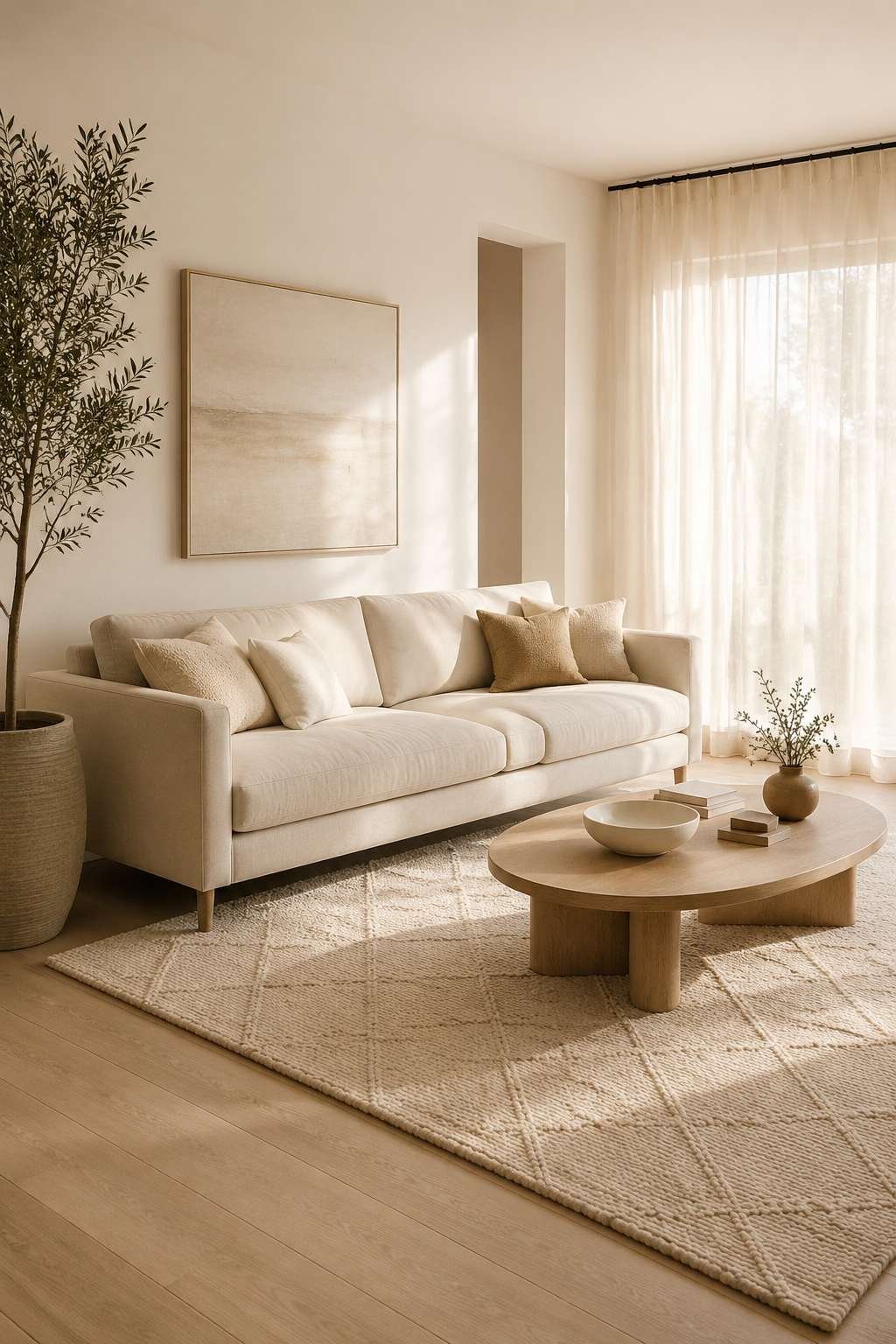
The bleached oak coffee table at the center of the arrangement is a masterstroke of material selection. Bleached oak has the rare quality of feeling simultaneously light and warm — pale enough to maintain the airy cream aesthetic, yet textured enough to introduce visual interest and a sense of natural authenticity. Positioned on a hand-woven wool rug with subtle geometric patterns, the coffee table anchors the seating arrangement with quiet authority. The geometric patterning in the rug is deliberately restrained, echoing the room’s broader commitment to texture over color contrast.
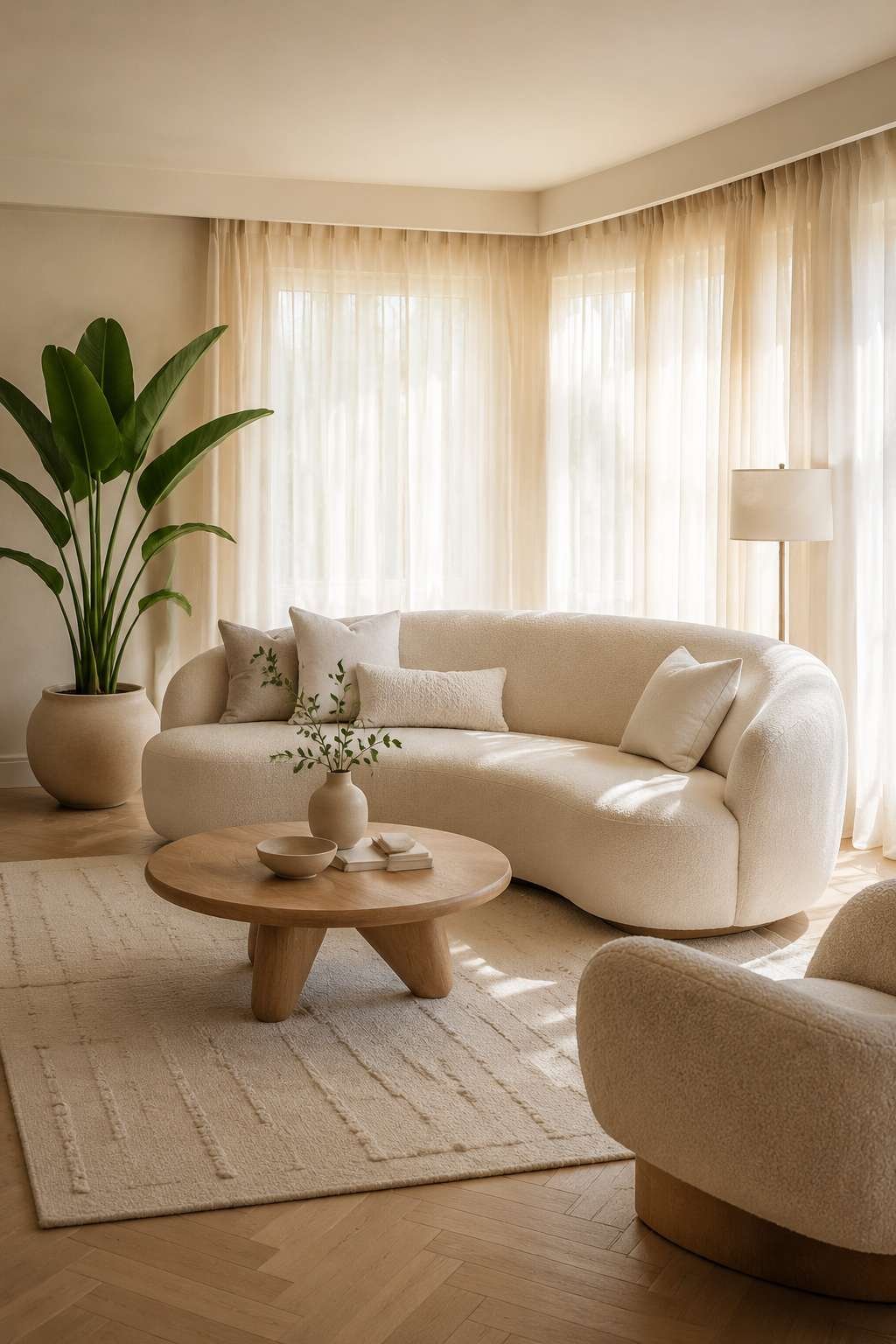
Sheer cream curtains are perhaps the most transformative element in this composition. By diffusing afternoon sunlight rather than blocking it, they allow the room to breathe with a soft, golden luminosity that shifts beautifully throughout the day. This approach to window treatment is deeply intentional — it acknowledges that in a cream living room, natural light is not just a practical necessity but an active design element. The way light moves across linen, oak, and wool at different times of day creates a living, changing interior that never feels static.
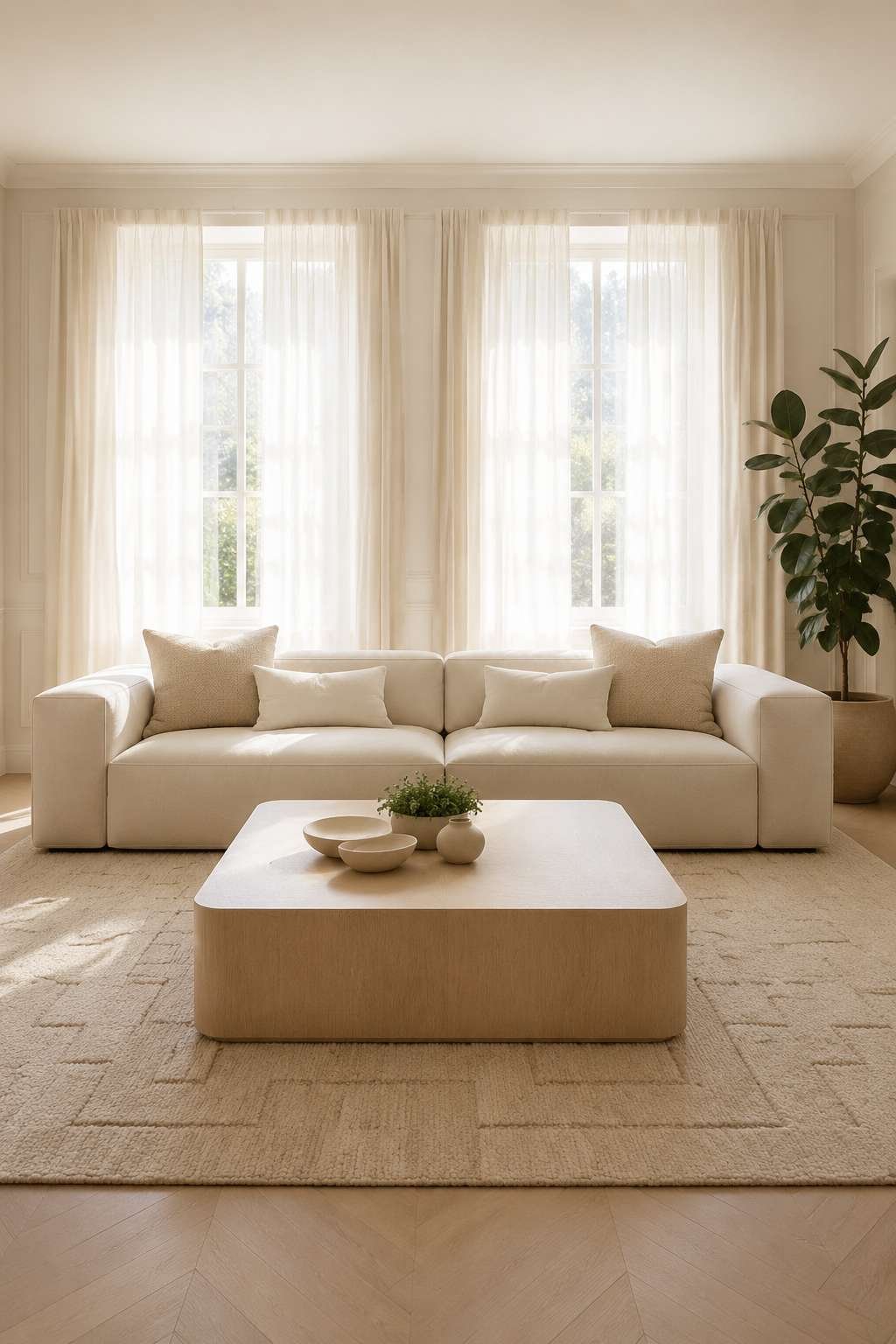
The overall mood of this space is one of cozy livability — it is the kind of room where you want to spend an entire Sunday afternoon, book in hand, surrounded by textures that reward closer inspection. The success of this design lies in its commitment to tonal layering: every element exists within the cream-to-sand spectrum, yet no two surfaces are exactly alike.
Key Design Tips:
- Layer at least three different cream and neutral tones within the same space to create depth without introducing jarring color contrast
- Choose linen upholstery for sofas in high-use living rooms — it is durable, naturally stain-resistant when treated, and only improves in character with age
- Use a hand-woven or hand-knotted area rug to introduce texture and pattern underfoot without competing with the neutral palette above
- Position sheer curtains close to the ceiling and extend them to the floor to maximize the illusion of height and light
- Select bleached or whitewashed wood for coffee tables and side furniture to maintain warmth while preserving the airy quality of the cream scheme
2. Warm Ambient Glow: Bouclé Sectional and Rattan Pendant Lighting
The deep-seated cream bouclé sectional sofa is one of the most coveted pieces in contemporary interior design, and for good reason. Its looped, textured fabric surface catches light in a way that makes it look subtly different from every angle — sometimes ivory, sometimes warm sand, sometimes almost golden. In a suburban home setting where comfort is paramount, a large bouclé sectional transforms the living room into a genuine sanctuary, its generous proportions encouraging sprawling, relaxed living while its refined fabric keeps the space feeling curated and considered.
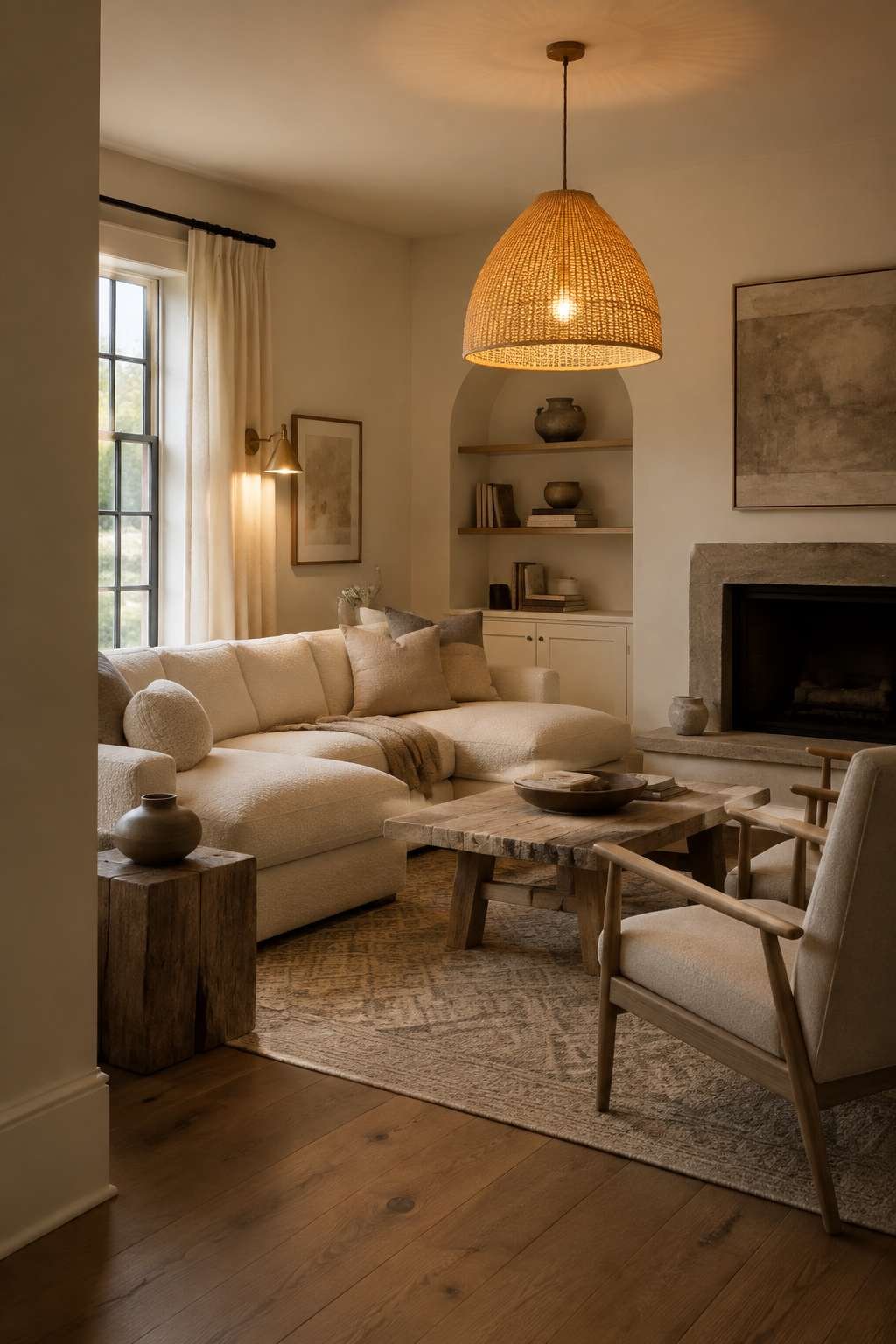
Warm ambient lighting is the secret ingredient that elevates this concept from pleasant to extraordinary. A rattan pendant fixture suspended above the seating arrangement casts a golden, dappled glow across the room — the natural weave of the rattan creates a beautiful pattern of light and shadow on cream walls, adding movement and warmth without any additional decor. This approach to overhead lighting is far more intimate and flattering than recessed spotlights, which can flatten a cream interior and strip it of its warmth.
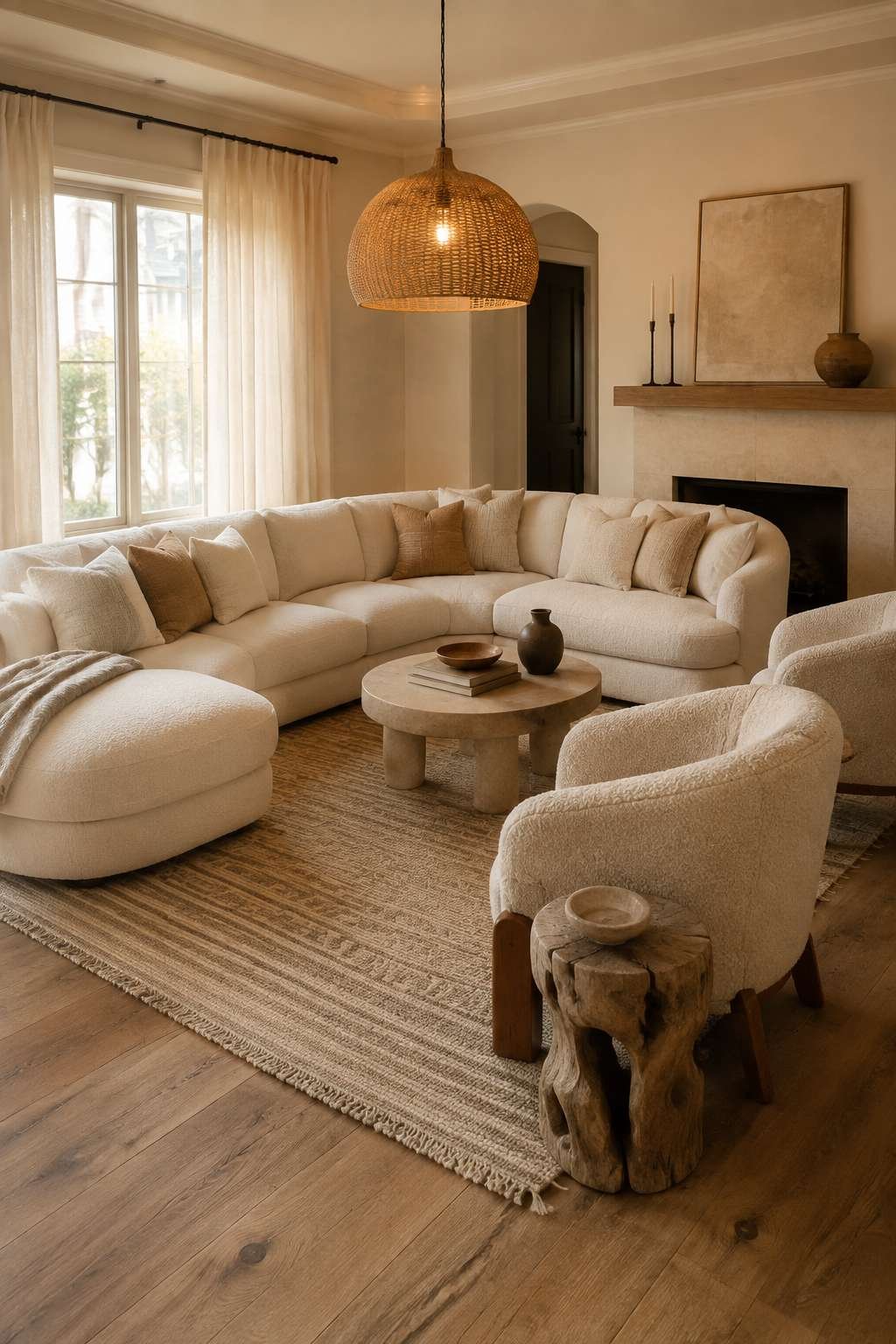
The material palette in this design is built around natural, organic materials that complement the bouclé’s tactile richness. A reclaimed driftwood side table introduces a note of coastal authenticity and raw texture, while linen-upholstered accent chairs extend the cream palette into the supporting furniture without creating visual monotony. The combination of bouclé, linen, rattan, and driftwood creates a layered tactile experience — every surface in the room offers a different textural reward.
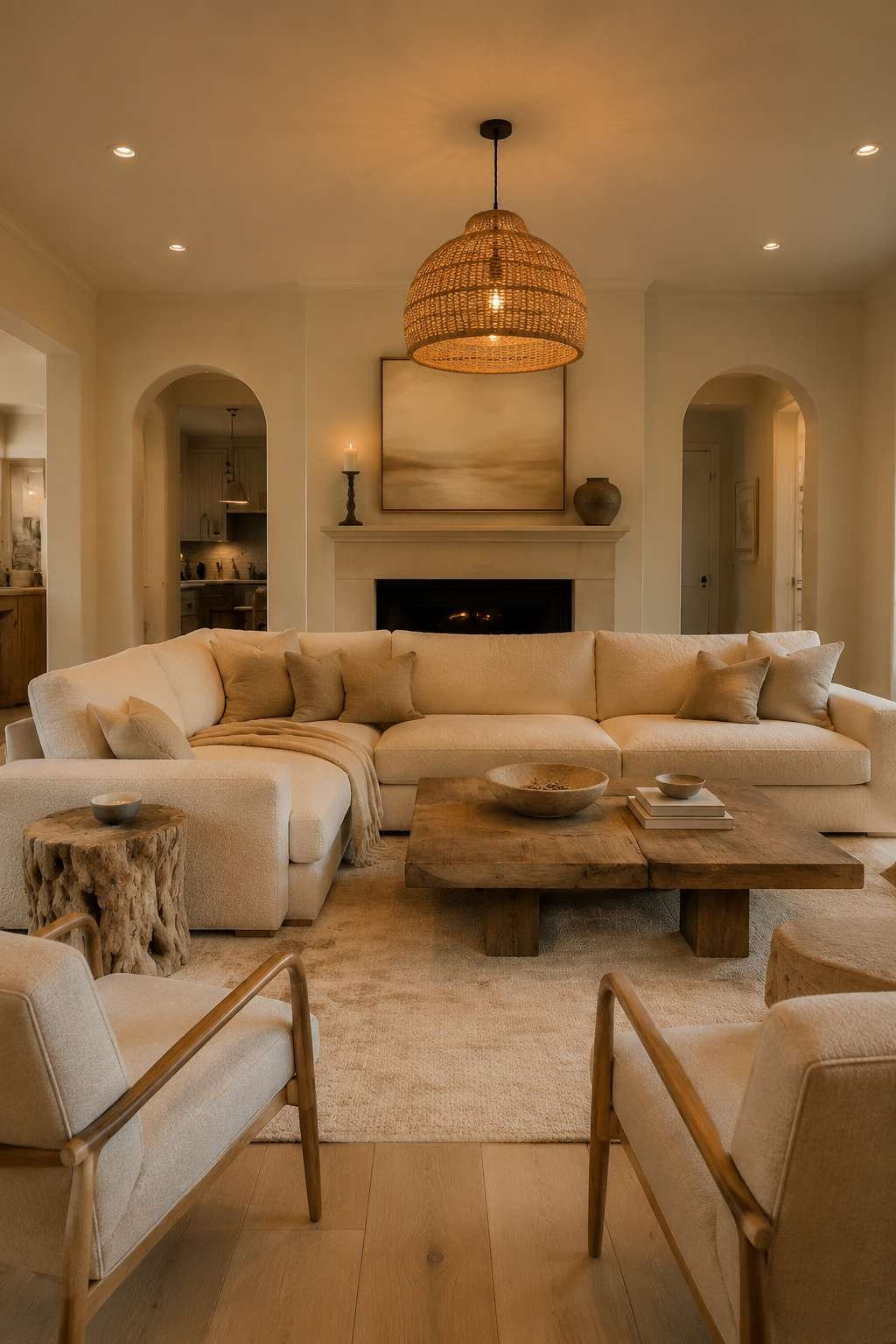
Cream walls with a hint of warm undertone — think cream leaning slightly toward amber rather than blue — are essential to the success of this concept. Cool-toned cream walls can feel stark under certain lighting conditions, but a wall color with warmth built into it will respond beautifully to the golden light of a rattan pendant, creating an enveloping, amber-tinged atmosphere that feels genuinely cozy regardless of the season or time of day.
Key Design Tips:
- Invest in a bouclé sofa as a statement piece — its textural complexity means it requires fewer additional decorative elements to feel complete
- Choose rattan, bamboo, or wicker pendant lights over living room seating to create warm, dappled ambient light that flatters cream interiors
- Select wall paint with a warm undertone (look for creams with yellow or amber bases rather than blue or green) to ensure the room glows rather than grays in artificial light
- Pair smooth materials like painted walls and linen with rough, organic materials like driftwood and rattan to prevent the cream palette from feeling overly uniform
- Consider a sectional configuration in family living rooms — the generous seating area accommodates multiple people comfortably while maintaining visual coherence
3. Architectural Elegance: Floor-to-Ceiling Bookshelves and Marble Fireplace
This concept elevates the cream living room into the realm of architectural sophistication, where the design framework itself becomes the primary decorative statement. Floor-to-ceiling built-in bookshelves painted in soft cream are the defining feature — a design choice that simultaneously maximizes storage, frames the room’s proportions, and creates an immersive, enveloping backdrop of warm, textured cream. When bookshelves are painted to match the walls, they lose their visual weight and become part of the architecture itself, making a room feel both larger and more considered.
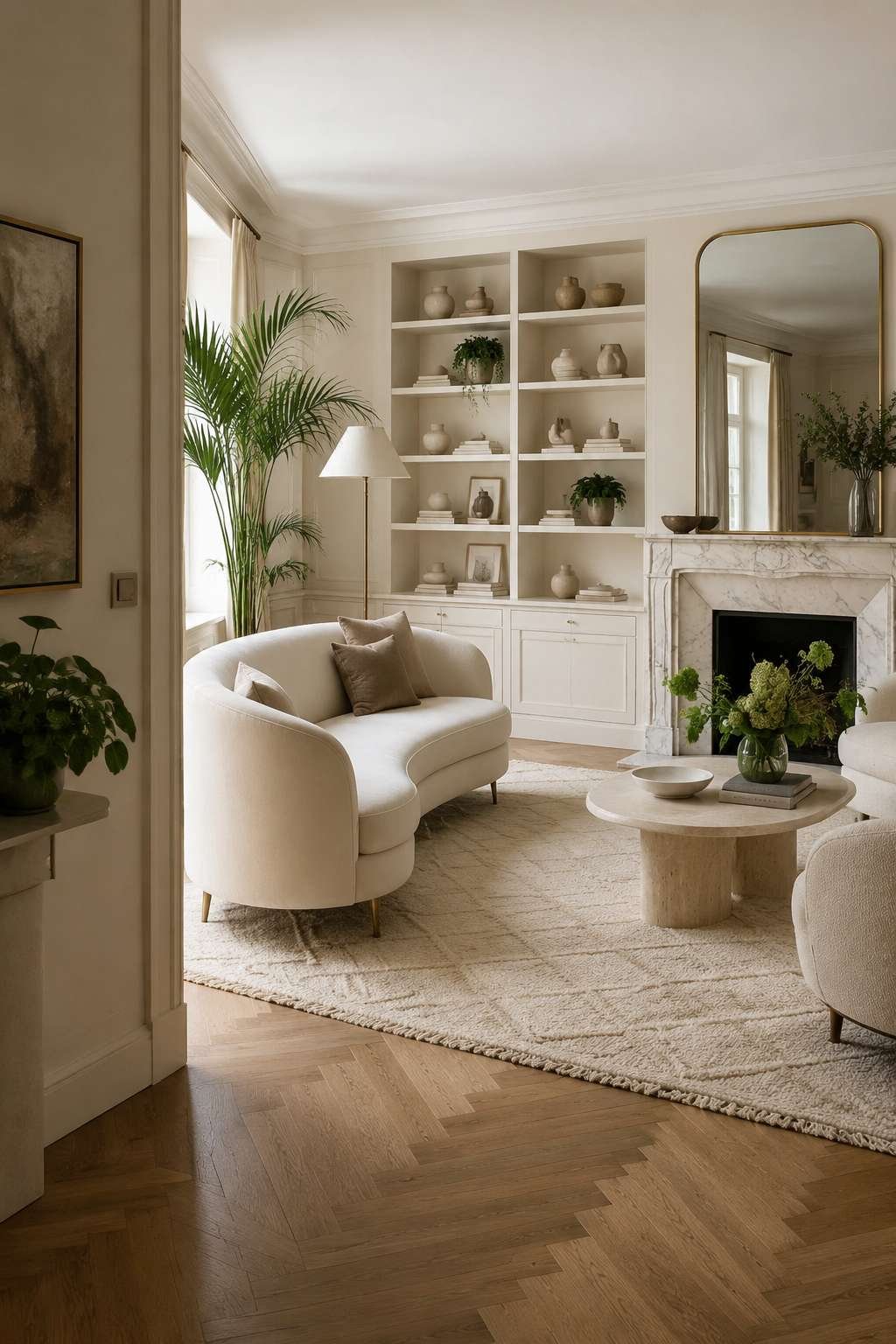
The cream velvet sofa with curved silhouette positioned opposite the fireplace is a deliberate choice that balances the room’s architectural rigidity with organic softness. Velvet has a directional pile that means it absorbs and reflects light differently depending on the viewing angle, creating a fabric surface that is simultaneously flat and dimensional. A curved silhouette — whether fully rounded or gently arced — softens the geometry of a room filled with straight-edged shelving and rectangular architectural details, introducing a note of sculptural elegance.
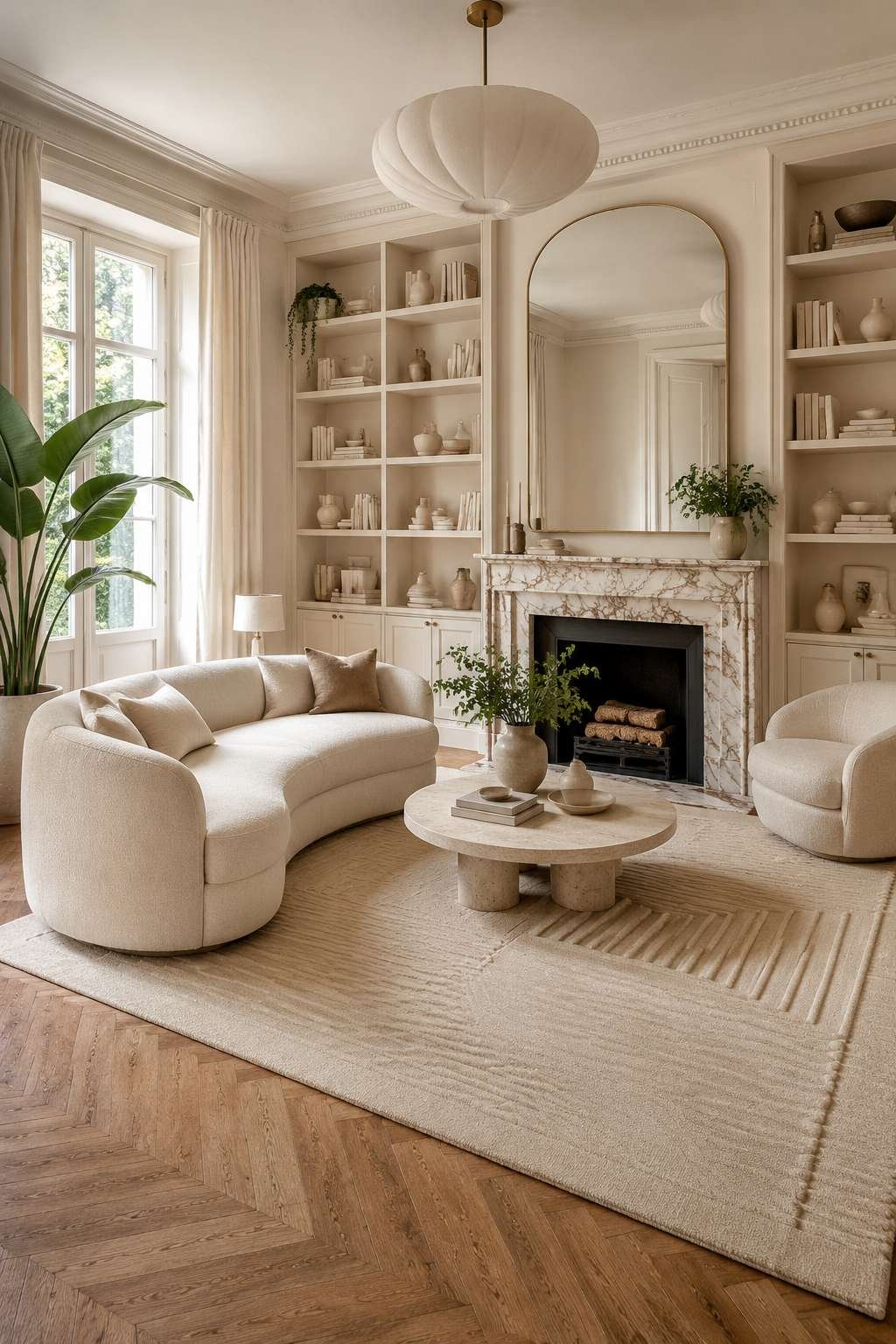
The marble-surround fireplace serves as the room’s focal anchor, its veined surface providing the only strong material contrast in an otherwise tonal cream composition. Choosing a marble with warm cream and ivory veining rather than stark grey or black keeps the fireplace within the cream palette while adding genuine material richness. Beneath the sofa, herringbone oak flooring introduces a classic pattern underfoot that adds visual rhythm to a room that might otherwise risk feeling too still.
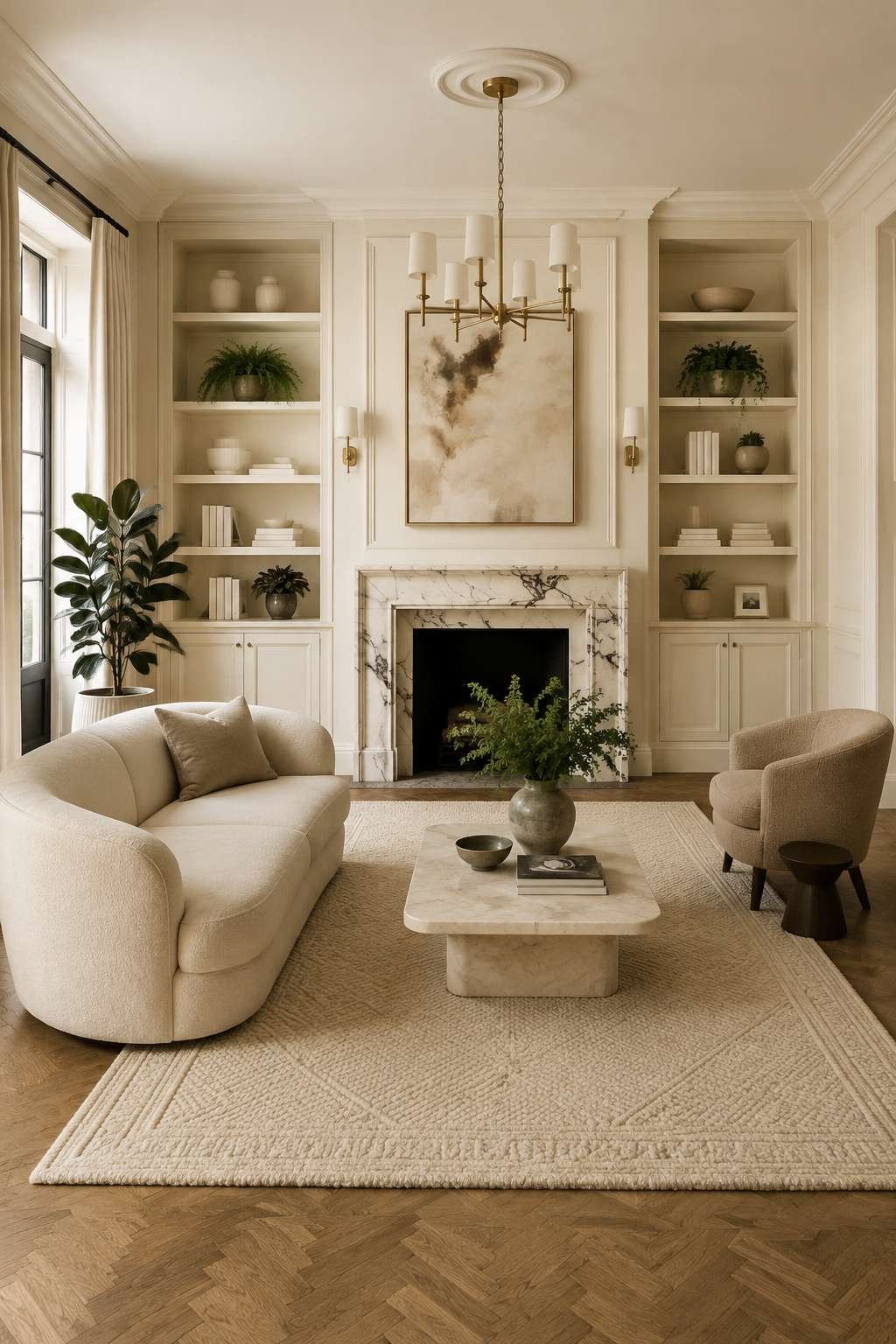
Neutral ceramics and greenery styled within the bookshelves introduce life and organic variation — small potted plants and sculptural ceramic vessels in cream, stone, and warm terracotta break up the expanse of books and painted shelving without introducing jarring color. This is interior design at its most considered: every element earns its place, and the cumulative effect is one of genuine, inhabitable luxury.
Key Design Tips:
- Paint built-in bookshelves the same color as the walls to create an immersive architectural effect and make the room feel larger and more cohesive
- Choose a marble fireplace surround with warm cream veining to maintain the tonal integrity of the cream palette while introducing genuine material richness
- Use velvet upholstery with a curved sofa silhouette to introduce softness and sculptural interest against the rigid geometry of built-in shelving
- Style bookshelves with a mix of books, ceramics, and trailing plants — the rule of thirds applies here: roughly one third each of books, objects, and organic elements
- Install herringbone flooring in warm oak beneath cream interiors to add classic pattern and visual warmth underfoot
4. Scandinavian Simplicity: Clean Lines and Monochromatic Calm
The Scandinavian-inspired cream living room is an exercise in restraint — a design philosophy that finds richness not in accumulation but in the careful selection of a very few, very considered elements. A low-profile cream linen sofa with a birch wood frame sets the aesthetic register immediately: natural materials, minimal ornamentation, and an unwavering commitment to functional beauty. The linen upholstery and birch frame together create a sofa that feels light, honest, and completely at ease within its setting.
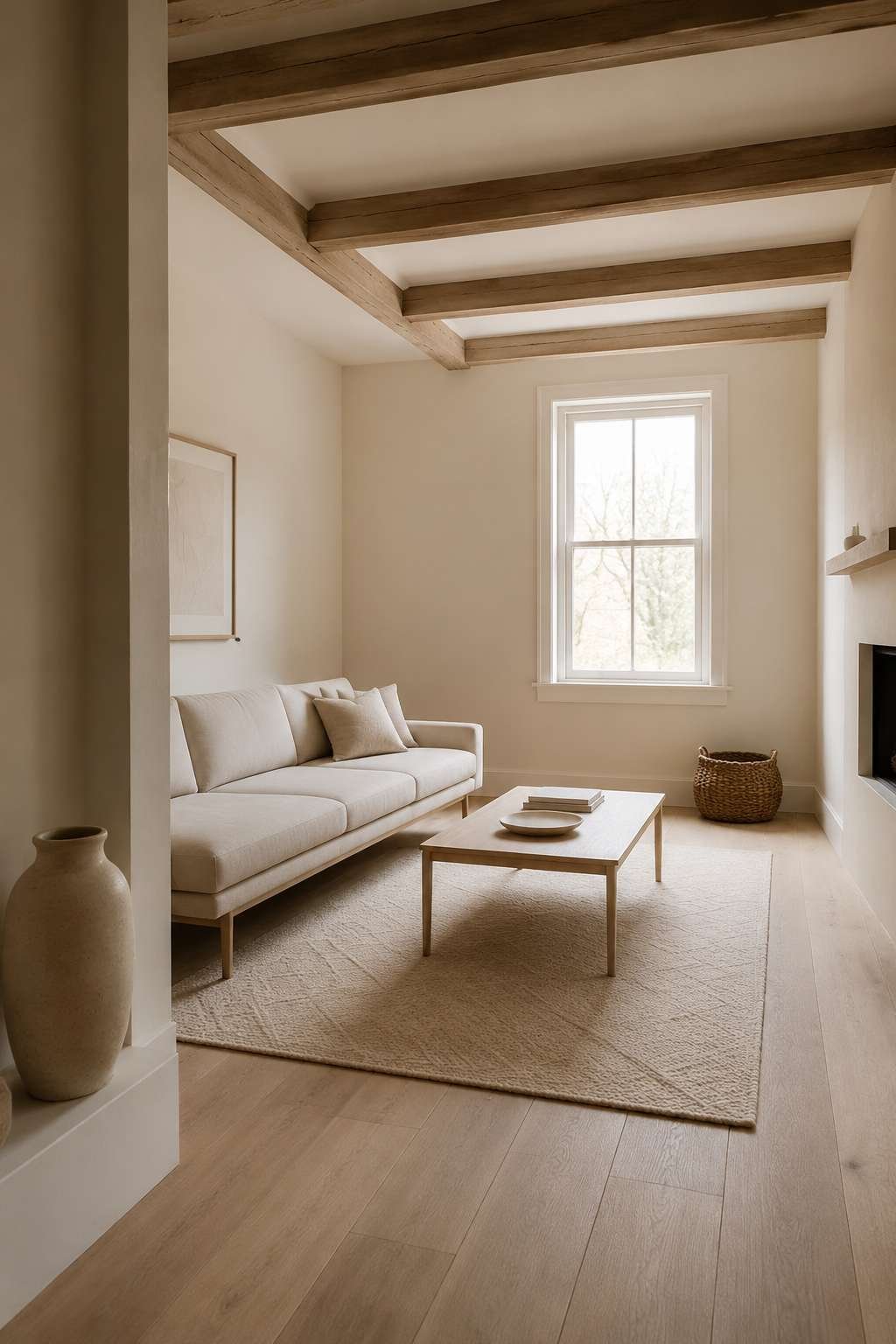
Pale cream walls meeting a white ceiling with exposed wooden beams is a combination that speaks directly to Scandinavian design’s Nordic roots — the exposed beams reference the timber construction of traditional Scandinavian architecture while the pale cream walls maximize the reflection of limited northern light. In interiors where natural light is precious, every surface should work to capture and distribute it, and a cream-on-white wall and ceiling combination does exactly that, bouncing light around the room and creating an ambient luminosity that feels genuinely uplifting.
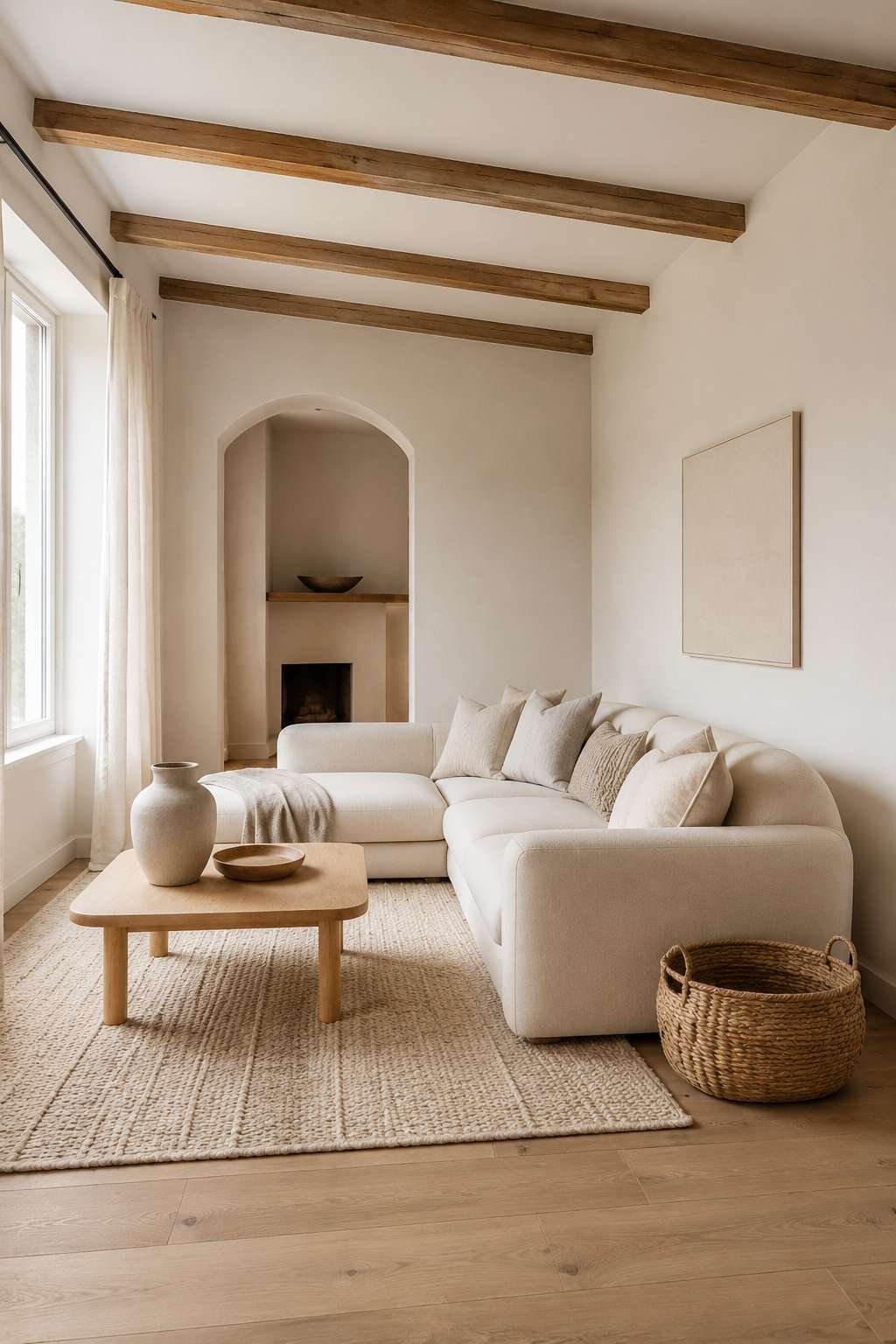
The minimal decor approach in this concept — a single large ceramic vase and a woven basket — is not merely aesthetic but philosophical. Scandinavian design has always understood that space itself is a luxury, and that the most calming living environments are those that resist the urge to fill every surface. The large ceramic vase provides a sculptural focal point, its organic form and matte cream glaze echoing the upholstery and walls, while the woven basket introduces a natural texture at floor level that grounds the composition without cluttering it.
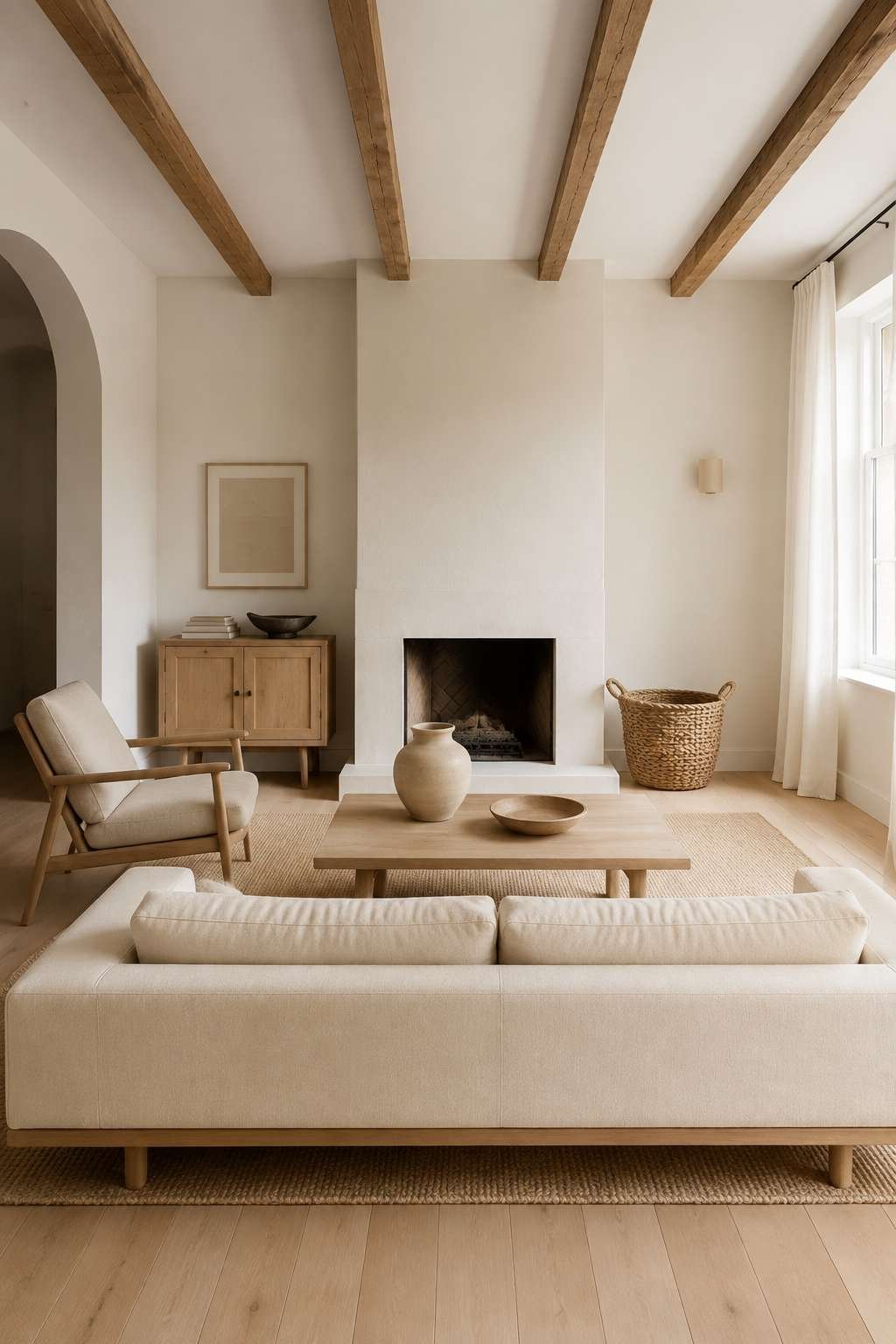
North-facing natural light is the ideal illumination for this kind of monochromatic cream palette — softer and more even than direct sunlight, it reveals the subtle tonal variations between cream linen, birch wood, ceramic, and woven fiber without creating harsh shadows or washing out detail. The result is an interior that feels both deeply peaceful and visually precise: a space where the calming quality of cream is allowed to express itself fully, undistracted by unnecessary complexity.
Key Design Tips:
- Embrace deliberate minimalism in Scandinavian cream interiors — resist the urge to add more; the power of the aesthetic lies in what you leave out
- Choose low-profile furniture on visible legs to maintain a sense of airiness and visual lightness in cream-on-cream interiors
- Use exposed wooden beams or structural timber to reference Scandinavian architectural tradition and introduce warmth to very pale interiors
- Select a single large-scale decorative object rather than multiple small ones — a statement ceramic vase or sculpture has more visual impact than a cluster of smaller pieces
- Opt for north-facing or diffused light in monochromatic cream rooms to reveal subtle tonal variations and avoid harsh shadow play
5. Transitional Opulence: Tufted Leather and Golden Hour Light
The transitional cream living room bridges the gap between traditional elegance and contemporary comfort, drawing on the best of both design vocabularies to create a space that feels simultaneously timeless and fresh. A tufted cream leather sofa is the central statement — leather upholstery in cream is a bold but deeply rewarding choice, its surface developing a beautiful patina over time while remaining easy to maintain. The button-tufting adds a note of traditional craftsmanship that anchors the transitional aesthetic.
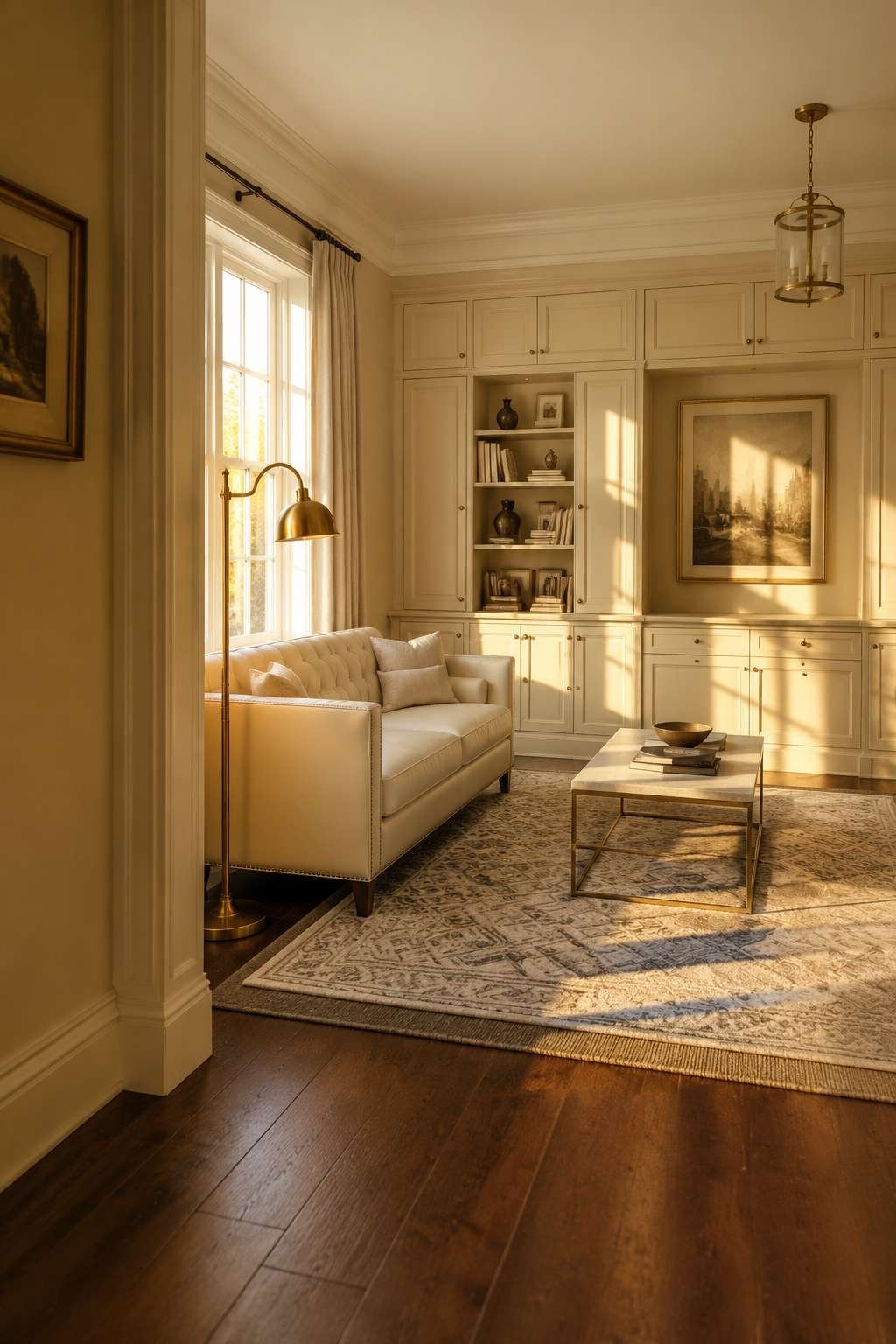
An antique brass floor lamp positioned beside the sofa introduces the warm, metallic gleam that distinguishes transitional interiors from their purely contemporary counterparts. Brass has enjoyed a sustained resurgence in interior design precisely because its warm, aged tone complements cream so beautifully — where chrome or nickel can feel cold against cream upholstery and walls, brass adds a note of honeyed warmth that feels genuinely luxurious. The floor lamp also serves a practical function, creating a reading zone within the larger seating arrangement.
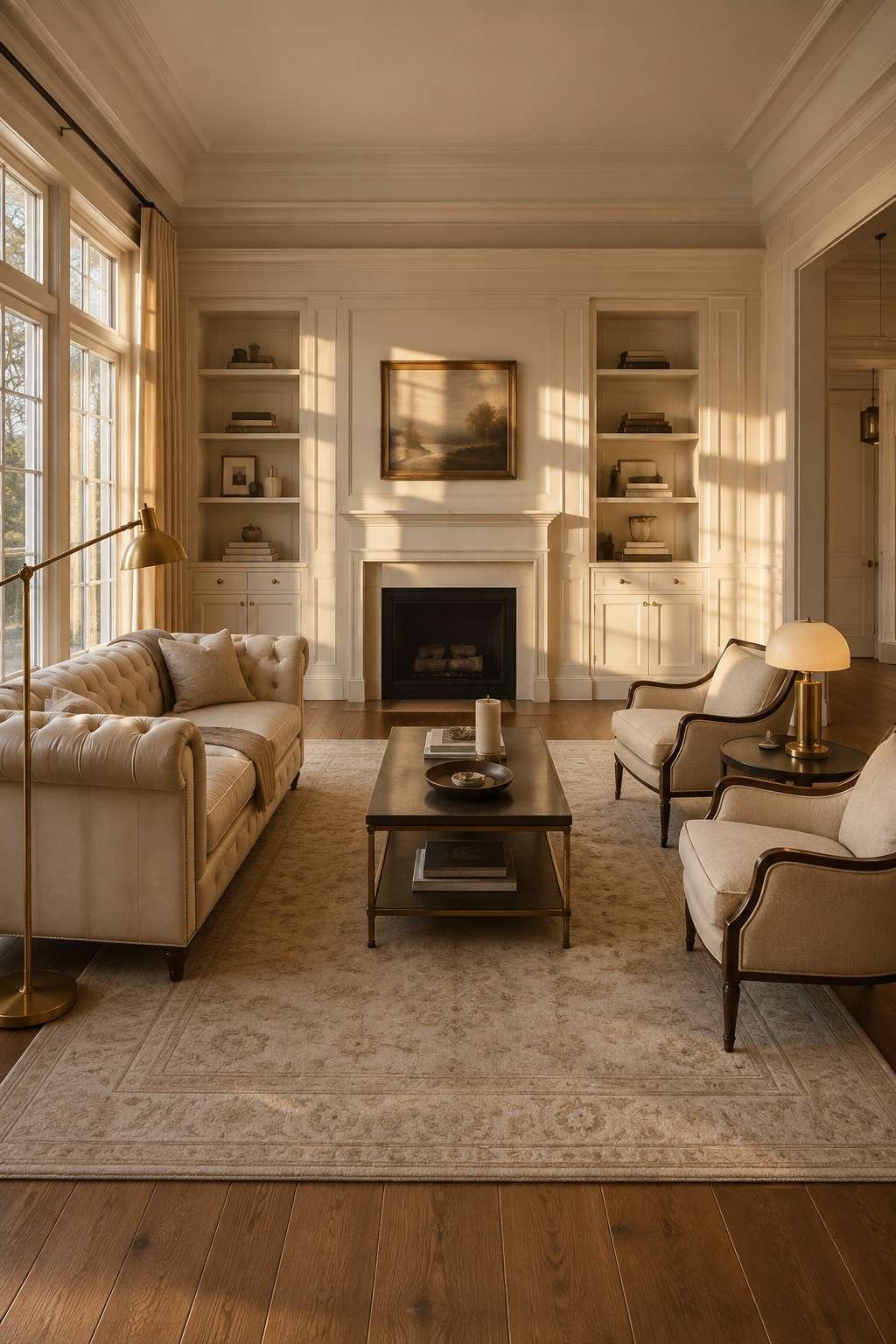
Layered area rugs in ivory and oatmeal tones are a distinctively transitional design choice, combining the traditional practice of layering textiles with a contemporary approach to tonal dressing. A larger flatweave in oatmeal beneath a smaller, thicker ivory rug creates visual depth underfoot while keeping the color palette cohesive. Crown molding in warm white frames the high ceiling, adding architectural detail that references classical design traditions without feeling stuffy or dated, while cream lacquer built-in cabinetry provides elegant storage that integrates seamlessly with the room’s palette.
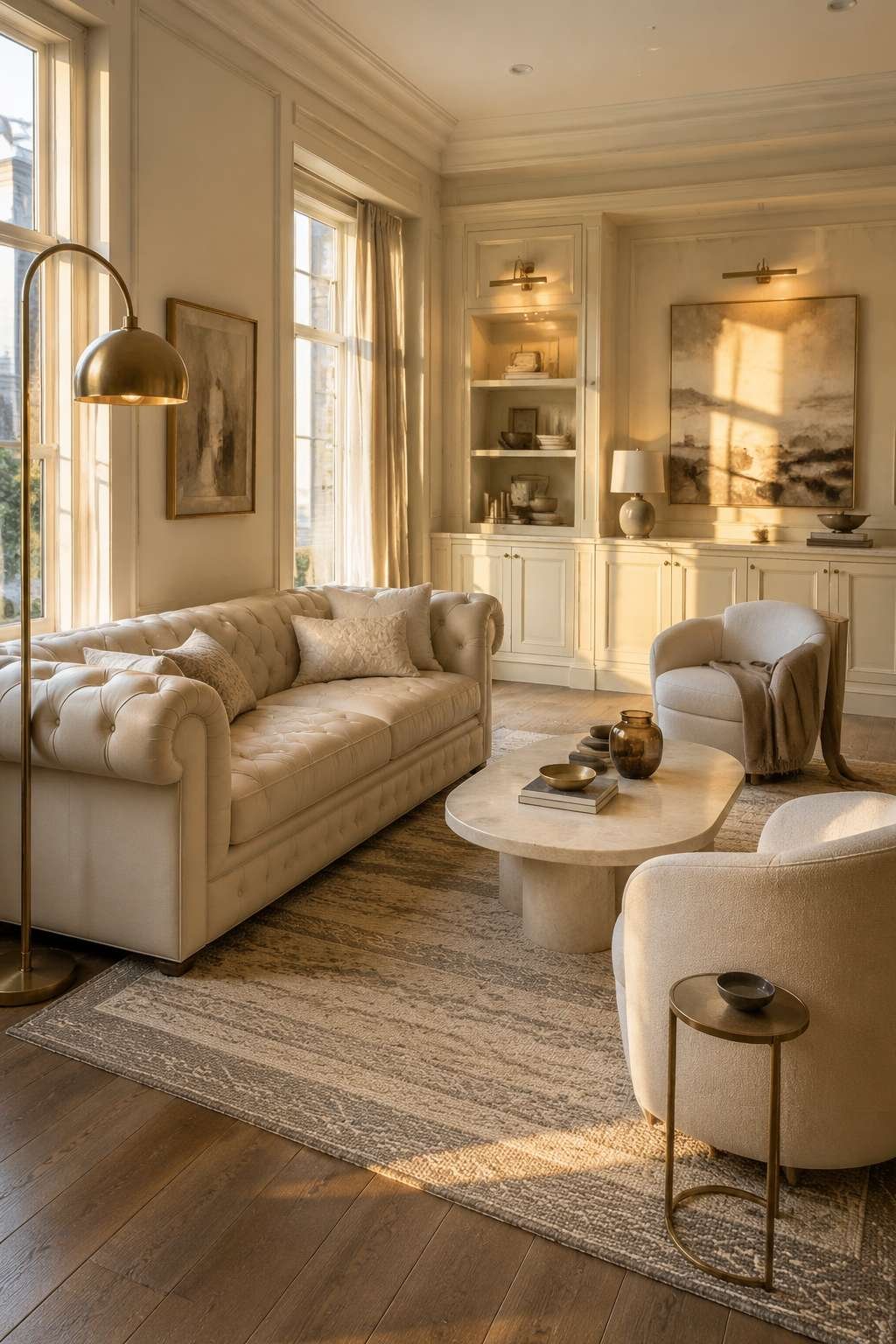
Late afternoon golden hour light is perhaps the most transformative element in this composition — it turns cream leather to warm gold, casts long, rich shadows across tufted upholstery, and fills the room with the kind of amber luminosity that makes any space feel like a movie set. Designing a living room to capture and make the most of directional golden light is one of the most underrated considerations in interior design, and this concept demonstrates its extraordinary potential.
Key Design Tips:
- Choose cream leather upholstery for high-traffic sofas — it is more durable than fabric, develops a beautiful patina, and cleans easily with a damp cloth
- Incorporate antique brass fixtures and hardware throughout a transitional cream interior to add warmth and cohesion across different decorative elements
- Layer area rugs of different sizes and textures to create depth and define zones within an open living room arrangement
- Install crown molding or cornice details in cream living rooms with high ceilings — the architectural detail adds elegance and frames the space without requiring additional decor
- Orient seating arrangements to face late afternoon sunlight where possible — the golden hour light that enters from west-facing windows is the most flattering illumination any living room can receive
6. Contemporary Open-Plan Grace: Grasscloth Walls and Travertine
The contemporary open-plan cream living room presents a particular design challenge: how to define and warm a large, connected space without compromising its sense of openness and flow. The solution in this concept lies in the careful deployment of cream grasscloth wallpaper as an accent wall — a material that introduces extraordinary tactile interest and natural texture while remaining entirely within the cream palette. Grasscloth’s woven surface creates a beautiful, light-responsive texture that changes character throughout the day as light moves across it.
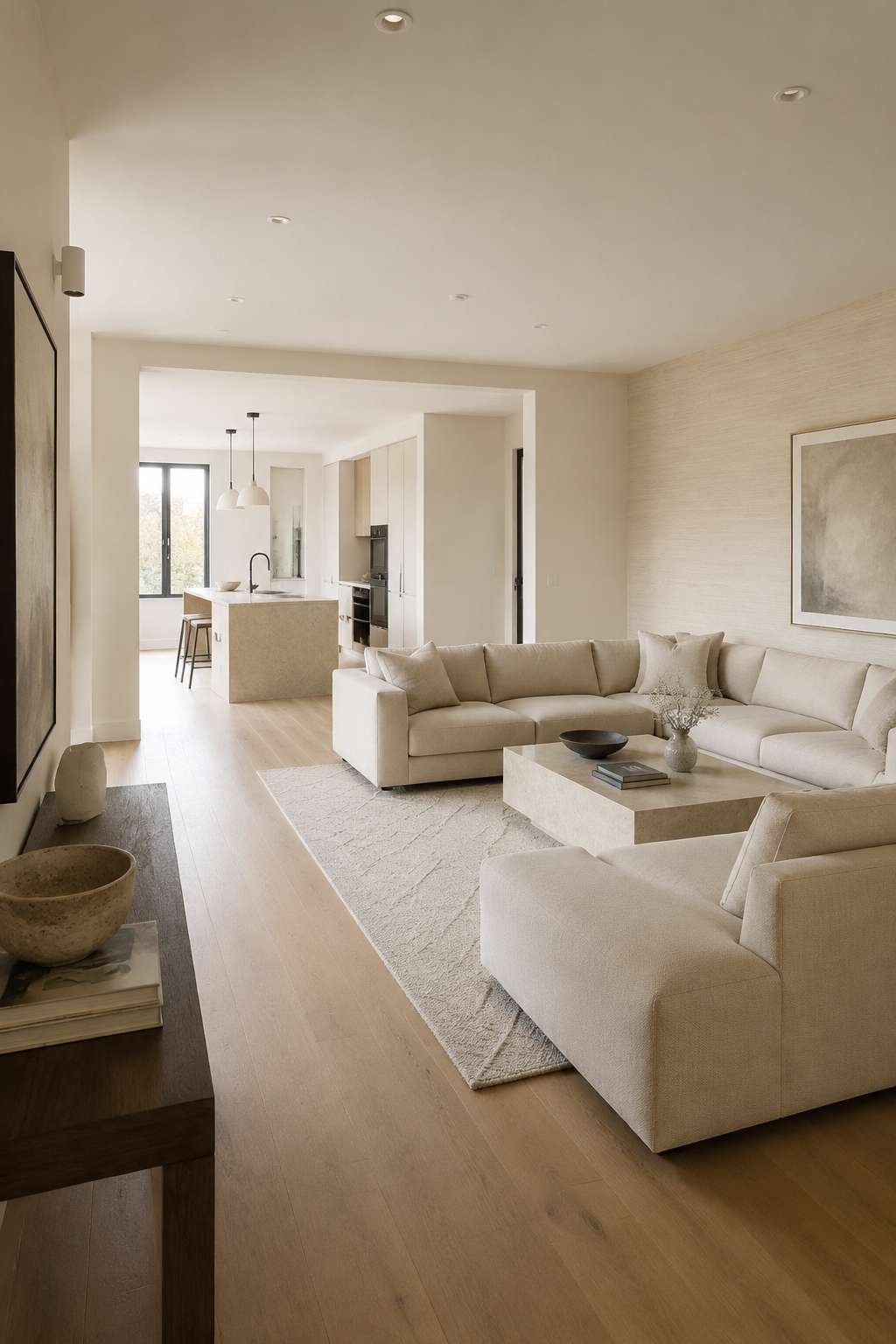
A modular cream fabric sofa in a U-shaped arrangement is the ideal seating solution for an open-plan living space — its generous footprint defines the living zone clearly within a larger floor plate, while its cream upholstery allows it to recede visually rather than imposing a hard boundary within the connected space. The U-shaped configuration encourages conversation and social connection, making the living area feel like a destination within the larger open-plan layout rather than simply an undefined zone.
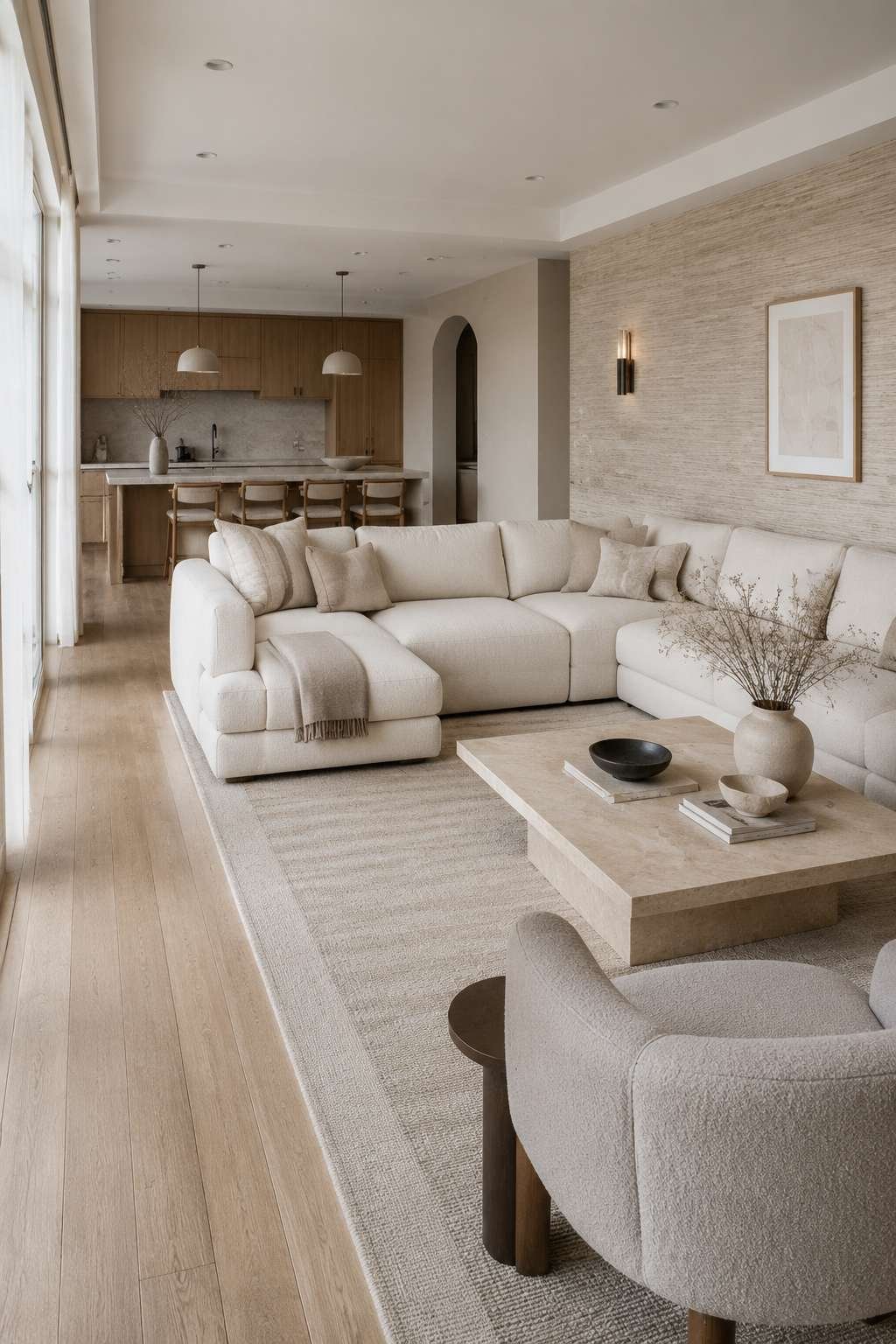
The low travertine coffee table at the center of the arrangement introduces the most significant material contrast in this design — travertine’s warm, fossil-rich surface sits beautifully within the cream palette while providing a note of genuine material luxury and visual weight. Travertine has become one of the defining materials of contemporary interior design precisely because it occupies that rare position of feeling simultaneously ancient and thoroughly modern. Its warm beige-cream tones integrate effortlessly with cream upholstery and walls.
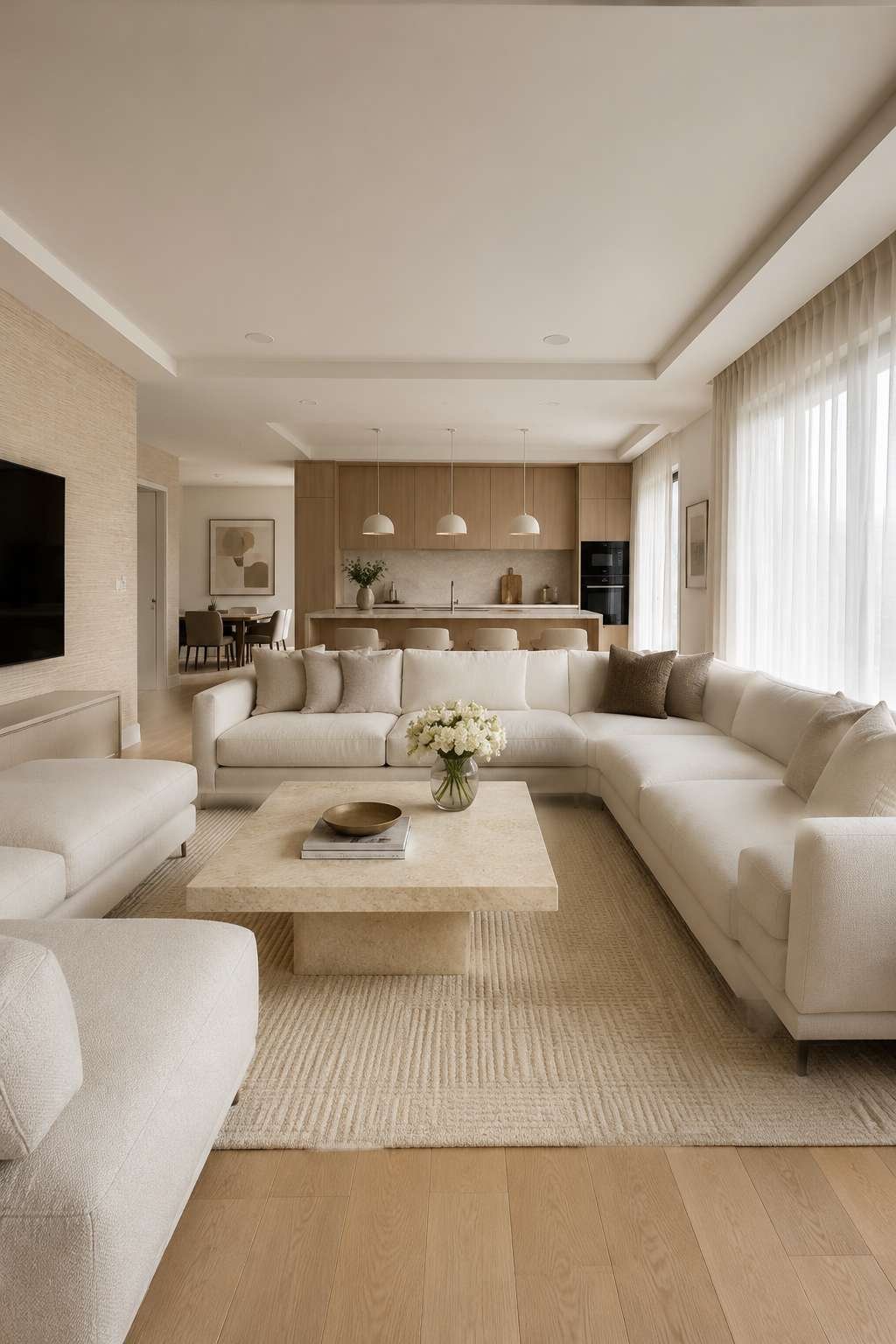
Light oak wood flooring flowing continuously from the cream-walled living area into the open-plan kitchen and dining spaces is the element that makes the whole composition cohere — it provides a consistent, warm surface that ties different zones together while its natural grain adds organic visual interest. The combination of cream walls, grasscloth accent texture, modular fabric sofa, and travertine coffee table creates a contemporary interior of practical elegance — beautiful enough for entertaining, robust enough for everyday living.
Key Design Tips:
- Use grasscloth or natural fiber wallpaper on a single accent wall in cream living rooms to introduce extraordinary tactile interest without disrupting the tonal palette
- Choose a modular sofa configuration in open-plan spaces — the ability to reconfigure modules as needs change adds genuine long-term value
- Select travertine or limestone for coffee tables in contemporary cream interiors — both materials have warm, cream-adjacent tones that integrate beautifully while adding material luxury
- Run light oak or ash wood flooring continuously through open-plan spaces to create visual cohesion and warmth across different functional zones
- In open-plan cream interiors, use soft furnishings and area rugs rather than partition walls to define zones — the visual boundary is created without compromising the flow of space and light
7. Cottage Warmth: Whitewashed Brick and Vintage Persian Rugs
The cottage-inspired cream living room is perhaps the most emotionally evocative concept in this collection — a design that speaks directly to our collective nostalgia for warmth, history, and the kind of comfortable imperfection that only comes with age and use. Exposed whitewashed brick is the defining architectural feature, its rough, porous surface absorbing cream paint in an uneven, organic way that creates a texture no manufactured finish could replicate. The whitewash treatment lightens the brick while preserving its character, maintaining the cream aesthetic without erasing the material’s history.
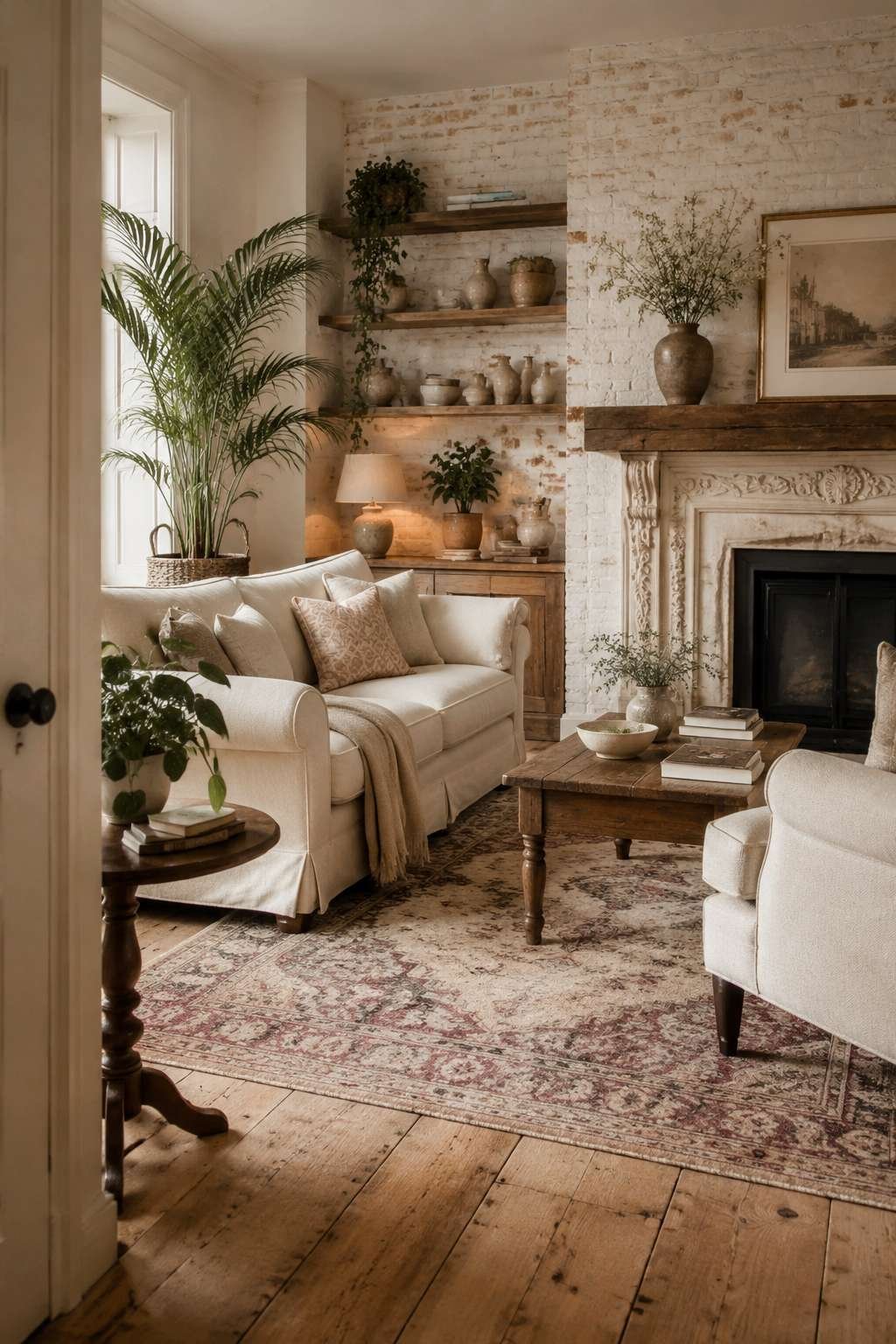
Cream linen roll-arm sofas are the quintessential cottage living room seating choice — the roll-arm silhouette references traditional English country house furniture, while the linen slipcover aesthetic communicates an easy, unpretentious comfort that is entirely in keeping with the cottage spirit. Loose slipcovers, slightly rumpled and casually arranged, are actually more difficult to achieve convincingly than they appear — they require a specific cut and a natural fiber fabric to fall correctly.
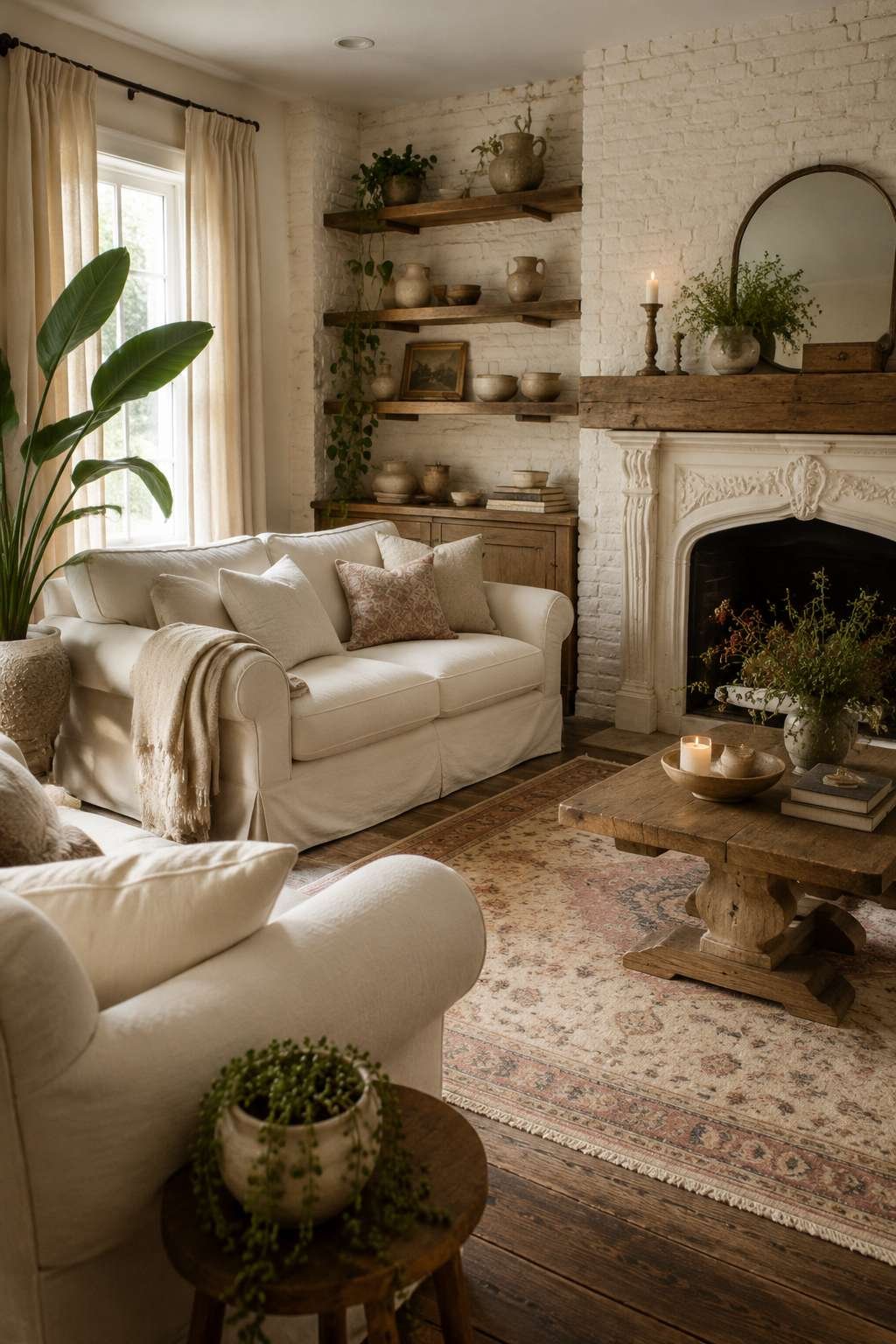
The vintage Persian rug in warm ivory and faded rose is the design element that elevates this cottage interior from charming to genuinely beautiful. An authentic antique or vintage Persian rug brings with it a depth of color, complexity of pattern, and irreplaceable material character that no contemporary reproduction can match. The faded rose tones sit warmly within the cream palette — far from clashing, they introduce a whisper of soft color that makes the cream upholstery and whitewashed brick appear even more luminous by contrast.
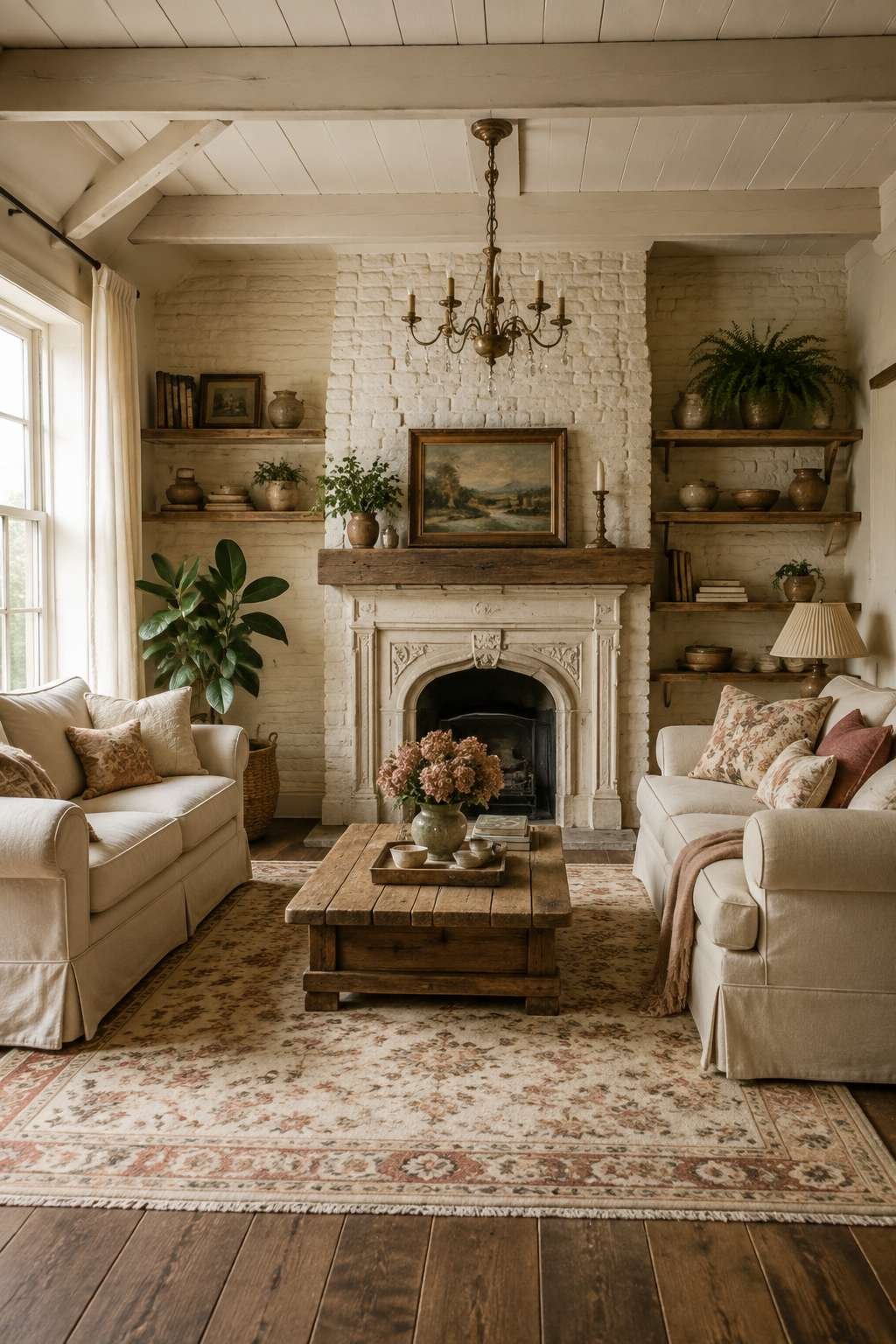
Open wooden shelving displaying curated ceramics and trailing plants transforms the practical need for storage into an opportunity for curated display — a cottage essential that draws on the tradition of the Welsh dresser and the farmhouse kitchen shelf. A reclaimed wood mantelpiece framing a cream fireplace surround completes the composition, its rough-hewn surface providing the kind of aged, handcrafted authenticity that is the emotional core of the cottage aesthetic.
Key Design Tips:
- Whitewash exposed brick walls with diluted cream or white paint — apply with a brush in an uneven, organic manner to preserve the texture and character of the brick beneath
- Choose vintage or antique area rugs over contemporary reproductions in cottage living rooms — the depth of color and complexity of pattern in aged rugs is genuinely irreplaceable
- Use linen slipcovers in roll-arm sofas for a casual, cottage-appropriate aesthetic that also has the practical advantage of being removable and washable
- Decorate open shelving with a curated mix of ceramics, vintage books, and trailing plants — avoid symmetry in favor of the organic, collected-over-time arrangement that defines cottage style
- Incorporate reclaimed or salvaged wood for mantlepieces, shelving, and side tables — the aged surface and natural imperfections are the material soul of the cottage interior
8. Modern Farmhouse Comfort: Shiplap Walls and Chunky Knit Textures
The modern farmhouse cream living room has become one of the most beloved interior aesthetics of the past decade, and this concept demonstrates exactly why. Shiplap walls painted in warm cream are the defining architectural detail — the horizontal lines of the shiplap boards create a subtle, rhythmic texture across the wall surface that catches light beautifully and provides visual interest without requiring additional wall decor. Painted in a warm cream rather than stark white, the shiplap retains its rustic authenticity while feeling thoroughly modern and considered.
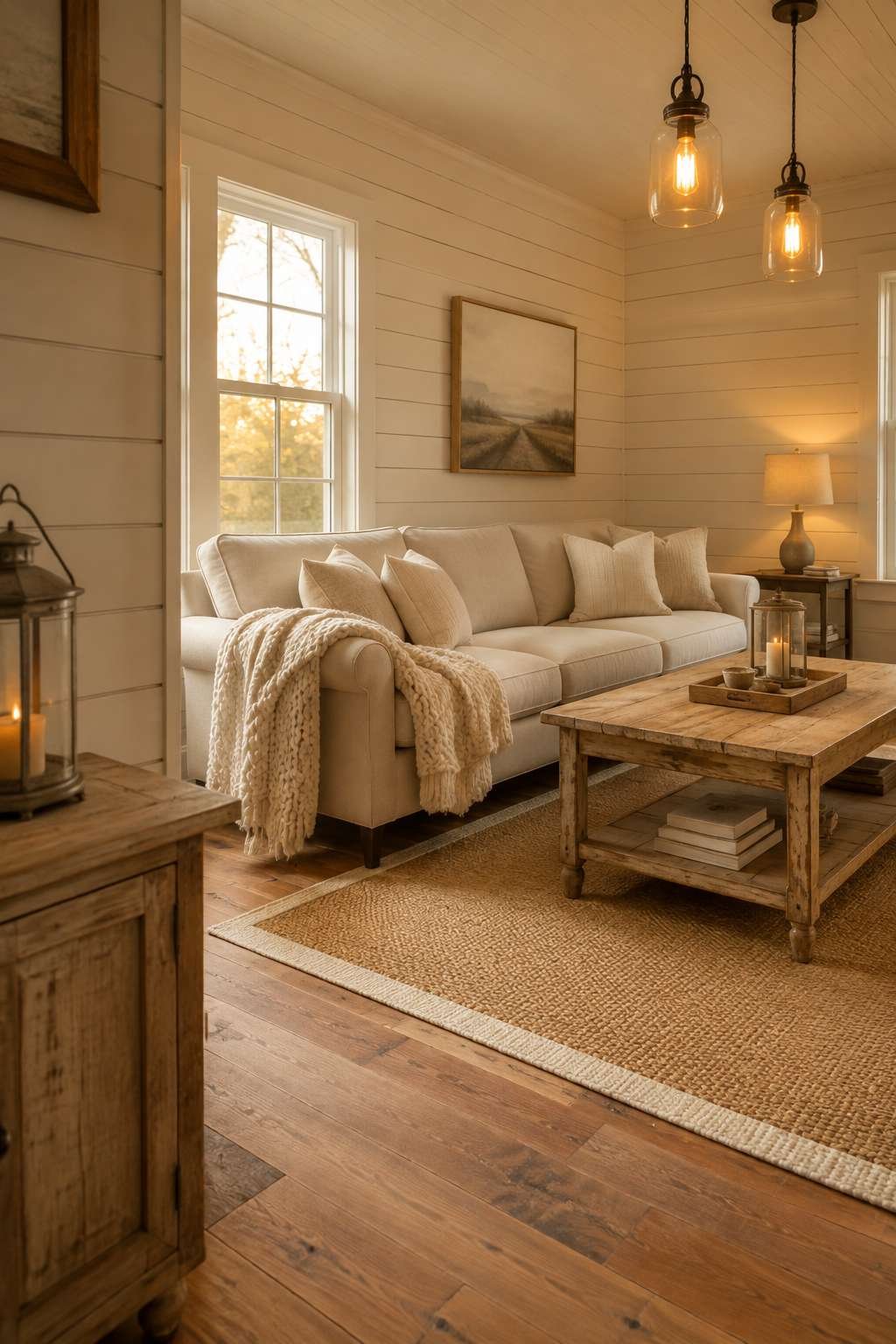
A linen sofa with rolled arms and a chunky knit cream throw draped naturally is the furniture equivalent of the perfect Sunday morning — comfortable, unpretentious, and deeply inviting. The key word here is “naturally” — a chunky knit throw draped with artful casualness is one of those styling details that appears effortless but requires some thought to achieve convincingly. Allow it to fall off one arm of the sofa rather than folding it neatly; let it rumple slightly rather than smoothing it flat. The texture of chunky knit yarn against linen upholstery creates a beautiful tactile contrast within the cream palette.
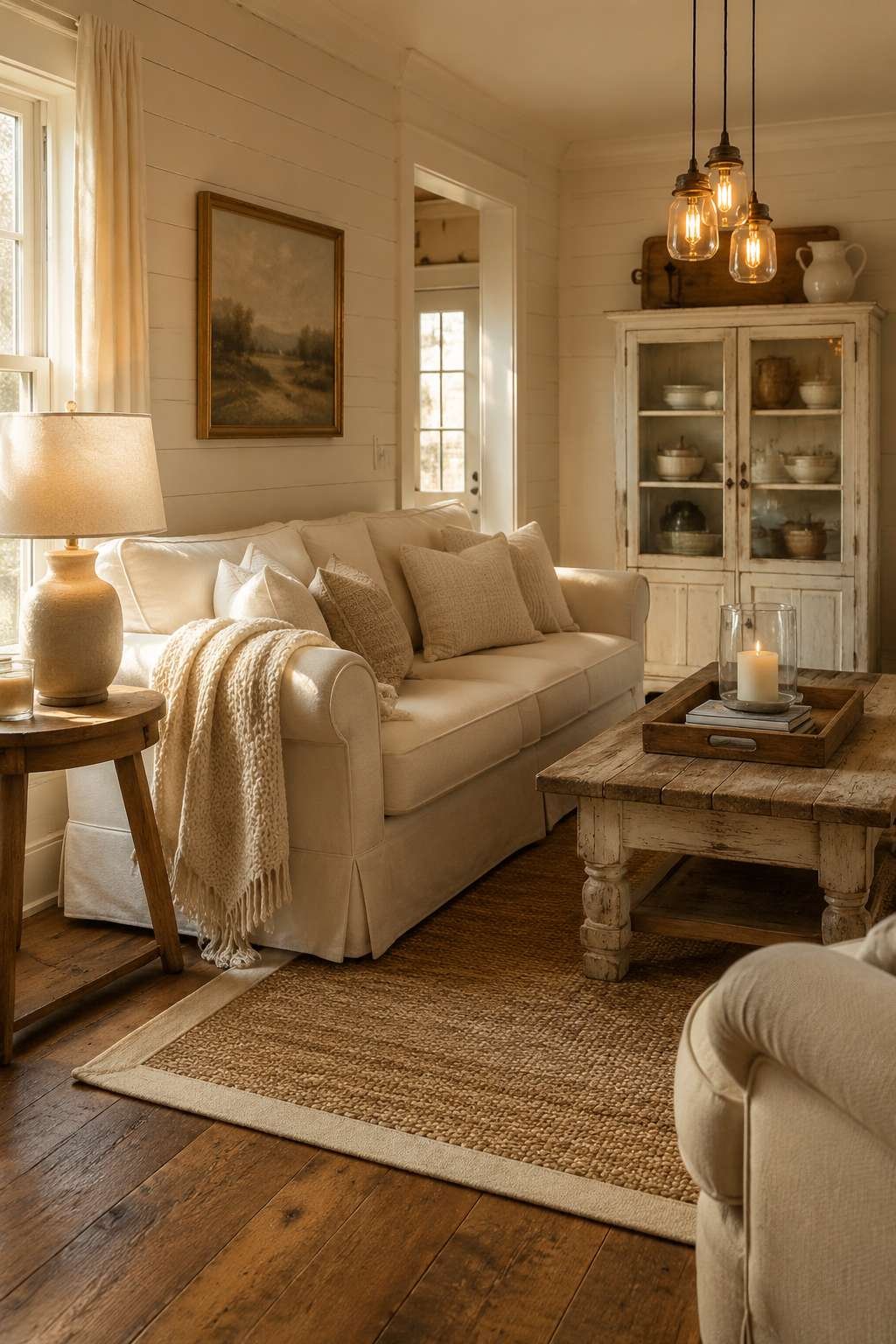
A distressed wooden coffee table is the farmhouse interior’s essential grounding element — its worn surface and slightly imperfect finish communicate age, authenticity, and the honest materiality that defines the farmhouse aesthetic. Positioned atop a jute rug with cream border, the coffee table sits within a layered, textured foundation that connects the seating arrangement to the floor in a way that feels organic and unforced. Jute is the ideal farmhouse area rug material — its natural golden-cream color integrates beautifully with cream upholstery and shiplap walls.
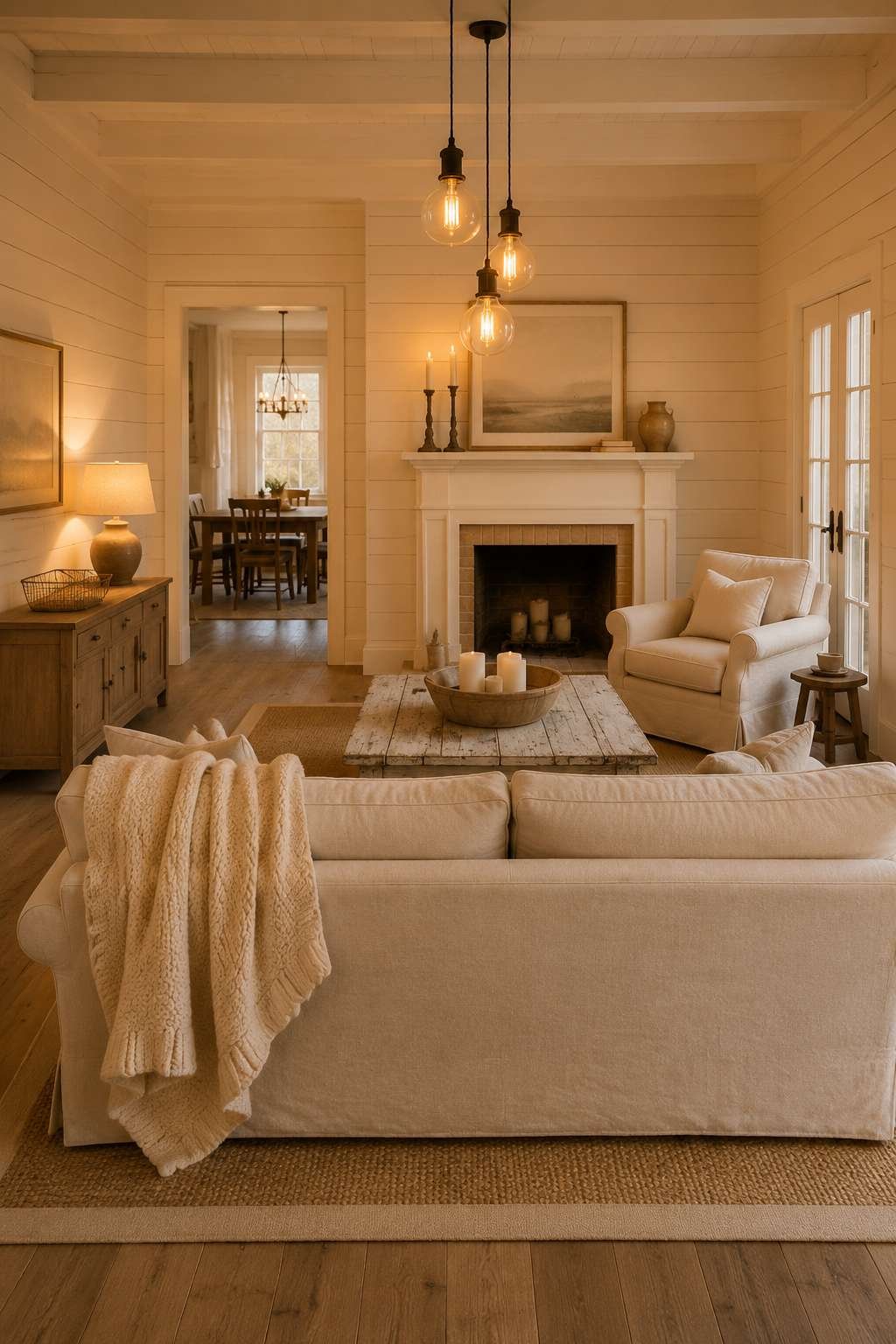
Edison bulb pendant lights suspended above the seating area cast the warm, amber-tinged glow that is the farmhouse interior’s signature illumination — it transforms cream walls and linen upholstery into something almost golden, creating an atmosphere of warmth and welcome that is universally appealing. The combination of shiplap texture, natural linen, chunky knit, jute, and Edison light makes this one of the most texturally rich cream living room concepts in this collection.
Key Design Tips:
- Install horizontal shiplap boards on a single feature wall and paint them the same cream as the surrounding walls — the texture remains visible while the color creates a seamless, immersive effect
- Use Edison bulb pendant lights in farmhouse cream living rooms to achieve the warm, amber glow that makes cream interiors feel genuinely cozy rather than merely neutral
- Style chunky knit throws with deliberate casualness — draped over one sofa arm rather than folded — to achieve the effortless, lived-in aesthetic that defines modern farmhouse style
- Choose jute or sisal area rugs in farmhouse cream rooms — their natural golden-cream tone integrates beautifully with the palette while their durable fiber construction is ideal for high-traffic areas
- Select distressed or reclaimed wood for coffee tables and side furniture to introduce the authentic material aging that gives farmhouse interiors their character and warmth
9. Luxury Redefined: Cashmere Sectionals and Travertine Styling
This concept represents the cream living room at its most uncompromisingly luxurious — a design where every material choice reflects the highest possible standard of quality and refinement. A large cream cashmere sectional sofa is the central statement, and it is a genuinely extraordinary piece: cashmere upholstery has a softness and warmth that no synthetic or even standard wool fabric can match, and its natural cream tone has a depth and luminosity that comes from the fiber’s inherent quality. This is a sofa that rewards proximity — the closer you get, the more impressive it becomes.
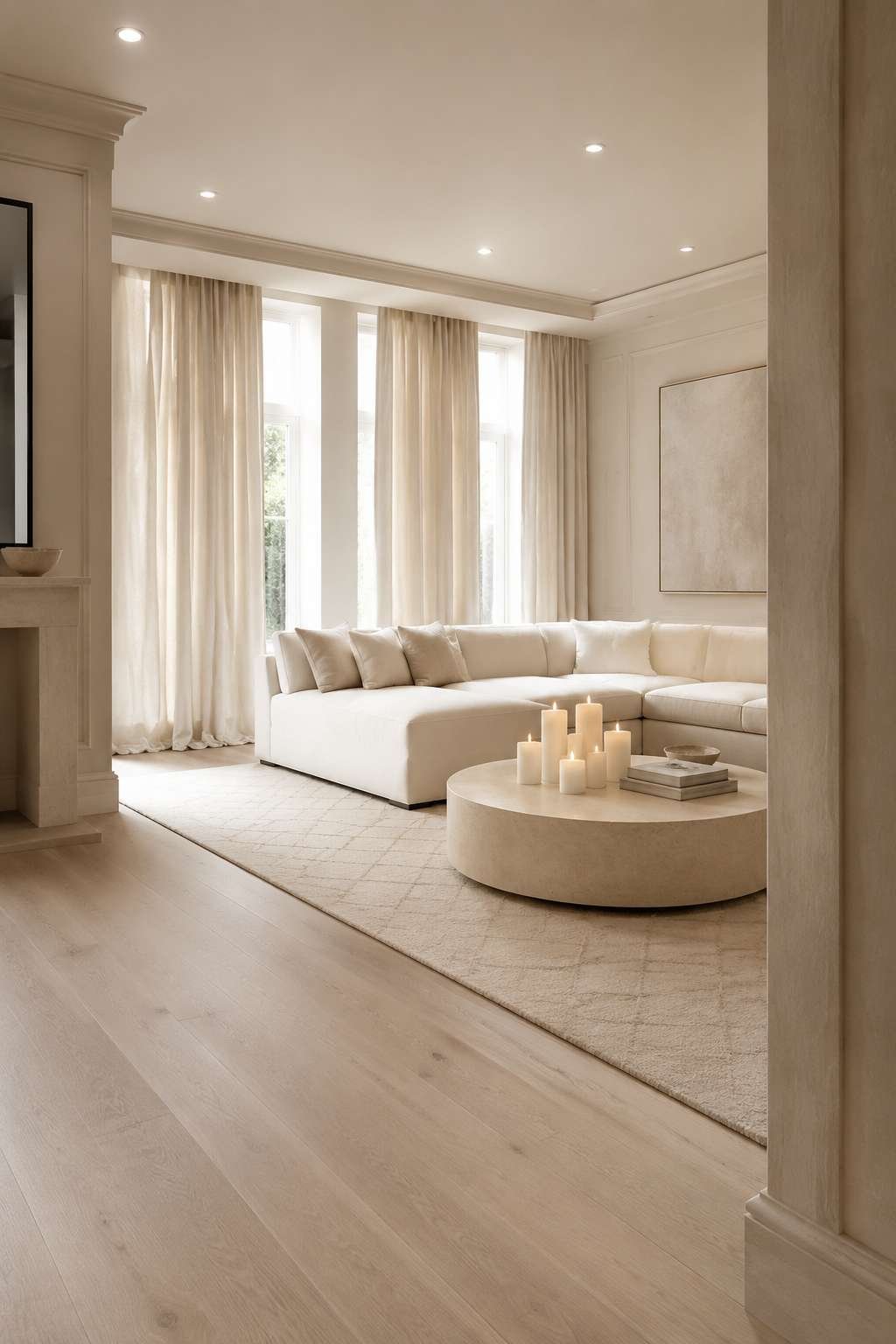
Custom cream silk drapes pooling on engineered white oak floors represent another level of material investment — silk curtains have a fluidity and sheen that no other fabric achieves, catching light in a way that makes them appear almost liquid when they move. The deliberate pooling of the fabric at the floor is a classic luxury design gesture that signals absolute confidence in material abundance. Against engineered white oak floors, the silk creates a beautiful material dialogue between matte and reflective surfaces, both within the cream palette.
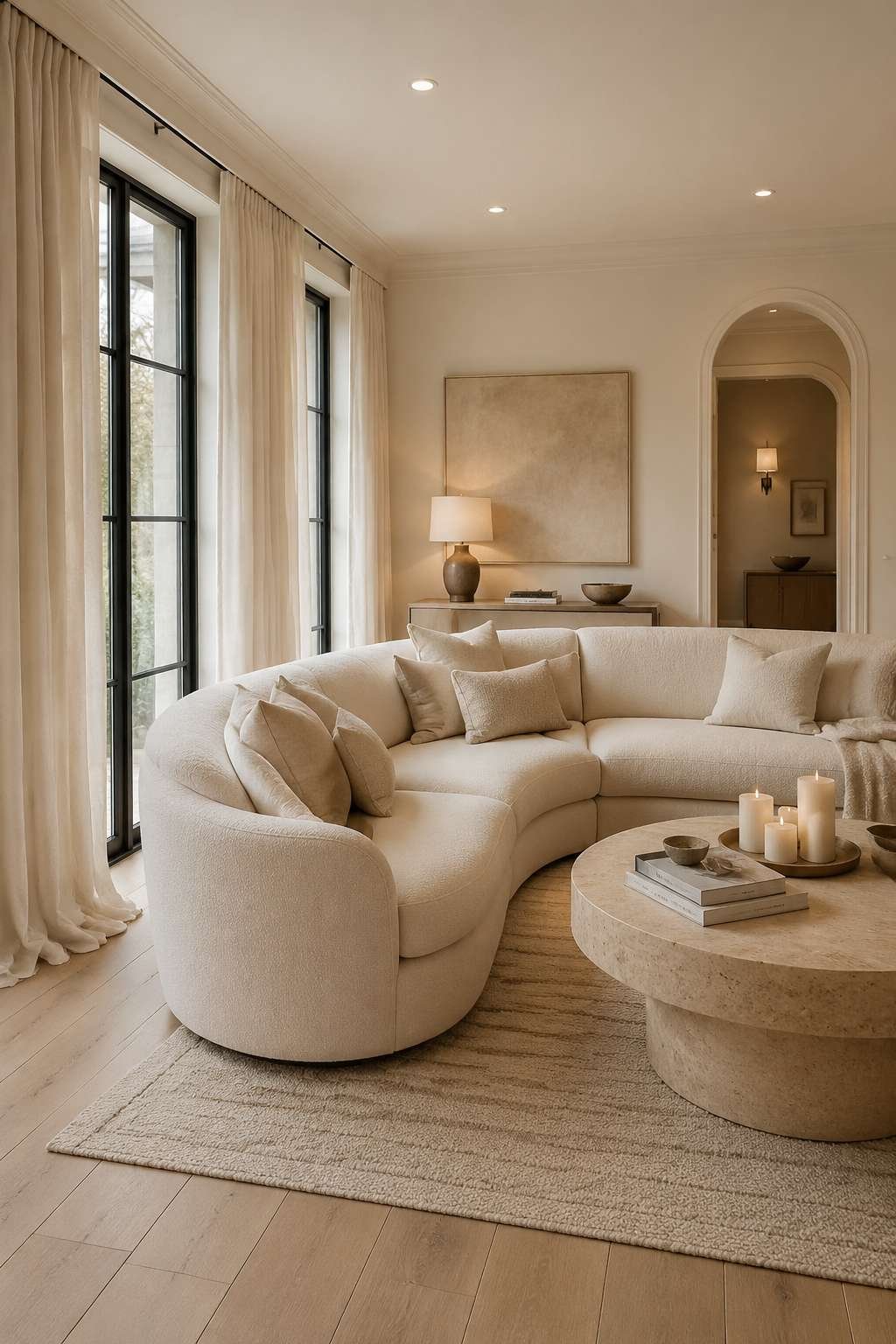
The round travertine coffee table with curated cream pillar candles and art books transforms the center of the room into a vignette of considered luxury. Art books in cream, ivory, and neutral covers stacked beneath sculptural pillar candles create a coffee table arrangement that looks organic but is in fact carefully composed — the key is to vary the heights and orientations of the books while keeping the color palette strictly within the cream and neutral spectrum. Travertine’s natural fossil impressions and warm veining give the table’s surface its own inherent decorative quality.
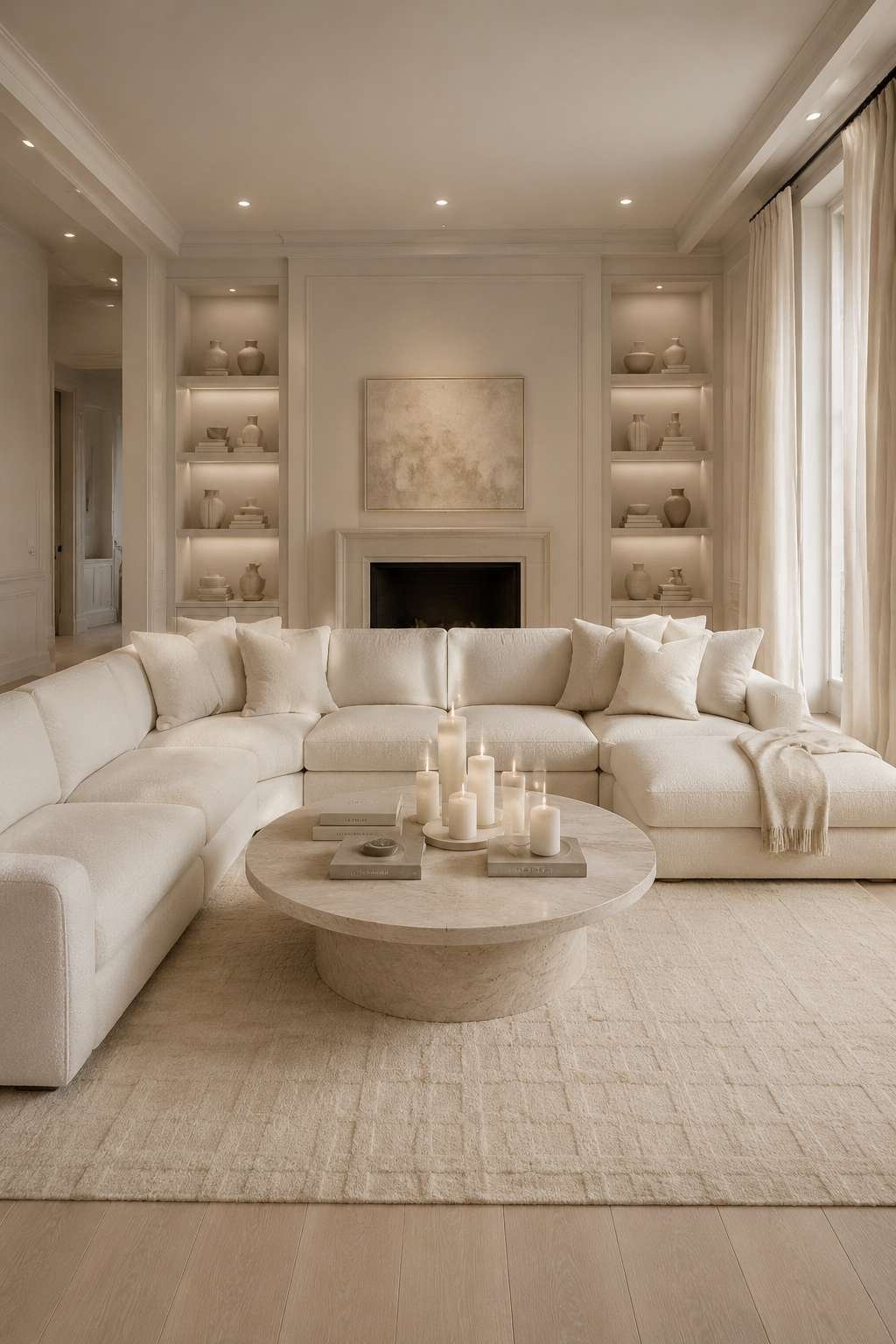
Recessed lighting providing soft ambient illumination is the appropriate lighting solution for this level of interior refinement — it maintains the visual cleanliness of the ceiling plane while delivering a warm, even light that shows every material surface at its best. The recessed lighting in this concept is not the primary source of atmosphere but rather the baseline illumination that allows the natural beauty of cashmere, silk, travertine, and white oak to express themselves fully.
Key Design Tips:
- Invest in cashmere or high-quality wool upholstery for sectional sofas in luxury cream living rooms — the difference in texture, depth of color, and longevity justifies the premium cost
- Choose silk or silk-blend drapes in cream luxury interiors and allow them to pool generously at the floor — the excess fabric is not wasteful but deliberately opulent
- Style travertine coffee tables with curated art books and cream pillar candles — keep the arrangement asymmetric and vary heights to achieve a composed yet organic appearance
- Install warm recessed lighting at a low lux level for ambient illumination in luxury cream rooms — combine with table lamps and floor lamps for a layered, controllable lighting scheme
- Maintain a strictly curated color palette in luxury cream interiors — limit accent colors to warm gold, ivory, and natural stone tones to preserve the refined, monochromatic aesthetic
10. Smart Small-Space Solutions: Cream Apartment Living
The cream palette is one of the most powerful tools available to the small-space interior designer — its light-reflective quality genuinely makes compact rooms feel larger, brighter, and more generous than they are. This concept demonstrates how to deploy cream intelligently in a small apartment, beginning with a compact cream linen loveseat with storage ottoman in matching fabric. The ottoman does double duty as additional seating, a footrest, and concealed storage — a small-space essential that maintains the visual coherence of the cream scheme.
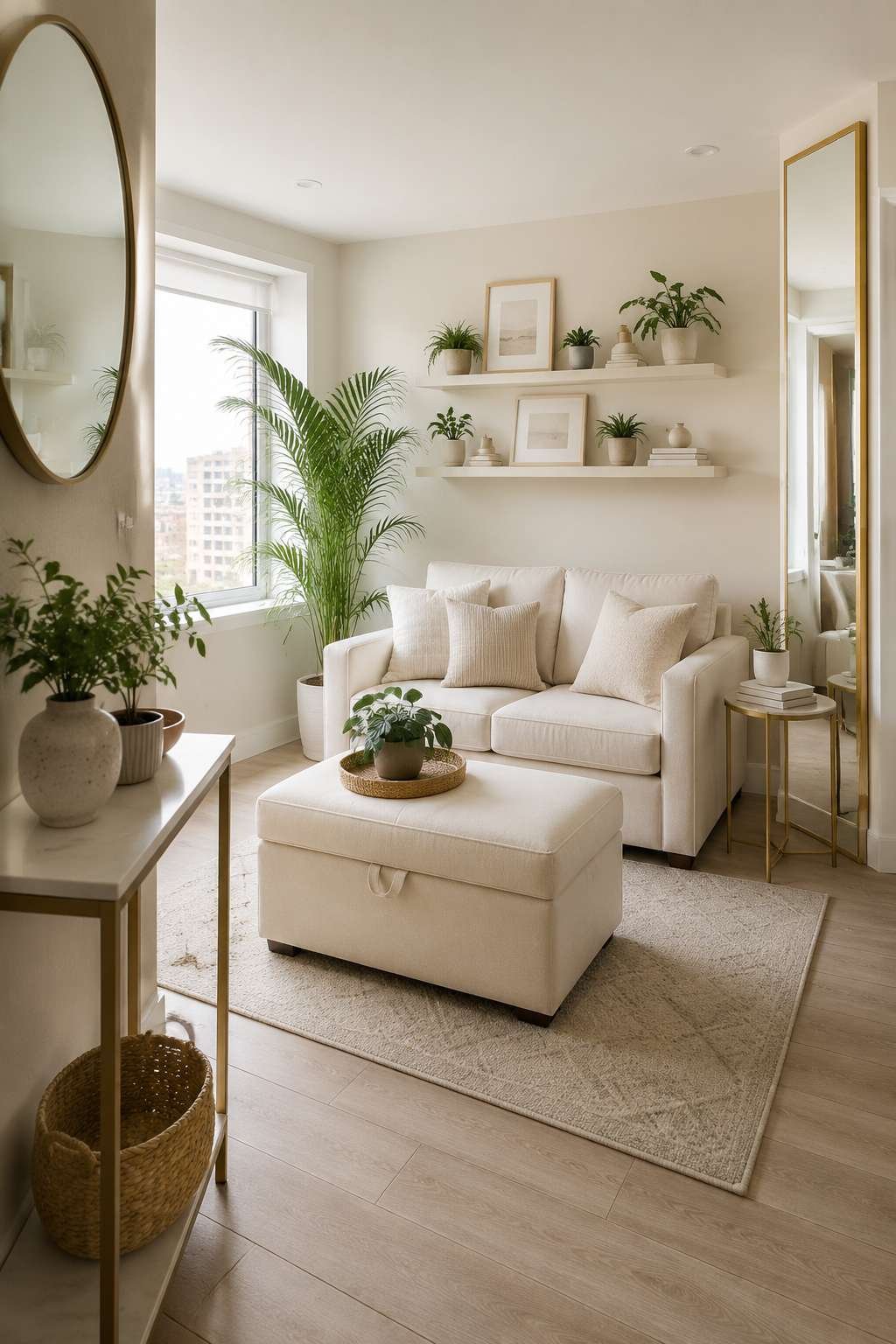
Wall-mounted floating shelves in cream lacquer are another small-space masterstroke — they provide display and storage without occupying any floor area, and when painted or lacquered to match the walls, they disappear visually while delivering practical function. Potted plants and minimal art displayed on these shelves introduce organic life and personality without cluttering the limited floor space. The key is to maintain generous negative space on the shelves — resist the urge to fill every inch.
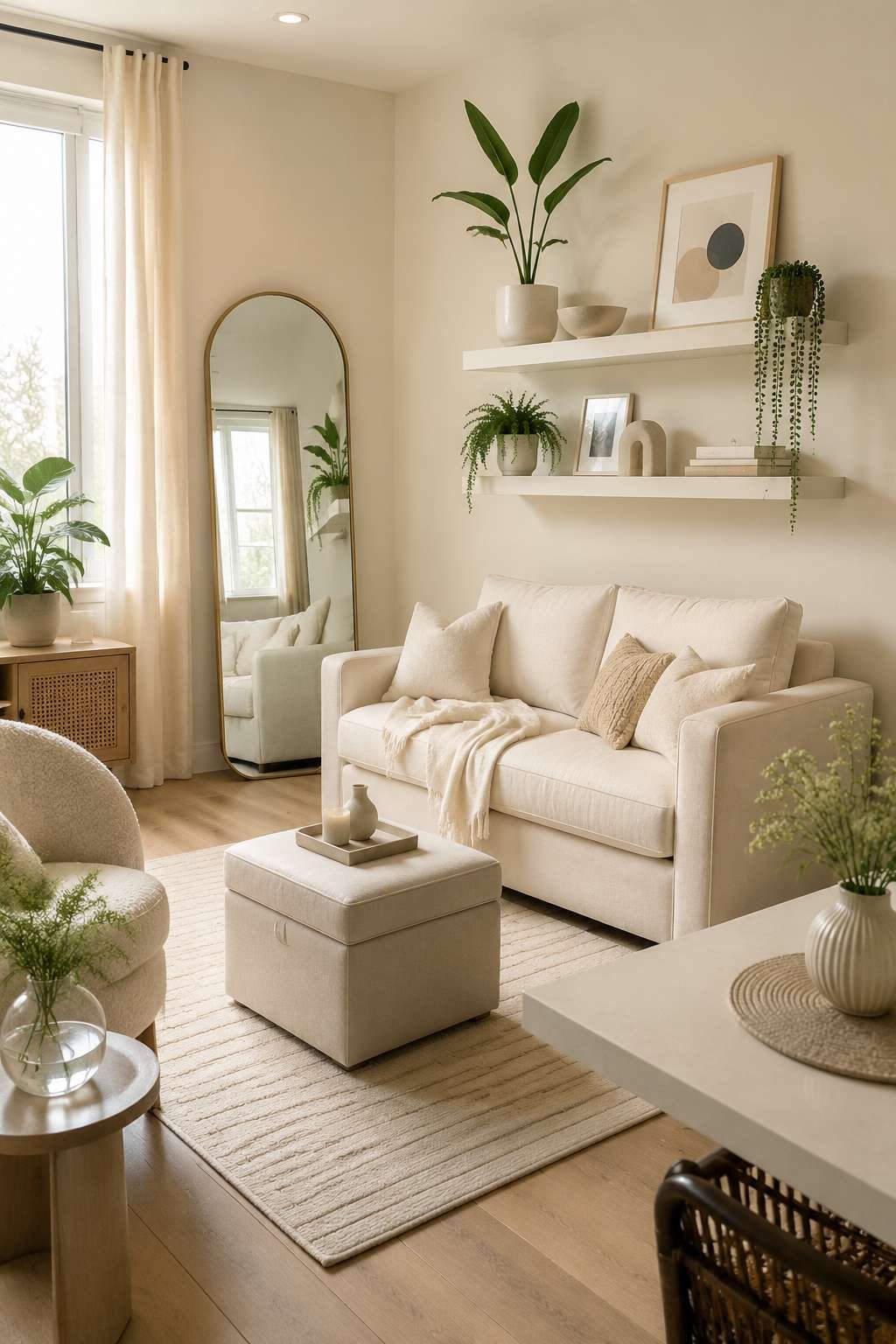
Mirrors positioned to expand the sense of space are the oldest trick in the small-space designer’s repertoire, but they remain extraordinarily effective when deployed correctly. A large mirror facing a window reflects natural light deep into the room, creating the impression of a second window and effectively doubling the room’s perceived brightness. In a cream apartment, the reflected light has a warm quality that makes the whole space feel more generous and welcoming.
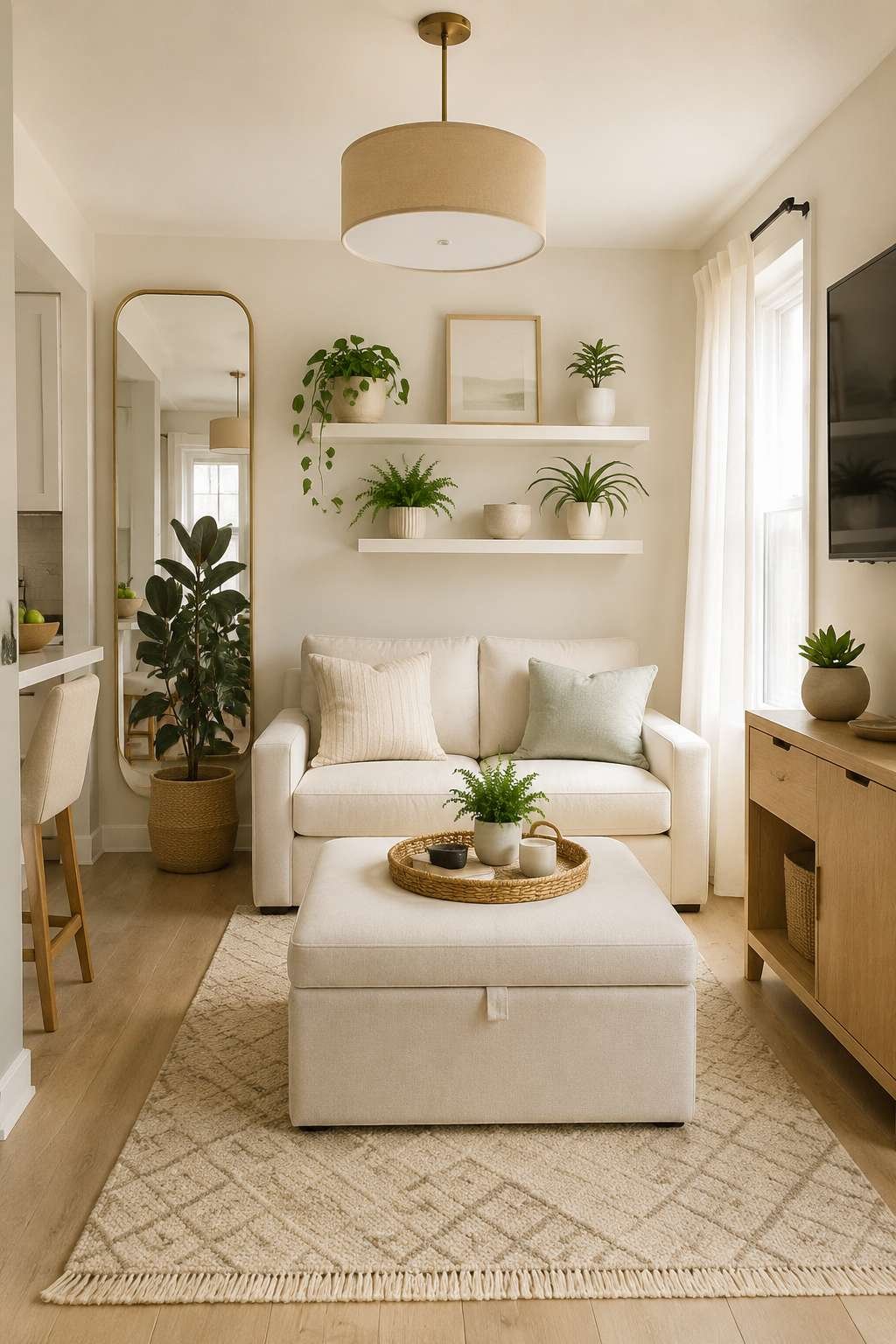
The brightening effect of the cream color scheme in a small apartment is genuinely transformative — where darker wall colors absorb light and make rooms feel smaller, cream reflects it, maintaining the room’s perceived volume. The practical furniture choices in this concept — loveseat rather than full sofa, storage ottoman rather than coffee table, wall-mounted rather than floor-standing storage — demonstrate that smart small-space design is not about compromise but about intelligence.
Key Design Tips:
- In small cream living rooms, choose multi-functional furniture such as storage ottomans, sofa beds, and nesting tables to maximize utility without increasing visual clutter
- Use wall-mounted storage in cream lacquer that matches the wall color to create the impression that shelving is part of the architecture rather than an addition to it
- Position large mirrors opposite windows to reflect natural light and create the impression of a second light source in compact rooms
- Maintain generous negative space on shelves and surfaces — in small rooms, restraint in decoration is more effective than abundance
- Choose cream upholstery and walls in small apartments to maximize light reflection and create a sense of spatial generosity that darker colors cannot achieve
11. Bohemian Soul: Macramé Focal Point and Layered Natural Fibers
The bohemian cream living room is a demonstration that maximalism and monochromatism are not mutually exclusive — that a room can be layered, eclectic, and texturally complex while remaining entirely within a cream and natural fiber palette. The cream macramé wall hanging as the focal point above a vintage rattan sofa is an inspired design choice — the hand-knotted textile introduces an extraordinary range of surface textures, its hanging knots and fringing creating both visual and tactile complexity within a single plane.
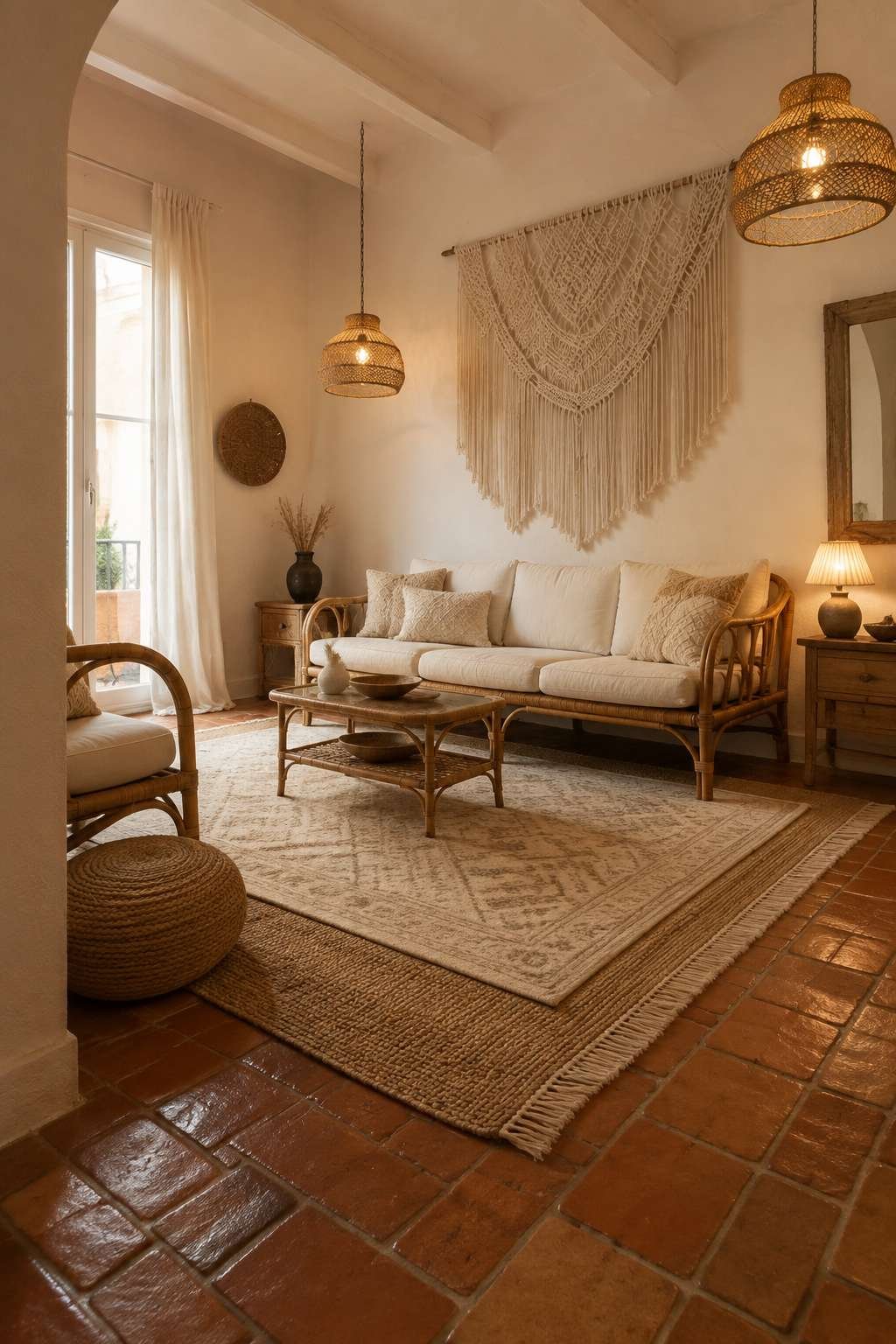
The vintage rattan sofa reupholstered in cream canvas is a piece that embodies the bohemian philosophy of valuing beauty, craftsmanship, and material authenticity over newness. Rattan’s natural cream-to-golden color integrates beautifully with the cream canvas reupholstery, while the structural frame’s organic curves and visible weave introduce an artisanal quality that mass-produced sofas simply cannot replicate. The canvas upholstery is deliberately plain — allowing the rattan frame to provide the visual interest while the fabric contributes texture and comfort.
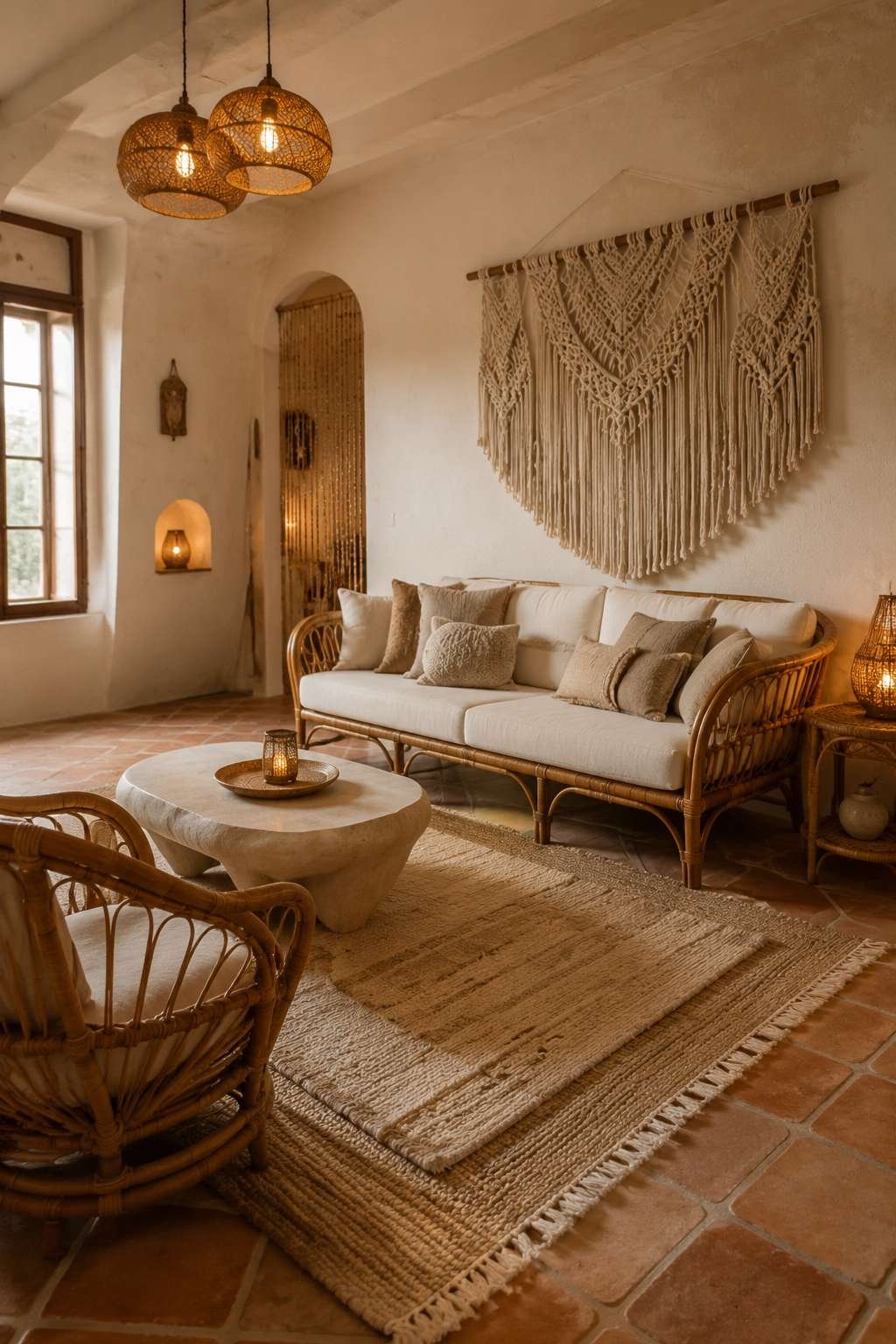
Layered area rugs in cream, sand, and warm taupe over terracotta tile floors create one of this concept’s most memorable design moments — the warm reddish-brown of the terracotta provides the only genuine color contrast in the room, making the cream and sand tones of the layered rugs appear even more luminous and warm by comparison. This is a masterful use of contrast: not between competing colors, but between the warmth of the terracotta tile and the warmth of the cream textile layers above it.
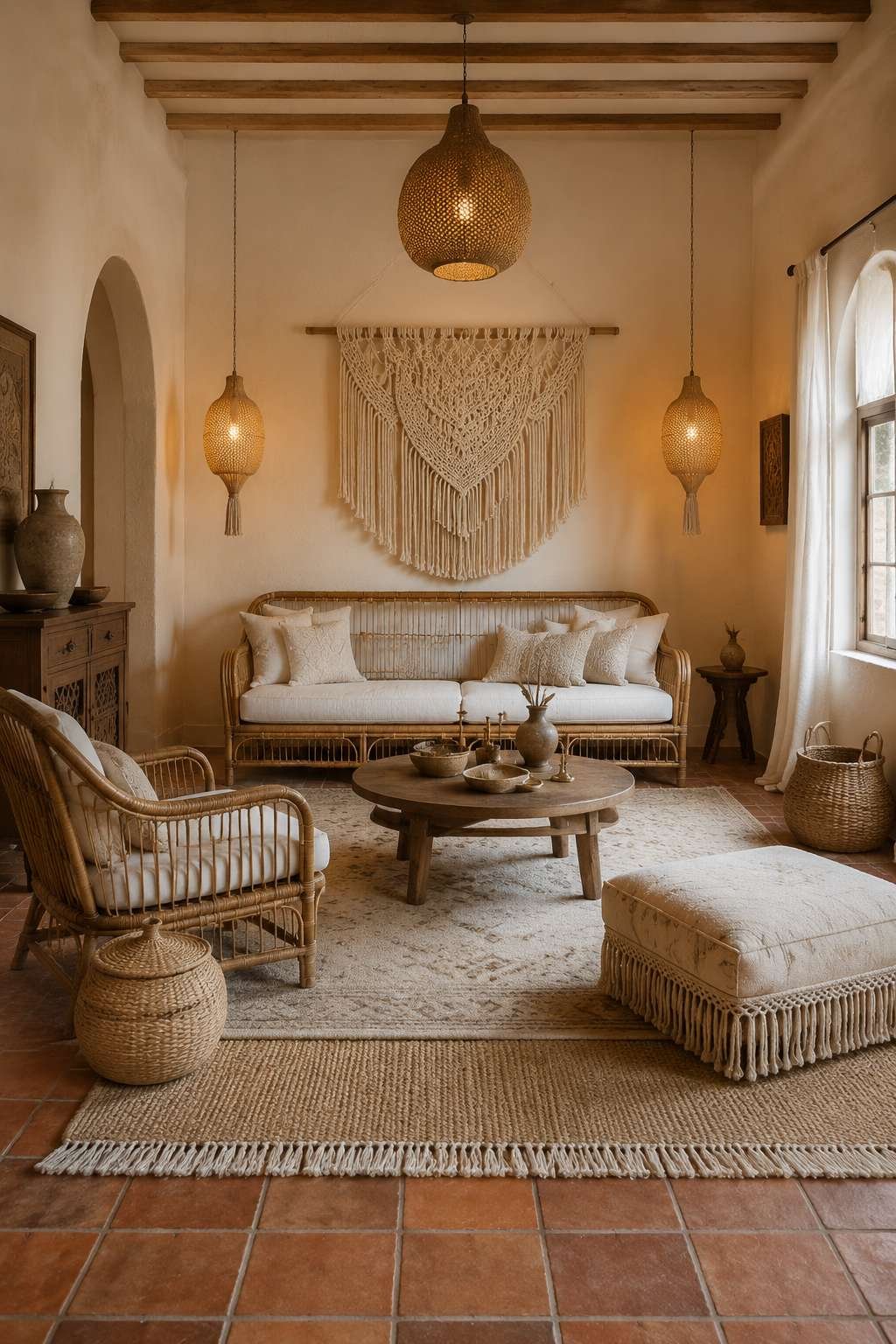
Hanging rattan lanterns as the primary light source complete the bohemian atmosphere — their organic forms and warm, dappled light are perfectly attuned to the natural fiber aesthetic of macramé, canvas, rattan, and woven rugs. The result is an interior that feels genuinely handcrafted and personally expressive, a living space that reflects a life lived with curiosity and aesthetic intention.
Key Design Tips:
- Use a large-scale macramé or woven textile wall hanging as the primary artwork in a bohemian cream living room — its texture and handcrafted quality cannot be matched by framed prints or canvas paintings
- Reupholster vintage rattan or cane furniture in cream or natural canvas — the combination of organic structural frame and plain fabric creates a sophisticated, artisanal aesthetic
- Layer area rugs of different sizes, textures, and natural tones over existing flooring to create warmth and define the seating zone within the larger room
- Use hanging rattan or wicker lanterns as pendant lighting in bohemian cream rooms — their organic material and warm glow reinforce the natural fiber aesthetic throughout
- Allow terracotta, stone, or concrete floors to remain visible at the rug edges in bohemian cream interiors — the contrast between warm flooring and cream textiles adds depth and earthiness
12. Sculptural Luxury: Plaster Fireplace and Boucle Accent Chairs
The statement cream plaster fireplace with organic curved edges is one of the most covetable design elements in contemporary interior design — a hand-crafted, architecturally sculptural piece that functions simultaneously as fireplace surround, artwork, and focal point. Unlike the sharp, geometric fireplaces of mid-century modernism or the ornate carved surrounds of Victorian interiors, the organic curved plaster fireplace occupies a uniquely contemporary position, referencing natural forms while remaining thoroughly abstract and modern.
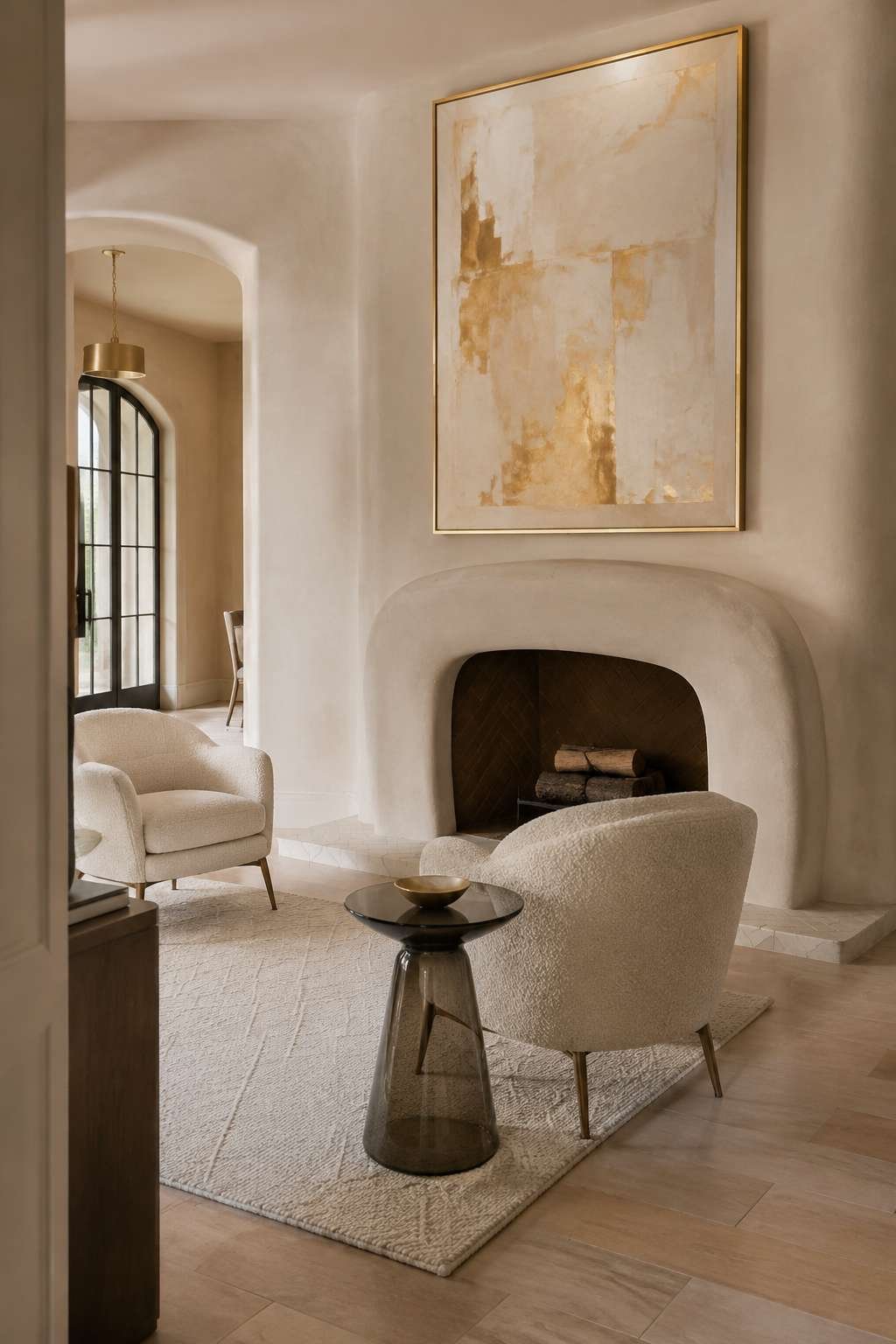
Cream boucle accent chairs positioned on either side of the fireplace create a symmetrical, formal arrangement that is nonetheless softened by the organic quality of the bouclé fabric and the curved plaster surround. Bouclé’s looped, textured surface has an affinity with plaster’s matt, slightly rough finish — both materials absorb light rather than reflecting it, creating a room that feels warm and enveloping rather than bright and crisp. The smoked glass side table between the chairs introduces the only genuinely reflective surface in the composition, its dark transparency adding depth and a note of contemporary sophistication.
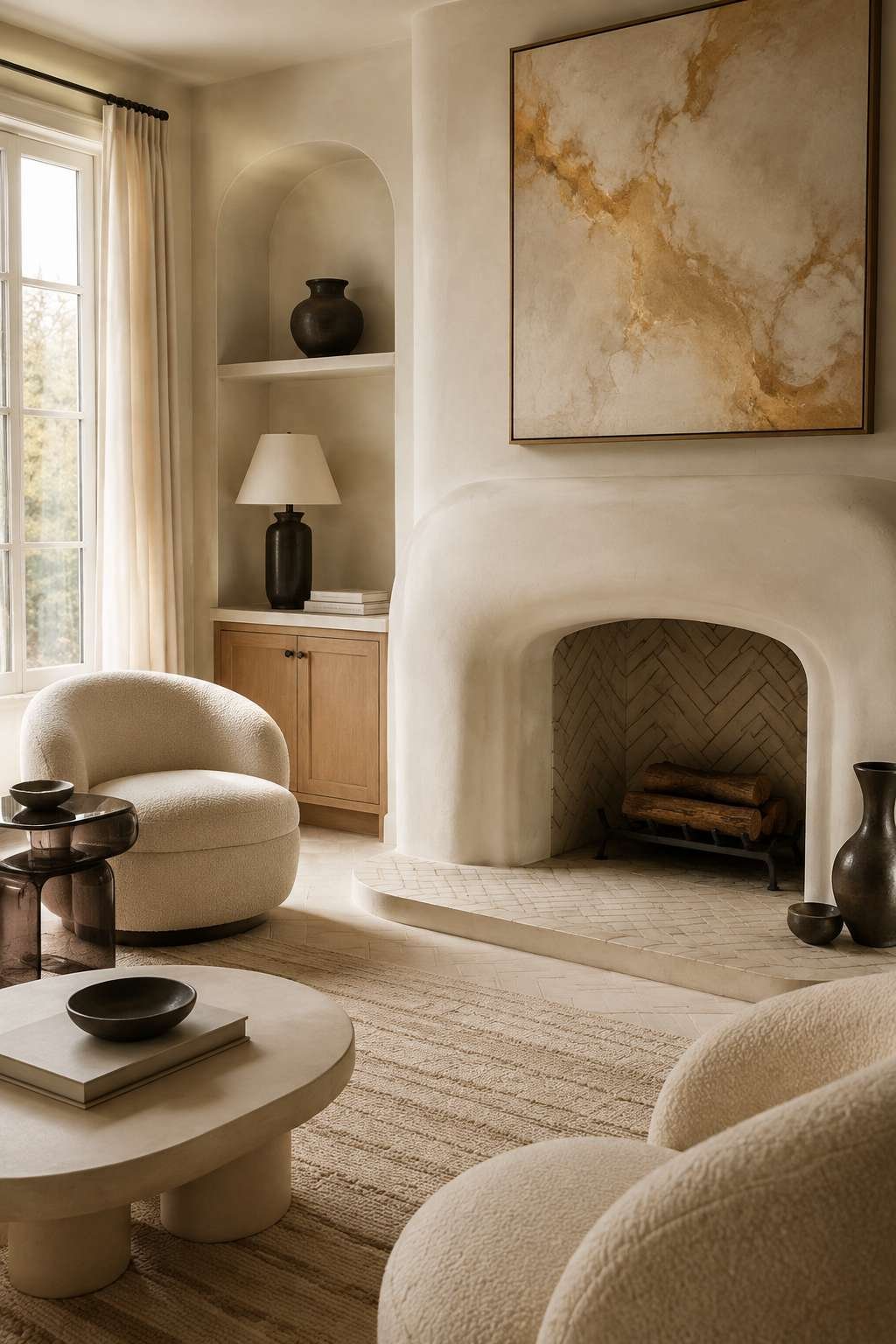
The large abstract artwork in cream and warm gold tones hanging above the plaster fireplace is carefully chosen to complement rather than compete — its warm gold notes echo the brass or gold hardware that might appear elsewhere in the room, while its cream tones maintain the palette’s monochromatic coherence. A herringbone cream marble tile hearth at the base of the fireplace adds a note of classical material luxury that grounds the more contemporary organic curves of the plaster surround above it.
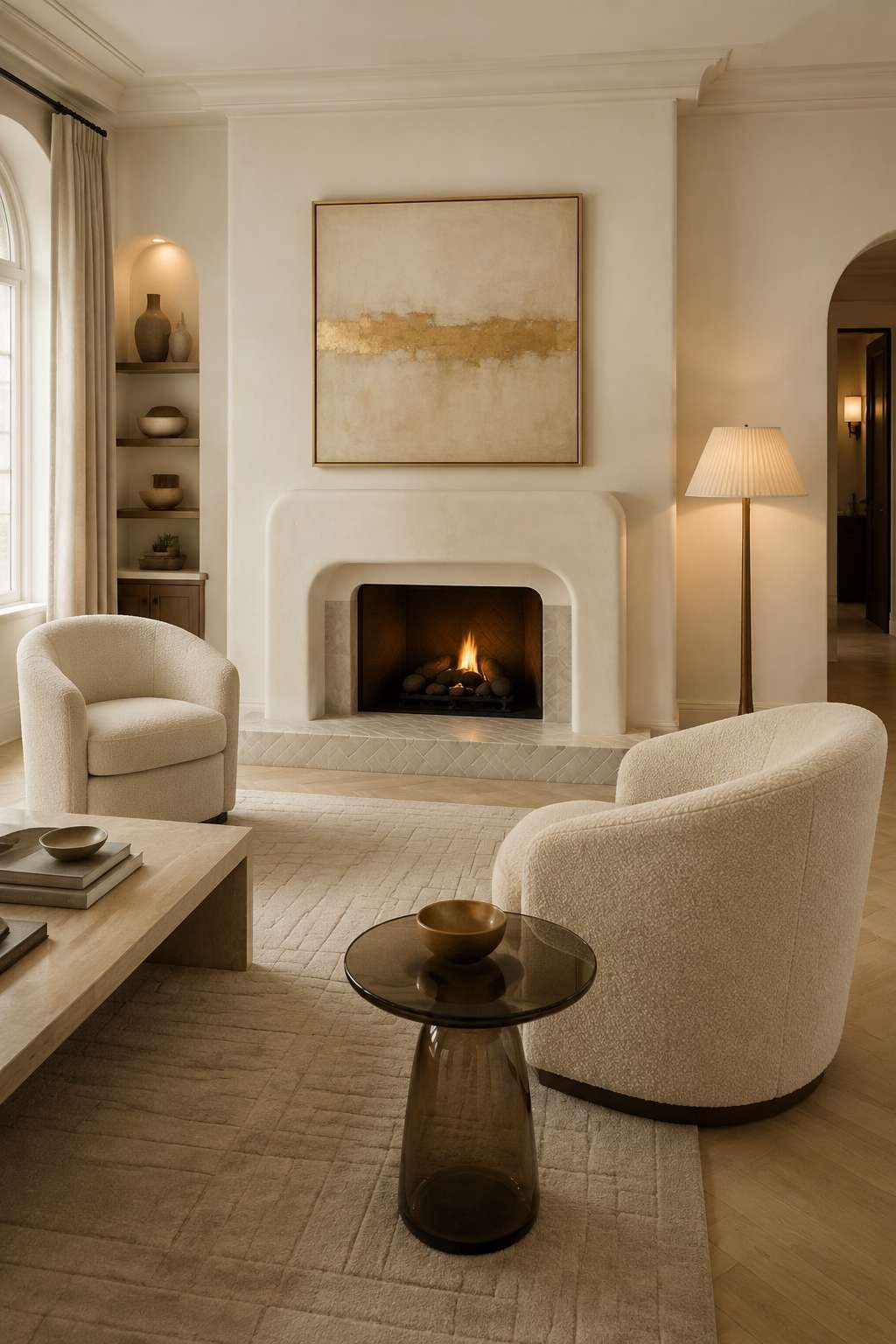
What makes this design concept truly exceptional is its commitment to material quality — every element, from the hand-applied plaster to the bouclé weave to the carved marble hearth, speaks to genuine craft and material investment. This is a cream living room that would reward the closest possible inspection, revealing new textural and material details at every scale of observation.
Key Design Tips:
- Commission a hand-applied organic plaster fireplace surround as a room’s focal sculptural element — the combination of organic curves and natural plaster finish creates an effect no mass-produced surround can replicate
- Flank fireplaces with matching boucle accent chairs in a symmetrical arrangement to create a formal yet warm and inviting conversation zone
- Choose smoked or tinted glass for side tables in material-rich cream interiors — its dark transparency adds depth without introducing a competing color or heavy visual mass
- Select abstract artwork in cream and warm metallic tones for display above organic plaster fireplaces — the tonal alignment creates visual coherence while the abstract quality complements the sculptural surround
- Use herringbone marble tile for fireplace hearths — the classic pattern adds a note of material refinement that grounds an otherwise contemporary organic design
13. Family-Friendly Functionality: Performance Fabric and Practical Design
The family-friendly cream living room demonstrates that beautiful design and practical functionality are not opposing values — that with the right material choices and furniture selection, it is entirely possible to create a cream living room that looks genuinely beautiful and survives the rigors of daily family life. The foundation of this concept is a washable cream performance fabric sofa — performance fabrics have advanced dramatically in recent years, and the best contemporary options are genuinely difficult to distinguish from natural linen or cotton while offering far superior stain resistance and durability.
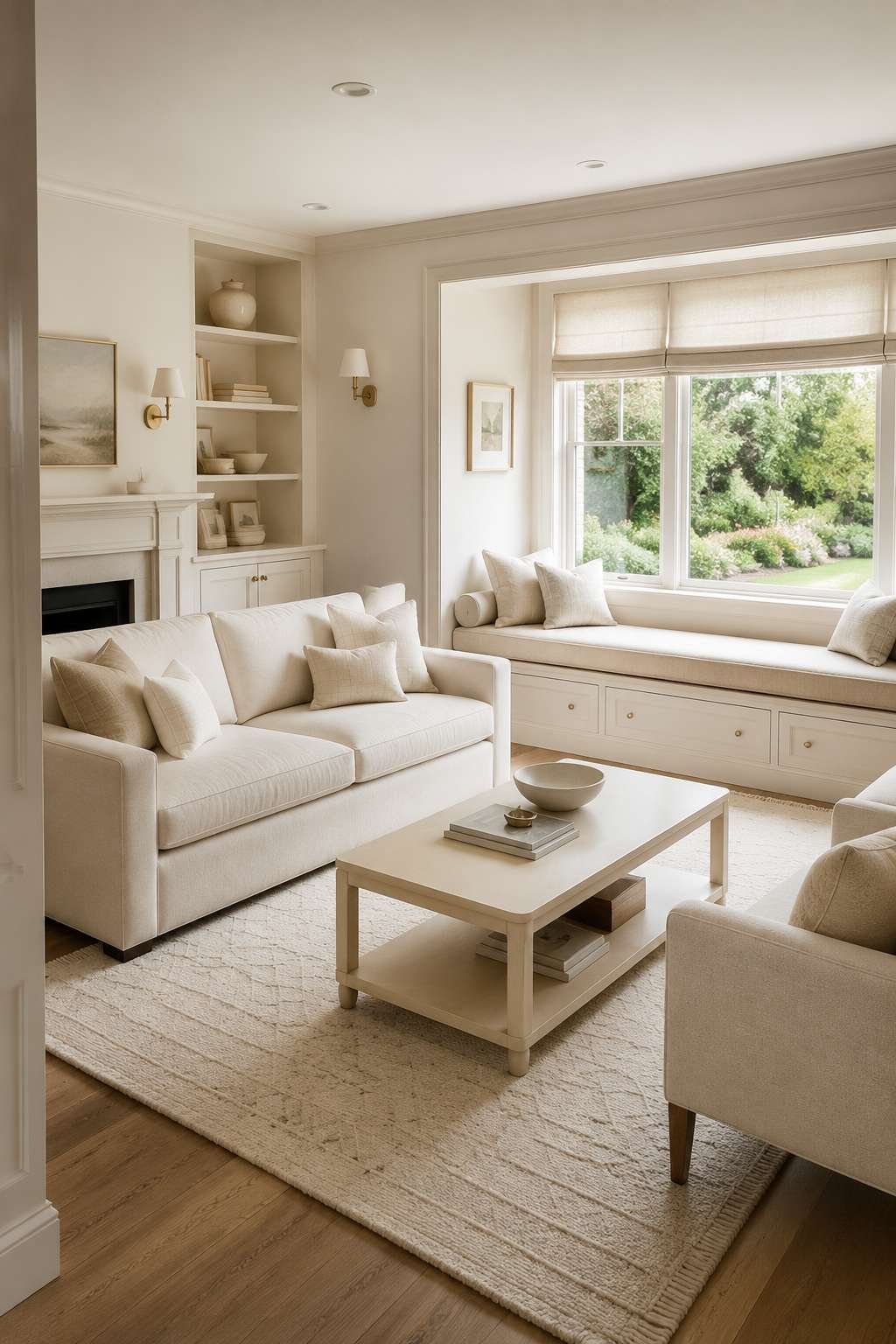
A cream-painted oak coffee table with rounded corners is the ideal family living room centrepiece — the rounded corners remove the injury risk of sharper-edged alternatives, while the durable oak construction and painted cream finish make it practical and cohesive within the palette. Cream linen roman blinds are a thoughtful window treatment choice for family spaces — they filter light effectively, are easier to maintain than floor-length curtains (which can be grabbed or tripped over), and their flat, folded profile adds a note of clean, unfussy elegance.
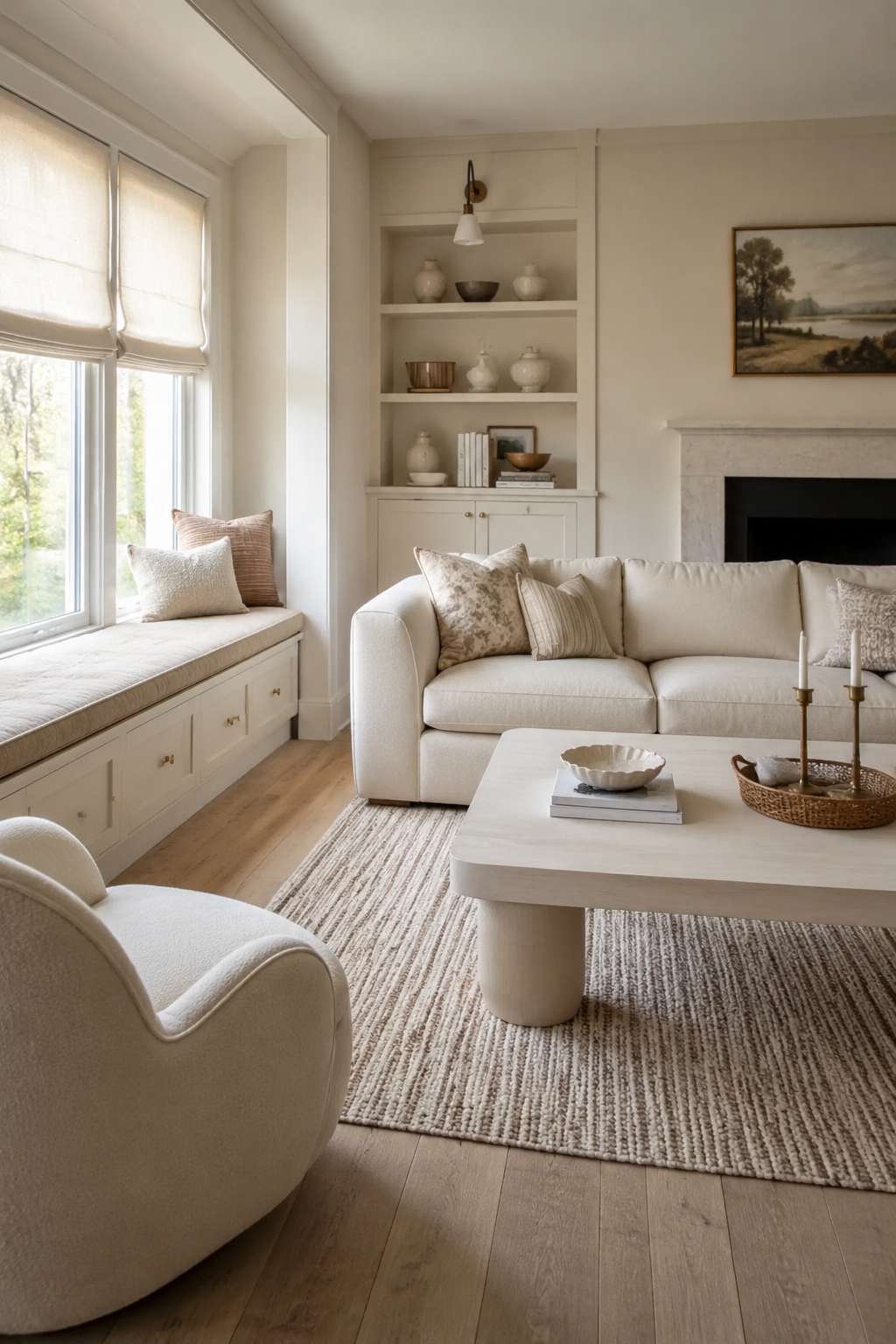
The built-in window seat with cream upholstered cushion is a design element that earns its place many times over in a family living room — it provides additional seating for guests, a reading perch for children, extra storage beneath the seat, and a visual connection to the garden or outdoor space beyond. Upholstered in a performance fabric that matches the main sofa, it integrates seamlessly into the room’s aesthetic while delivering genuine practical value.
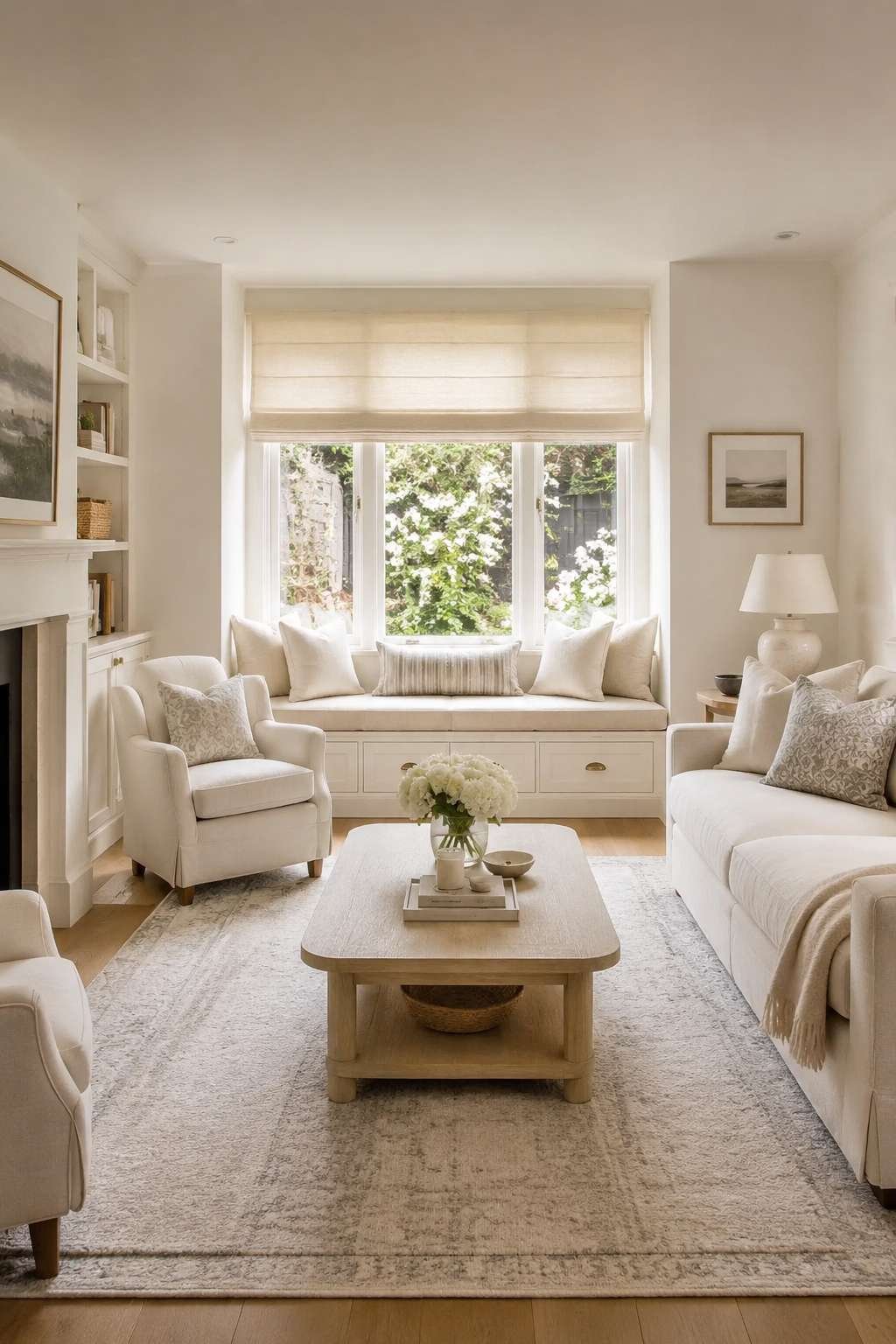
Natural light flooding a practical and inviting space is the most important environmental factor in a family living room — rooms where children play and families gather should feel open, bright, and generous, and cream walls and upholstery are the most effective tools for maximizing that quality of light. This concept proves that thoughtful functional design and beautiful aesthetics are not a compromise but a collaboration.
Key Design Tips:
- Choose washable performance fabric for sofas in family cream living rooms — look for fabrics with a Martindale rub count above 30,000 for genuine durability alongside visual appeal
- Select coffee tables with rounded corners and durable painted or lacquered finishes for family spaces — safety and practicality need not come at the expense of style
- Install roman blinds rather than floor-length curtains in family living rooms — they deliver effective light control without the trailing fabric that poses a trip hazard or accumulates daily dust
- Consider a built-in window seat in family living rooms — the combination of extra seating, storage, and connection to the outdoor view makes it one of the highest-value design additions possible
- Position seating arrangements so that natural light falls across the room rather than directly into eyes — this creates comfortable, glare-free illumination that is ideal for all family activities
14. Mid-Century Refinement: Walnut Legs and Cream Wool Upholstery
The mid-century modern cream living room occupies a design sweet spot between the organic warmth of natural materials and the clean precision of modernist geometry. A cream wool upholstered sofa on tapered walnut legs is the defining piece — the tapered legs lift the sofa visually, creating a sense of lightness and airiness that heavier, floor-level furniture cannot achieve, while the walnut wood’s rich, dark grain provides a beautiful material counterpoint to the cream wool upholstery. Wool is an ideal mid-century upholstery fabric — its slight texture and natural warmth are entirely in keeping with the period’s aesthetic sensibility.
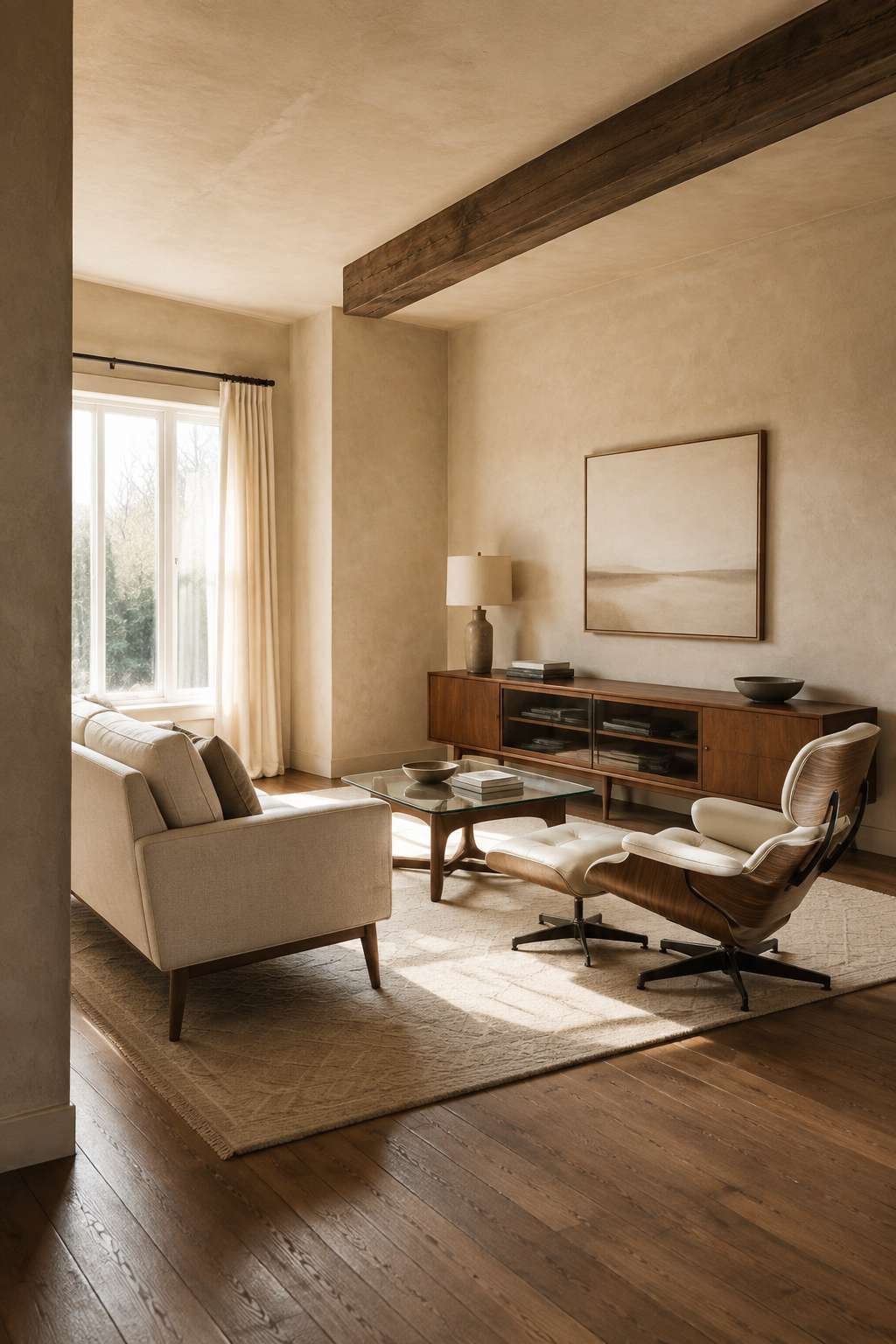
A pair of cream leather Eames-style lounge chairs extends the mid-century reference while maintaining the cream palette — leather upholstery in cream has a particular quality in mid-century settings, its subtle sheen and increasing patina over time aligning with the period’s appreciation for materials that age honestly. The Eames silhouette — low-slung, broadly proportioned, with visible structural elements — is one of the most enduring chair designs in the history of modern furniture, and its compatibility with cream upholstery is well established.
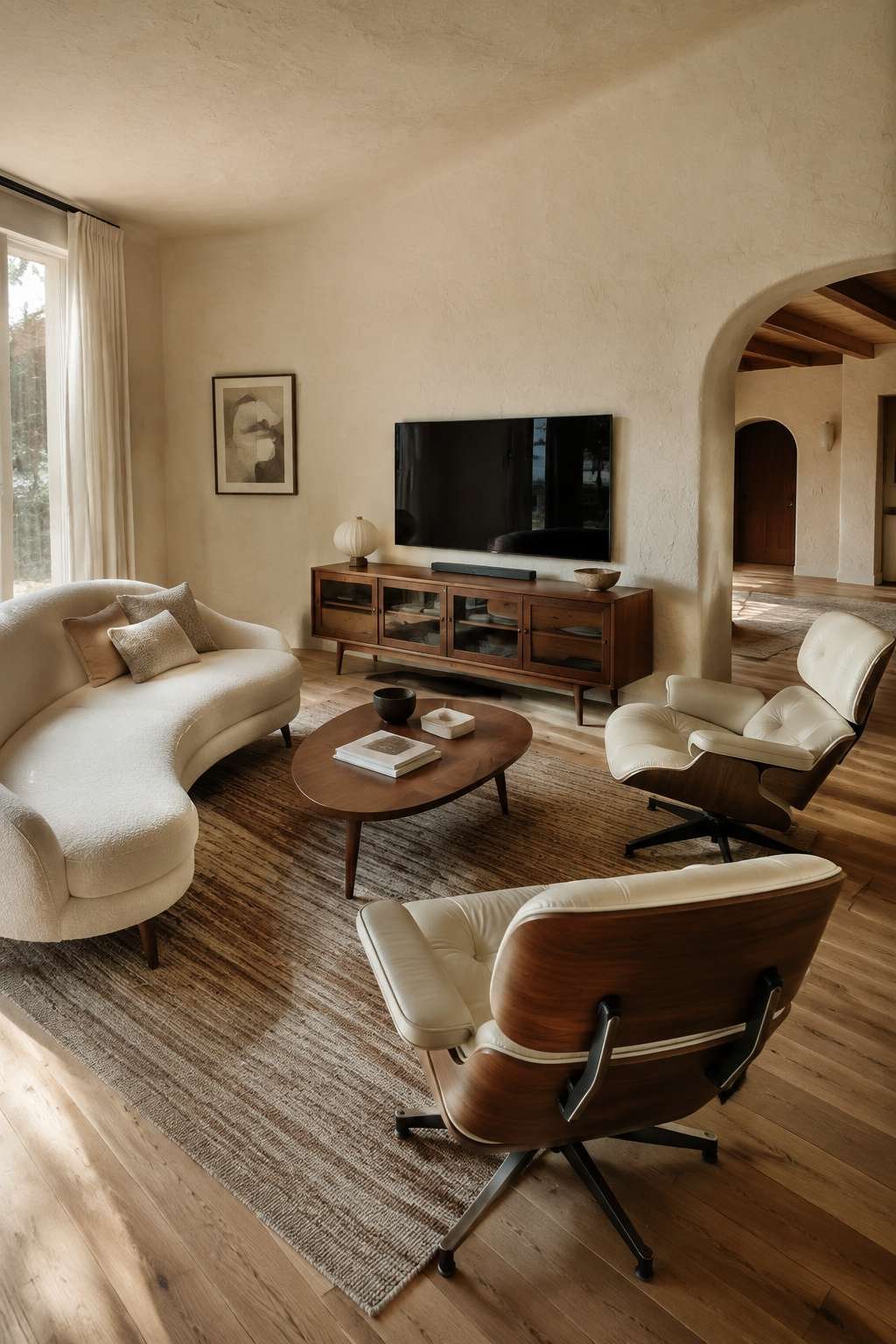
The walnut and glass credenza serving as a media console is a mid-century essential — the clean horizontal lines, the combination of solid walnut carcass and glass or cane inserts, and the considered proportions of a good credenza bring an extraordinary amount of design quality to the wall it occupies. Against warm cream textured plaster walls, the walnut grain appears even richer and darker, creating a material dialogue between the warm, organic wall finish and the precise, crafted furniture surface.
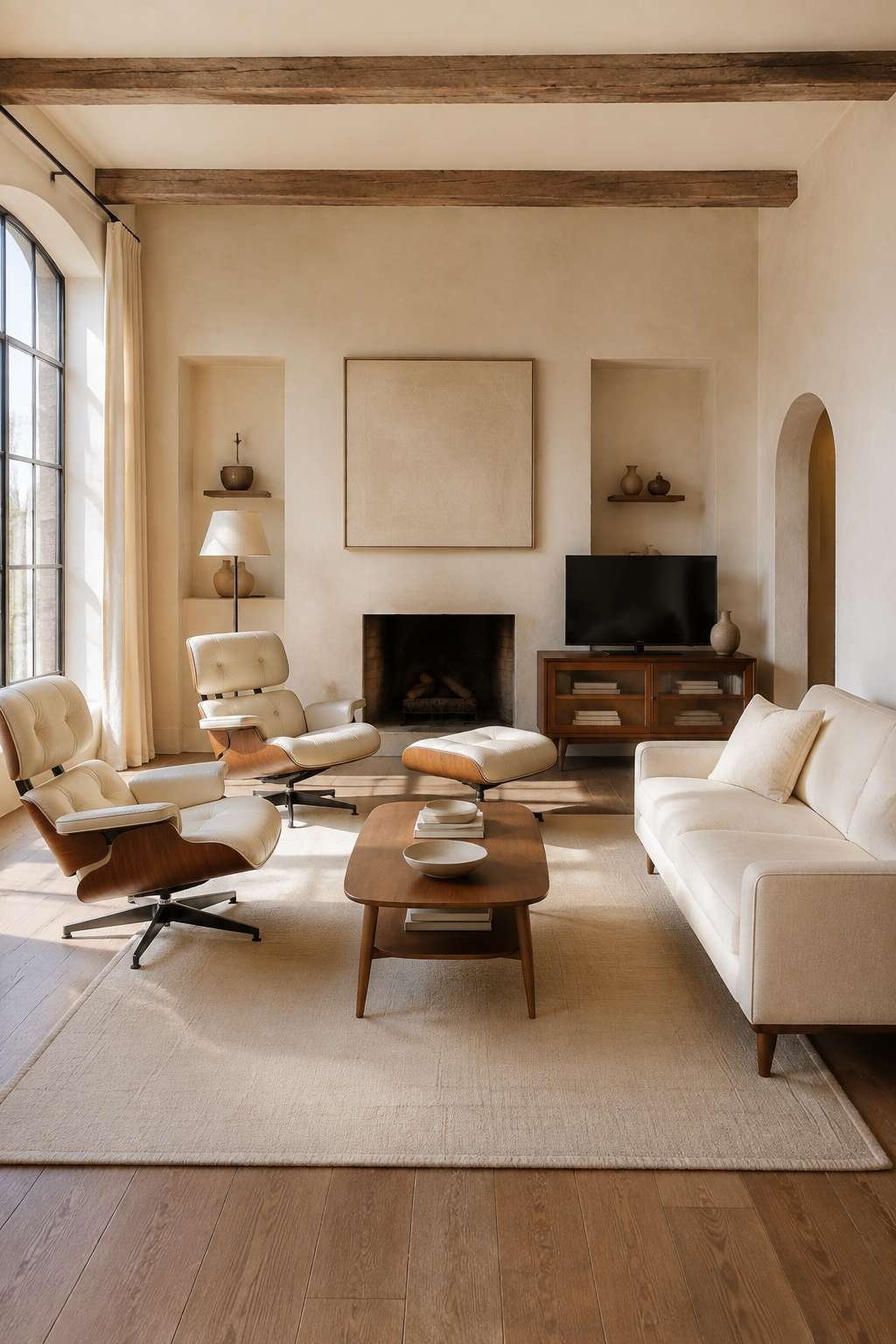
Natural morning light is the ideal illumination for mid-century cream interiors — its cool clarity reveals the true colors of walnut grain and cream wool without the amber cast of afternoon or artificial light. The combination of cream wool, cream leather, walnut wood, and textured plaster creates a palette of extraordinary material richness within a very restrained color range — the essence of mid-century modernism’s enduring appeal.
Key Design Tips:
- Choose sofas and chairs with exposed tapered legs in walnut or oak for mid-century cream living rooms — the visible legs create visual lightness and are a defining characteristic of the period’s furniture aesthetic
- Pair cream wool or cream leather upholstery with dark walnut wood for the classic mid-century material contrast — the combination has a timeless quality that transcends specific trends
- Use a walnut credenza as a media console — its horizontal proportions, material quality, and mid-century aesthetic credentials make it one of the most useful and beautiful furniture pieces available
- Apply textured plaster or limewash to walls in mid-century cream rooms — the organic, slightly rough surface quality complements the period’s appreciation for honest, natural materials
- Arrange furniture away from walls in mid-century rooms — the period’s open, floating furniture arrangements create a sense of spatial generosity that pushing furniture against walls cannot achieve
15. Japandi Serenity: Japanese-Inspired Minimalism in Cream
The Japandi cream living room — a fusion of Japanese and Scandinavian design philosophies — is perhaps the most spiritually intentional concept in this collection. Where other design styles engage with space, Japandi contemplates it. A low-profile cream linen floor sofa is the room’s primary gesture — positioned directly on the floor or on a very low platform, it establishes the room’s physical and aesthetic relationship with the ground plane, creating an interior that encourages stillness, groundedness, and deliberate presence.
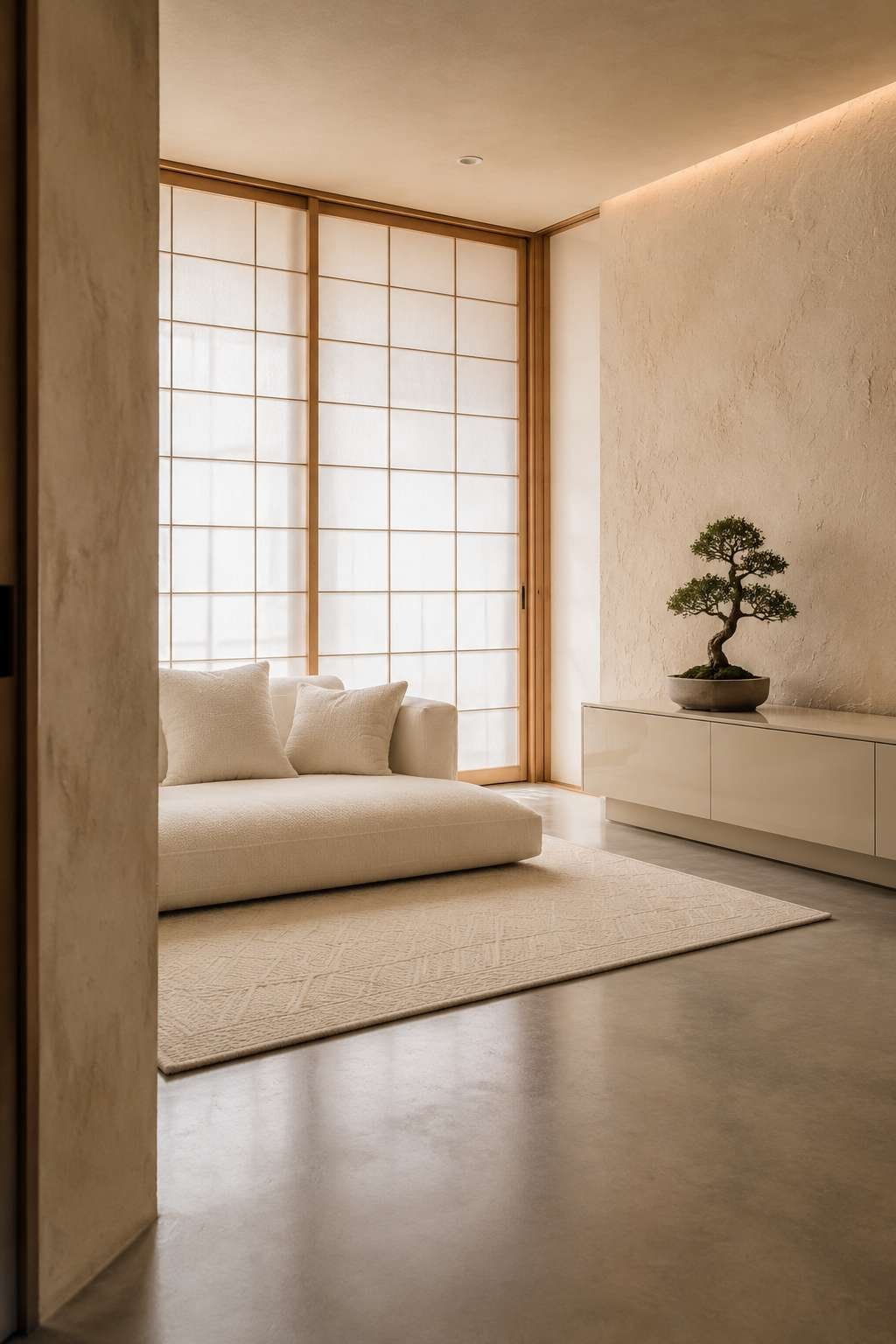
Shoji-style screen panels diffusing soft natural light are the defining architectural feature — their washi paper or translucent fabric panels filter direct sunlight into a soft, even luminosity that is the most flattering and meditative light quality any interior can achieve. In a cream interior, this diffused light reveals the subtle tonal variations between cream linen, cream lacquer, textured plaster, and polished concrete in a way that direct sunlight or artificial light cannot match. The shoji panels also serve as a room divider, creating a sense of enclosure and privacy within an otherwise open space.
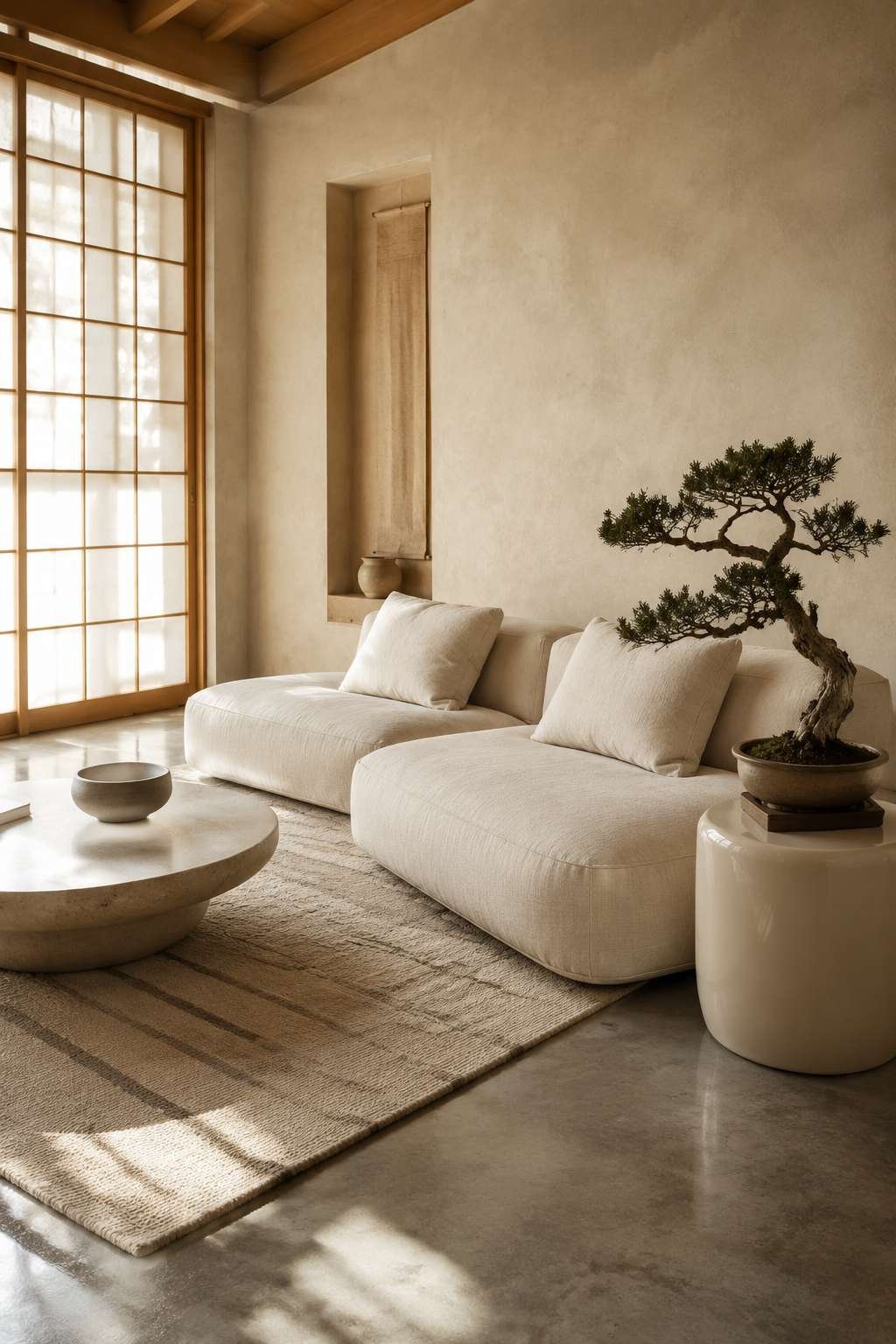
A single ceramic bonsai display on a cream lacquer side table demonstrates the Japandi philosophy of wabi-sabi — the appreciation of beauty in imperfection, incompleteness, and transience. A bonsai tree, with its carefully trained form and visible aging, is an object of profound aesthetic contemplation in Japanese design culture, and its presence in this cream interior transforms the space from a designed room into a considered environment. The cream textured plaster wall meeting smooth polished concrete flooring creates a material dialogue between rough and smooth, matte and reflective, that is deeply characteristic of the Japandi aesthetic.
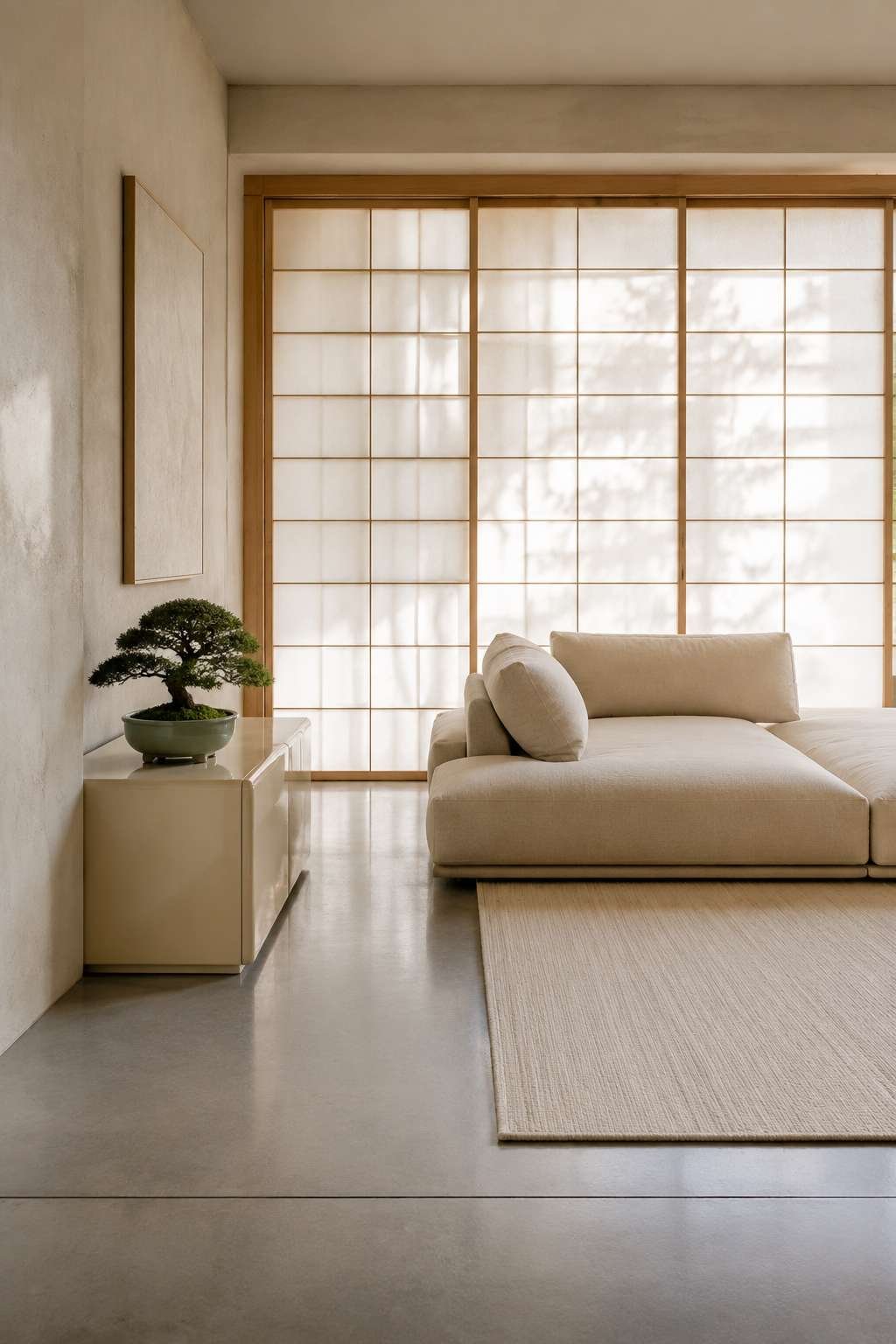
The tranquility of this space is not accidental but engineered — every material choice, every furniture decision, every spatial arrangement is oriented toward creating an environment of genuine calm and visual rest. In a world of increasing sensory complexity and visual noise, the Japandi cream living room offers something genuinely radical: a room designed not to impress but to restore.
Key Design Tips:
- Choose low-profile floor-level furniture in Japandi cream living rooms to create a physical connection with the ground plane and a sense of settled, deliberate calm
- Install shoji-style panels or translucent screens to diffuse direct sunlight — the resulting even, soft light quality is the most meditative and flattering illumination available
- Display a single, considered organic object — bonsai, a sculptural stone, a single branch — rather than multiple decorative items; in Japandi design, one perfect thing is infinitely more powerful than many adequate things
- Contrast cream textured plaster walls with smooth polished concrete or stone floors — the rough/smooth, matte/reflective material dialogue is a defining Japandi design tension
- Practice deliberate restraint in furniture arrangement — Japandi rooms should contain only what is necessary, with generous floor space preserved as a design element in its own right
16. Curated Refinement: Gallery Wall and Chesterfield Velvet
The cream velvet Chesterfield sofa is one of the most iconic pieces in English furniture history, and its presence in a curated, gallery-inspired cream living room elevates the entire composition into the realm of sophisticated collecting. The Chesterfield’s deep button tufting, rolled arms, and equal-height back and arms create a silhouette of absolute confidence — it is a piece of furniture that has nothing to prove and knows it. In cream velvet, the tufting creates a beautiful interplay of light and shadow across the fabric surface, making the sofa appear almost three-dimensional.
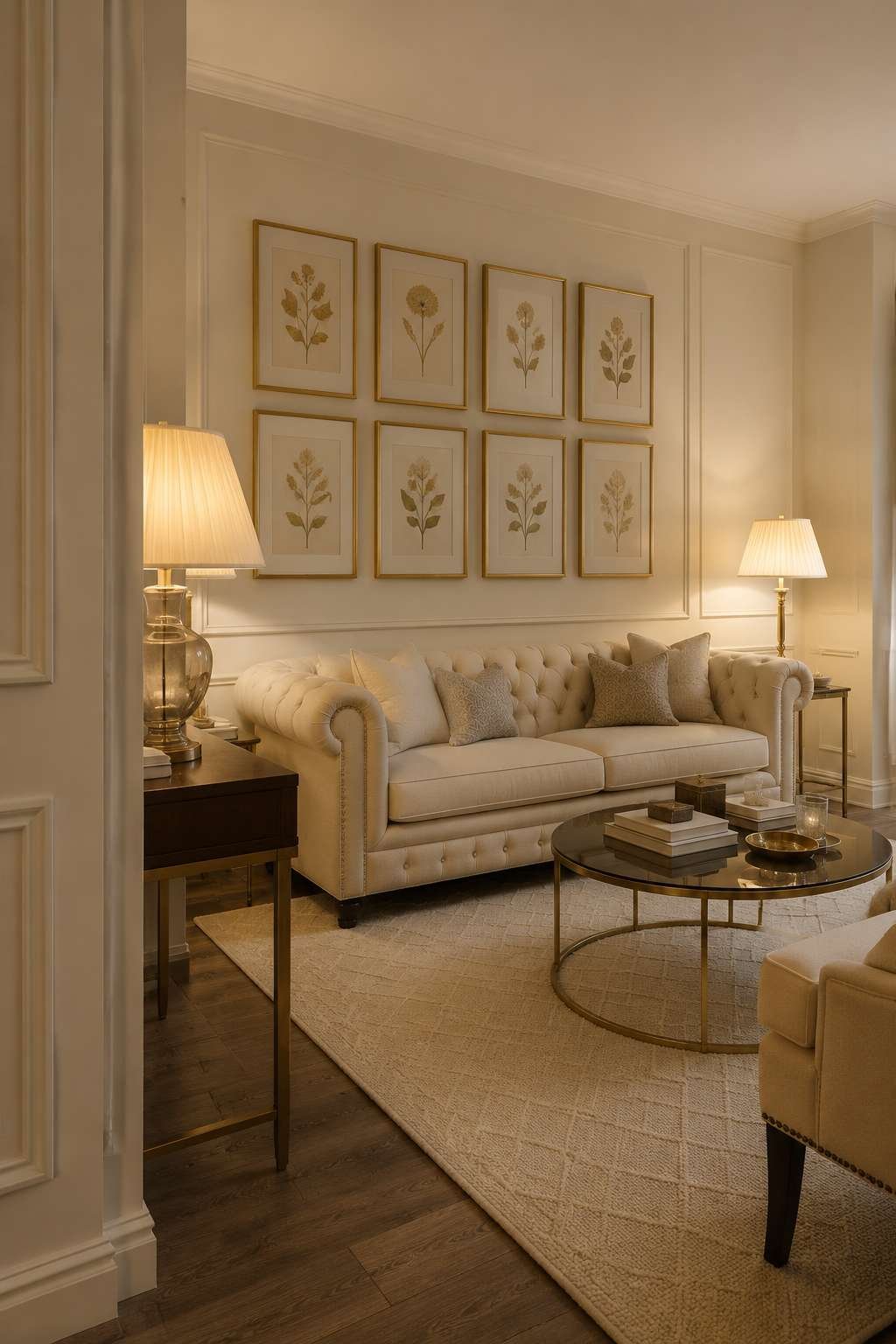
A gallery wall of cream-matted botanical prints in thin brass frames above the Chesterfield is a display strategy that requires considerable care to execute well — the key is to choose prints that share a consistent botanical subject matter and presentation style, matt them in identical cream card, frame them in matching thin brass profiles, and arrange them in a grid or loose cluster that maintains internal coherence. The cream matting is crucial — it creates a consistent visual border between each print and the fabric behind it, unifying the gallery wall into a single composed element.
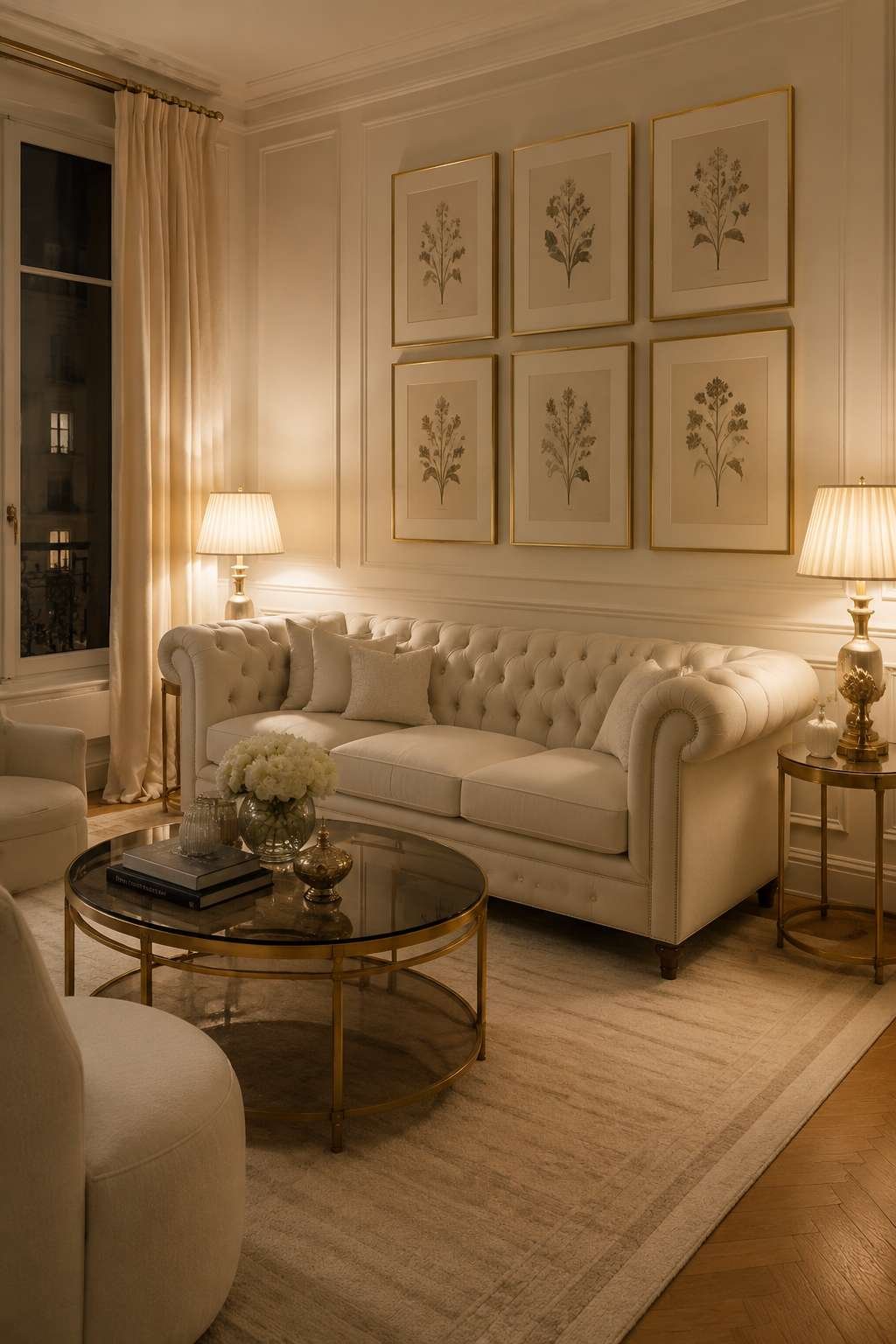
A round brass and smoked glass coffee table grounds the seating arrangement with a note of contemporary sophistication — the circular form prevents the accumulation of sharp angles in the composition, while the combination of brass and smoked glass creates a piece that is simultaneously transparent and substantial. On a cream flatweave rug, the coffee table’s brass legs appear to glow with reflected warmth, creating a pool of warm metallic light at the center of the seating arrangement.
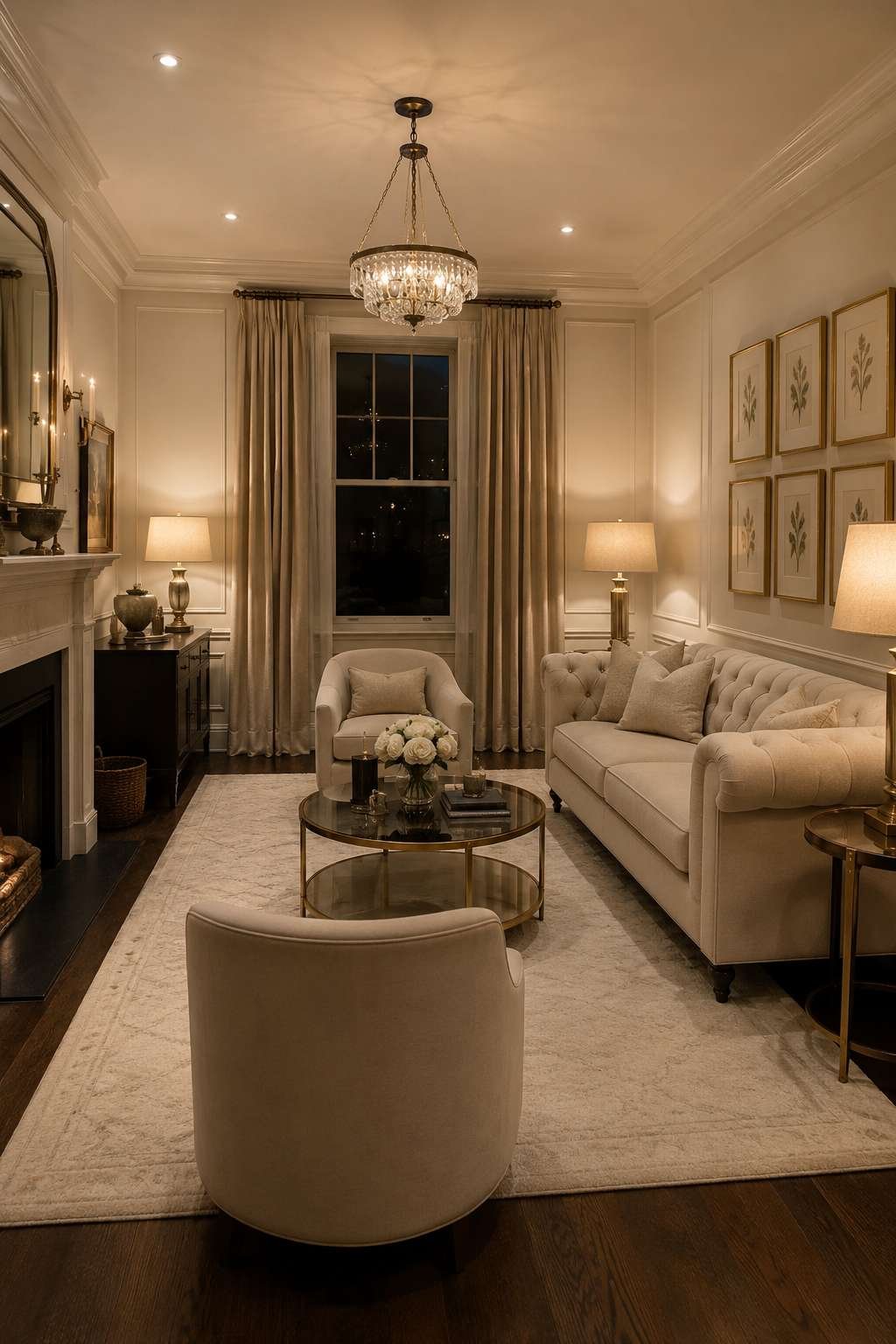
Warm incandescent table lamps creating an intimate evening ambiance are the perfect lighting solution for a room of this curated, domestic refinement — their warm glow is flattering to velvet, botanical prints, and brass alike, creating the kind of intimate, amber-lit atmosphere that makes a living room feel genuinely private and personal. This is a cream living room conceived as a gallery of refined taste — every element curated, every material considered, every surface chosen with deliberate aesthetic intention.
Key Design Tips:
- Create a gallery wall above a Chesterfield sofa using a consistent theme — botanical, architectural, or topographical prints in matching cream mats and thin brass frames create a cohesive, curated display
- Choose cream velvet for Chesterfield sofas — the fabric’s directional pile creates beautiful light and shadow variation across the deep tufting, making the upholstery itself a decorative surface
- Select circular coffee tables in rooms with multiple rectangular furniture pieces to introduce organic form variation and prevent visual rigidity
- Use warm incandescent or LED-filament table lamps as the primary light source in curated cream living rooms — their warm glow is more intimate and flattering than overhead lighting
- Maintain consistent framing and matting throughout a gallery wall — the discipline of identical frames and mats is what transforms a collection of pictures into a curated display
17. Industrial Scale, Cream Warmth: Loft Living with Plaster Pendants
The high-ceiling loft cream living room presents a unique design challenge: how to introduce warmth and human scale into a space defined by raw industrial materials and dramatic vertical proportions. The answer begins with oversized cream linen drapes extending from ceiling to floor — by running the curtains from the maximum ceiling height to the floor, the room’s extraordinary vertical dimension is celebrated rather than obscured, while the cream linen introduces a softness and warmth that is the tonal and material opposite of the concrete floor and exposed structural elements beneath.
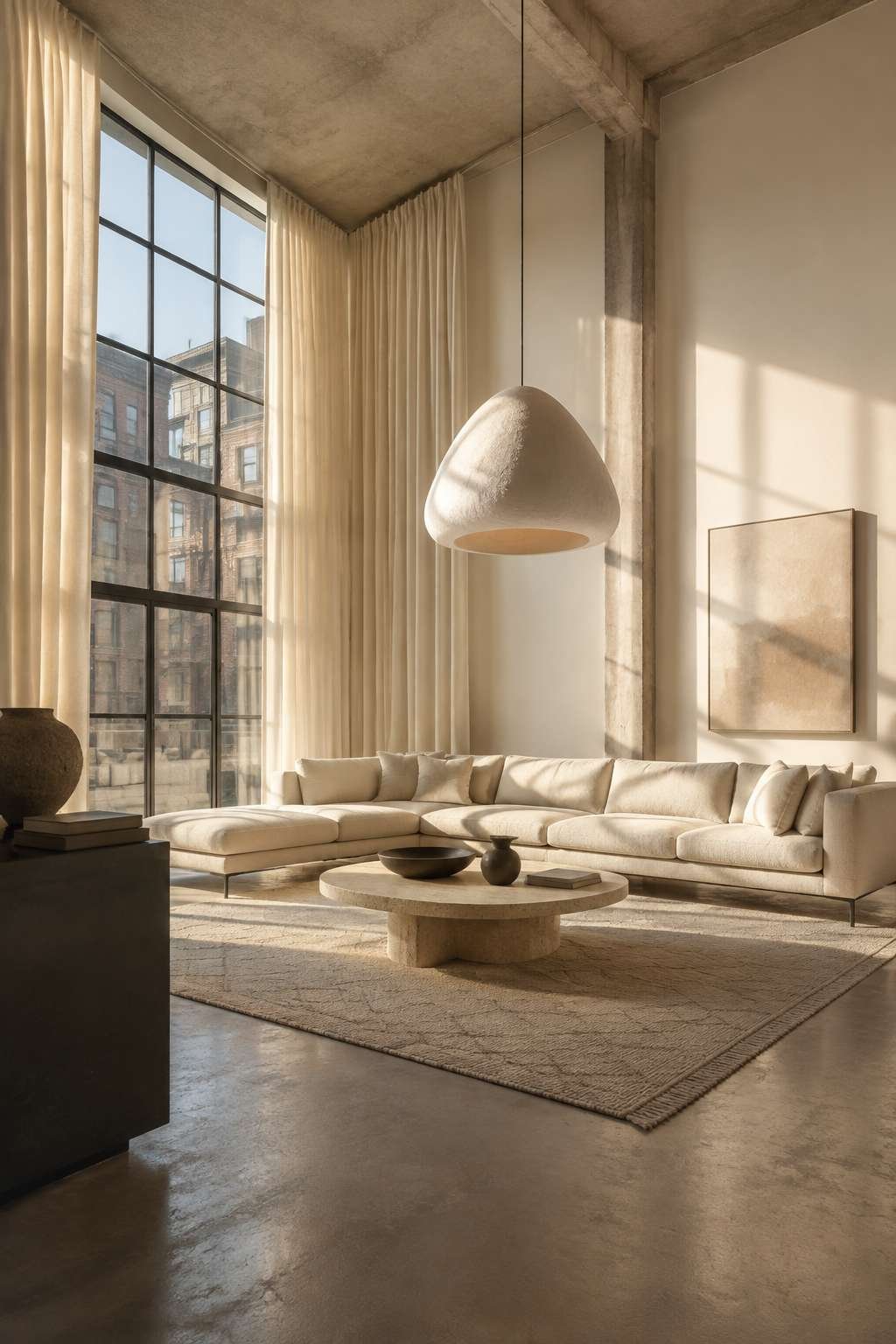
A large L-shaped cream tweed sofa is appropriately scaled for the loft’s generous footprint — a smaller sofa would be lost in the space, while the L-shaped configuration defines and domesticates a zone within the larger industrial floor plate. Tweed is an inspired fabric choice for a loft setting — its woven surface and slightly rough texture have an affinity with industrial materials like concrete and steel, while its cream coloration brings the warmth and refinement that the raw industrial shell cannot provide on its own.
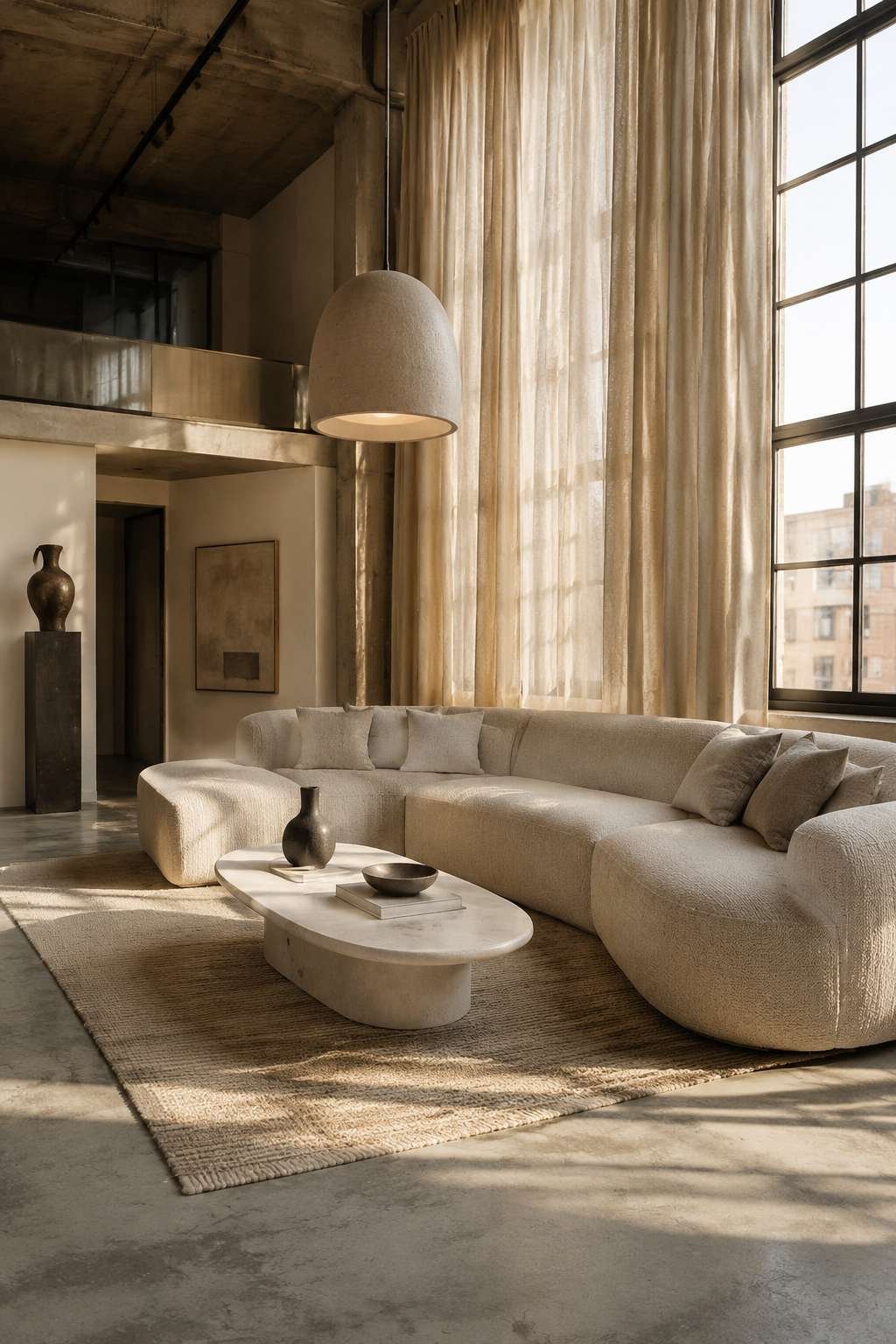
A statement cream plaster pendant light is one of the most effective design tools for addressing the loft’s dramatic ceiling height — by hanging a large pendant low above the coffee table, the designer effectively creates a visual ceiling within the volume of the loft, establishing a human-scale zone of warmth and intimacy beneath the industrial expanse above. Cream plaster as a pendant material is particularly effective because its matte, organic finish absorbs light rather than reflecting it, creating a warm, diffused glow rather than a harsh, directional beam.
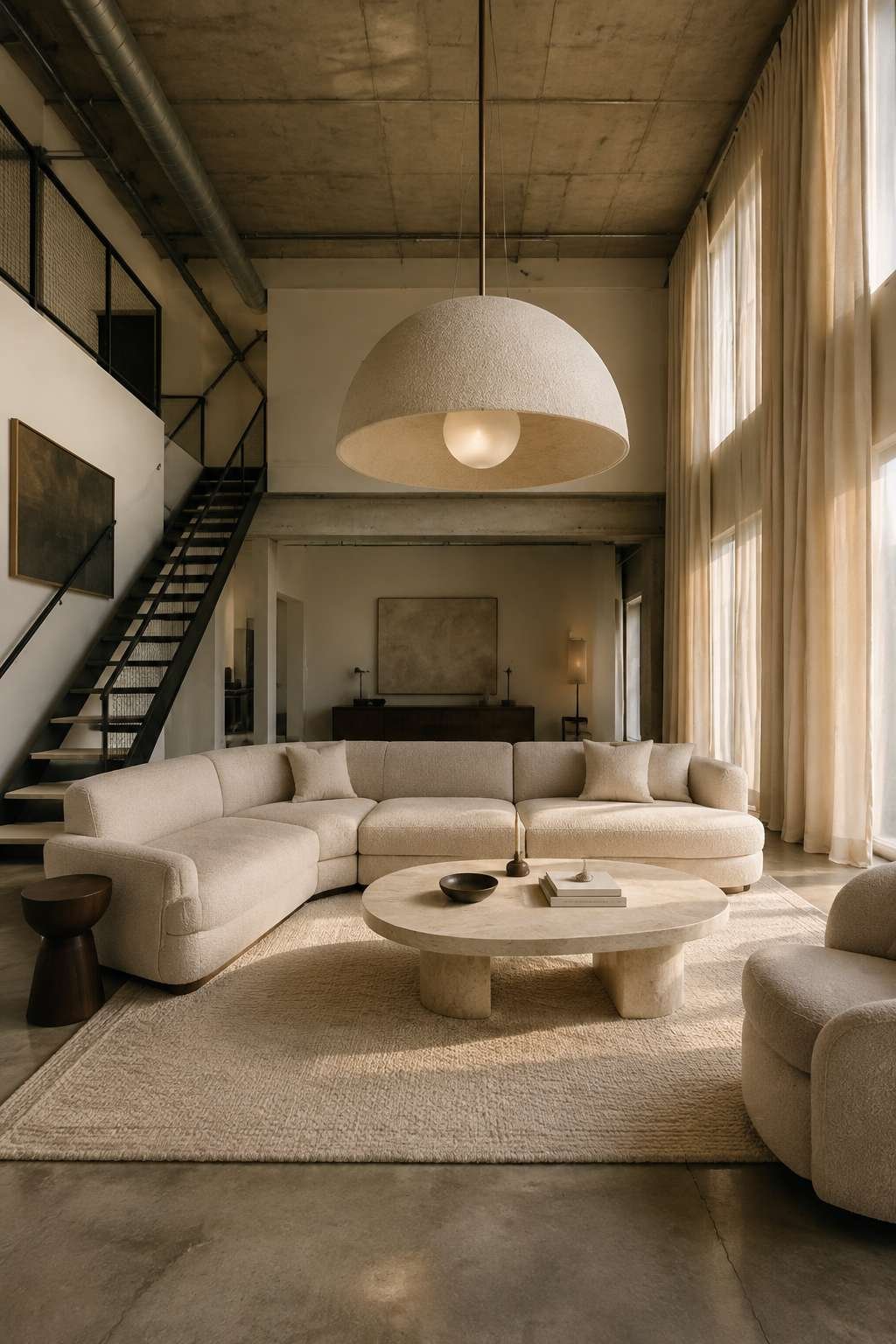
The concrete floor is the industrial loft’s most challenging element from a cream perspective — its grey, cool, reflective surface sits at the opposite end of the warmth spectrum from cream linen and tweed. The solution is not to disguise it but to contrast with it deliberately, allowing the warmth of cream textiles and plaster to appear even more inviting against the industrial honesty of the concrete beneath. This is cream used not as camouflage but as counterpoint — and the contrast is one of the most compelling design tensions in the collection.
Key Design Tips:
- In loft and high-ceiling spaces, hang drapes from the maximum ceiling height to celebrate vertical scale while introducing the softness and warmth that industrial volumes require
- Choose large-scale furniture appropriately proportioned for high-ceiling spaces — a standard sofa will look lost in a loft; an L-shaped or oversized sectional is the correct response
- Install a statement pendant light hung low above the coffee table in loft spaces to create a human-scale zone of warmth and intimacy beneath the industrial volume above
- Use cream textiles and plaster finishes in industrial spaces as deliberate warm counterpoints to concrete, steel, and glass — the contrast between industrial and cream materials is more visually compelling than attempting to warm the industrial elements themselves
- Select tweed, canvas, or heavy linen upholstery for loft sofas — fabrics with visible texture and structural weight have an appropriate affinity with industrial material contexts
18. Organic Living: Natural Textures and Botanical Authenticity
The nature-inspired cream living room is built on the conviction that the most beautiful interior is one that brings the outside in — that honors the textures, colors, and organic qualities of the natural world rather than replacing them with manufactured alternatives. A sisal rug beneath a cream slipcovered sofa with casually arranged linen cushions establishes the room’s material philosophy immediately: every surface is natural, every fiber is plant-derived, every texture is the result of organic processes rather than industrial manufacturing.
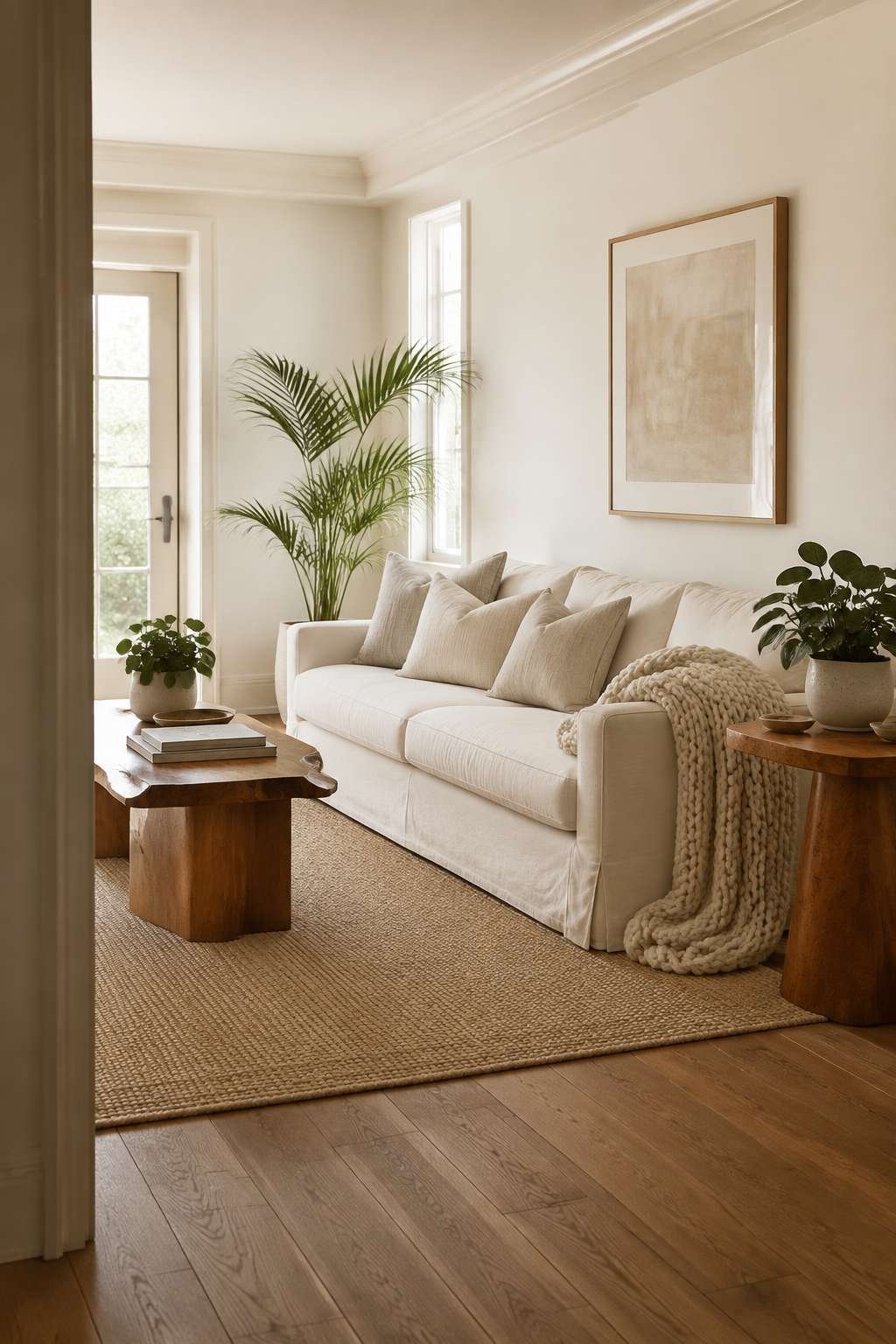
The slipcovered sofa is a design choice with both aesthetic and practical dimensions — aesthetically, the slightly rumpled, relaxed quality of a well-made slipcover communicates an ease and informality that is entirely in keeping with the nature-inspired theme; practically, slipcovers can be removed and washed, making them ideal for rooms that integrate plant life and natural materials. Casually arranged linen cushions in ivory and cream complete the sofa’s relaxed arrangement — the word “casually” is important here, indicating a deliberate choice to allow softness and imperfection rather than achieving a rigid, styled appearance.
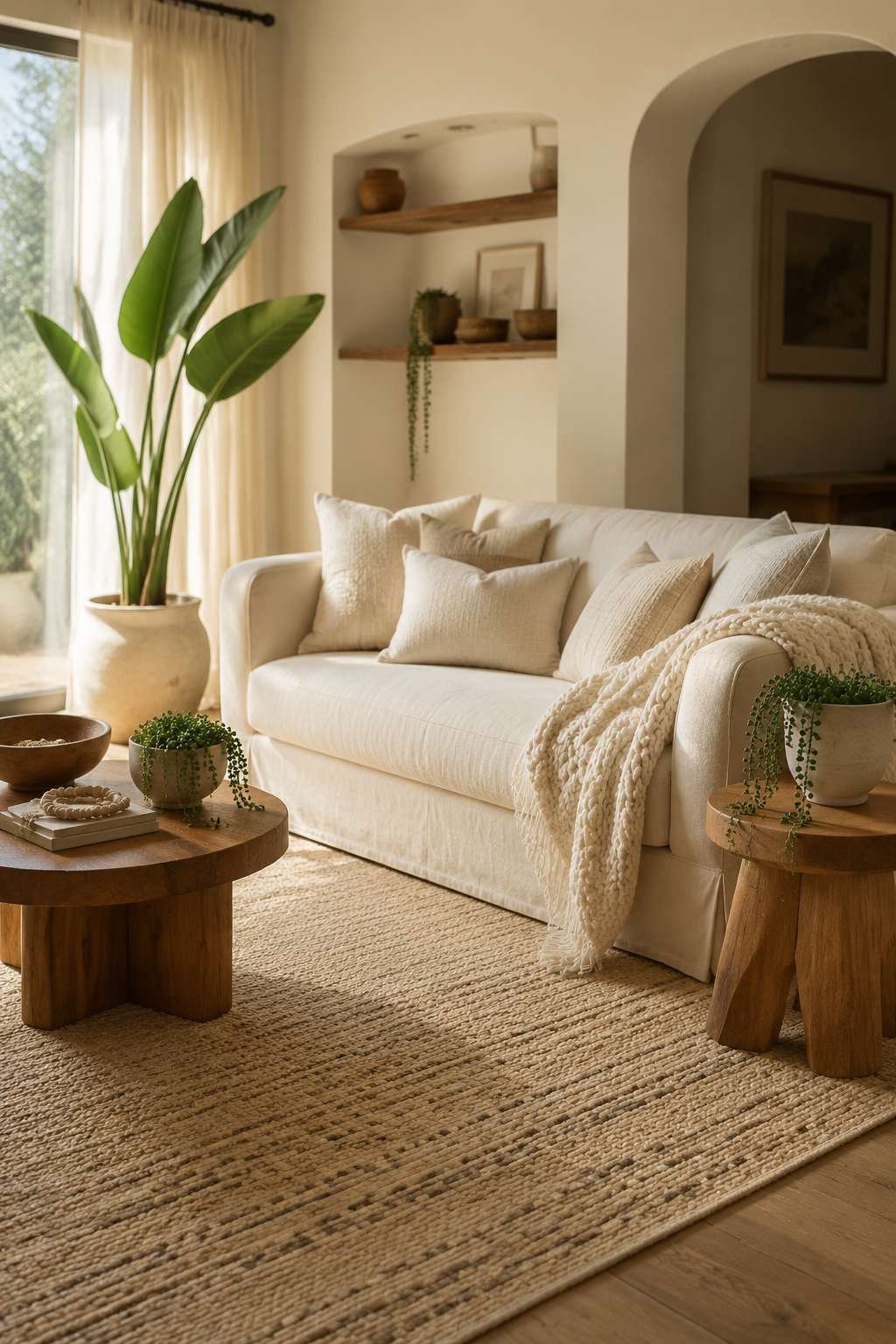
Wooden side tables with organic edges — live-edge pieces that preserve the natural contour of the original timber — are the nature room’s essential furniture element, introducing the most direct possible reference to the tree from which they were made. Positioned beside potted fiddle-leaf fig plants in cream ceramic pots, the live-edge tables create a composition that bridges the interior and the natural world in the most literal way possible. The fiddle-leaf fig is an inspired plant choice — its large, architectural leaves introduce a strong botanical form that complements rather than competes with the cream upholstery and organic side tables.
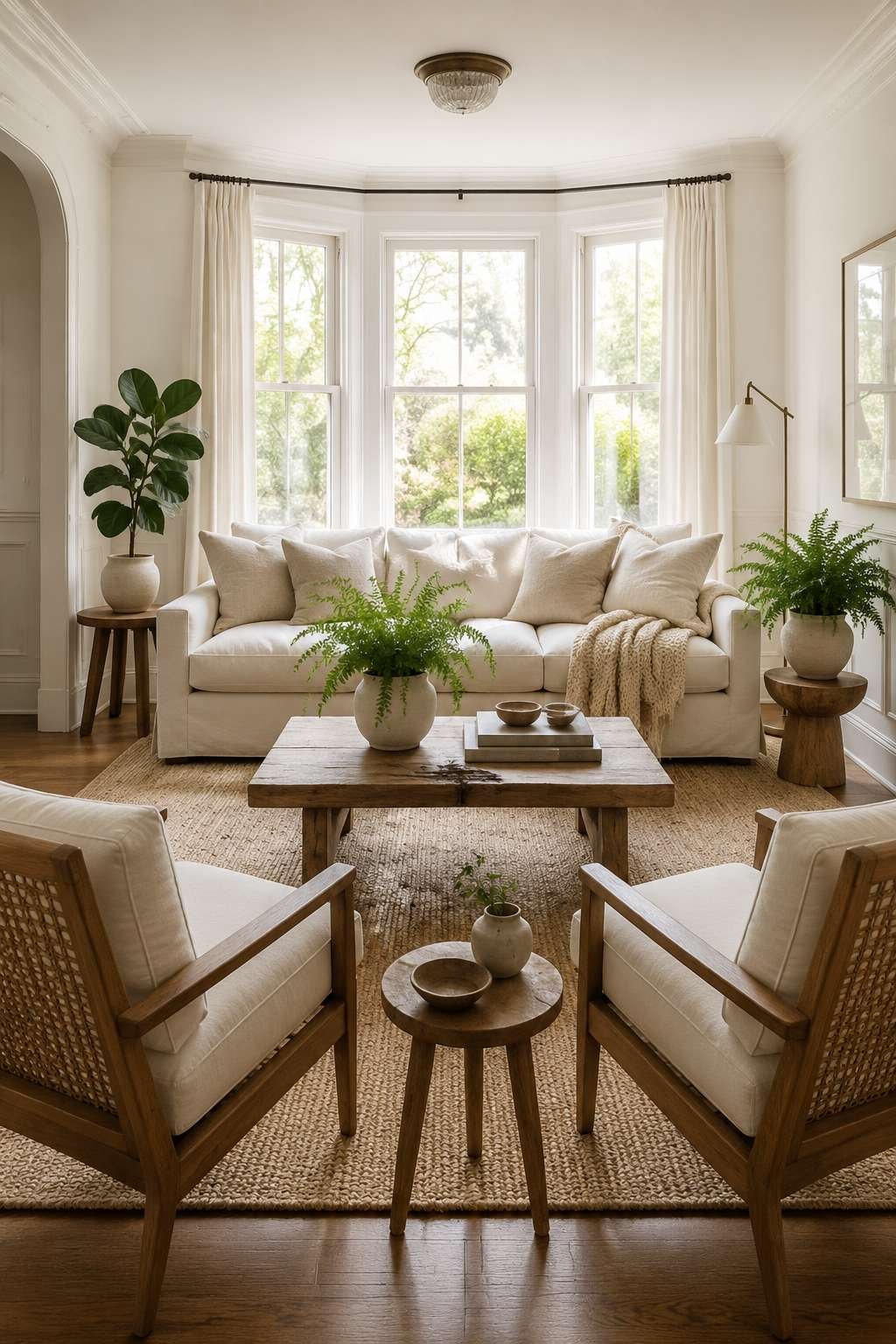
Soft morning window light is the ideal illumination for this nature-inspired interior — its cool clarity and gentle quality reveal the true colors and textures of sisal, linen, live-edge wood, and ceramic without the distorting warmth of afternoon sun or artificial light. The result is a room that feels genuinely alive — a living space in the most literal sense, animated by plant life, natural fiber, and organic material.
Key Design Tips:
- Choose sisal, jute, or seagrass area rugs in nature-inspired cream rooms — their natural golden-cream fiber integrates beautifully with cream upholstery while their organic texture connects the interior to the natural world
- Select live-edge or organically shaped wooden side tables to introduce the most direct possible reference to natural timber in a cream interior
- Use slipcovers on sofas in nature-inspired rooms — their relaxed, slightly imperfect quality communicates ease and informality while their removability makes them practical in rooms with plant life and natural materials
- Incorporate large architectural plants such as fiddle-leaf figs, olive trees, or rubber plants in cream ceramic pots — their strong botanical forms provide visual interest and organic life without requiring additional decorative elements
- Allow soft morning light to illuminate nature-inspired cream rooms — its cool clarity is the most honest and flattering illumination for natural material interiors
19. Romantic Nostalgia: Camelback Sofas and Candlelit Ambiance
The romantic cream living room is a celebration of a particular kind of beauty — one that is unafraid of sentiment, that values atmosphere above efficiency, and that understands that a room can be genuinely moving as well as merely functional. A cream upholstered camelback sofa draped with a delicate Belgian linen throw is the romantic interior’s essential furniture piece — the camelback silhouette, with its characteristic undulating back rail, is one of the most graceful in the entire history of furniture design, and its presence immediately signals that this is a room concerned with beauty as a primary value.
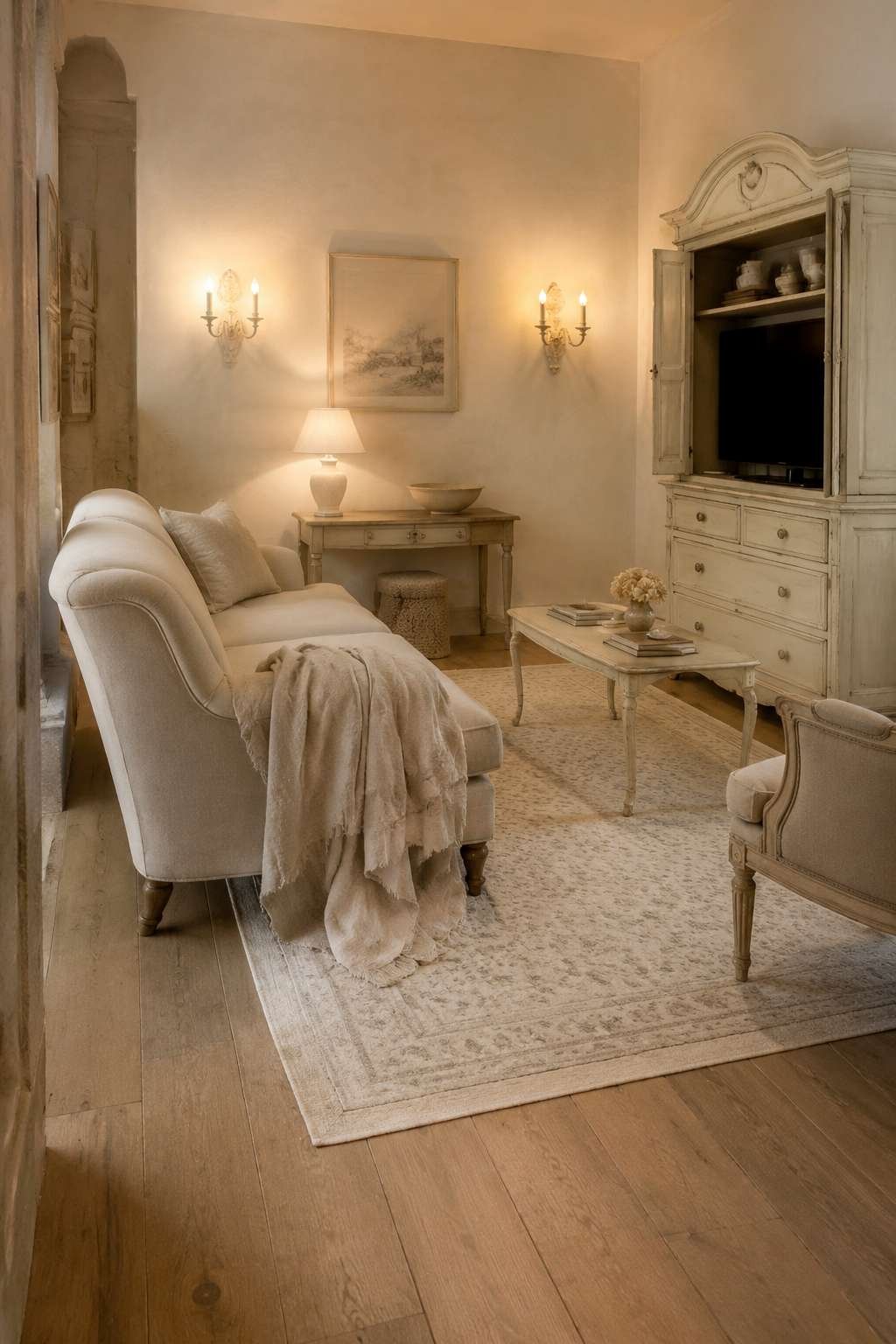
Vintage-inspired cream plaster wall sconces providing warm candlelight-like illumination transform the evening quality of this interior completely — their warm, amber glow casts soft shadows across textured surfaces and draped fabrics, creating an atmosphere of intimate warmth that no overhead lighting can achieve. The sconces’ plaster finish connects them materially to the walls they are mounted on, making them appear to be part of the architecture rather than additions to it. Their candlelight quality is not merely aesthetic but emotional — candlelight has been associated with intimacy, romance, and domestic warmth for thousands of years.
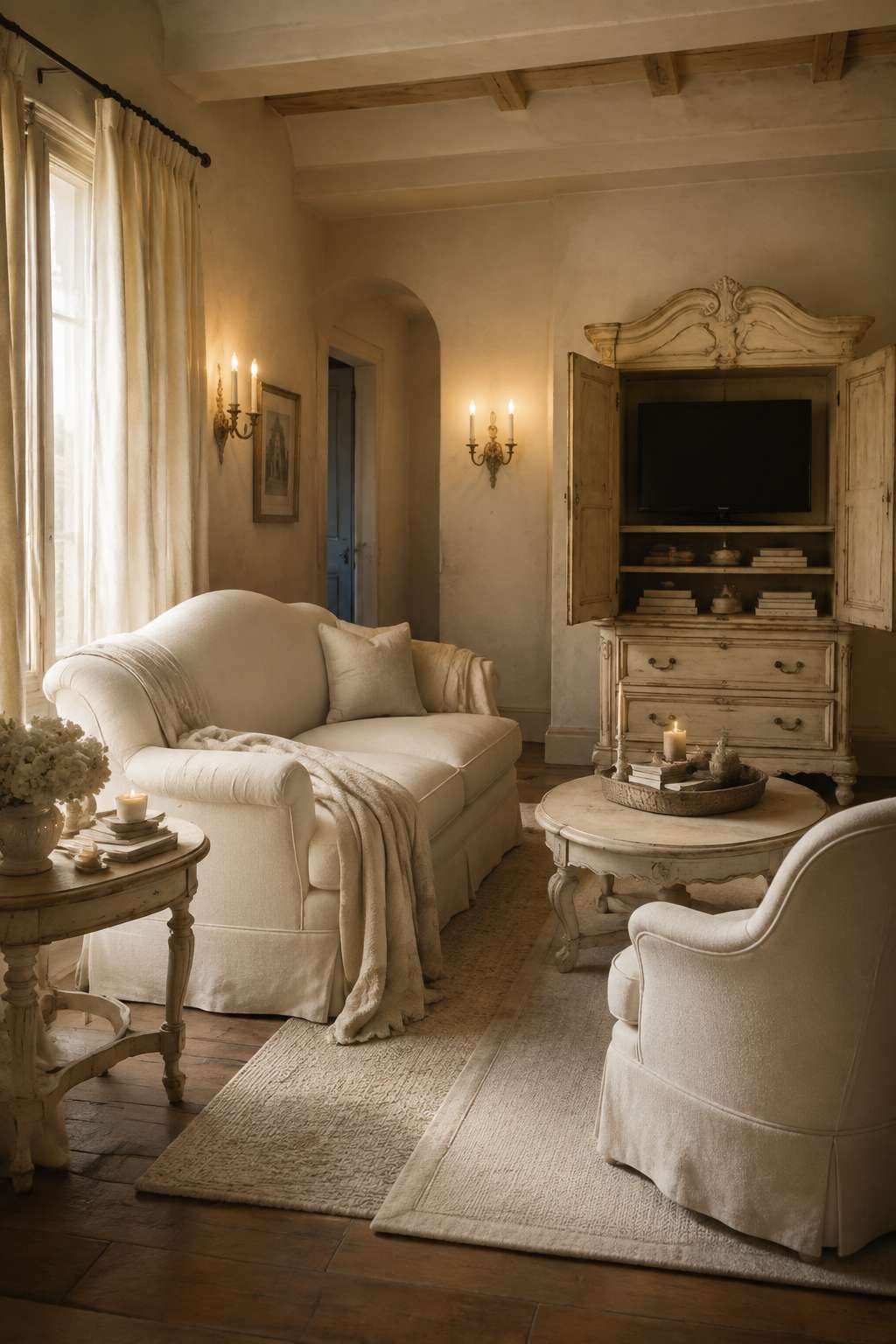
A distressed cream-painted armoire serving as a media cabinet demonstrates one of the romantic interior’s core design strategies: finding beautiful old pieces and repurposing them within the contemporary home. An armoire’s generous proportions and decorative architectural details — carved moldings, brass hardware, shaped panels — bring a history and material richness to the room that no contemporary media cabinet can provide. The cream paint treatment integrates it within the palette while preserving its period character.
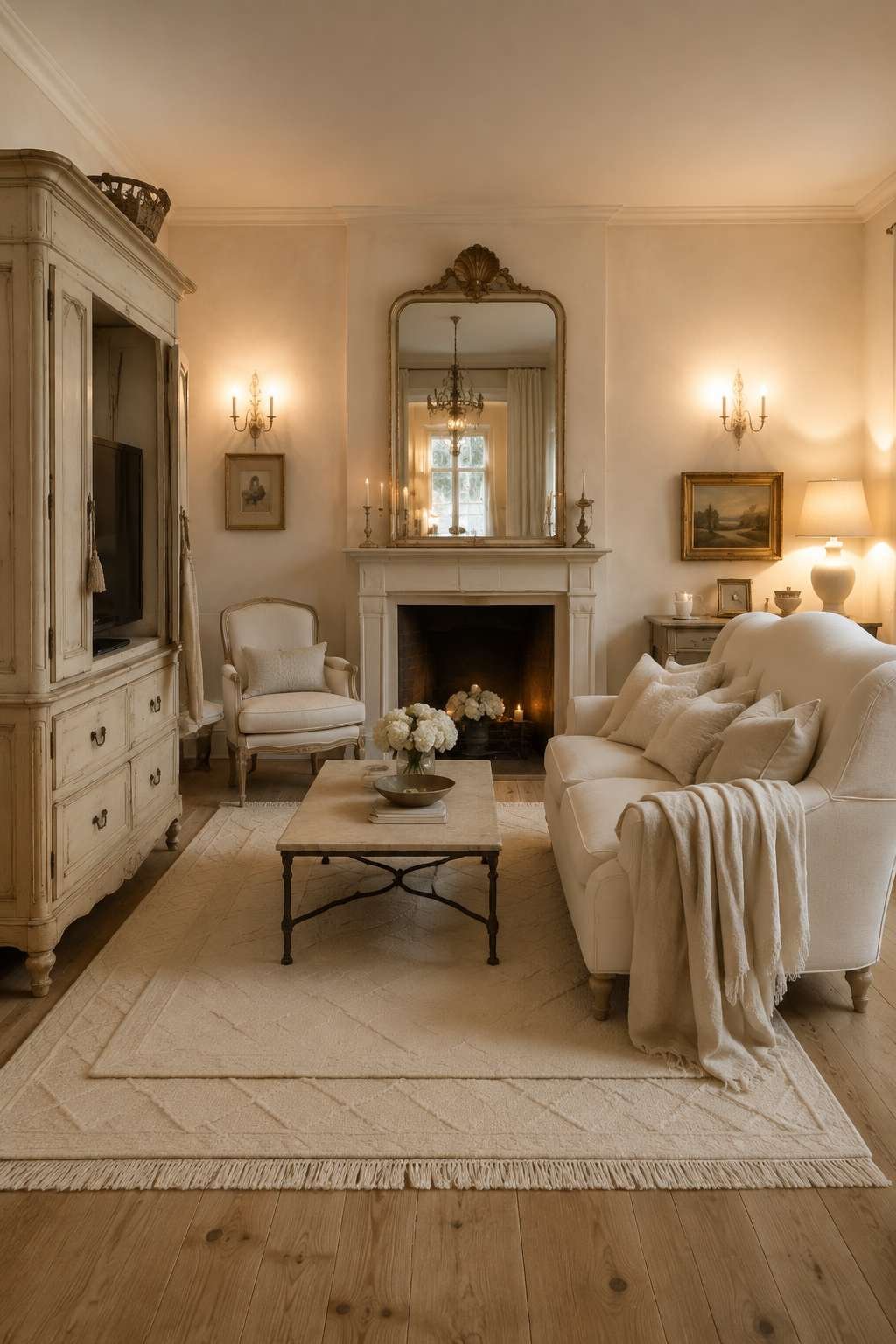
Layered ivory and off-white area rugs add dimensional softness underfoot that amplifies the room’s sense of warmth and enclosure — in a romantic interior, the floor should feel as luxurious and enveloping as every other surface. The tonal complexity within the cream scheme — the slight variation between the camelback sofa’s cream upholstery, the Belgian linen throw, the distressed armoire, and the layered rugs — is itself a form of beauty, revealing itself slowly in different lighting conditions throughout the day.
Key Design Tips:
- Choose a camelback or other classically shaped sofa silhouette in cream upholstery for romantic living rooms — the graceful, curved back rail is one of furniture design’s most enduring and beautiful forms
- Install cream plaster wall sconces as the primary evening light source in romantic interiors — their warm, directional glow creates the intimate, candlelit atmosphere that ceiling fixtures cannot achieve
- Repurpose antique or vintage armoires and cabinets as media storage in romantic cream rooms — their decorative architectural details and material history add genuine beauty that contemporary alternatives cannot match
- Layer area rugs of slightly different cream and ivory tones for dimensional softness and tonal complexity underfoot — the slight variation between tones is a design asset rather than an inconsistency
- Embrace tonal complexity within the cream palette — allowing upholstery, textiles, paint, and wood finishes to vary slightly within the cream-to-ivory spectrum creates a room of genuine visual richness
20. Coastal Breeze: Whitewashed Oak and Nautical Accents
The cream coastal living room takes the palette in its most relaxed and sunlit direction — a space where cream and white meet the brightness of ocean-reflected daylight and the organic textures of natural coastal materials. Whitewashed oak floors are the room’s defining surface — the whitewashing process lightens the natural oak grain while preserving its texture, creating a floor surface that feels simultaneously beachside and refined, casual and considered. Against cream walls and upholstery, whitewashed oak floors create a seamless transition between floor and wall that makes the room feel larger and more open.
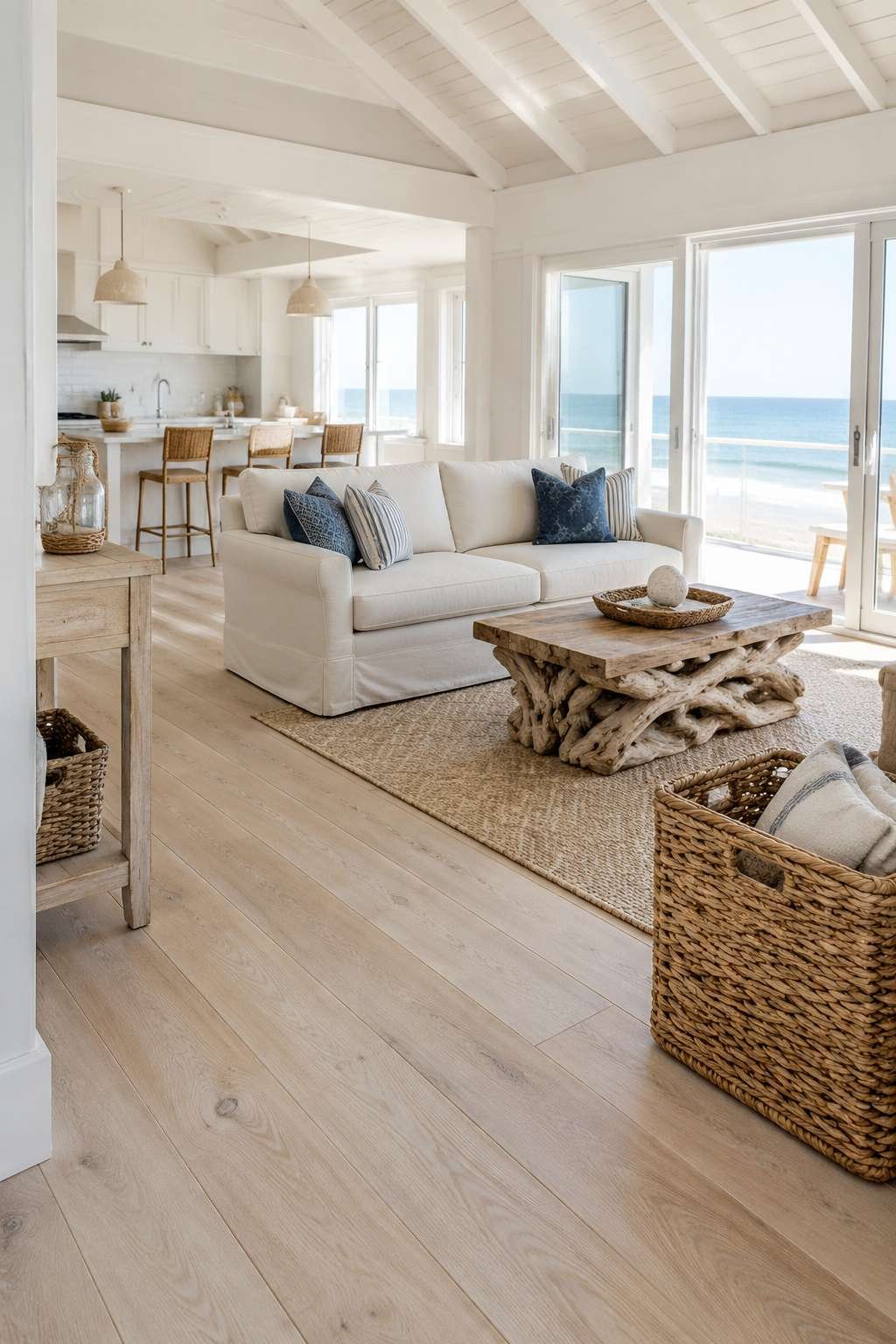
A cream slipcovered sofa with nautical navy accent cushions introduces the coastal concept’s only significant color note — navy is the most restrained and elegant accent color for a cream coastal interior, its deep blue providing a sense of depth and visual weight that anchors the otherwise very light palette. The slipcover is again the appropriate upholstery format for a coastal space — its relaxed, informal quality is in keeping with the barefoot, holiday atmosphere that coastal interiors aspire to create.
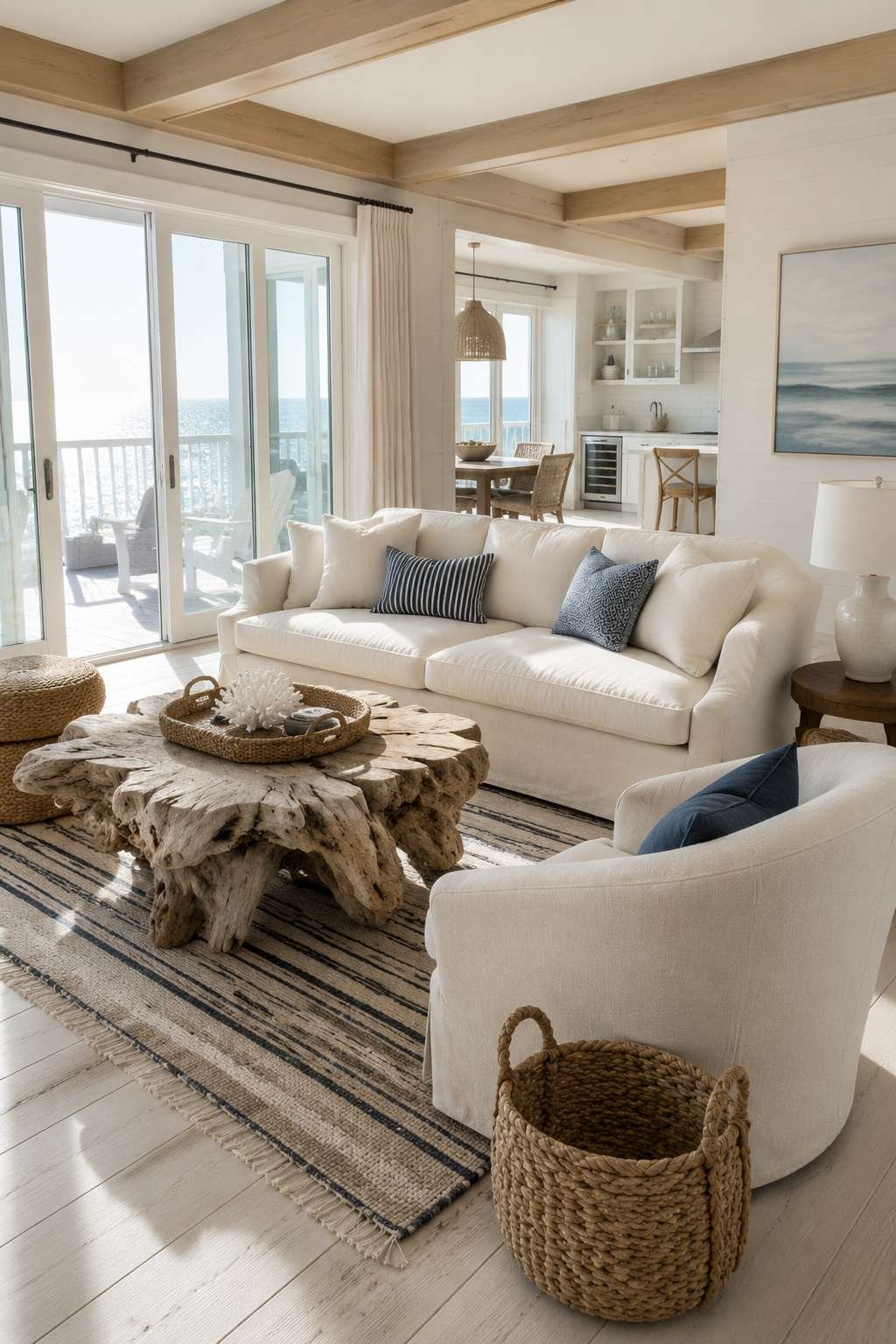
Woven sea grass storage baskets are both practical and beautiful in a coastal cream interior — their natural golden-cream fiber integrates with the palette while their organic weave texture connects the interior to the seaside landscape outside. Baskets at floor level also help to define the seating zone and ground the arrangement, providing a visual base that prevents the very light palette from feeling unanchored. A driftwood coffee table is the coastal interior’s most authentic material statement — genuinely sea-worn driftwood has a color and texture that is uniquely beautiful, its bleached, smooth surface the product of years of salt and wave action.
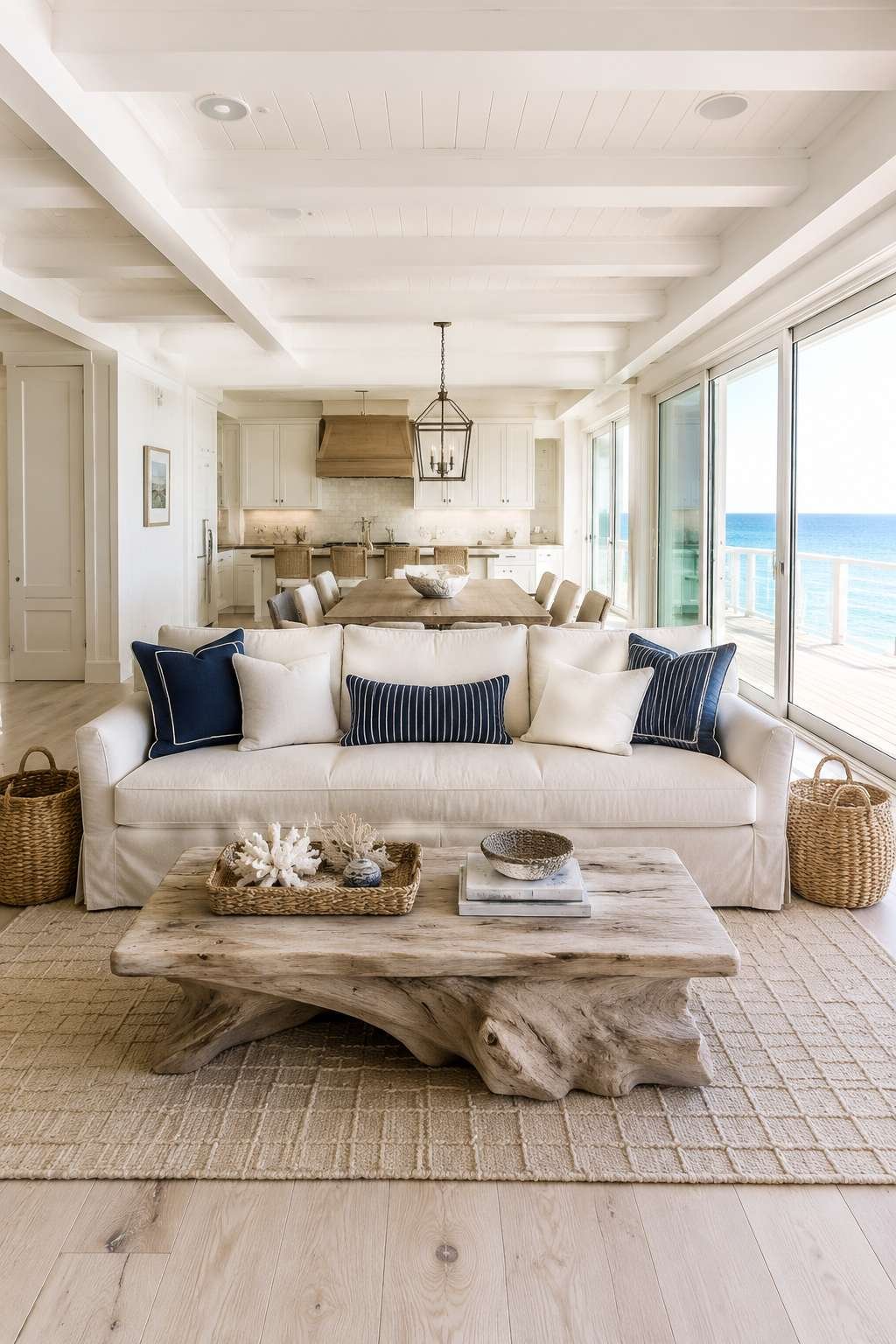
Sliding glass doors flooding the space with bright ocean-reflected daylight transform this cream interior into something truly exceptional — the light that enters from an ocean-facing sliding door is the brightest and most energizing natural light available, and in a cream interior it creates a luminosity that borders on the transcendent. The combination of whitewashed oak, cream slipcover sofa, sea grass baskets, and driftwood coffee table makes this one of the most materially authentic cream living room concepts in the collection.
Key Design Tips:
- Install whitewashed or limewashed oak flooring in coastal cream living rooms — the pale, textured surface bridges interior and exterior, creating a seamless flow between inside space and outdoor landscape
- Use navy or deep teal accent cushions sparingly in cream coastal interiors — one or two deeply colored cushions provide visual weight and coastal authenticity without disrupting the light, airy palette
- Choose woven sea grass or rattan storage at floor level in coastal rooms to ground the arrangement and introduce authentic coastal material texture
- Install sliding or folding glass doors wherever possible in coastal cream rooms — the connection between interior and exterior, and the extraordinary quality of ocean-reflected light, transforms the entire room
- Select genuine driftwood or sea-worn timber for coffee tables and side furniture in coastal interiors — the authentic material has a color and texture that is genuinely irreplaceable
21. The Perfect Vignette: Boucle Armchair and Cream Bookshelf Styling
The cream boucle armchair vignette is the most intimate concept in this collection — a composition focused on a single chair, a single lamp, and a single wall of books, demonstrating that exceptional interior design does not require an entire room but can be achieved in the space of a few square metres. The cream boucle armchair positioned beside a floor-to-ceiling bookshelf painted in matching warm cream creates an immediate sense of enclosure and invitation — it is the physical embodiment of the ideal reading corner, a place that says clearly and warmly: sit here, stay a while.
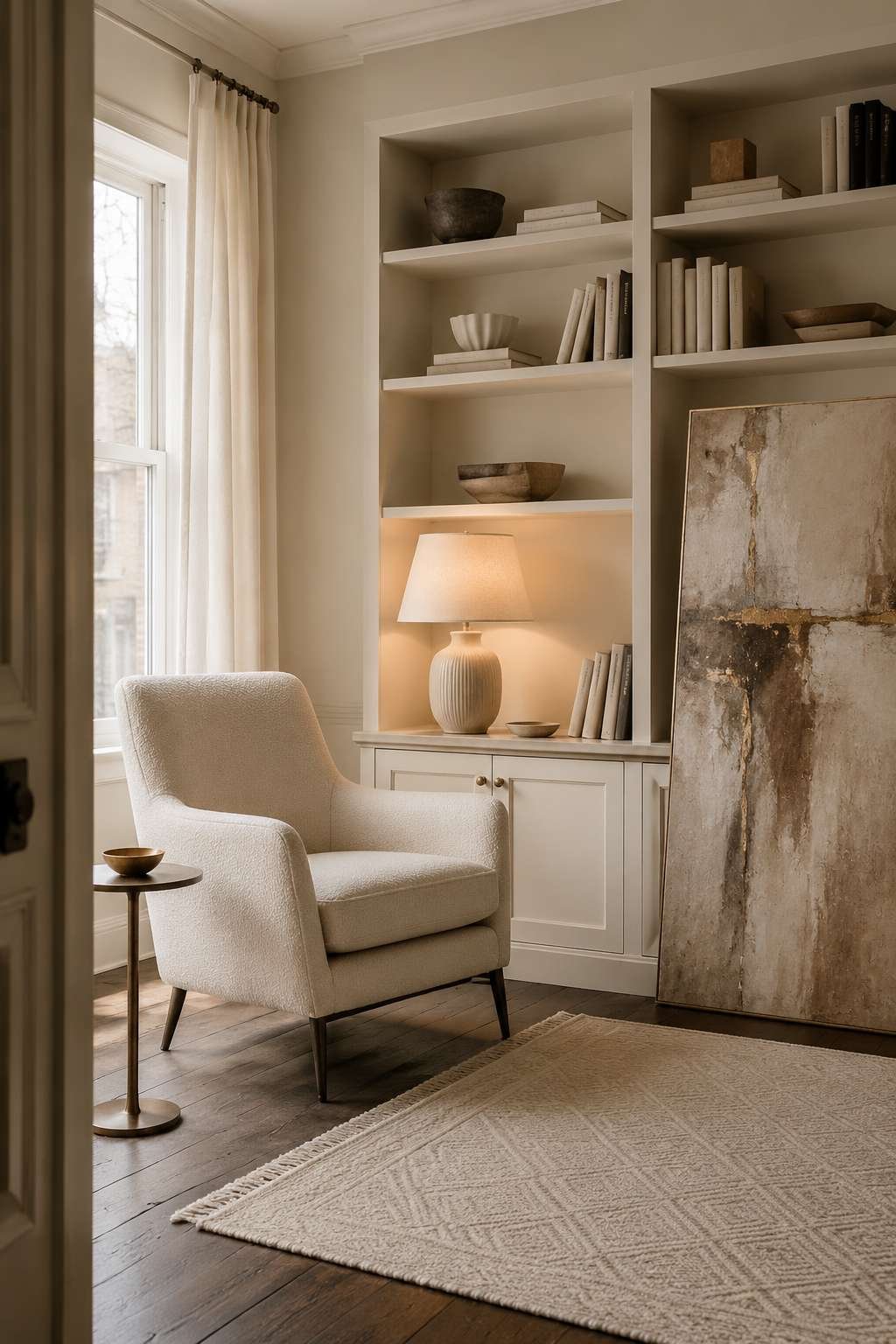
The ceramic table lamp with a cream linen shade is the vignette’s light source and its most intimate design element — positioned on a small side table at the armchair’s elbow, it creates a pool of warm, focused light that defines the reading zone within the larger room. The ceramic base in a warm cream or stone tone connects materially to the bookshelf’s cream paint, while the linen shade diffuses the lamp’s light into a soft, warm glow that flatters the boucle upholstery and illuminates the bookshelf without creating glare.
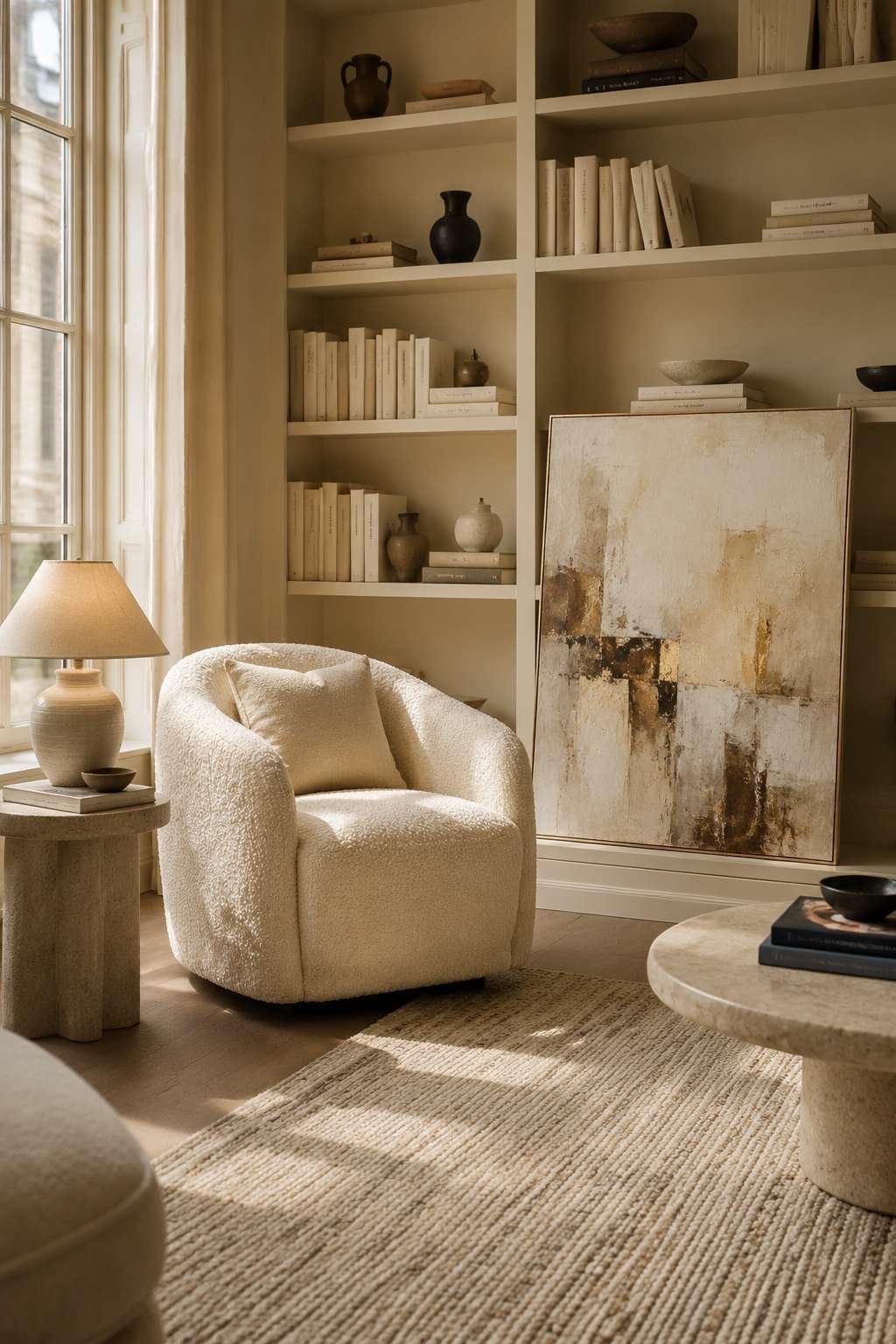
The large abstract canvas in cream, raw umber, and gold leaning casually against the shelving is a styling detail of considerable sophistication — the choice to lean rather than hang the painting communicates an attitude of effortless curation, as though the canvas arrived and found its natural resting place. The raw umber tones in the abstract work introduce the only departure from the cream palette, their earthy warmth grounding the composition and making the cream and gold tones appear even more luminous by contrast.
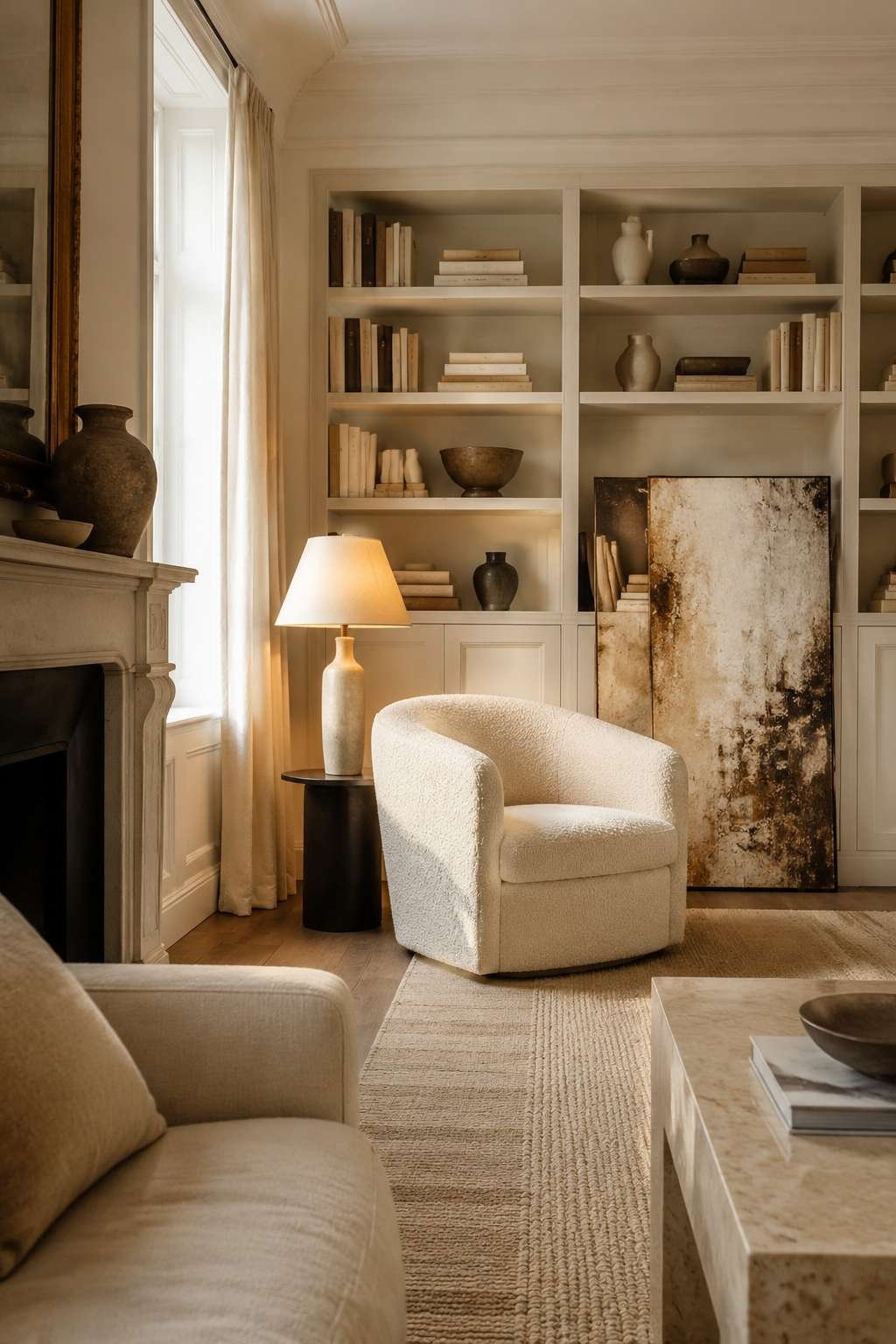
This concept demonstrates a truth that runs through all great interior design: scale is not a prerequisite for quality. A single well-chosen armchair, a thoughtfully painted bookshelf, a ceramic lamp, and a leaning canvas can create a vignette of genuine beauty and emotional resonance. The cream boucle chair in this composition is more than a piece of furniture — it is an invitation to slow down, to read, to be present in a beautiful space.
Key Design Tips:
- Create intimate reading vignettes with a single bouclé or upholstered chair, a floor lamp or table lamp, and a small side table — the concentrated scale of a vignette creates an emotional warmth that larger room arrangements sometimes lack
- Paint floor-to-ceiling bookshelves the same color as the walls — the seamless surface makes the shelving feel architectural rather than furniture, and makes the room feel larger and more considered
- Style bookshelves with books arranged by color or tone rather than alphabetically — a cream-to-neutral book arrangement integrates the shelving into the room’s palette rather than introducing visual noise
- Use ceramic lamps with linen shades in cream reading corners — the combination of matte ceramic and diffuse linen light is the warmest and most flattering reading illumination available
- Lean large artworks against bookshelves or walls rather than hanging them for a curated, effortlessly styled appearance — the casual placement communicates confidence and artistic authenticity
Conclusion: Your Cream Living Room Awaits
The twenty-one cream living room ideas explored in this article share a single foundational conviction: that cream is not a neutral choice but an active one, capable of creating interiors of extraordinary beauty, warmth, and emotional resonance across every conceivable design style and lifestyle context. From the raw industrial loft to the intimate cottage, from the family farmhouse to the luxury penthouse, cream adapts and rewards — absorbing the character of the materials, textures, and light around it while maintaining its essential quality of warmth and calm.
The most important lesson across all twenty-one concepts is the power of layered texture within a tonal palette. Cream living rooms succeed not because they are monochromatic but because they are rich — rich in material variation, in surface complexity, in the play of natural and artificial light across linen, velvet, plaster, wool, oak, travertine, and rattan. A cream room with a single texture is flat and uninspiring; a cream room with five or six different surface qualities is endlessly interesting, revealing new details as light changes throughout the day.
Begin with the concept that resonates most deeply with your own aesthetic sensibility and lifestyle needs, then commit to it with the same confidence and material generosity that distinguishes the best interior design. Whether you are drawn to the serene minimalism of Japandi, the curated refinement of the gallery wall Chesterfield, or the texturally abundant warmth of the modern farmhouse, the cream palette will reward your commitment with a living room of lasting beauty — a space that feels genuinely, personally, and beautifully yours.
