


Few colors in the interior design spectrum carry the same weight of sophistication, warmth, and dramatic allure as burgundy. This deep, wine-inspired hue sits at the intersection of passionate red and refined purple, creating a tone that feels simultaneously bold and grounded. Whether you are drawn to classic traditional aesthetics, sleek modern minimalism, or free-spirited bohemian arrangements, burgundy has an extraordinary ability to anchor a living room with character and depth. The resurgence of rich, jewel-toned interiors in contemporary design has placed burgundy firmly at the forefront of living room color conversations, and for very good reason.
Thoughtful interior design goes far beyond selecting a sofa or painting a wall. It is about curating an experience — a space that reflects your personality, supports your lifestyle, and invites those who enter to feel something meaningful. Burgundy living rooms achieve this with remarkable ease, offering a canvas that pairs beautifully with metals like brass and gold, natural materials like walnut and jute, and complementary tones ranging from blush pink to deep charcoal. The versatility of this color makes it accessible to apartments, townhouses, family homes, and loft spaces alike.
This article explores 21 distinct burgundy living room ideas, each representing a unique design philosophy and aesthetic vision. From maximalist grandeur to Scandinavian simplicity, from festive holiday warmth to industrial edge, every concept presented here offers actionable inspiration and professional design insight. Whether you are planning a complete room overhaul or simply seeking a few transformative touches, these ideas will guide you toward a living space that is as beautiful as it is livable.
1. The Velvet Focal Point: Burgundy Sofa with Gold and Ivory Accents
At the heart of this design lies a deep wine-red velvet sofa that commands attention the moment you enter the room. Velvet has long been associated with luxury and refinement, and in this rich burgundy tone , it becomes the undisputed focal point of the entire living space. The sofa’s plush surface catches light beautifully, shifting subtly between deep crimson and warm mahogany depending on the angle of illumination. Against warm walnut hardwood floors , the arrangement feels grounded and anchored, while a cream wool area rug introduces softness underfoot and visually separates the seating zone from the surrounding floor space. Our warm living room ideas has more inspiration along these same lines.

The gold and ivory throw pillows scattered across the sofa perform an essential design function — they bridge the richness of the burgundy upholstery with the lighter tones present elsewhere in the room. Ivory softens the overall palette and prevents the deep color from feeling overwhelming, while gold introduces a note of glamour that elevates the composition without tipping into excess. This careful balance of bold and neutral is a hallmark of professional interior design, ensuring the room feels curated rather than chaotic.

Lighting plays a transformative role in this setting. Brass floor lamps positioned at strategic points throughout the room cast a warm golden glow that enhances the richness of the velvet upholstery and deepens the tones of the walnut flooring. The layered approach to ambient lighting means the space transitions seamlessly from bright daytime functionality to an intimate evening atmosphere. The soft diffused quality of the light also highlights rich fabric textures and creates natural shadow play across the surface of the sofa, adding visual dimensionality to the entire room.

This design rewards attention to detail. The interplay between the deep burgundy, the warmth of brass, and the softness of cream and ivory creates a tonal harmony that feels both timeless and deeply personal. It is a room that whispers luxury without shouting it — a space where quality materials and thoughtful placement do all the talking.
Key Design Tips:
- Invest in high-quality velvet upholstery as the centerpiece and keep surrounding furniture more restrained to let it breathe
- Use brass or gold metallic accents in lamps, picture frames, and decorative objects to complement burgundy without clashing
- Layer a cream or ivory wool rug beneath the seating arrangement to ground the space and add textural contrast
- Opt for warm-toned bulbs in floor lamps to enhance the richness of burgundy fabric rather than washing it out
- Balance bold upholstery with neutral throw pillows in ivory and soft gold to prevent the palette from feeling heavy
2. The Dramatic Accent Wall: Deep Merlot Paint and Marble Fireplace
There is a particular kind of drama that only a deep merlot-toned matte accent wall can deliver. In this design concept, a single boldly painted wall becomes the defining architectural statement of the entire room, creating an immediate sense of depth and sophistication. The matte finish is a deliberate and important choice — it absorbs light rather than reflecting it, giving the wall a velvety, almost tactile quality that draws the eye without creating glare. Against this dramatic backdrop, a sleek marble fireplace surround in ivory white emerges like a sculptural feature, its cool veined surface providing a striking counterpoint to the warm, enveloping wall color.

The neutral linen sectional in warm taupe is a masterstroke of tonal balancing. By choosing an upholstery color that sits comfortably in the warm neutral spectrum, this design allows the accent wall to remain the star of the show while still providing a generous and inviting seating arrangement. The taupe linen fabric introduces a natural, organic texture that softens the formal quality of the marble and painted wall, making the overall room feel approachable and comfortable rather than intimidatingly grand.

Accessories on the fireplace mantel tell a story of collected refinement. Antique brass candleholders and a gilded mirror bring warm metallic tones into eye level, catching and reflecting the room’s ambient light in ways that enliven the entire composition. The mirror also serves a practical design function — it bounces light across the room, counteracting any heaviness that a dark accent wall might otherwise introduce. The reflective quality of the gilded frame against the matte merlot wall creates a beautiful tension between surface finishes.

Professional interior photographers know that the real magic of a dramatic accent wall lies in the interplay between deep background color and warm metallic accents. The balance of exposure required to capture both the depth of the merlot tone and the brightness of the marble surround is considerable, which speaks to just how much visual complexity this design packs into a single wall arrangement. In person, this dynamic quality makes the room feel endlessly interesting — a space that rewards lingering and looking closely.
Key Design Tips:
- Choose a matte finish for dark accent walls to achieve a sophisticated, light-absorbing quality that feels luxurious
- Anchor a dark accent wall with a light-colored fireplace surround or built-in shelving to create visual relief and focal structure
- Pair bold wall color with neutral upholstery in warm taupe or linen to maintain visual balance and comfort
- Use gilded or antique brass mirrors above the fireplace to reflect light and add depth without competing with the wall color
- Keep accessory editing tight on the mantel — three to five well-chosen objects create more impact than a crowded display
3. Traditional Comfort: Burgundy Armchairs, Persian Rug, and Mahogany Bookshelves
This design concept is a love letter to traditional interior design in its most comfortable and livable form. A pair of plush burgundy armchairs flanking a dark walnut coffee table creates an immediately inviting conversational arrangement, the kind of symmetrical placement that feels both formal and deeply welcoming. The Persian-style area rug with deep red and gold motifs beneath the seating arrangement is perhaps the most important single element in the room — it provides pattern, warmth, and historical richness, tying together the various wood tones and upholstery colors into a cohesive narrative.

Built-in mahogany bookshelves lining the walls transform this living room into something approaching a private library. The rich reddish-brown tones of mahogany align beautifully with the deep wine hues of the upholstery, creating a room where every surface contributes to the overall color story. Curated books and decorative objects displayed across the shelves add layers of personal meaning and visual interest, while also introducing varied textures — leather-bound spines, ceramic objects, framed photographs — that prevent the room from feeling monotonous despite its unified palette. Our brown living room decorating ideas has more inspiration along these same lines.

Afternoon sunlight filtering through floor-length ivory linen drapes is the element that lifts this traditional arrangement from heavy to glowing. The sheer quality of linen diffuses direct sunlight into something softer and more golden, casting the room in a warm, amber-tinted light that brings out the depth of the burgundy upholstery and the richness of the wood surfaces. This quality of light is the reason traditional rooms so often feel more beautiful in late afternoon than at any other time — the warm spectrum of setting sun aligns perfectly with the warm tones of the materials.

The overall mood of this space is one of intellectual comfort and considered luxury. It is a room designed for reading, for conversation, for the quiet enjoyment of beautiful things assembled over time. The inviting traditional arrangement speaks to a lifestyle that values depth, permanence, and the pleasure of surrounding oneself with objects of quality and meaning.
Key Design Tips:
- Use a Persian or Oriental area rug with deep red and gold tones to anchor a traditional burgundy seating arrangement cohesively
- Mahogany or dark walnut built-in bookshelves amplify burgundy’s warmth and add architectural permanence to the room
- Choose floor-length linen drapes in ivory or cream to diffuse natural light and keep the room feeling luminous despite dark furnishings
- Symmetrical furniture placement with matching armchairs creates a formal yet welcoming conversational setting
- Curate shelving displays with a mix of books, ceramics, and framed art to add personality without overwhelming the design
4. Modern Minimalism: Burgundy Leather and Charcoal Accents
The marriage of streamlined burgundy leather upholstery with clean-lined charcoal accent chairs represents one of the most compelling contemporary interpretations of this classic color. The sofa’s visible leather grain brings tactile authenticity and a sense of aged refinement to what is otherwise a very current, minimal aesthetic. Leather in deep wine tones carries an inherent masculinity and weight that prevents the room from feeling too sleek or cold — a constant challenge in minimalist design where warmth can easily be sacrificed in the pursuit of clean lines. See our the minimalist living rooms feel warm for more direction in this style.

The low-profile concrete coffee table at the center of the arrangement is a design choice that speaks to a confident, contemporary sensibility. Concrete’s subtle surface variations — its natural pitting, tonal inconsistencies, and matte finish — create a textural conversation with the leather sofa that is endlessly interesting. The material’s industrial quality provides an unexpected but highly effective foil to the luxury associations of deep burgundy, creating a room that feels both refined and grounded in the real world. A geometric wool rug in cream and rust tones beneath the seating zone adds warmth and pattern without disrupting the minimal composition.

Minimalist brass pendant lighting suspended from above completes the material palette with precision. Brass in a modern context — smooth, lacquered, or lightly brushed — has a different quality than antique brass. It reads as contemporary luxury, contributing warmth and refinement without the nostalgic associations of aged metal. The decision to use pendant lighting rather than floor lamps in this setting reinforces the clean, uncluttered quality of the floor plane, allowing the rug and furniture legs to be seen clearly and the room’s proportions to be fully appreciated.

Professional interior photography of this space would rightly focus on material textures — the visible grain of leather upholstery and the subtle concrete surface variations — because these details are what elevate the design from competent to memorable. This is a room built for those who appreciate quality over quantity, where every material has been chosen for both its beauty and its tactile quality.
Key Design Tips:
- Pair burgundy leather upholstery with charcoal or dark grey accent seating for a sophisticated, high-contrast modern palette
- Choose a low-profile concrete or stone coffee table to ground the arrangement with industrial texture while maintaining clean lines
- Use minimalist brass pendant lighting rather than floor lamps to keep floor space visually clear and uncluttered
- Select a geometric area rug in cream and rust to add pattern and warmth while respecting the room’s minimal aesthetic
- Let material quality and texture do the decorative work in minimalist rooms — invest in the best leather and concrete finishes you can afford
5. Small Space Solutions: Burgundy Loveseat in a Compact Apartment
Designing a small apartment living room around a bold color requires confidence, restraint, and a deep understanding of how scale and proportion interact. This concept demonstrates that deep wine-red upholstery can work beautifully in compact spaces when the surrounding palette is carefully managed. A burgundy loveseat and matching armchair provide generous seating without overwhelming the footprint of the room, their rich color becoming more impactful precisely because they are scaled appropriately for the space.
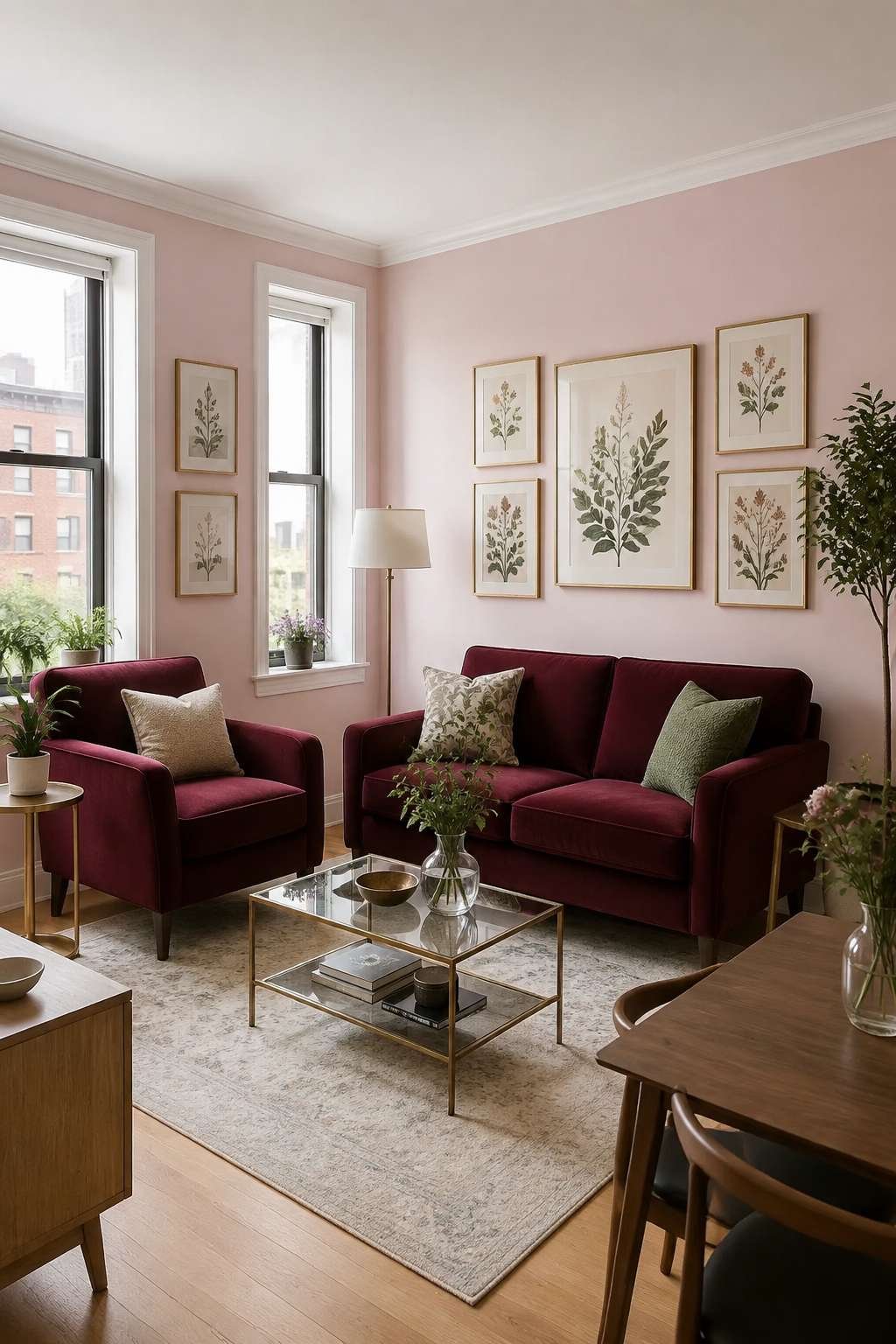
Pale blush walls are the key decision that makes everything else possible here. By choosing a wall color that picks up on the pink undertones of burgundy while remaining soft and light, the design creates a room that feels cohesive and intentional rather than randomly assembled. The light oak flooring reinforces this brightness, its warm blonde tones bouncing natural light around the room and keeping the space feeling open despite the bold upholstery choices. In smaller rooms, the relationship between floor and wall color has an outsized impact on the perception of space.

A gallery wall of botanical prints in brass frames adds personality and vertical interest without encroaching on precious floor space — a brilliant small-space design strategy. The botanical subject matter introduces organic color notes of green and cream that complement the burgundy beautifully, while the brass frames pick up on the warm metallic quality of the loveseat’s sofa legs or any hardware present in the room. The gallery arrangement also draws the eye upward, making the ceiling feel higher and the room more generous.
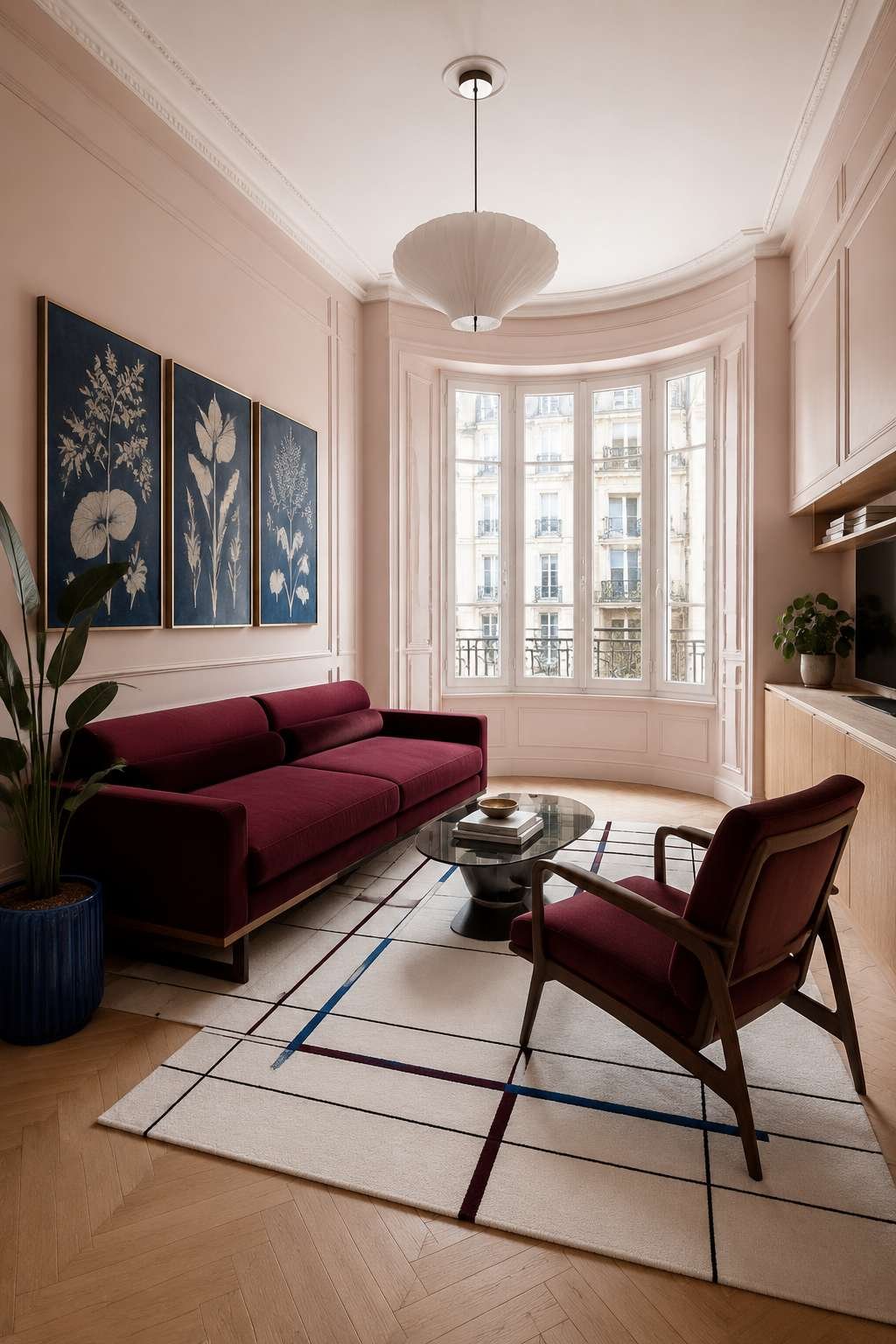
Natural daylight from large windows is leveraged here as a primary design tool rather than an afterthought. The way daylight highlights the rich burgundy upholstery tones at various times of day gives the room a dynamic quality that larger, more permanently furnished spaces sometimes lack. In a compact apartment, this shifting quality of light is one of your greatest design assets.
Key Design Tips:
- Choose pale blush or warm ivory wall colors to complement burgundy upholstery while keeping small spaces feeling open and bright
- Scale furniture thoughtfully — a loveseat and single armchair provide ample seating in compact rooms without overwhelming proportions
- Use gallery walls with brass frames to add personality and visual interest without consuming floor space
- Light oak or blonde wood flooring maximizes light reflection in small rooms and provides warm contrast to deep burgundy
- Position seating near large windows to let natural daylight animate the richness of wine-red upholstery tones throughout the day
6. Eclectic Character: Tufted Chesterfield with Vintage and Contemporary Mix
The tufted burgundy chesterfield sofa is one of furniture history’s most enduring and recognizable forms, and in this eclectic setting it serves as the perfect anchor for a design that deliberately mixes eras and aesthetics. The visible button detail and natural linen texture of the upholstery speak to authenticity and craftsmanship — this is furniture with personality and history, the kind of piece that suggests a room assembled thoughtfully over time rather than purchased as a complete set. The chesterfield’s deep tufting creates a play of light and shadow across its surface that is enormously photogenic and visually satisfying.

Mismatched side tables in dark wood and brushed brass are a deliberate choice that signals design confidence. In a less assured room, mismatched furniture might read as accidental or unfinished. Here, the careful balance of dark wood and brushed metal — materials that share a warm tone even while differing in surface and weight — creates a studied casualness that is entirely intentional. The antique table lamps with cream shades perched atop these tables bring the warmth of soft incandescent light to eye level, where it has maximum impact on the perception of comfort and intimacy.
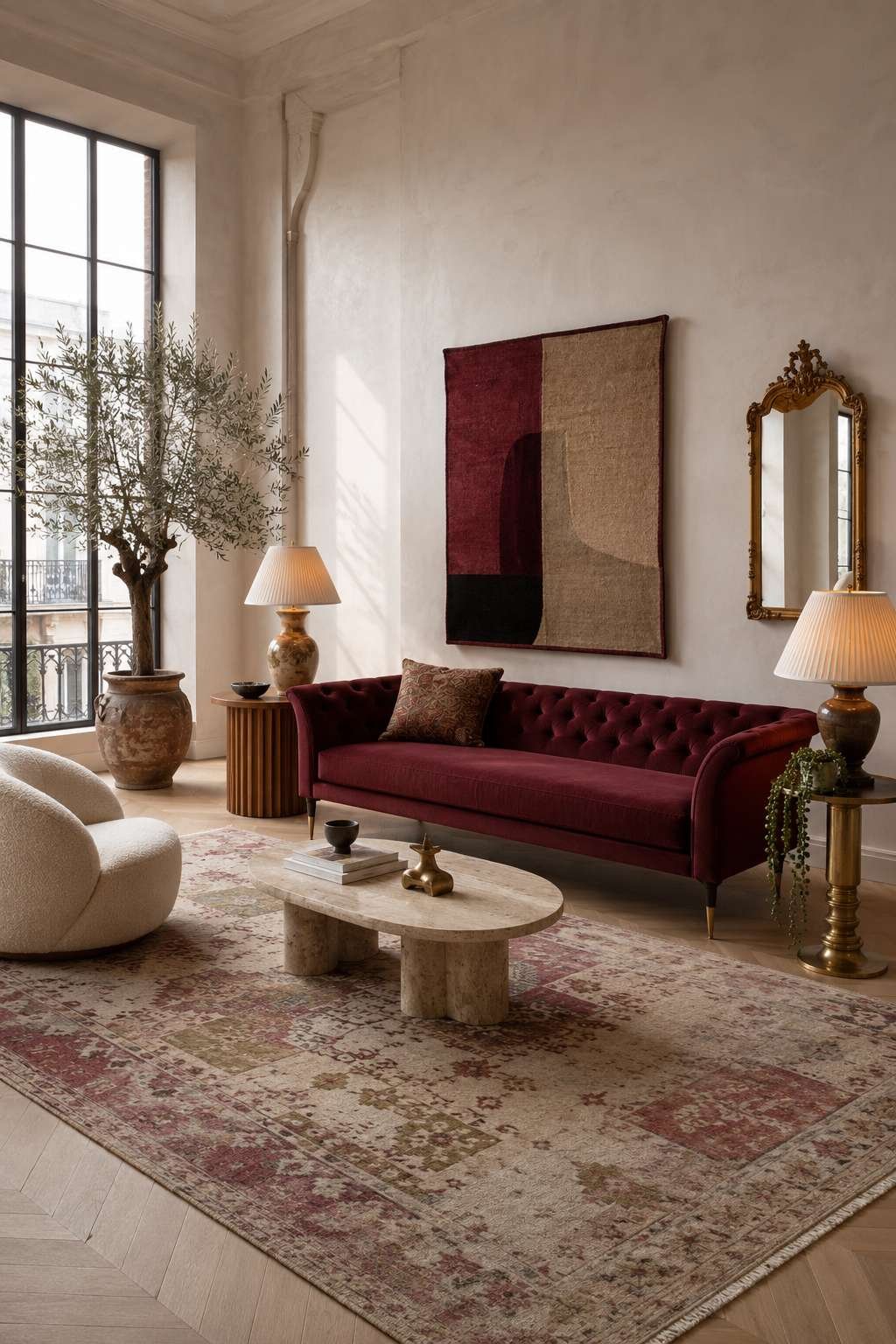
A hand-knotted jute rug beneath the seating arrangement grounds the entire composition in natural, organic texture. Jute’s rough-hewn, earthy quality provides a wonderful contrast to the sophistication of the chesterfield sofa, preventing the room from taking itself too seriously and introducing a note of relaxed, bohemian warmth. The warm incandescent lighting that illuminates this space creates a golden ambiance that unifies all of the room’s diverse elements under a single tonal mood — there is something almost alchemical about the way warm light transforms a collection of individual pieces into a cohesive interior.
This eclectic approach celebrates the idea that beautiful rooms are assembled over time, that mixing periods and styles is not a design failure but a design philosophy. The result is a living room that tells a story — about travel, about taste, about the pleasure of surrounding yourself with things you genuinely love.
Key Design Tips:
- Anchor an eclectic room with a statement piece like a tufted chesterfield that has enough visual weight to unify diverse surrounding elements
- Mix dark wood and brushed brass side tables deliberately — shared warm undertones create cohesion even when forms differ
- Use hand-knotted jute or natural fiber rugs to introduce organic texture that contrasts beautifully with sophisticated upholstery
- Layer warm incandescent or amber-toned lighting to unify a visually diverse collection of furniture and accessories
- Embrace imperfection and mismatch as design choices — rooms that look perfectly assembled suggest personality and curation rather than a single shopping trip
7. Scandinavian Warmth: Burgundy Wool Sofa with Birch and White
The Scandinavian design philosophy — with its emphasis on simplicity, natural materials, and the pursuit of hygge (the Danish concept of cozy contentment) — might seem an unlikely partner for the intensity of burgundy. Yet this design concept proves that the combination is not only possible but extraordinary. A clean-lined burgundy wool sofa against white-painted walls and pale pine flooring creates a room of remarkable visual clarity and warmth. The deep wine-red upholstery becomes a single, deliberate statement against the predominantly light and airy backdrop, its intensity made more beautiful by the restraint surrounding it.

Natural birch wood furniture pieces — a coffee table, perhaps a side table or shelving unit — introduce the organic, warm-toned material that is central to Scandinavian aesthetic. Birch’s pale, almost golden-white grain has a luminosity that responds beautifully to natural light, and its warmth prevents the white walls from feeling clinical or cold. The combination of birch, white, and burgundy creates a palette that feels both contemporary and deeply rooted in the natural world — an essential quality of successful Scandinavian design.

Simple ceramic vases in muted earth tones and a chunky knit ivory throw complete the composition with characteristic Nordic restraint. The ceramic vessels introduce handmade quality and subtle color variation — dusty greens, warm greys, muted ochres — that add depth without complicating the palette. The chunky knit throw draped casually across the sofa arm is perhaps the most perfectly hygge detail in the entire arrangement — it is an invitation to curl up, to settle in, to resist the pull of productivity in favor of simple comfort.

The soft diffused north light that characterizes Scandinavian interiors is what makes this particular color combination sing. North light has a cool, even quality that renders colors with unusual accuracy and depth, meaning the warm and cool tones of the room — the white walls, the pale pine, the warm birch, and the deep burgundy — are all seen simultaneously at their truest and most beautiful.
Key Design Tips:
- Contrast deep burgundy wool upholstery with white walls and pale pine flooring for a Scandinavian-inspired composition of striking simplicity
- Choose birch or light ash wood furniture to introduce warm organic material that bridges the gap between white walls and wine-red upholstery
- Add chunky knit throws in ivory or cream as hygge-inspired accessories that invite comfort and add tactile warmth
- Keep accessories minimal and handmade — ceramic vessels in muted earth tones add warmth without visual complexity
- Maximize natural light from north or east-facing windows to render the contrast between deep burgundy and pale backgrounds at its most beautiful
8. Grand Proportions: Floor-to-Ceiling Claret Silk in a High-Ceiling Townhouse
Some rooms demand to be dressed on an architectural scale, and this high-ceiling townhouse living room is precisely such a space. Floor-to-ceiling curtains in deep claret silk that pool gently on dark hardwood floors create an effect of breathtaking grandeur — fabric used not merely as window dressing but as a defining architectural element that frames the room’s proportions and amplifies its sense of height. The claret silk catches light in a constantly shifting way, its smooth surface creating highlights and shadows that animate the room with every change in natural illumination.

A matching pair of burgundy velvet sofas positioned facing each other across a marble-topped ottoman create a formal seating arrangement of genuine elegance. The bilateral symmetry of this layout is a classical design device — it conveys order, intention, and a sense of occasion that feels appropriate to the grandeur of the space. The marble-topped ottoman serving as a central coffee table is both practical and beautiful, its white and grey veining providing a cool, light-toned contrast that prevents the facing sofas from feeling too enclosed or heavy.

Recessed ceiling lighting combined with an antique crystal chandelier creates the layered illumination strategy that grand rooms require. The chandelier provides the visual drama and focal point appropriate to a space of such height, while recessed lighting offers practical ambient illumination that can be adjusted to support different activities and moods. Together, these light sources cast layered illumination across the room in a way that highlights the dramatic richness of the silk curtains and velvet upholstery simultaneously.
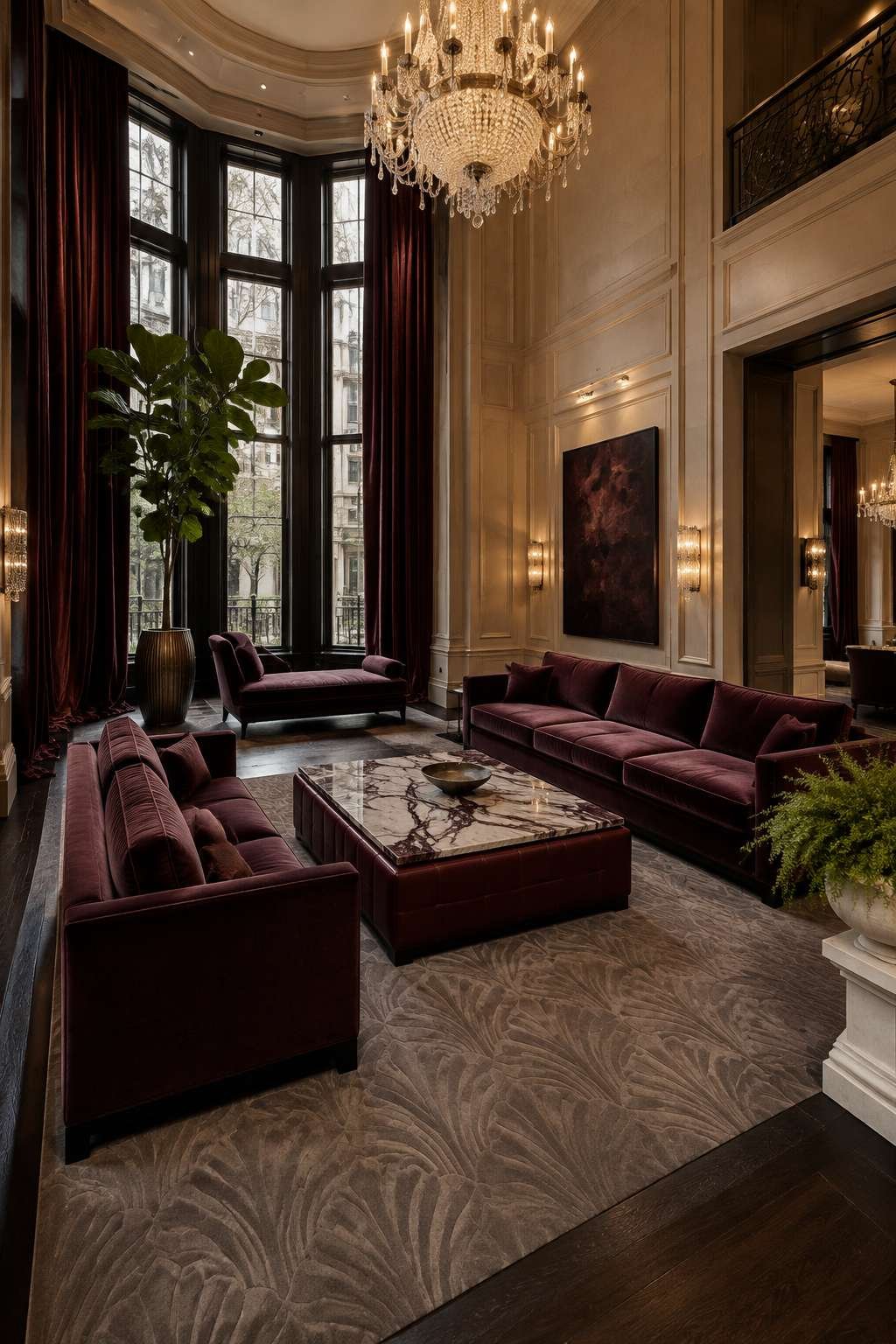
This is design in the tradition of Architectural Digest — rooms created not just to be lived in but to be marveled at. The material opulence of silk, velvet, and marble speaks to a commitment to quality and beauty that transcends trends. This is a room designed to age magnificently, to become more personal and more beautiful with each passing year.
Key Design Tips:
- In high-ceiling rooms, use floor-to-ceiling curtains that pool on the floor to emphasize vertical proportions and create architectural drama
- Silk or silk-blend curtain fabric in deep claret or burgundy adds grandeur and light-responsive movement that heavier fabrics cannot achieve
- Position matching sofas facing each other across a marble ottoman for a formal, symmetrical arrangement appropriate to grand spaces
- Layer a chandelier with recessed lighting to provide both dramatic focal illumination and practical ambient light
- Allow premium materials — velvet, silk, marble — to justify the space’s scale; understated furniture will feel lost in grand proportions
9. Mid-Century Modern: Burgundy Tweed with Walnut and Sunburst Details
Mid-century modern design has proven one of the most enduring and beloved aesthetic movements in interior design history, and its marriage with burgundy produces results of particular beauty and warmth. A low-profile burgundy tweed sofa with tapered walnut legs captures the essential character of the period — clean horizontal lines, honest material expression, and an organic warmth that distinguishes it from later, cooler modernisms. The tweed fabric is a sophisticated choice, its woven texture adding visual complexity and tactile interest that a plain weave would lack.

A sunburst wall clock in brushed gold hanging above a credenza in warm walnut veneer is a composition that speaks the mid-century language with complete fluency. The sunburst form — radiating spokes of gold catching light from every angle — was one of the signature decorative motifs of the 1950s and 60s, and its continued presence in contemporary interiors speaks to the enduring appeal of its optimistic, energetic symbolism. The warm walnut veneer of the credenza picks up the tones of the sofa legs and creates a unified wood palette that grounds the arrangement.
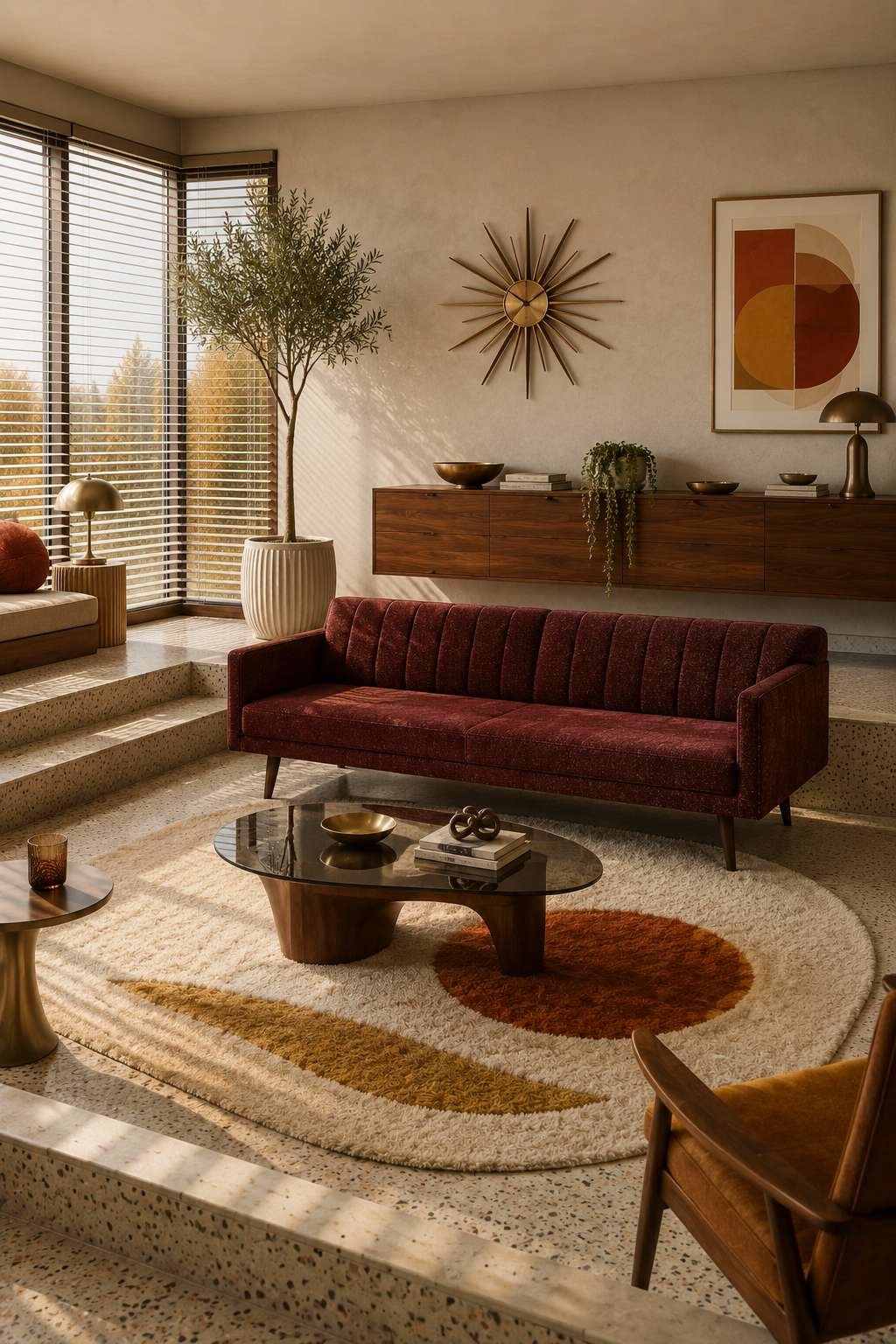
Geometric abstract prints in terracotta and mustard hung above the credenza or positioned elsewhere in the room introduce the color energy that mid-century interiors thrive on. These warm, earthy tones sit harmoniously alongside burgundy in the warm spectrum of the color wheel, their combination evoking the palette of autumn landscapes and the warmth of late afternoon sunlight. The late afternoon golden light streaming through horizontal slat blinds — itself a quintessentially mid-century window treatment — casts the room in the amber warmth that makes this aesthetic so emotionally resonant.

The retro-modern aesthetic achieved here is one that respects its historical roots while remaining entirely livable and contemporary. This is not a museum recreation of a 1960s interior but a living, breathing space that draws on the best qualities of the period — optimism, warmth, honest craftsmanship — and applies them to present-day living.
Key Design Tips:
- Choose a low-profile sofa with tapered wood legs in walnut or teak to capture authentic mid-century proportion and material warmth
- Use a sunburst clock or mirror in brushed gold as a signature mid-century decorative element above a credenza or fireplace
- Complement burgundy tweed upholstery with abstract prints in terracotta, mustard, and warm ochre for a cohesive period-appropriate palette
- Install horizontal slat blinds for a mid-century window treatment that filters golden afternoon light beautifully
- Ground the arrangement with a walnut credenza or media unit that unifies the wood tones of sofa legs, shelving, and decorative accessories
10. Bohemian Layers: Macrame, Kilim, and Rattan in Warm Burgundy Tones
Bohemian interior design is fundamentally about the layering of textiles, textures, and cultures into a composition that feels richly personal and utterly free of design rules. This burgundy bohemian living room achieves that quality with a collection of layered textiles that are individually beautiful and collectively extraordinary. A burgundy macrame wall hanging introduces handcrafted texture at the largest scale, its knotted forms creating depth and shadow against the wall surface. A kilim rug in rust and burgundy tones beneath the seating area brings the geometric precision of traditional weaving craft into dialogue with the organic, flowing quality of the macrame.

Embroidered cushion covers in complementary warm shades — saffron, terracotta, deep rose — piled generously across a rattan sofa with plush burgundy seat cushions create the layered, abundant quality that defines bohemian living rooms at their best. Rattan is a brilliant material choice in this context — its organic, woven structure shares a material kinship with the macrame wall hanging and kilim rug, while its light color provides an important visual contrast to the deep burgundy cushions that rest within its frame. The overall impression is of a space assembled by someone who has traveled widely and collected thoughtfully.

Hanging plants in terracotta pots suspended at various heights throughout the room introduce the living, breathing quality that no manufactured object can replicate. The combination of deep green foliage against the warm burgundy and rust palette creates a contrast that feels completely natural — like the colors of a sunset landscape. Terracotta pots reinforce the earthy, warm color story and introduce a Mediterranean or Southwestern quality that aligns beautifully with the global textile references of the kilim and macrame.
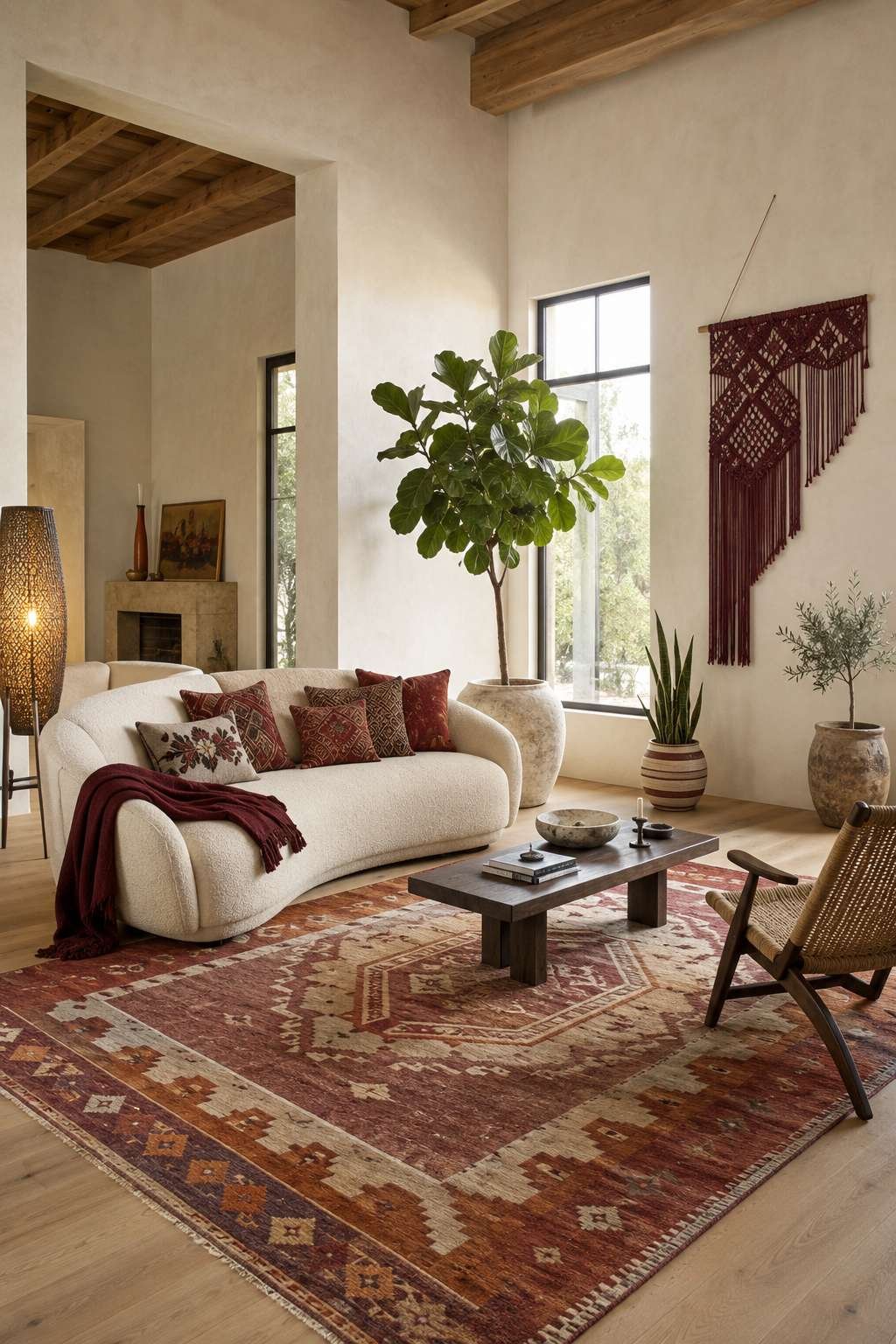
Woven pendant lights clustered together cast a warm, dappled light that enhances the earthy, intimate quality of the entire arrangement. Light filtered through woven material has a uniquely organic character — soft, warm, and slightly unpredictable in the way it falls across surrounding surfaces. This quality of light is the final ingredient that transforms a collection of beautiful objects into a living room with genuine soul.
Key Design Tips:
- Layer macrame wall hangings, kilim rugs, and embroidered cushions in burgundy and rust tones for authentic bohemian depth and visual richness
- Choose a rattan or cane sofa frame for its organic material kinship with other natural textiles in the bohemian palette
- Incorporate hanging plants in terracotta pots at varied heights to add living color and reinforce the earthy warm palette
- Use woven or rattan pendant lights to cast soft, organic light that enhances the handcrafted quality of the surrounding textiles
- Build the palette around warm earth tones — rust, saffron, terracotta — as natural companions to deep burgundy in a bohemian arrangement
11. Formal Elegance: Burgundy Brocade Wingbacks and an Oriental Rug
Formal living rooms occupy a particular place in the history of interior design — they are spaces designed for the reception of guests, for the performance of domestic ritual, for the display of taste and status. This symmetrical furniture placement with burgundy brocade wingback chairs flanking a carved marble fireplace channels that tradition with complete conviction. The wingback form itself is historically rich — designed originally to shield sitters from drafts, it has evolved into one of the most recognizable symbols of traditional domestic comfort and dignity.

The brocade fabric chosen for the upholstery adds an extraordinary level of visual complexity to the wingback chairs. Brocade’s woven pattern — typically featuring raised floral or geometric motifs worked in contrasting threads — catches light differently than a plain weave fabric, creating a constantly shifting surface that rewards close examination. In deep wine tones, brocade feels genuinely historic, evoking the interiors of country houses and historic townhomes where such fabrics were once standard rather than exceptional.

A matching sofa in deep wine velvet facing the fireplace across a richly patterned Oriental area rug completes the formal seating arrangement. The Oriental rug is the room’s most complex design element — its intricate pattern and deep color palette drawing together every tone present in the upholstery, woodwork, and architectural details of the room. Brass wall sconces with cream candle shades at either side of the fireplace provide the soft, directional side lighting that formal rooms require — light that flatters faces, creates intimacy, and respects the convivial purpose of the space.

The classic traditional arrangement presented here is one that has been tested and refined across centuries of domestic design. Its symmetry, its emphasis on quality materials, and its respect for the fireplace as the room’s physical and emotional center reflect a design intelligence that transcends any particular period or trend.
Key Design Tips:
- Use brocade or damask fabric in deep burgundy for wingback chairs to introduce historical richness and complex textile pattern
- Maintain strict bilateral symmetry in formal living rooms — matching chairs flanking a fireplace is a timeless and highly effective arrangement
- Choose an Oriental or Persian area rug whose color palette draws together the tones of upholstery, woodwork, and wall color
- Install brass wall sconces with cream shades at fireplace height for soft, flattering side lighting appropriate to formal entertaining
- Invest in a carved marble fireplace surround as the architectural focal point — this single element elevates the entire room’s quality level
12. Open-Plan Living: Burgundy Sectional Defining a Suburban Space
Open-plan living areas present one of contemporary interior design’s most interesting challenges: how to create distinct, purposeful zones within a continuous floor space without resorting to walls or partitions. This design uses a deep burgundy microfiber sectional as both seating and spatial definition, its L-shaped form clearly delineating the living zone from the adjacent dining area through furniture placement alone. The sectional’s scale — inherently generous and imposing — gives it the spatial authority to perform this defining role effectively.

A large abstract canvas in burgundy, blush, and gold hanging above the sofa performs multiple design functions simultaneously. It provides a focal point for the seating area that is visible from across the entire open-plan space, it reinforces the burgundy color theme at the largest possible scale, and it introduces the blush and gold tones that bridge the sofa’s deep wine hue with lighter elements elsewhere in the room. Statement artwork in open-plan spaces must be scaled to the spatial context — a small painting would be entirely lost here.

White-painted exposed brick on one wall adds industrial texture that prevents the suburban setting from feeling too polished or generic. The brick’s rough, matte surface provides an excellent backdrop for the sectional, its white paint keeping the wall light while preserving the textural interest of the underlying masonry. Brass shelving units mounted against this textured wall display curated decor objects — ceramics, books, small plants — in a way that adds personality without creating visual clutter.

The natural afternoon light that characterizes suburban homes with generous window provision is an asset that this design fully exploits. Flooding the open-plan space with daylight keeps the deep burgundy sectional from feeling heavy or dominating, while ensuring that the artwork’s colors are seen at their most vivid and accurate.
Key Design Tips:
- Use a large L-shaped sectional in deep burgundy to define and anchor the living zone within an open-plan space without physical dividers
- Choose statement artwork scaled to open-plan proportions — at least 120cm wide — to create a focal point visible across the entire space
- White-painted exposed brick introduces industrial texture while keeping walls light in open-plan suburban settings
- Install brass shelving units for display storage that adds warmth and personality to the industrial brick backdrop
- In open-plan spaces, ensure the sectional’s back faces the dining area cleanly — this creates an invisible spatial boundary while maintaining visual flow
13. Transitional Style: Tufted Bench and Floral Throw with Greige Linen
Transitional interior design occupies the comfortable middle ground between traditional and contemporary aesthetics, borrowing the warmth and detail of classic design while embracing the cleaner lines and less ornate sensibility of modern interiors. This concept executes the transitional brief beautifully, pairing a tufted burgundy upholstered bench used as an unconventional coffee table alternative with a linen sofa in warm greige. The bench brings traditional craftsmanship into dialogue with a sofa that reads as more contemporary in its simplicity and neutral tone.

A dramatic burgundy and navy blue floral throw introduces pattern and color depth to the composition in a way that maintains the room’s design coherence. The deep navy within the floral pattern creates a sophisticated secondary tone that enriches the overall palette — this is not simply a burgundy room but a room where wine red and deep blue create a richer, more complex color story. The floral motif itself references traditional design vocabulary while the bold scale of the pattern keeps it feeling current rather than old-fashioned.

Dark espresso wood side tables support vintage-inspired table lamps that bring warm, focused light to the seating arrangement at the most useful height. The espresso tone of the wood is important — it is deep enough to feel rich and considered, but its brown base tone rather than reddish mahogany gives it a more contemporary character that aligns with the transitional aesthetic. The vintage-inspired lamp design — perhaps with a ceramic or turned wood base and a warm fabric shade — references the traditional without recreating it literally.

The early morning soft light from sheer curtained windows that illuminates this space has a gentle, diffused quality that suits the transitional room’s mood perfectly. It is neither the dramatic golden light of mid-century interiors nor the crisp, even light preferred by contemporary design photography — it occupies its own gentle middle territory, just as the design itself does.
Key Design Tips:
- Use a tufted bench in deep burgundy as a coffee table alternative to introduce traditional craftsmanship within a contemporary setting
- A greige or warm taupe linen sofa provides the neutral anchor that allows bolder burgundy accessories and throws to take center stage
- Choose a floral throw with burgundy and navy tones to introduce pattern while maintaining the room’s deep, rich color palette
- Espresso-toned side tables offer the depth of dark wood with a contemporary character that works in transitional settings
- Sheer curtains at windows preserve natural light and create soft, diffused illumination that flatters transitional rooms’ warm palettes
14. Compact and Contemporary: Burgundy Sofa Bed in a Studio Apartment
Studio apartment living demands that every design decision serve multiple purposes simultaneously. A compact burgundy sofa bed with clean lines does exactly this — providing comfortable everyday seating that transforms into sleeping accommodation when needed, while the deep wine-red color ensures that this practical piece of furniture carries genuine design weight within the room. The clean lines of the sofa bed form are essential in a studio context, where visual complexity quickly becomes visual clutter.

A gallery wall of black-framed prints above the sofa creates a bold, graphic statement that lends the studio apartment a gallery-like quality, elevating the space beyond its modest proportions through the presence of art and intention. The black frames provide a sharp, high-contrast element that grounds the gallery wall and creates a deliberate visual boundary above the sofa. The prints themselves — whether photography, illustration, or typography — tell the story of the inhabitant’s aesthetic interests and transform a functional sleeping-sitting space into a personal sanctuary.

A round glass coffee table floating on a burgundy and charcoal geometric rug is a brilliant spatial strategy. The glass surface of the table allows the rug’s pattern to remain fully visible beneath it, preserving the visual interest of the floor plane while providing a practical surface at seated height. In small spaces, visual continuity — the ability to see through and across objects — is one of the most powerful tools for maintaining a sense of openness. The geometric rug pattern adds energy and structure to the floor plane that anchors the seating arrangement.

Minimalist track lighting overhead provides clean, adjustable illumination that can be directed toward the gallery wall, the seating area, or the functional spaces of the studio as needed. In a single-room living situation, flexible lighting is not a luxury but a necessity — it is the tool by which one space becomes many different environments throughout the course of a day.
Key Design Tips:
- Choose a compact sofa bed in deep burgundy with clean lines as the multifunctional cornerstone of a studio apartment living space
- Black-framed gallery walls above the sofa add artistic personality and create a deliberate visual boundary for the seating zone
- Use a round glass coffee table to maintain visual openness in small spaces while preserving the rug design beneath
- Select a burgundy and charcoal geometric rug to add structured pattern that grounds the seating arrangement without overwhelming the space
- Install adjustable track lighting to provide flexible illumination appropriate to a studio’s changing functional needs throughout the day
15. Industrial Edge: Burgundy Leather and Exposed Concrete in a Loft
The industrial loft aesthetic — with its celebration of raw materials, exposed infrastructure, and honest construction — provides a remarkable and unexpected backdrop for the warmth and richness of burgundy. An exposed concrete ceiling with visible ductwork creates a setting that is aggressively architectural, its grey tones and utilitarian character setting the stage for the deep burgundy leather sofa to read as an almost revolutionary statement of comfort and warmth within the industrial framework. The visible stitch detail on the leather upholstery speaks to the craft quality that the best industrial-inspired design insists upon.

Raw steel pipe shelving displaying curated books and metal decorative objects reinforces the industrial material language while maintaining the intellectual, personal quality that prevents loft spaces from feeling like showrooms. The steel picks up the grey undertones of the concrete ceiling and floor, creating a unified structural palette within which the burgundy sofa acts as the single, defining warm element. This is a design strategy of considerable restraint — resisting the temptation to add multiple colorful elements in favor of letting one extraordinary piece of burgundy leather do all the emotional work.

Edison bulb pendant clusters hanging from the concrete ceiling are perhaps the most recognizably industrial lighting choice available, and here they cast a warm amber light across the dark tones of the room that creates an atmosphere of striking, almost theatrical warmth. The amber quality of Edison bulbs is not accidental — it is deeply complementary to deep burgundy tones, enriching the red-brown warmth of the leather while softening the grey austerity of the concrete and steel. Worn oak flooring with natural patina adds further warmth at floor level, its aged tones bridging the gap between industrial surfaces and the luxury leather of the sofa.

The dramatic contrast between industrial surfaces and rich wine-red upholstery is what makes this design concept so compelling. It is a room of genuine originality — one that refuses the obvious and creates something more interesting precisely through the tension between its constituent elements.
Key Design Tips:
- Allow deep burgundy leather to be the sole warm, rich element in an industrial loft setting — its impact is amplified by the surrounding austerity
- Choose visible stitch detail in leather upholstery as a craftsmanship signal appropriate to the honest material ethos of industrial design
- Use raw steel pipe shelving to reinforce industrial material language while displaying books and objects that add personal warmth
- Install Edison bulb pendant clusters for warm amber light that enriches burgundy leather tones while softening industrial grey surfaces
- Incorporate worn oak flooring with natural patina to bridge the gap between cold industrial materials and the warmth of wine-red upholstery
16. Tonal Monochromatic: Layered Burgundy, Dusty Rose, and Blush
Monochromatic interior design — the practice of building a room’s palette around a single hue in its varied tones and shades — is one of the most sophisticated and visually cohesive approaches available to interior designers. This concept applies the strategy to burgundy with extraordinary results, layering a deep wine-red sofa, a dusty rose accent chair, and a blush-toned area rug into a composition of remarkable tonal depth and nuance. Each element contributes a different value and saturation of the same essential hue, creating a room that feels intensely personal and emotionally resonant.

Cream and ivory accessories — ceramic vases and woven throws — are essential to the success of this monochromatic scheme. Without neutral relief, a room built entirely in variations of deep red risks feeling oppressive or theatrical. The cream and ivory elements provide visual breathing room, their near-white tone reflecting light and preventing the room from absorbing too much ambient illumination. They also introduce textural variation through the smooth ceramic surface of the vases and the woven structure of the throws, adding tactile interest without introducing color complexity.

A large arched mirror in antique gold serves multiple functions in this composition. Its reflective surface bounces natural light across the room, ensuring that the subtle tonal variations between the deep burgundy, dusty rose, and blush elements are clearly visible and fully appreciated. Without sufficient light, a monochromatic room risks all its carefully chosen tones blending into undifferentiated darkness. The antique gold frame introduces the warm metallic accent that prevents the palette from feeling cold or exclusively feminine.
The professional challenge of photographing this space lies in capturing the nuanced variation of burgundy and pink tones with accurate exposure — ensuring that the deep wine of the sofa, the soft rose of the accent chair, and the gentle blush of the rug are all rendered distinctly and beautifully. In person, the effect is one of extraordinary sophistication — a room that reveals its complexity gradually, rewarding careful attention with increasingly fine distinctions.
Key Design Tips:
- Build a monochromatic burgundy palette by layering deep wine, dusty rose, and blush tones across sofa, accent chair, and area rug respectively
- Introduce cream and ivory accessories as essential neutral relief that prevents a monochromatic deep-toned room from feeling oppressive
- Use a large arched mirror in antique gold to reflect and amplify natural light, ensuring tonal variations in the palette are clearly visible
- Keep ceramic and textile accessories minimal in monochromatic rooms — too many objects dilute the clean tonal impact of the palette
- Choose antique gold or warm brass as the sole metallic accent — it warms the pink-red spectrum without introducing a competing color note
17. The Reading Nook: Burgundy Velvet Armchair with Brass Arc Lamp
A deeply cushioned burgundy velvet armchair positioned beside a tall bookcase in a sunlit corner represents one of interior design’s most universally appealing archetypes — the perfect reading nook. There is something about the combination of rich velvet upholstery, the warm glow of a brass arc floor lamp, and the proximity of a shelf full of books that speaks to a deep human desire for intimate, purposeful comfort. This design concept realizes that archetype with exceptional material quality and thoughtful composition.

The brass arc floor lamp performs a role here that goes beyond simple task lighting. Its elegant curved form — a long arm sweeping from floor to shoulder height — creates a visual gesture that frames the armchair and defines the nook as a distinct zone within the larger room. The focused task lighting it provides is practical for reading, but its warm, directed quality also creates a pool of intimacy that separates this corner from the rest of the space, making it feel like a private retreat within a shared room.
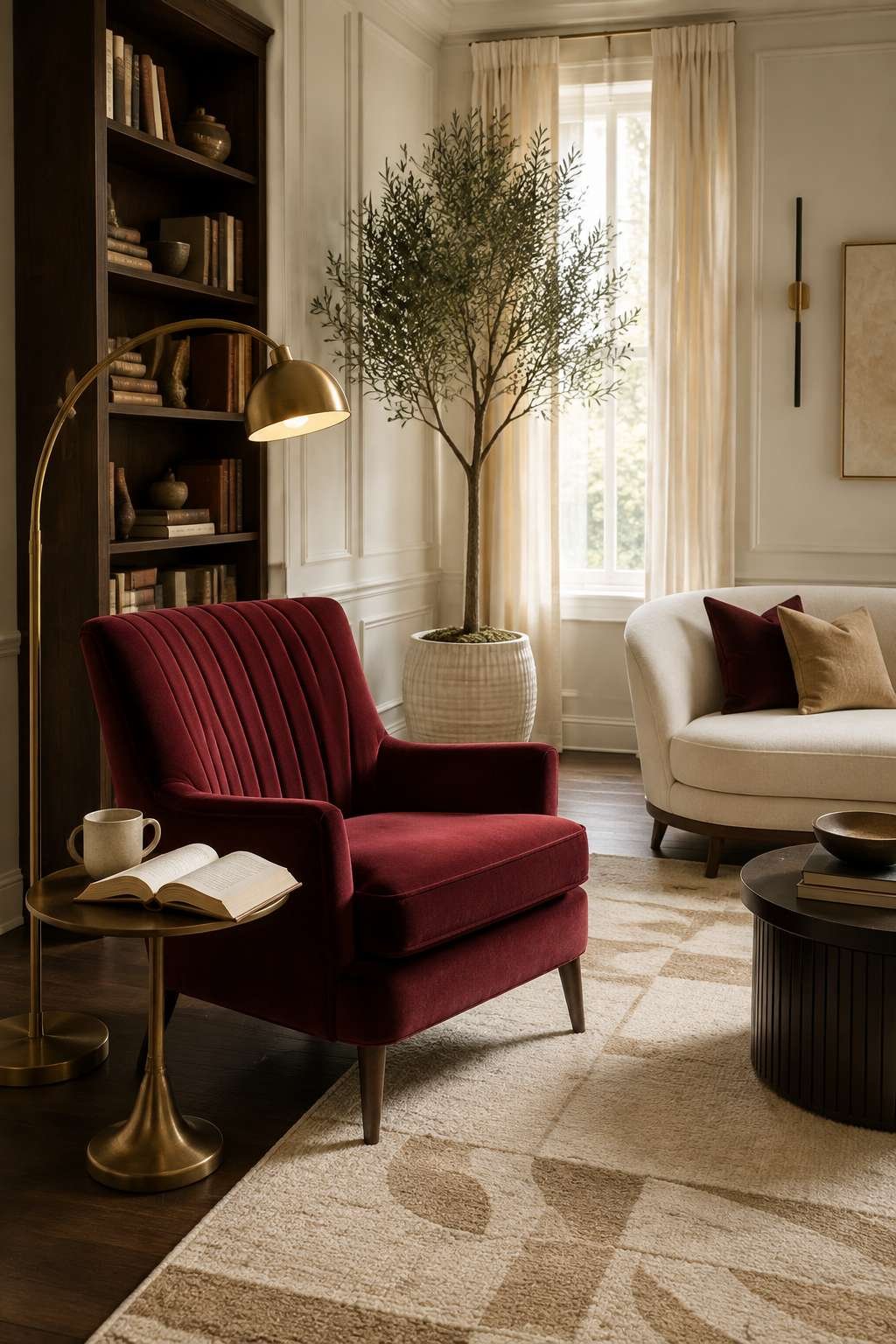
A small side table holding a ceramic mug and an open hardcover book is the most powerful accessory in this arrangement — not because of its design contribution, which is modest, but because of what it communicates. It signals that this chair is actually used, that the books on the shelves are actually read, that the nook has been created for genuine comfort rather than photographic effect. The best interior design always contains these lived-in details that speak to real habitation.
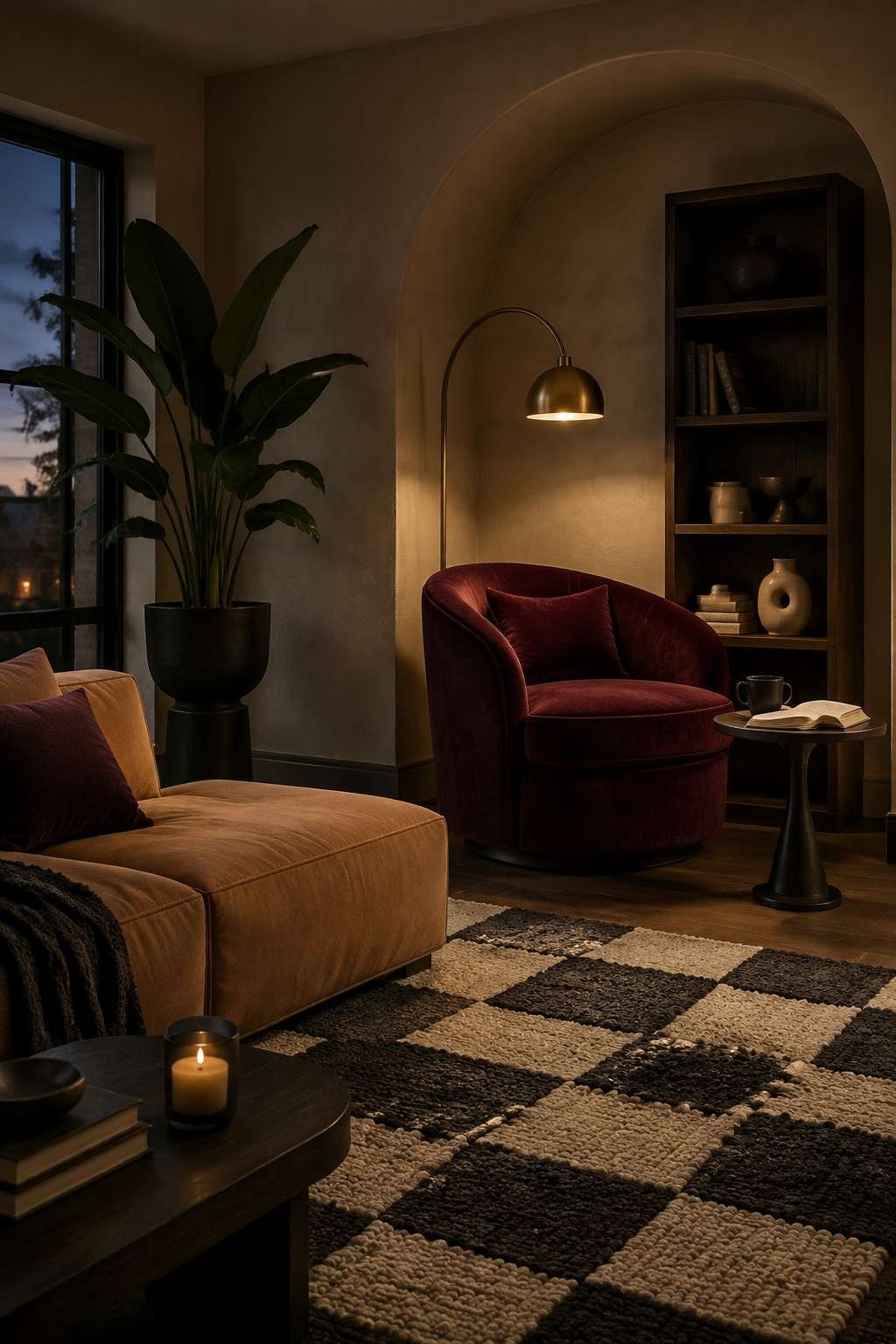
The tall narrow bookcase in dark walnut beside the armchair creates a warm, wood-toned backdrop that harmonizes with the deep burgundy of the upholstery. The warm ivory walls and dark hardwood floors of the surrounding room provide a beautifully balanced context — light above, dark below, rich wine-red at the human scale in between. This is a room designed around the body, around actual human experience and comfort.
Key Design Tips:
- Position a deep burgundy velvet armchair beside a tall narrow bookcase to create an intimate reading nook with built-in visual and functional richness
- A brass arc floor lamp frames the nook beautifully and provides the warm, focused task lighting that makes reading comfortable
- Include a small side table with a mug or book as a lived-in accessory that signals genuine habitation and comfort
- Choose dark walnut shelving adjacent to the armchair to create warm wood tones that harmonize with deep burgundy upholstery
- Ensure the reading nook connects visually to the larger room — it should feel like a private retreat within a shared space, not an isolated corner
18. Holiday Warmth: Burgundy Sofa with Festive Greenery and Firelight
The transformation of a classic burgundy sofa into the centerpiece of a holiday living room requires only the addition of a few carefully chosen seasonal elements. Plaid throw pillows in deep red, forest green, and cream are the first and most impactful change — their traditional tartan or plaid pattern immediately signals the festive season while remaining in complete harmony with the wine-red upholstery. The introduction of forest green is particularly powerful, creating a two-tone holiday palette of burgundy and green that is both timeless and deeply evocative.
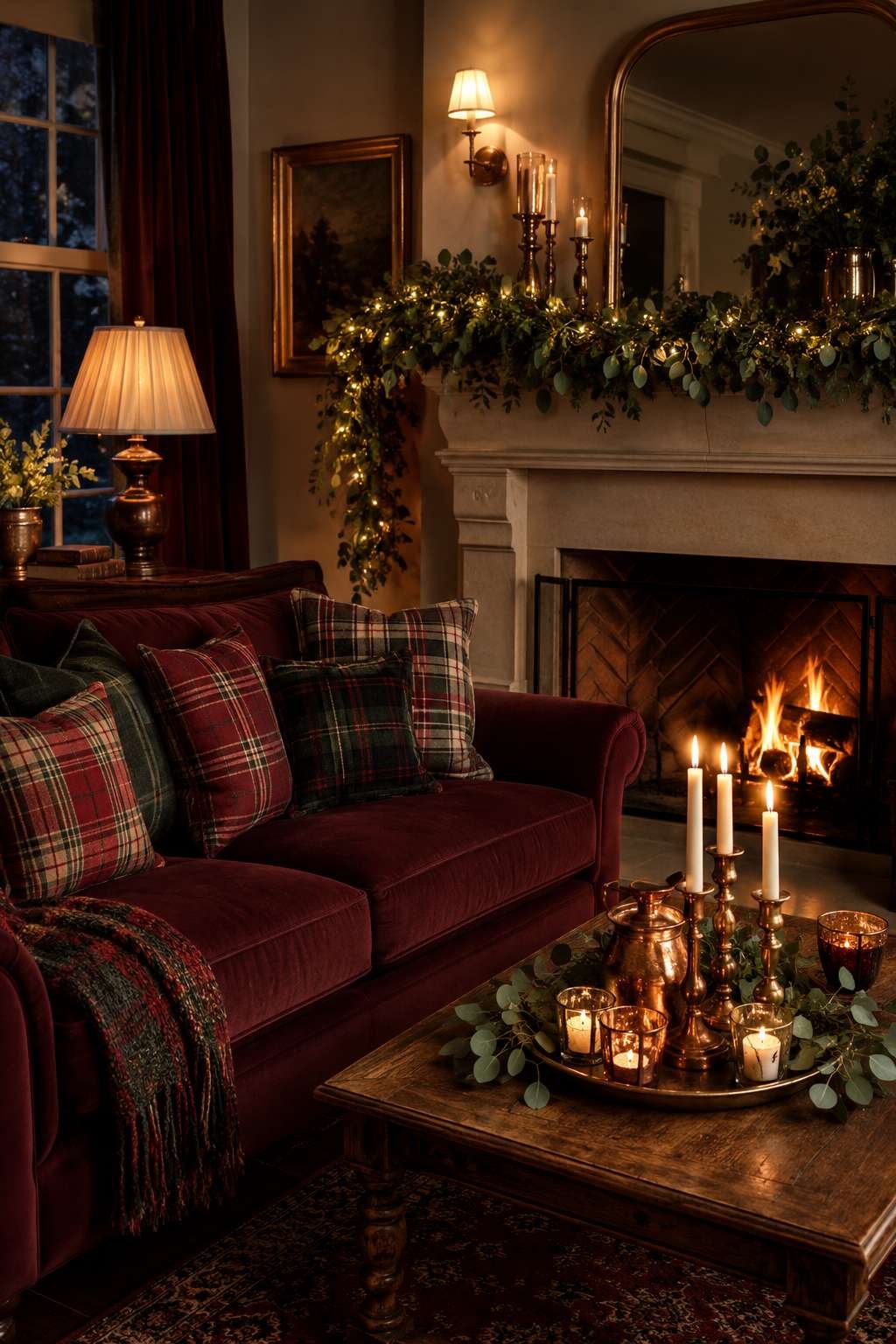
A garland of fresh eucalyptus with small warm fairy lights draped across the fireplace mantel is a contemporary take on the traditional mantel decoration. Fresh eucalyptus offers silver-green foliage and a subtle, clean herbal fragrance that fills the room naturally. The warm fairy lights woven through the garland create a soft, twinkling quality that is enormously evocative of winter warmth and festive intimacy. Above a crackling fire, this mantel arrangement becomes the room’s emotional and visual heart.
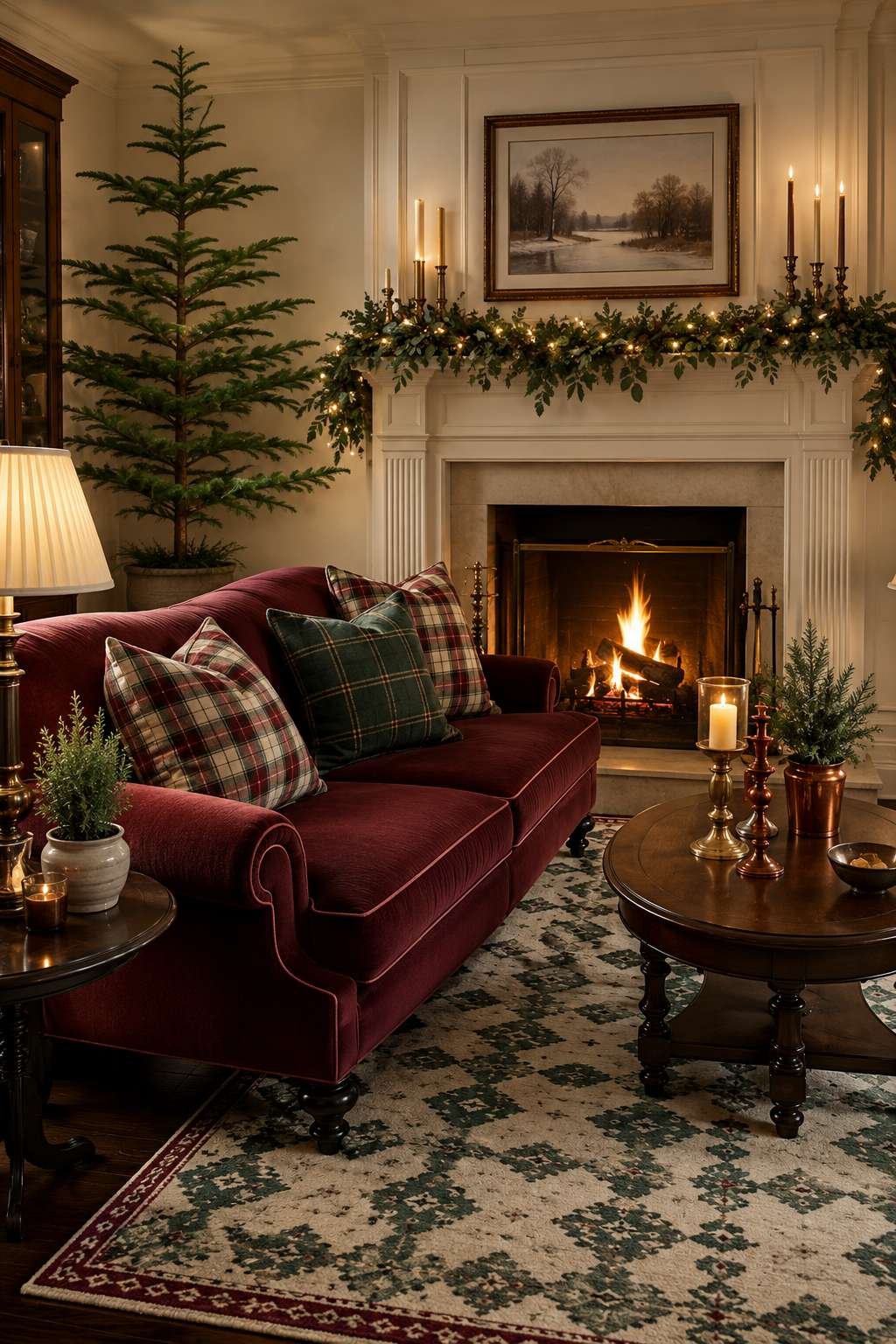
Copper and brass candleholders arranged on the coffee table introduce a second layer of warm, flickering light at a lower level, surrounding the central seating area with the kind of ambient illumination that no electric source can replicate. The copper tones complement burgundy in a particularly warm and rich way, their reddish-gold quality picking up the red undertones of the upholstery while adding a festive sparkle. The combination of firelight, fairy lights, and candlelight creates a multi-source, warm-toned illumination scheme of extraordinary beauty.

The evening ambient lighting that characterizes this holiday setting is the result of deliberately layered sources — table lamps providing soft background light, fire and candles creating foreground warmth and movement. The rich golden tones that emerge from this combination are perhaps the most beautiful quality that a burgundy living room can achieve, transforming a domestic space into something that feels genuinely magical.
Key Design Tips:
- Dress a burgundy sofa for the holidays with plaid throw pillows in deep red, forest green, and cream for a classic festive palette
- Use fresh eucalyptus garland with warm fairy lights for a contemporary mantel decoration that adds fragrance, color, and festive light
- Arrange copper and brass candleholders on the coffee table for a second level of warm, flickering light that envelops the seating area
- Layer firelight, candlelight, and table lamps to create the multi-source warm illumination that makes holiday rooms feel magical
- Return to this core burgundy palette year-round by simply removing seasonal elements — the sofa and room remain beautiful in every season
19. Contemporary Luxury: Modular Burgundy Sectional with Marble and Plaster
A modular sofa in deep wine-red fabric arranged in an L-shape represents the contemporary living room at its most generous and functional. The modular form offers both practical flexibility — sections can be rearranged as needs change — and aesthetic ambition, its large footprint filling a suburban living room with the kind of comfortable authority that immediately makes arriving home feel like a genuine luxury. The deep wine-red fabric gives this practical, modern form an unexpected richness that elevates it from merely functional to genuinely beautiful.

A sleek marble coffee table in white and grey veining against the dark upholstery creates one of interior design’s most compelling material contrasts. The coolness of marble — its smooth surface, geological patterns, and light-reflecting quality — counters the warmth and absorption of the deep red fabric in a way that feels both unexpected and inevitable. The white and grey veining of the marble introduces a drawing-like quality that adds visual complexity without color competition, keeping the burgundy as the room’s dominant color note.
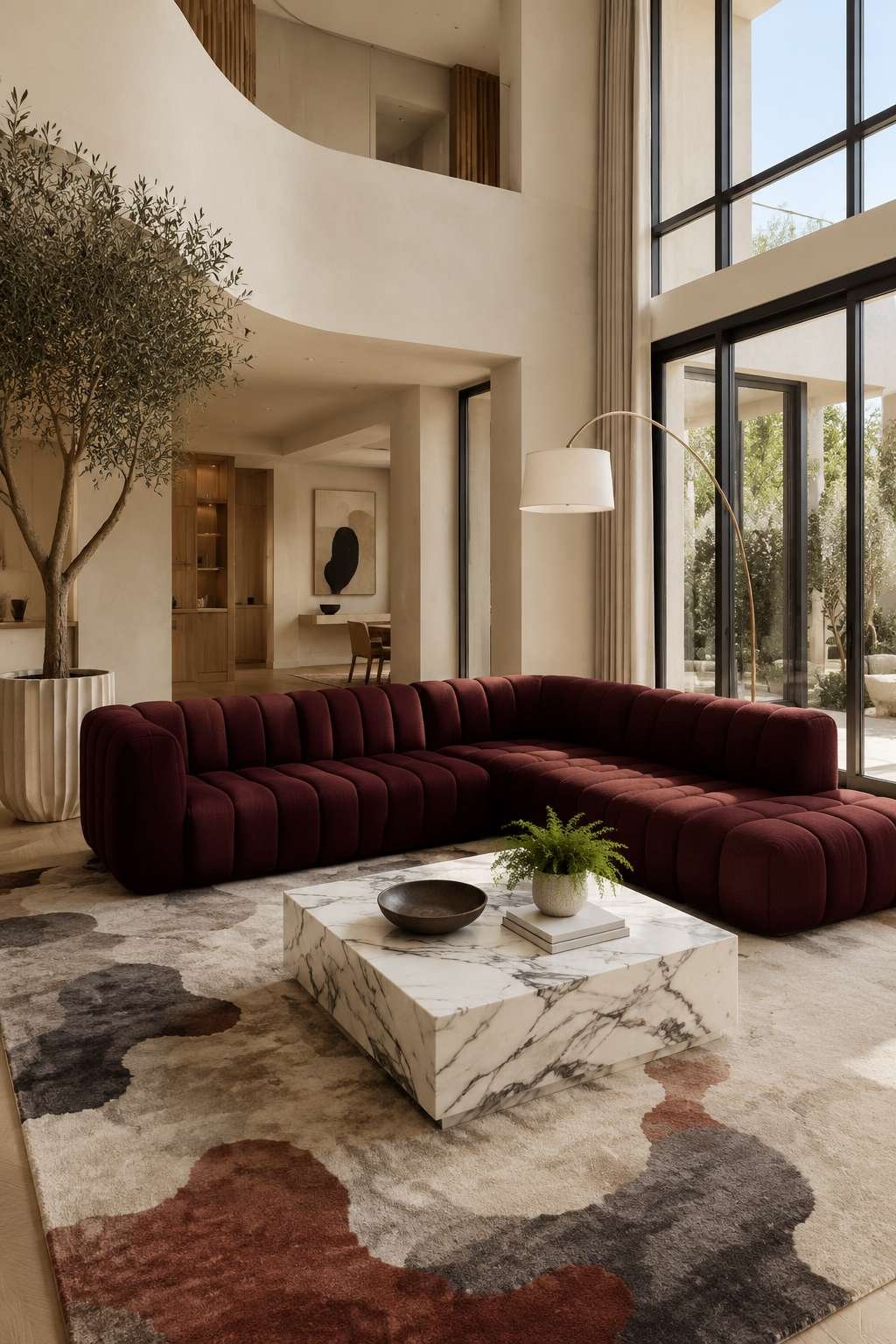
A textured plaster accent wall in warm off-white behind the sectional is the design’s most sophisticated move. Plaster’s organic texture — created through the application of thin layers of material that catch and hold light at micro-scale — gives the wall a three-dimensional quality that no paint finish can achieve. Warm off-white plaster behind deep burgundy upholstery creates an effect of extraordinary material richness, the rough texture of the wall making the smooth fabric of the sofa feel even more luxurious by comparison.

Recessed LED lighting and slim designer floor lamps provide the clean, contemporary illumination that modern interiors require. The combination ensures that the premium material quality of the marble, plaster, and fabric is visible and appreciated without the lighting itself becoming a visual distraction from the room’s material story.
Key Design Tips:
- Choose a modular L-shaped sectional in deep wine-red for maximum seating flexibility combined with strong visual presence in large suburban living rooms
- Pair deep burgundy upholstery with a white and grey marble coffee table for a material contrast of coolness and warmth that is visually compelling
- Apply textured plaster in warm off-white to the accent wall behind the sectional for organic wall texture that enhances the luxury quality of the fabric
- Use recessed LED lighting as the primary source to maintain clean, uncluttered ceiling lines in contemporary interiors
- Allow premium materials — marble, plaster, and quality fabric — to justify the room’s contemporary design language through their inherent visual richness
20. Maximalist Jewel Box: Burgundy Wallpaper, Velvet, and Emerald Accents
Maximalist interior design asks a fundamental question: what happens when you commit fully and without reservation to richness, depth, and visual abundance? This design concept answers that question with extraordinary confidence, saturating multiple surfaces with deep burgundy wallpaper featuring a subtle damask pattern, complementing it with a jewel-toned sofa in matching wine-red, and layering velvet cushions in complementary emerald and gold. The result is a room of genuine opulence — a space that envelops you in color and texture the moment you enter.

The damask pattern of the wallpaper is visible only at close range against the deep burgundy ground — it reads from a distance as a rich, textured surface, revealing its intricate geometric-floral structure only when you approach. This quality of revealed complexity is one of maximalism’s great pleasures — the room rewards attention, offering new details to discover with every viewing. The sofa in matching wine-red against this wallpapered backdrop creates a tonal immersion effect that is simultaneously enveloping and dramatic.
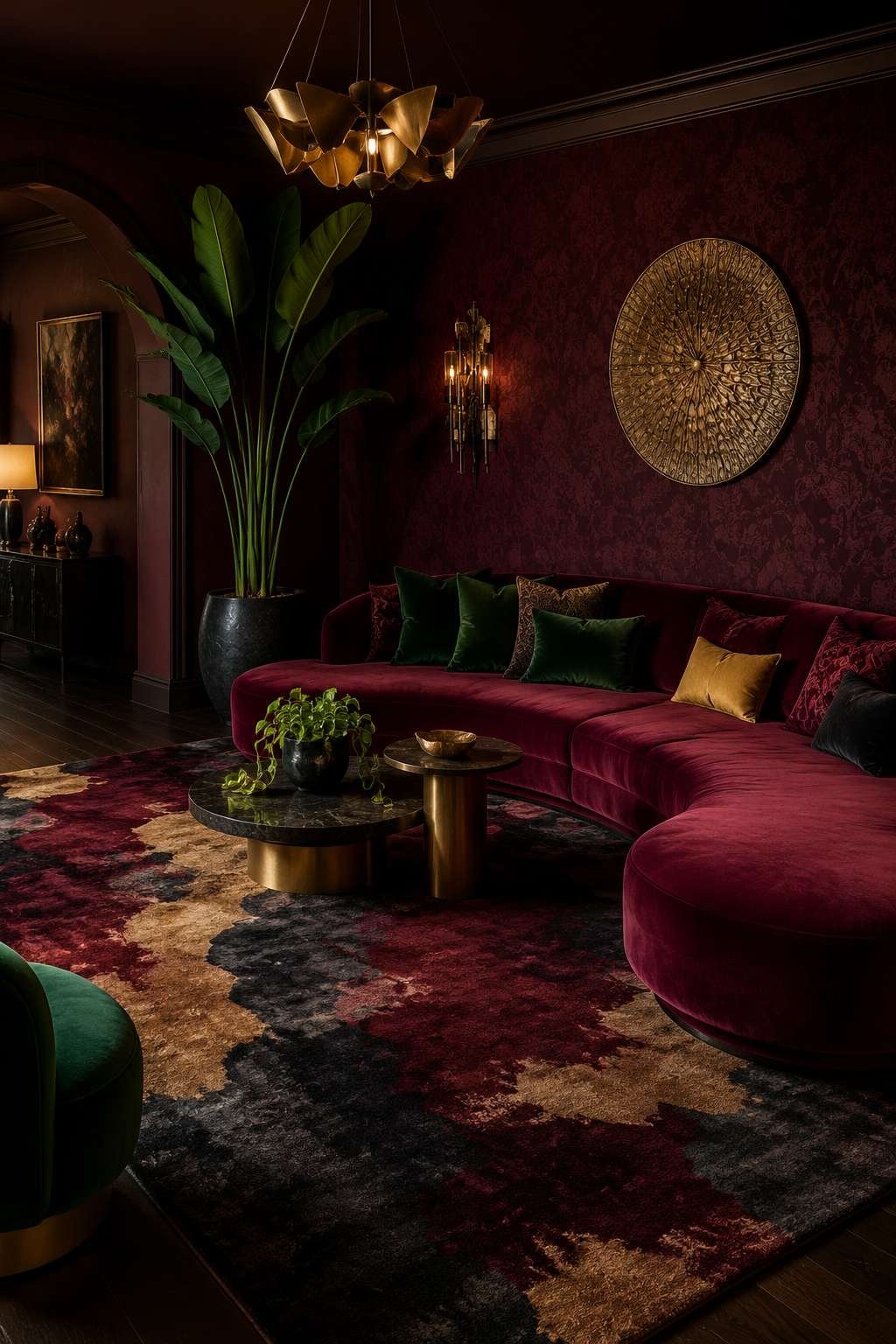
Velvet cushions in emerald and gold introduce the jewel-tone contrast that gives this room its particular excitement. Emerald green and deep burgundy are near-complementary colors — they sit across from each other in the warm-cool spectrum in a way that creates the vibrating visual energy characteristic of jewel-tone palettes. Gold mediates between them, sharing warmth with the burgundy while harmonizing with the richness of the emerald, creating a three-color palette of extraordinary sophistication.

A bold chandelier with dark iron frame and amber glass pendants is the room’s defining architectural moment. Its dramatic focal point quality is essential in a maximalist room — without a clear ceiling anchor, the visual richness of the walls and upholstery risks feeling directionless. The amber glass of the pendants emits a warm, golden light that enriches all surrounding surfaces, making the burgundy wallpaper glow and the emerald cushions shimmer. Dark stained hardwood floors complete the enveloping quality, creating a room where every surface contributes to the total experience.
Key Design Tips:
- Commit fully to damask or pattern wallpaper in deep burgundy as the most dramatically immersive way to envelope a room in this rich color
- Pair burgundy wallpaper with a matching sofa for total tonal immersion — the effect is overwhelming in the best possible way
- Add emerald green and gold velvet cushions as jewel-tone contrasts that create visual energy and prevent the monochromatic palette from feeling flat
- Choose a chandelier with amber glass pendants and dark iron frame for warm, dramatic ceiling illumination that enriches all surrounding surfaces
- Use dark stained hardwood floors to complete the enveloping maximalist composition and maintain the richness of the deep color story throughout
21. The Family Living Room: Durable Burgundy Performance Fabric for Real Life
The most enduring challenge in interior design is not achieving beauty but maintaining it in the context of real family life. This concept addresses that challenge directly and intelligently, centering the room on a burgundy performance fabric sofa with removable washable covers — a furniture choice that refuses the false choice between good design and practical living. Performance fabric in deep wine-red has the same visual richness and impact as velvet or standard upholstery, but its engineered properties allow it to resist staining, withstand heavy use, and be laundered when necessary.

Practical storage ottomans upholstered in matching deep wine tones double as additional seating, coffee table surface, and concealed toy or blanket storage simultaneously. This kind of multifunctional furniture is the backbone of successful family living rooms — pieces that earn their place not just through beauty but through the genuine daily value they provide. The matching upholstery tone ensures these practical pieces read as intentional design choices rather than afterthoughts, maintaining the room’s visual coherence.
Soft cream walls and medium-toned oak floors maintain the brightness and openness that family rooms require. Children’s rooms and family spaces benefit enormously from light-reflecting wall tones — they make supervision easier, amplify natural light, and prevent the dominant dark upholstery from making the space feel heavy or oppressive. Oak flooring at a medium tone is forgiving of scratches and marks while contributing genuine warmth to the overall palette.
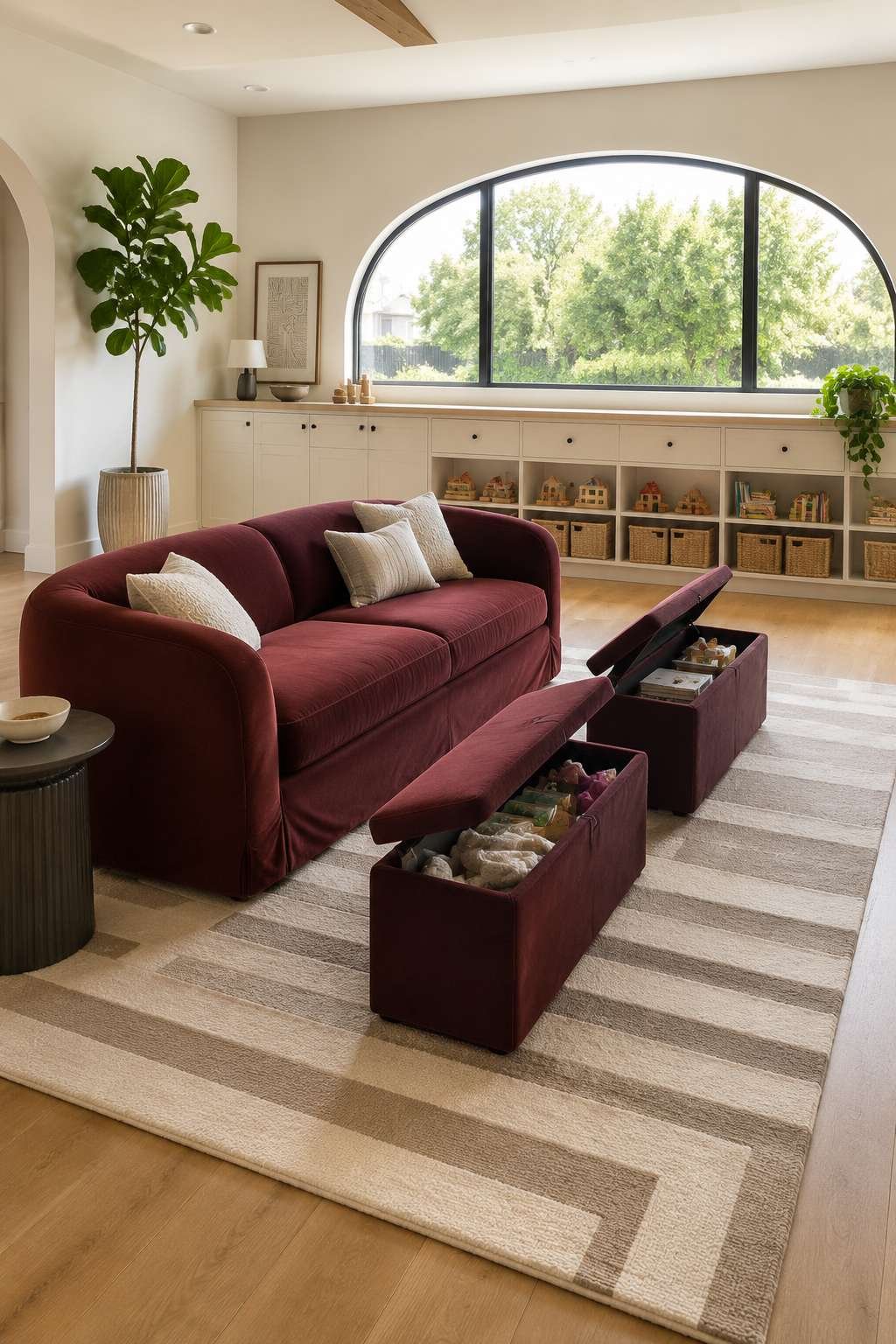
Practical shelving with baskets for toy storage integrates seamlessly into the bookcase wall, the baskets providing concealed, organized storage that can be deployed and returned with minimal effort. The combination of open shelving for decorative display and basket storage for toys and practical items creates a wall of considerable visual interest and genuine functional value. Natural midday light from large picture windows floods this realistic and functional family space with the brightness that keeps it feeling clean, open, and genuinely livable — proving that good design and real family life are not merely compatible but can be genuinely, beautifully unified.
Key Design Tips:
- Choose performance fabric upholstery with removable washable covers in deep burgundy for a family-proof sofa that maintains design quality under daily use
- Use storage ottomans in matching burgundy fabric as multifunctional pieces that provide seating, surface space, and concealed storage simultaneously
- Maintain cream or soft white walls in family living rooms to maximize light reflection and prevent dark upholstery from overwhelming the space
- Integrate basket storage within open shelving for a family-friendly display wall that conceals practical items while maintaining visual coherence
- Select medium-toned oak flooring for its warmth, durability, and forgiving quality in high-traffic family spaces
Conclusion
The twenty-one burgundy living room ideas explored throughout this article represent the full breadth of what this extraordinary color can achieve in domestic space. From the velvet grandeur of a high-ceiling townhouse draped in claret silk to the practical intelligence of a family room upholstered in performance fabric, burgundy has proven itself one of the most versatile and emotionally resonant colors available to interior designers and homeowners alike.
What unites every concept in this collection is the recognition that burgundy is not simply a color choice — it is a design commitment. It asks you to think carefully about the materials that will accompany it, the lighting that will animate it, and the neutral tones that will allow it to breathe. When these decisions are made with intention and care, the results are consistently extraordinary: rooms that feel warm without being heavy, dramatic without being theatrical, and personal without being inaccessible.
The key takeaways from this exploration are clear: pair burgundy with warm metals like brass and gold for maximum harmony; balance deep tones with light walls, pale floors, or neutral upholstery to maintain visual openness; invest in quality textures — velvet, wool, silk, leather — because burgundy rewards material richness; and layer your lighting to ensure the color is animated beautifully at every hour of the day. Whether you choose to introduce burgundy through a single velvet armchair, a dramatic accent wall, or an all-encompassing maximalist palette, the color will reward your courage with a living room of extraordinary beauty and timeless appeal.
