


Few furniture choices carry as much quiet power as a light grey couch. It is the rare design anchor that manages to feel both neutral and intentional, blending seamlessly into a wide range of aesthetics while still commanding visual attention. Whether you are starting from scratch in a new home or refreshing a tired living space, a grey sofa offers a uniquely flexible foundation upon which virtually any design vision can be built. From the warmth of farmhouse styling to the precision of minimalist modernism, grey works with — never against — your creative instincts.
The living room is the emotional heart of any home. It is where families gather, guests are welcomed, and individuals find their private moments of rest and reflection. Getting this space right means balancing visual harmony, functional comfort, and personal expression in equal measure. A light grey sofa achieves this balance naturally. Its cool-to-neutral undertones complement warm wood tones, bold accent colors, natural textures, and metallic finishes alike, making it an endlessly adaptable design tool in the hands of both professional decorators and inspired homeowners.
In this article, we explore 21 distinct living room concepts, each centered on a light grey couch and interpreted through a unique design lens. From Scandinavian minimalism and coastal breezy styling to art deco glamour, wabi-sabi tranquility, and urban industrial character, these ideas span the full spectrum of contemporary interior design. Whatever your personality, lifestyle, or budget, there is a grey couch living room concept here that will speak directly to your vision.
1. The Cozy Heather Grey Sanctuary: A Textured Haven of Warmth
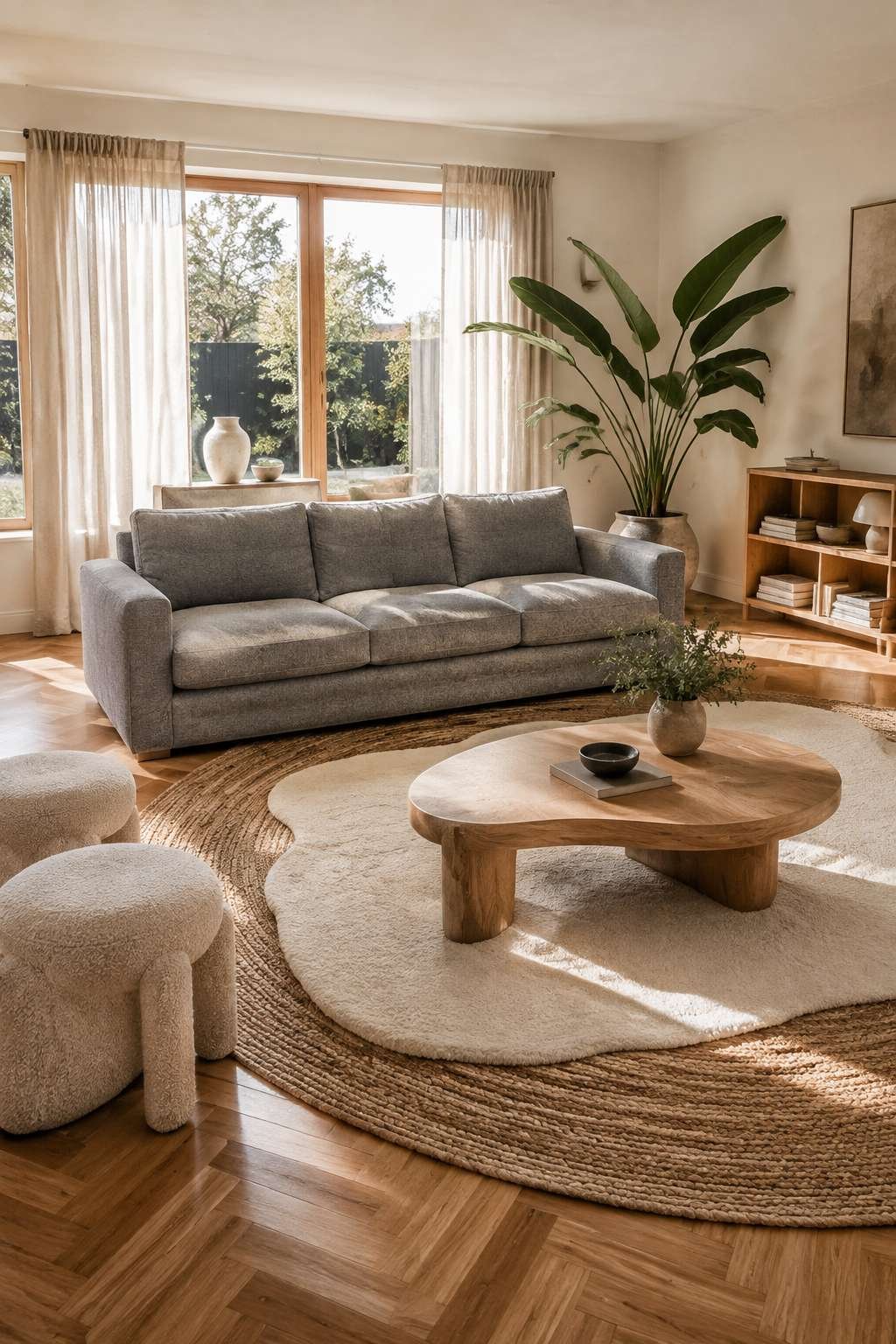
There is something deeply restorative about a living room that wraps you in comfort the moment you step inside. This concept achieves that feeling through a deep-seated three-cushion sofa in soft heather grey fabric with a subtle woven texture that rewards the eye on close inspection. The weave catches light differently throughout the day, shifting from cool silver in the morning to a warmer ash tone as afternoon sun enters the room. This dynamic quality gives the space a living, breathing quality that flat-painted surfaces simply cannot replicate.
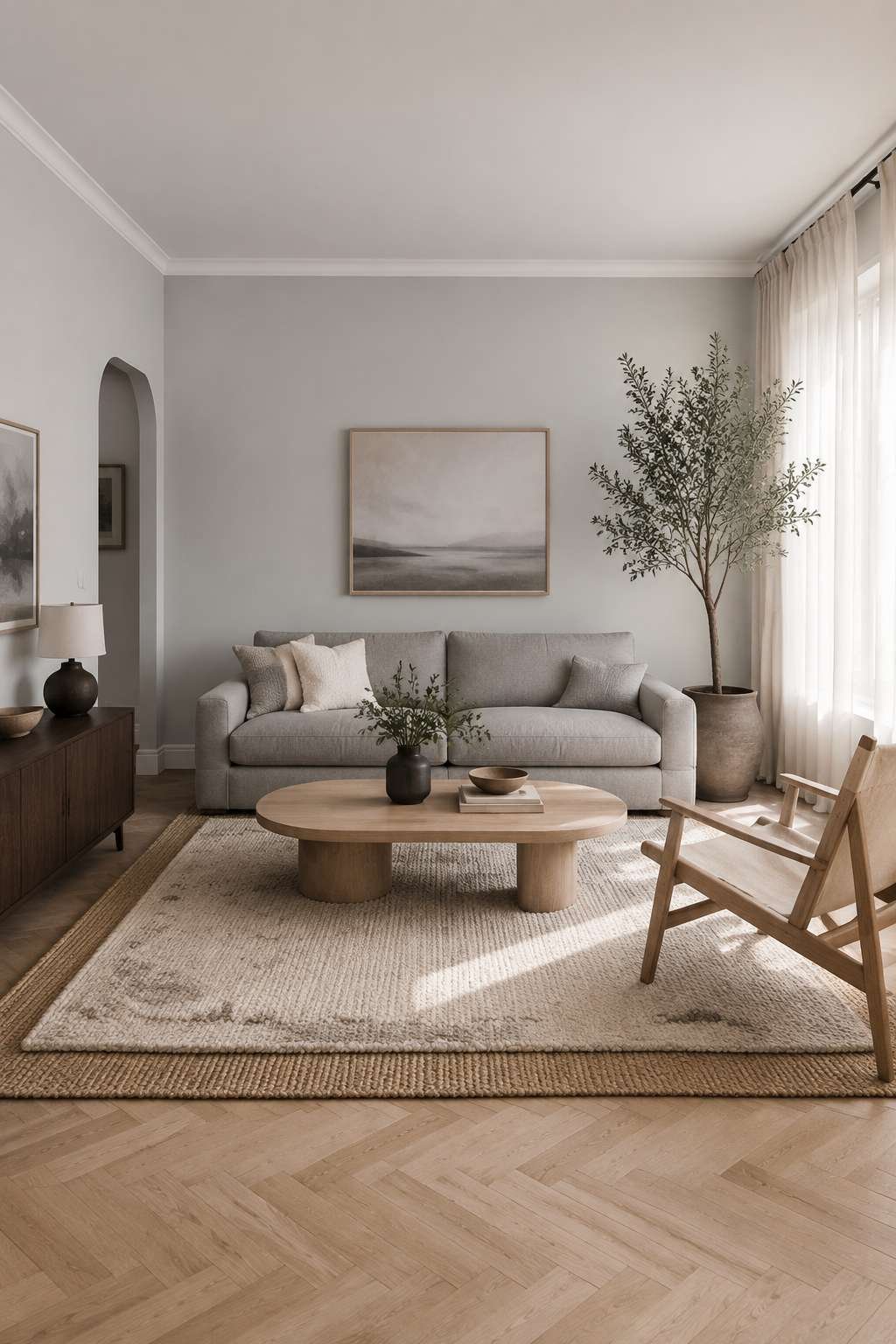
Grounding the arrangement is a bleached oak coffee table whose pale, almost driftwood-like finish echoes the sofa’s light tones without competing with them. Beneath the seating zone, layered jute and wool rugs in warm neutral tones introduce organic texture underfoot, creating a soft contrast with any hard flooring beneath. The layering technique — placing a smaller wool rug atop a larger jute base — is a designer favourite for adding depth without introducing pattern or color disruption.
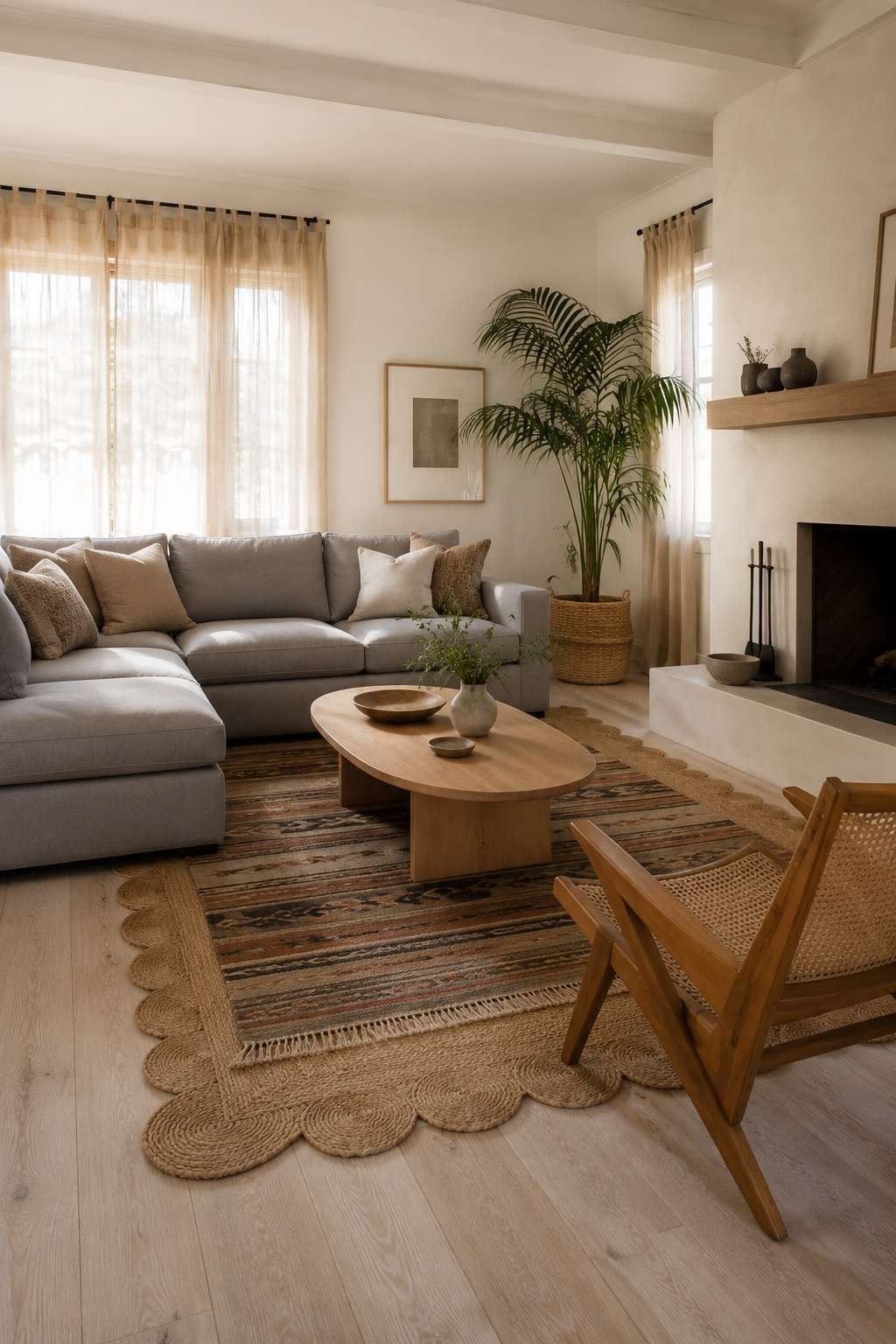
Sheer linen curtains diffuse afternoon sunlight into the space, wrapping the room in a soft, golden haze rather than harsh direct rays. This quality of light is essential to the cozy aesthetic: it softens edges, warms skin tones, and makes fabric textures glow with quiet richness. The overall palette — heather grey, bleached oak, warm jute, and cream linen — creates a seamless tonal story that feels curated yet effortless.
Key Design Tips:
- Layer a smaller wool rug over a larger jute rug to add texture depth without disrupting your neutral palette
- Choose sheer linen curtains over blackout panels to maintain softness and allow natural light diffusion
- Select a coffee table in bleached or pale oak to complement light grey upholstery without visual competition
- Invest in high-pile or woven fabric upholstery that catches directional light and adds tactile interest
- Keep decorative accessories in the same warm neutral family (cream, sand, oat) for cohesive calm
2. Scandinavian Mist: Clean Lines and Natural Calm
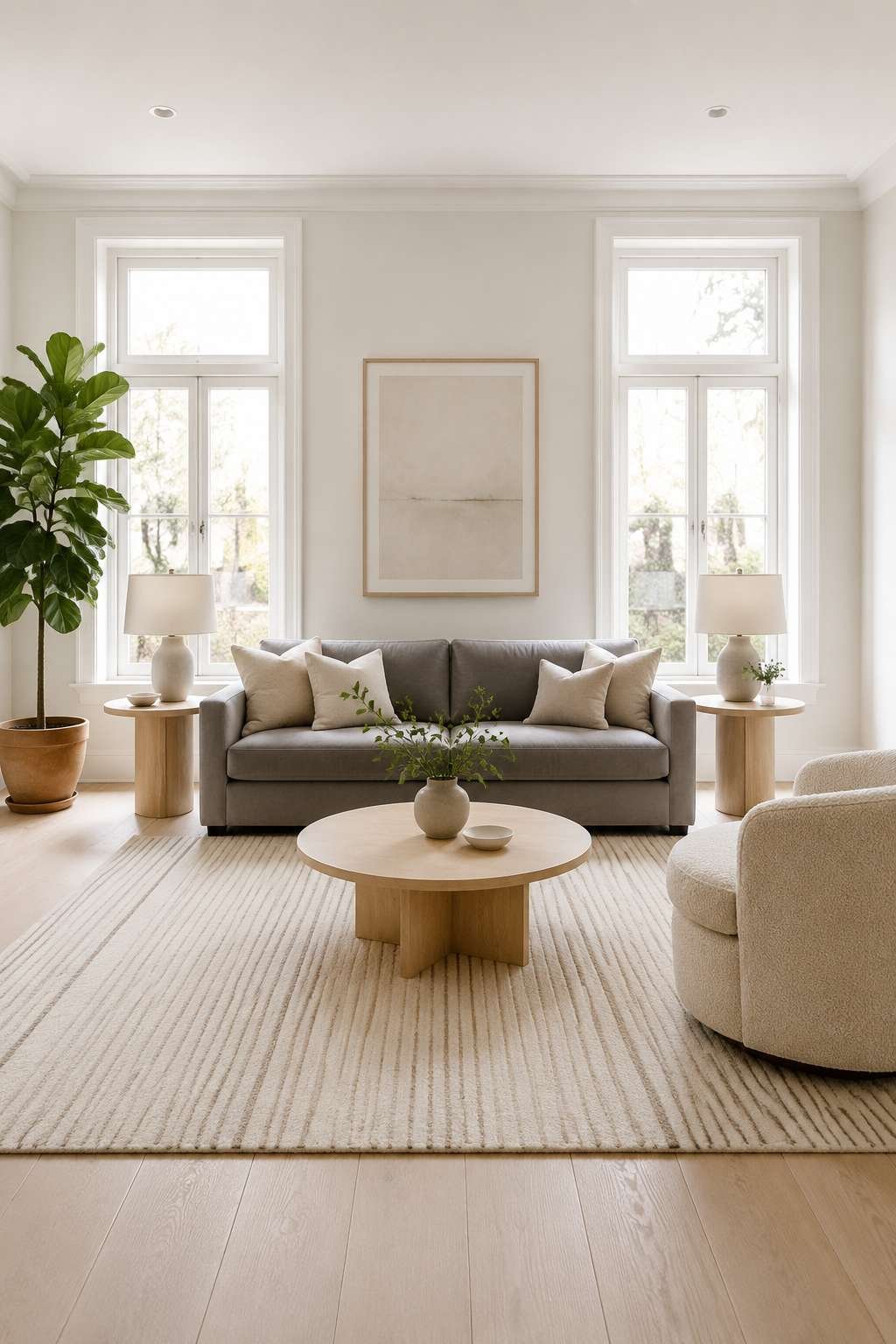
The Scandinavian design philosophy is rooted in a deep respect for materials, light, and purposeful simplicity. In this living room concept, a low-profile velvet sofa in mist grey anchors the space with quiet confidence, its plush surface inviting both relaxation and visual admiration. The low silhouette — a hallmark of Nordic furniture design — keeps the room feeling open and airy, an essential quality in spaces where natural light and spatial clarity are prized above all else.
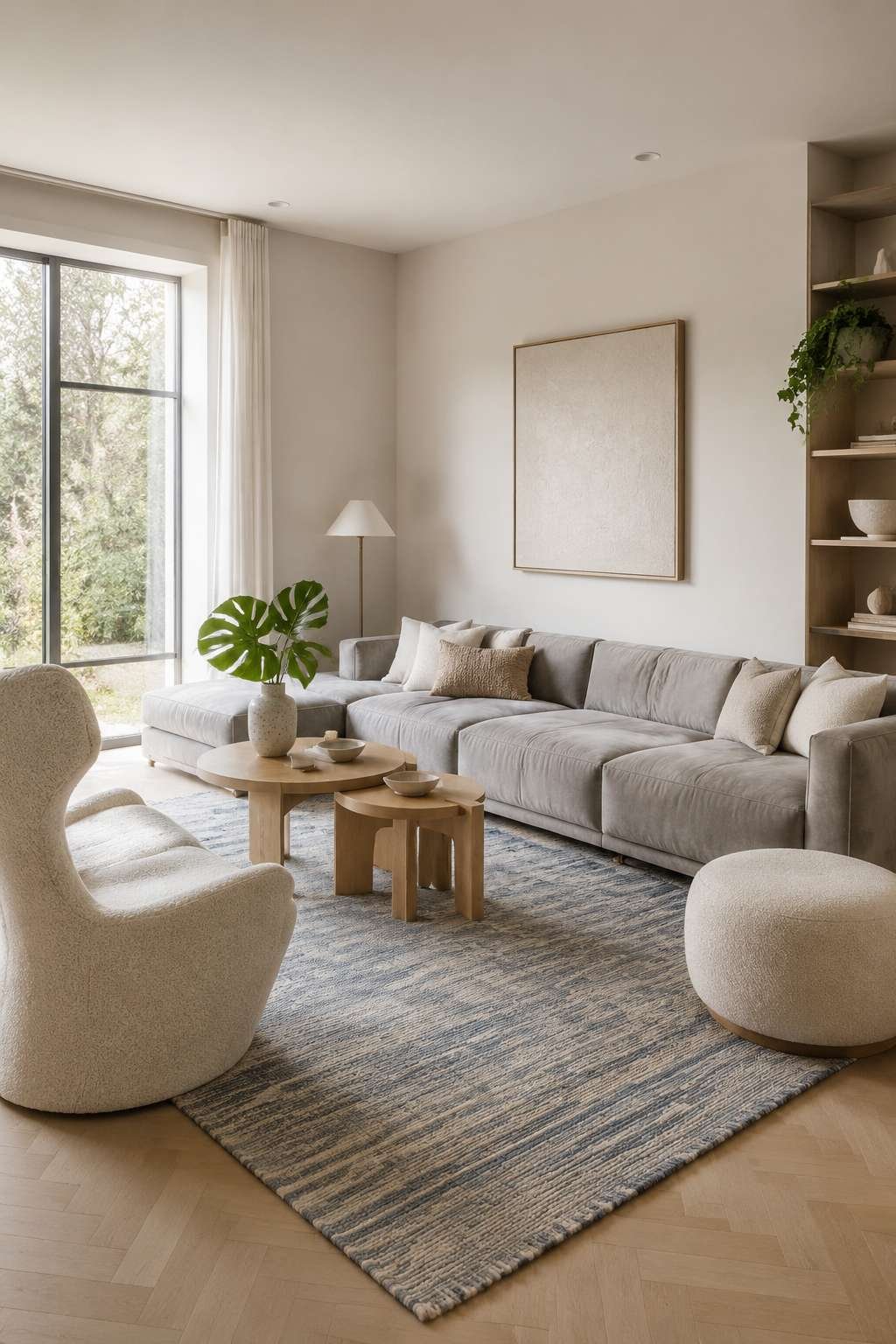
Matching birch side tables flank the sofa with characteristic Scandinavian symmetry, their pale wood grain introducing warmth without heaviness. Beside this cool, composed sofa arrangement, a cream boucle accent chair provides textural contrast that feels luxurious without being loud. The boucle fabric — with its looped, cloud-like surface — is one of the most beloved materials in contemporary Nordic-inspired interiors, offering softness, warmth, and an organic irregularity that perfectly offsets the sofa’s smooth velvet.
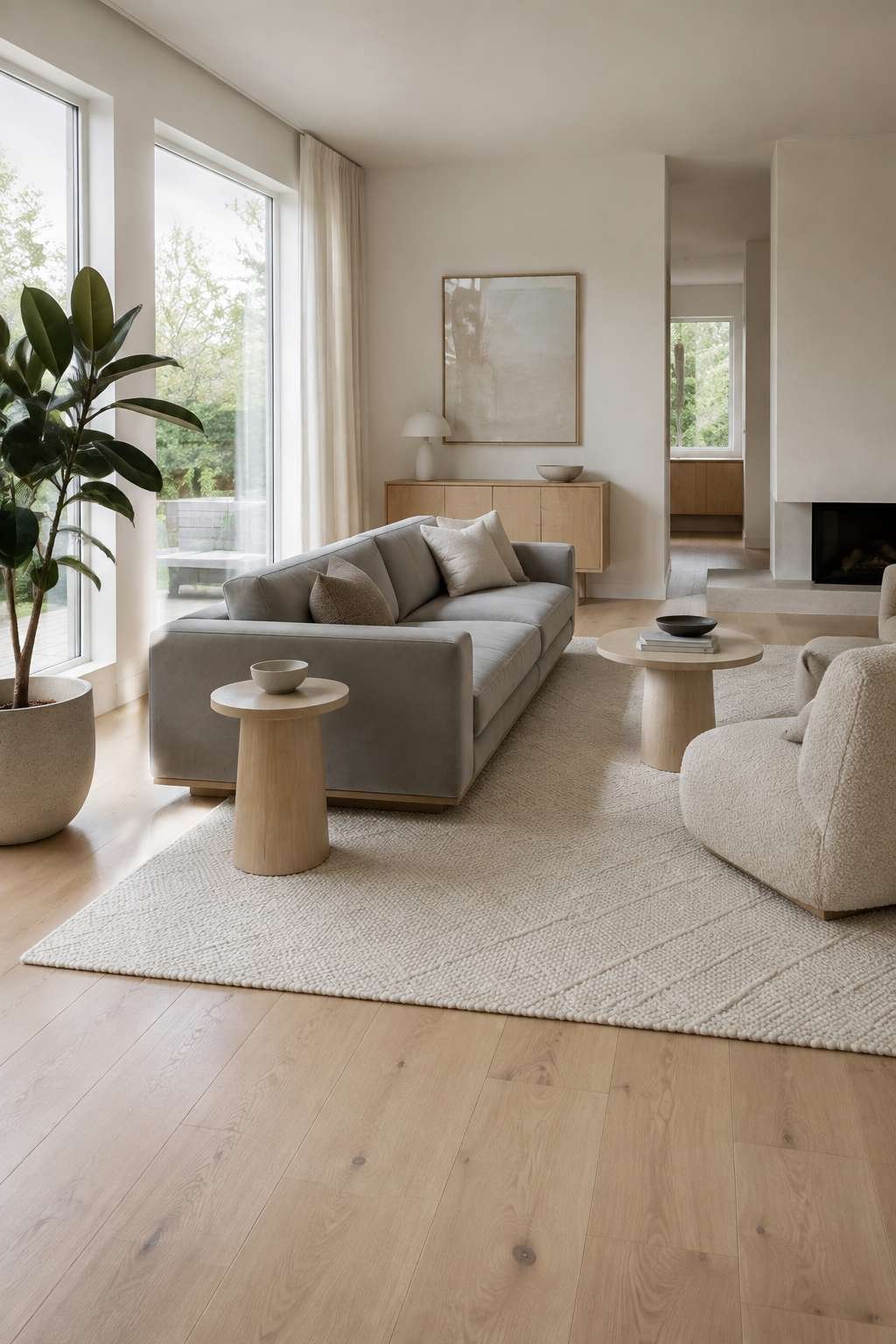
Living greenery plays an essential role in Scandinavian interiors, and here potted fiddle-leaf figs in terracotta pots introduce a note of organic life that prevents the neutral palette from feeling sterile. The terracotta pots — warm, earthy, and tactile — provide the single most important moment of warmth in the room, grounding the cool misty greys and creams with a vital earthy anchor. Soft diffused morning light through oversized windows bathes every surface in the kind of gentle, even illumination that makes Scandinavian interiors look so effortlessly beautiful in photographs.
Key Design Tips:
- Choose a low-profile sofa silhouette to maintain the airy, open feeling central to Scandinavian design
- Introduce a boucle or textured accent chair to add warmth and tactile contrast beside a velvet sofa
- Use terracotta or clay pots for indoor plants — their warmth is the perfect counterpoint to cool grey and cream
- Keep side tables in pale birch or beech to maintain tonal consistency with Nordic timber traditions
- Allow oversized windows to remain unobstructed or dressed only in sheer white panels to maximize morning light
3. Dove Grey Modular Minimalism: Architecture Meets Comfort
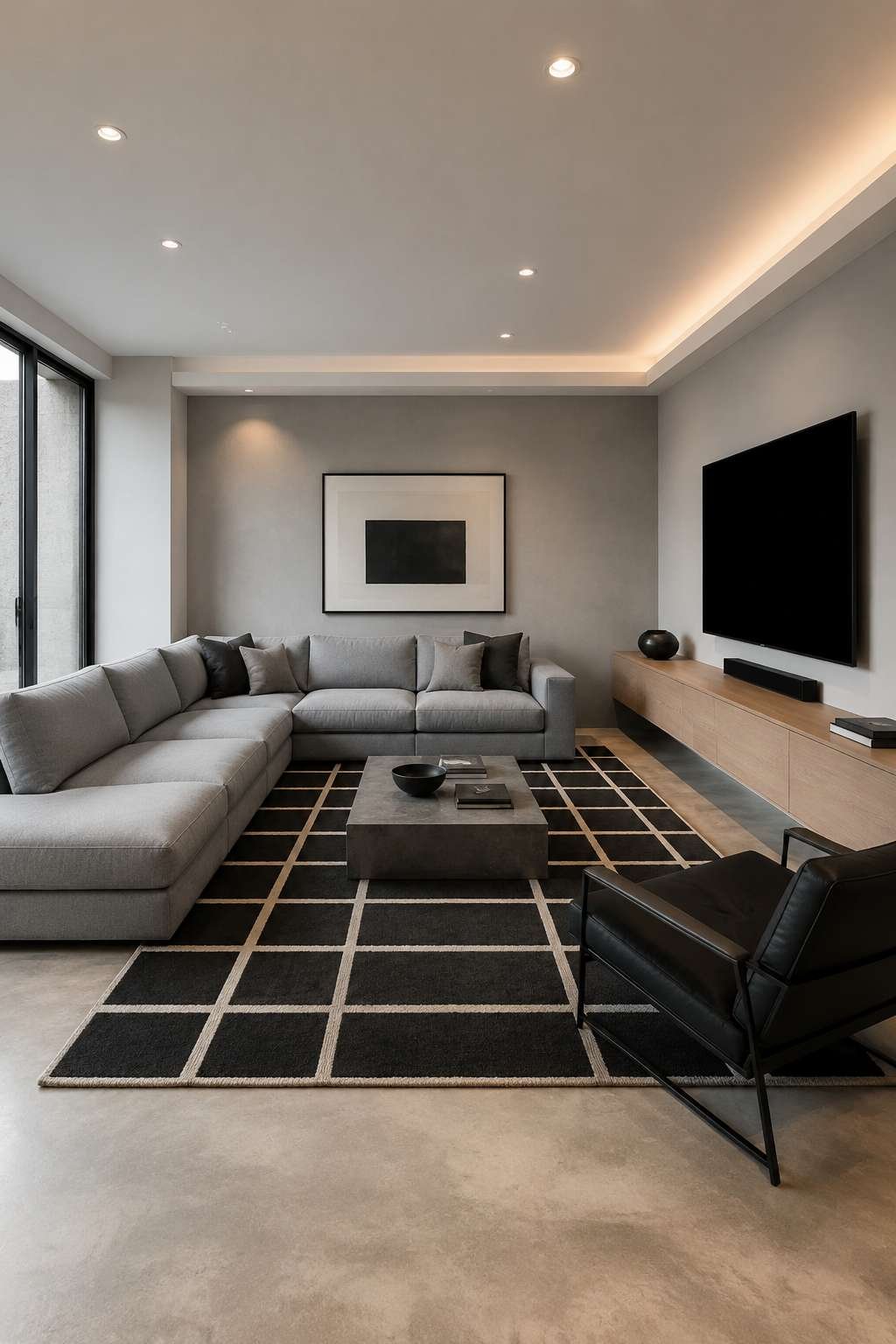
Modern minimalism is not about emptiness — it is about intentionality. Every element in this living room earns its place through function, proportion, and material quality. At the center sits a modular sectional sofa in cool dove grey performance fabric, a choice that speaks to both aesthetic precision and practical intelligence. Performance fabrics — engineered for durability, stain resistance, and easy cleaning — are increasingly the material of choice for design-conscious homeowners who refuse to sacrifice beauty for practicality.
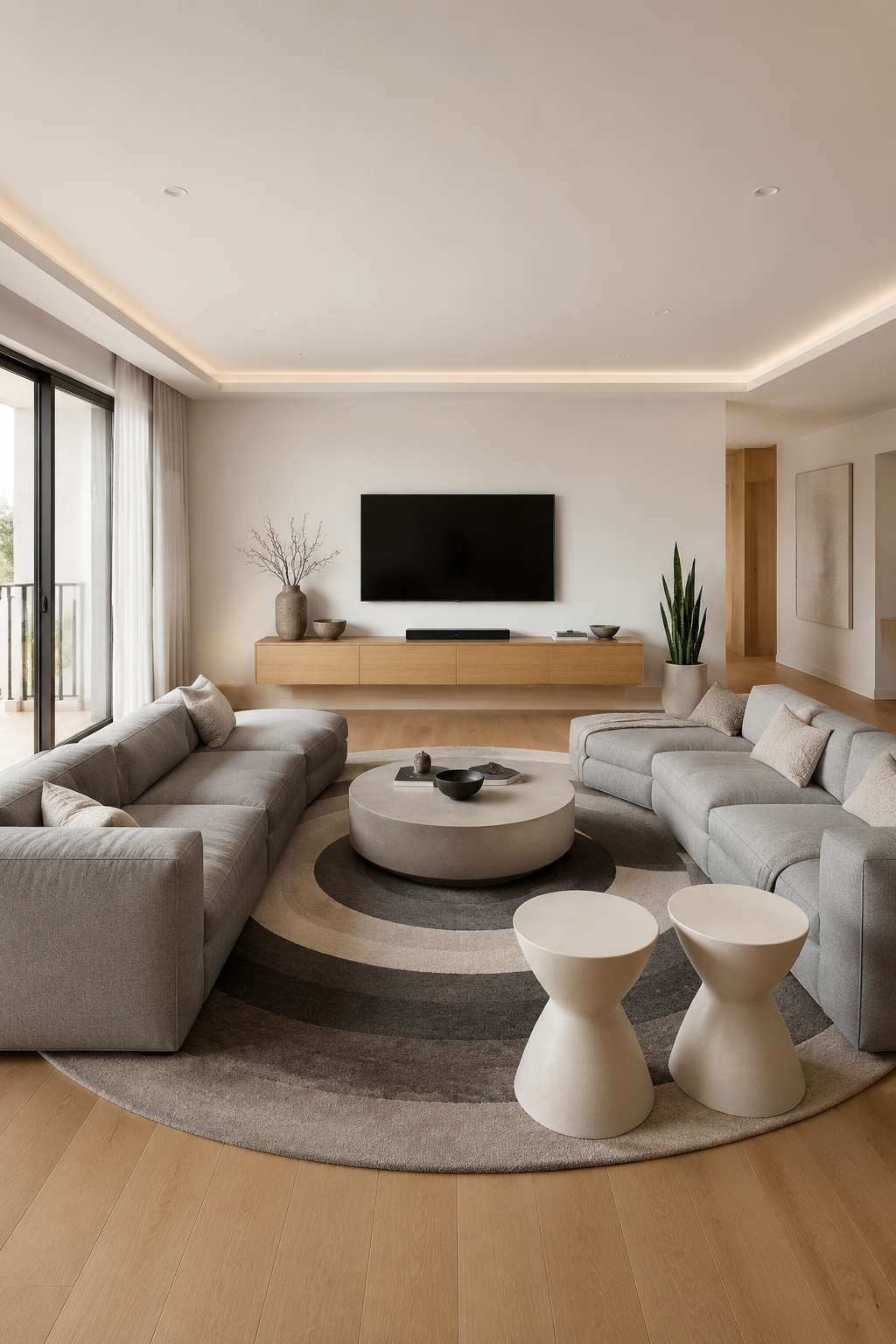
The large geometric monochrome rug beneath the sectional defines the living zone with graphic clarity while maintaining the room’s cool, restrained palette. Geometry in rugs serves a dual purpose in minimalist spaces: it introduces visual interest without color disruption and reinforces the architectural sensibility of the overall design. The rug’s pattern is felt rather than loudly announced, which is precisely the right balance in a space defined by discipline.
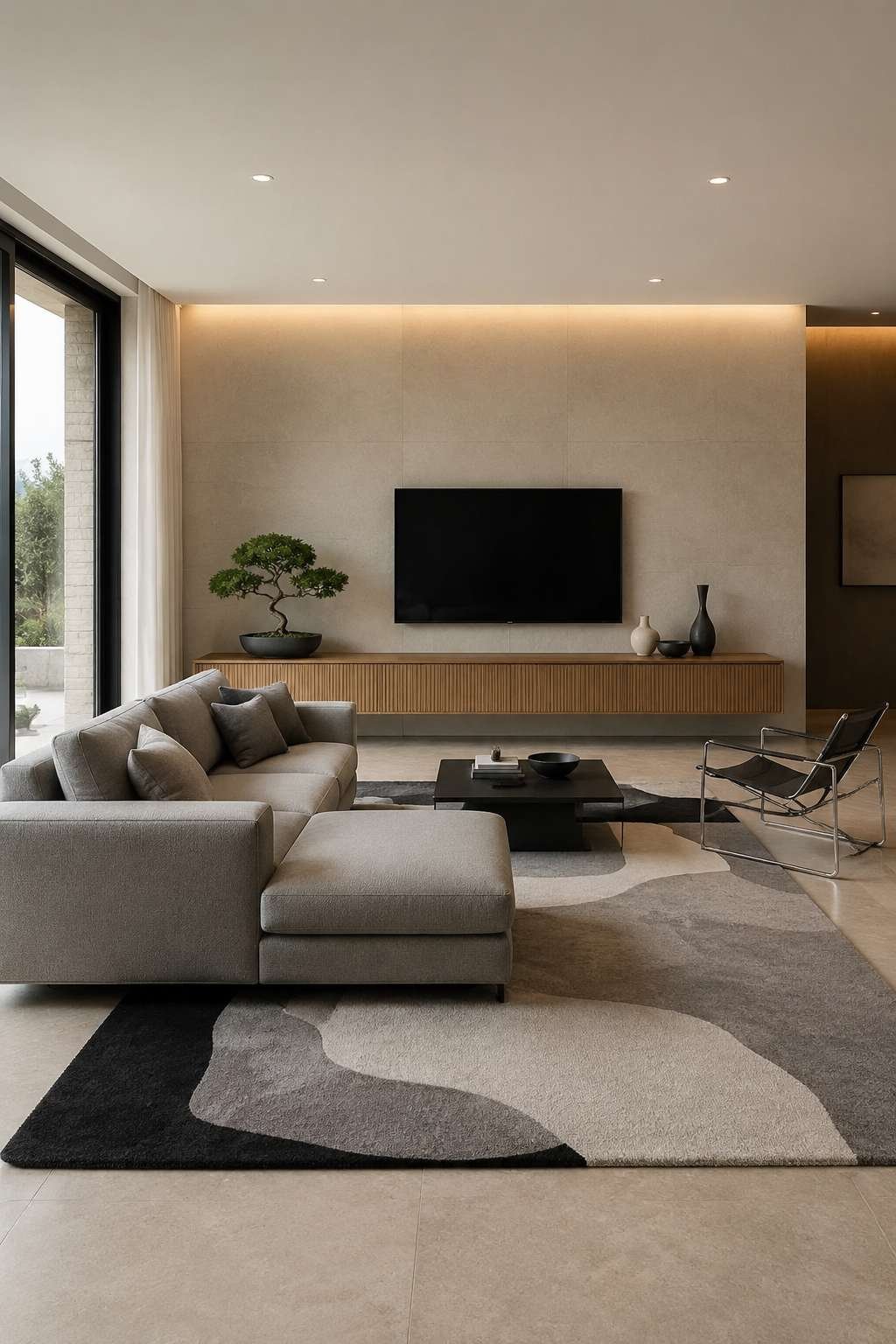
Across the room, a floating media console in white oak anchors the opposite wall with horizontal elegance. The grain of the white oak — subtle, linear, and quietly beautiful — adds natural warmth to what might otherwise feel like a clinical arrangement. Recessed ceiling lights provide ambient illumination in soft pools, avoiding the harsh uniformity of flush ceiling panels and instead creating a gentle play of light and shadow that brings the room’s material palette to life. The result is a space that feels both architecturally rigorous and genuinely livable.
Key Design Tips:
- Choose modular sectional configurations that can adapt to different room layouts and future needs
- Invest in performance fabric upholstery for households that value both design integrity and practical durability
- Use a geometric monochrome rug to introduce graphic interest without disturbing a minimal color palette
- Install recessed ceiling lights rather than surface-mounted fixtures to maintain clean ceiling lines
- Select media consoles in white oak or light ash to bring warmth into a cool-toned minimalist scheme
4. Bohemian Warmth: Layers, Texture, and Soulful Character
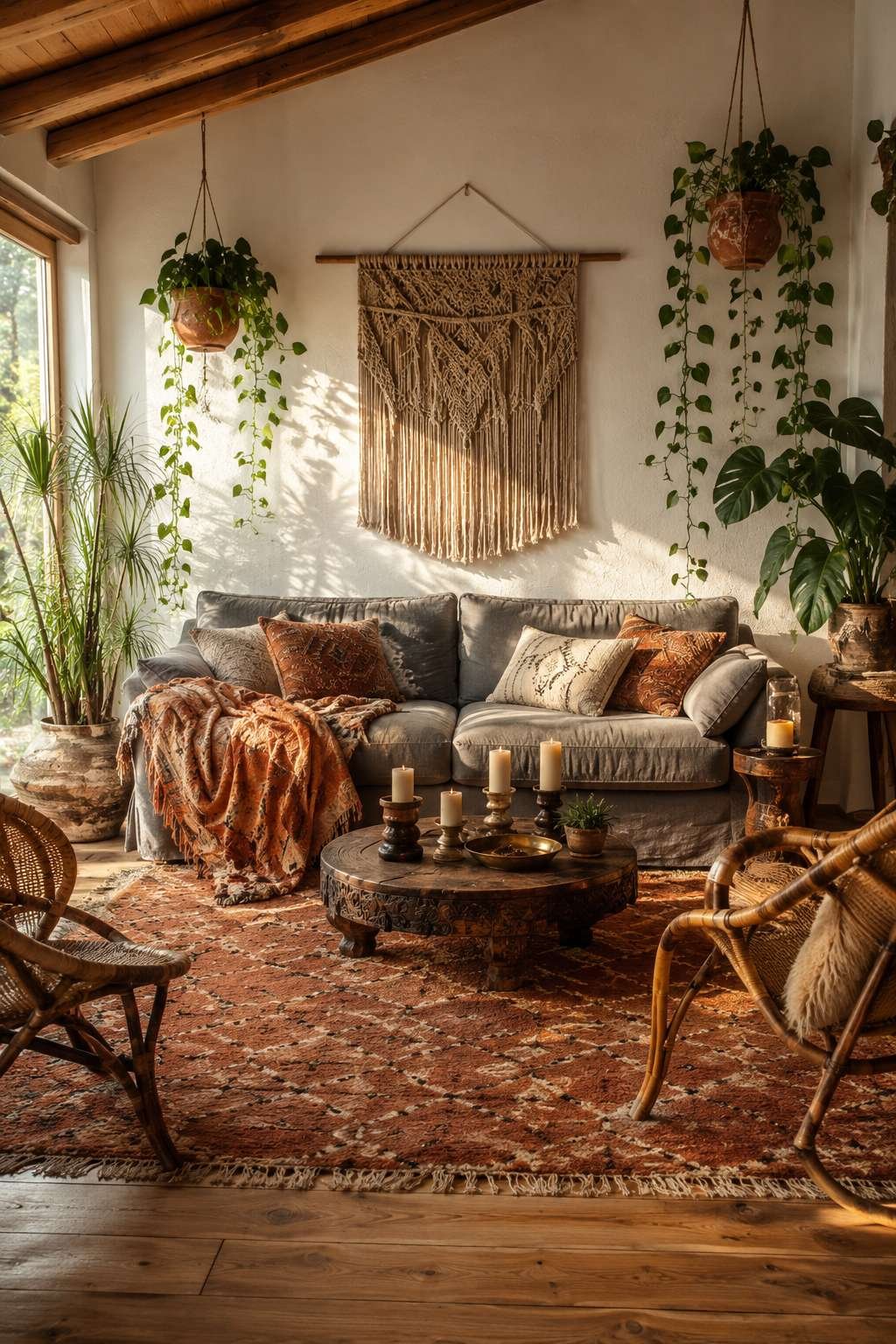
Bohemian interiors celebrate a joyful accumulation of stories, textures, and cultures. In this concept, a slouchy linen sofa in warm ash grey becomes the relaxed centerpiece of a room that is equal parts art installation and lived-in home. The sofa’s generous, slightly disheveled proportions — deep cushions, relaxed back pillows, unhurried arms — immediately communicate an invitation to settle in and stay a while. Draped across it, a hand-woven Moroccan throw in terracotta and cream introduces the first note of cultural warmth that defines the boho aesthetic.
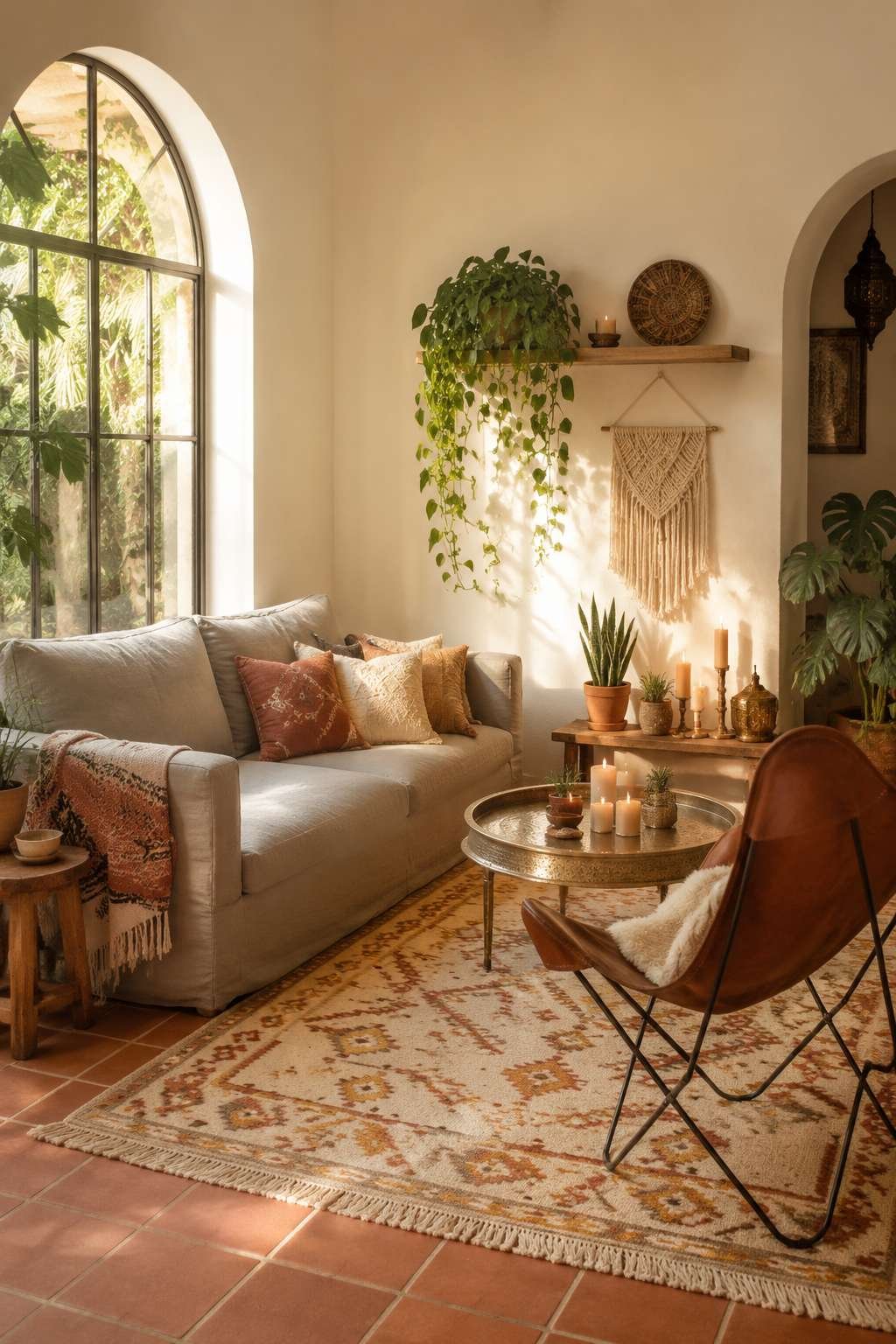
Mixed-height candles grouped on the coffee table create an intimate, ceremonial atmosphere when lit, while macramé wall hangings above the sofa add handmade texture and vertical interest. The macramé — with its knotted, organic forms — speaks to the bohemian reverence for craft, tradition, and the human hand. Trailing pothos plants cascade from shelves and hanging planters, filling the upper zones of the room with lush green vitality that feels spontaneous rather than staged.
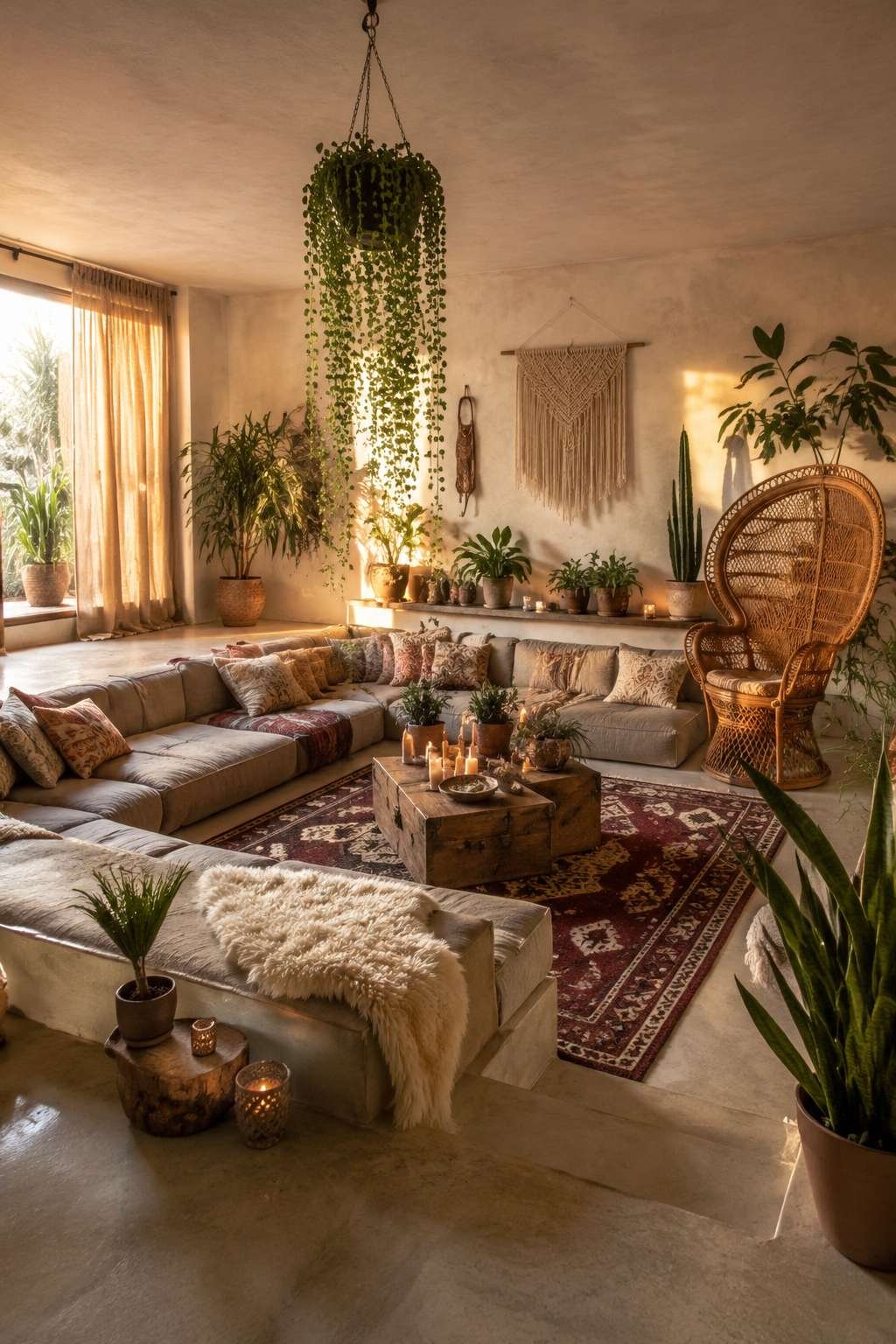
Golden hour sunlight transforms this space with particular magic. As late afternoon light enters the room, it turns the terracotta tones to burnished copper, warms the linen sofa to a richer honey-ash, and sets the macramé fibres glowing. The layering of textiles — rug over rug, throw over cushion, hanging over wall — creates a space that rewards slow, contemplative looking, revealing new details with every glance. This is interior design as emotional experience, and the light grey linen sofa is the perfectly understated anchor at its heart.
Key Design Tips:
- Layer a hand-woven throw in terracotta or rust tones over a light grey sofa to immediately introduce bohemian warmth
- Group candles at varying heights on coffee tables and sideboards for intimate, atmospheric evening lighting
- Incorporate trailing plant varieties like pothos or ivy to fill vertical space organically and without effort
- Choose macramé or woven wall hangings as textural art pieces that reinforce the craft-forward boho spirit
- Combine multiple rug layers in complementary patterns and textures to build the characteristic boho depth
5. Industrial Edge: Raw Textures and Urban Grit

The industrial aesthetic finds beauty in the unfinished, the structural, and the utilitarian. This living room pairs a firm two-seater sofa in charcoal grey upholstery with exposed brick walls and polished concrete flooring — a combination that delivers immediate urban character and material authenticity. The sofa’s firm structure and clean lines feel entirely at home against the rough texture of the brick, the contrast between refined upholstery and raw masonry creating a compelling visual dialogue.
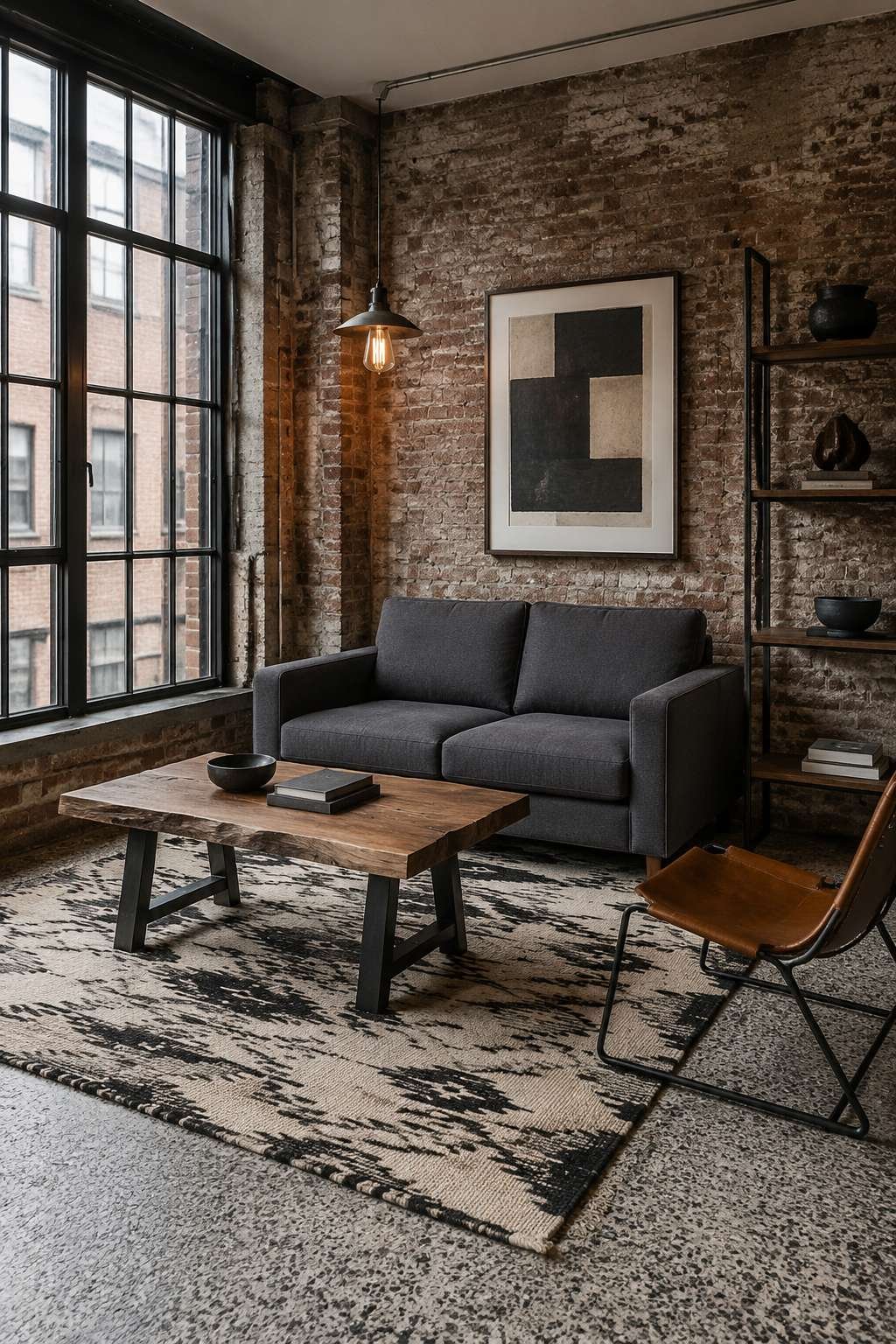
At the center of the seating arrangement, a reclaimed wood coffee table with metal hairpin legs brings together the two dominant material languages of the industrial interior: salvaged organic material and machined metal. The hairpin legs — a design icon born in mid-century industrial manufacturing — are simultaneously minimal and characterful, lifting the coffee table visually while reinforcing the space’s structural aesthetic. The reclaimed wood surface, with its age marks and grain variation, introduces warmth that the cool concrete and brick cannot provide alone.
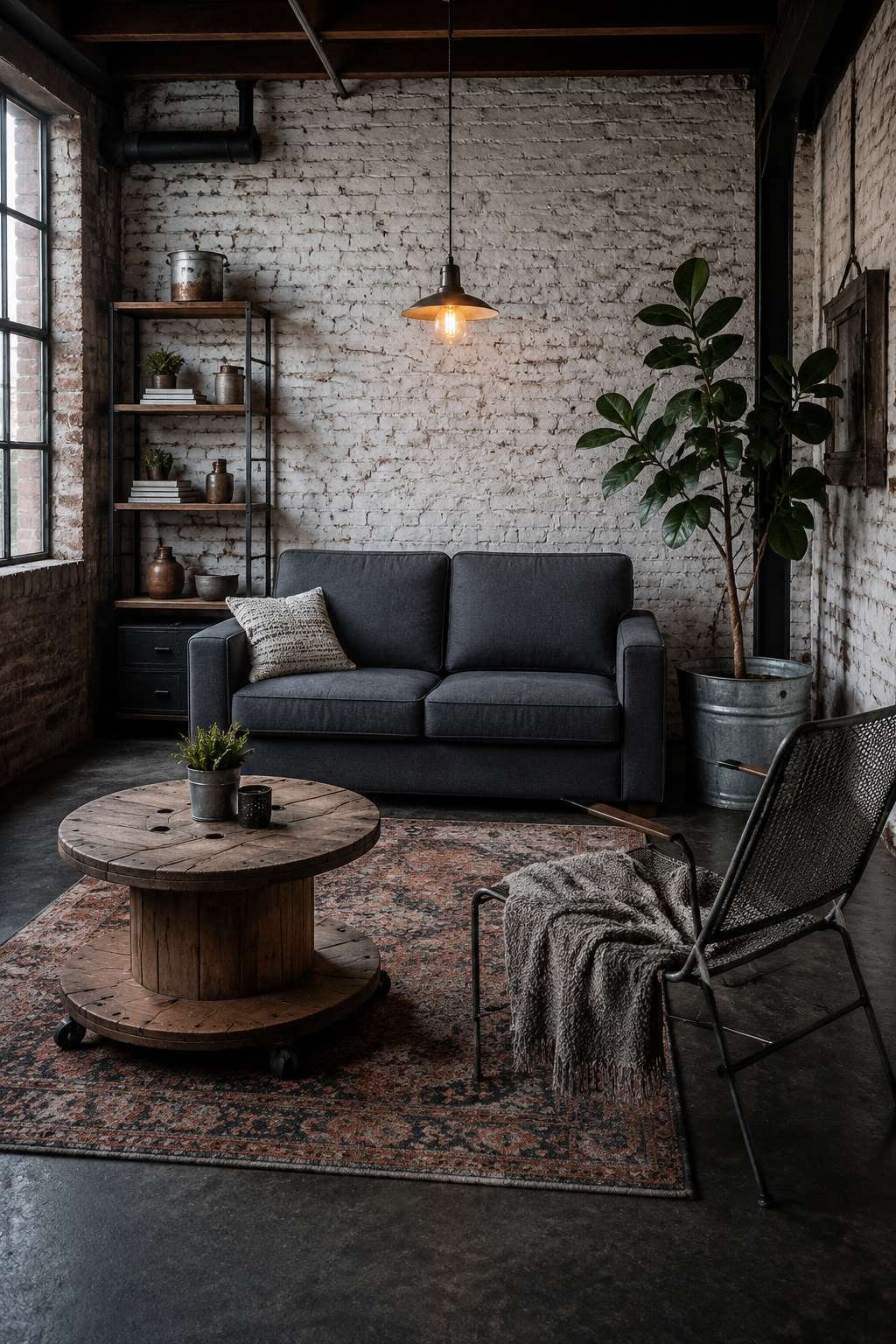
Overhead, Edison bulb pendant lights hang in warm amber clusters, their filament-visible globes providing a deliberate contrast to the cool, hard surfaces below. This warm-against-cool tension is one of the industrial interior’s most effective tricks: the warmth makes the space feel habitable rather than harsh, while the raw materials ensure it never slips into conventional comfort. The charcoal grey sofa serves as the tonal bridge between the warmth of the Edison light and the coolness of the concrete, holding the palette together with quiet authority.
Key Design Tips:
- Pair a charcoal or dark grey sofa with exposed brick and concrete for maximum industrial material tension
- Choose reclaimed wood furniture with visible age marks to introduce organic warmth into the hard industrial palette
- Install Edison bulb pendants to create warm ambient contrast against cool concrete and metal surfaces
- Use metal hairpin legs on coffee tables and sideboards as a period-appropriate industrial design detail
- Keep accessories minimal and functional — leather, iron, and aged brass finishes reinforce the industrial character
6. Coastal Driftwood Dreams: Breezy, Bleached, and Beautiful
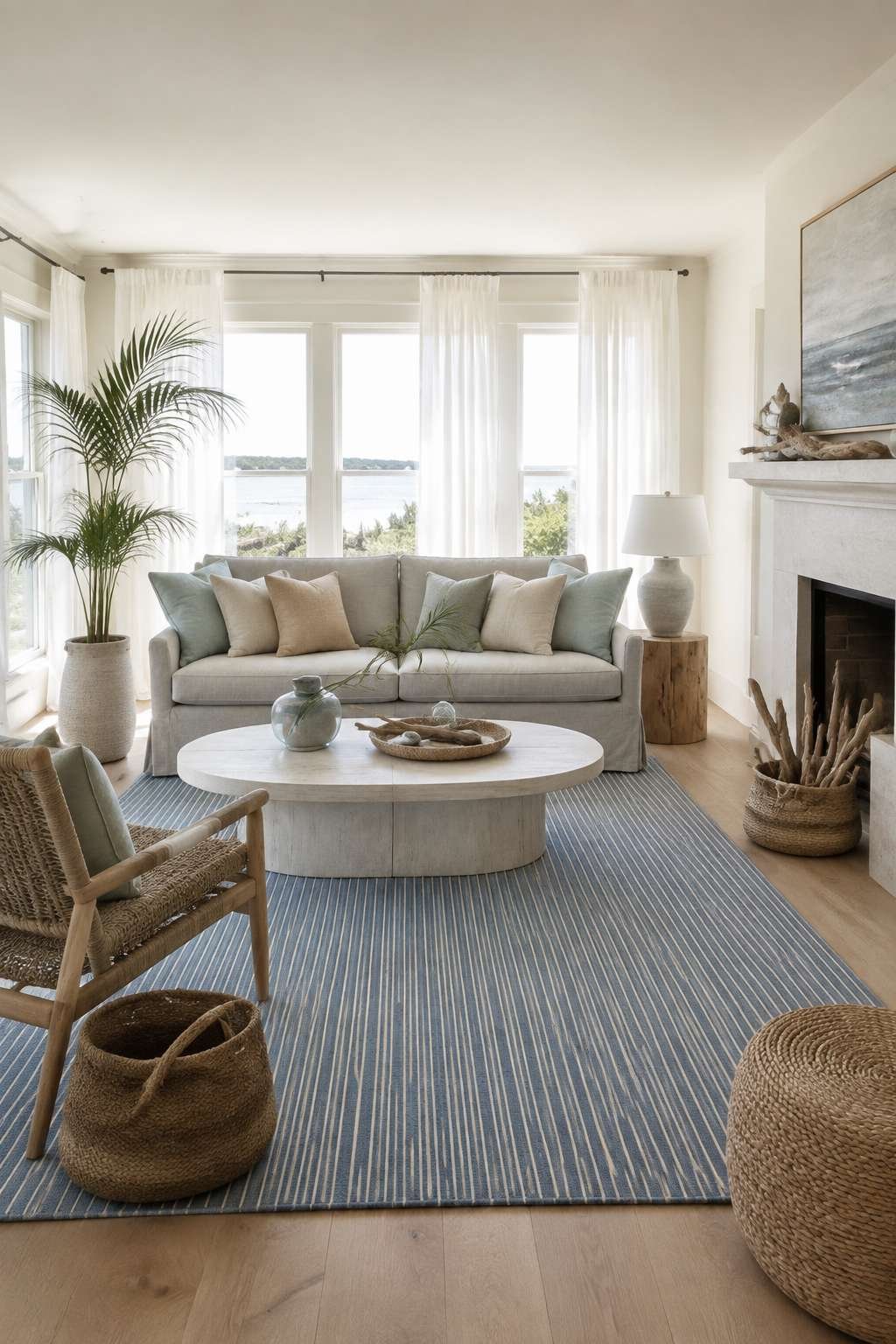
Coastal interiors distill the essence of a seaside life: salt air, sun-bleached wood, soft waves, and effortless ease. This living room achieves that feeling with a slipcovered sofa in faded driftwood grey linen, its relaxed, washable slipcover cover embodying the casual elegance of coastal living. Loose cushions in sand and seafoam tones complement the sofa’s sun-washed grey with the precise color palette of a summer beach — warm sand on one end, cool ocean green on the other.
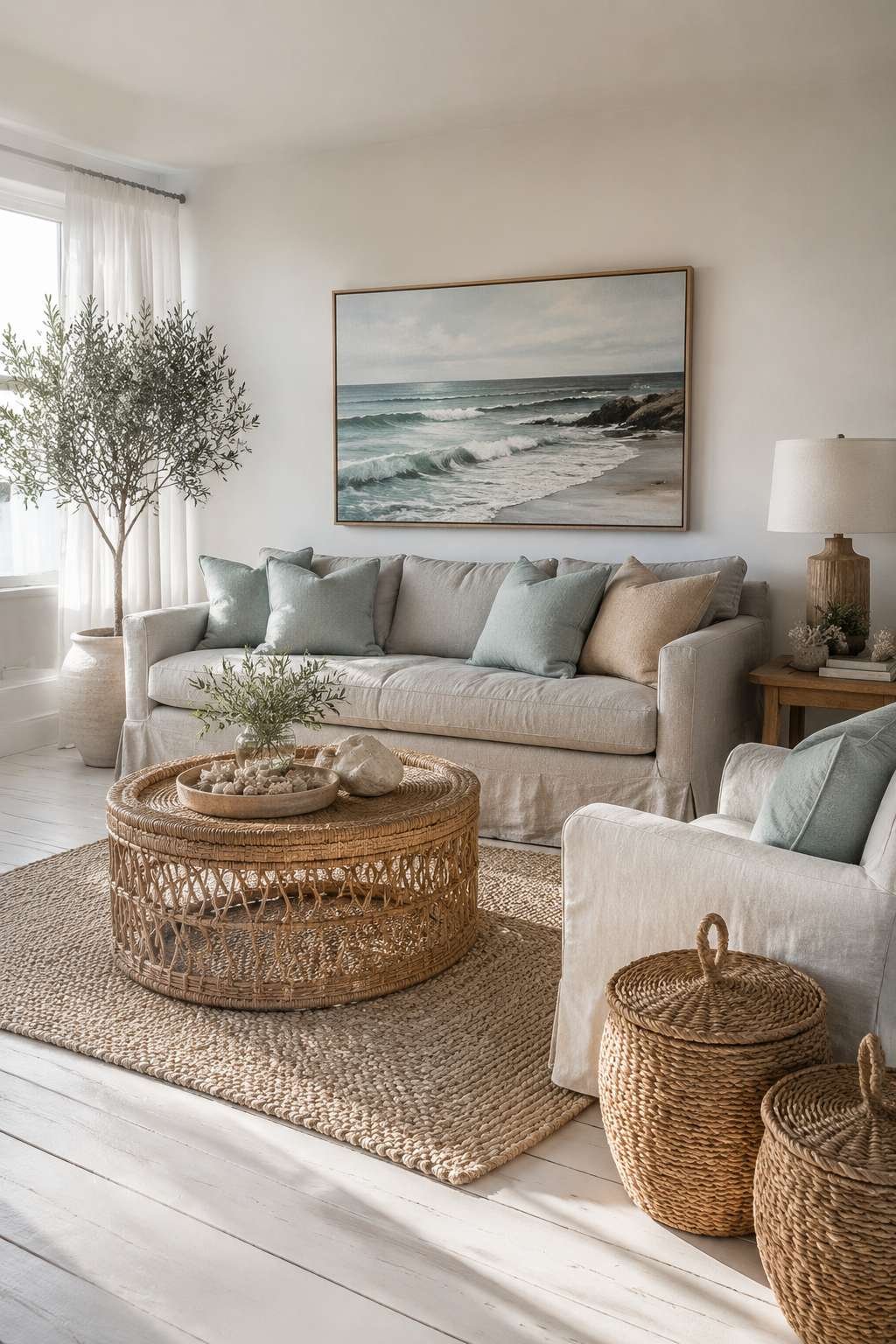
Woven seagrass baskets and bleached driftwood décor reinforce the coastal narrative throughout the room, each piece selected for its material connection to the natural shoreline. Seagrass — one of the most versatile and beautiful coastal materials — appears in baskets, trays, and occasional tables, its pale golden weave introducing warmth and texture in equal measure. Above the windows, sheer white voile curtains billow softly in any passing breeze, evoking the movement of sailcloth and diffusing bright mid-morning natural light into a luminous, even glow.
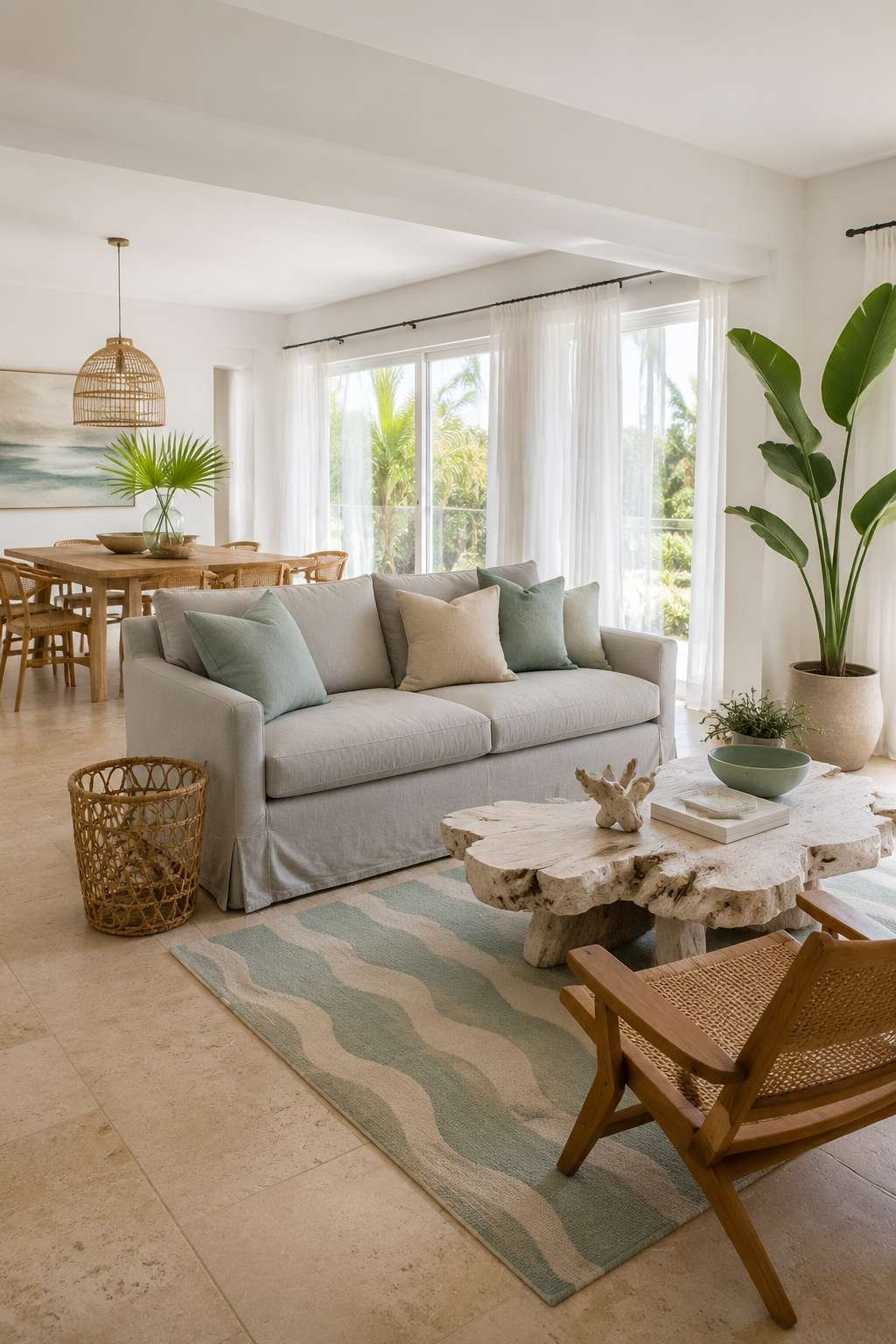
The overall atmosphere is one of unhurried ease — a space that feels perpetually ready for bare feet, light reading, and long afternoon conversations. The driftwood grey sofa is central to this mood, its faded, salt-washed tone feeling entirely natural in a room that celebrates the beautiful impermanence of coastal life. This is an interior that does not try too hard, and it is precisely that quality of effortlessness that makes it so deeply appealing.
Key Design Tips:
- Choose a slipcovered sofa in linen or cotton for coastal rooms — washable covers suit the casual, sand-tracked lifestyle
- Layer sand, seafoam, and white cushion tones over a driftwood grey sofa to instantly establish a coastal palette
- Incorporate seagrass baskets and bleached wood accessories as material references to the natural shoreline
- Hang sheer voile curtains rather than structured panels to maintain the breezy, light-filled coastal atmosphere
- Avoid overly polished surfaces — matte, worn, and natural finishes feel most authentic in coastal settings
7. Mid-Century Modern Warmth: Walnut, Wool, and Timeless Proportion
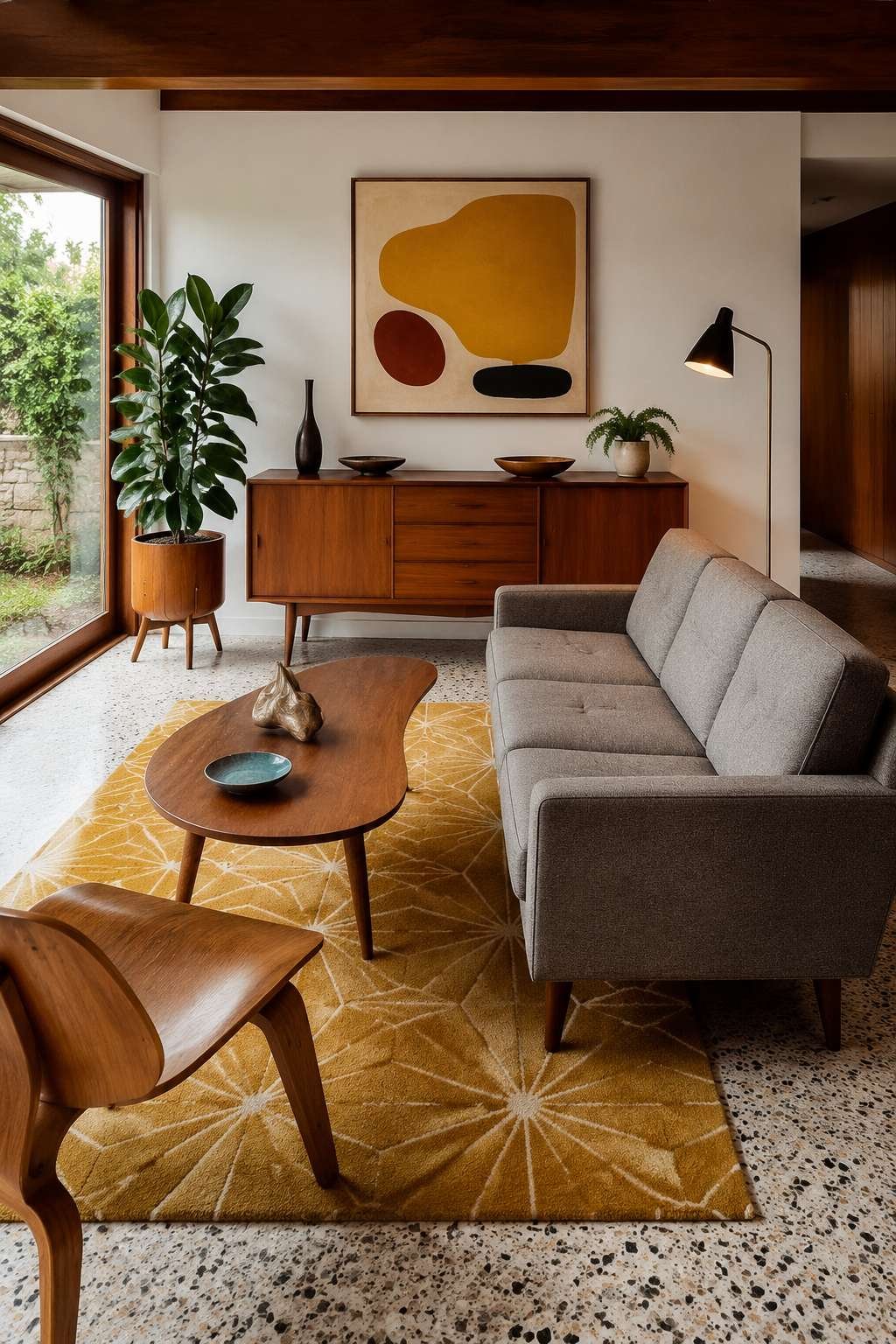
The mid-century modern interior has proven to be one of design history’s most enduring achievements, and for good reason. Its commitment to beautiful proportion, warm natural materials, and functional elegance produces spaces that feel simultaneously nostalgic and permanently relevant. In this concept, a structured three-seater sofa in medium grey wool flannel with tapered walnut legs immediately establishes the period’s characteristic balance of form and material warmth.
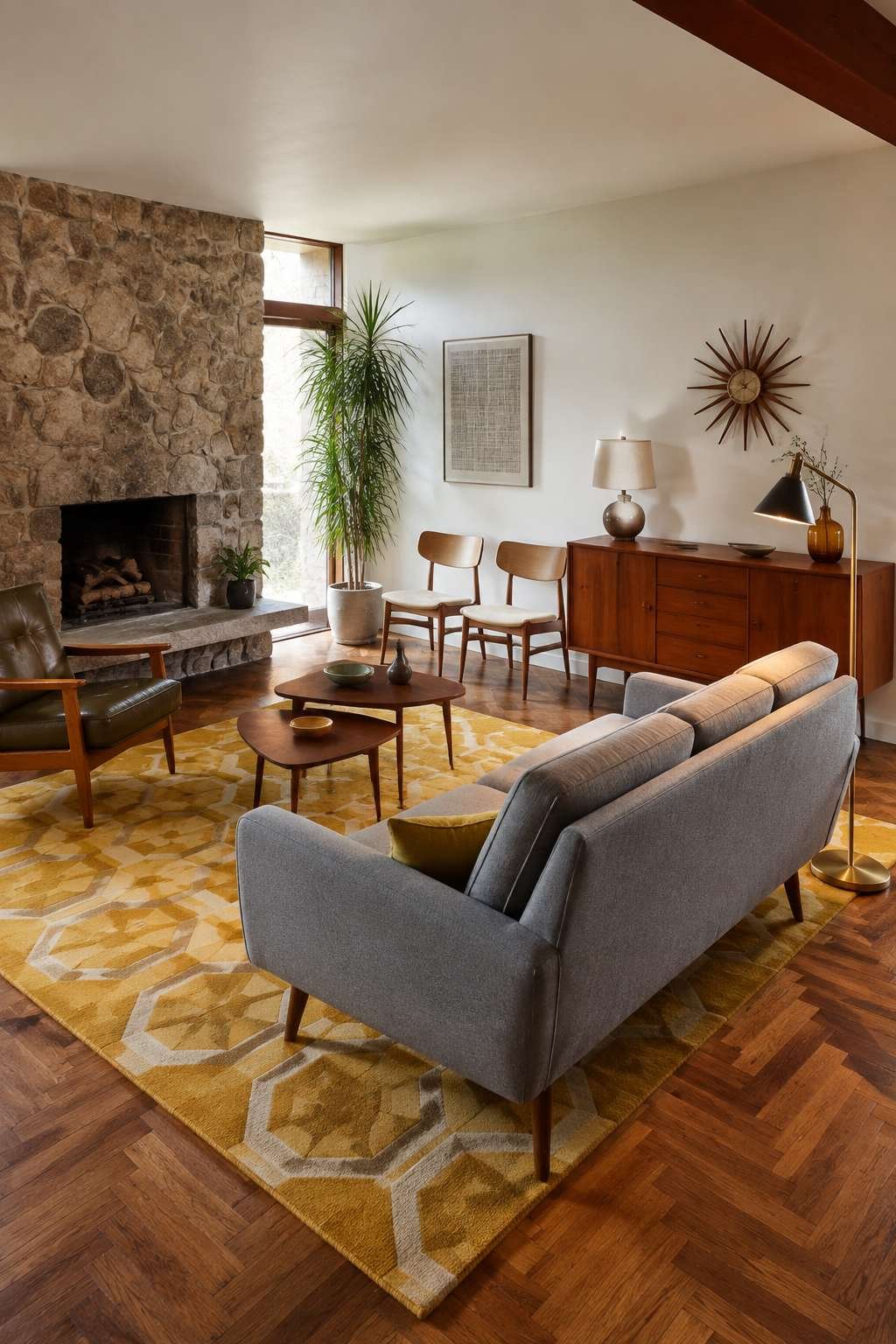
The teak credenza along one wall functions as a masterclass in mid-century storage design: low, long, and linear, it grounds the room’s horizontal emphasis while offering beautiful display and concealed storage. Eames-era side chairs complete the furniture arrangement, their iconic silhouettes providing conversation and visual punctuation that no other chair design can quite replicate. Beneath the seating arrangement, a mustard yellow geometric rug delivers the period’s love of bold accent color against neutral upholstery — a combination that remains as visually satisfying today as it was in 1960.

The lighting in this space — a warm directional floor lamp with a tapered shade — bathes the seating arrangement in that iconic warm mid-century glow. This style of floor lamp, positioned beside the sofa at reading height, was a fixture of the era’s domestic interiors, and it remains one of the most functional and atmospheric lighting choices available. The grey wool flannel sofa reads differently in this warm directed light than in neutral daylight — it becomes richer, warmer, more inviting — demonstrating how powerfully lighting shapes the experience of upholstery color.
Key Design Tips:
- Choose a sofa with tapered wood legs in walnut or teak as the essential mid-century design signal
- Pair medium grey wool upholstery with a mustard yellow or burnt orange area rug for authentic period contrast
- Include a teak credenza or sideboard as the anchor storage piece — its horizontal form defines the mid-century silhouette
- Use a warm-toned directional floor lamp beside the sofa to recreate the intimate, atmospheric mid-century lighting
- Source Eames-era or Danish modern accent chairs as conversation pieces that anchor the period narrative
8. Small Space Solutions: Compact, Smart, and Surprisingly Generous
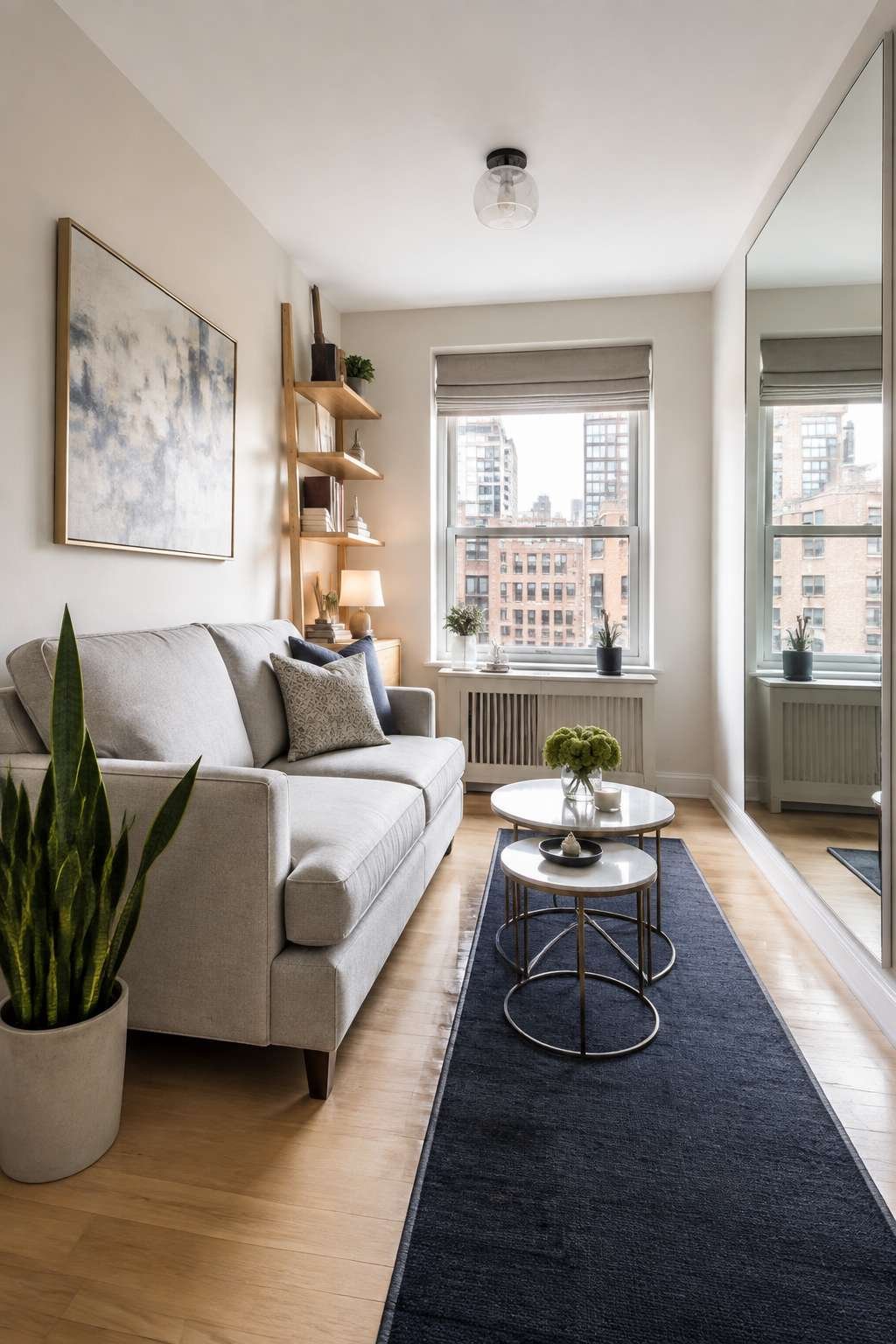
The challenge of designing a small apartment living room is one that most urban dwellers know intimately. The solution lies not in minimizing ambition but in maximizing intelligence. This concept demonstrates how a compact loveseat in pale silver-grey microfiber can feel generous and considered rather than apologetic and cramped. The pale silver-grey tone is a deliberate spatial strategy: lighter upholstery visually recedes rather than advances, making the sofa feel like a natural extension of the room rather than an obstacle within it.
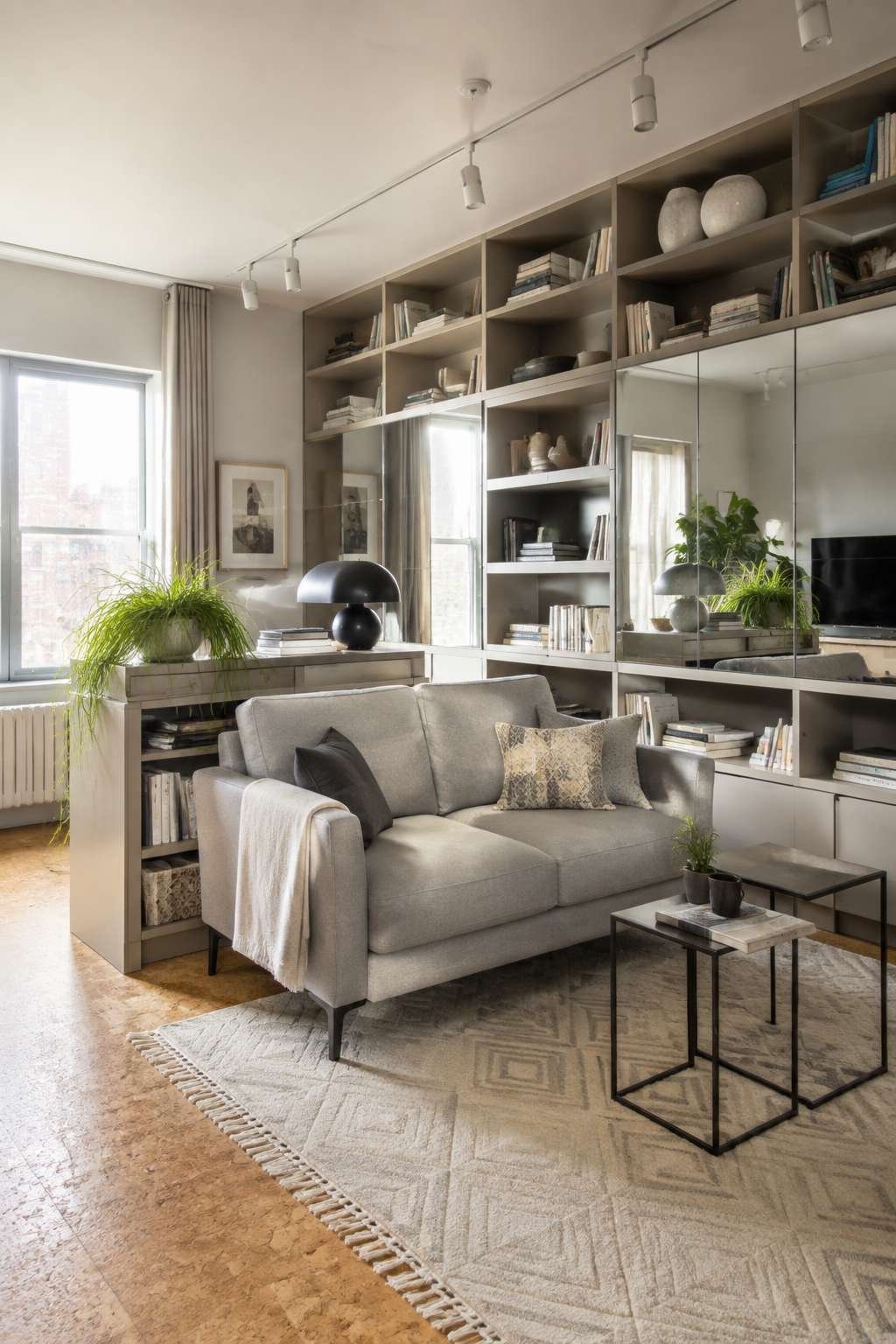
A slim nesting coffee table replaces the standard fixed coffee table, allowing the central floor space to expand and contract according to use. Nesting tables — one of the smartest pieces of furniture available to small-space decorators — provide surface area when needed and disappear when entertaining or exercising requires clear floor. Floor-to-ceiling open shelving along one wall maximizes vertical storage, drawing the eye upward and reinforcing the room’s height while providing organized display for books, plants, and personal objects.
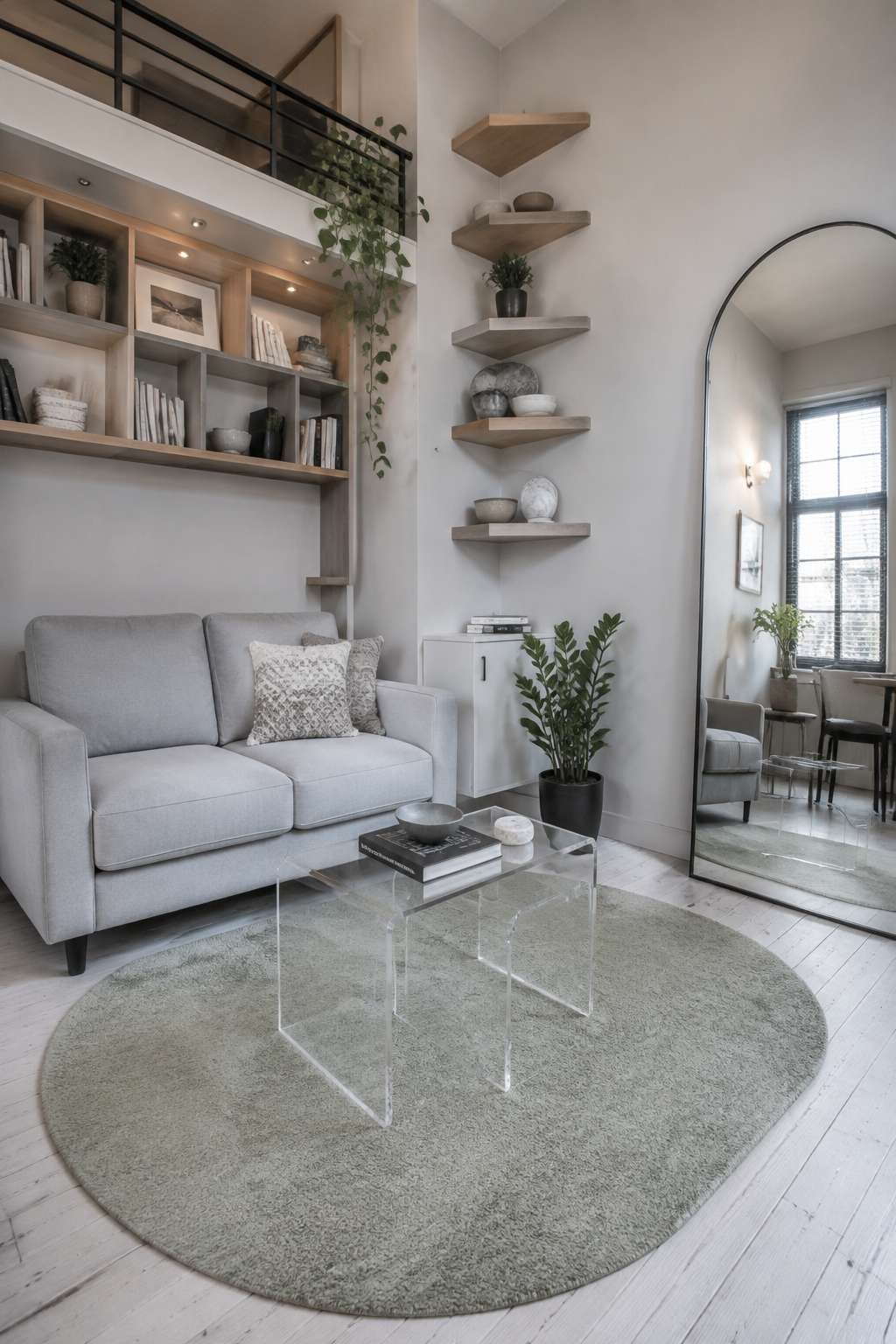
Strategically placed mirrors amplify natural light and extend perceived space — a technique every small-space designer relies upon. A large mirror opposite the room’s primary window doubles the incoming daylight, effectively making the room feel twice as bright and twice as deep. The pale silver-grey loveseat sits at the center of this intelligent composition, modest in scale but precise in placement, proving that small living rooms can deliver large amounts of design satisfaction when approached with creativity and care.
Key Design Tips:
- Choose pale silver or light grey upholstery for small spaces — lighter tones advance less visually than dark fabrics
- Replace fixed coffee tables with nesting or lift-top alternatives to create flexible, multi-use central floor space
- Install floor-to-ceiling shelving on at least one wall to maximize vertical storage and draw the eye upward
- Place large mirrors opposite windows to double natural light and significantly expand perceived room depth
- Limit decorative accessories to intentional, functional pieces — clutter is the enemy of small-space serenity
9. Farmhouse Charm: Rolled Arms, Reclaimed Wood, and Rural Warmth
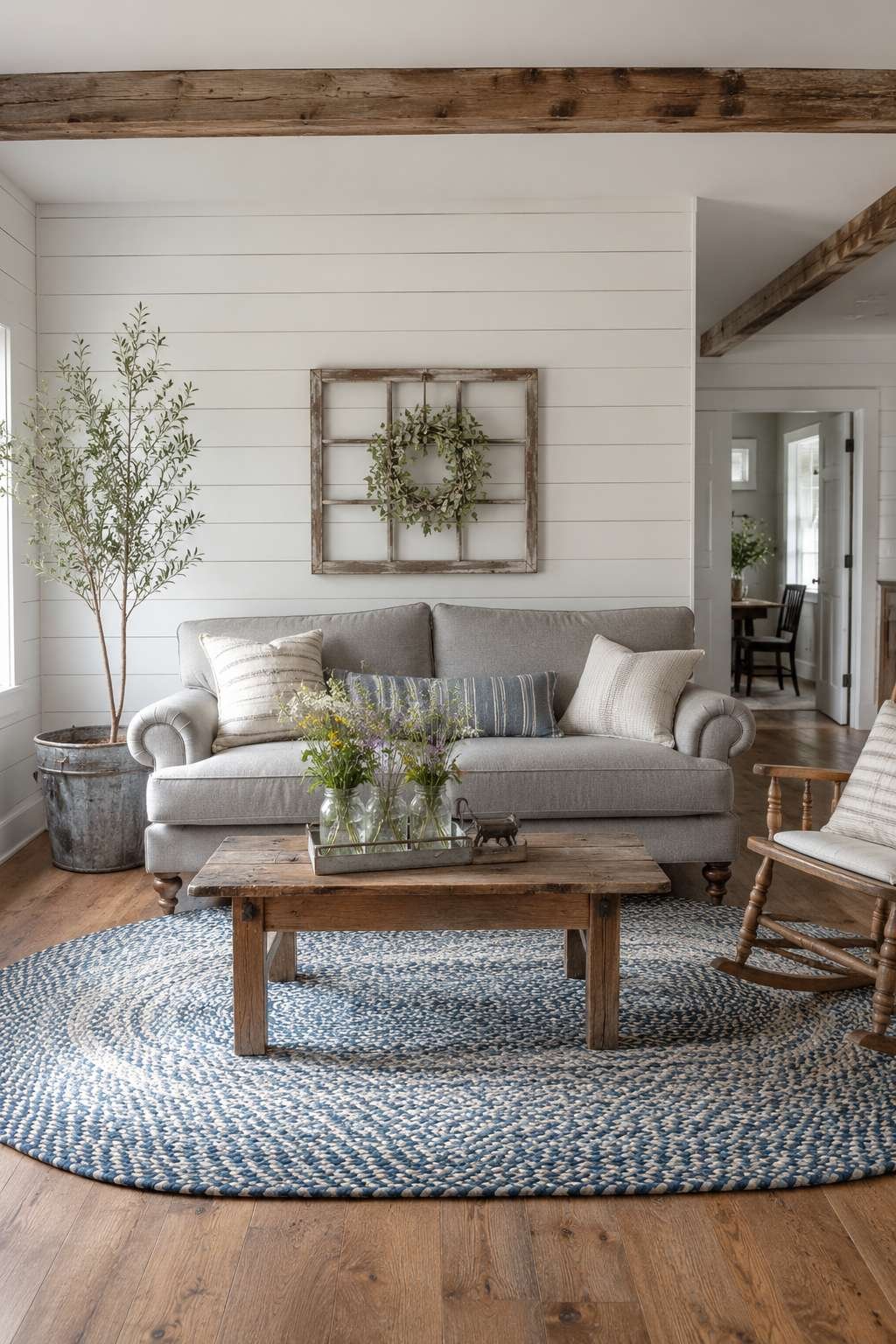
The farmhouse interior aesthetic taps into a deeply felt nostalgia for simpler times — handmade objects, honest materials, and spaces that feel as though they have accumulated warmth over generations. At the heart of this concept, a linen-upholstered sofa in faded grey with rolled arms and turned wooden legs embodies the farmhouse furniture ideal perfectly. The rolled arm profile — generous, rounded, and inviting — is one of the signature forms of traditional American farmhouse design, and in pale faded grey linen it feels both timeless and contemporary.
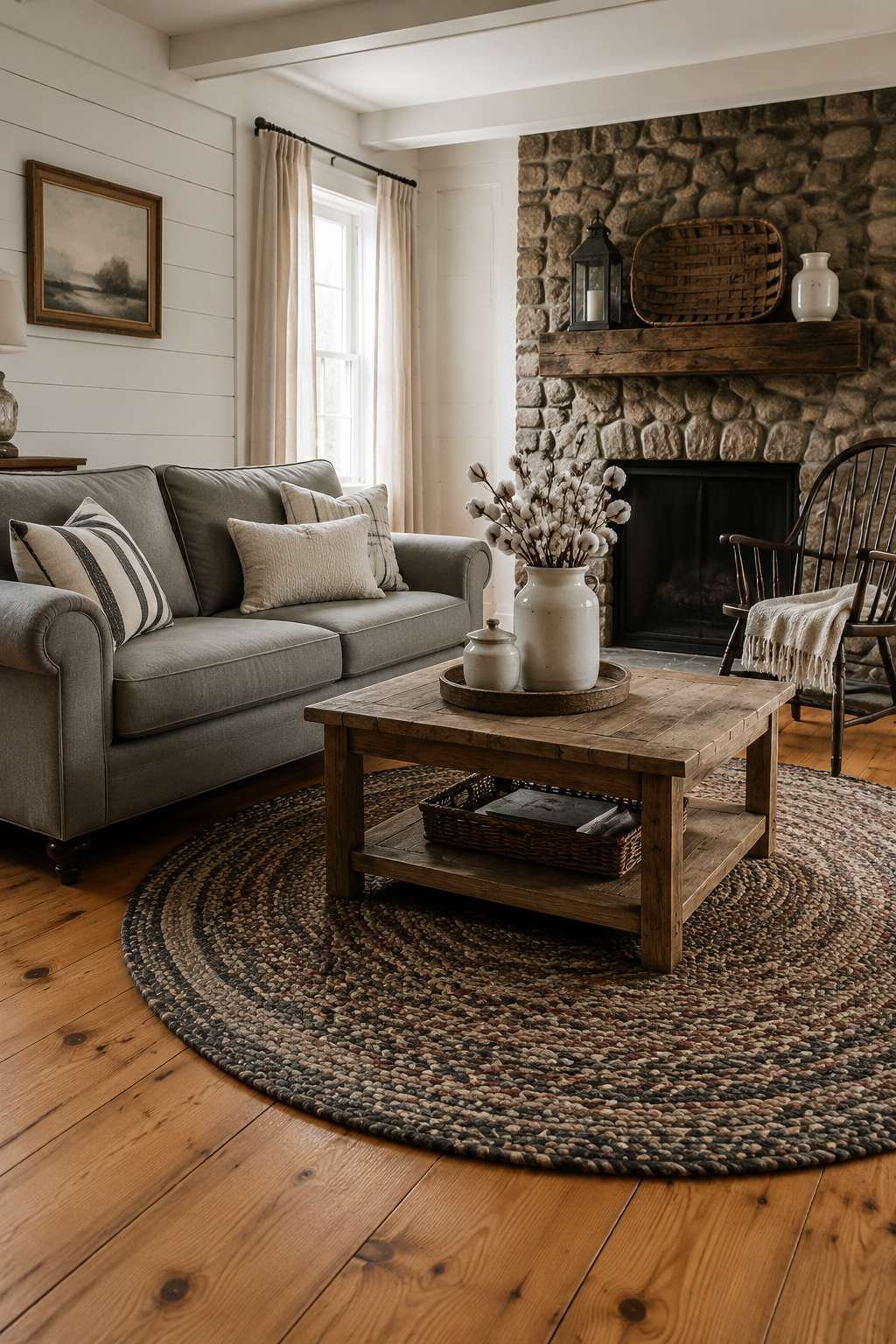
The reclaimed barn wood coffee table in front of the sofa arrives with its own quiet history — nail holes, saw marks, and color variations that no new piece of furniture could replicate. This is precisely the point in farmhouse design: imperfection is not a flaw to be corrected but a story to be celebrated. Beneath the seating arrangement, a braided cotton rug in natural tones introduces the kind of humble, handmade texture that is central to the farmhouse aesthetic. Its circular or oval braided form is a direct reference to traditional American hooked and braided rug-making traditions.
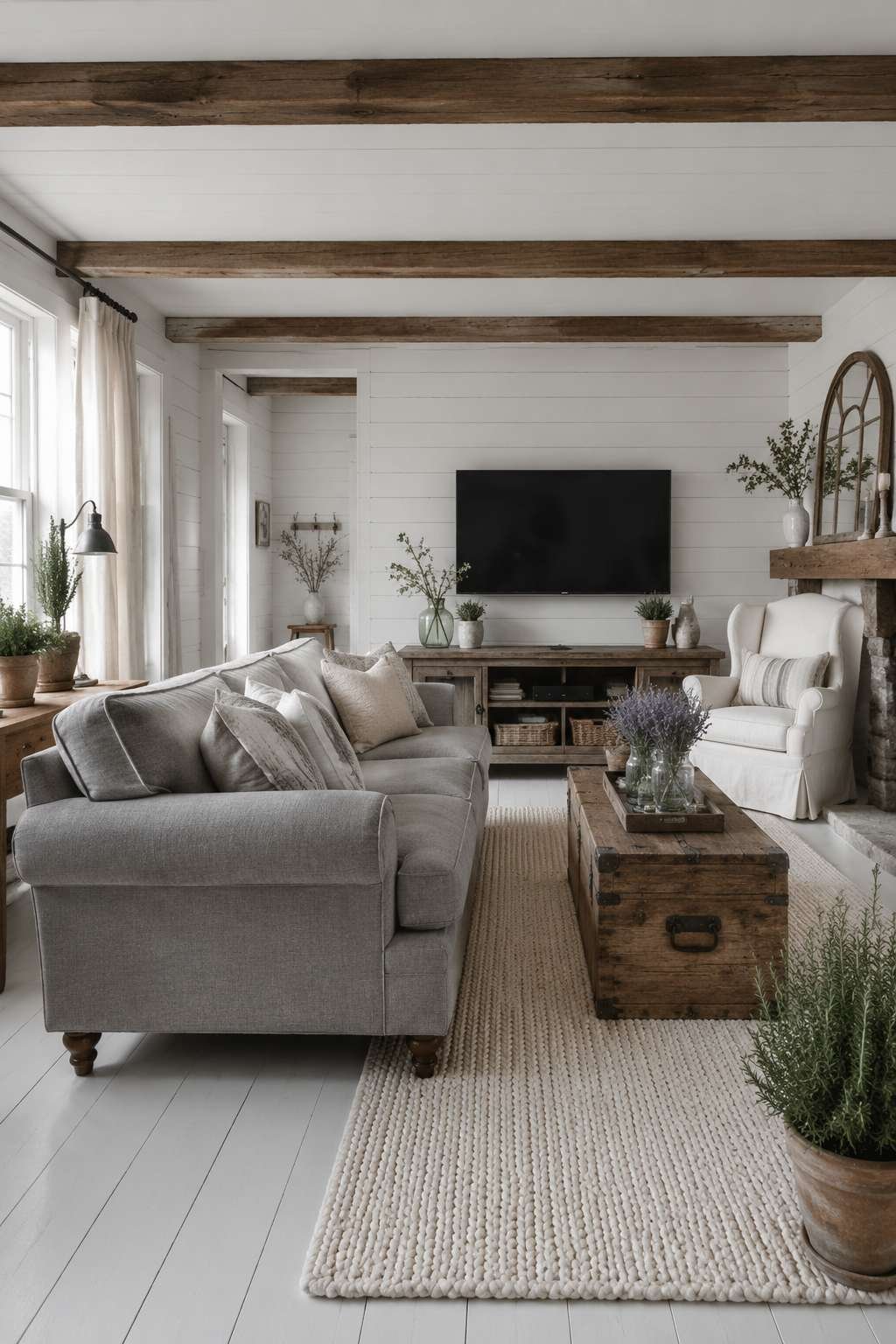
Mason jar florals, cotton stems in ceramic vases, and a shiplap accent wall complete the scene with the farmhouse design vocabulary’s most beloved elements. The shiplap wall — white-painted horizontal boards with reveal gaps — provides an architectural backdrop that photographs exceptionally well and requires remarkably little decoration to look beautiful. Soft diffused natural lighting is essential to the farmhouse interior’s emotional warmth; harsh, directional light would undermine the cozy, unpretentious character that makes this aesthetic so universally appealing.
Key Design Tips:
- Select a sofa with rolled arms and turned or tapered wooden legs to establish immediate farmhouse furniture character
- Source a reclaimed wood coffee table — the age marks and imperfections are design assets, not liabilities
- Use braided cotton or jute rugs in natural tones for humble, handmade texture beneath farmhouse seating
- Install a shiplap accent wall behind the sofa as a photogenic, low-maintenance architectural backdrop
- Style with cotton stems, dried botanicals, and mason jar florals for accessible, season-friendly farmhouse décor
10. Luxurious Dove Grey: Cashmere, Marble, and Elevated Elegance
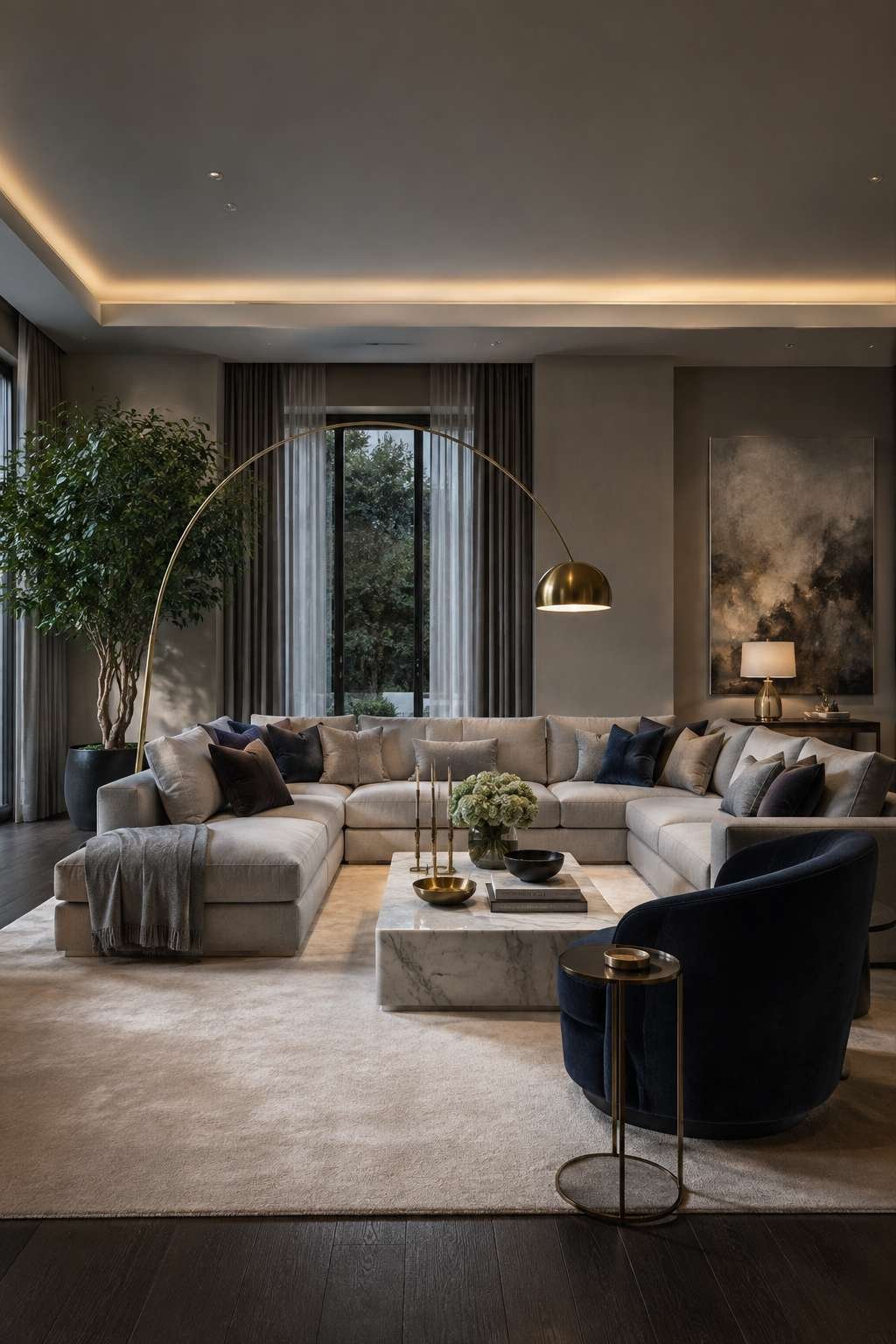
Luxury in interior design is a function of material quality, spatial generosity, and the precise calibration of every sensory element within a room. This concept delivers on all three with a deep L-shaped sectional in soft dove grey cashmere-blend fabric with down-filled cushions — a combination that represents the absolute apex of sofa comfort and upholstery refinement. The cashmere blend gives the fabric a subtle luminosity, a gentle sheen that shifts with viewing angle and catches light with quiet drama.
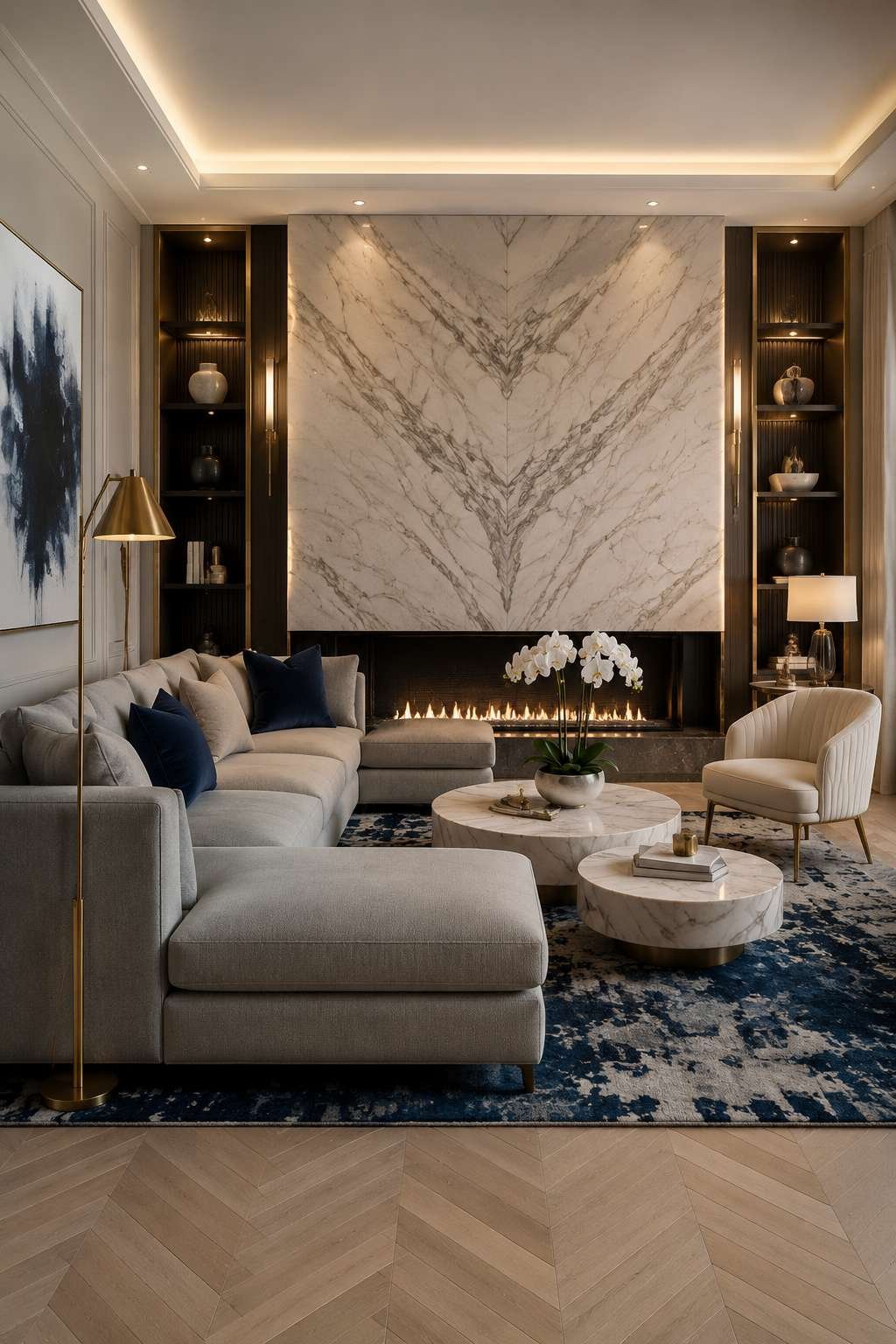
A polished Carrara marble coffee table anchors the seating arrangement with cool geological splendor, its white and grey veining providing a visual echo of the sofa’s dove grey tone at a completely different material register. Brushed brass floor lamps flank the sectional, their warm metallic glow creating a conversation with the cool marble and grey fabric that is one of luxury interior design’s most effective pairings: warm metal against cool stone against soft textile. Velvet navy accent pillows provide the room’s one strong color note, their deep jewel tone making the grey appear richer and more dimensional by contrast.
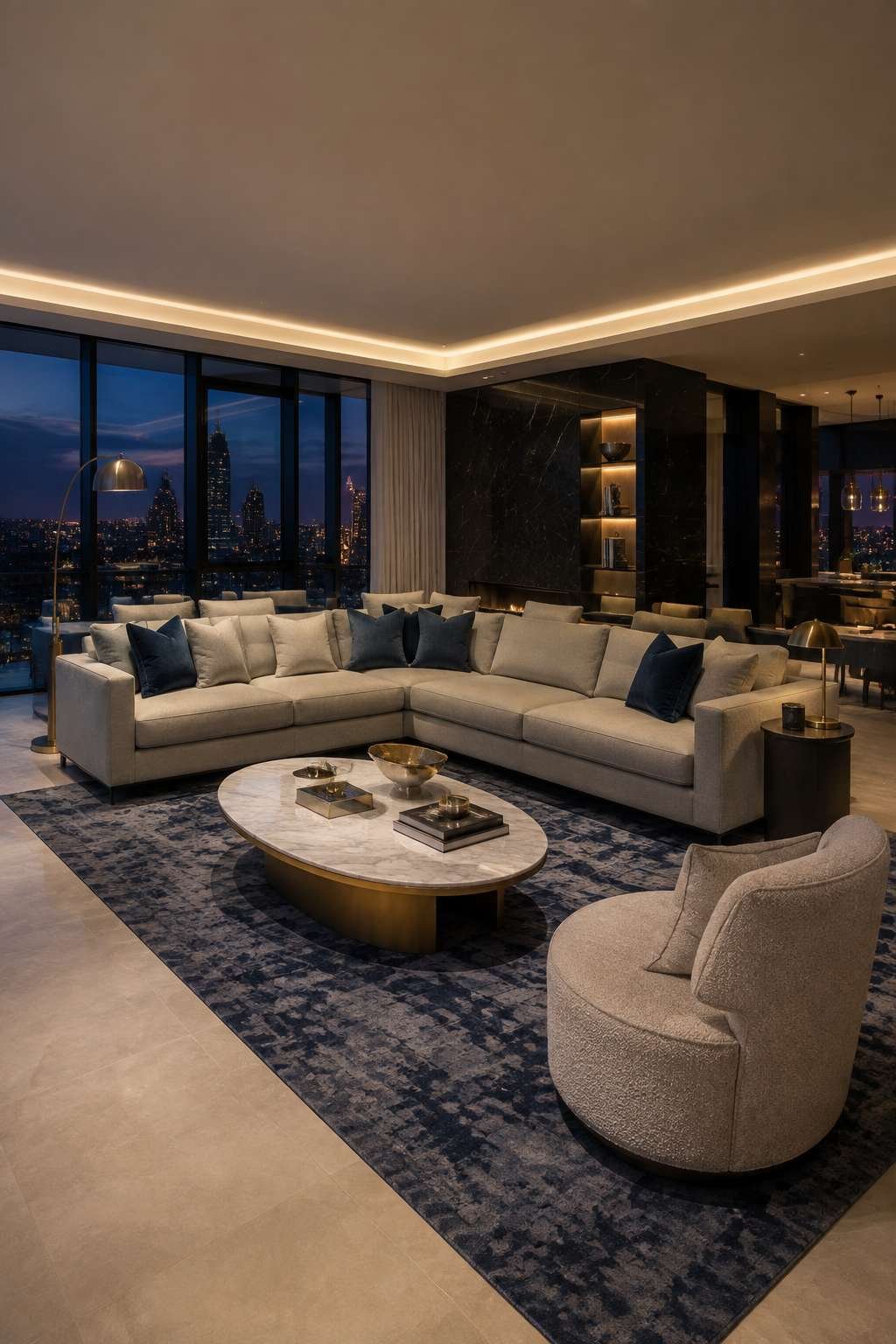
Evening ambient lighting — from concealed LED strips behind floating shelves and table lamps with fabric shades — creates the cinematic quality of light that distinguishes a truly luxurious interior from a merely expensive one. At night, this room becomes a different kind of beautiful: darker, warmer, more intimate, with pools of golden light drawing attention to the marble’s veining and the cashmere’s subtle lustre. The dove grey sectional is the stage upon which all this material theatre performs, and it does so with the perfect combination of visual neutrality and physical indulgence.
Key Design Tips:
- Invest in cashmere-blend or high-quality velvet upholstery for sofas intended as long-term luxury statements
- Pair a Carrara marble or marble-effect coffee table with a grey sofa for a cool, elevated material contrast
- Use brushed brass or aged gold fixtures and lamps as warm metallic counterpoints to cool grey and white
- Add jewel-toned velvet accent pillows in navy, emerald, or sapphire to make grey upholstery appear richer
- Layer concealed LED strips with table and floor lamps to create the multi-level ambient lighting that defines luxury interiors at night
11. Family-Friendly Function: Performance Fabric and Practical Beauty
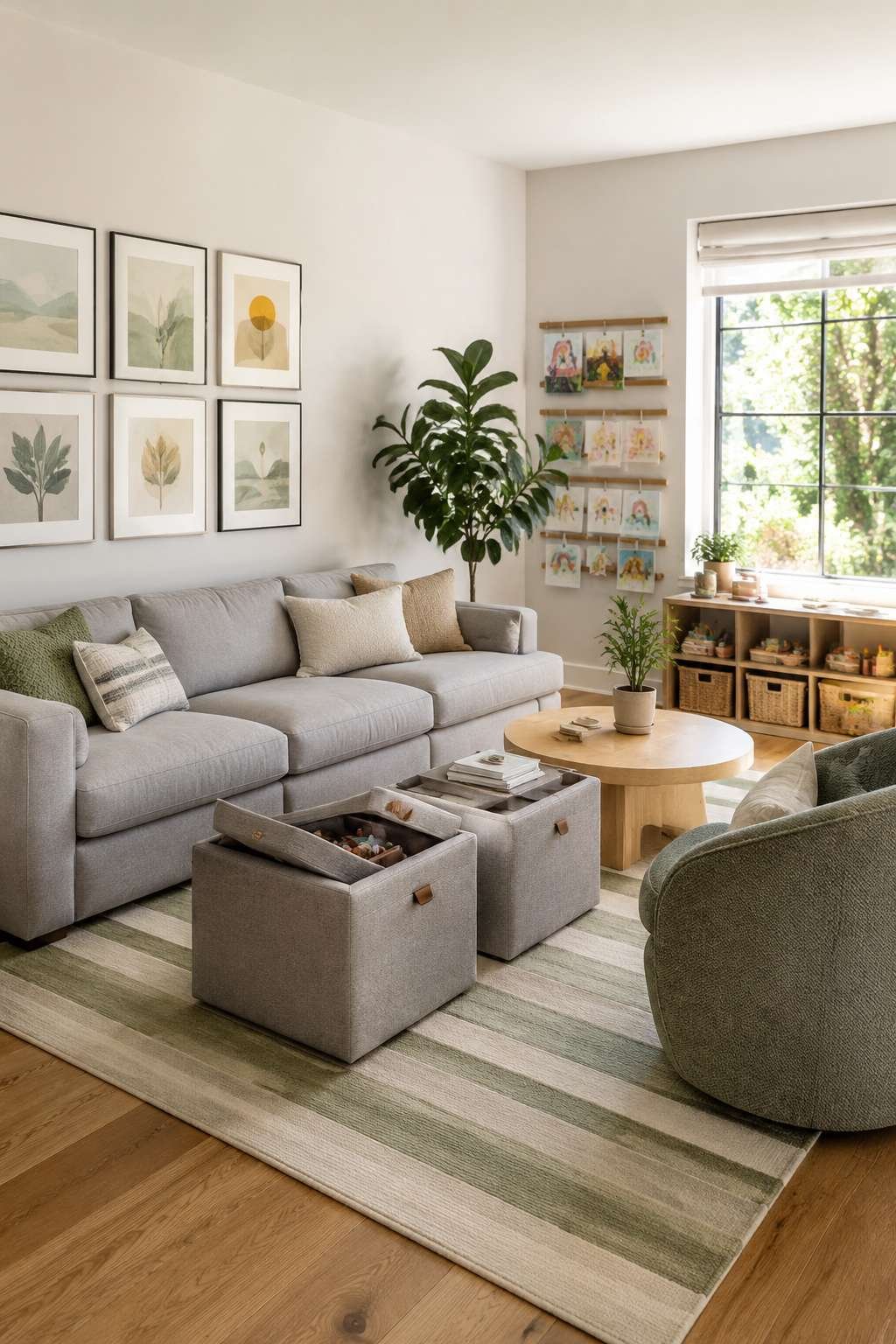
The best family living rooms understand that beauty and practicality are not opposites — they are partners. This concept demonstrates how a performance fabric sofa in easy-clean light grey can look as considered and stylish as any high-end piece while quietly delivering the durability that family life demands. Performance fabrics have evolved dramatically in recent years: today’s options offer the look and feel of natural textiles with the stain-repellent, moisture-resistant, and fade-resistant properties of engineered synthetics.
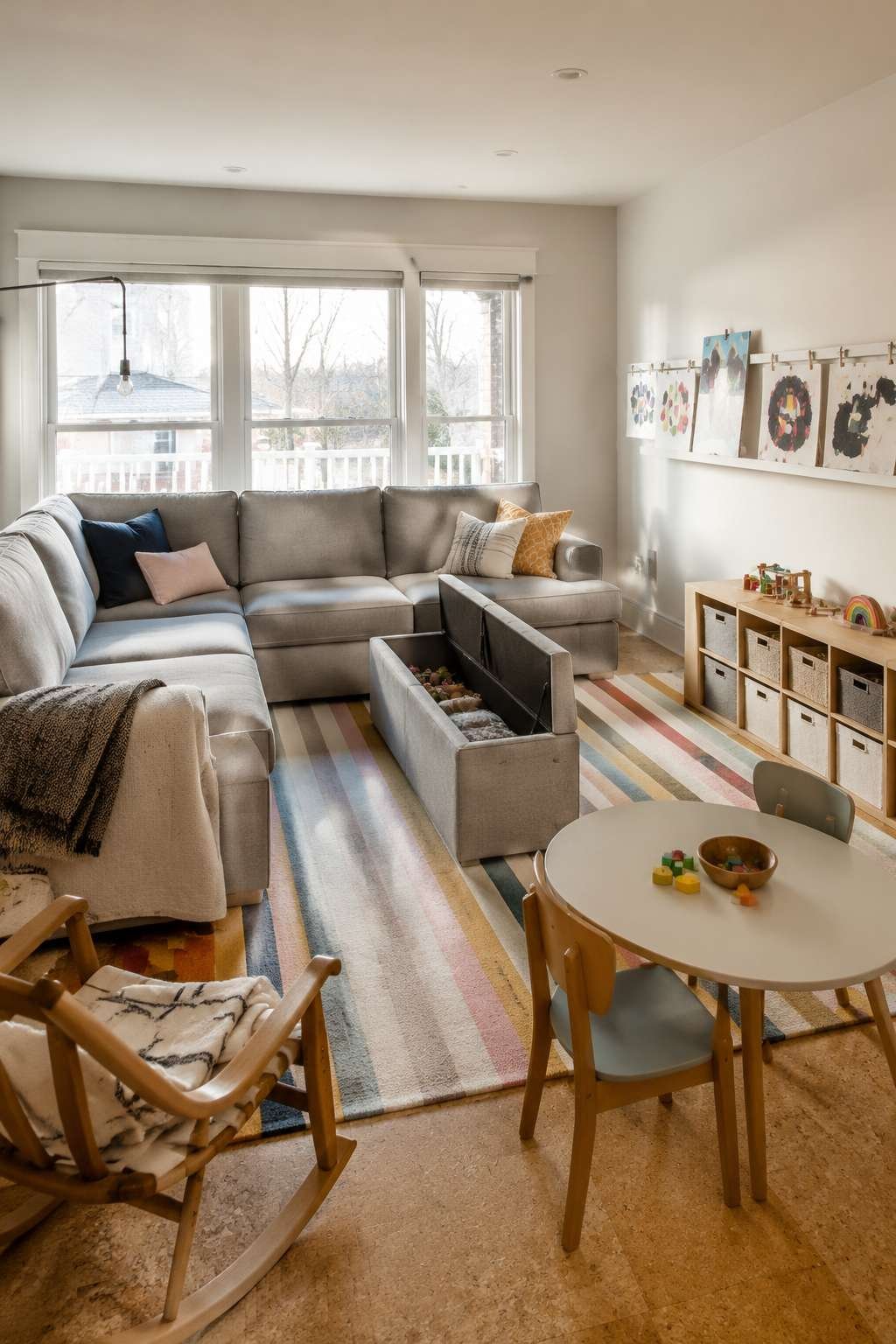
Ottomans doubling as storage serve the family living room with admirable dual functionality: as extra seating when guests arrive, as a footrest during relaxed evenings, and as concealed storage for toys, blankets, and the various objects that family life accumulates. A child-height art display wall — where young family members’ artwork is framed and hung at their own eye level — transforms the room into a living gallery that celebrates family creativity rather than merely tolerating its products.
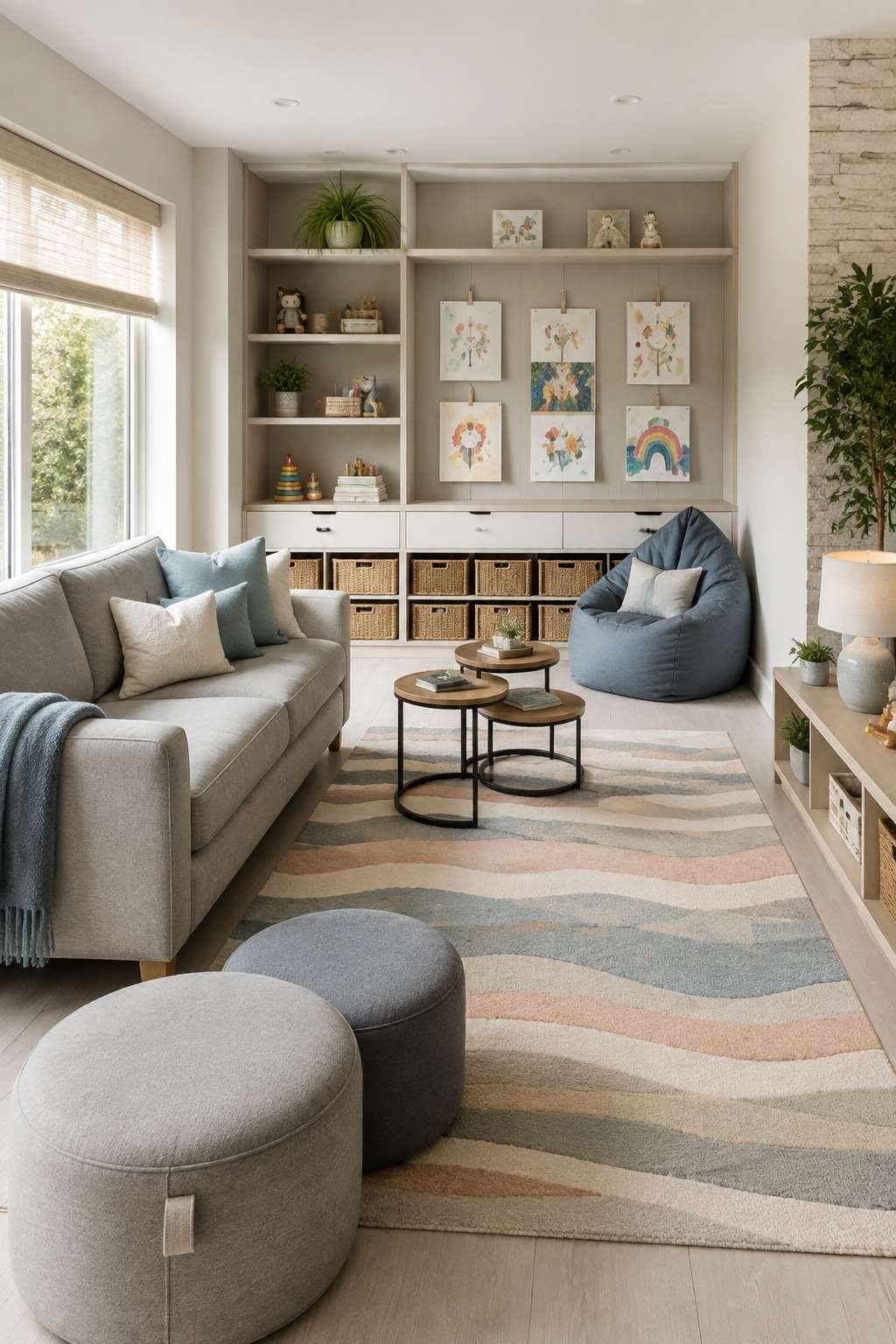
A washable cotton rug in muted stripes anchors the seating arrangement with color that is soft enough to suit the grey sofa while patterned enough to disguise the inevitable marks of busy family life. Striped cotton rugs are a perennial favourite in family homes for precisely this reason: their pattern is forgiving, their cotton construction is washable, and their classic simplicity complements virtually every furniture arrangement. Abundant natural afternoon light makes the space feel welcoming and healthy, reinforcing the sense of a home that is genuinely lived in and loved.
Key Design Tips:
- Specify performance fabric upholstery for family sofas — it looks premium and handles stains, pets, and children with equal grace
- Choose ottoman coffee tables with internal storage to manage the clutter that family life inevitably generates
- Install a child-height art display wall using simple frames at low hanging heights — it is inclusive, creative, and endlessly changeable
- Select washable cotton stripe rugs in muted tones for family rooms — they are practical, classic, and pattern-forgiving
- Prioritize natural afternoon light by keeping window treatments minimal and light-colored in family living spaces
12. Transitional Balance: Where Traditional Meets Contemporary
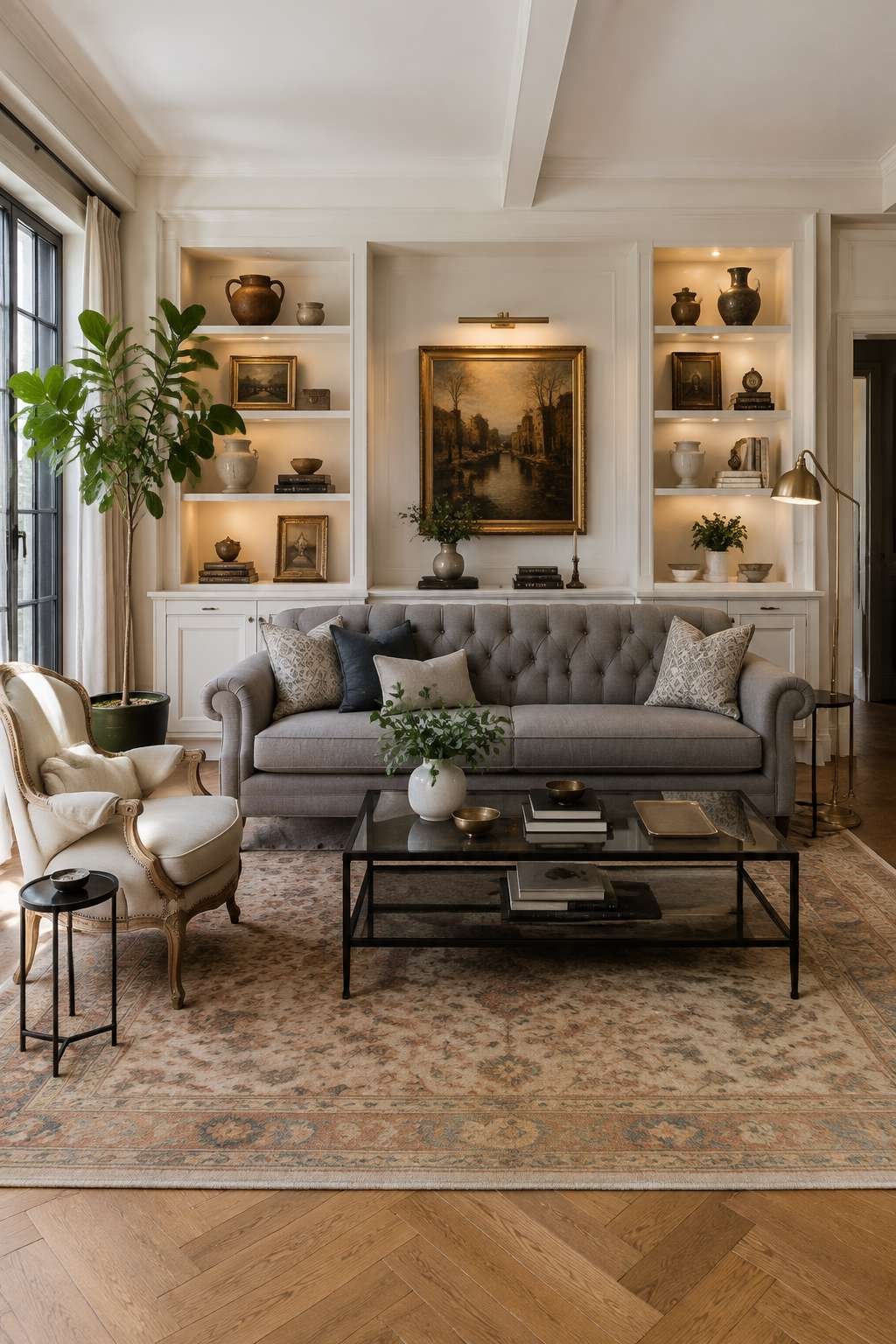
The transitional interior occupies the sophisticated middle ground between traditional warmth and contemporary restraint, borrowing the best qualities of each while avoiding their respective excesses. This concept achieves that balance with a button-tufted grey sofa in Belgian linen — a piece that references the formal upholstery traditions of classic furniture design while reading as entirely current in its material and color choice. Belgian linen is the ideal fabric for this purpose: it has the natural, slightly irregular texture of a traditional material but the relaxed, contemporary aesthetic of modern textile design.
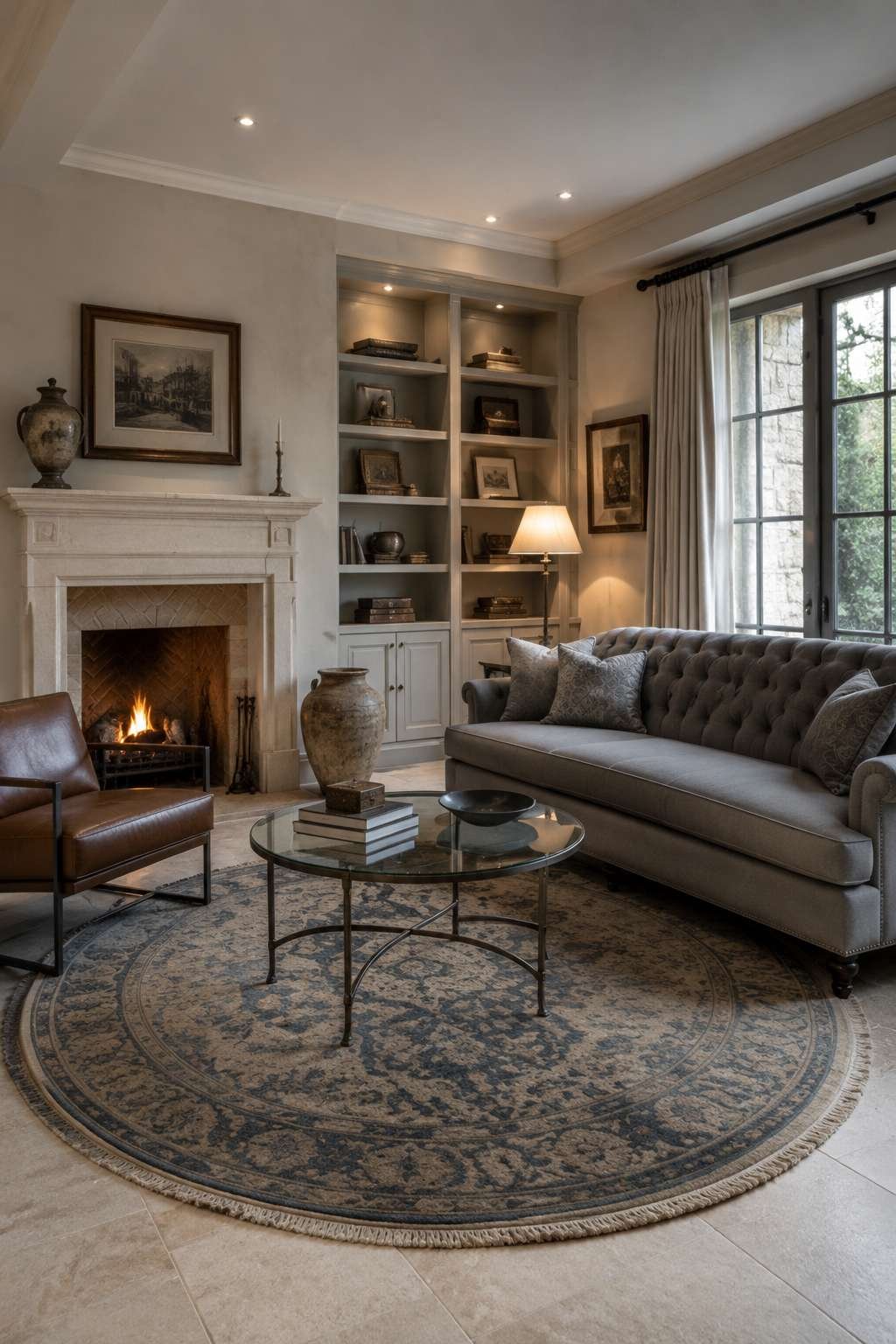
A glass-top iron coffee table expresses the same transitional philosophy in furniture form: the iron base speaks to traditional craft and material permanence while the glass top introduces the lightness and transparency of modern design. Mixed antique and modern accessories on built-in shelving reflect the room’s hybrid identity, placing a contemporary ceramic beside an inherited silver candlestick without any sense of incongruity. This comfort with aesthetic plurality is the transitional interior’s defining quality and its greatest practical strength.
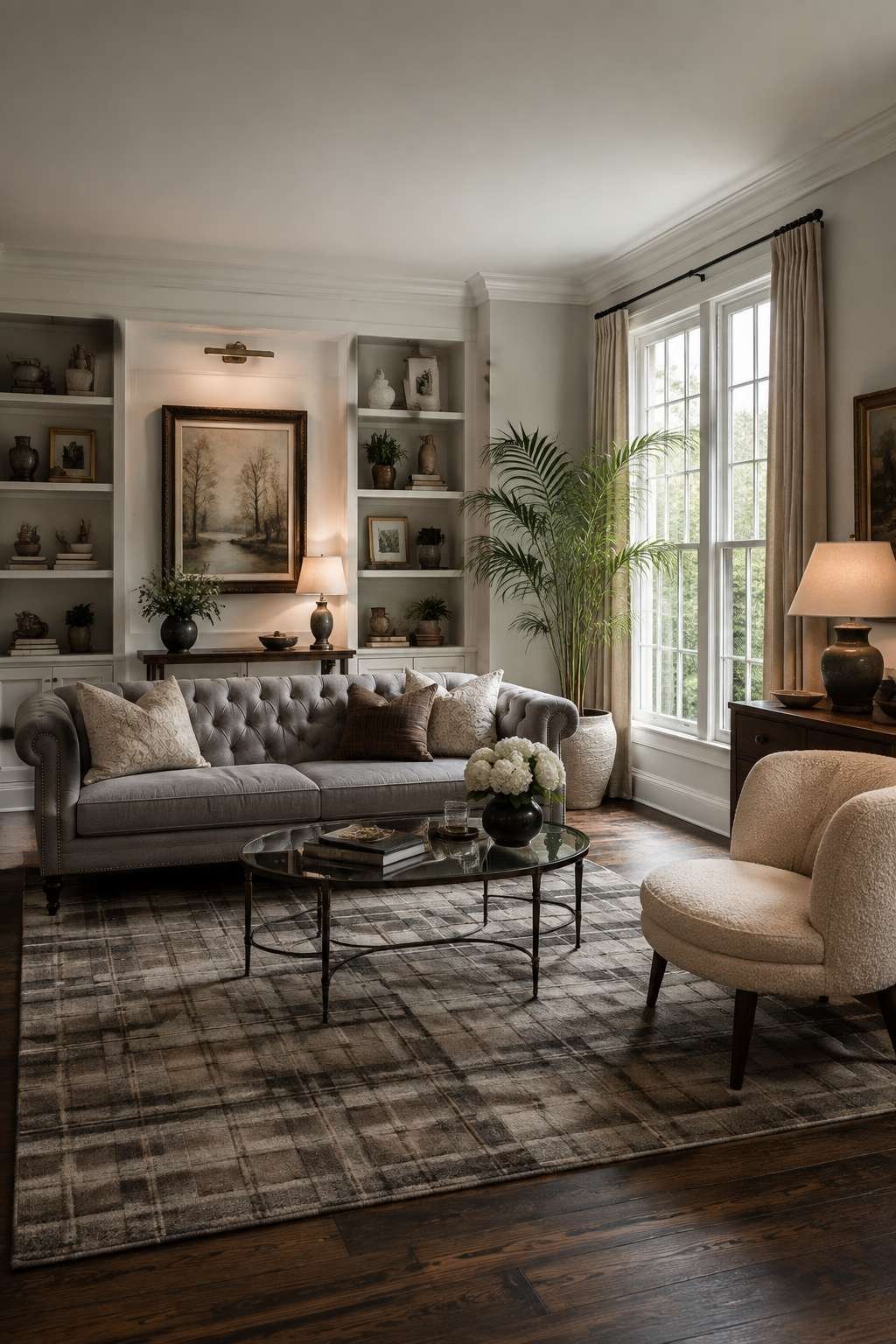
Warm table lamp light plays beautifully against the cool natural window light entering the room, creating the kind of layered illumination that gives a space depth and visual interest at different times of day. In the morning, cool daylight reveals the texture of the Belgian linen and the grain in the iron coffee table legs. By evening, warm lamp light shifts the whole room toward amber, making the grey sofa appear warmer and the accessories richer. This responsiveness to changing light conditions is one of the most appealing qualities of the transitional interior’s carefully chosen palette.
Key Design Tips:
- Choose button-tufted upholstery in Belgian linen or natural fabric to bridge traditional form and contemporary material
- Pair a glass-top coffee table with a metal or iron base to express both transparency and traditional craftsmanship
- Mix one or two antique pieces into a predominantly contemporary accessory arrangement for authentic transitional character
- Use warm-toned table lamps alongside cool natural light to create layered illumination that shifts beautifully through the day
- Style built-in shelving with a mix of object heights, materials, and eras — this controlled eclecticism defines the transitional aesthetic
13. Art Deco Glamour: Geometry, Velvet, and Jewel-Tone Drama
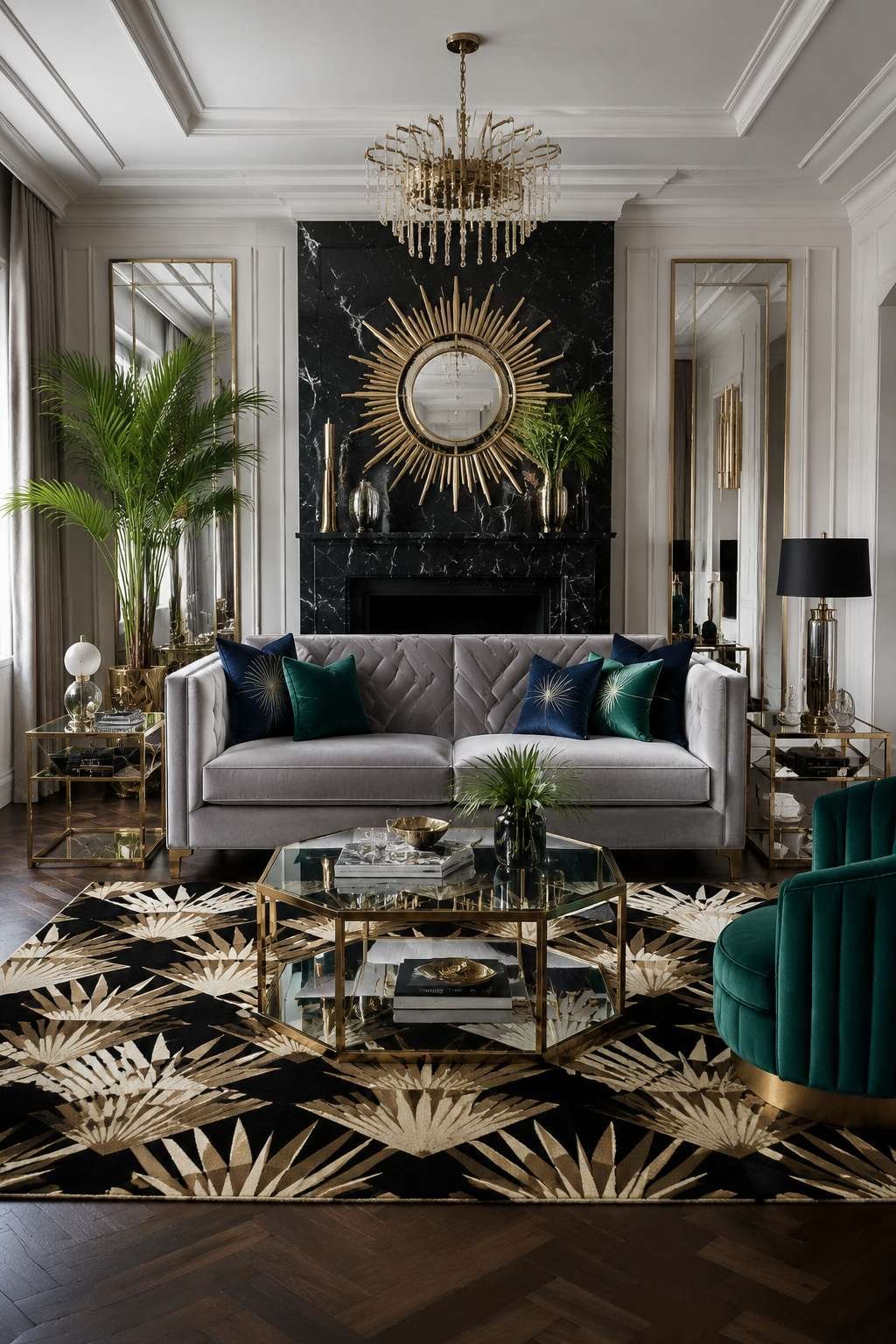
Art deco is interior design’s most theatrical style — a celebration of bold geometry, reflective surfaces, luxurious materials, and unapologetic glamour. In this concept, a streamlined velvet sofa in silver grey with geometric-cut back cushions immediately announces the deco sensibility: clean lines, precise forms, and a material vocabulary that prioritizes visual impact. The silver grey velvet is the perfect art deco upholstery choice — cool, lustrous, and quietly dramatic without competing with the room’s more overtly decorative elements.
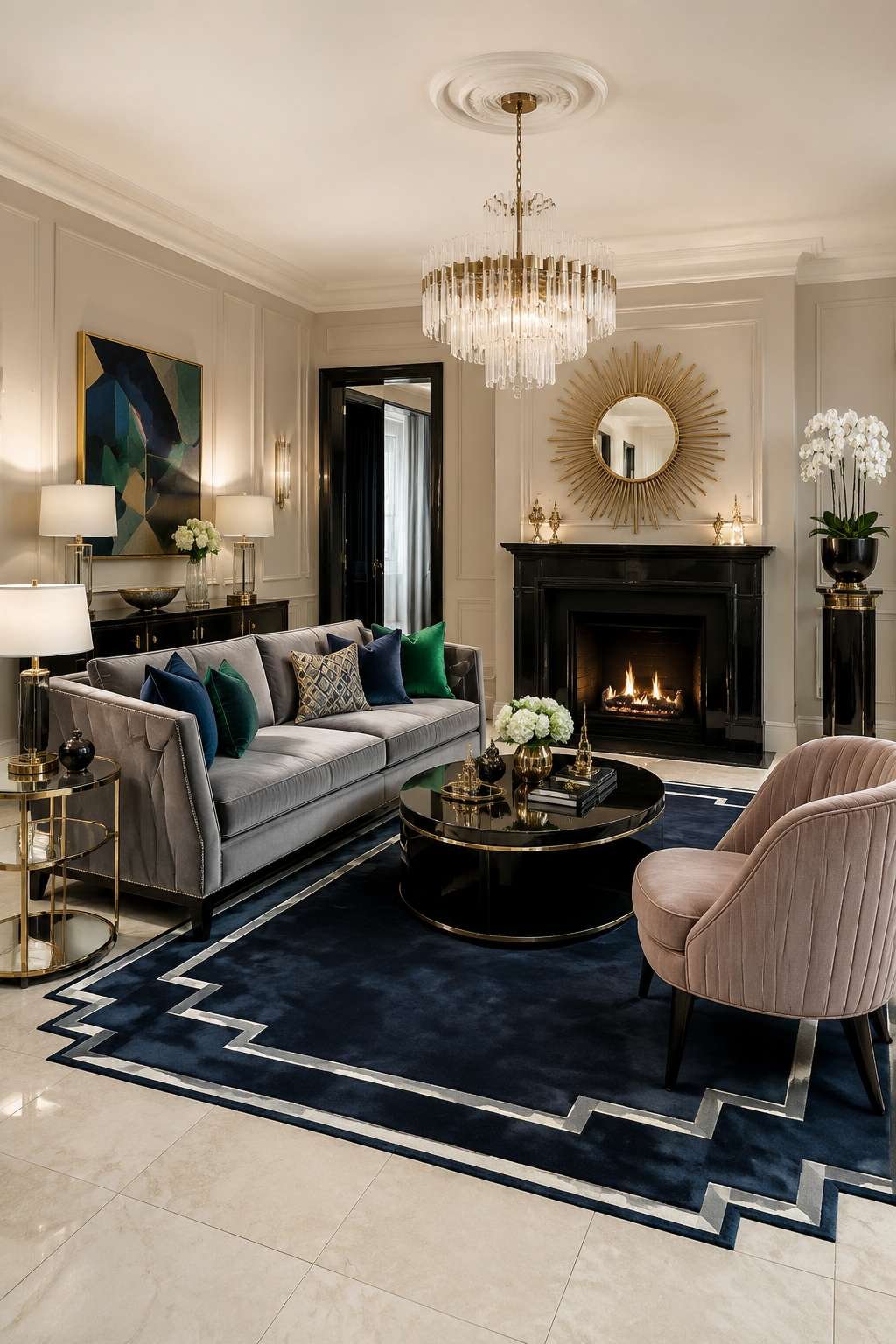
Mirrored side tables with gold trim flank the sofa with characteristic art deco showmanship, their reflective surfaces multiplying the room’s candlelight and lamp glow into a constellation of warm points. Above the fireplace, a sunburst mirror — one of art deco design’s most iconic motifs — radiates golden spokes across the white wall, simultaneously referencing solar geometry and cinematic Hollywood glamour. Rich jewel-toned throw pillows in emerald and sapphire punctuate the grey velvet sofa with deep, saturated color that makes every surface in the room appear more intensely beautiful by contrast.

Directional interior lighting is deployed with intent in the art deco room, highlighting the geometry of the sofa’s cushion cuts, the concentric circles of the sunburst mirror, and the faceted planes of the mirrored side tables. Light in this context is not merely functional — it is a design element in its own right, as carefully considered as any piece of furniture or decorative object. The result is a living room of extraordinary visual richness, where the silver grey sofa serves as the composed, elegant centre of a room that celebrates beauty as a virtue in itself.
Key Design Tips:
- Choose velvet upholstery in silver grey or jewel tones as the primary art deco sofa material for its lustre and chromatic depth
- Incorporate sunburst mirrors and geometric decorative motifs as the defining architectural gestures of the deco aesthetic
- Use mirrored or lacquered side tables with gold or brass trim to multiply light and reinforce the reflective deco character
- Add emerald, sapphire, or ruby velvet accent pillows to grey upholstery to create the jewel-box color drama of authentic art deco
- Design lighting specifically to highlight geometric forms and reflective surfaces — directional picture lights and table lamps achieve this precisely
14. Double-Height Drama: Soaring Ceilings and Vertical Ambition
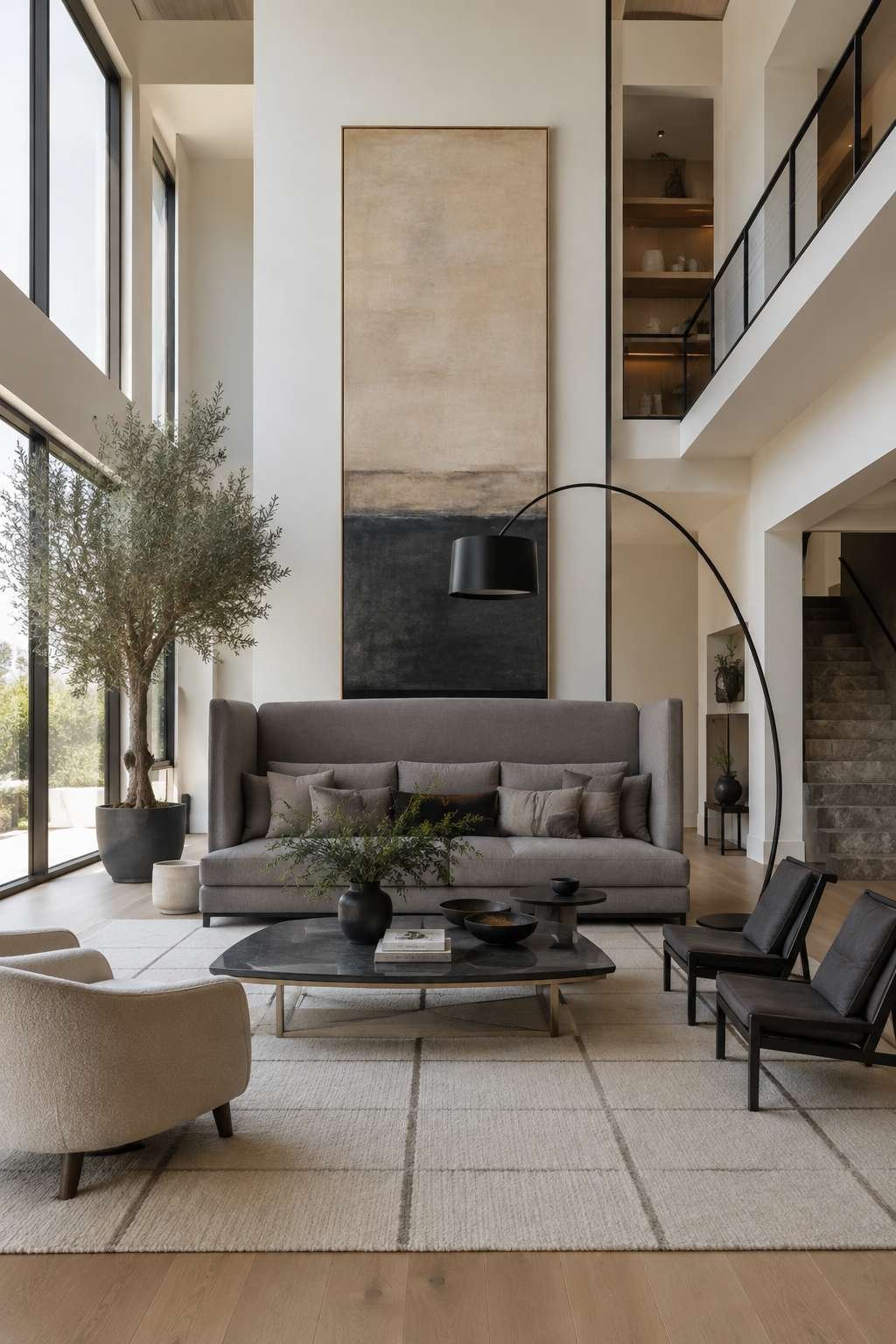
Rooms with double-height ceilings present a rare and exhilarating design challenge: how to honor the vertical drama without losing the human-scale warmth that makes a room feel livable. This concept solves the problem with characteristic intelligence, positioning a tall-backed sofa in warm stone grey to anchor the vast space with grounded authority. The tall back — significantly higher than a standard sofa — creates a visual mass that holds its own against the soaring ceiling, providing the room’s human-scale focal point without competing with its architectural ambition.
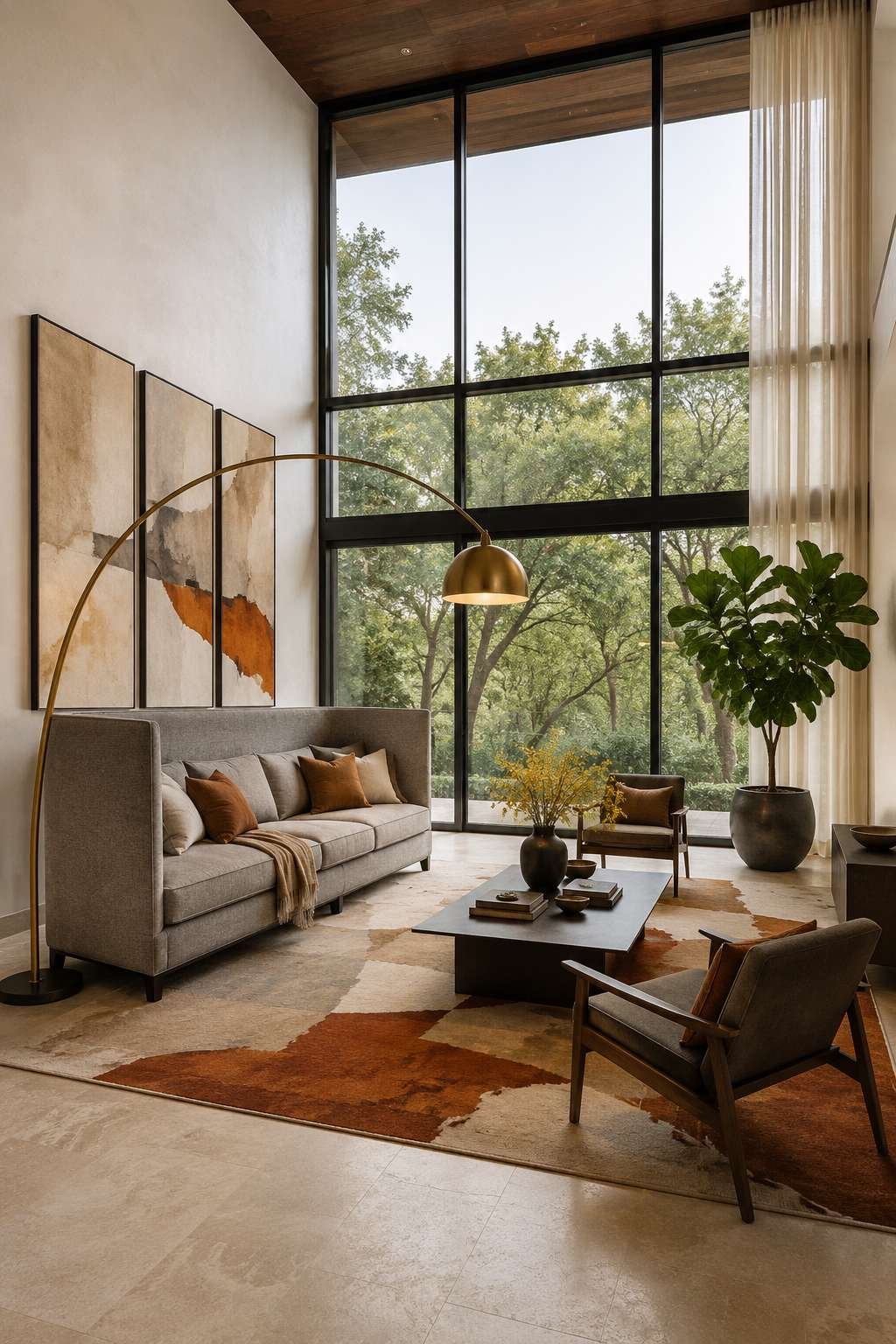
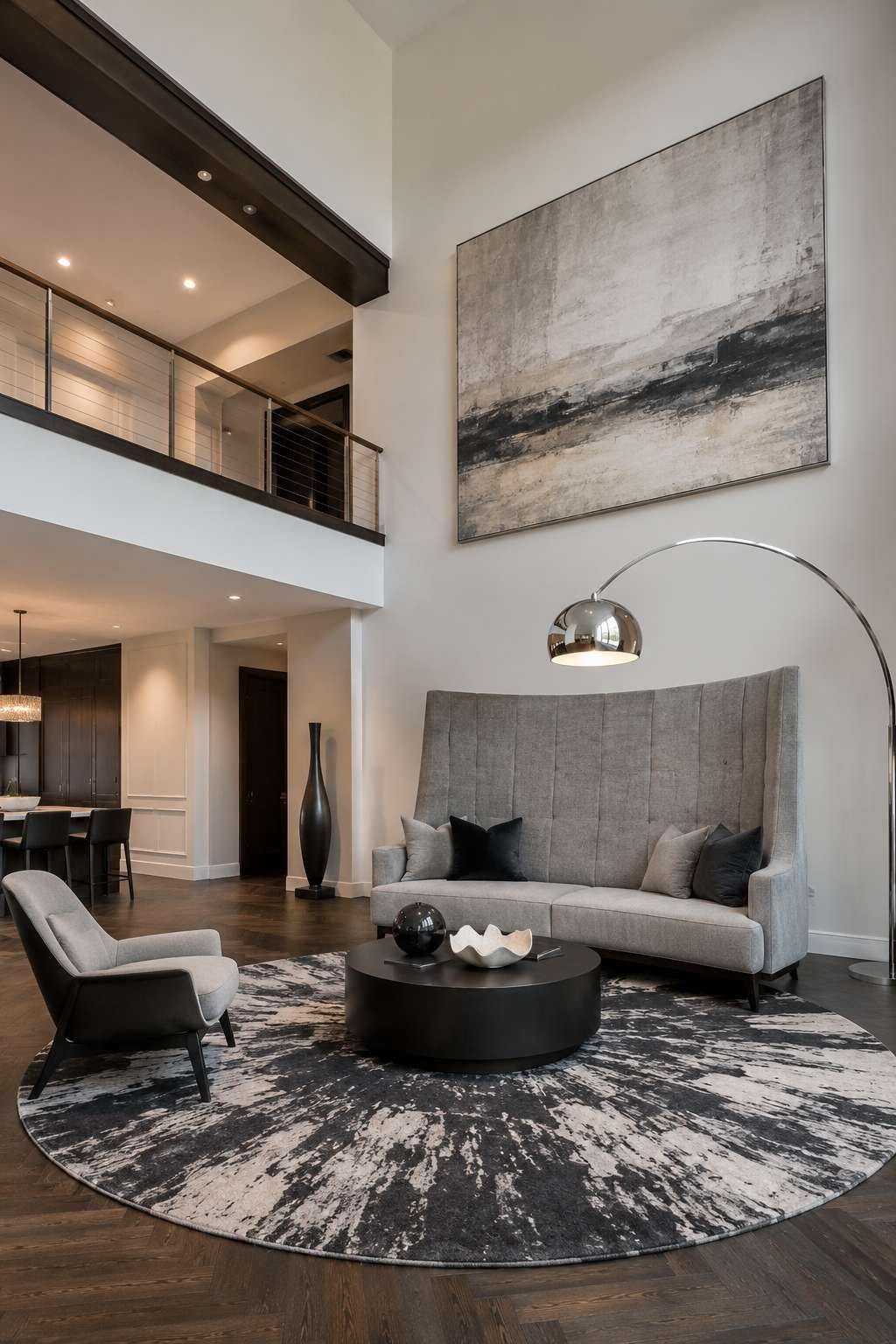
Oversized abstract canvas art hung above the sofa draws the eye upward with purposeful visual energy, filling the double-height wall plane in a way that only large-scale art can. The abstract canvas — in tones that complement the stone grey sofa — acts as both decoration and spatial calibration, its generous scale making the ceiling feel intentionally grand rather than randomly tall. A dramatic arc floor lamp sweeps over the sofa from one side, its exaggerated curve echoing the architectural boldness of the double-height space while delivering intimate, human-scale light to the seating arrangement below.
The warm stone grey sofa performs a specific spatial function in this context: it establishes the room’s intimate core, a place of warmth and rest within the grandeur of the architectural envelope. Visitors entering the space are simultaneously aware of the room’s dramatic scale and the sofa’s invitation to sit and be comfortable — a productive tension that makes double-height living rooms feel thrillingly alive. Designing for vertical scale requires courage and conviction, and this concept delivers both with admirable assurance.
Key Design Tips:
- Choose a tall-backed sofa for double-height rooms — it provides visual mass that balances the vertical scale without fighting it
- Hang oversized abstract or architectural art above the sofa to fill the double-height wall plane with intentional visual energy
- Use an arc floor lamp with an extended reach to bridge the dramatic ceiling height and the intimate seating zone
- Maintain a warm, grounded sofa color (stone, taupe, warm grey) to create an inviting human-scale anchor in a grand space
- Resist the temptation to add too many large pieces — one or two dramatic gestures are more effective than a crowded statement
15. Wabi-Sabi Tranquility: Imperfection, Simplicity, and Mindful Beauty
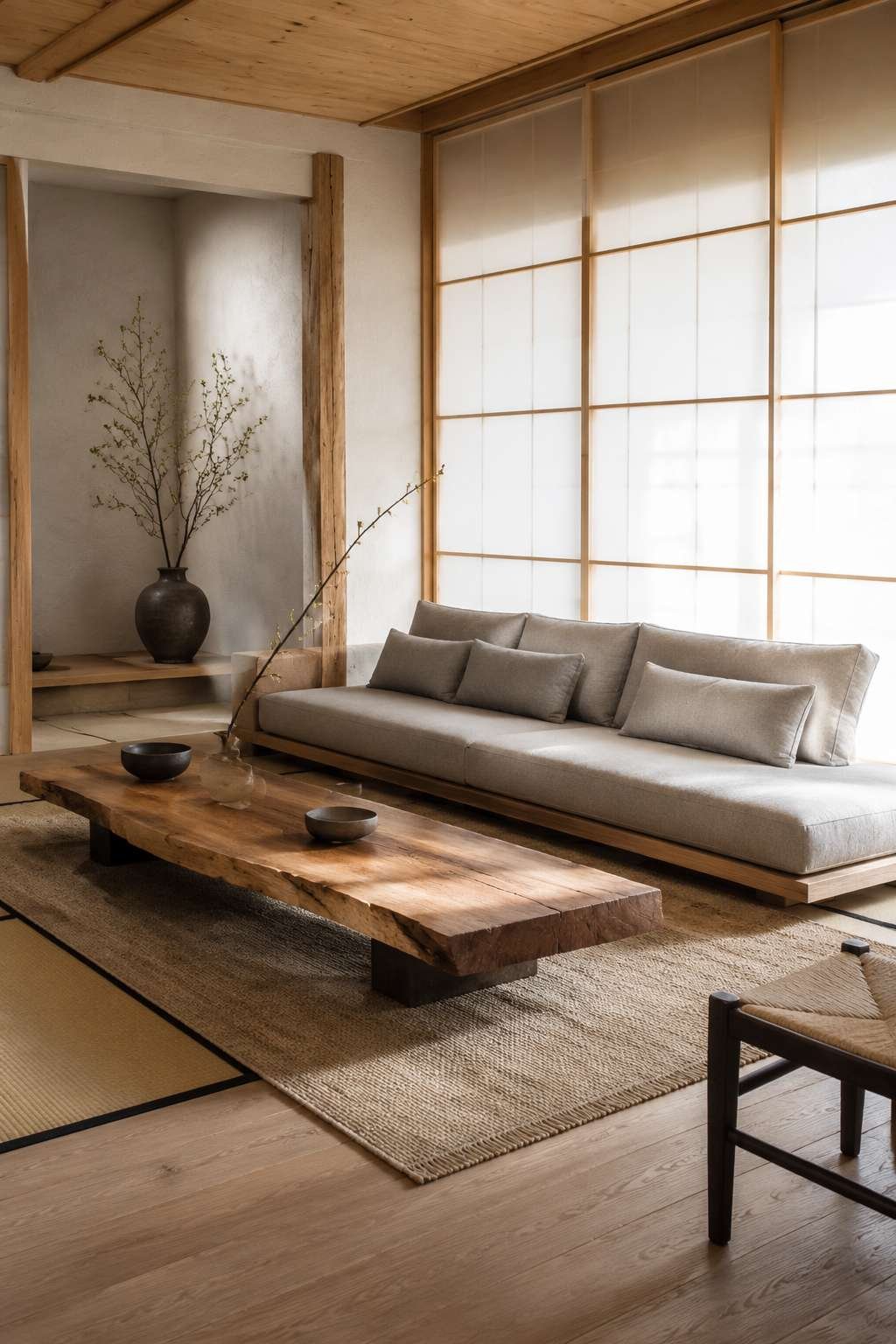
The Japanese philosophy of wabi-sabi — finding beauty in imperfection, impermanence, and incompleteness — offers contemporary interior design one of its most profound and countercultural ideas. In this living room concept, a low platform sofa in undyed linen with a natural, unfinished grey tone embodies this philosophy with remarkable precision. The undyed linen carries the irregular color variations and textural inconsistencies of its natural fiber state, making each cushion and panel subtly unique — a quality that mass-produced furniture explicitly tries to eliminate and that wabi-sabi explicitly celebrates.

A raw-edge cedar slab coffee table sits before the sofa, its irregular organic edge preserved rather than refined, its surface oiled to protect the wood while maintaining its raw, living quality. The cedar’s natural aroma is an additional sensory dimension that conventional furniture cannot offer. Ceramic vessels with hand-formed irregularities are displayed on the table and surrounding surfaces — slightly uneven walls, fingerprint-visible glazes, rims that are not quite level. In the context of wabi-sabi, these apparent imperfections are precisely the points of beauty, evidence of the human hand and the unpredictability of the kiln.
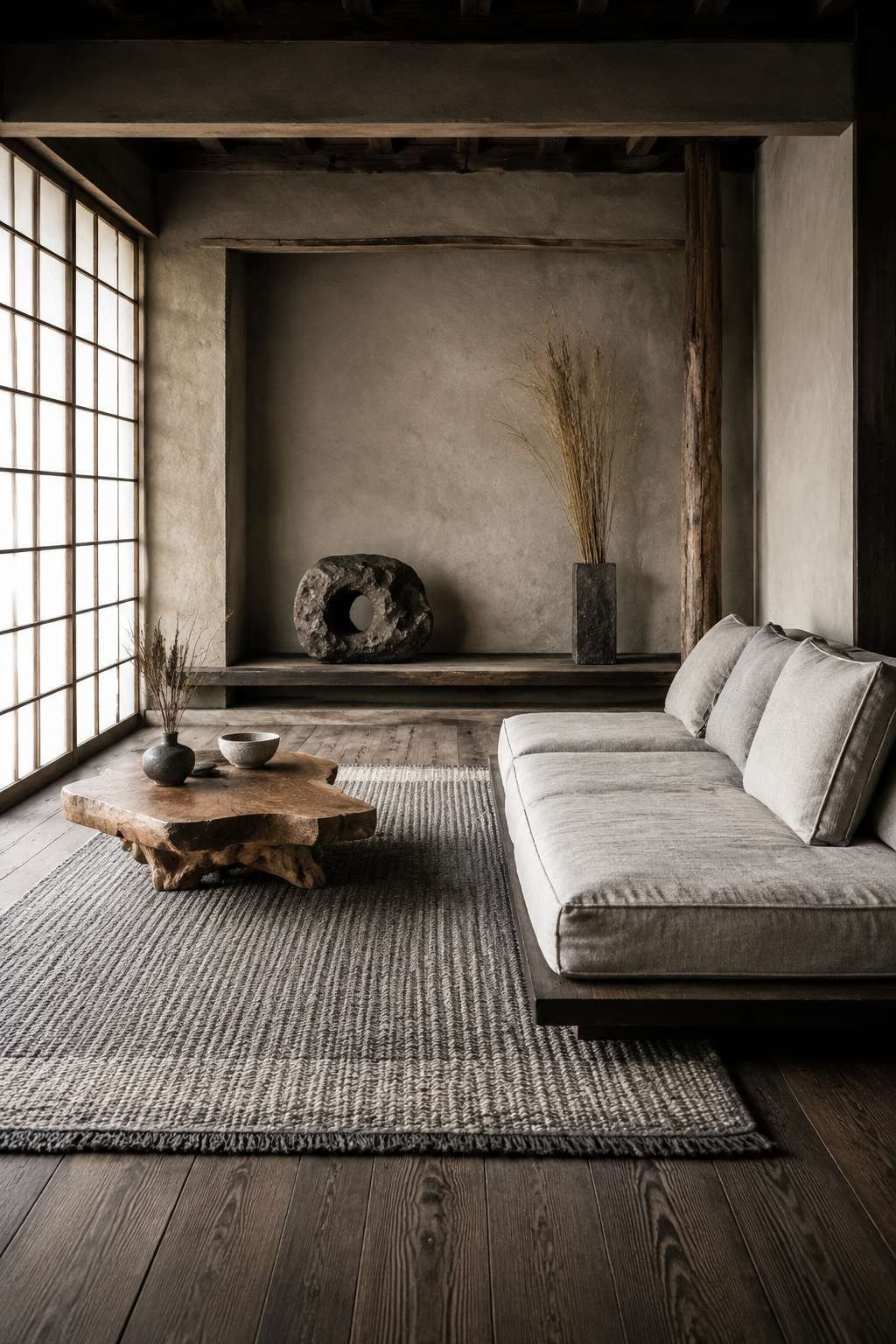
Filtered morning light through shoji-style panels creates the concept’s defining atmospheric quality: soft, directionless illumination that arrives without harshness or drama, suffusing every surface in an even, contemplative glow. This quality of light — which Japanese architects and designers have refined over centuries — makes materials visible in their most honest form, without the drama of shadow or the harshness of direct sun. In this light, the undyed linen sofa reveals every subtle variation in its weave, every gentle shadow cast by the low platform’s edge, every quiet imperfection that makes it uniquely itself.
Key Design Tips:
- Choose undyed or naturally-finished linen for wabi-sabi interiors — its tonal irregularity is a feature, not a flaw
- Source a raw-edge wood coffee table and preserve the organic edge rather than cutting it to a regular form
- Display hand-thrown ceramics with visible irregularities — uneven glazes, fingerprint marks, and asymmetry are aesthetic virtues in this context
- Install shoji-style translucent panels instead of curtains to achieve the soft, directionless light central to Japanese spatial aesthetics
- Resist the urge to fill every surface — deliberate negative space is as important as the objects themselves in wabi-sabi composition
16. Bright Suburban Cheer: Botanical Prints, Bay Windows, and Family Joy
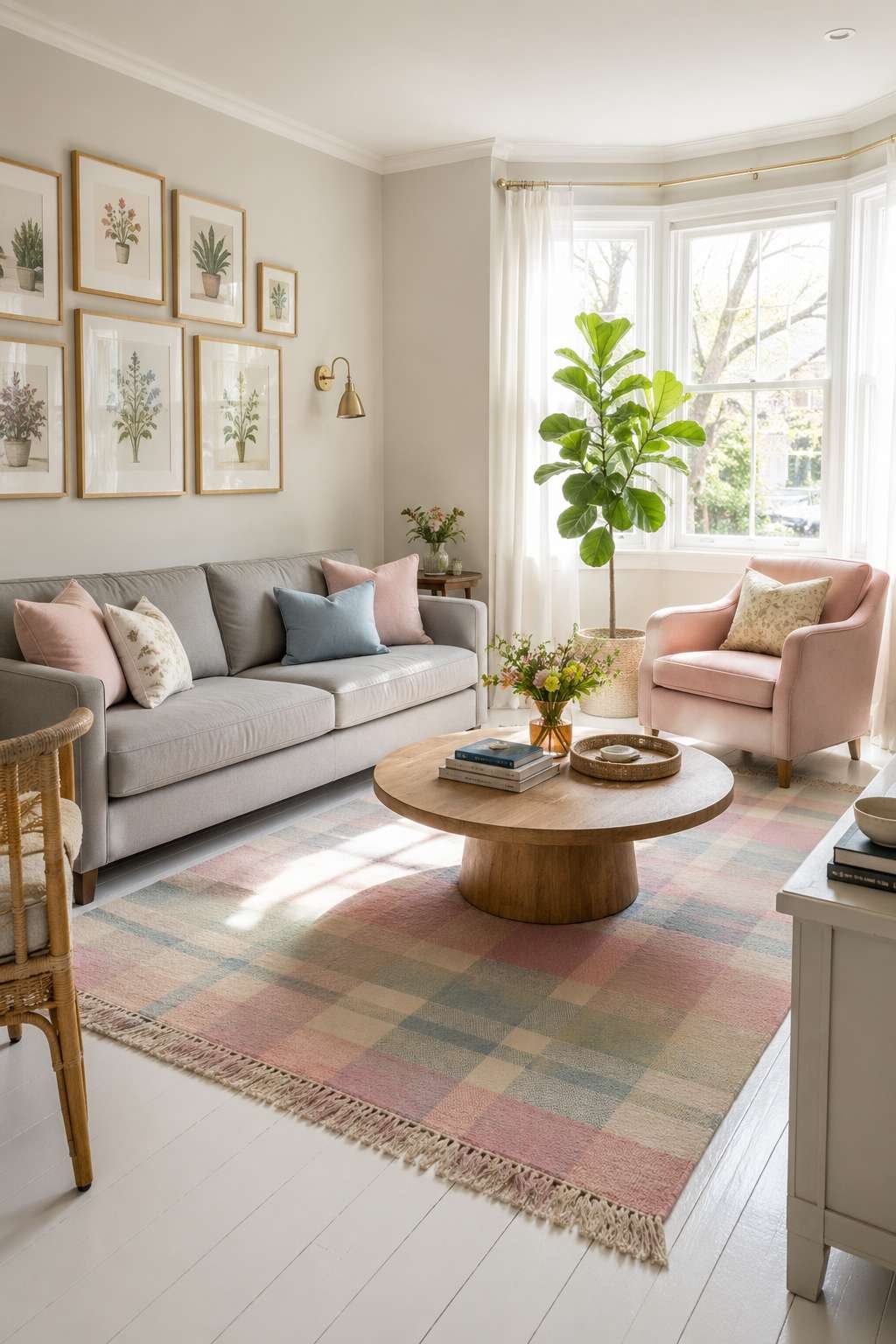
Not every living room needs to be a design statement. Some rooms succeed most beautifully by being simply happy, bright, and genuinely welcoming — spaces that make every occupant and visitor feel immediately at ease. This concept achieves exactly that with a three-seat sofa in warm light grey cotton blend, pastel throw pillows, and a gallery wall of framed botanical prints. The botanical prints — arranged in matching frames at consistent heights — provide the room’s primary decorative gesture, their soft greens and blush tones creating a visual connection to the garden beyond.
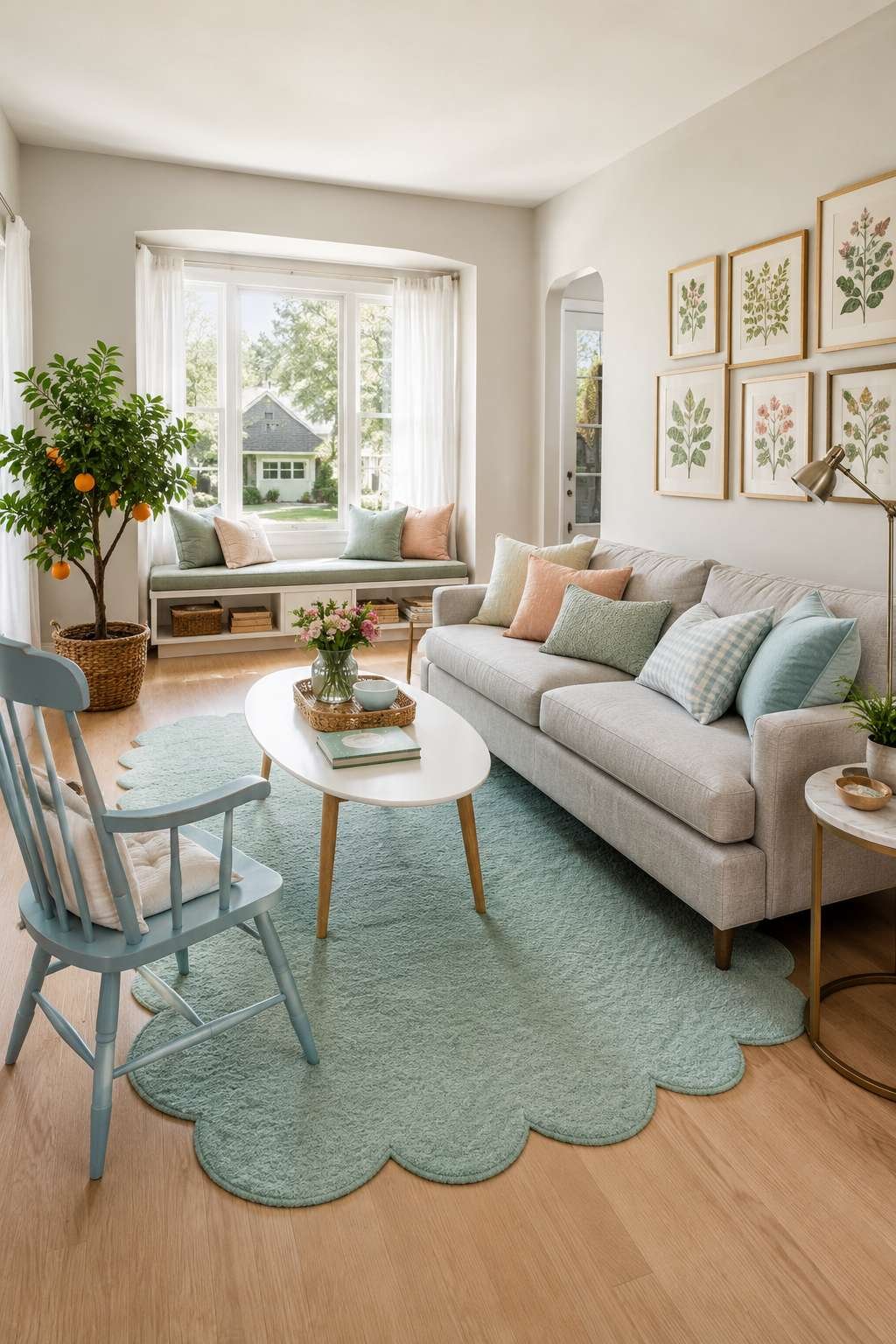
White painted hardwood floors are one of the most effective tools available for making a living room feel larger and brighter, and here they perform that function with characteristic generosity. Their pale, light-reflective surface amplifies every ray of sunlight entering through the bay window, whose deep sill provides additional display space for trailing plants and ceramic vessels. Sheers on a bay window are the perfect window treatment for this type of space: they maintain privacy and soften the window’s proportions while allowing the full-room daylight to flood the interior freely.
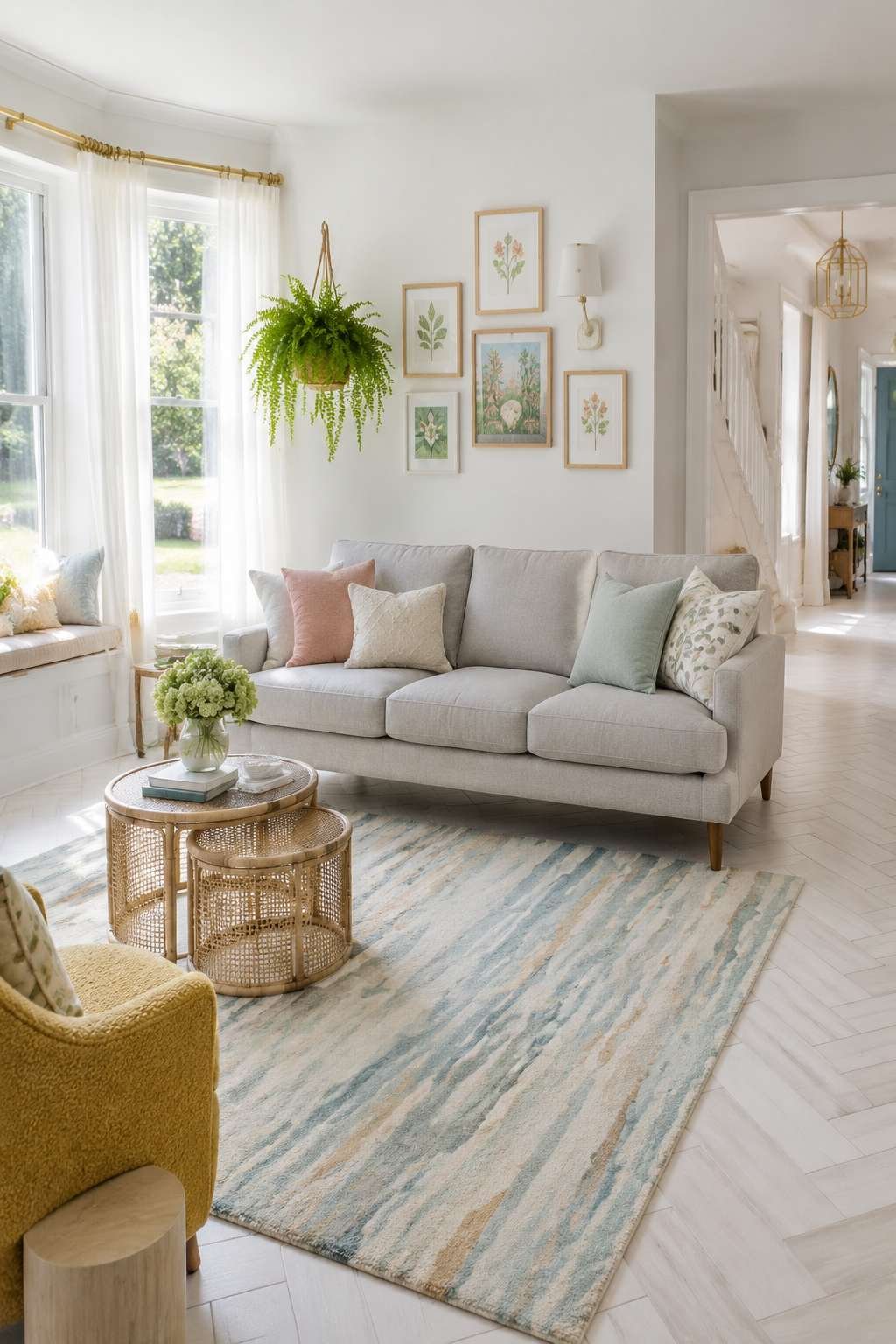
The overall character of this room is warmth without formality, style without self-consciousness. The warm light grey cotton sofa is the ideal anchor for this register of living room design: substantial enough to feel considered, neutral enough to accommodate the botanical gallery wall’s greens and blushes, and comfortable enough to invite the kind of long, easy afternoons that make a house feel genuinely like a home.
Key Design Tips:
- Create a gallery wall of framed botanical prints in matching frames for a fresh, cheerful decorative statement that connects interior to garden
- Paint or install white hardwood floors to maximize light reflection and visually expand the room’s footprint
- Dress bay windows with sheer panels to maintain light flow while softening the window’s deep architectural form
- Choose pastel throw pillows in soft green, blush, or lavender to complement a warm light grey sofa without introducing visual tension
- Position trailing plants on window sills and side tables to blur the boundary between interior design and the natural world outside
17. Moody Eclectic Drama: Olive Walls, Velvet, and Intellectual Warmth
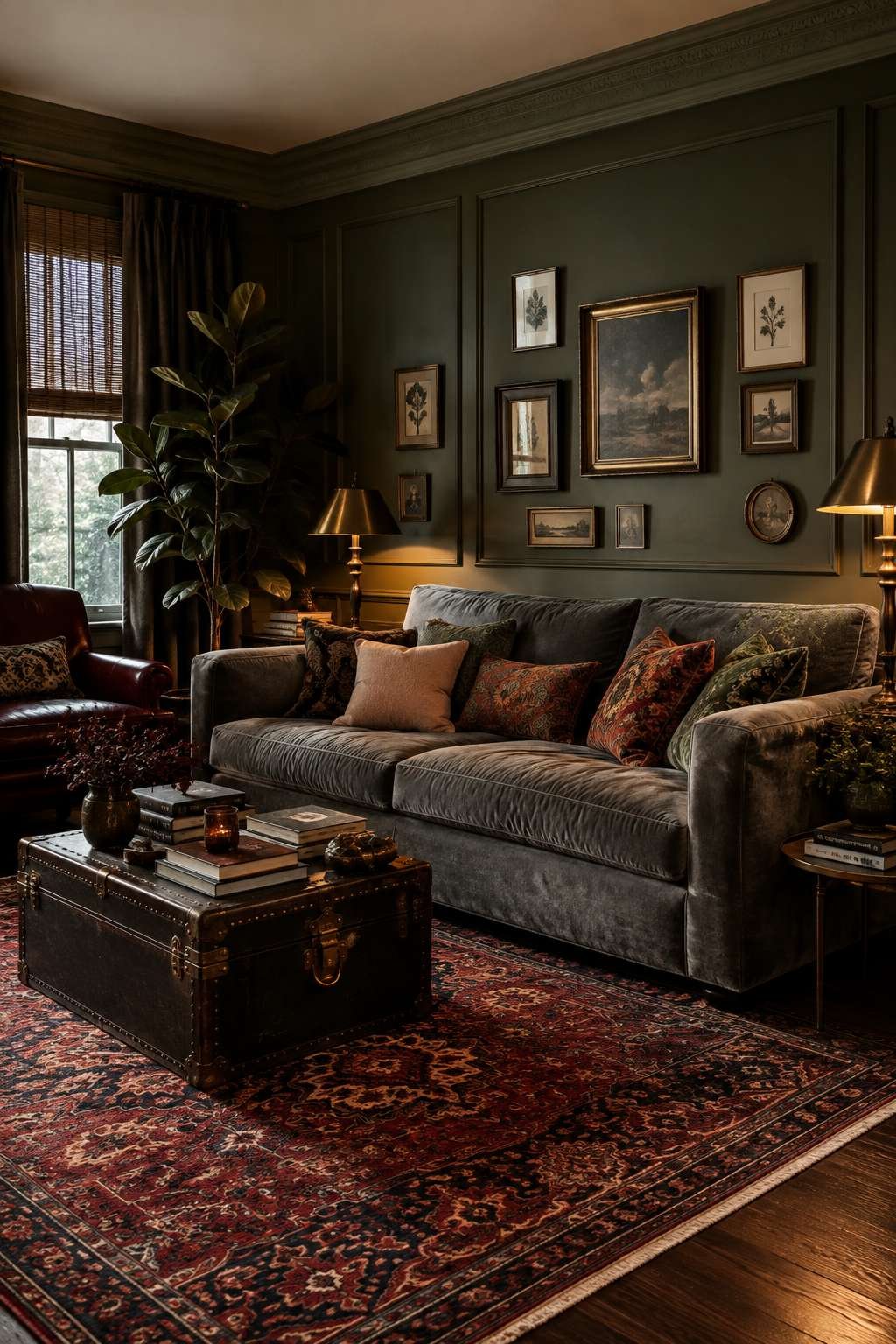
The moody eclectic living room is for those who find conventional bright and airy interiors emotionally insufficient — people who prefer depth, layering, and the sense of a room that has been assembled thoughtfully over time rather than purchased as a complete set. This concept anchors its drama with dark olive walls that immediately transform the room’s emotional register, creating a cocooning quality that makes every object placed against them appear jewel-like and intentional. Against this deep olive ground, an oversized grey velvet sofa commands attention through scale and texture alone.

The sofa’s generous proportions — wide, deep-seated, pile-rich — are layered with patterned throw pillows in rust, olive, and blush, each one contributing a different print or texture to a deliberately complex arrangement. This kind of cushion layering — mixing geometric with organic, print with plain, different scales of pattern — requires a confident hand but rewards with extraordinary richness. A vintage Persian rug in related warm tones anchors the seating arrangement while providing the room’s most powerful decorative element, its intricate pattern and aged coloring telling a story no contemporary rug can match.

Stacked books on every available surface — coffee table, side table, shelf — reinforce the intellectual character of the space, as do the brass table lamps whose warm tungsten glow creates the distinctive evening atmosphere of a room that loves reading, conversation, and the quiet pleasure of a well-considered environment. In this light, the grey velvet sofa transforms from its daytime coolness to an evening warmth that makes it feel like the most comfortable piece of furniture ever made. This is a room for people who understand that drama and comfort are not opposites.
Key Design Tips:
- Paint walls in deep olive, forest green, or charcoal to create the cocoon-like depth that gives moody interiors their power
- Commit to generous cushion layering with mixed prints, scales, and textures — timidity produces muddle rather than richness
- Source a vintage Persian or Turkish rug as the room’s primary decorative investment — its age, pattern complexity, and coloring reward long-term living with
- Use brass table lamps with warm-toned bulbs as the primary evening light source — overhead lighting destroys the moody eclectic atmosphere
- Allow books and personal objects to accumulate visibly — the curated clutter of a well-read, well-traveled life is this aesthetic’s most authentic accessory
18. Two-Tone Grey Mastery: Tonal Depth Without Color Complexity
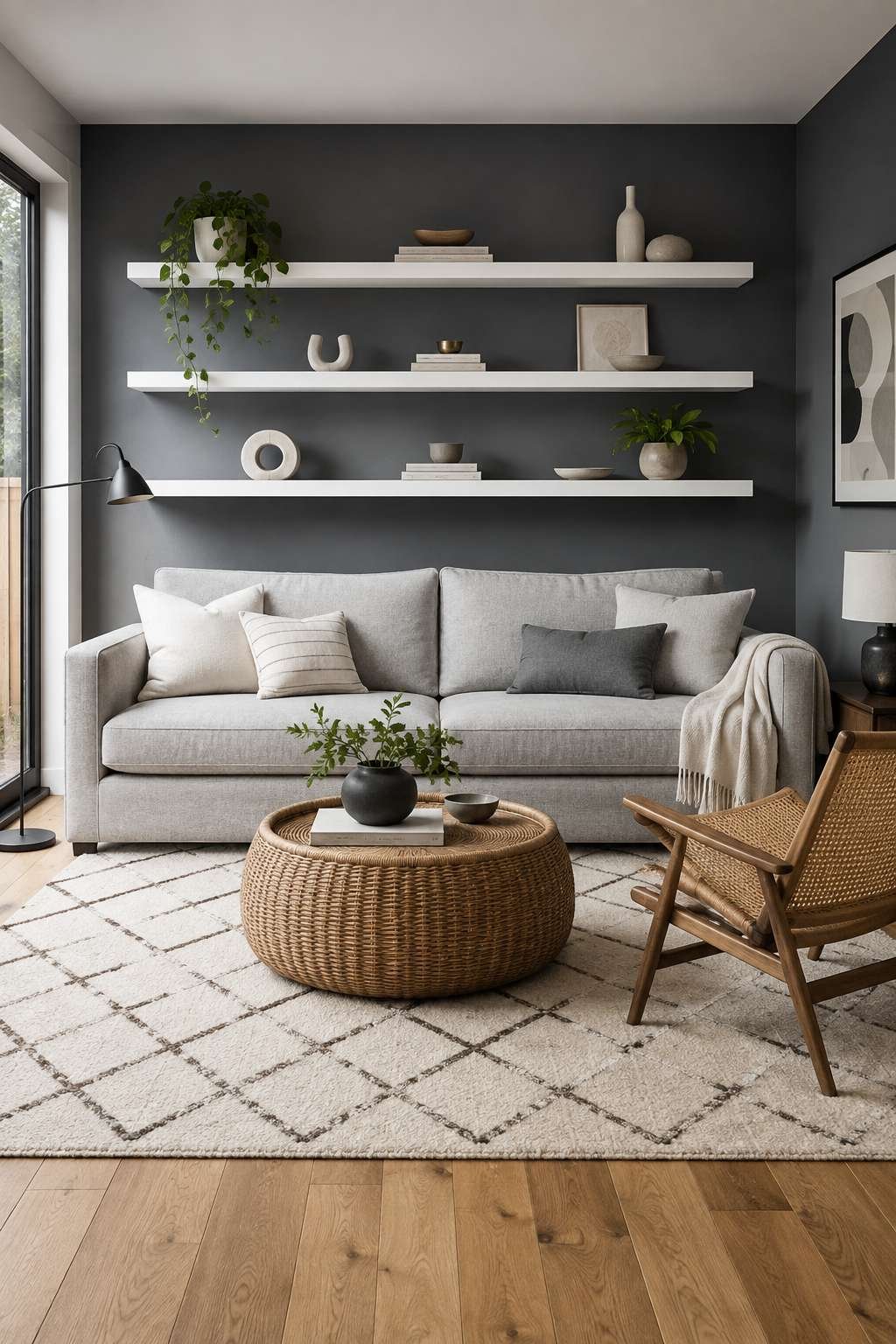
Playing with the tonal range within a single color family is one of interior design’s most sophisticated and underutilized techniques. This concept demonstrates its power by pairing a pale grey linen sofa against a darker charcoal accent wall, creating a layered tonal relationship that generates genuine visual depth without the complexity or risk of introducing additional colors. The contrast between the light sofa and dark wall is strong enough to create drama but closely enough related in hue to feel deeply considered rather than accidentally contrasting.
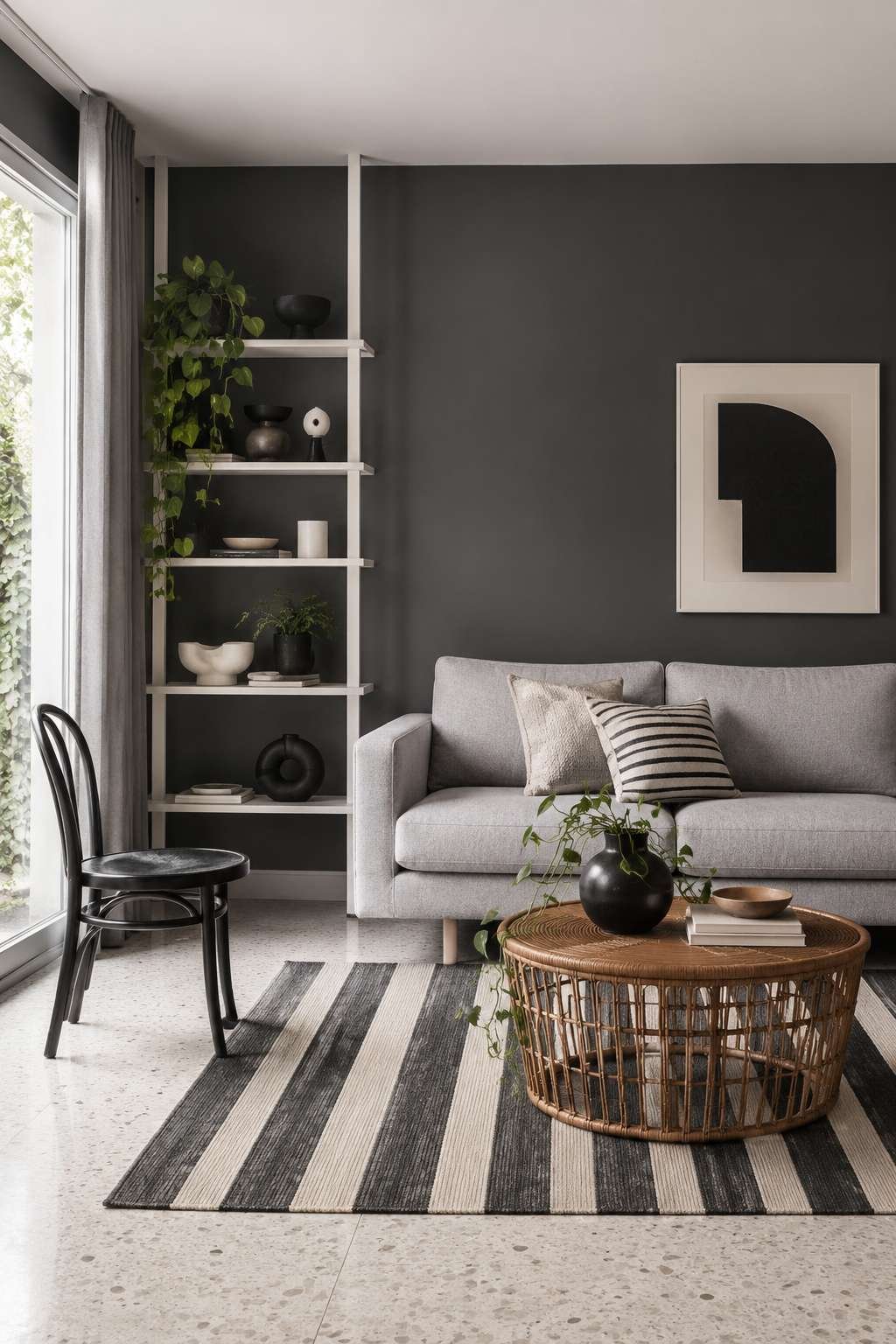
White floating shelves mounted against the charcoal wall provide functional display space while introducing a third tonal element — the white of the shelves — that bridges sofa and wall with crisp precision. On the shelves, sculptural objects and trailing pothos create a mix of geometric form and organic life that prevents the monochromatic scheme from feeling austere. The pothos, with its heart-shaped leaves cascading downward, introduces the only true natural green in the space — a single note of chromatic contrast that makes every grey surface appear richer by comparison.
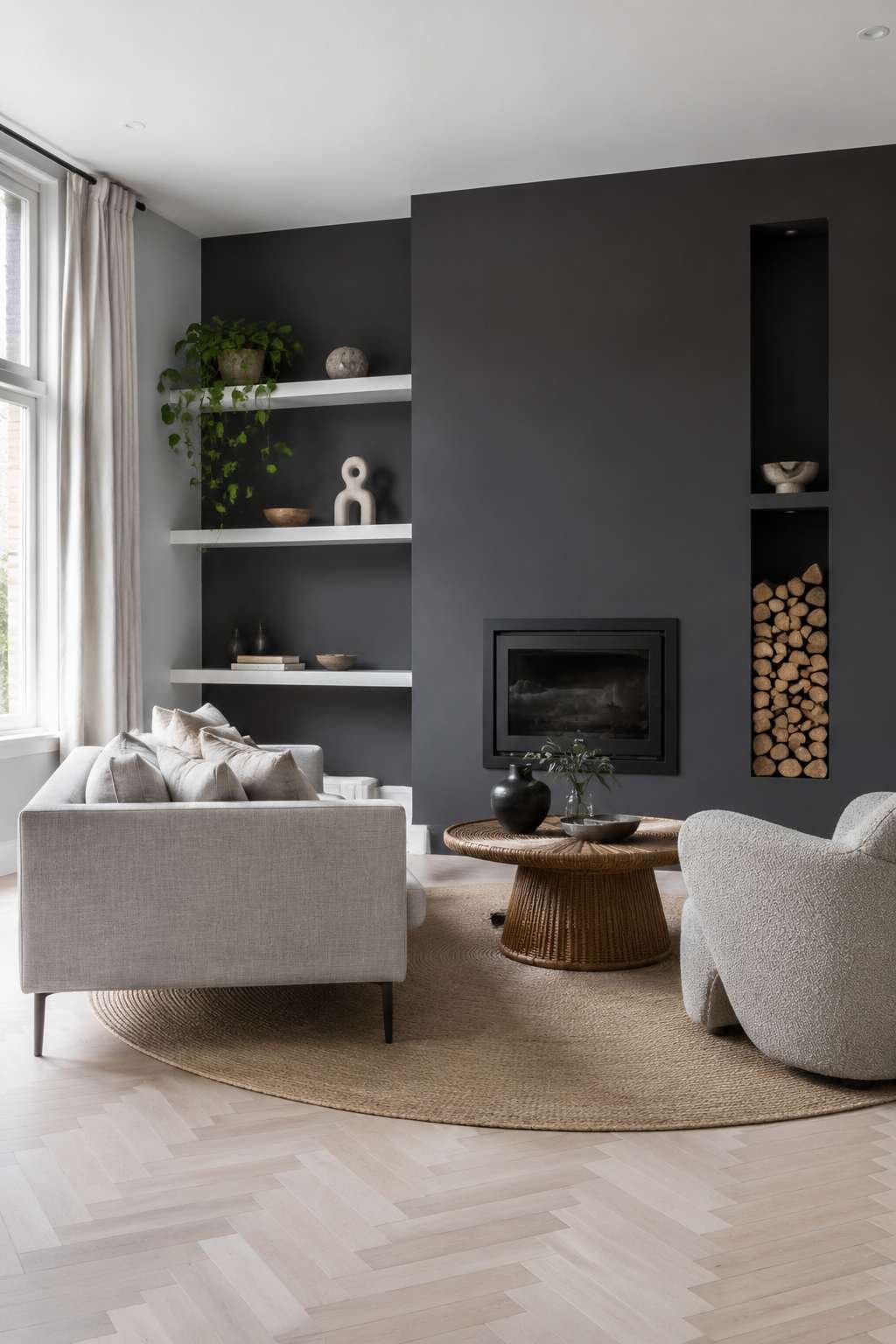
A round rattan coffee table introduces the concept’s one deliberate departure from the grey tonal scheme: its warm honey-brown woven surface provides natural contrast that grounds the space without disrupting its sophisticated restraint. Round coffee tables also bring welcome geometric contrast to the rectangular forms of sofa and shelving, softening the room’s overall composition with circular warmth. Soft daylight through unobstructed windows reveals the full tonal range — from the pale linen sofa through the mid-tone rattan to the deep charcoal accent wall — with maximum clarity and beauty.
Key Design Tips:
- Create tonal depth by pairing a pale grey sofa against a charcoal or dark grey accent wall — the relationship between light and dark within one hue is powerfully sophisticated
- Use white floating shelves as a third tonal element to bridge the contrast between pale sofa and dark wall
- Introduce a round rattan or natural-fiber coffee table for warm material contrast within a monochromatic grey scheme
- Place a single trailing plant variety in the scheme to provide the one chromatic contrast that makes grey interiors feel alive
- Allow daylight to reveal the tonal gradation — keep window treatments minimal or absent on the wall adjacent to the accent wall
19. Open-Plan Harmony: Defining Zones with Confident Neutrality
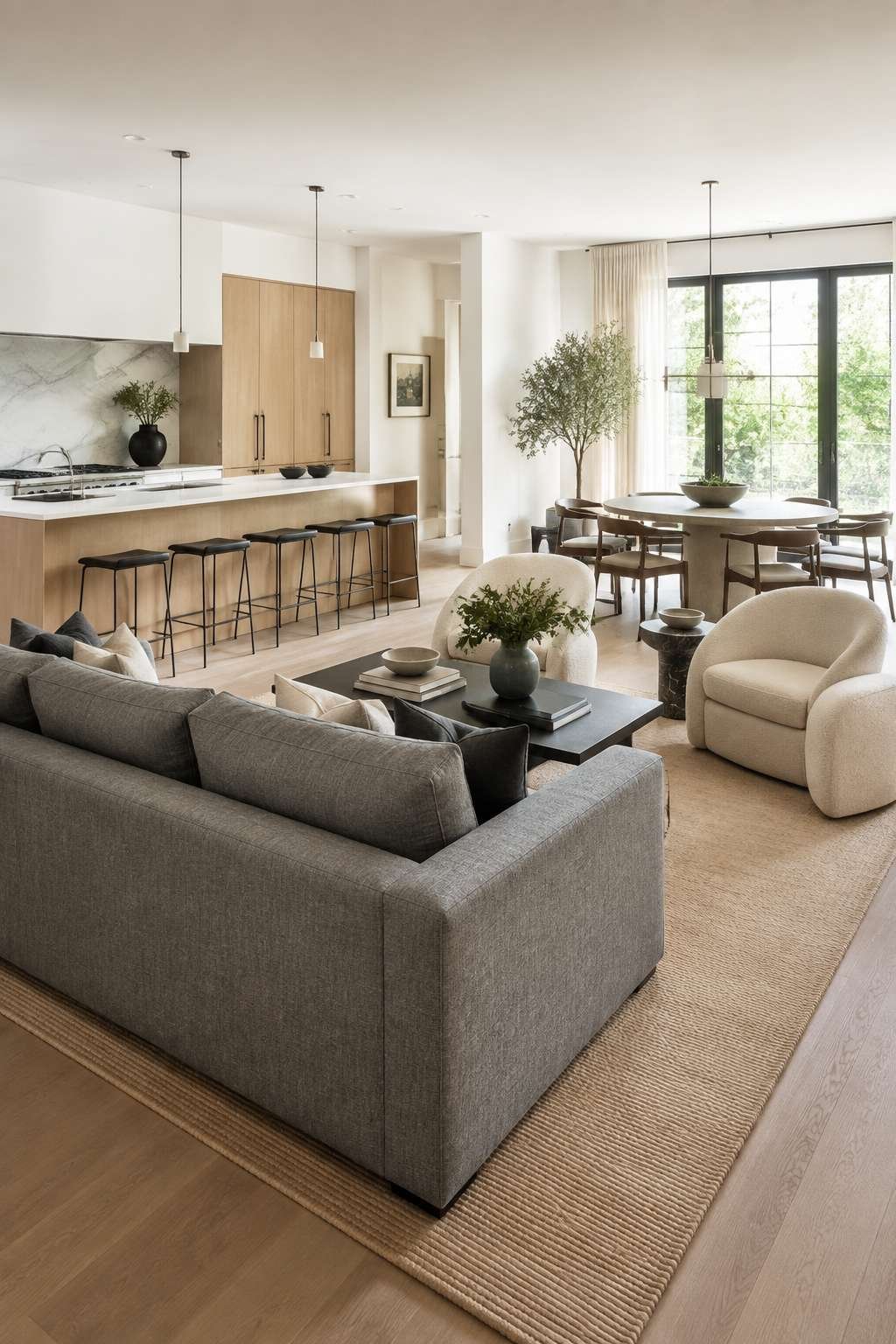
The contemporary open-plan home presents a specific interior design challenge: how to create functionally distinct zones — living, dining, cooking — within a single continuous space without resorting to walls, partitions, or heavy visual separation. This concept demonstrates how a light grey sofa can define the living zone within a combined kitchen-dining-living layout with quiet authority, its presence establishing where the living area begins and ends without explicit demarcation.

A large area rug in warm sand beneath the sofa and coffee table is the primary zoning tool, its edges marking the boundaries of the living area with soft precision. The rug’s warm sand tone creates a visual warmth that distinguishes the seating area from the kitchen’s harder, cooler surfaces, reinforcing the zone’s domestic identity without conflicting with the grey sofa or the broader neutral palette. A kitchen island provides the visual separation between cooking and living zones, its counter height and material language creating a natural boundary that guides the eye and movement through the space.
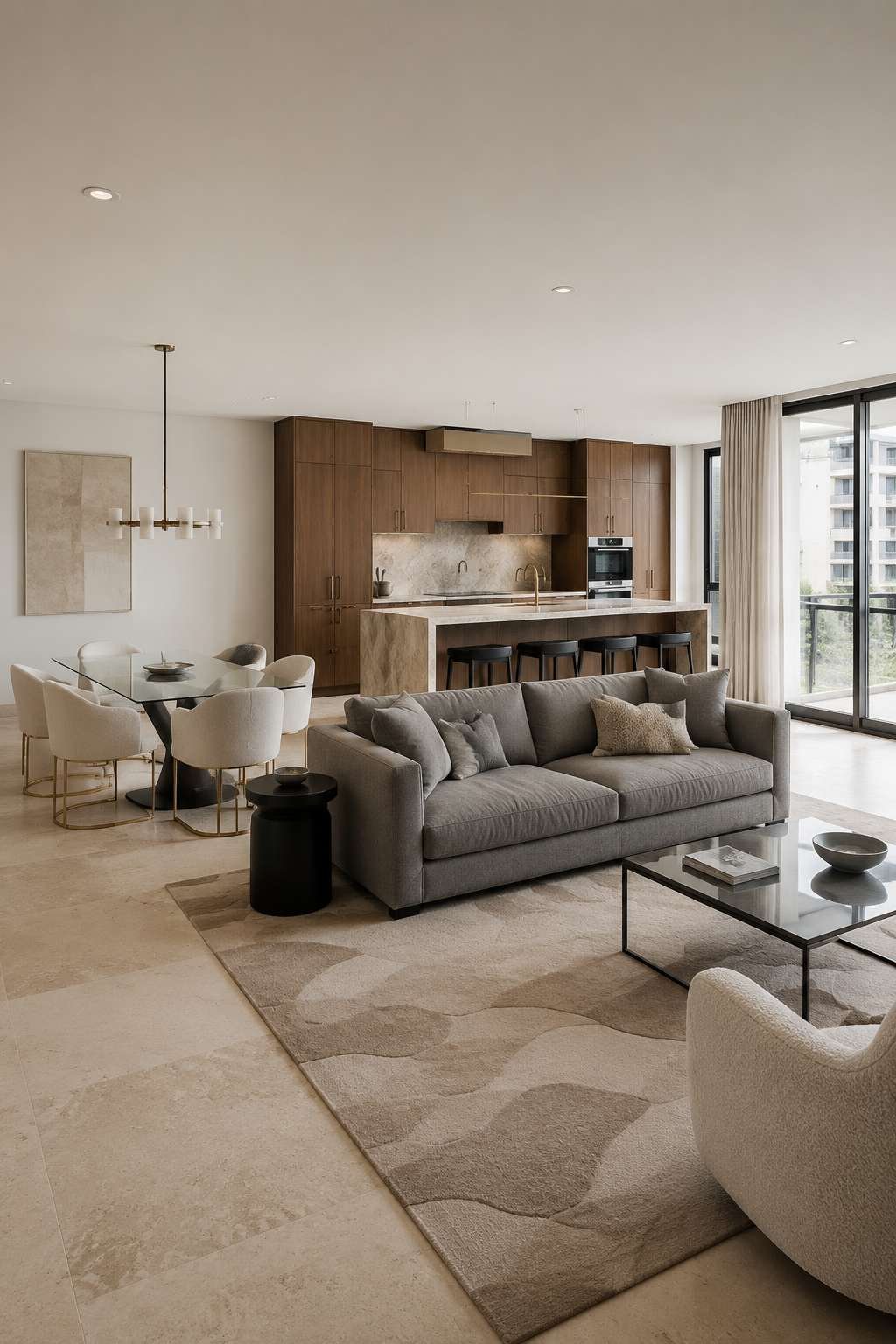
Bright, even natural daylight in an open-plan space demands a cohesive neutral palette — multiple strong color choices in such a space would create visual chaos, while the light grey sofa’s neutral tone functions as a unifying element that connects the living zone to the dining and kitchen areas without competition. This is interior design as spatial coordination, and the grey sofa performs its role within the larger composition with exemplary fluency. When all zones speak the same material language — neutral, warm, natural — the open-plan home achieves a coherence that is both visually satisfying and practically functional.
Key Design Tips:
- Use a large area rug as the primary open-plan zoning tool — its edges define the living area without physical separation
- Choose warm sand or natural tones for open-plan rugs to create warmth-contrast with kitchen surfaces while unifying the overall palette
- Position the grey sofa to face away from the kitchen where possible — its back subtly signals the boundary between zones
- Maintain a consistent neutral palette across all zones of an open-plan space to achieve visual coherence over the full floor plate
- Allow the kitchen island to function as the natural visual and physical boundary between living and cooking zones
20. Nordic Hygge: Chunky Knits, Candlelight, and Intimate Cocoons
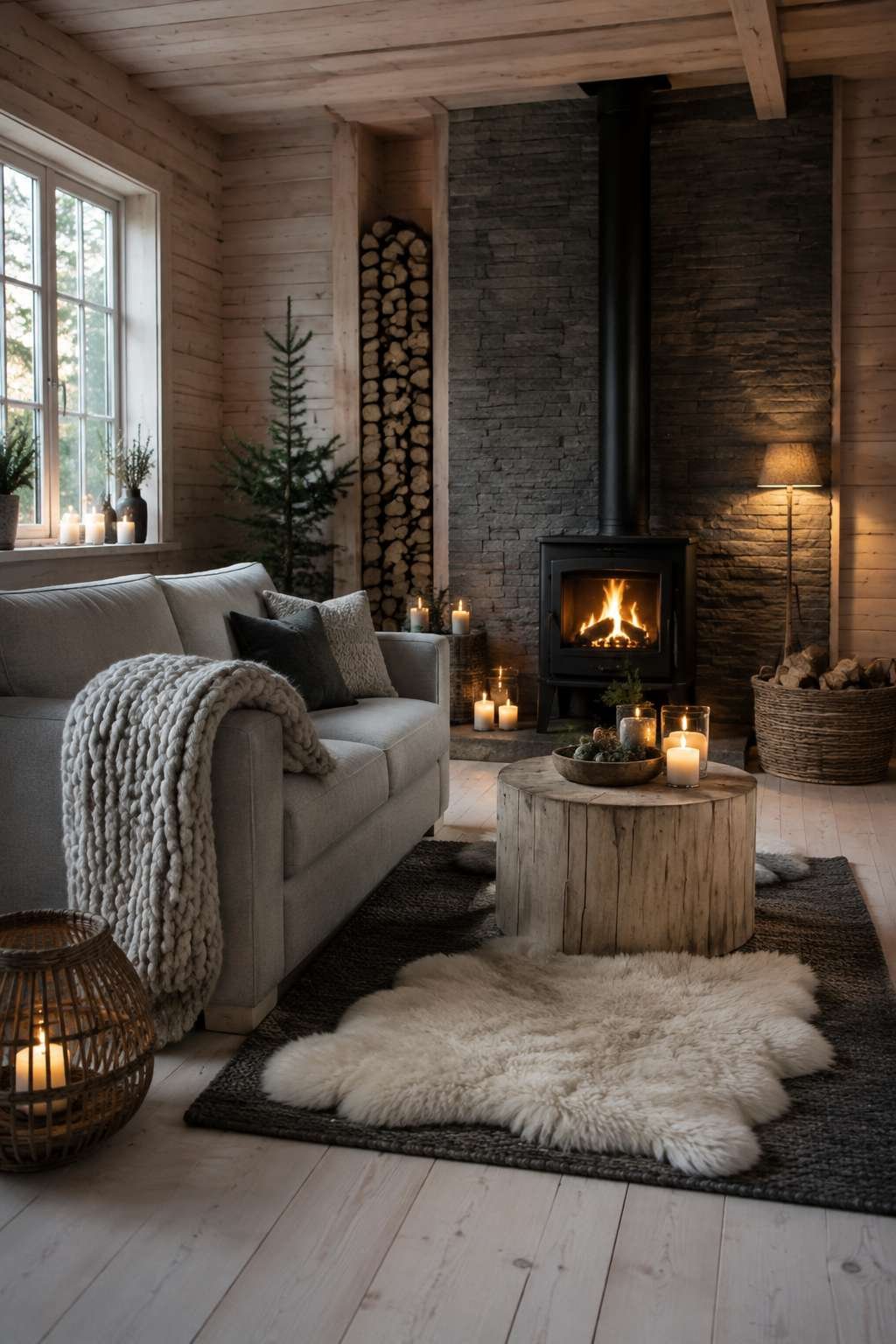
The Danish concept of hygge — roughly translated as cozy conviviality — represents one of the most influential ideas in contemporary interior design, and one of the most achievable. At its heart, hygge is about creating physical and emotional conditions for genuine comfort and connection, and this living room concept translates those conditions into material form with beautiful precision. A pale grey wool sofa draped with a chunky-knit throw sits beside a cast iron wood-burning stove, a combination that addresses the body’s most fundamental desire for warmth with complete directness.
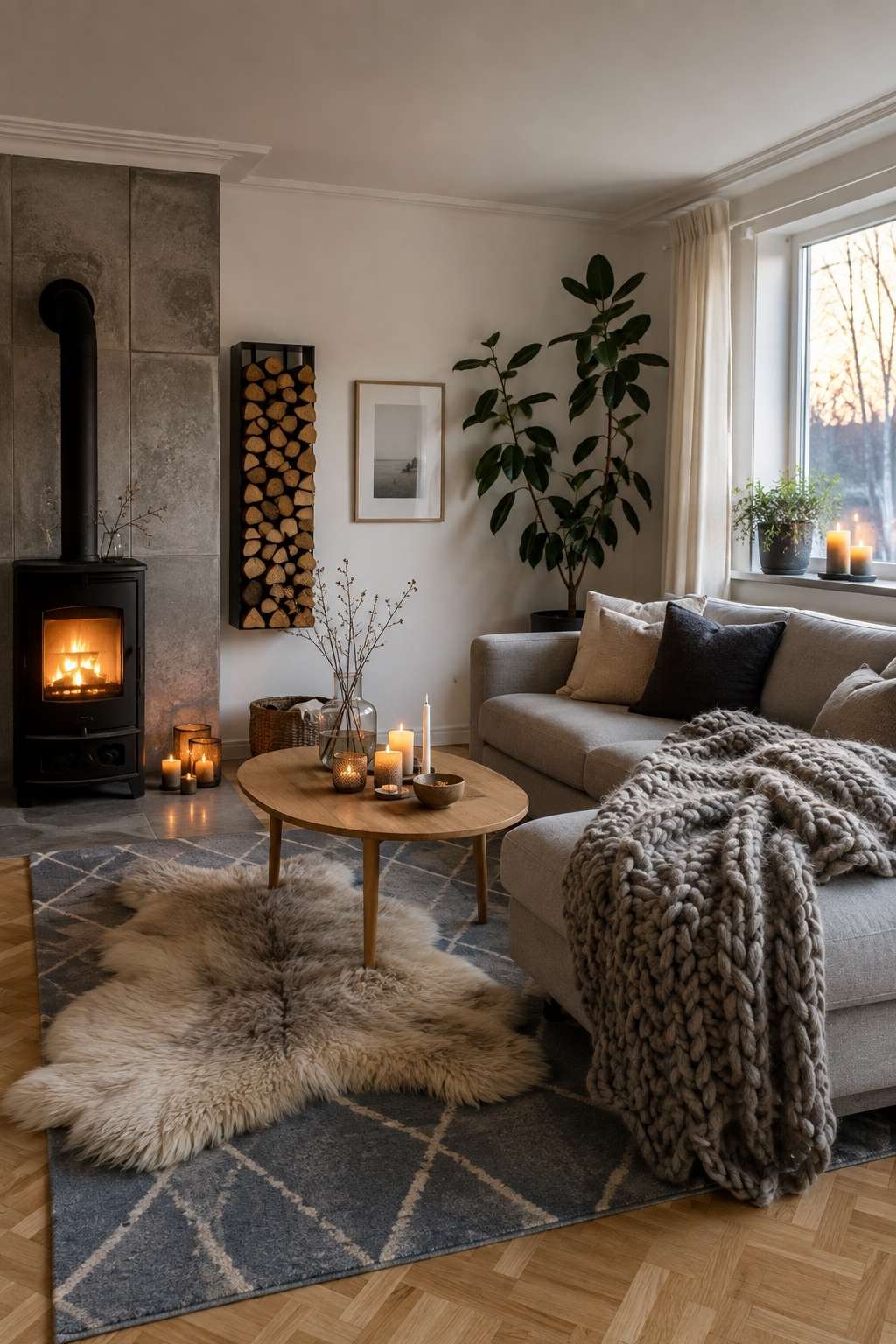
Candles in varying heights are arranged on the coffee table, side tables, and hearth, their warm flickering glow creating the intimate, pre-electric quality of light that makes a room feel genuinely cocooning. Hygge lighting is always warm, always low, and always multiple-sourced — a constellation of small flames rather than the flat uniformity of overhead illumination. A sheepskin rug on the floor beside the sofa adds the tactile luxury of a natural textile at the point of closest contact — beneath bare feet, around shoulders during a long evening — while birch log storage beside the stove provides both practical function and beautiful visual texture.
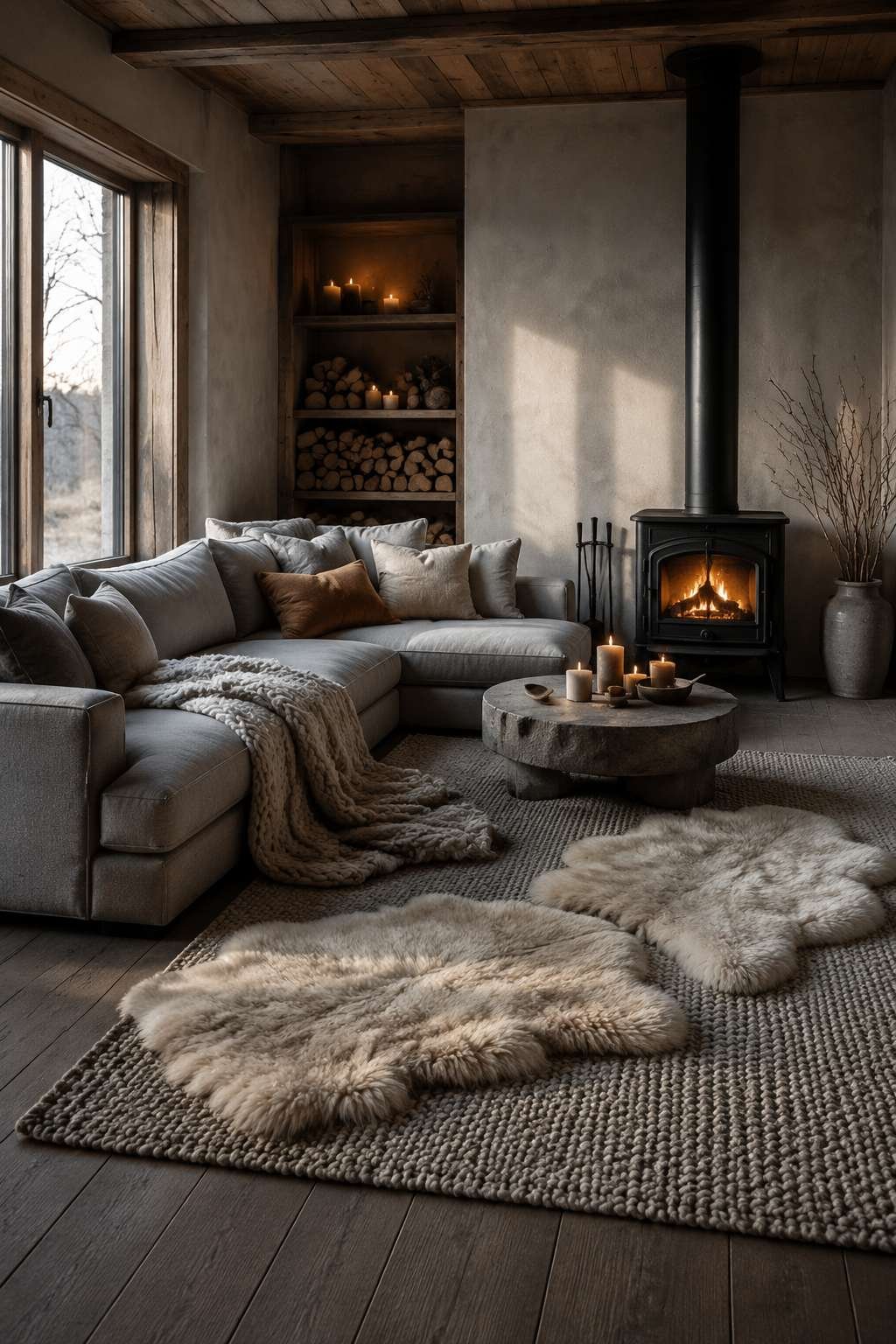
The pale grey wool sofa is the perfect hygge centerpiece — soft enough to invite long occupation, neutral enough to disappear into the room’s warm candlelit atmosphere, and tactile enough to reward the close contact that cold evenings naturally encourage. The chunky-knit throw draped over the sofa’s arm is simultaneously functional and intensely beautiful, its oversized stitching creating the tactile experience of hand-made warmth that is central to the hygge philosophy. This is a room that makes staying home feel like the best possible choice.
Key Design Tips:
- Invest in a chunky-knit or handmade throw for the grey sofa — its tactile generosity is the quintessential hygge textile gesture
- Arrange candles at multiple heights and in multiple locations — never rely on a single candle source for hygge illumination
- Place a sheepskin rug at the foot of the sofa for the tactile luxury of natural material underfoot on cold evenings
- Consider a wood-burning or gas stove as the room’s focal point — its warmth and visual drama are unmatched by any other heat source
- Keep accessories in warm, natural materials only — wool, wood, ceramic, and beeswax reinforce the hygge material philosophy comprehensively
21. Urban Loft Sophistication: Leather, Concrete, and City Light
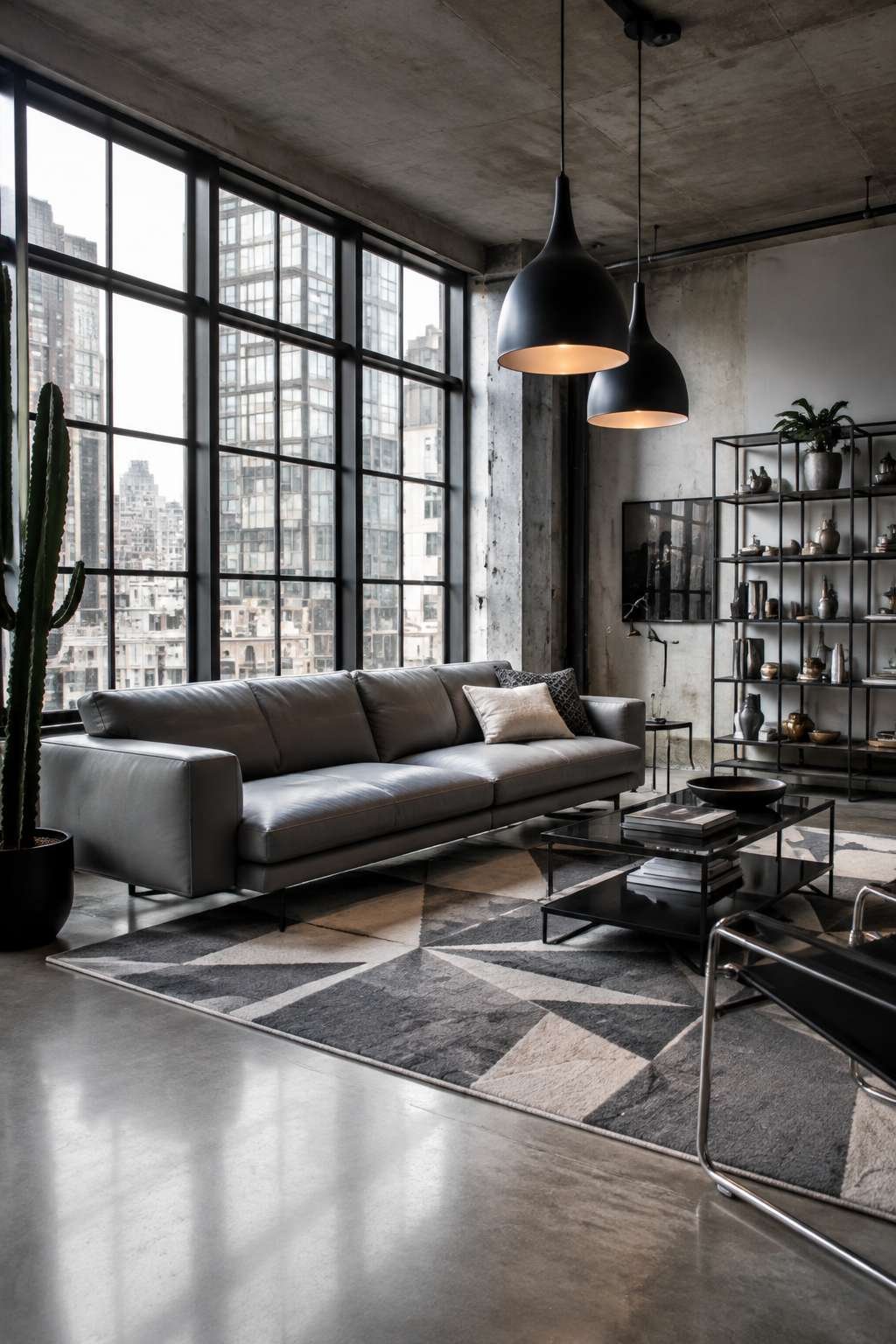
The contemporary urban loft living room synthesizes industrial heritage, material confidence, and the visual drama of city living into a single coherent aesthetic. In this concept, a streamlined grey leather sofa on polished concrete floors delivers the material statement that defines this interior category, its clean silhouette and smooth surface creating a precise dialogue with the reflective grey concrete beneath. Grey leather is an exceptional sofa material for urban loft contexts: it reads as both refined and tough, contemporary and timeless, easy to clean and visually distinguished.
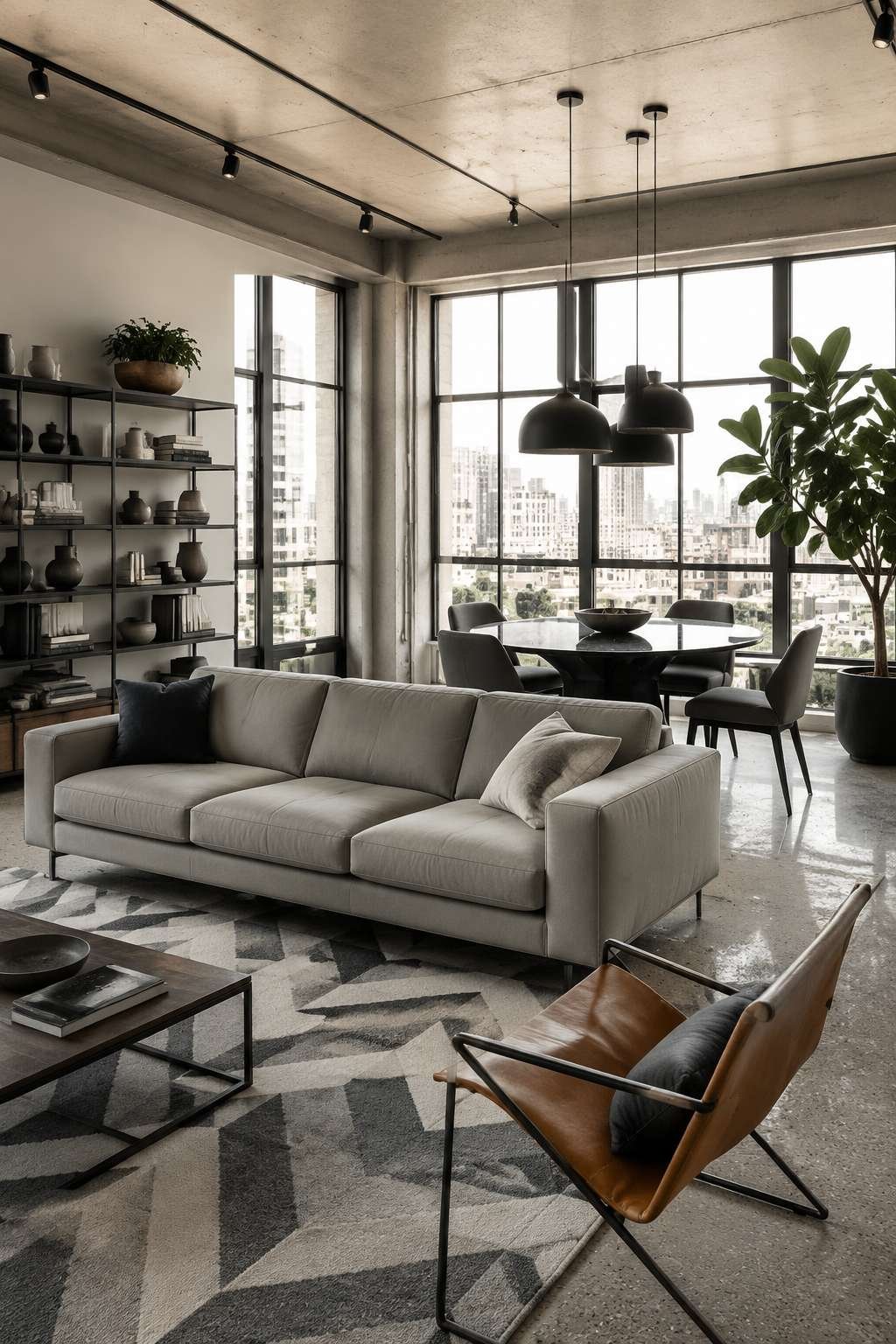
Black steel shelving along one wall provides the architectural storage solution that industrial loft interiors demand — its open framework displaying books, objects, and plants with functional transparency while reinforcing the space’s structural aesthetic language. A geometric wool rug in grey and white grounds the seating arrangement with graphic boldness, its geometric pattern adding visual complexity to an otherwise restrained palette. Statement pendant lighting in matte black hangs above the seating zone, its industrial silhouette connecting ceiling to floor with bold linear drama.
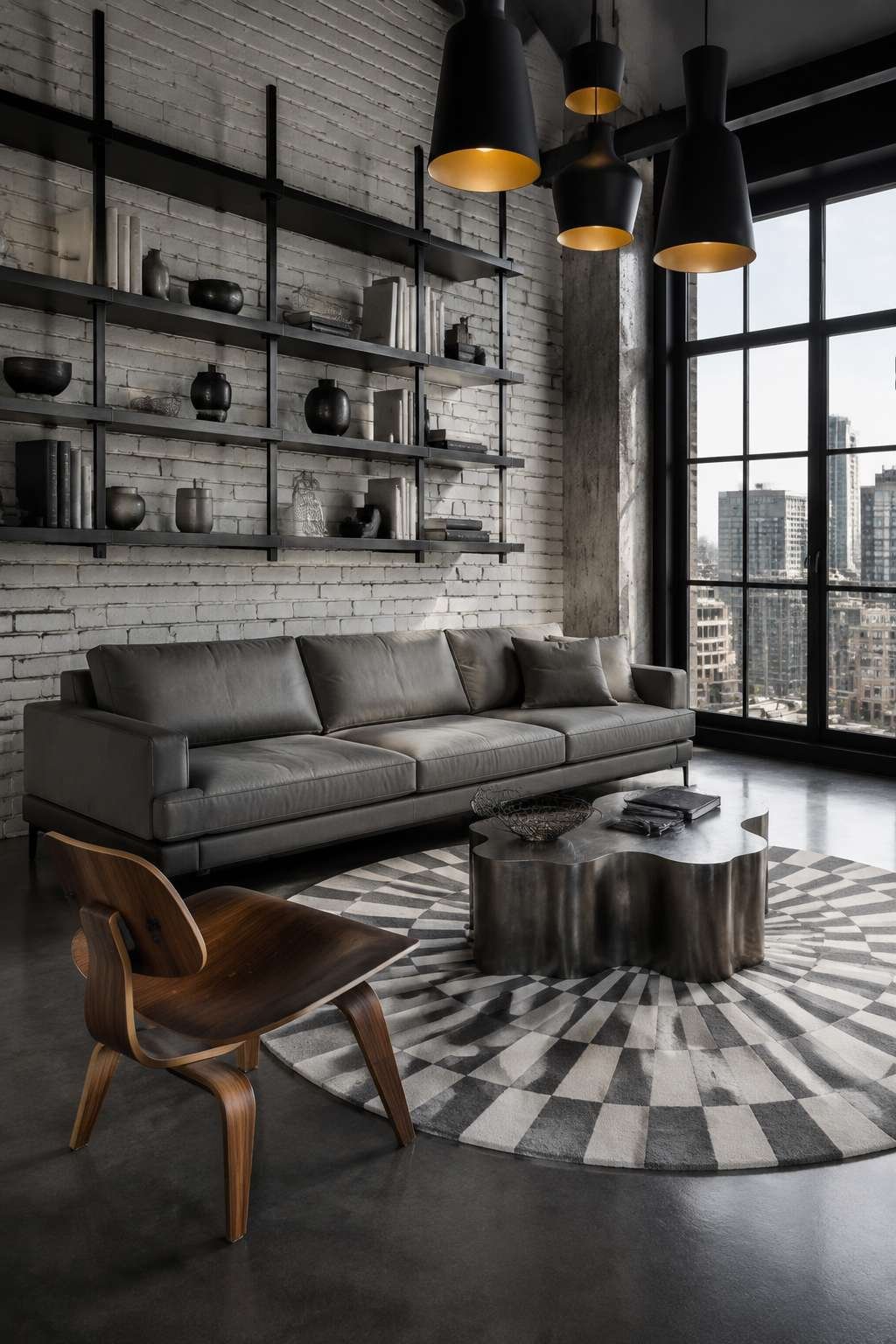
The concept’s defining experiential quality is the relationship between interior and exterior: city views through industrial steel-framed windows bring the urban environment into the living space as a constantly changing backdrop. The grey leather sofa faces these windows, positioning the city itself as the room’s primary art installation. At night, when the city lights replace the daylight with a warm electric glow, the polished concrete floor mirrors the skyline in miniature, and the entire room becomes a luminous, cinematic experience that no rural retreat could replicate. This is a living room that celebrates urban life with intelligence, commitment, and complete design conviction.
Key Design Tips:
- Choose grey leather upholstery for urban loft sofas — it is simultaneously refined, tough, and perfectly suited to the industrial material palette
- Install black steel open shelving for the combined aesthetic and functional benefits of industrial-inspired storage
- Select geometric wool rugs in grey, white, or black to add pattern complexity to a loft’s restrained industrial palette
- Use matte black pendant lights as the primary ceiling fixture — their graphic silhouette reinforces the industrial aesthetic language
- Position the sofa to face city-view windows directly where possible — the urban skyline is the loft interior’s most spectacular and freely available piece of art
Why These Light Grey Couch Living Room Ideas Are the Best
Across all 21 concepts presented here, the consistent versatility of the light grey sofa as a foundational design element becomes unmistakably clear. Whether dressed in cashmere for a luxury master suite, wrapped in washable performance fabric for a busy family home, or upholstered in natural undyed linen for a wabi-sabi sanctuary, the grey couch demonstrates a range of adaptability that no other furniture color quite matches. Its neutrality is not passive — it is actively enabling, making possible design combinations that stronger colors would foreclose.
The ideas in this collection span the full range of contemporary interior aesthetics, from the hygge-inspired Nordic warmth of Concept 20 to the art deco glamour of Concept 13, from the industrial urban confidence of Concepts 5 and 21 to the farmhouse rural charm of Concept 9. In every case, the grey sofa functions as the room’s emotional and visual anchor — present but not dominating, characterful but not restrictive, beautiful in itself while supporting the beauty of everything around it. This is the quality that makes grey sofa living room ideas so enduringly popular with professional interior designers and homeowners alike.
For those searching for light grey couch decorating ideas, grey sofa colour schemes, living room ideas with grey couch and wood floors, what colors go with a grey sofa, grey couch accent colors, or how to style a grey couch, these 21 concepts provide a comprehensive, style-spanning reference that demonstrates the full creative potential available within a single, brilliantly chosen furniture piece. The grey sofa is not a compromise — it is a canvas.
Conclusion
The living room concepts explored in this article demonstrate, with inspiring variety, that a light grey couch is one of the most creatively empowering decisions you can make for your home. From the intimate warmth of a hygge-inspired Nordic setup to the architectural drama of a double-height urban loft, from the humble honesty of wabi-sabi linen to the extravagant luxury of cashmere and Carrara marble, the grey sofa has proven itself equal to every aesthetic challenge and every lifestyle demand presented to it.
The key takeaway across all 21 ideas is this: the grey sofa succeeds because it listens rather than insists. It allows your chosen materials, colors, textures, and accessories to tell the room’s story, providing a composed, beautiful foundation that amplifies everything built upon it. Choose your preferred aesthetic from these pages, identify the material combinations and lighting approaches that resonate most deeply with your own tastes, and build your living room with the confidence that a light grey couch will support your vision every step of the way. The room of your dreams is closer — and more achievable — than you might think.
