


Cooking beneath an open sky, surrounded by the sights, sounds, and scents of a thriving garden, feels undeniably magical. A well-designed backyard kitchen is no longer a luxury reserved for grand estates — it has become one of the most sought-after home improvements for families, entertainers, and design enthusiasts alike. The outdoor kitchen bridges the gap between the warmth of interior living and the freedom of the great outdoors, creating a space that is as functional as it is beautiful. When thoughtfully planned, a backyard kitchen becomes the true heart of the home, a place where meals are crafted, memories are made, and the boundaries between indoor comfort and outdoor adventure dissolve entirely.
What makes the outdoor kitchen so compelling is the extraordinary range of design possibilities available to homeowners. Whether your aesthetic leans toward sleek modern minimalism, rustic farmhouse charm, tropical resort opulence, or zen-inspired tranquility, there is an outdoor kitchen concept perfectly suited to your personality and lifestyle. The materials, textures, lighting choices, and spatial arrangements you select will define not only the look of the space but also how it feels to spend time there — and ultimately, how often you and your loved ones actually use it. Thoughtful design transforms a simple grill station into a fully realized outdoor room.
In this article, we explore 21 inspiring backyard kitchen ideas that span a remarkable spectrum of styles, budgets, and spatial scales. From a sprawling luxury island with professional-grade appliances to a clever compact setup designed for a narrow urban terrace, each concept offers actionable design wisdom and a distinct visual identity. Whether you are starting from scratch or looking to refresh an existing outdoor cooking area, these ideas will spark your imagination and help you create the backyard kitchen of your dreams.
1. The Classic Entertainer: Built-In Grill Station with Granite Countertops
Few outdoor kitchen configurations communicate timeless sophistication quite like a built-in stainless steel grill station set into natural stone cladding and crowned with granite countertops. This is the archetypal backyard kitchen — a design that has earned its place in countless dream homes because it delivers on every front: durability, visual weight, and an undeniable sense of permanence. The stainless steel grill gleams against the rugged backdrop of stone, creating a beautiful material contrast that speaks to both the precision of fine cooking and the organic beauty of the natural world.
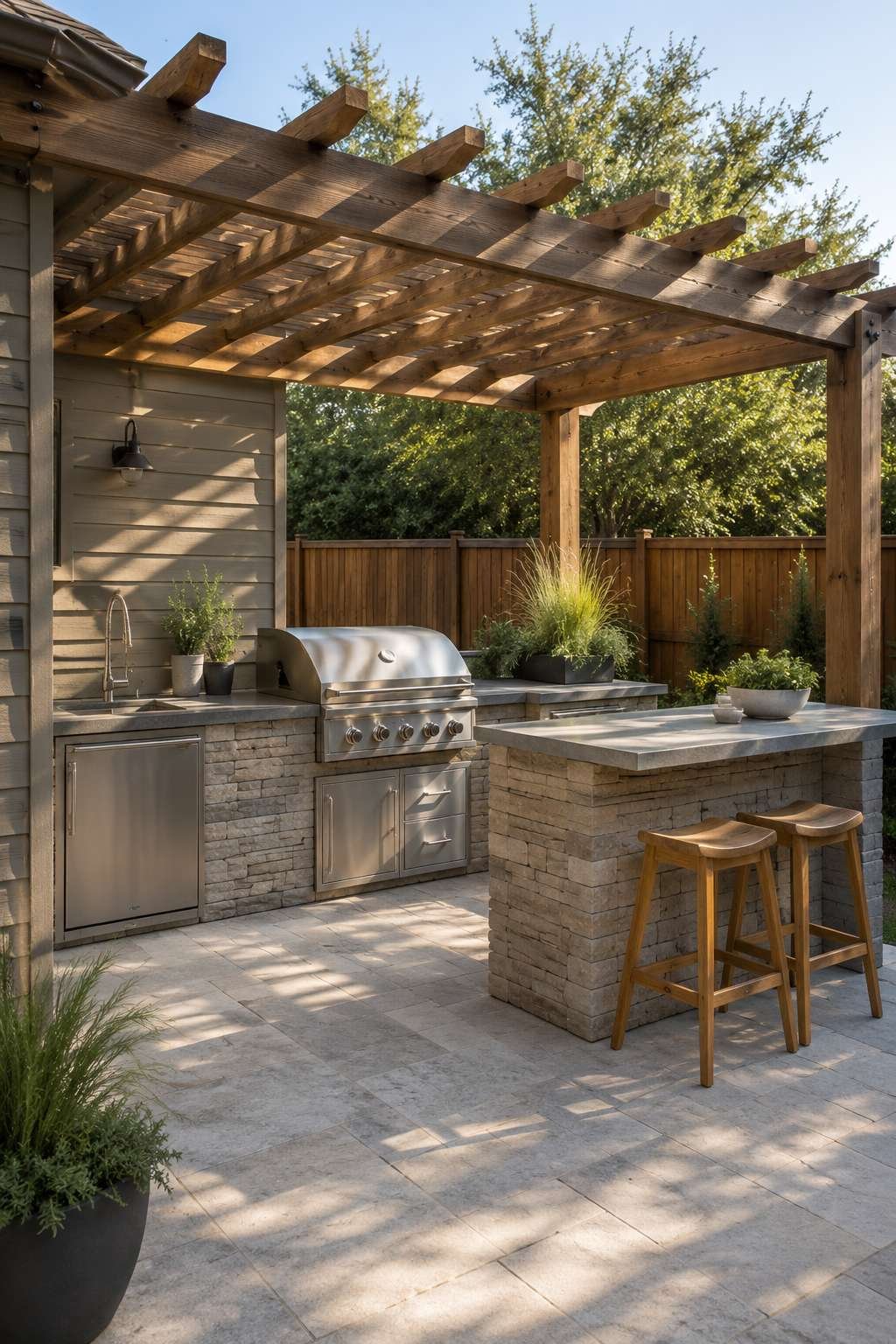
A pergola draped with climbing vines overhead transforms the cooking area into a living, breathing space that shifts with the seasons. In summer, the canopy of foliage provides dappled shade, filtering harsh midday sun into soft, diffuse pools of light that fall gently across the granite surface. By evening, the golden hour bathes the entire arrangement in warm amber tones, highlighting the crystalline flecks within the granite countertop and the brushed texture of the stainless steel fixtures. This interplay between natural light and premium materials is what elevates the space from a functional cooking zone to a genuinely beautiful outdoor room.
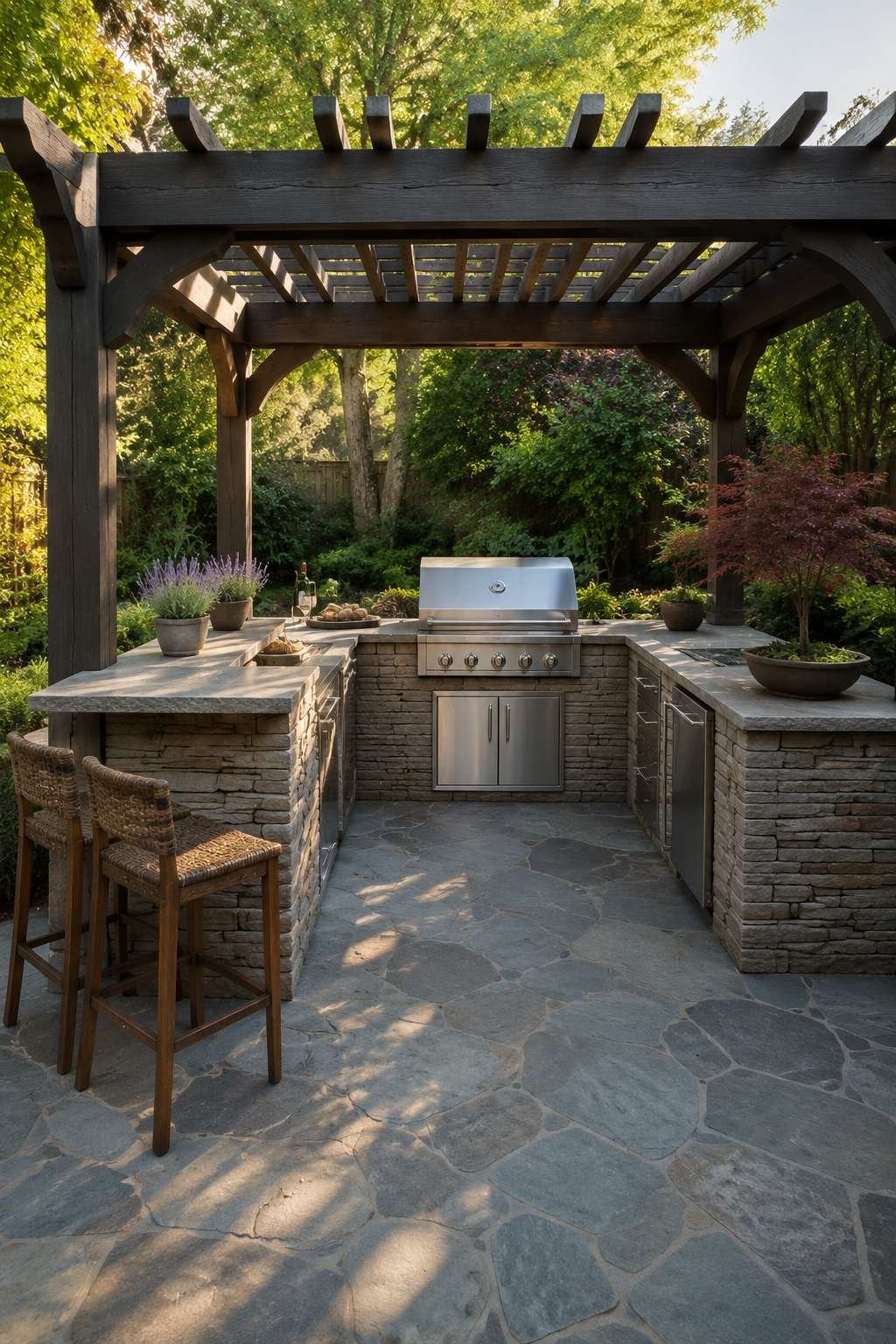
The inclusion of an adjacent prep counter with an undermount sink and brushed nickel faucet completes the workflow logic of the kitchen, ensuring that everything a cook needs — from washing produce to plating dishes — is within easy reach. This functional layout mirrors the ergonomic principles of the finest indoor kitchens, adapted thoughtfully for the outdoor environment. Natural stone cladding on the vertical surfaces anchors the entire composition, giving it a sense of weight and solidity that reinforces the feeling of a permanent, considered installation rather than an afterthought.

What truly makes this design endure is its seamless integration with the surrounding garden. The stone cladding echoes natural rock formations, the climbing vines blur the boundary between structure and landscape, and the warm afternoon light ties every element together into a cohesive scene of outdoor living at its most refined.
Key Design Tips:
- Choose granite slabs with subtle movement and natural variation for countertops — they hide wear beautifully and age gracefully outdoors.
- Select stainless steel grades 304 or 316 for grill stations and hardware to ensure genuine corrosion resistance in all climates.
- Train climbing vines such as wisteria, jasmine, or Virginia creeper on pergola structures for seasonal shade and natural fragrance.
- Install an undermount sink rather than a drop-in model for easier outdoor countertop cleaning and a more polished aesthetic.
- Position the grill station with prevailing wind direction in mind so smoke flows away from seating and prep areas.
2. Rustic Artisan Charm: The Wood-Fired Pizza Oven as Centerpiece
When a wood-fired pizza oven takes center stage in a backyard kitchen, the entire space transforms into something closer to an artisan’s workshop than a conventional cooking area. Constructed from reclaimed brick with a natural stone surround, this type of oven carries a sense of history and craft that no gas appliance can replicate. The irregular surfaces of aged brick, each one slightly different in color and texture, create a visual tapestry that becomes more beautiful with each passing season as the oven develops its own character through use and exposure.

Flanking the pizza oven, weathered teak wood countertops bring warmth and organic texture to the composition. Teak is one of the finest outdoor timber choices available — its natural oils render it highly resistant to moisture, insects, and temperature fluctuation, while its honey-to-silver aging process adds character rather than deterioration over time. Open shelving below stores cast iron cookware in full view, celebrating these functional tools as design objects in their own right. The juxtaposition of rough-hewn brick, silky wood grain, and the matte black of cast iron creates a richly layered material palette.
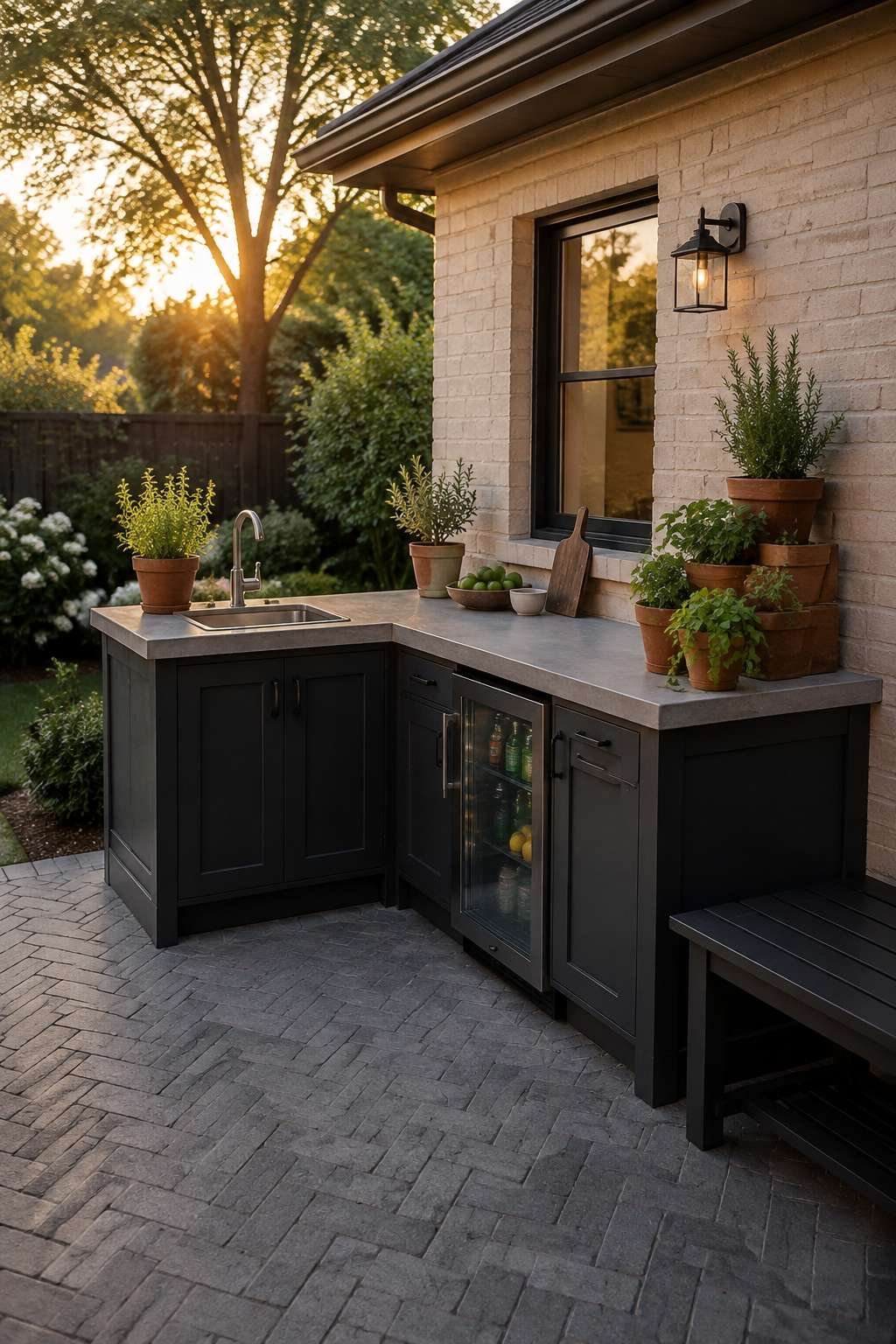
As evening descends, string lights draped overhead shift the mood entirely. The warm glow of incandescent bulbs softens every surface, casting gentle shadows across the brick texture and making the natural wood grain appear even richer. This is a kitchen designed as much for the pleasure of being present as for the act of cooking — a space that invites guests to linger, pour another glass of wine, and watch the flames dance within the oven’s arched opening. The twilight atmosphere created by string lighting is one of the most cost-effective and transformative elements any outdoor kitchen designer can employ.
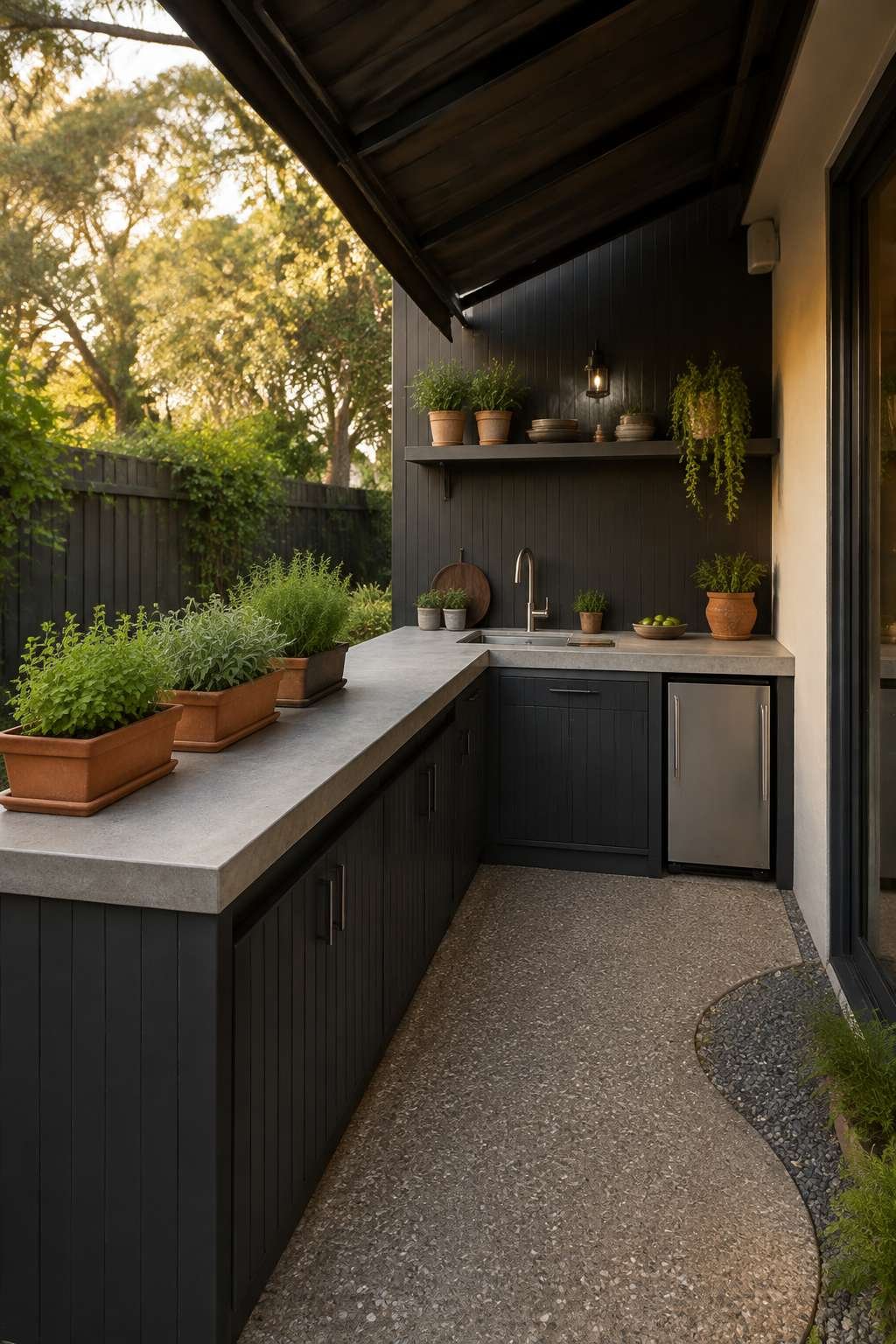
The authentic charm of an artisan cooking space lies precisely in its imperfection — the slight irregularity of handmade brick, the natural variation of wood grain, the honest patina of well-used cookware. This is a backyard kitchen that tells a story, and that narrative quality is what makes guests feel immediately at home.
Key Design Tips:
- Use reclaimed brick from demolished buildings for authentic texture and color variation that new brick cannot replicate.
- Seal teak wood countertops with a quality teak oil annually to preserve the warm honey tone, or allow natural silvering for a more rustic aesthetic.
- Install string lights on dimmer switches to control ambiance from lively entertaining to intimate evening dining.
- Pair a wood-fired oven with a covered wood storage alcove to keep fuel dry and accessible while adding a functional design element.
- Add a pizza peel hook and dedicated utensil rail beside the oven for organized, professional workflow during cooking.
3. Smart and Compact: The Space-Efficient Suburban Backyard Kitchen
Smaller yards need not mean compromised outdoor kitchens. A compact powder-coated black aluminum frame with concrete countertops and an integrated propane grill demonstrates that thoughtful design can pack an extraordinary amount of function into a modest footprint. The black aluminum framework provides structural integrity without visual heaviness, while the concrete countertop introduces an industrial texture that feels intentional and contemporary rather than budget-constrained. Together, these materials create a kitchen that punches well above its spatial weight.
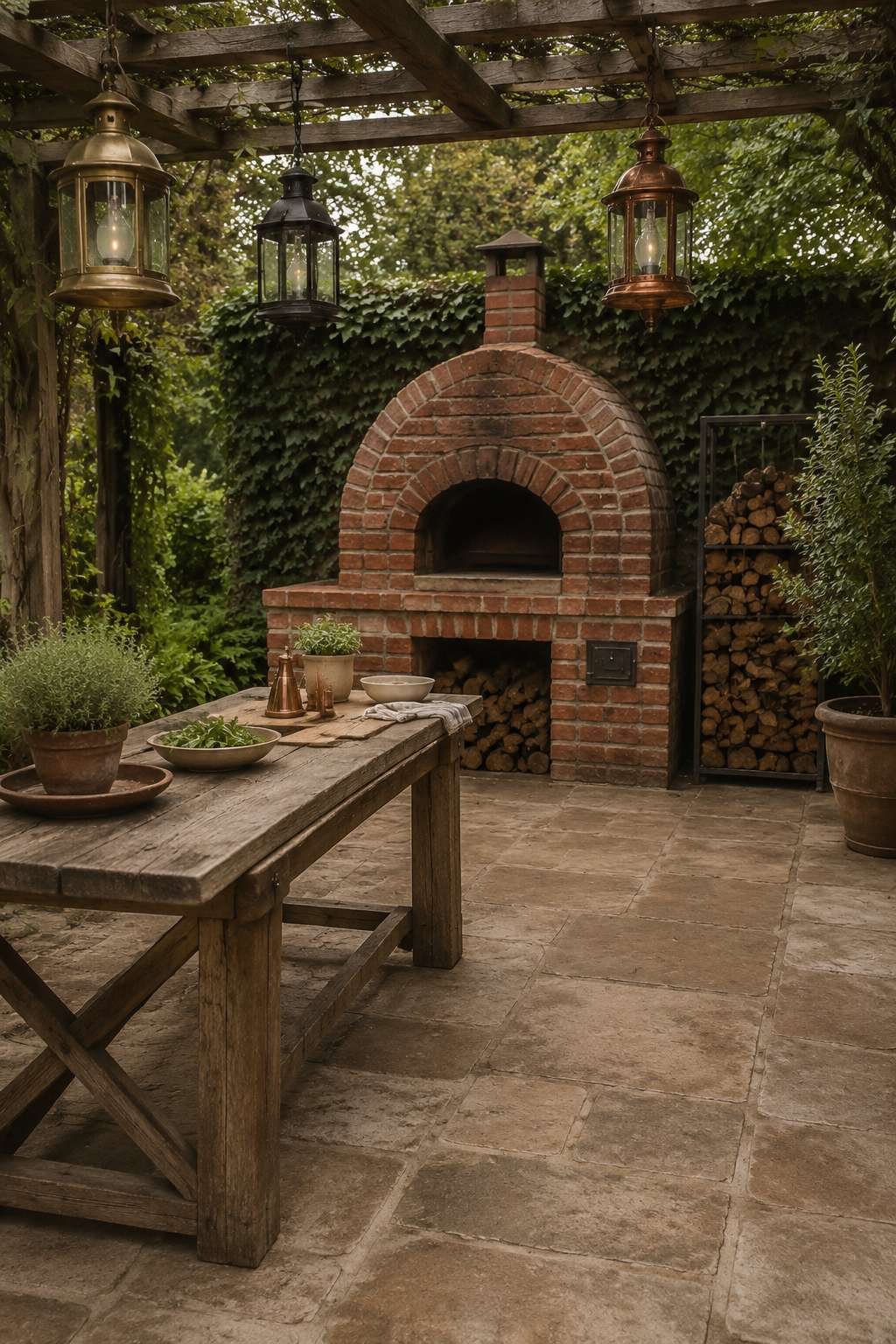
The real design genius of this setup lies in the smart pegboard backsplash, which transforms what would otherwise be wasted vertical space into a dynamic, reconfigurable storage system. Grilling tools, herb planters, spice racks, and even small lighting fixtures can be mounted, repositioned, and swapped out with ease. This modular approach to storage is particularly valuable in a compact outdoor kitchen where every square inch must earn its place. Paired with living herb planters on the pegboard, the arrangement brings fresh fragrance and ingredient accessibility directly into the cooking zone.

The surrounding bamboo screening serves a dual purpose — it provides privacy from neighboring yards while its lush green presence creates a natural backdrop that makes the industrial black and concrete elements sing by contrast. Soft morning light filtering through bamboo creates a gentle, dappled quality that highlights the texture of concrete aggregate and makes the whole space feel serene and considered. This is a kitchen that rewards an early-morning coffee ritual as much as an evening barbecue session.

What this design proves is that space efficiency and aesthetic ambition are not mutually exclusive. By committing fully to a bold, intentional color palette — deep matte black against the natural greens of bamboo and fresh herbs — and by solving storage challenges creatively, a modest suburban backyard kitchen can feel as purposeful and inspiring as a far larger installation.
Key Design Tips:
- Choose powder-coated aluminum for framing in compact kitchens — it is lightweight, rust-proof, and available in virtually any color.
- Install a pegboard backsplash in weatherproof painted plywood or metal for a flexible, reconfigurable storage solution.
- Use living herb planters integrated into the kitchen structure to add color, fragrance, and fresh cooking ingredients within arm’s reach.
- Select propane over natural gas for compact setups to avoid the cost and disruption of running gas lines to smaller spaces.
- Plant fast-growing bamboo screening in planters to create instant privacy without requiring permanent fencing structures.
4. Modern Elegance: Sleek White Quartz and Cedar Pergola
A white quartz countertop with a waterfall edge is one of the most striking statements an outdoor kitchen can make — and when paired with frameless cabinetry in weatherproof dove-white powder coat, the result is a space of genuinely breathtaking contemporary elegance. The dove-white finish reflects available light beautifully, making the kitchen appear expansive and luminous even in the shifting conditions of an outdoor environment. This is a design that translates the language of high-end indoor kitchens directly into the garden, refusing to accept any compromise in material quality or visual refinement.
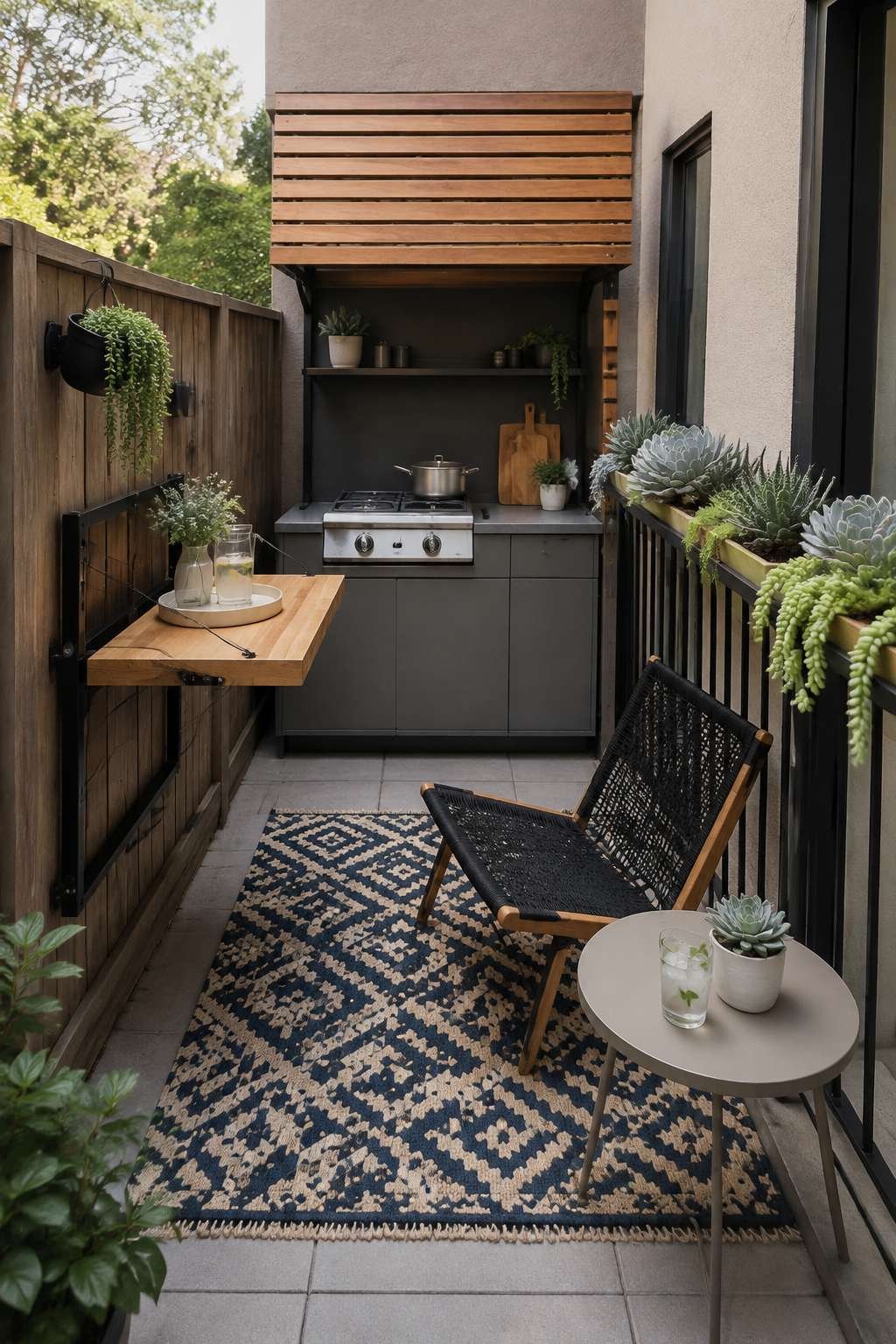
The waterfall island edge — where the quartz countertop continues vertically down the side of the island — is a design detail borrowed from the finest contemporary interior kitchens, and its application here demonstrates a sophisticated understanding of how indoor and outdoor design language can speak to one another. Beneath the counter, a built-in refrigerator and wine cooler unit ensure that entertaining logistics are handled seamlessly, eliminating the constant traffic back and forth to the house. This level of appliance integration is what separates a truly functional outdoor kitchen from a glorified grill station.
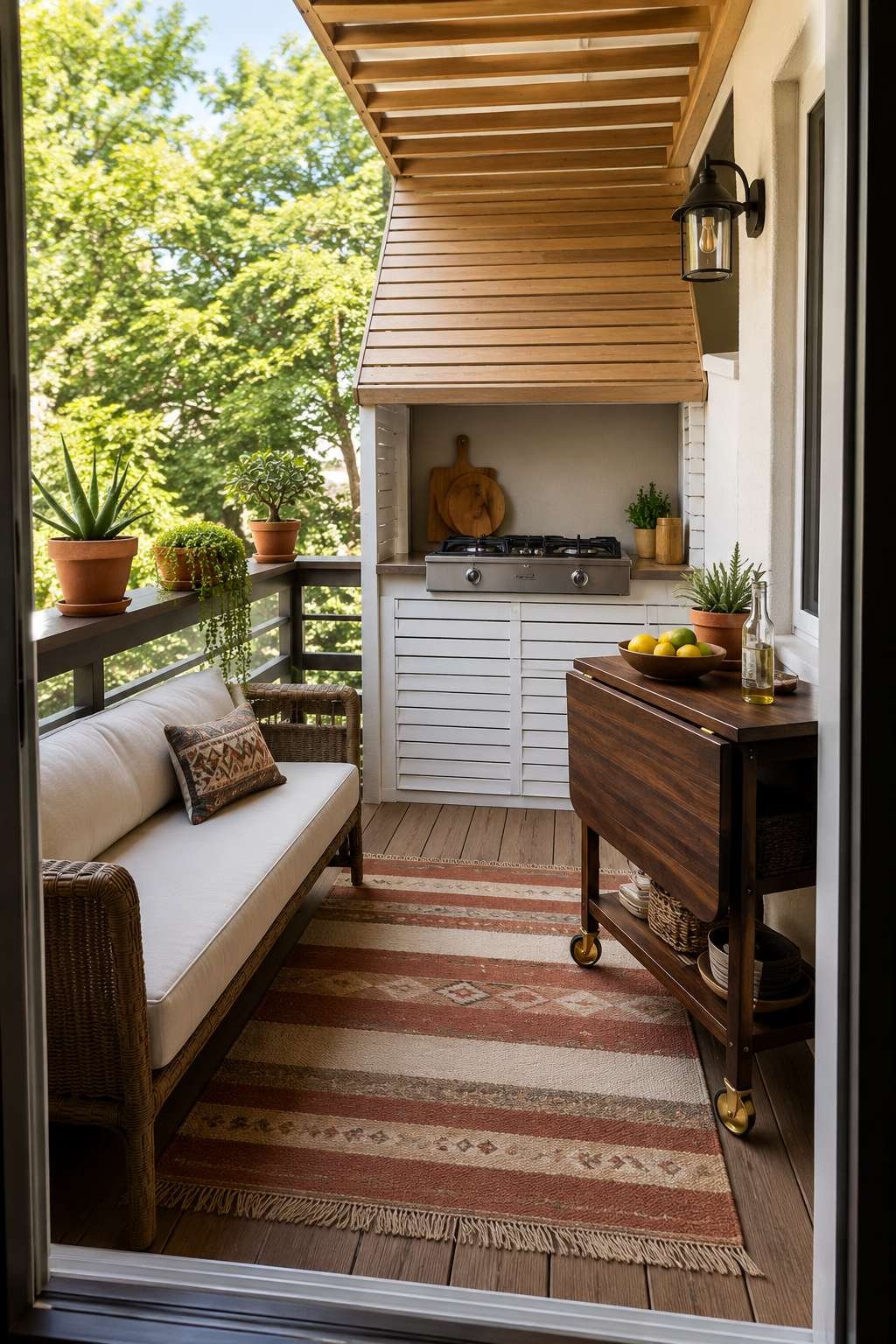
Overhead, minimalist pendant lighting hanging from a slatted cedar pergola introduces the one element of warmth the otherwise cool-toned palette requires. The natural grain and honey tone of cedar wood creates a beautiful tension with the crisp white cabinetry below, and the slatted structure allows light to filter through in geometric patterns that shift across the quartz surface throughout the day. By evening, the pendant lights cast a focused, warm downlight that makes the reflective quartz surface come alive with depth and luminosity.
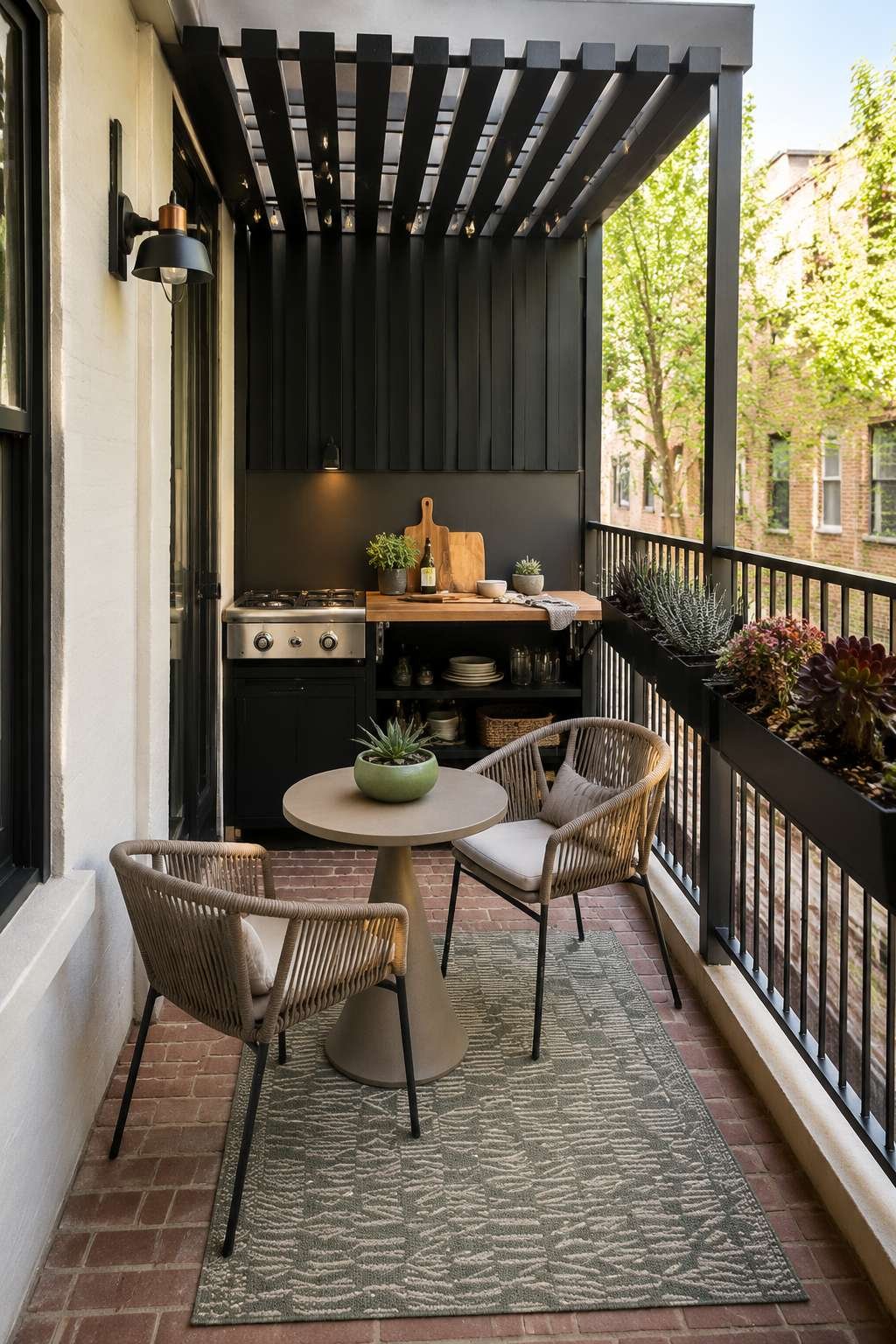
The contrast of white cabinetry against natural wood overhead structure is one of the most enduring combinations in contemporary design, and its application in an outdoor kitchen context feels fresh and genuinely inspiring. This is a space that invites effortless, stylish entertaining — a place where the act of mixing cocktails or serving a summer meal feels as elevated as the environment itself.
Key Design Tips:
- Specify engineered quartz rated for outdoor use — not all quartz formulations are UV-stable, and indoor products will discolor in direct sunlight.
- Choose weatherproof powder-coat finishes over paint for outdoor cabinetry — they resist chipping, fading, and moisture penetration far more effectively.
- Install cedar or ipe wood for pergola structures — both species offer exceptional natural weather resistance without requiring chemical treatment.
- Use a waterfall countertop edge on kitchen islands to create a sophisticated focal point that elevates the entire design.
- Pair pendant lighting with dimmer switches to transition smoothly from bright functional cooking light to intimate evening ambiance.
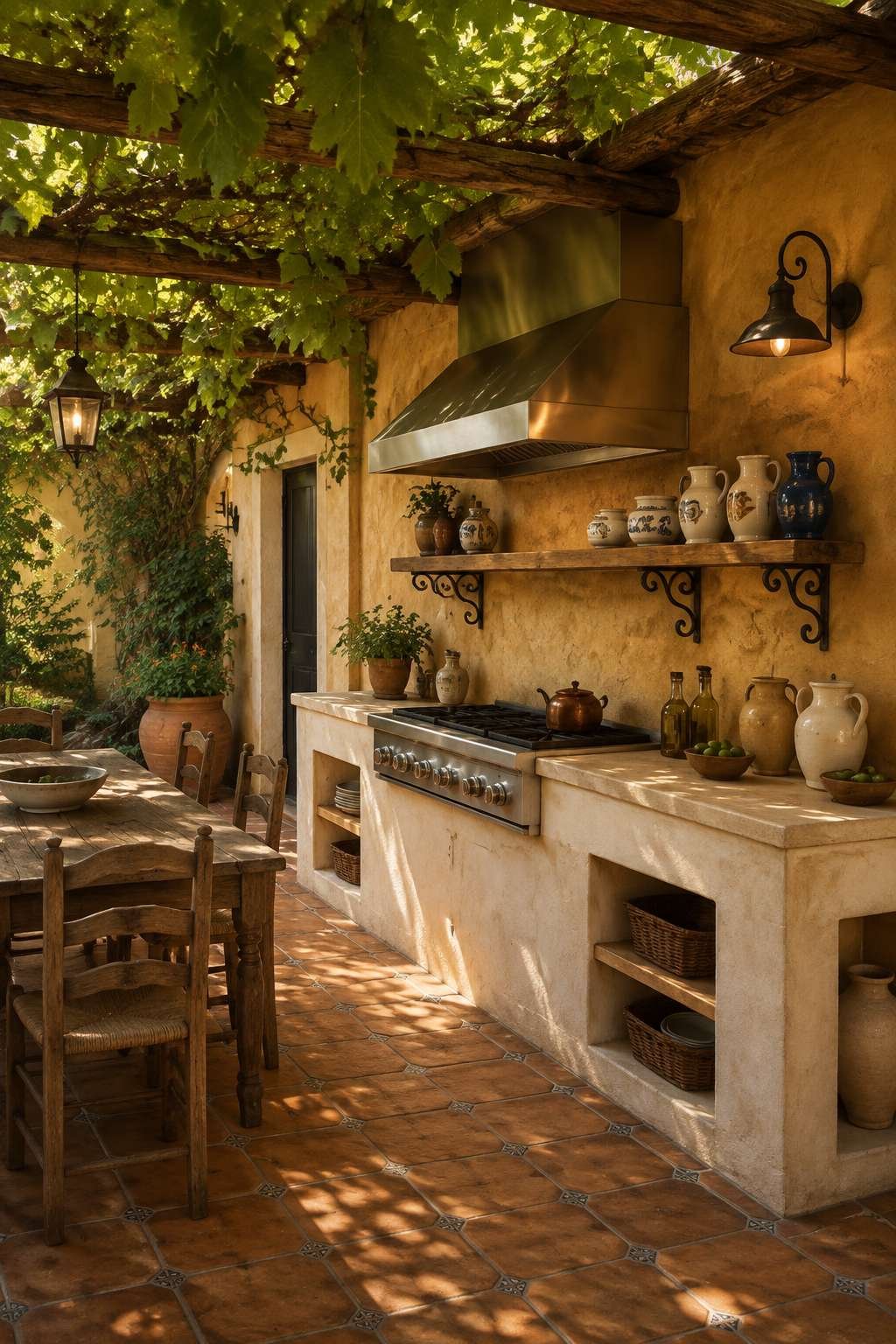
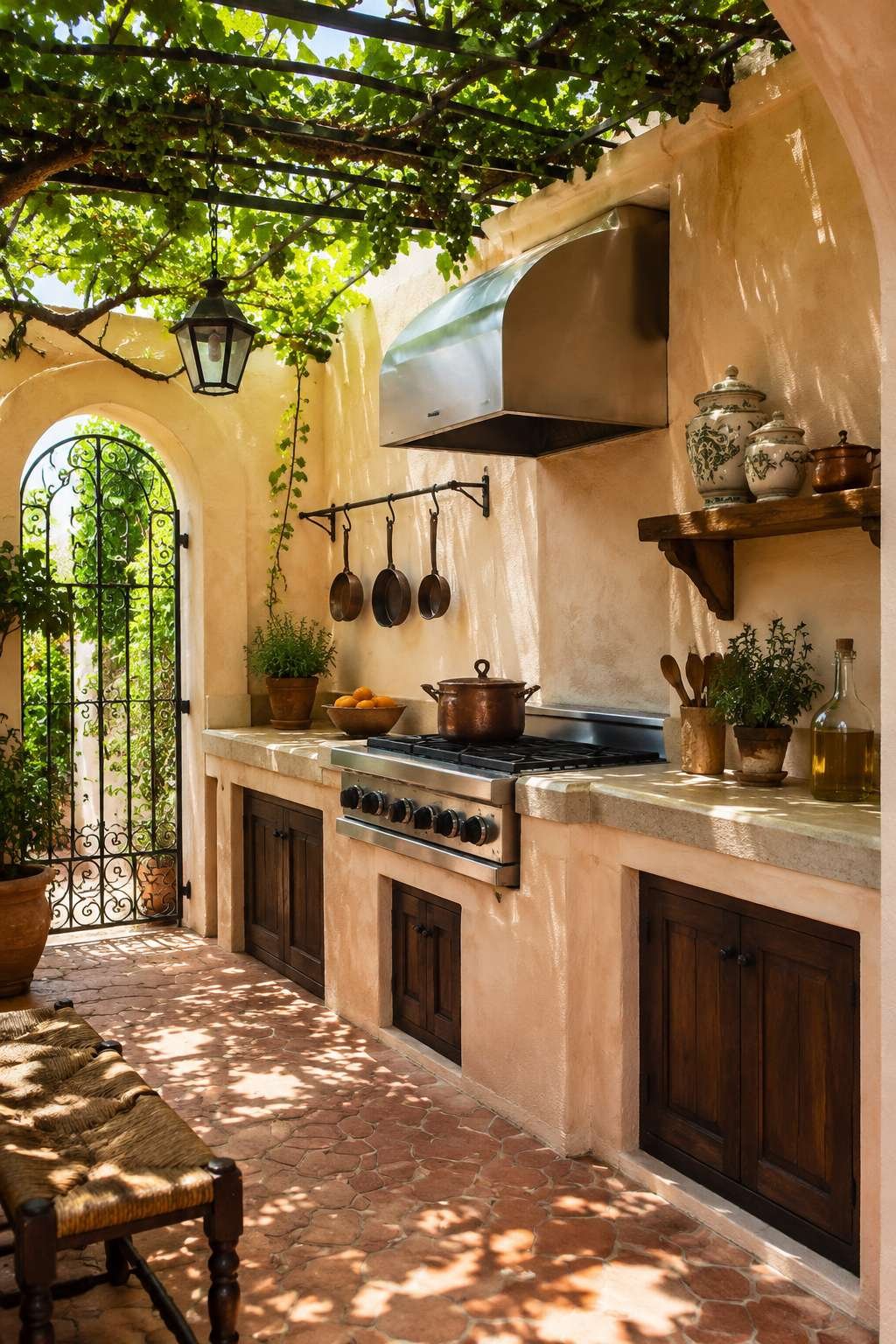
5. Mediterranean Soul: Terracotta, Azulejo, and Old-World Warmth
A Mediterranean-inspired outdoor kitchen speaks directly to those who believe that cooking should be an act of cultural celebration as much as nourishment. Terracotta tile countertops in warm burnt orange and sienna tones immediately establish the color story — earthy, sun-baked, and deeply rooted in the traditions of southern European domestic life. The hand-painted azulejo backsplash, with its intricate geometric patterns in cobalt blue and white, provides the visual focal point of the entire composition, a tile canvas that rewards close inspection with its artisanal detail and historic charm.
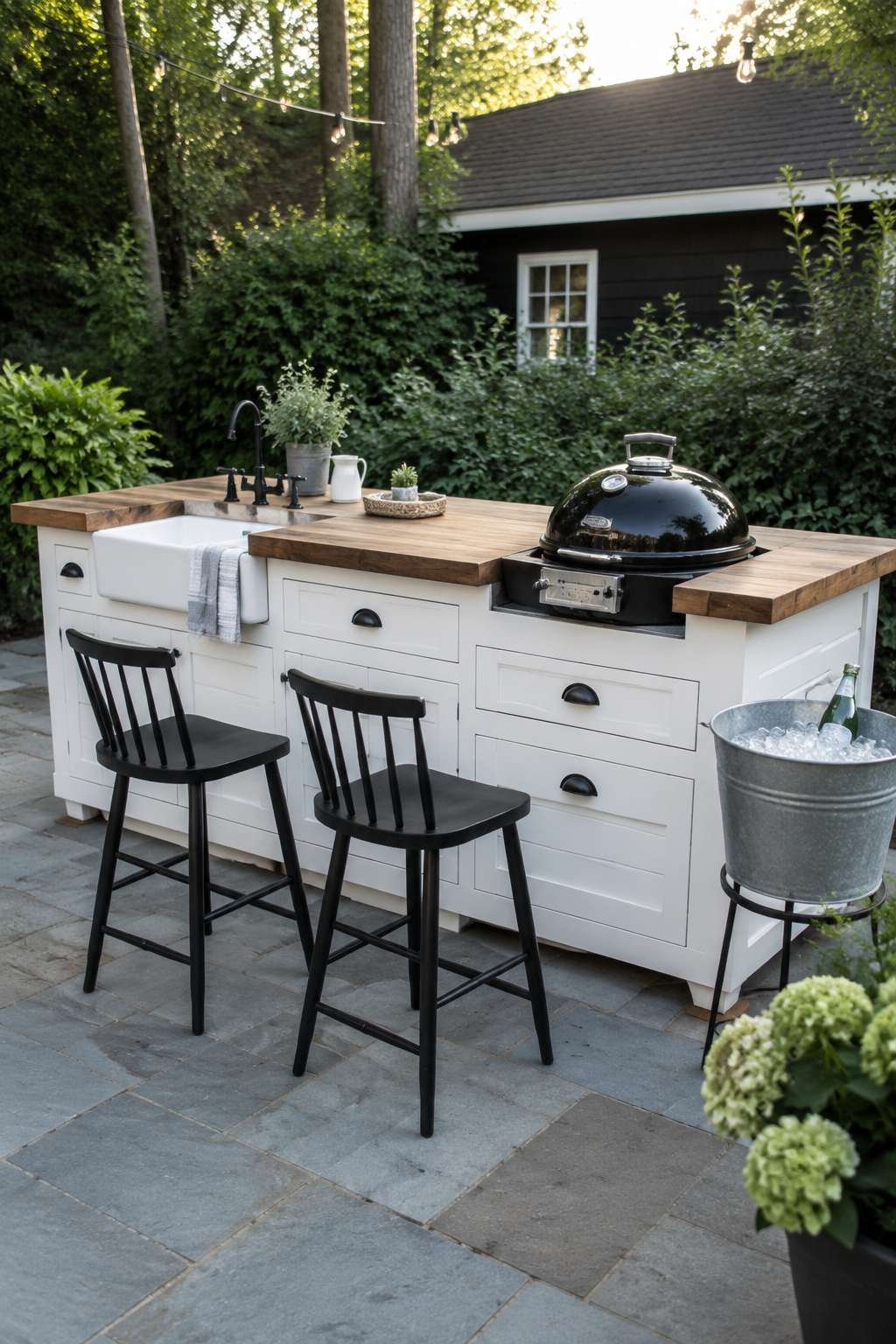
The built-in clay chimenea functions as both a practical heat source for cool evenings and a sculptural centerpiece that reinforces the old-world aesthetic with unmistakable authority. Aged wrought iron fixtures — drawer pulls, towel rings, faucet handles — continue the artisanal metalwork theme, their dark, slightly rough texture contrasting beautifully against the smooth ceramic tile surfaces. A rustic farmhouse sink in hand-formed fireclay completes the material narrative, its apron front echoing the generous, unpretentious hospitality that Mediterranean kitchen culture embodies.
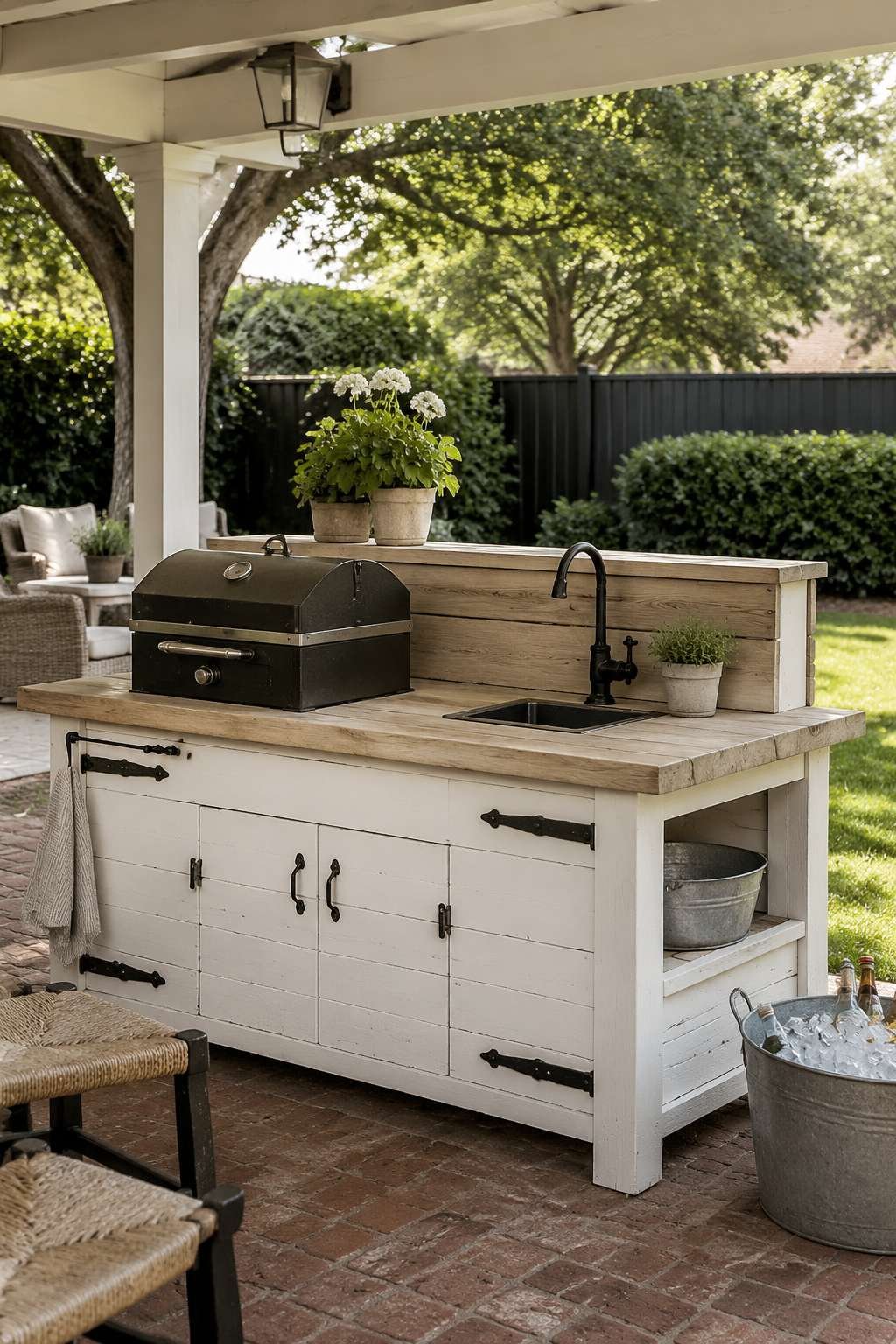
Potted olive trees and lavender lining the perimeter of the kitchen bring the landscape into direct dialogue with the design. The silver-green foliage of olive trees has an almost architectural quality — their gnarled forms creating vertical interest while their cultural significance as ancient symbols of abundance and peace adds a layer of meaning to the space. Lavender provides fragrance, attracts pollinators, and contributes a purple-blue color note that harmonizes beautifully with the azulejo tile palette.
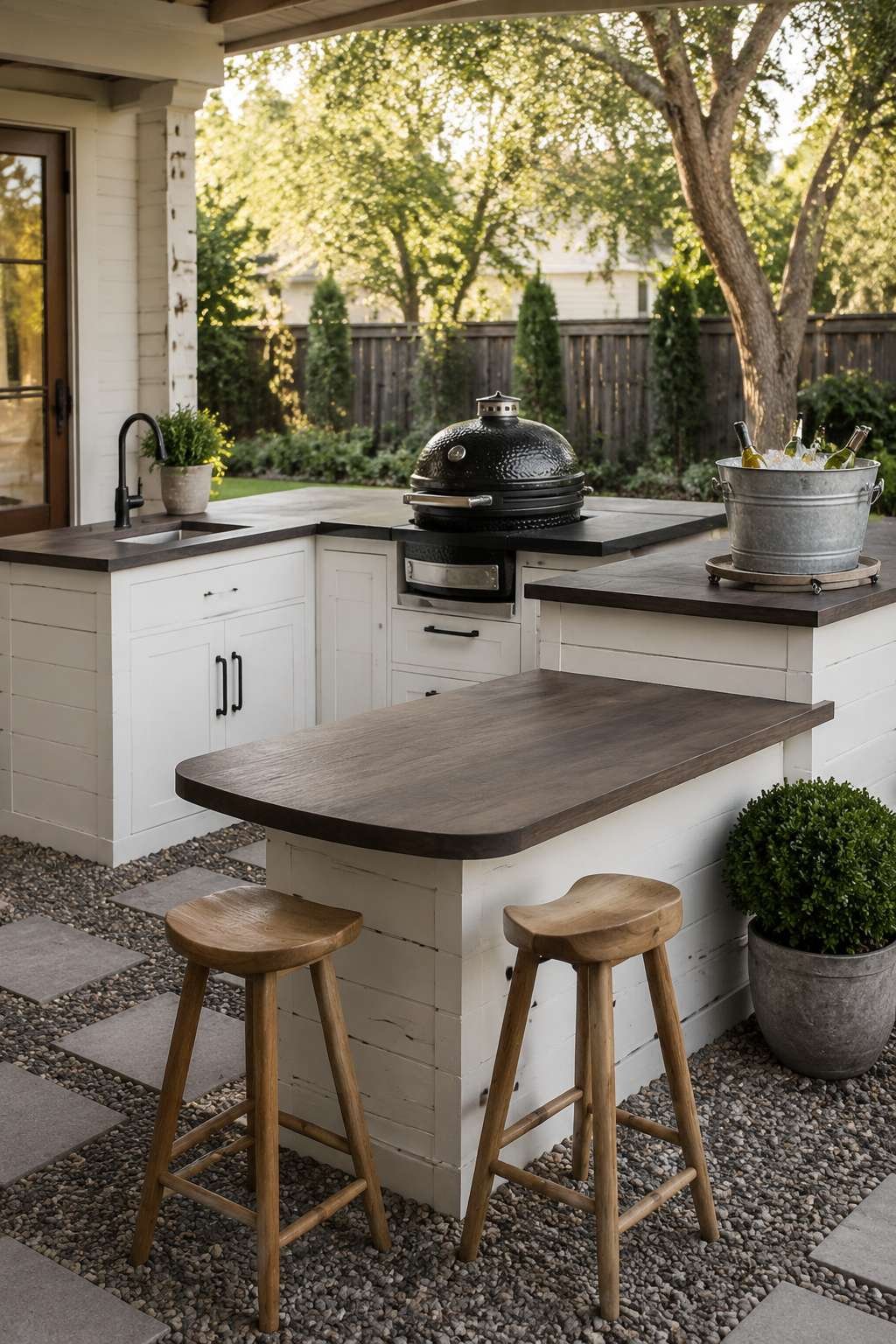
Golden afternoon light is this kitchen’s most flattering companion, warming the terracotta tones to a deep, glowing amber and bringing out the subtle surface variation of handmade tile. In this light, the space looks almost impossibly beautiful — a scene more likely to be found on a hillside in Andalusia or the Amalfi coast than in a suburban backyard.
Key Design Tips:
- Source hand-painted azulejo tiles from artisan suppliers for authentic pattern variation — machine-printed reproductions lack the depth and charm of genuine handcraft.
- Seal terracotta tile countertops with a penetrating food-safe sealer and reseal annually to prevent staining and moisture absorption.
- Plant dwarf olive trees in large terracotta pots for a movable, Mediterranean landscape element that can be brought indoors during harsh winters.
- Install a clay chimenea on a non-combustible tile or stone base at least 18 inches from any cabinetry for safety.
- Combine wrought iron and hand-hammered copper fixtures for a layered artisanal metalwork aesthetic that resists stylistic dating.
6. Professional Grade: The Stainless Steel Outdoor Kitchen Island
For the serious outdoor cook who refuses to compromise on performance, a professional-grade outdoor kitchen island with 304-grade stainless steel cabinet doors represents the gold standard of backyard cooking infrastructure. Grade 304 stainless steel is the same specification used in commercial restaurant kitchens — chosen for its exceptional resistance to corrosion, its food-safe surface properties, and its ability to maintain its appearance after years of demanding use. The brushed steel finish on cabinet doors and drawer fronts diffuses light evenly, avoiding harsh reflections while communicating a sense of serious, purposeful design.

The double side burners and deep storage drawer system reflect a workflow-centric design philosophy where every element has been placed to minimize unnecessary movement and maximize cooking efficiency. At one end of the island, a built-in smoker sits beside a refrigerator drawer unit, creating a dedicated low-and-slow cooking station that can operate independently of the main grill area. This level of appliance specialization transforms a backyard kitchen into a genuine outdoor culinary studio, capable of handling complex, multi-component meals with professional precision.
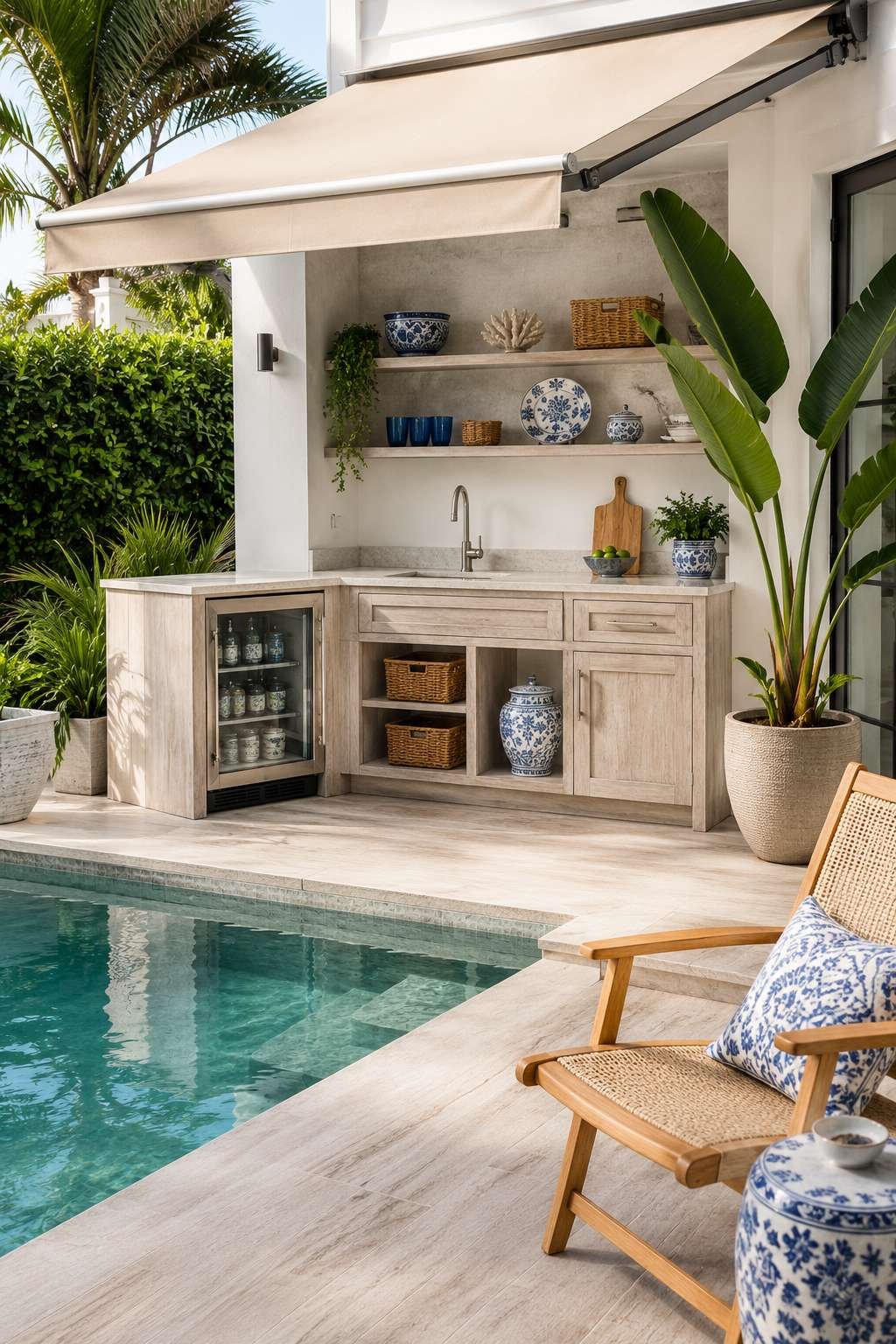
A shade sail in sandy canvas overhead solves the midday sun problem elegantly — its tensioned form creates a clean, architectural overhead plane that contrasts beautifully with the industrial precision of the stainless steel island below. Unlike a rigid pergola, the shade sail introduces a slightly dynamic quality, its form shifting subtly in the breeze and casting gently moving shadow patterns across the polished steel surface. This combination of hard-edged professional cooking equipment and softly tensioned textile overhead creates an unexpectedly appealing visual dialogue.
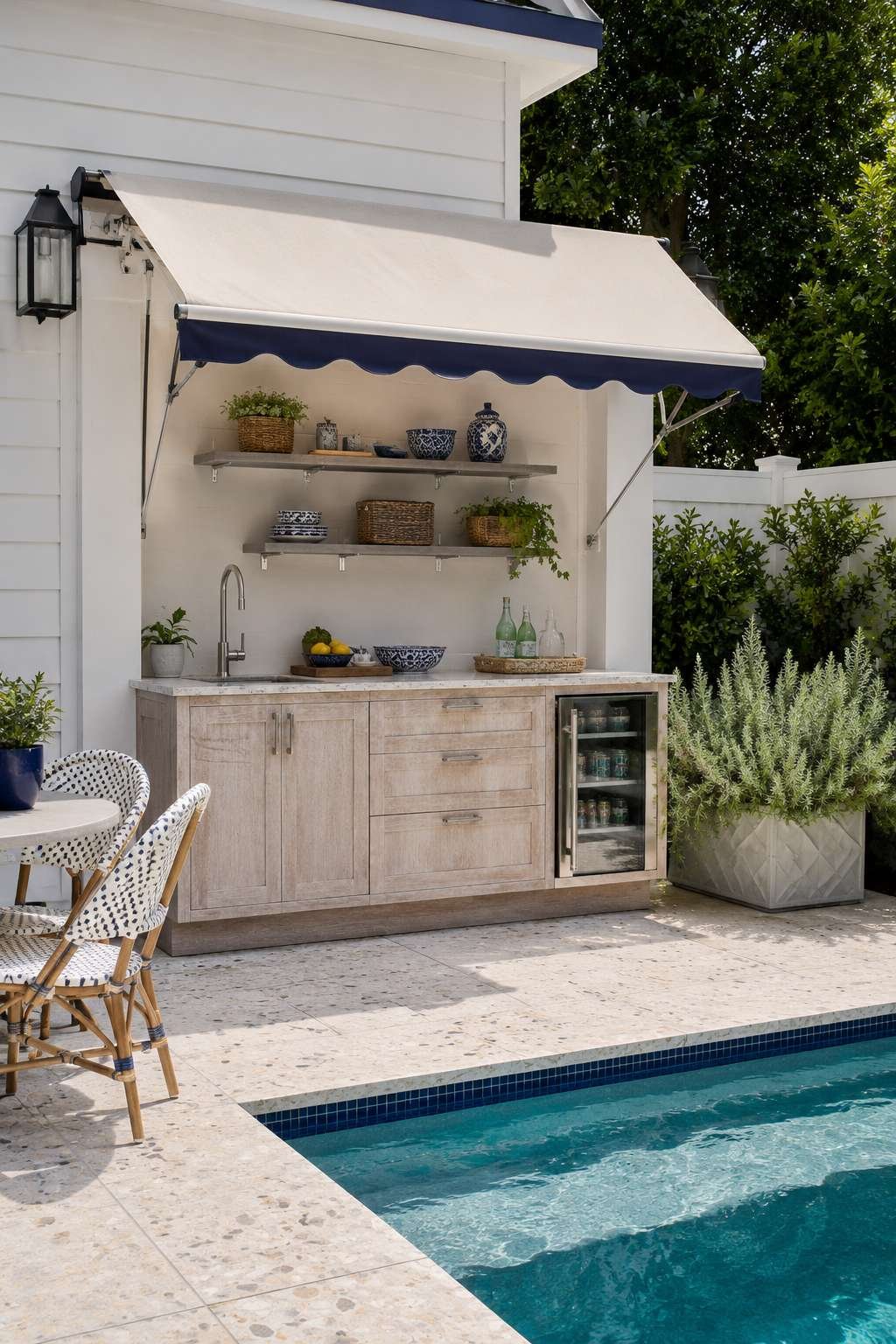
The functional workflow of a professional outdoor cooking station is this design’s greatest asset. Every tool has a home, every appliance is within logical reach, and the surface area available for prep and plating is generous enough to support serious entertaining. This is an outdoor kitchen built for people who love to cook, not merely for those who occasionally grill.
Key Design Tips:
- Always specify grade 304 or 316 stainless steel for outdoor kitchen components — lower grades will rust and pit in humid or coastal environments.
- Install refrigerator drawer units rather than upright outdoor fridges for a sleeker profile and more ergonomic access during active cooking.
- Choose tensioned shade sails in UV-stabilized, water-resistant canvas for stylish, flexible overhead sun protection without permanent structure costs.
- Dedicate a specific zone for smoking positioned downwind of prep and dining areas to prevent smoke disruption during entertaining.
- Add pull-out trash and recycling drawers within the island structure to maintain a clean work surface throughout cooking and entertaining.
7. Cottage Garden Kitchen: Whitewashed Brick and Edison Warmth
A cottage-style outdoor kitchen achieves its considerable charm through an accumulation of small, carefully considered details rather than grand gestures. Whitewashed brick walls provide the foundational texture — the paint applied in a thin wash that allows the natural variation of the brick beneath to show through, creating a surface that appears simultaneously bright and aged. This layered painting technique is essential to the cottage aesthetic: it lightens the palette while preserving the sense that the space has existed for decades, weathered by seasons and enriched by use.
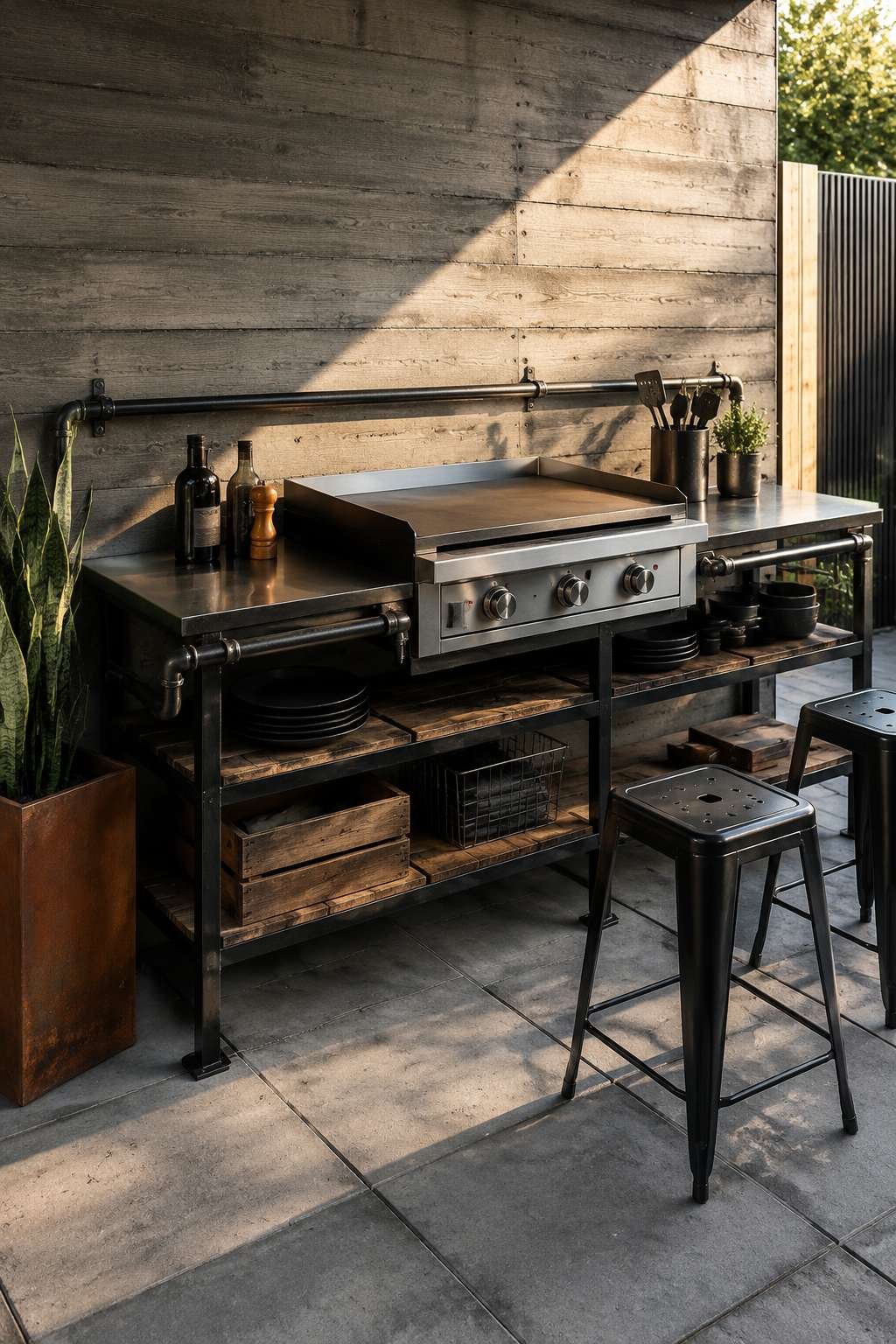
Open pine shelving displaying ceramic dishware and mason jar herb collections introduces the kitchen’s organizational philosophy — everything on display, everything beautiful, nothing hidden. The warm honey tones of pine complement the whitewashed brick perfectly, while the casual arrangement of ceramics and glass jars creates a scene that feels like a still-life painting brought to life. A compact two-burner outdoor range beneath a custom weatherproof wood hood completes the cooking infrastructure without overwhelming the intimate scale of the space — this is a kitchen designed for cooking for a few beloved people, not catering to crowds.
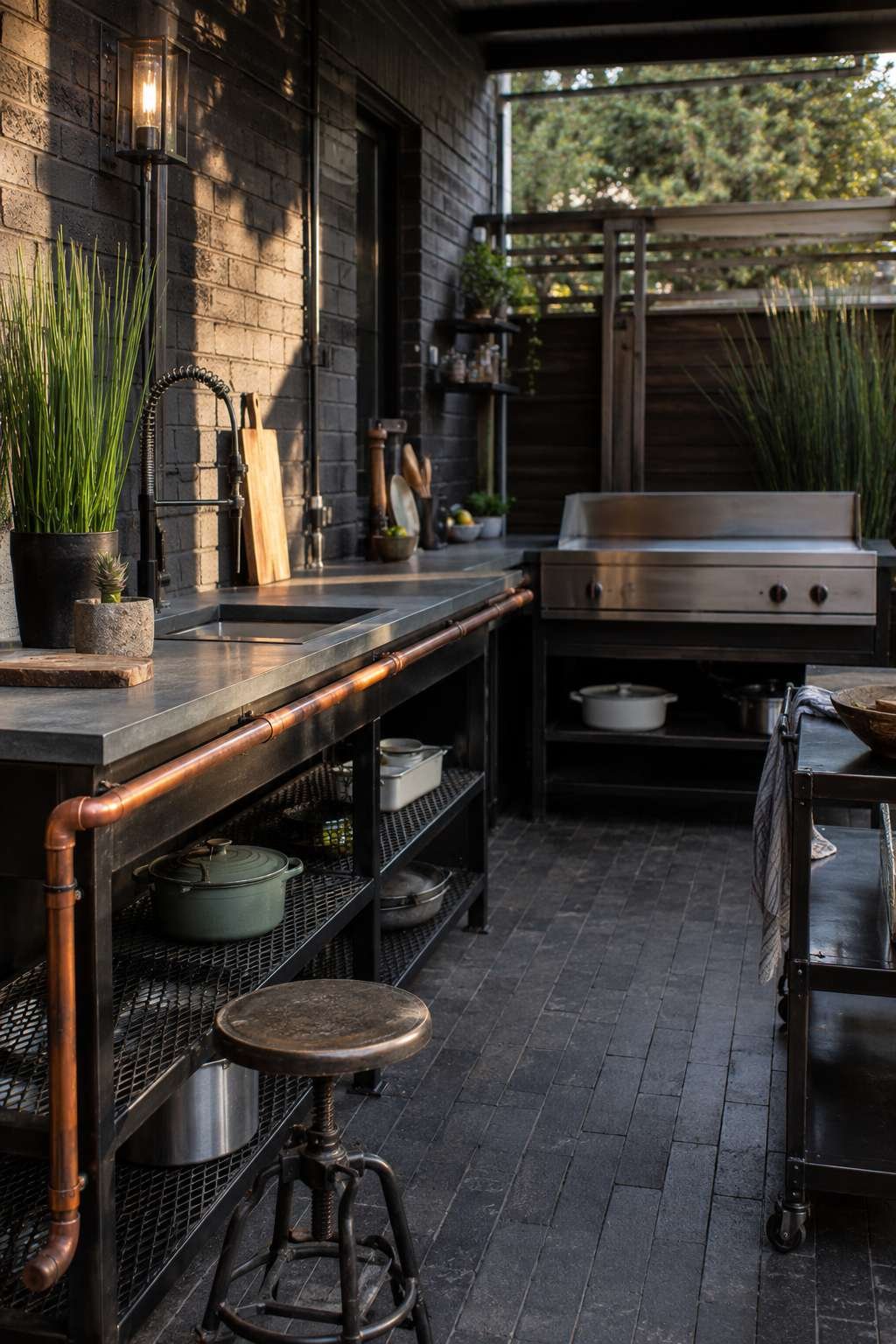
Edison bulb string lights are the element that transforms this space from daytime charm to evening magic. The warm, amber-tinted filament glow of Edison bulbs is uniquely flattering to the cottage palette — it deepens the honey tones of pine, adds golden warmth to white brick, and makes every ceramic surface gleam with soft luster. There is a reason this lighting choice has become synonymous with outdoor entertaining atmosphere: it consistently delivers a quality of warmth and intimacy that cooler LED alternatives struggle to replicate at this price point.
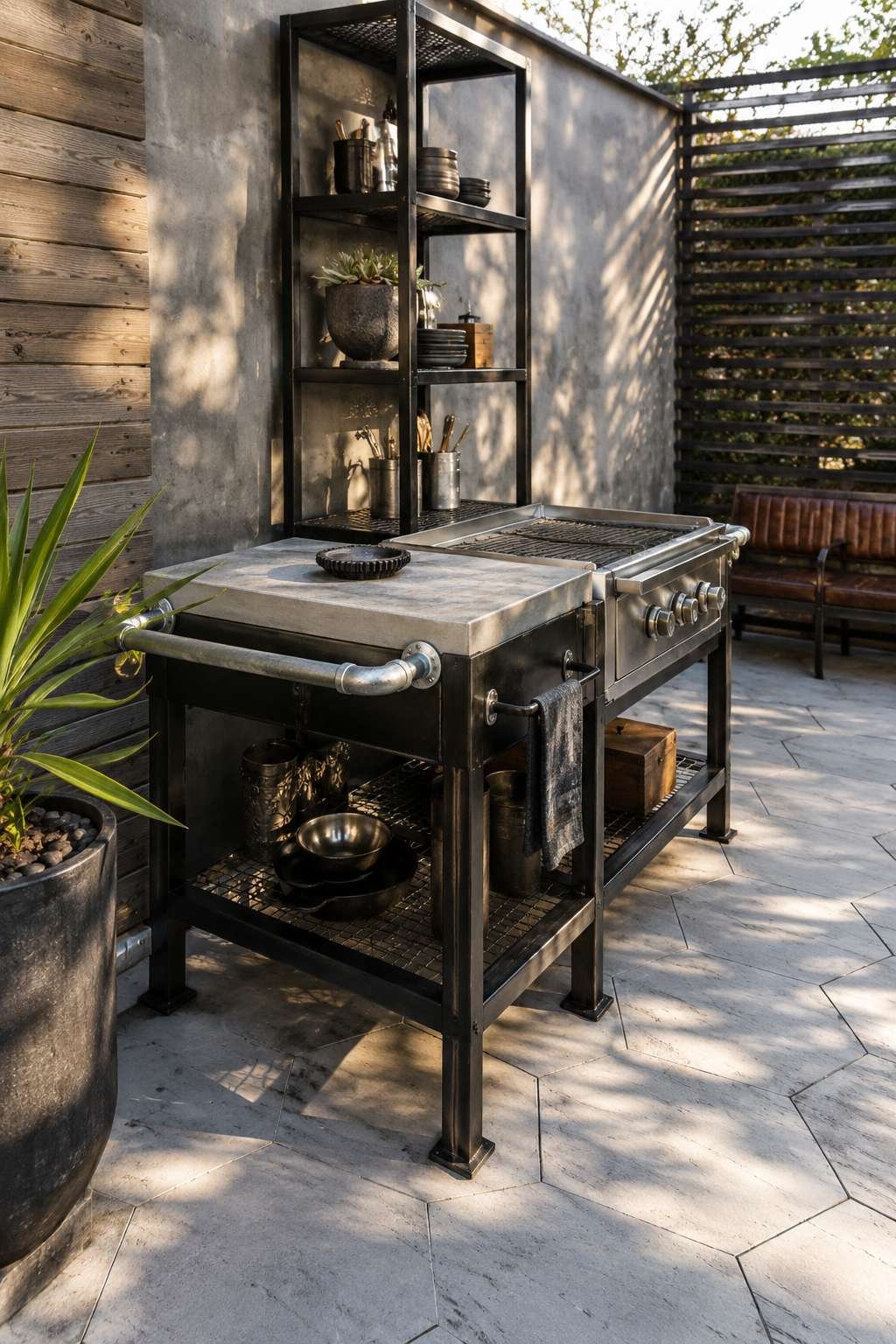
The genuinely lived-in warmth of a cottage outdoor kitchen is its most powerful quality — and it is achieved not through expense but through authenticity. The slight wear on painted surfaces, the mismatched beauty of collected ceramics, the natural imperfection of mason jar collections: these are the details that make guests feel immediately comfortable and at home in the space.
Key Design Tips:
- Apply whitewash paint with a damp rag rather than a brush for a more authentic, translucent finish that reveals the brick texture beneath.
- Choose open pine shelving sealed with an outdoor-rated clear finish to display kitchen objects while protecting the wood from weather.
- Use mason jars for fresh herb storage — they are inexpensive, visually charming, and allow you to monitor water levels at a glance.
- Install Edison bulb string lights on a weatherproof outdoor dimmer switch for flexible ambiance control through the evening.
- Add potted cottage garden flowers — lavender, rosemary, and thyme — in mismatched clay pots to reinforce the informal, lived-in aesthetic.
8. Luxury Dark Drama: Book-Matched Porcelain and Louvered Roof
When budget and ambition align without constraint, a luxury outdoor kitchen with book-matched porcelain countertops in dark charcoal represents perhaps the most sophisticated expression of outdoor living design currently available. Book-matching — the technique of mirroring two adjacent slabs cut from the same stone block to create a symmetrical veining pattern — is a hallmark of ultra-premium interior design, and its application in an outdoor kitchen context is genuinely breathtaking. The dark charcoal tones of the porcelain create a moody, dramatic surface that absorbs light rather than reflecting it, giving the kitchen an air of serious, composed luxury.
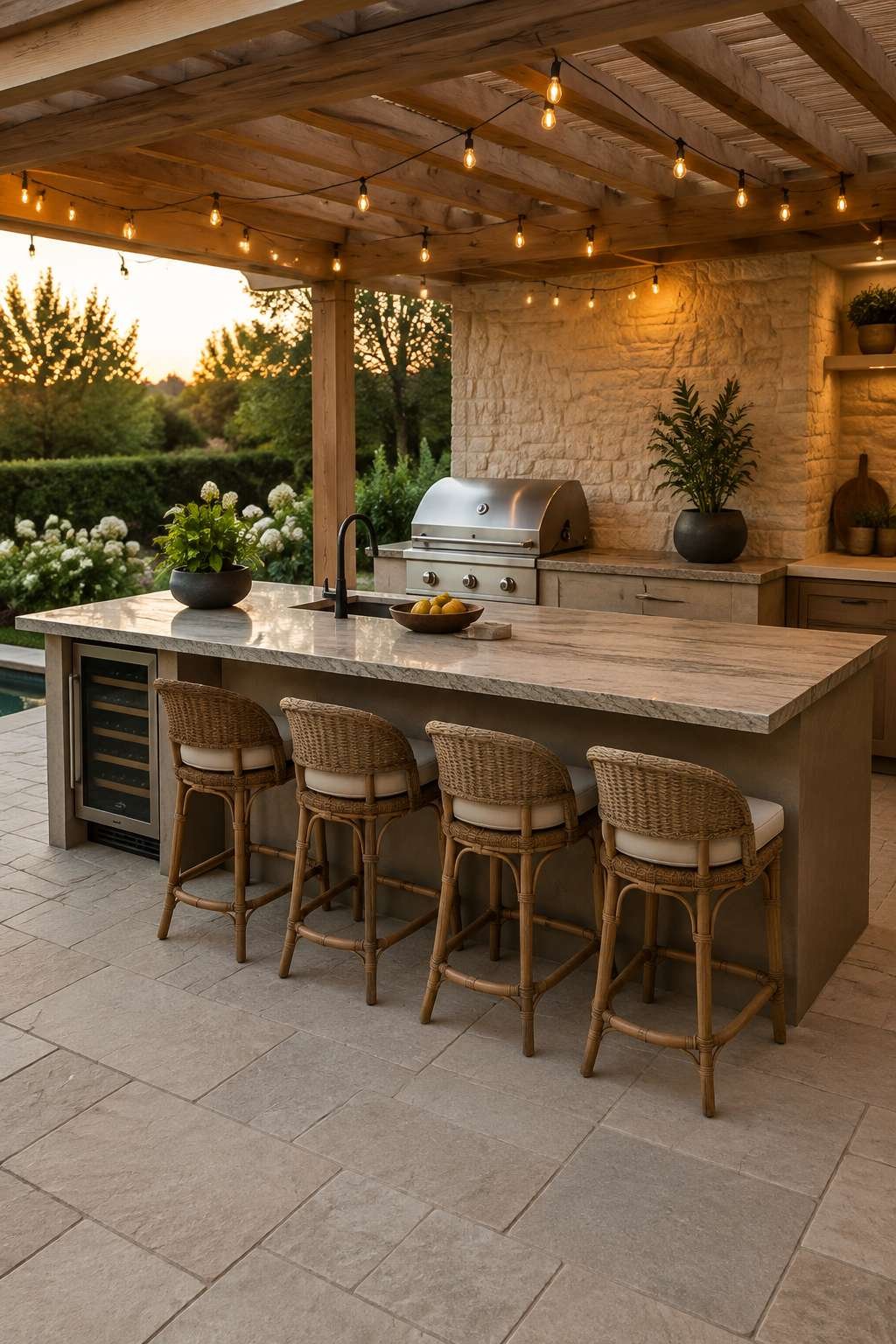
Built-in Wolf outdoor grill and side burner units are the cooking heart of this design, their professional heritage lending performance credibility to match the visual ambition of the surrounding materials. Wolf’s outdoor appliance range is widely regarded as the benchmark for outdoor cooking performance — the same reputation earned in professional and luxury domestic indoor kitchens, extended to the garden. The seamless integration of these appliances into the porcelain island, with minimal visible gaps or transitions, achieves a level of finish quality more commonly associated with high-end kitchen showrooms than outdoor cooking spaces.
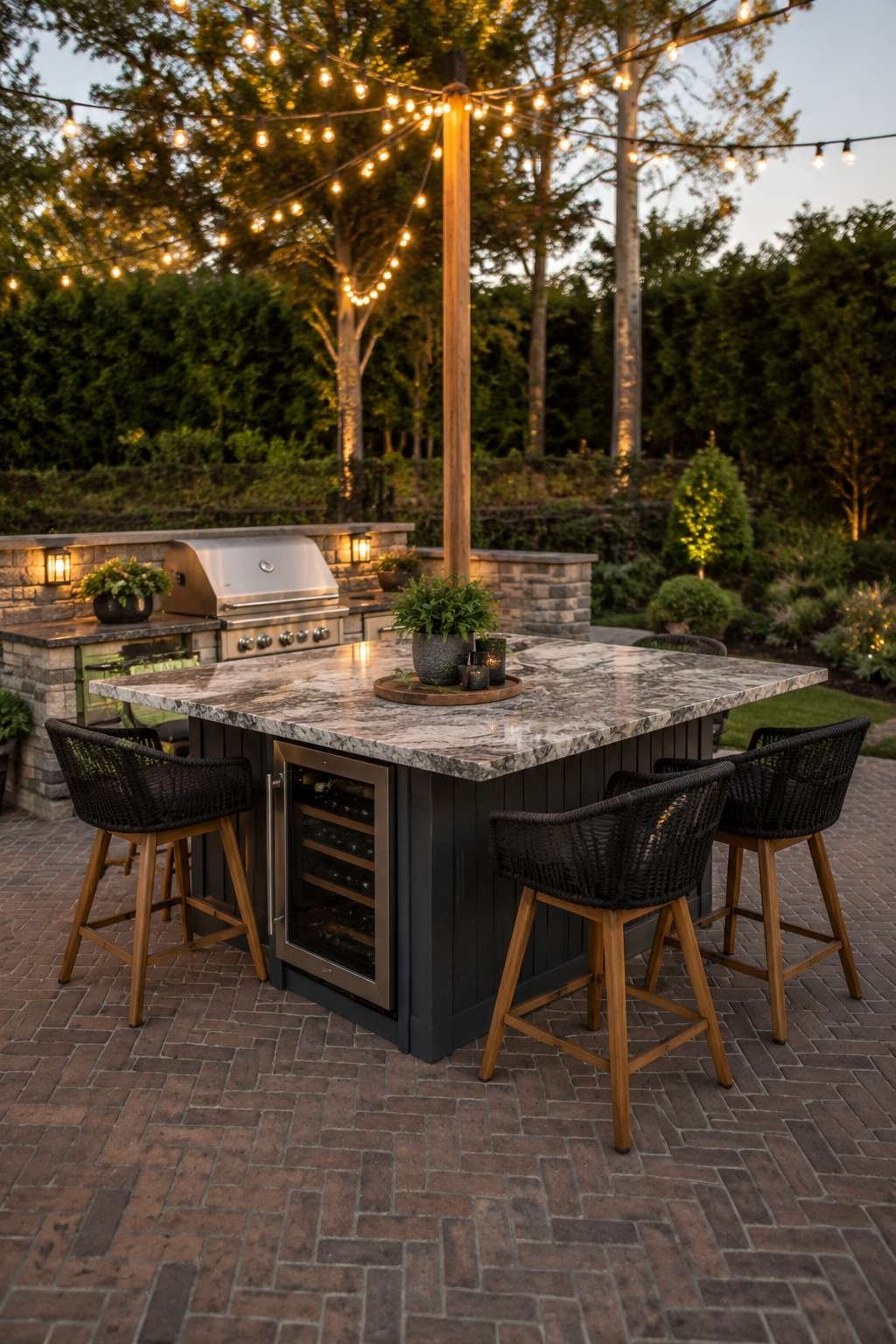
A sleek pergola with retractable louvered roof panels provides the overhead element, and it is here that the design truly demonstrates its premium ambitions. Motorized louvered roofs allow the homeowner to precisely control light, shade, and weather protection at the touch of a button — opening fully on clear days to allow sunlight to bathe the space, partially closing to create filtered shade during peak afternoon hours, and closing completely to provide waterproof shelter during unexpected showers. This level of climate control flexibility transforms the outdoor kitchen from a fair-weather luxury into a year-round entertainer’s paradise.
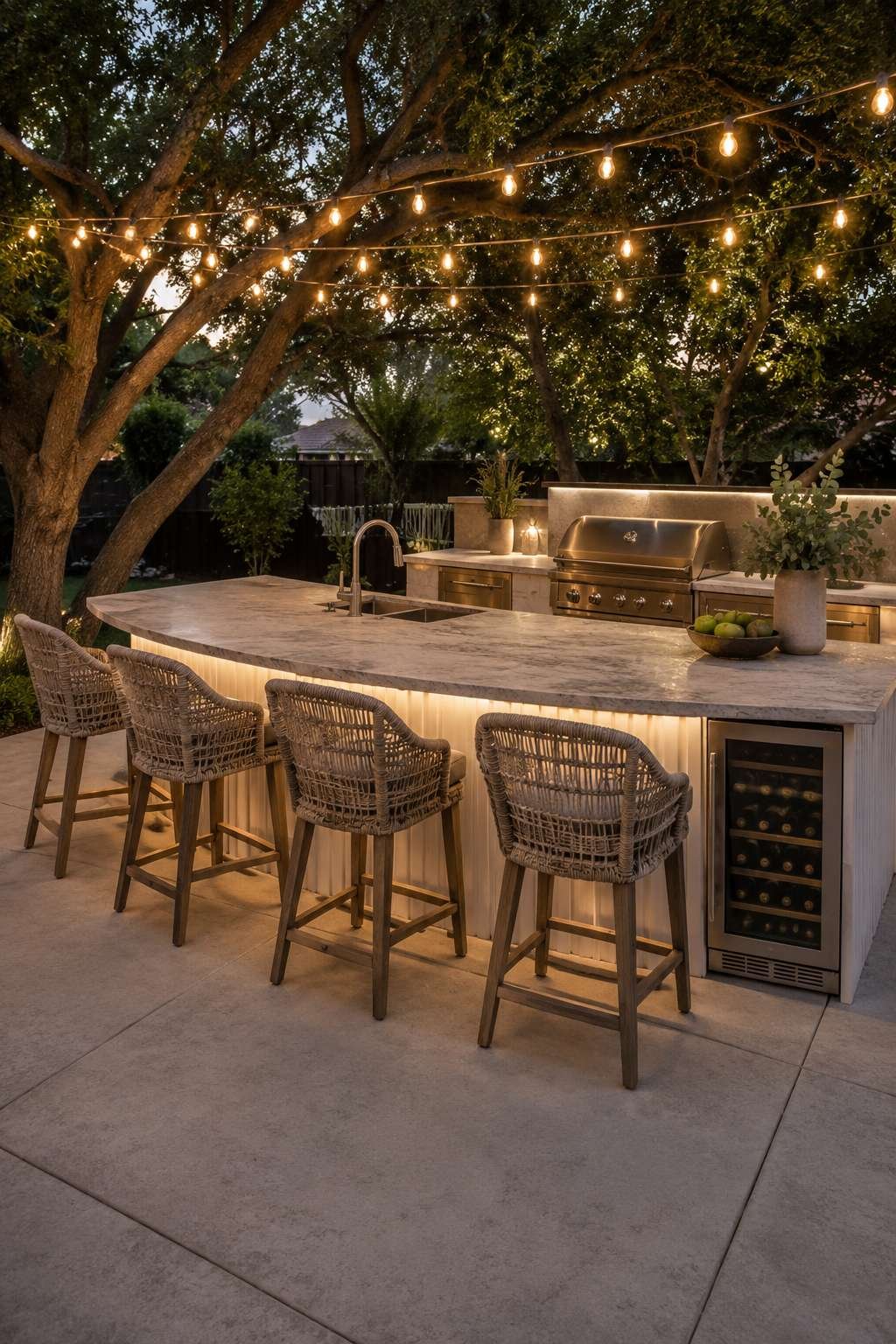
Hidden LED strip lighting under counters adds the final layer of drama at night, casting a controlled luminous glow beneath the dark porcelain that makes the island appear to float. Combined with the polished concrete flooring beneath, which reflects this subtle light back upward, the evening atmosphere achieves a quality of sophisticated drama that rivals the finest restaurant spaces.
Key Design Tips:
- Invest in motorized louvered pergola systems — the ability to control light and weather protection dramatically increases the usable hours and seasons of an outdoor kitchen.
- Specify large-format porcelain slabs rather than natural stone for dark countertops — porcelain is non-porous, highly stain-resistant, and does not require sealing.
- Use low-voltage LED strip lighting under counters and along base profiles for dramatic evening ambiance without energy waste.
- Choose polished concrete for outdoor kitchen flooring — its reflective surface amplifies ambient lighting while being extremely durable and easy to clean.
- Engage a specialist outdoor kitchen designer for luxury installations to ensure perfect appliance integration, waterproofing details, and material coordination.
9. Industrial Authenticity: Raw Steel, Concrete, and Reclaimed Brick
The industrial-style outdoor kitchen speaks to those who find beauty in honesty — in materials that make no attempt to conceal what they are or where they have been. A framework of exposed galvanized steel pipe shelving announces the design philosophy immediately: this is a kitchen that celebrates structure rather than hiding it. The pipes, fittings, and brackets that in other design styles would be concealed behind finished surfaces are here proudly displayed, their silver-grey metallic quality becoming a central element of the visual composition.
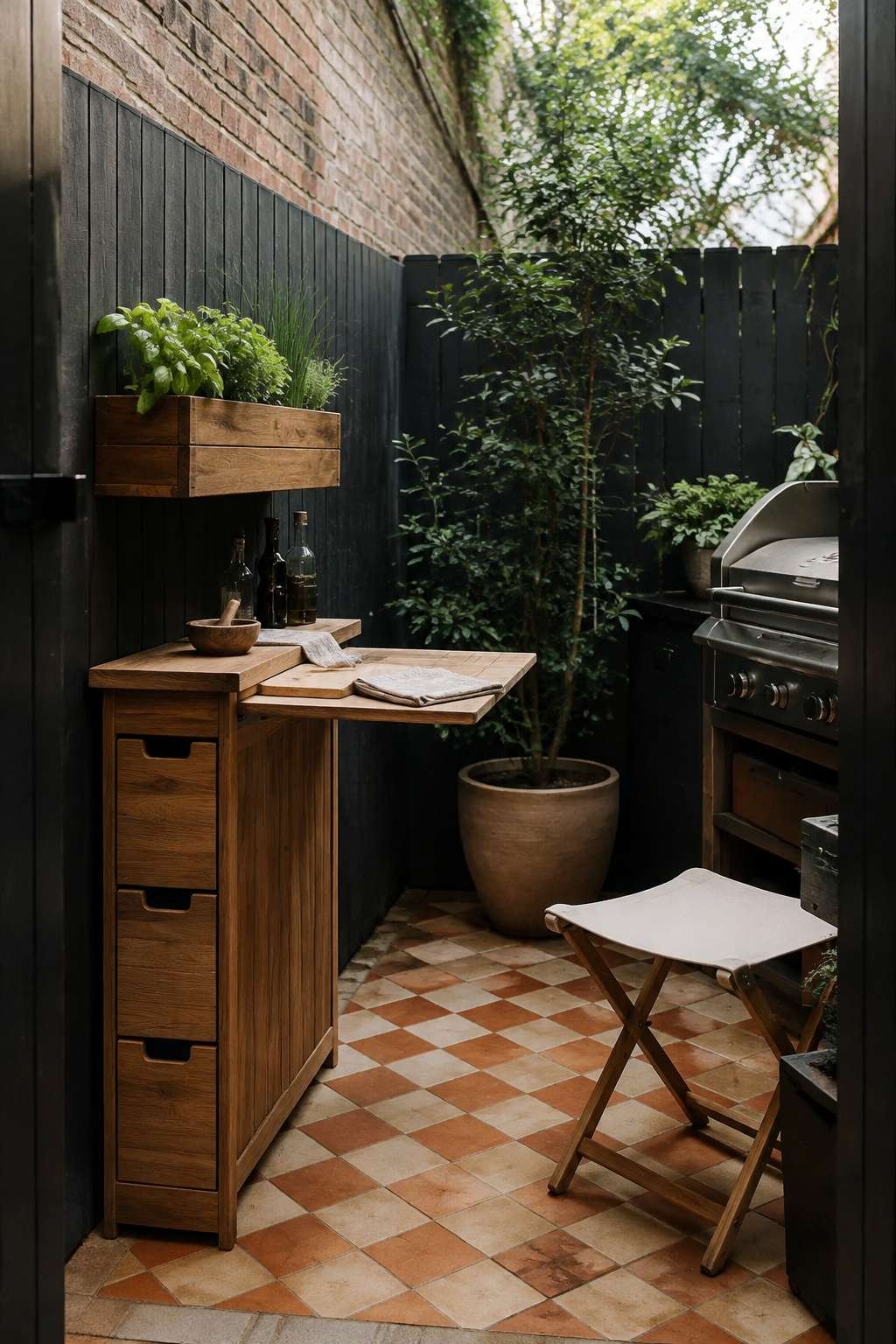
Poured concrete countertops with visible aggregate detail are among the most tactilely satisfying surfaces available to outdoor kitchen designers. Unlike polished concrete, which presents a smooth, refined face, exposed aggregate concrete reveals its constituent materials — the small stones, sand grains, and mineral inclusions that give the mix its structural integrity. Running a hand across this surface is a genuinely sensory experience, and its visual texture at both close range and distance is extraordinarily rich. The patina that develops over time as the concrete weathers — subtle color variation, minor surface marks, the occasional hairline crack filled with life — only enhances its character.
A reclaimed factory-brick surround provides the backdrop for the commercial-style outdoor griddle positioned at center stage, the brick’s varied tones of red, orange, and ochre warming what might otherwise be an overwhelmingly cool-toned material palette. The keg tap station beside the griddle announces this kitchen’s entertainments priorities with cheerful directness: this is a space for serious food and equally serious social gatherings. Edison bulb pendant lights hanging from a raw steel beam overhead complete the composition, their warm filament glow softening the industrial hardness of the surrounding materials without undermining the design’s fundamental authenticity.
The industrial outdoor kitchen rewards close inspection. Every surface tells a story — the galvanized pipe that has aged to a specific patina, the reclaimed brick bearing ghost marks from its previous life, the concrete aggregate exposed through a careful grinding process. These are materials with biographies, and that quality of embedded narrative gives the space a depth and interest that no perfectly smooth, pristine kitchen can match.
Key Design Tips:
- Source reclaimed bricks from local salvage yards for genuinely aged texture — specify “face bricks” for consistent sizing that makes installation straightforward.
- Seal exposed aggregate concrete countertops with a penetrating concrete sealer rather than a topical coating to preserve the textural quality while providing stain resistance.
- Use galvanized pipe and fitting kits from plumbing supply stores to build custom shelving — they are far less expensive than pre-made industrial shelving systems.
- Install a commercial-grade outdoor griddle for the most versatile high-heat cooking surface available — it handles everything from pancakes to seared proteins with equal authority.
- Choose Edison bulbs rated for outdoor damp locations when hanging pendant lighting in exposed outdoor kitchen settings.
10. Tropical Paradise: Palapa Roof, Bamboo Cabinetry, and Lava Rock
A tropical resort-inspired outdoor kitchen is perhaps the most immersive of all backyard kitchen design approaches — a concept that invites total commitment to a theme and rewards that commitment with an atmosphere of pure, transporting pleasure. The thatched palapa roof is the defining architectural gesture, its organic palm frond layers creating a naturally insulating canopy that is simultaneously highly effective at blocking sun and completely extraordinary to look at from below. The dappled sunlight filtering through palm fronds creates a constantly shifting pattern of light and shadow across the cooking space that no engineered shade structure can replicate.
Bamboo cabinetry with stainless steel inserts demonstrates that tropical design need not sacrifice durability or function. Bamboo — technically a grass, though one of the hardest and most dimensionally stable plant materials available — brings golden-green warmth to the cabinetry while being genuinely weather-resistant when properly treated and finished. The stainless steel inserts at drawer and door panels add a contemporary precision note that prevents the bamboo from feeling folkloric and ensures the kitchen reads as a sophisticated design statement rather than a themed novelty.
Lava rock countertops are among the most unusual and visually compelling surface choices available in outdoor kitchen design. Their porous, dark-toned surface is strikingly beautiful against the warm bamboo cabinetry, and their volcanic origin lends the space a material authenticity that resonates with the broader tropical theme. A built-in charcoal grill and outdoor pizza oven under the palapa are joined by a tiki-style bar counter with built-in ice bin — because a tropical kitchen is, fundamentally, a social kitchen, and no truly tropical outdoor experience is complete without cold drinks served with style.
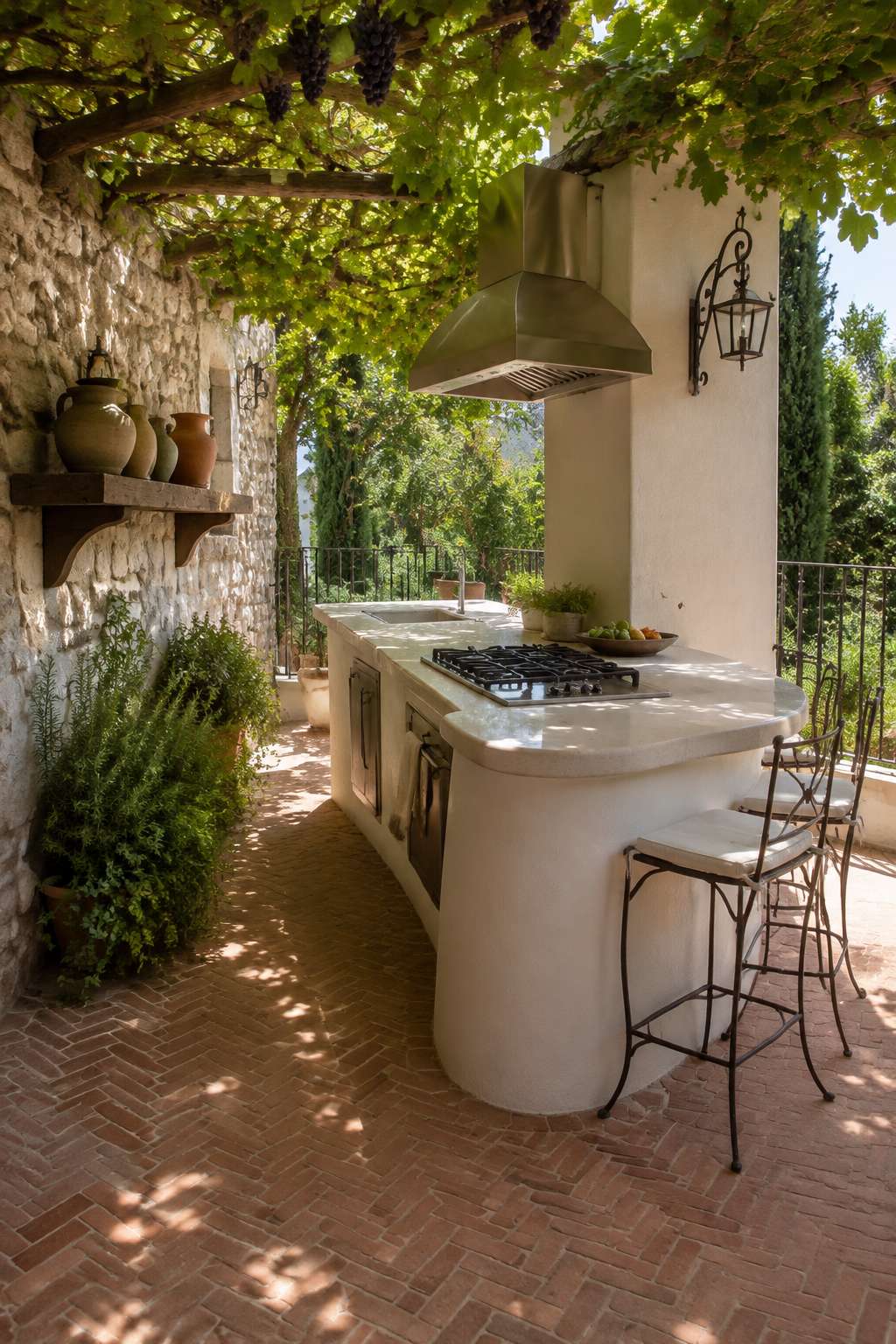
Surrounding tropical plantings — bird of paradise, heliconia, banana palms, and flowering ginger — blur the boundary between constructed kitchen and living landscape, creating the genuinely immersive quality that makes this design approach so transformative. When the cooking aromas mix with the fragrance of tropical flowers and the sound of the breeze moving through palm fronds, the backyard kitchen ceases to feel like a home improvement and becomes, quite simply, a destination.
Key Design Tips:
- Commission a purpose-built palapa structure from a specialist in thatched roof construction — proper installation significantly extends the lifespan and weather performance.
- Treat bamboo cabinetry with a UV-resistant outdoor finish and inspect annually for moisture ingress or insect activity.
- Choose lava rock tiles rather than full lava rock slabs for countertops — tiles are lighter, easier to install, and simpler to replace if damaged.
- Plant fast-growing tropical species in large planters to create immediate landscape density without waiting years for in-ground plantings to mature.
- Install a built-in ice bin as a fundamental element of any outdoor bar or tropical kitchen — it eliminates the need for a separate ice cooler and elevates the entertaining experience immediately.
11. Modern Farmhouse: Shiplap, Black Matte Hardware, and Butcher Block
The modern farmhouse aesthetic has proven its enduring appeal in interior design over the past decade, and its translation into outdoor kitchen design is equally compelling. Shiplap-clad exterior walls painted in warm white establish the characteristic textural backdrop of this style — the horizontal planks creating a rhythmic pattern of shadow lines that give depth and visual interest to what would otherwise be a flat surface. The paint color is critical: warm white, rather than stark cool white, ensures the space retains the welcoming, human quality that defines farmhouse design at its best.

Black matte hardware throughout — drawer pulls, cabinet handles, faucet fixtures, and grill knobs — provides the essential contrast that prevents the warm white palette from feeling bland or underdifferentiated. The matte finish is particularly important here: glossy black hardware would create a harder, more contemporary visual, while matte black lands in precisely the right territory between rustic and refined. Butcher block prep counters beside the stainless steel grill station introduce a third material register — the warm honey tones and visible end-grain of hardwood butcher block adding organic warmth that completes the material trio of white, black, and natural wood.
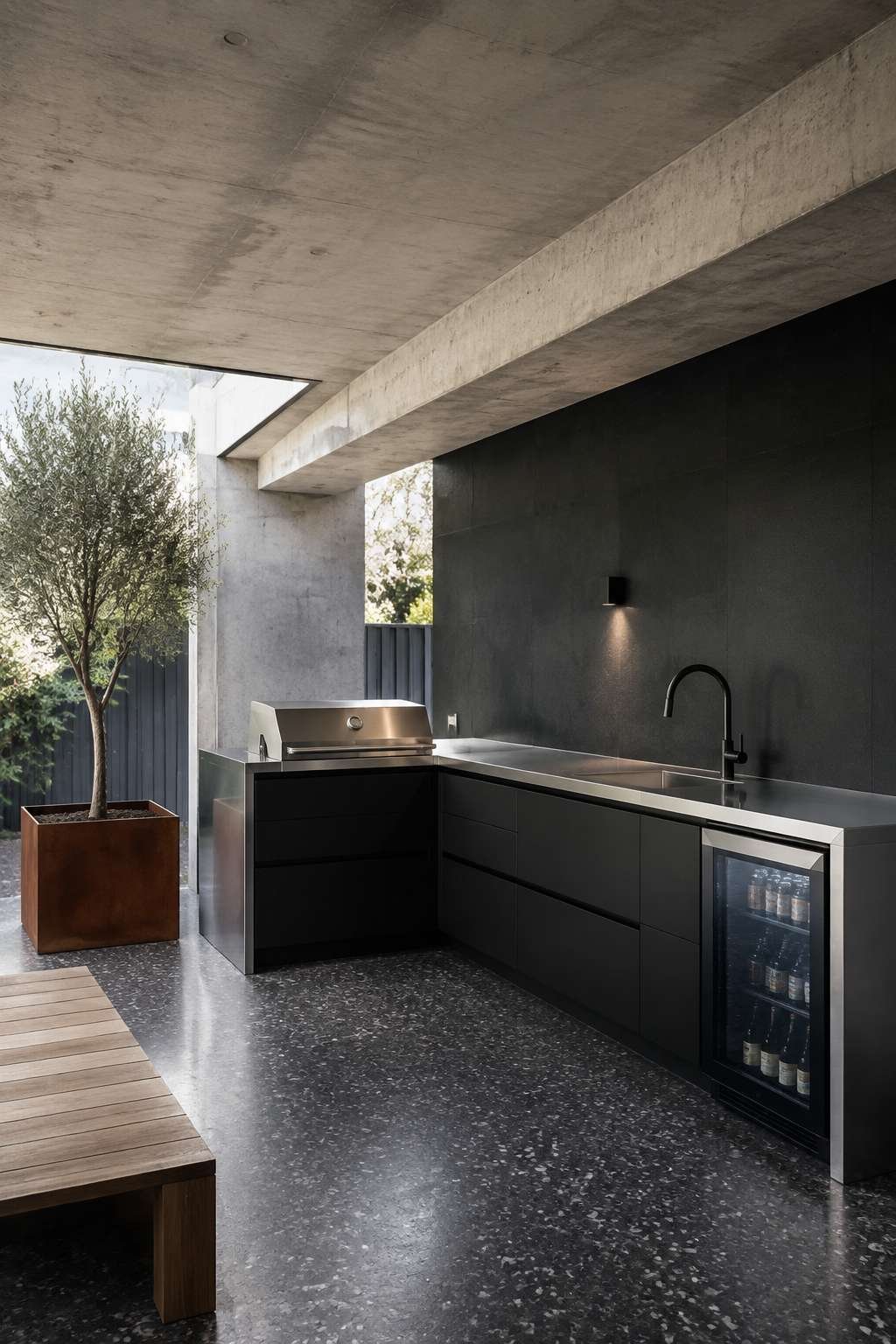
The sliding barn door concealing the weatherproof pantry cabinet is both a functional solution and a narrative design element — a direct reference to agricultural vernacular architecture that grounds the entire composition in its farmhouse heritage. The rolling track hardware for this door should be specified in the same matte black finish as all other metalwork to maintain the consistent hardware language throughout the kitchen. By day, the barn door’s movement provides a dynamic, engaging quality; by evening, it can close completely to protect pantry contents from overnight dew.
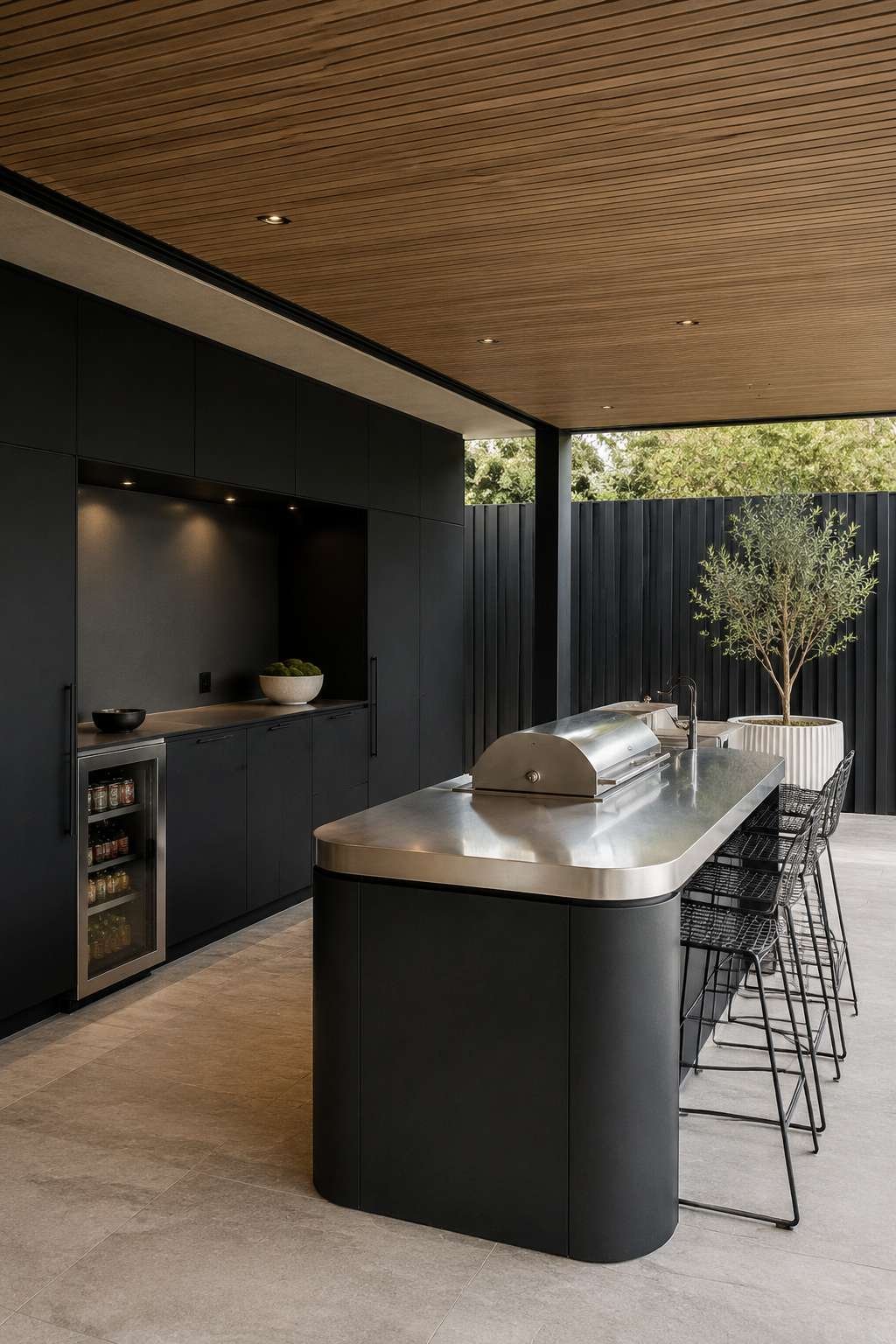
Edison string lights overhead bathe the evening kitchen in precisely the warm amber light that the farmhouse aesthetic requires — soft, non-directional illumination that flattens harsh shadows and makes every surface glow with welcoming warmth. This is a kitchen designed to look as beautiful at 10 PM as it does at noon, and the contrast of white shiplap against black fixtures under warm evening lighting achieves a quality of romantic, practical charm that is deeply satisfying.
Key Design Tips:
- Apply shiplap cladding in a genuine tongue-and-groove profile rather than flat boards with applied battens — the shadow line quality is markedly superior.
- Specify exterior-grade hardwood butcher block treated with food-safe outdoor oil — standard indoor butcher block will crack and warp in outdoor conditions.
- Use matte black powder-coat finish for all hardware rather than matte black paint — powder coat is far more durable and consistent in color over time.
- Install a barn door in FSC-certified hardwood with a stainless steel or powder-coated black sliding track rated for outdoor exposure.
- Seal all painted shiplap surfaces with an exterior satin finish paint rather than flat — satin resists moisture and is far easier to wipe clean.
12. Industrial Innovation: The Shipping Container Kitchen
A reclaimed shipping container transformed into an outdoor kitchen is one of the most conceptually compelling approaches to backyard cooking space design available today. The corrugated metal exterior of the container is its most immediately striking visual quality — the regular ridges of galvanized steel catching light differently across their curved surfaces, creating a dynamic, textured facade that is wholly unlike any other outdoor kitchen cladding choice. Rather than attempting to disguise the container’s industrial origins, this design approach celebrates them entirely, embracing the authenticity of repurposed infrastructure as a design asset.
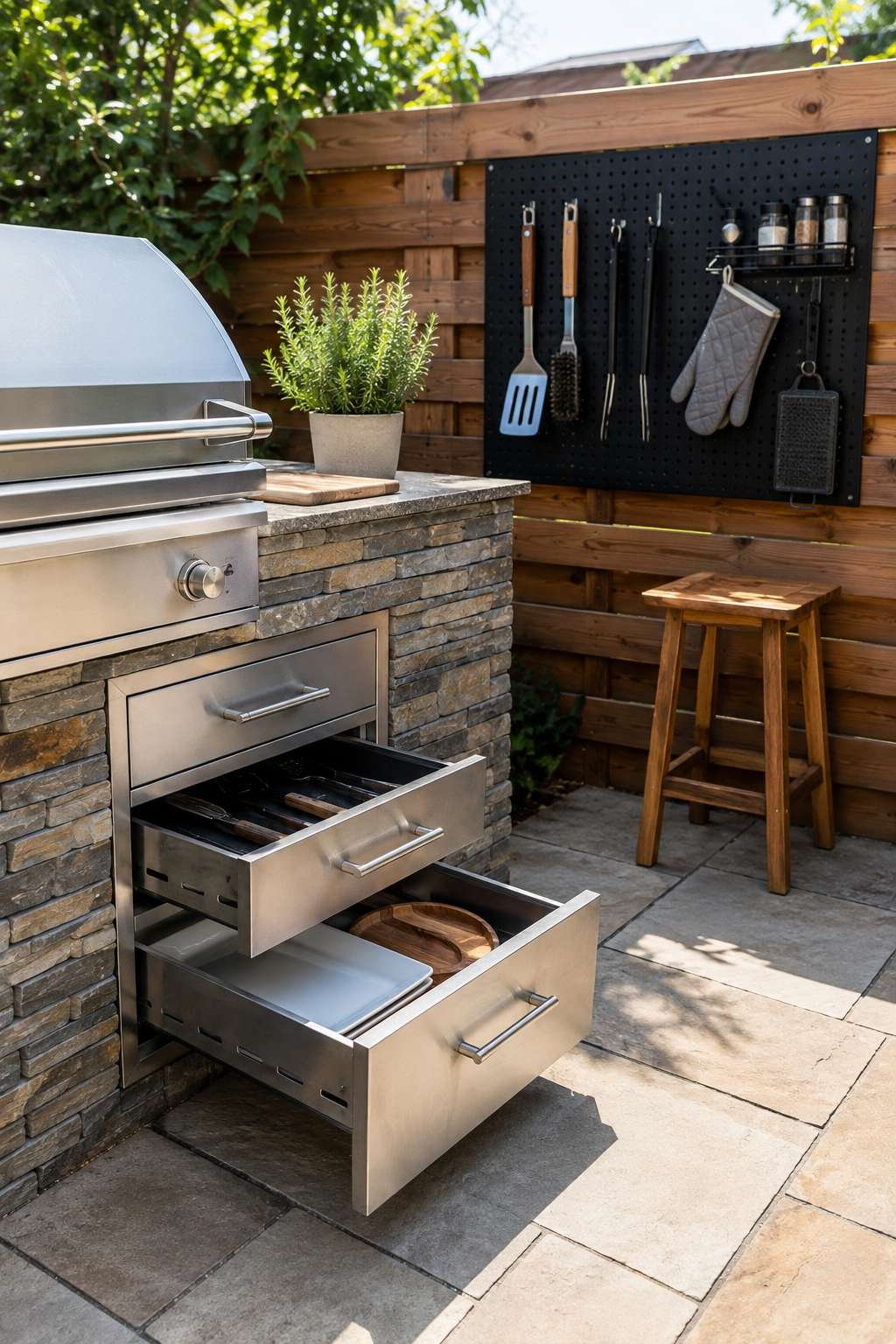
The roll-up industrial window is the design’s master stroke — by raising it fully, the entire cooking and prep station is revealed in one dramatic gesture, transforming the contained, protected workspace into an open-air kitchen in seconds. This spatial flexibility is extraordinary: the container kitchen can function as a fully weatherproof enclosed space when conditions demand it, and as a completely open, integrated outdoor kitchen when the weather is perfect. No other kitchen structure offers this range of operational modes within a single, coherent design.
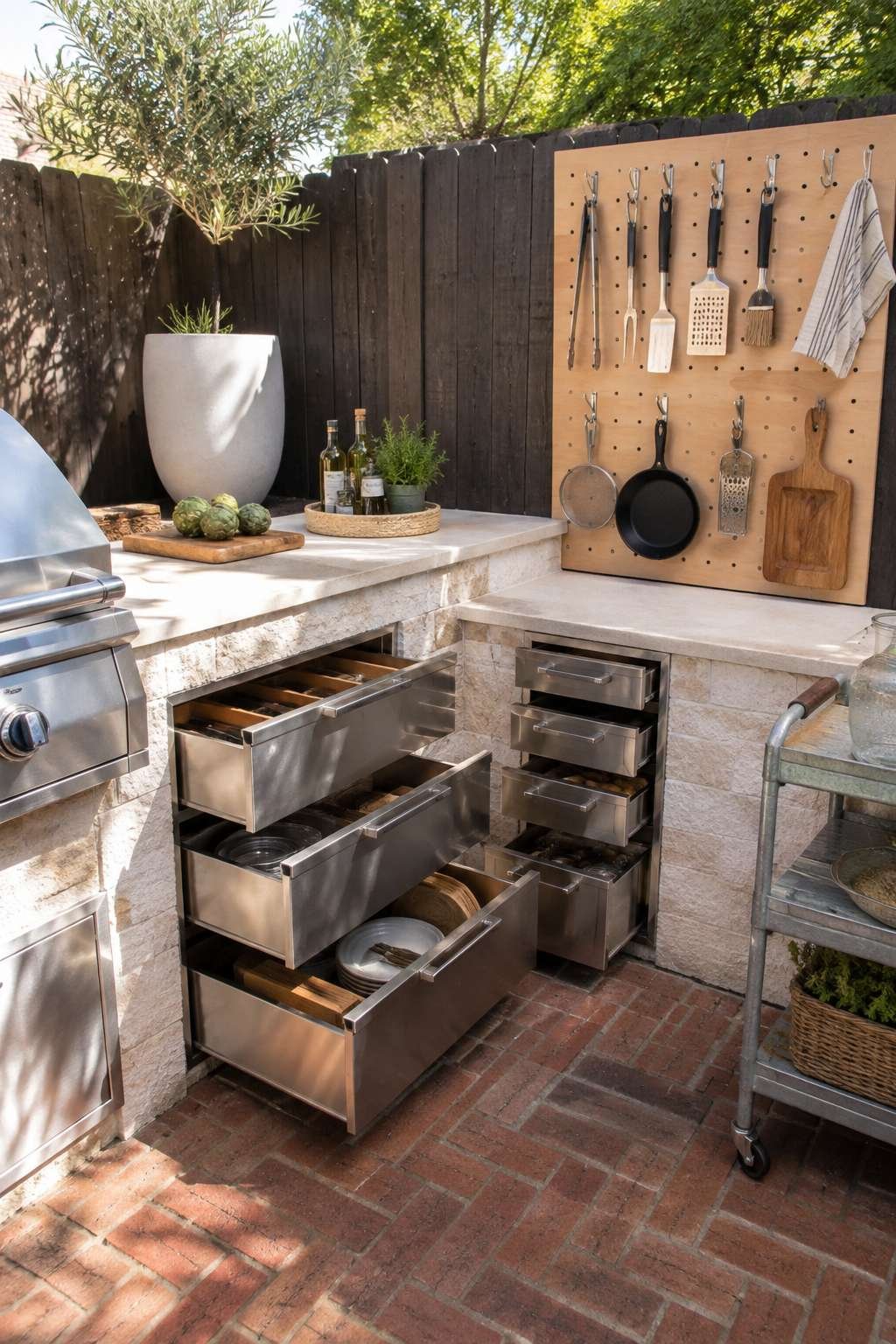
Inside the container, warm wood interior shelving contrasts beautifully with the raw metal shell, the natural grain and warm tones of timber humanizing what might otherwise feel like an excessively industrial environment. Concrete countertops bring additional textural interest while maintaining the hardworking, no-nonsense functional ethos that the container concept demands. Evening LED strip lighting illuminates the workspace with precision, the linear fixtures echoing the horizontal ridges of the corrugated exterior in a satisfying architectural rhyme.
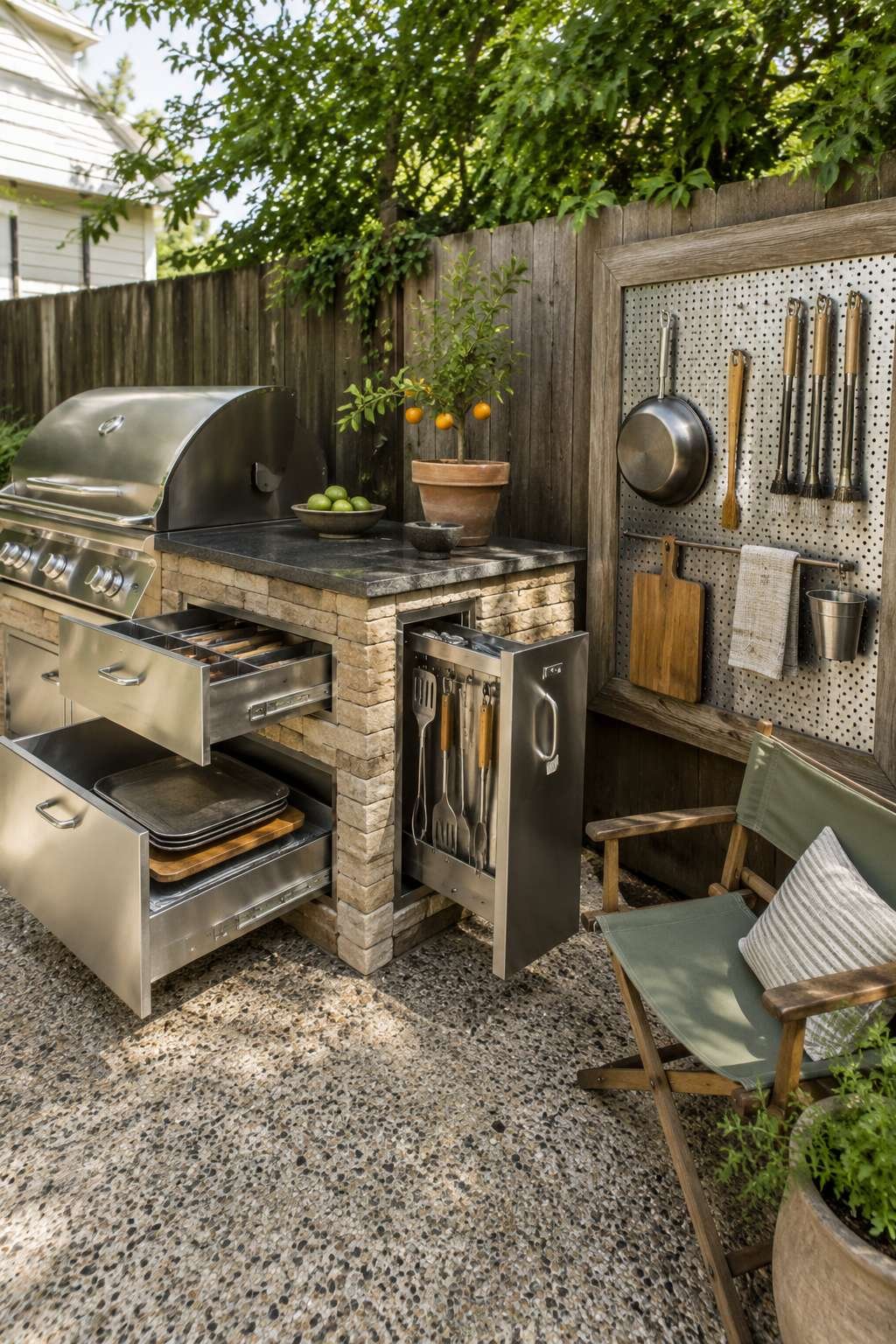
Viewed at three-quarter angle as evening falls, a container kitchen is a genuinely extraordinary sight — the glowing interior visible through the raised roll-up window, the corrugated metal exterior catching the last of the day’s light, the professional-grade cooking equipment within promising serious culinary capability. This is a backyard kitchen for design thinkers — people who find beauty in unexpected places and have the confidence to make bold, unconventional choices.
Key Design Tips:
- Source 20-foot containers rather than 40-foot for typical residential outdoor kitchen applications — 20-foot containers provide ample space while remaining manageable on most properties.
- Install roll-up garage-door style windows in container walls for the most elegant solution — they are weather-tight when closed and fully disappear when open.
- Line container interiors with a vapour barrier before installing timber shelving to prevent condensation from damaging wood elements.
- Specify LED strip lighting in warm white (2700-3000K) for container interior illumination — cooler color temperatures will emphasize the industrial quality at the expense of warmth.
- Check local planning regulations before installing a shipping container structure — some jurisdictions require permits or have restrictions on container use as permanent outdoor structures.
13. Scandinavian Simplicity: White Cabinetry and Ash Wood Accents
Scandinavian minimalism applied to outdoor kitchen design produces results of extraordinary restraint and quiet beauty. Clean-lined white weatherproof cabinetry establishes the palette with characteristic Nordic confidence — the absence of ornament or unnecessary detail communicating a design philosophy that values function, quality of material, and spatial clarity above all else. In an outdoor context, this white cabinetry creates a luminous focal point that reads clearly against any garden backdrop, from lush green lawn to gravel garden to mixed perennial border.
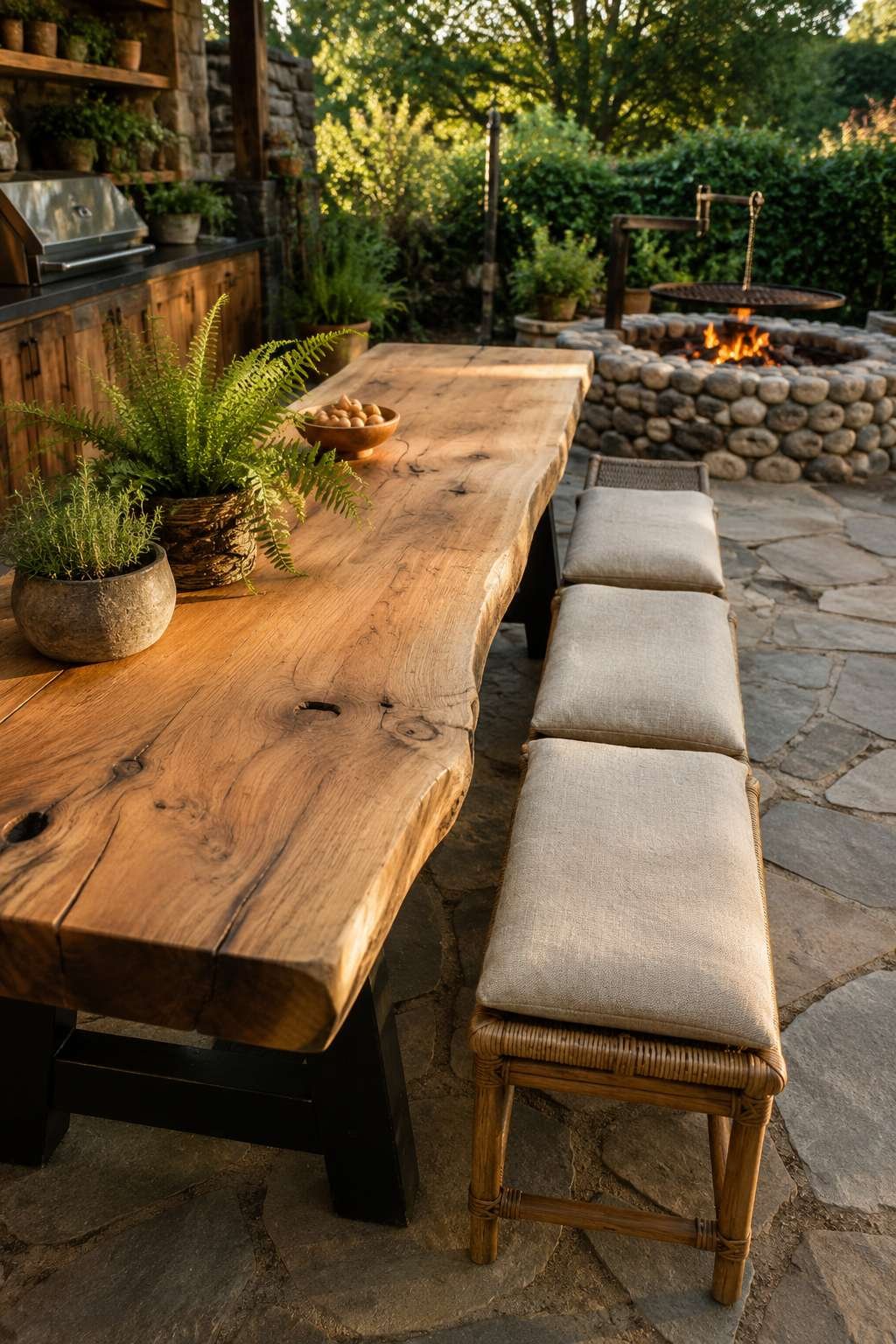
Light ash wood accents introduce the only chromatic warmth in an otherwise carefully neutral palette. Ash is a Nordic design staple — its pale, consistently grained character is ideal for an aesthetic that prizes uniformity and control of detail. Used for counter edging, shelf faces, and structural elements within the island, the ash wood creates a material hierarchy within the composition: white cabinetry as the primary field, ash as the defining accent, and the garden itself as the broader natural canvas into which the entire composition is set.
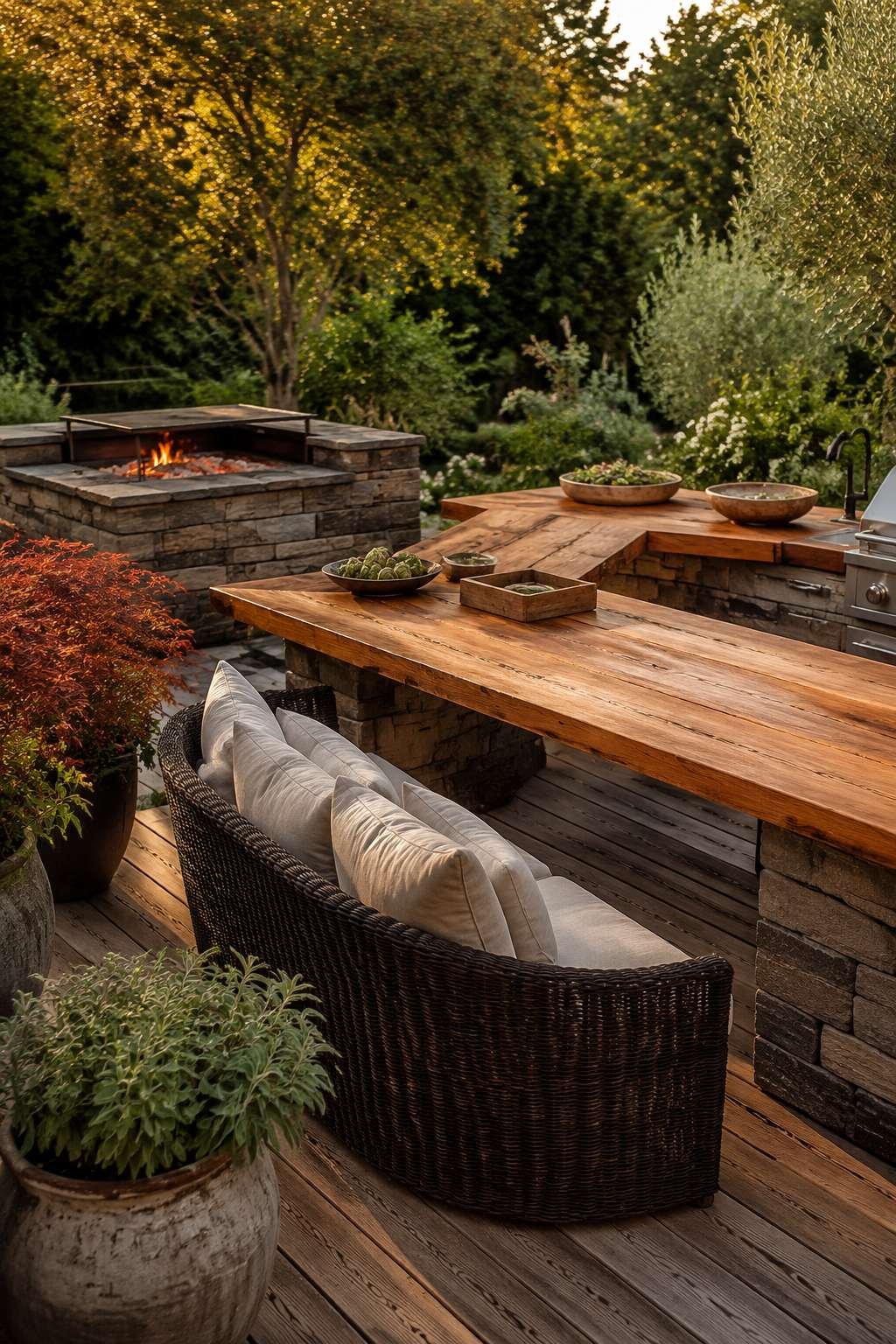
The single-burner outdoor cooktop integrated into a streamlined island demonstrates the Scandinavian principle that quality always outweighs quantity. Rather than accumulating appliances and features, this kitchen identifies what is truly essential and delivers it at the highest possible level of execution. The concrete stepping stones leading from the house through a gravel garden to the kitchen station are themselves a piece of considered landscape design — a pathway that frames the approach to the kitchen as a deliberate, enjoyable journey through a designed landscape rather than a mere functional transit route.
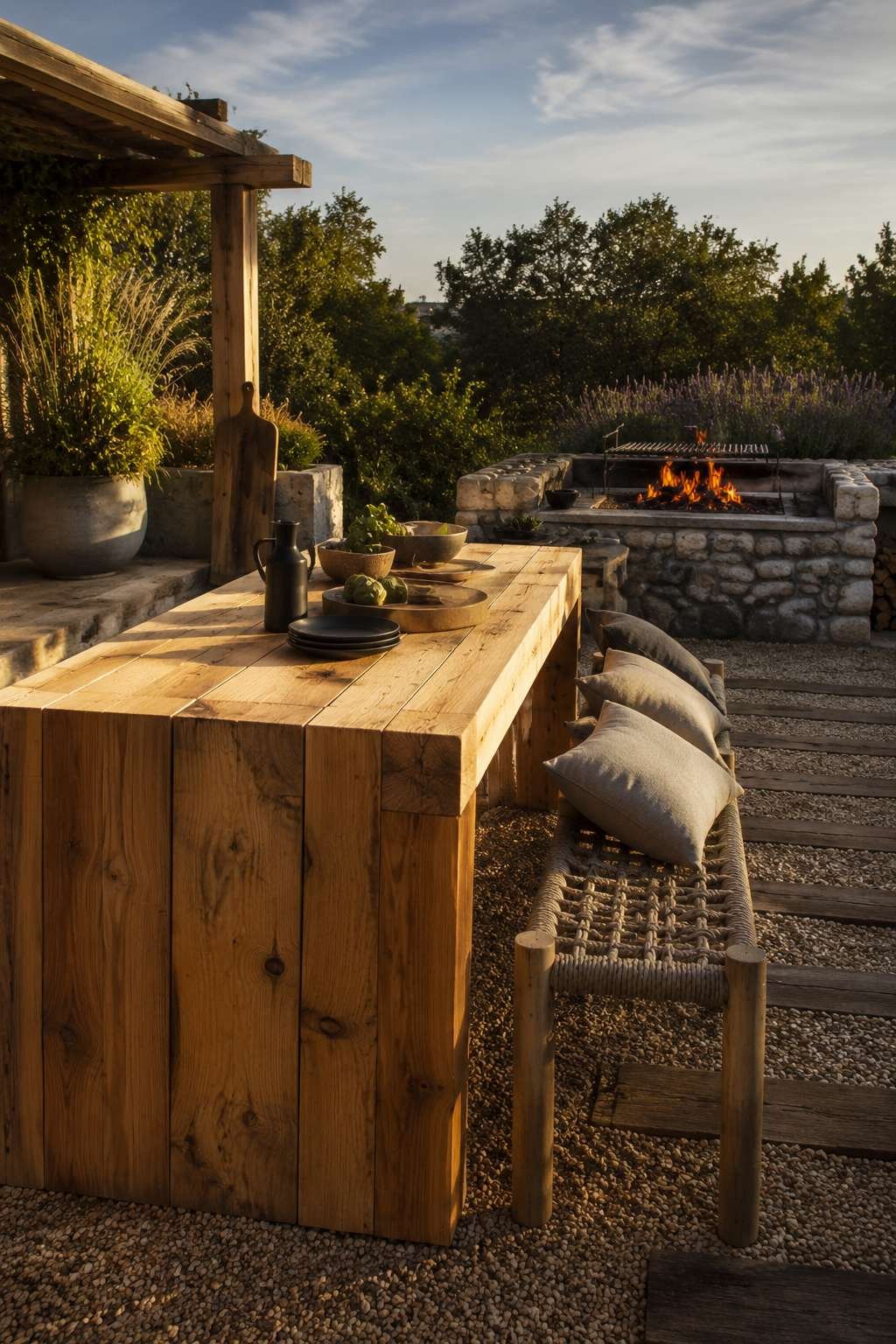
Soft overcast natural daylight is this kitchen’s most flattering light condition — the even, shadow-free illumination that a cloudy Nordic day provides suits the controlled precision of the design perfectly, revealing the subtle material quality of white cabinetry and ash wood without the dramatic highlights and shadows that direct sunlight would create. This is a kitchen that rewards careful looking, revealing its quality gradually rather than announcing itself loudly.
Key Design Tips:
- Specify ultra-matte white finishes for cabinetry in Scandinavian-style outdoor kitchens — glossy surfaces undermine the design’s restrained character.
- Choose thermally modified ash for outdoor wood accents — the thermal modification process dramatically improves durability and stability without chemical treatment.
- Use fine gravel (pea gravel) rather than bark mulch for garden areas adjacent to minimalist outdoor kitchens — gravel maintains the clean, low-visual-noise quality the aesthetic requires.
- Select stepping stones in simple geometric forms — squares or rectangles in natural concrete or stone — for pathways that complement rather than compete with minimalist kitchen design.
- Resist the temptation to add decorative objects or accumulated accessories — the Scandinavian outdoor kitchen derives its power from selective restraint.
14. Social Hub: The Outdoor Cocktail and Cooking Bar
An outdoor kitchen designed around cocktail and cooking bar functionality represents a fundamentally social approach to backyard design — a space conceived primarily as a stage for entertaining rather than as a private family cooking station. A long polished concrete countertop built into a curved stucco wall sets the scene with architectural ambition: the curve of the wall creates an embracing, enveloping quality that draws people naturally to the bar counter, while the smooth concrete surface invites the placement of drinks, plates, and elbows with equal ease.

The integrated bar sink, mini fridge, and bottle storage built directly into the curved wall ensure that every entertaining essential is permanently in place and immediately accessible, eliminating the improvised, temporary quality of less considered outdoor bar setups. Weatherproof rattan bar stools lining one side of the counter introduce texture, warmth, and the critical seating element that transforms a cooking counter into a genuine gathering place — guests can settle comfortably, face the cook, and participate in the preparation process as active, engaged members of the social event rather than passive bystanders awaiting the results.
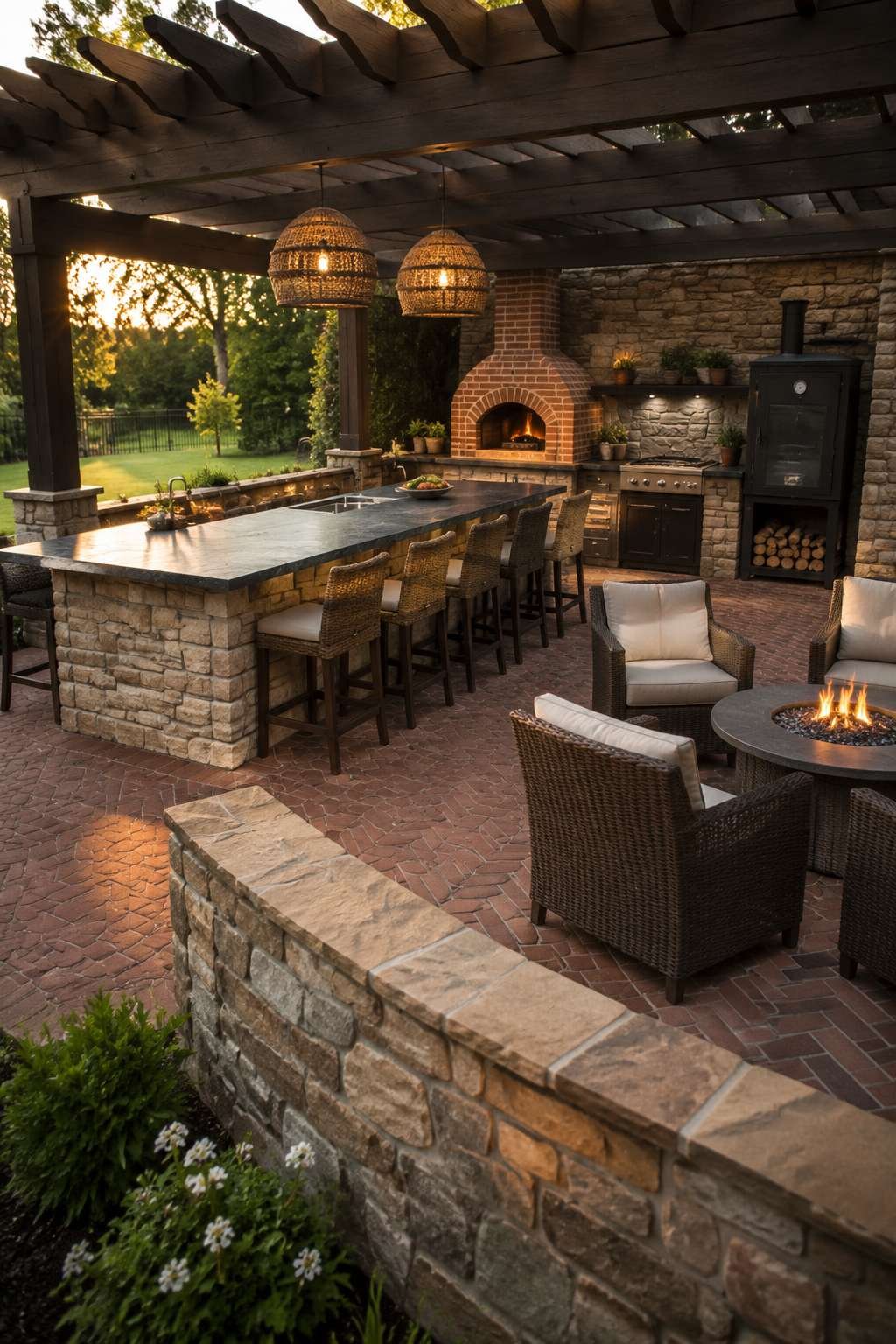
A market umbrella in natural canvas provides the overhead shelter element with a generosity of shade proportional to the social ambitions of the space — wide enough to protect multiple bar stools from afternoon sun while maintaining the relaxed, café-inspired quality the design is seeking. The warm stucco wall tones — ranging from pale cream to ochre depending on the specific mix and finish — age beautifully outdoors, developing a character of gentle weathering that makes the entire bar installation feel like it has always been part of the garden.
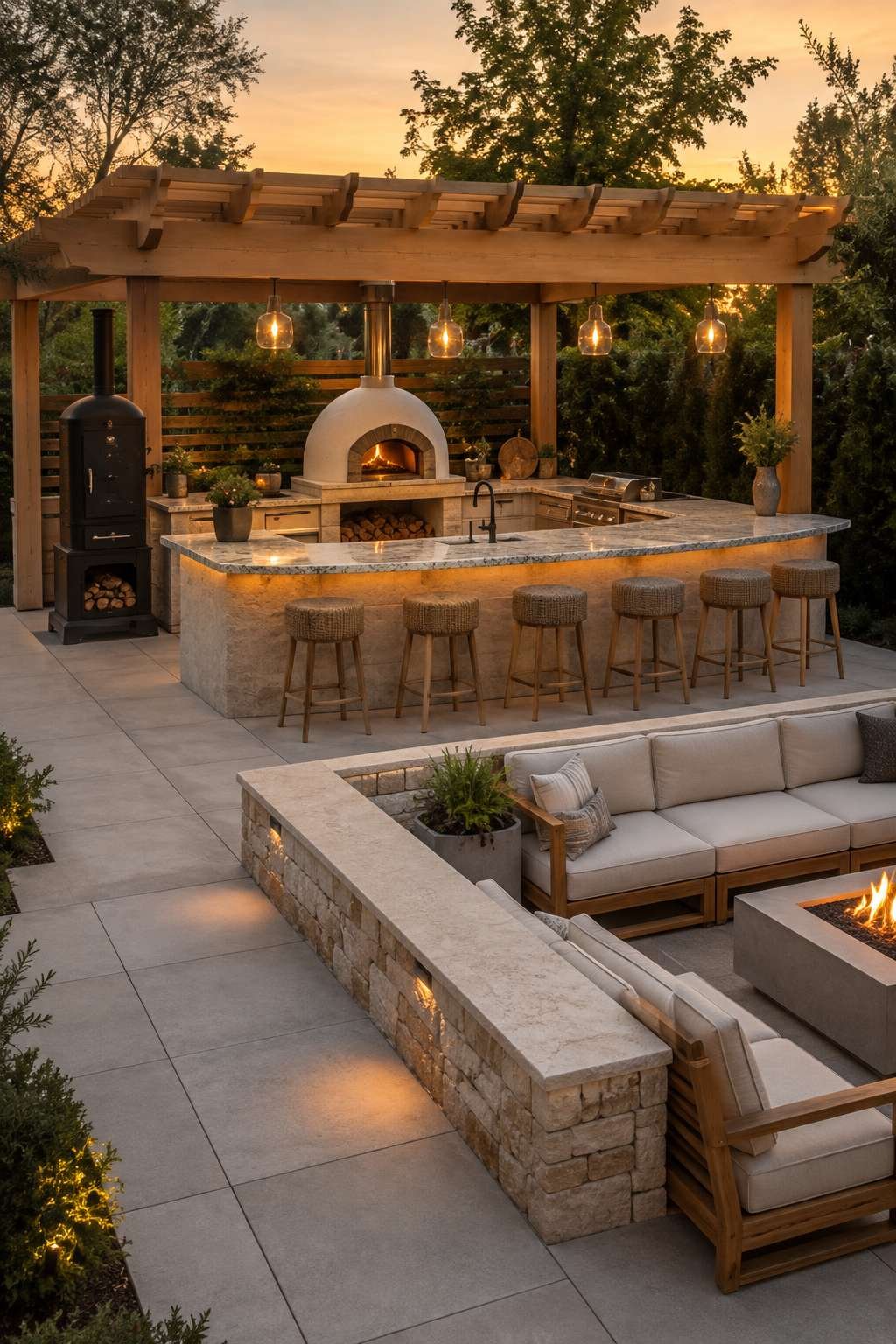
The polished concrete surface texture is what makes this bar work visually at every scale — from the expanse of the full counter viewed from across the garden to the intimate close-up detail of aggregate and sheen as you set your glass down. This is a surface that can be casually wiped clean, that conceals minor marks while developing an honest patina, and that communicates quality without pretension — exactly the qualities a sociable outdoor bar counter requires.
Key Design Tips:
- Design outdoor bar counters at standard bar height (42 inches) rather than kitchen counter height to ensure comfortable use with bar stools.
- Specify curved countertop forms using GFRC (glass fiber reinforced concrete) — this material can be cast into any curve while remaining lightweight and crack-resistant.
- Install a weatherproof beverage refrigerator rated specifically for outdoor ambient temperature fluctuations — indoor units will fail prematurely in outdoor conditions.
- Choose weatherproof rattan or resin wicker bar stools with removable, washable cushion covers for the most practical and comfortable outdoor seating solution.
- Plant climbing vines or espalier shrubs against stucco bar walls to create a living backdrop that softens the architecture and provides seasonal color.
15. Japanese Zen: Yakitori Station and Wabi-Sabi Materials
A Japanese zen-inspired outdoor kitchen achieves its remarkable atmosphere through the scrupulous application of a single overriding aesthetic principle: wabi-sabi — the Japanese philosophy of finding beauty in imperfection, impermanence, and incompleteness. The minimalist yakitori grill station in matte black steel is the functional and visual heart of the design — its simple, unadorned form a perfect expression of Japanese design’s conviction that purpose and beauty are indistinguishable when an object is perfectly suited to its function.

Shou sugi ban charred wood cabinetry is perhaps the most extraordinary material choice available to any outdoor kitchen designer — and simultaneously one of the most practical. The ancient Japanese technique of charring the surface of timber to create a durable, weather-resistant finish produces a surface of deep, rich blackness with subtle texture variation that is visually unlike anything else in outdoor kitchen design. The charred surface is naturally insect and rot-resistant, requiring minimal maintenance while developing a beautiful, evolving patina that deepens the wabi-sabi quality of the space over time.
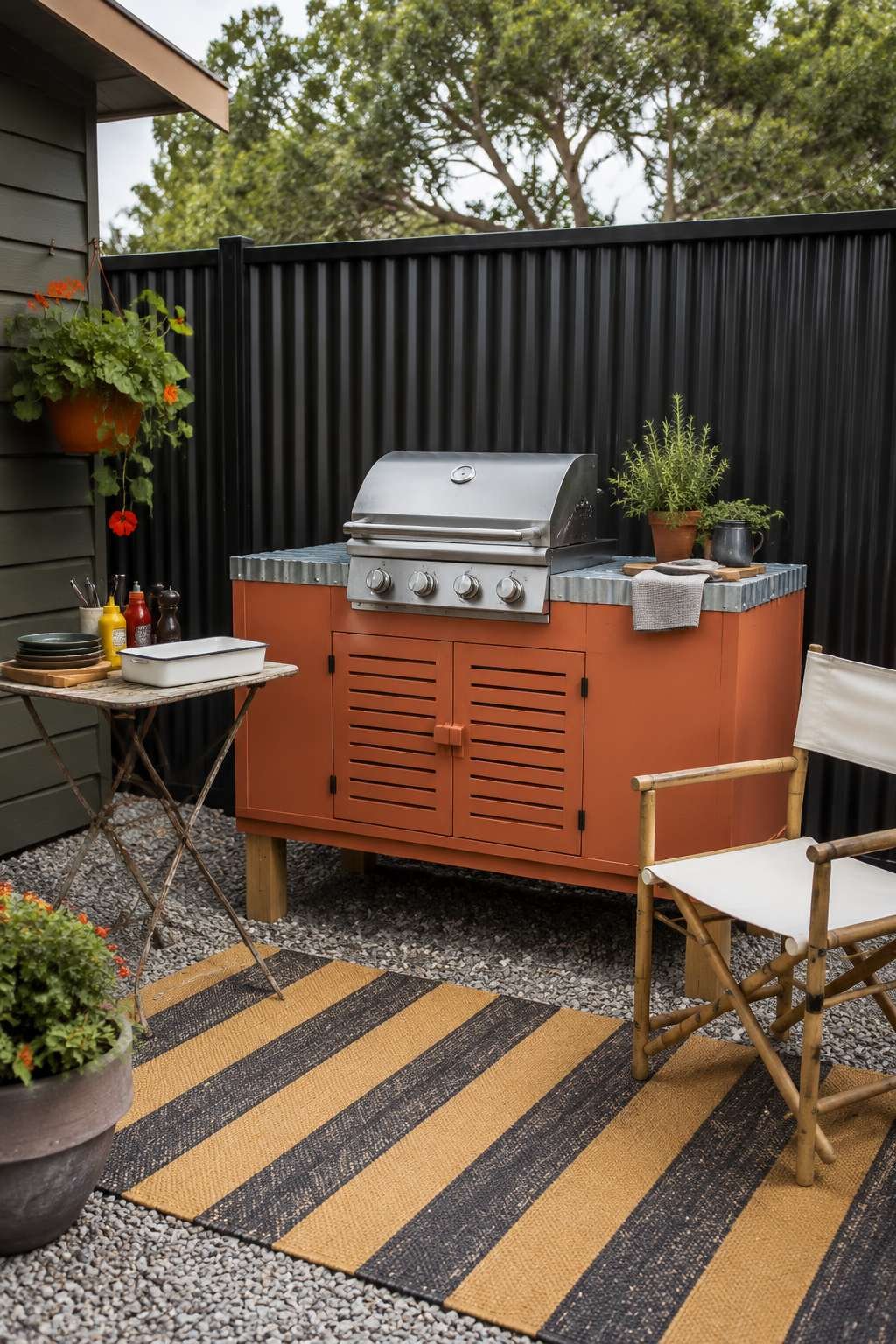
Raked gravel, stepping stone pathways, and carefully pruned bonsai surrounding the kitchen station extend the Japanese garden aesthetic beyond the kitchen structure into the landscape itself, creating a composed, contemplative setting that makes the act of preparing food feel like a meditative practice. Smooth granite countertops provide the precise, cool work surface that this disciplined aesthetic demands — their subtle mineral variation and polished sheen offering a quiet visual luxury within an otherwise ascetically restrained composition.
Soft evening lantern lighting is the design element that most completely transforms the zen outdoor kitchen at nightfall. The warm, low-level glow of Japanese-style garden lanterns — whether traditional stone tōrō or modern interpretations in blackened steel — creates pools of gentle light that emphasize the textures of gravel, charred wood, and polished stone while leaving surrounding areas in soft shadow. In this light, the backyard kitchen achieves a quality of meditative stillness that is profoundly different from the convivial bustle of a Western entertaining kitchen — and all the more valuable for it.
Key Design Tips:
- Commission a shou sugi ban specialist for charred timber cabinetry — the depth of char, the brushing technique, and the finishing oil application all significantly affect the final appearance and durability.
- Use Decomposed granite (DG) rather than sand for raked garden areas — DG packs more firmly and maintains raked patterns more clearly than sand.
- Select slow-growing bonsai species appropriate to your climate — juniper, pine, and maple are widely adaptable and develop the twisted, aged forms that complement the wabi-sabi aesthetic most effectively.
- Install low-voltage garden lanterns on a timer to ensure the evening lighting atmosphere is activated automatically, requiring no management during cooking.
- Choose matte black powder-coat finishes for all metalwork — the matte quality resonates with the wabi-sabi philosophy, avoiding the superficial perfection of polished or glossy surfaces.
Why These Are the Best Backyard Kitchen Ideas
The 21 backyard kitchen concepts explored throughout this article represent the full spectrum of what outdoor kitchen design can achieve when approached with genuine ambition, material knowledge, and respect for the lifestyle needs of the people who will use them. From the built-in granite and stainless classic to the eco-conscious recycled glass sustainable kitchen, each concept has been developed around a coherent design philosophy rather than an assemblage of unrelated features — and this coherence is what makes each one genuinely inspirational rather than merely adequate.
The best outdoor kitchen designs share several qualities regardless of style: they use materials appropriate to outdoor conditions, they provide logical workflow that makes cooking genuinely pleasurable, they create atmosphere as well as function, and they connect meaningfully with the landscape and architecture surrounding them. Whether you are drawn to the rustic authenticity of reclaimed brick and wood-fired ovens, the sophisticated drama of dark porcelain and motorized louvered roofs, the minimalist restraint of Scandinavian white cabinetry, or the environmental commitment of a solar-powered sustainable kitchen, the principles of successful outdoor kitchen design remain consistent across all styles.
The outdoor kitchen trend continues to grow because it addresses a genuine human desire — the desire to cook, eat, and gather in the open air, in beautiful surroundings, without sacrificing the quality, comfort, and functionality of the finest indoor kitchen. The backyard kitchen ideas presented here demonstrate conclusively that this desire can be fulfilled at every budget level and in every style, from the modest but perfectly considered compact terrace kitchen to the extravagant pool-side luxury installation.
Conclusion
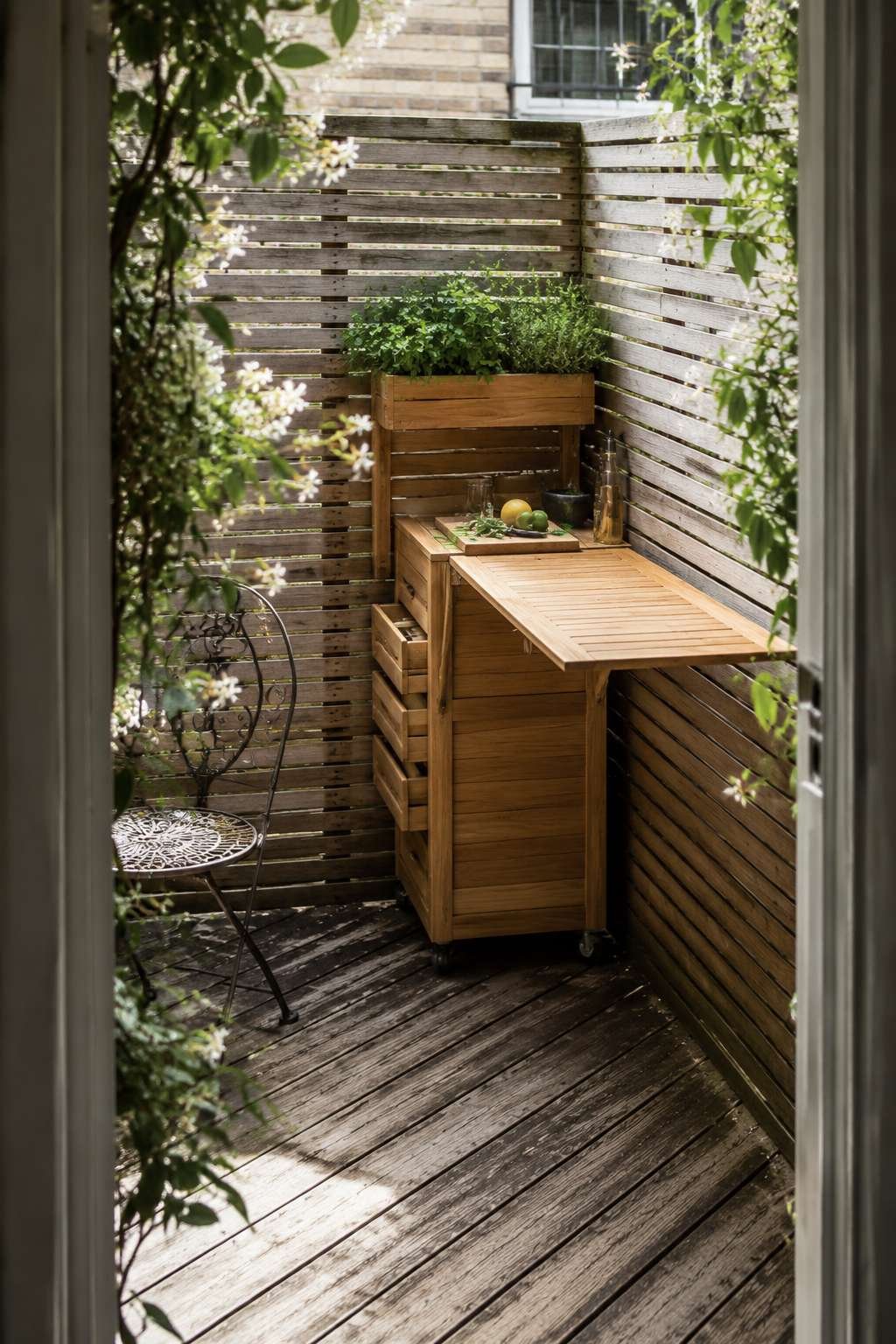
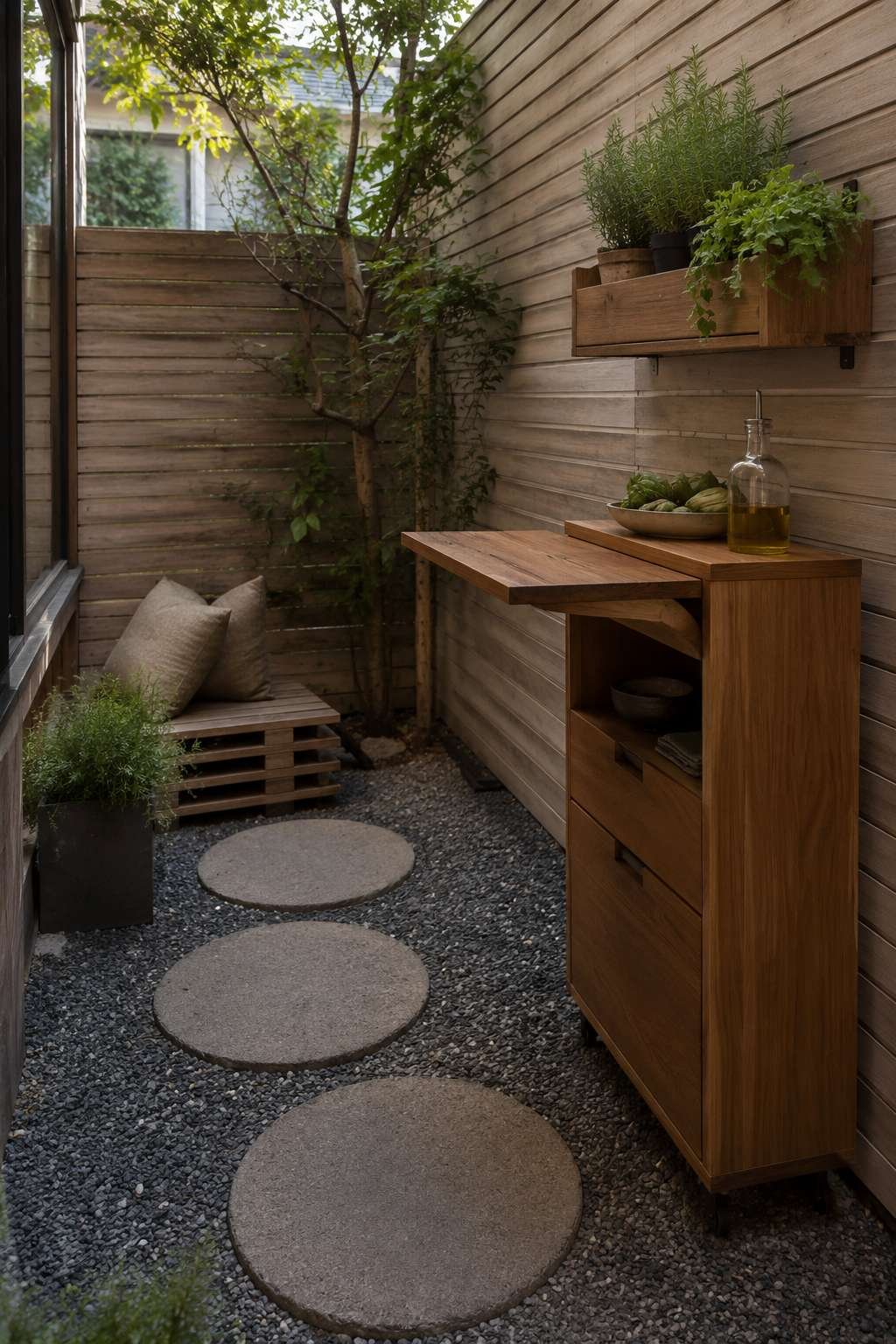
The journey through these 21 backyard kitchen ideas reveals a consistent truth: the most successful outdoor kitchen is not necessarily the largest or most expensive, but the one most perfectly suited to the people who will use it, the space it inhabits, and the lifestyle it is designed to support. A compact fold-down teak counter in a narrow urban side yard can deliver as much genuine pleasure as a luxury Wolf-equipped pool-side kitchen island — provided both are designed with equal care, equal attention to material quality, and equal understanding of how the space will actually be lived in.
As you consider which of these ideas might inspire your own outdoor kitchen project, focus first on the questions of how you cook, how you entertain, and how you want to feel when you step into your backyard kitchen. The answers to these questions will guide you toward the style, scale, and material choices that will make your outdoor kitchen not merely a beautiful design statement but a space of genuine, daily joy. Start with what resonates most deeply, trust the design principles illustrated throughout these concepts, and do not be afraid to combine elements from multiple styles into a personalised outdoor kitchen that is entirely and uniquely your own.
The backyard kitchen you create will not only transform how you use your outdoor space — it will transform how you feel about your home, how often you gather with the people you love, and how naturally and joyfully outdoor cooking and entertaining become woven into the fabric of your everyday life.
