


Designing a narrow living room can feel like navigating a spatial puzzle, but with the right approach, these challenging layouts can become some of the most charming and functional spaces in your home. Long, slim living rooms are common in urban apartments, converted row houses, and modern condominiums, where maximizing every square foot is essential. Rather than viewing the narrow proportions as a limitation, savvy interior designers recognize these spaces as opportunities for creative problem-solving and innovative design solutions that showcase both style and intelligence.
The key to success in narrow living room design lies in understanding how to manipulate visual perception, optimize furniture placement, and leverage vertical space. Strategic color choices, thoughtful lighting, and multi-functional furnishings can transform what might initially seem like an awkward layout into a sophisticated, welcoming environment. Whether you’re dealing with a railroad-style apartment or a converted attic space, the principles of proportion, scale, and flow remain paramount. The narrow living room demands intentionality—every piece must earn its place, every color must serve a purpose, and every design decision must contribute to the overall sense of openness and livability.
In this comprehensive guide, we’ll explore ten distinct approaches to narrow living room design, each offering unique solutions to common spatial challenges. From minimalist Scandinavian aesthetics to symmetrical formal arrangements, from light-enhancing monochromatic schemes to clever zone-based layouts, these ideas demonstrate how thoughtful design can conquer even the most challenging architectural constraints. You’ll discover practical techniques for furniture arrangement, color theory applications, storage innovations, and lighting strategies—all specifically tailored to the unique demands of the narrow living space.
1. Streamlined Furniture Arrangement for Maximum Flow
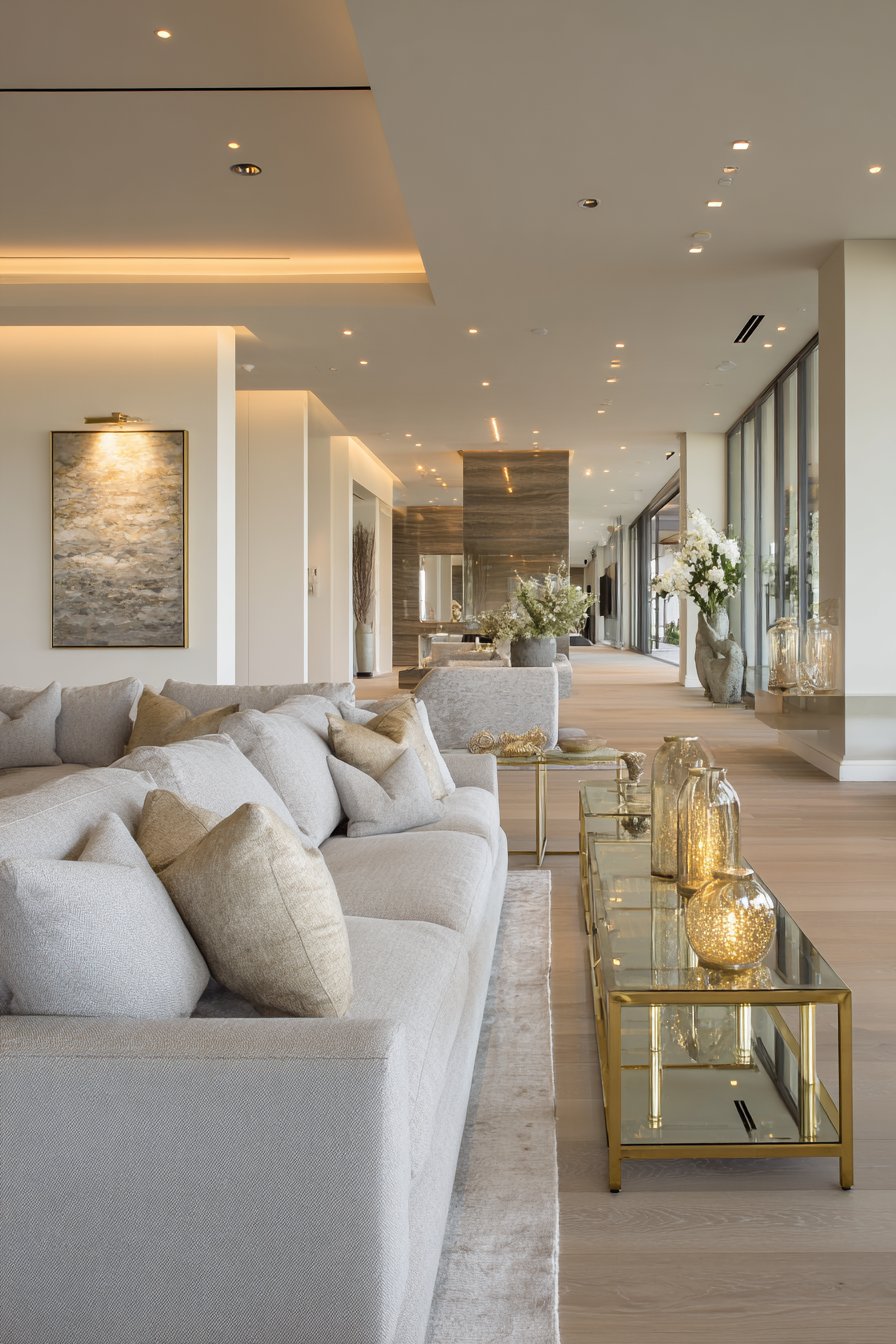
The foundation of any successful narrow living room begins with strategic furniture placement that prioritizes circulation and visual balance. In this approach, a slim-profile grey linen sofa takes pride of place against the longest wall, its clean lines and neutral tone preventing visual bulk while providing comfortable seating. The beauty of this arrangement lies in its respect for the room’s natural geometry—by aligning major furniture pieces with the walls, you maintain precious floor space in the center, creating an invisible pathway that allows for easy movement through the space.
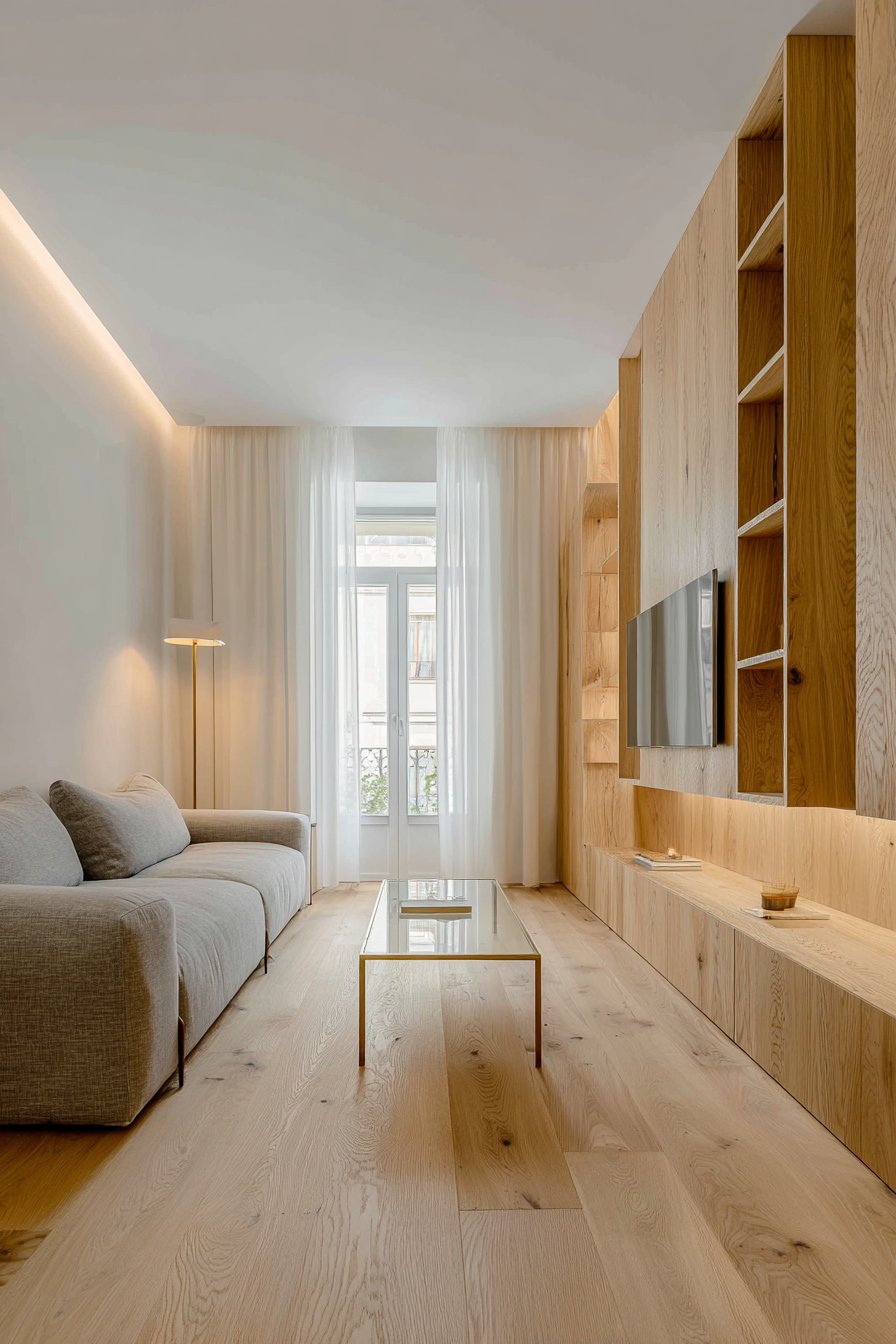
Flanking the sofa, tall vertical storage units reach toward the ceiling, embodying one of the most important principles in narrow room design: when you can’t expand outward, expand upward. These units maximize storage capacity without consuming valuable floor space, drawing the eye upward and creating the illusion of higher ceilings. The verticality of these pieces counteracts the horizontal stretch of the room, establishing a more balanced proportion. Each shelf, each compartment serves dual purposes—practical storage and architectural interest.
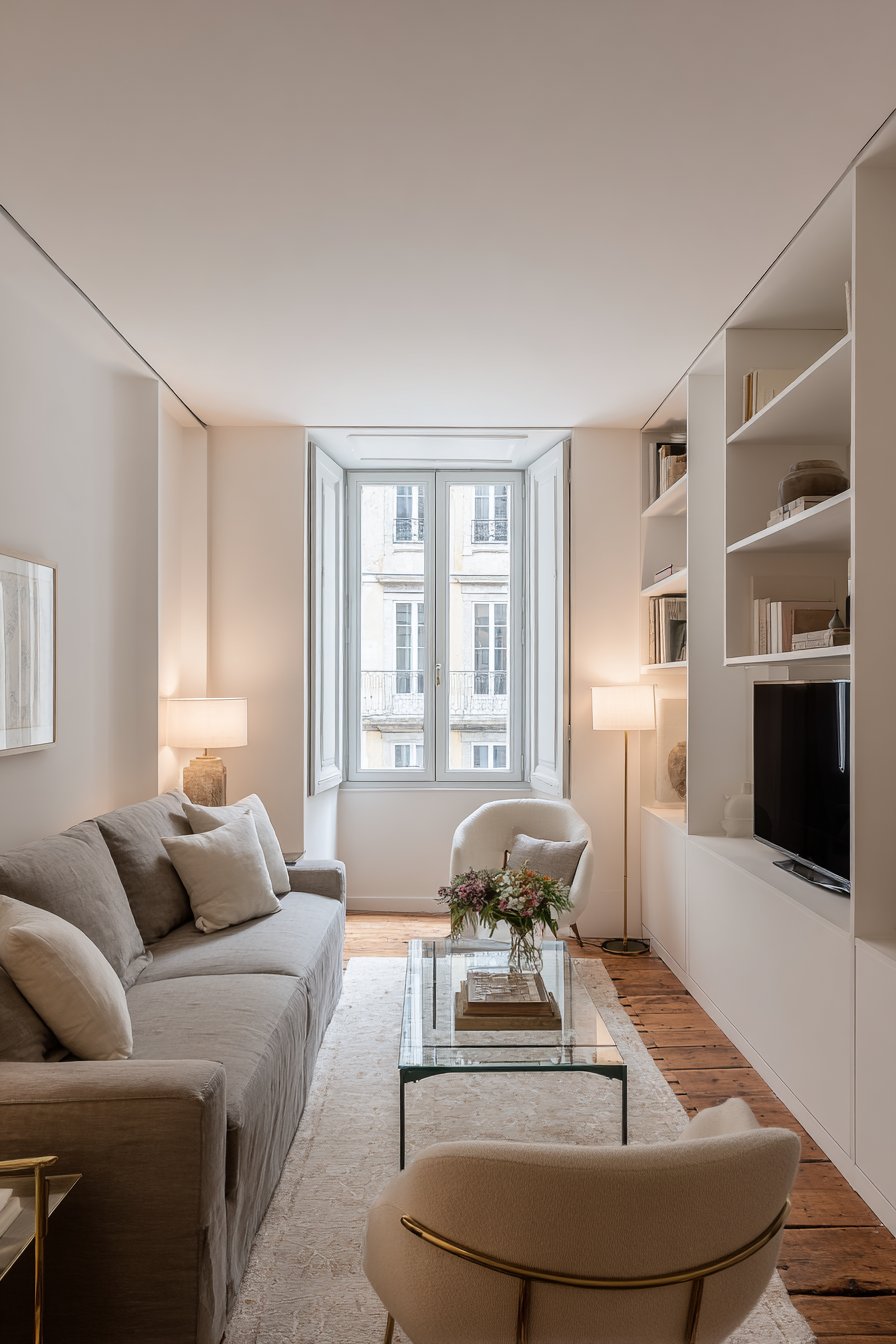
The narrow glass coffee table with brass legs represents a masterclass in material selection for tight spaces. Glass provides essential functionality—a surface for drinks, books, and decorative objects—while maintaining visual transparency. Light passes through rather than being blocked, preventing the center of the room from feeling heavy or congested.
The brass legs add a touch of warmth and sophistication, their slender profile reinforcing the streamlined aesthetic. This piece proves that in narrow rooms, what you can see through is just as important as what you can see.
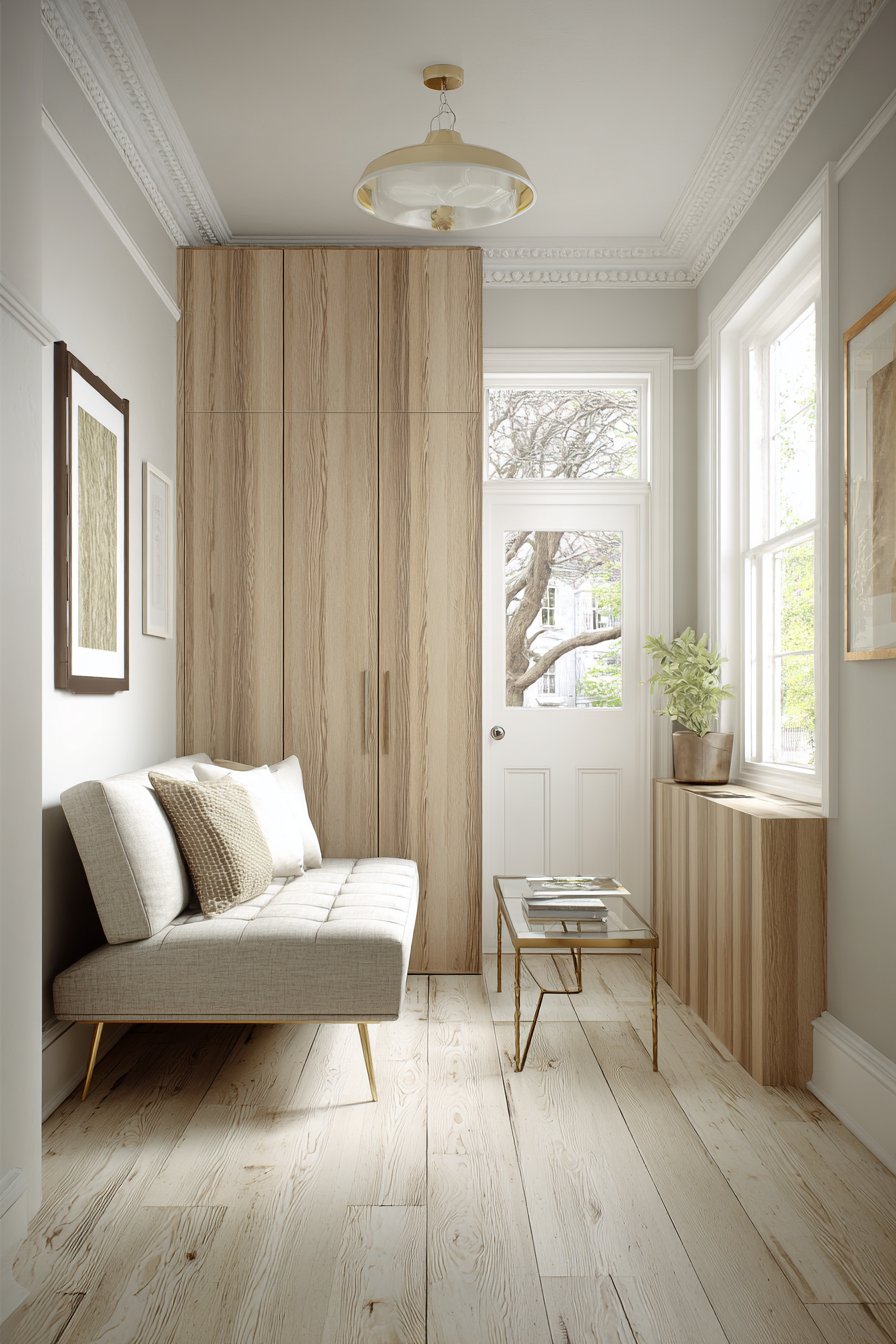
The light neutral color palette works harmoniously with the natural oak flooring, which runs lengthwise to visually extend the room’s depth. This directional element is crucial—just as horizontal stripes can make a person appear wider, lengthwise flooring planks guide the eye toward the far end of the room, emphasizing depth over width. Soft white walls reflect natural and artificial light, creating an envelope of brightness that prevents the space from feeling cave-like or oppressive.
Key Design Tips:
- Position your largest furniture piece against the longest wall to maintain central floor space for circulation and create a sense of openness that prevents the narrow room from feeling like a corridor.
- Choose furniture with exposed legs rather than pieces that sit flush to the floor, as visible floor space beneath furnishings creates visual lightness and makes the room feel more spacious.
- Select glass or acrylic furniture for coffee tables and side tables to maintain functionality without blocking sight lines, allowing light to flow freely through the space.
- Install vertical storage solutions that reach toward the ceiling, maximizing unused overhead space while keeping the floor area clear for movement.
- Run flooring lengthwise along the room’s longest dimension to create visual continuity and emphasize depth rather than the narrow width.
2. Built-In Window Bench with Wall-Mounted Entertainment
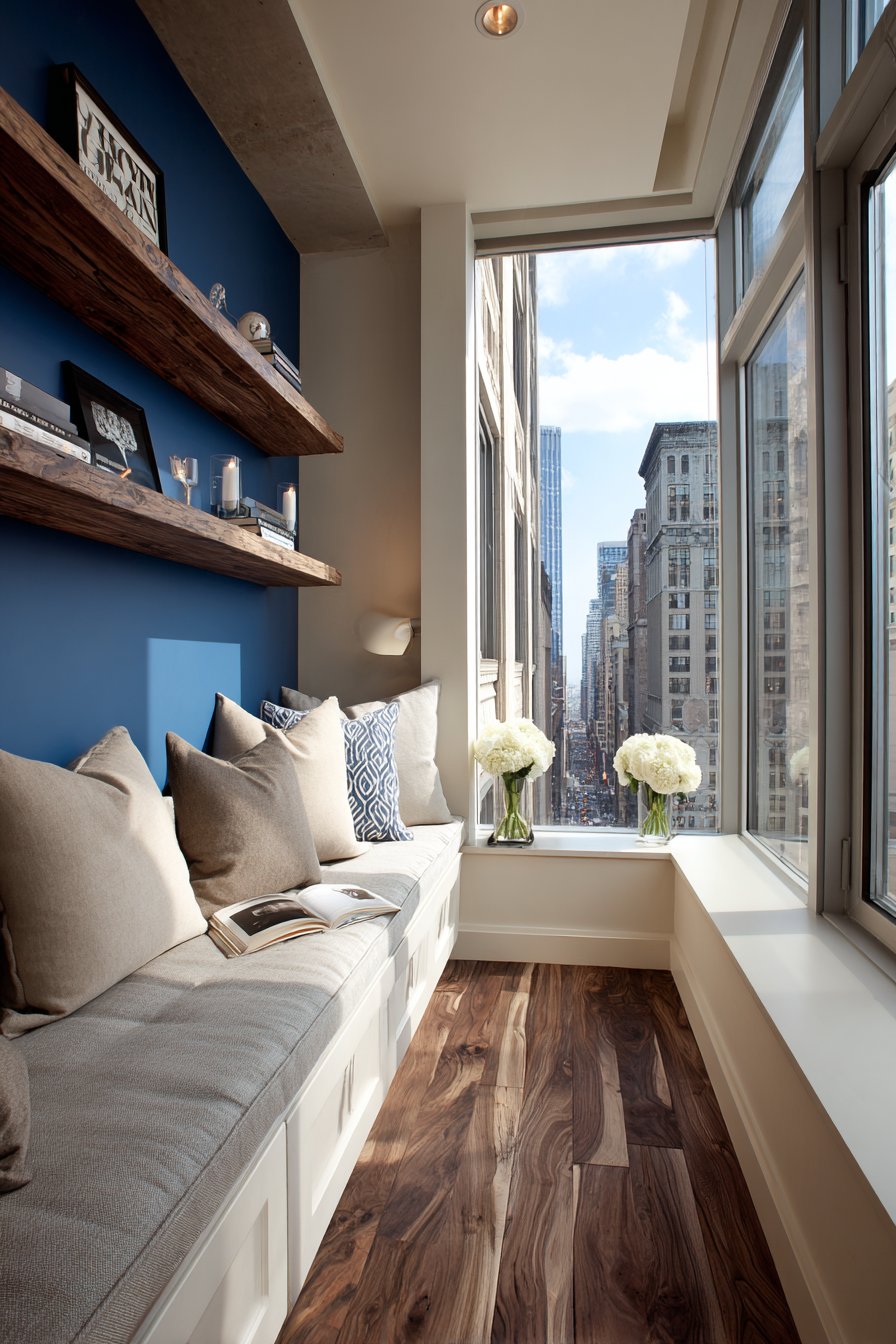
Creative seating solutions can revolutionize narrow living rooms, and the built-in window bench represents one of the most ingenious approaches to maximizing limited space. This design features a comfortable grey fabric-upholstered bench that hugs one wall, transforming what might otherwise be wasted space into functional, inviting seating.
The genius lies beneath the cushioned surface—hidden storage compartments provide a home for blankets, books, magazines, and seasonal items, eliminating the need for bulky storage furniture that would crowd the narrow footprint.
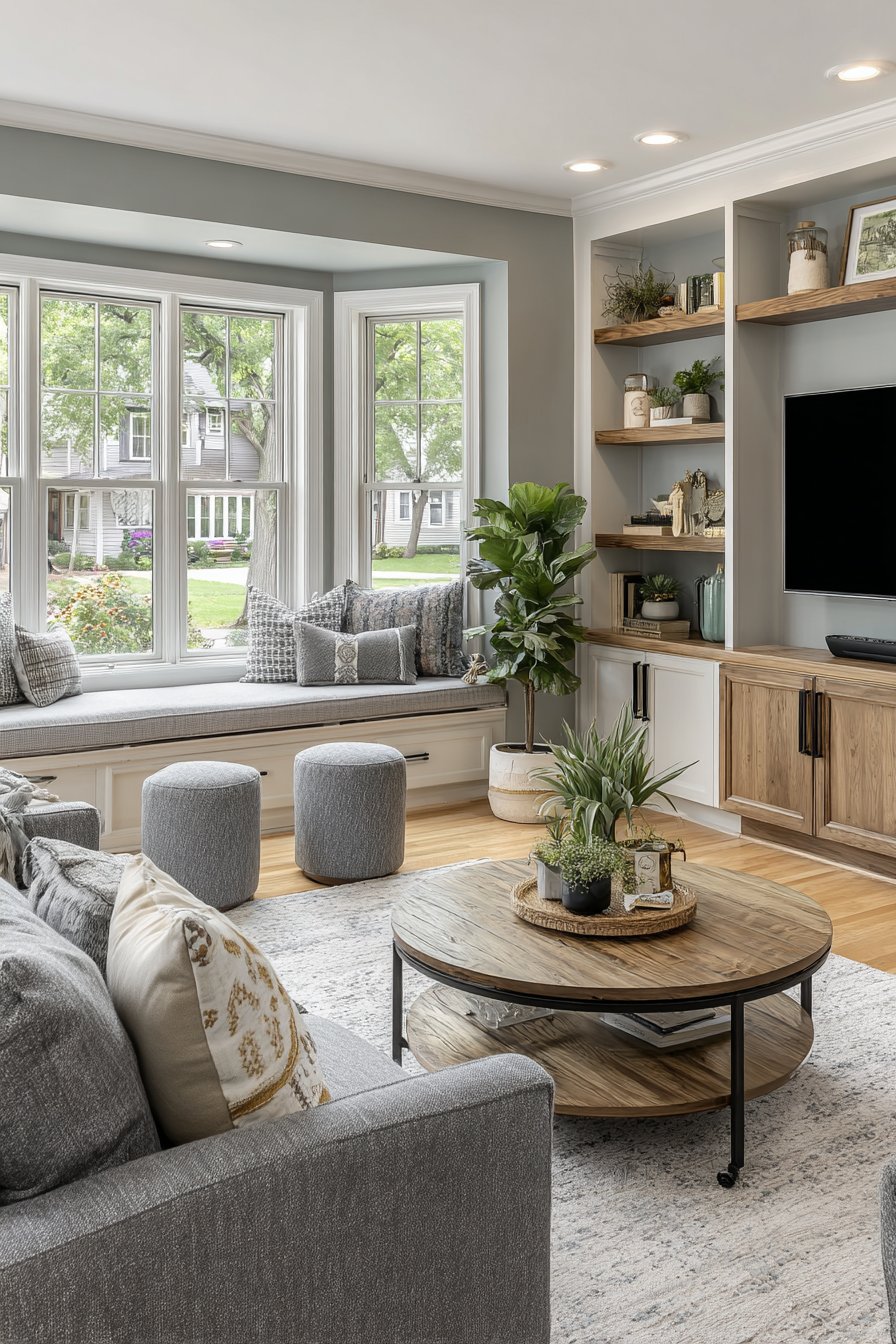
The window bench serves multiple purposes beyond mere seating. It creates a natural gathering spot bathed in daylight, perfect for reading, conversation, or simply enjoying the view. The built-in nature of this element means it doesn’t protrude into the room as much as freestanding furniture would, maintaining clear pathways and visual flow. The durable grey fabric is both practical and versatile, coordinating with virtually any color scheme while hiding minor wear and tear that comes with frequent use.
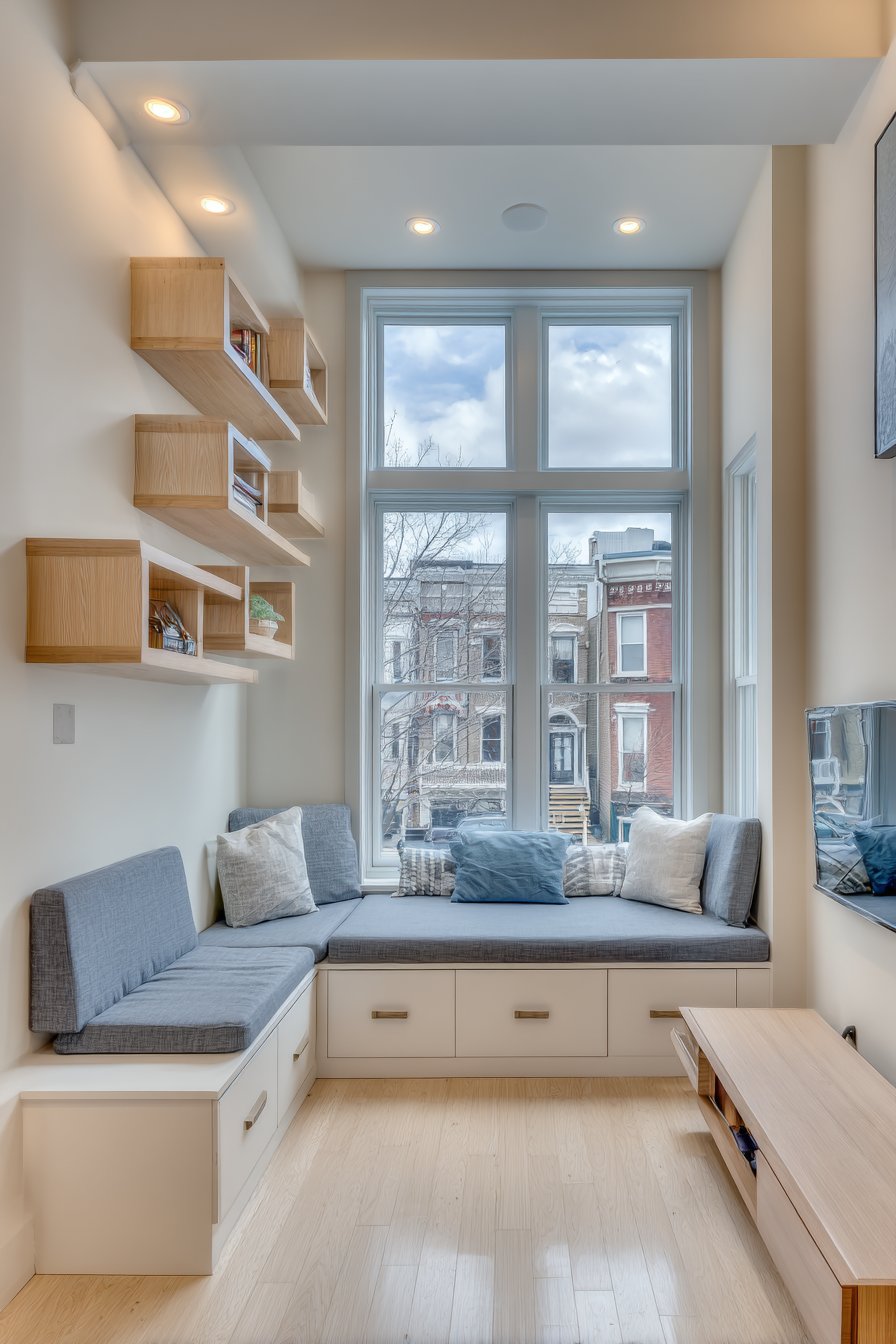
On the opposite wall, a wall-mounted media console in natural walnut provides a sophisticated focal point while eliminating the footprint of traditional entertainment centers. This floating installation creates the illusion that furniture is hovering, revealing floor space beneath and contributing to an airier atmosphere.
The natural walnut finish brings warmth and organic texture to the space, grounding the design with natural beauty. Above the console, floating shelves extend the storage capacity vertically, displaying decorative objects, books, and media components without requiring additional floor space.
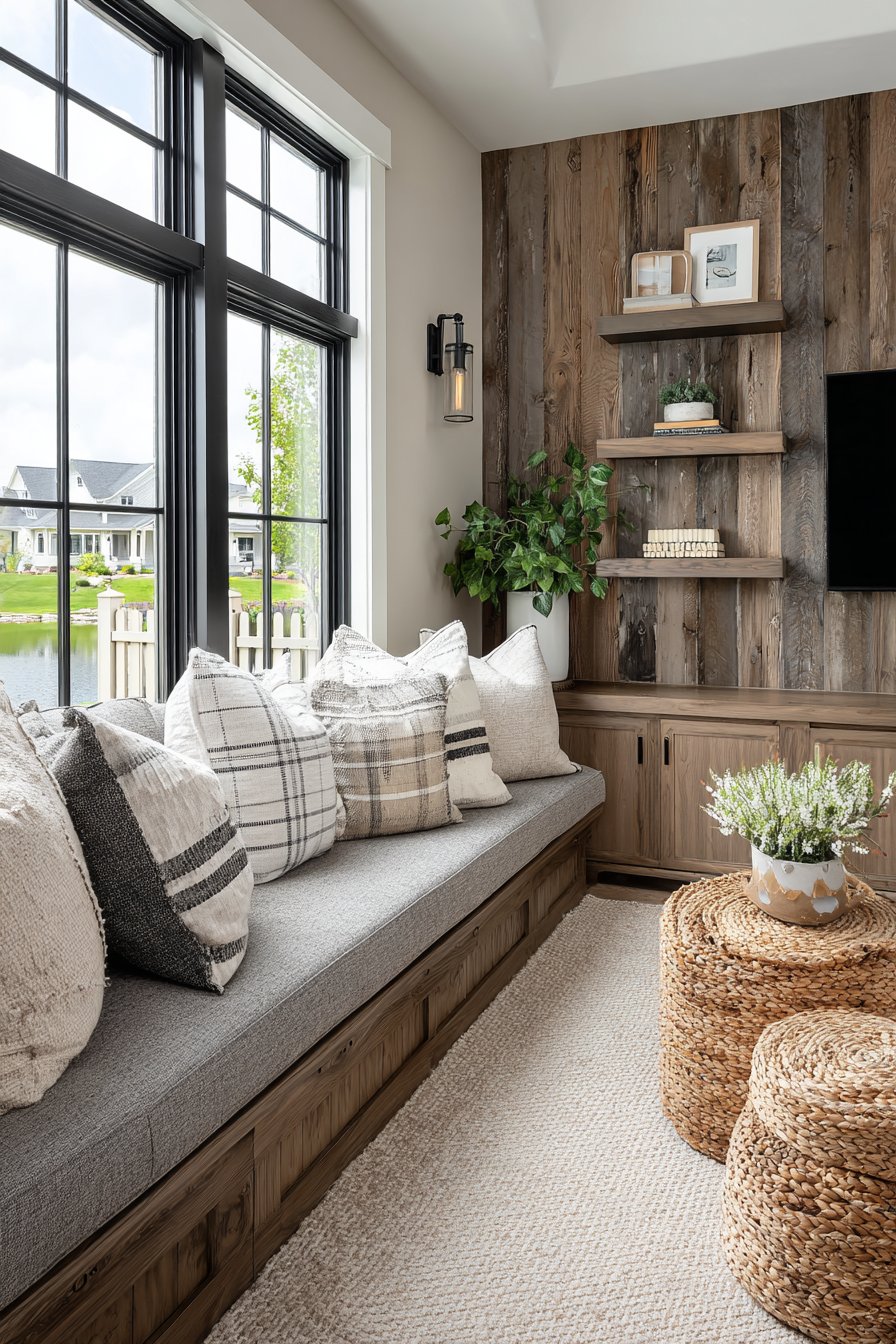
This streamlined design demonstrates how vertical thinking can solve horizontal constraints. Every element has been carefully considered to maintain an open floor plan—nothing extends unnecessarily into the walking space, yet the room lacks nothing in terms of functionality or style. Natural daylight from windows illuminates the practical space-saving solutions, creating a bright, welcoming environment that feels significantly larger than its actual dimensions might suggest.
Key Design Tips:
- Install built-in seating along windows or walls to maximize functionality without consuming floor space that freestanding furniture would require, creating custom solutions tailored to your exact dimensions.
- Incorporate hidden storage beneath seating to eliminate the need for additional storage furniture, keeping the visual field clear and uncluttered.
- Mount your television and media components on the wall using floating consoles and shelves that reveal floor space and create a contemporary, streamlined aesthetic.
- Choose furniture with dual purposes where every piece serves multiple functions, maximizing utility in the limited square footage available.
- Maintain consistent floor-to-ceiling lines by aligning built-ins and wall-mounted elements to create visual harmony and emphasize the room’s vertical dimension.
3. Mirror Magic and Strategic Reflection
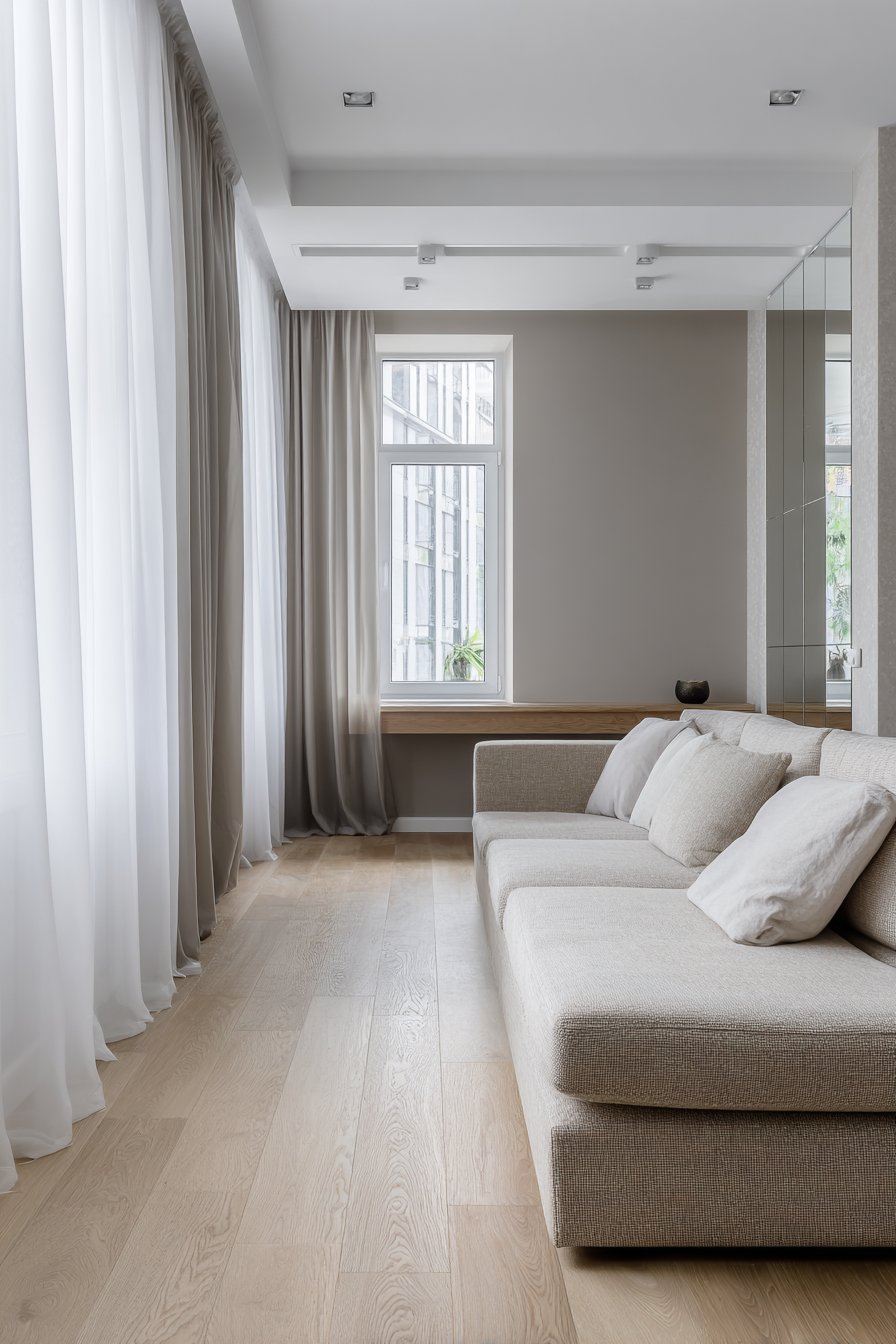
Mirrors are the interior designer’s secret weapon for narrow spaces, and this approach harnesses their transformative power to dramatic effect. Strategically placed on the shorter end wall, a large mirror creates the illusion of width by reflecting the room back onto itself, essentially doubling the perceived space.
This isn’t mere trickery—the psychological impact of seeing expansive reflection genuinely makes the room feel more open and less confined. The mirror also captures and multiplies natural light, bouncing illumination throughout the space and creating a brighter, more inviting atmosphere.
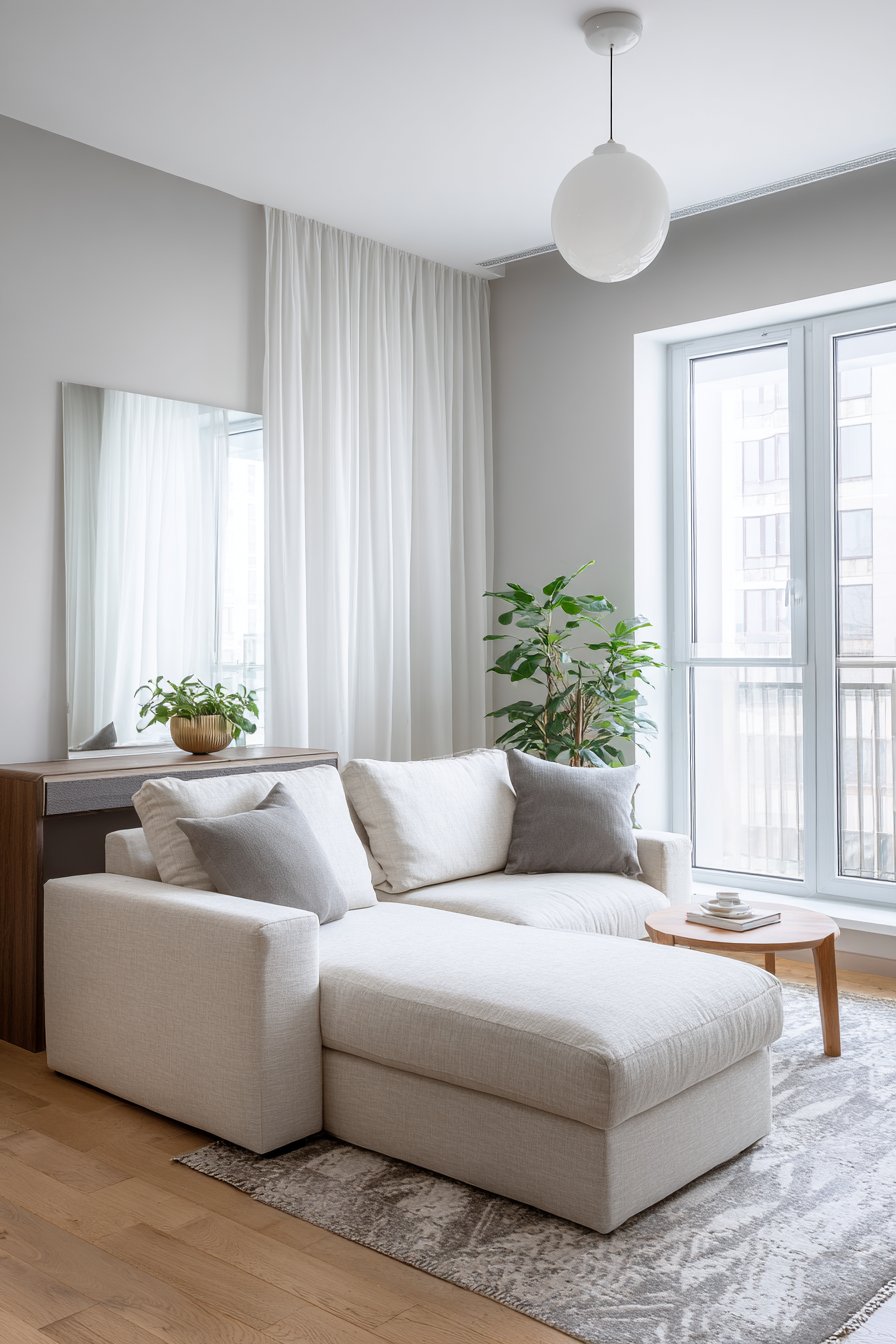
The furniture selection complements this optical strategy with a compact sectional sofa in light beige, positioned to maximize seating capacity without obstructing pathways. The L-shaped configuration tucks neatly into one corner, providing ample seating for family and guests while maintaining clear circulation routes along the walls. The light beige color recedes visually, creating a soft, neutral backdrop that doesn’t compete for attention or make the space feel crowded with color.
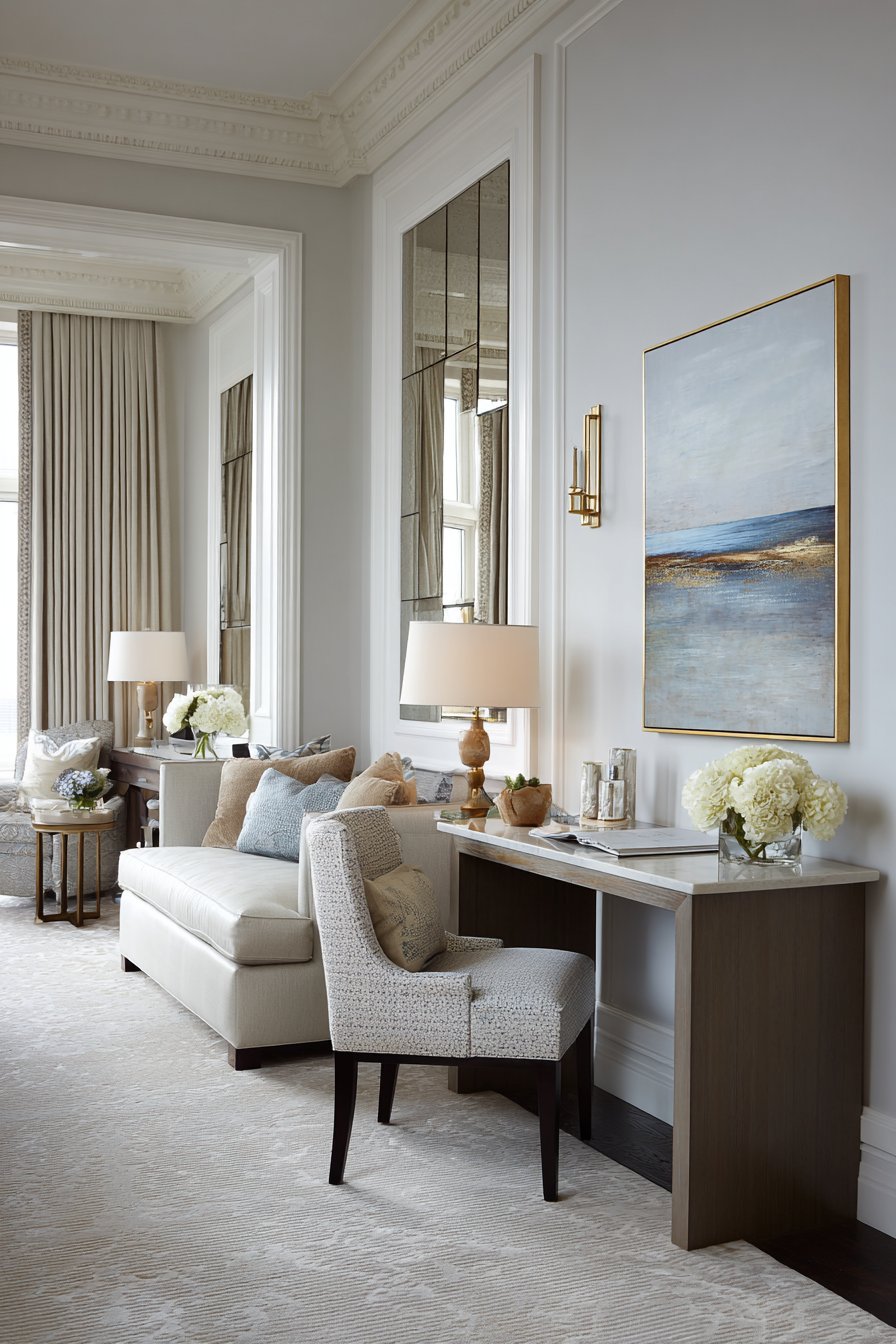
Behind the sofa, a narrow console table performs the delicate balancing act that narrow rooms demand—providing additional surface area for lamps, photos, and decorative objects without consuming precious floor space. This layered approach to furniture placement adds depth and dimension to the room, creating visual interest while maintaining functionality. The console table proves that you can have both form and function without sacrificing circulation space.
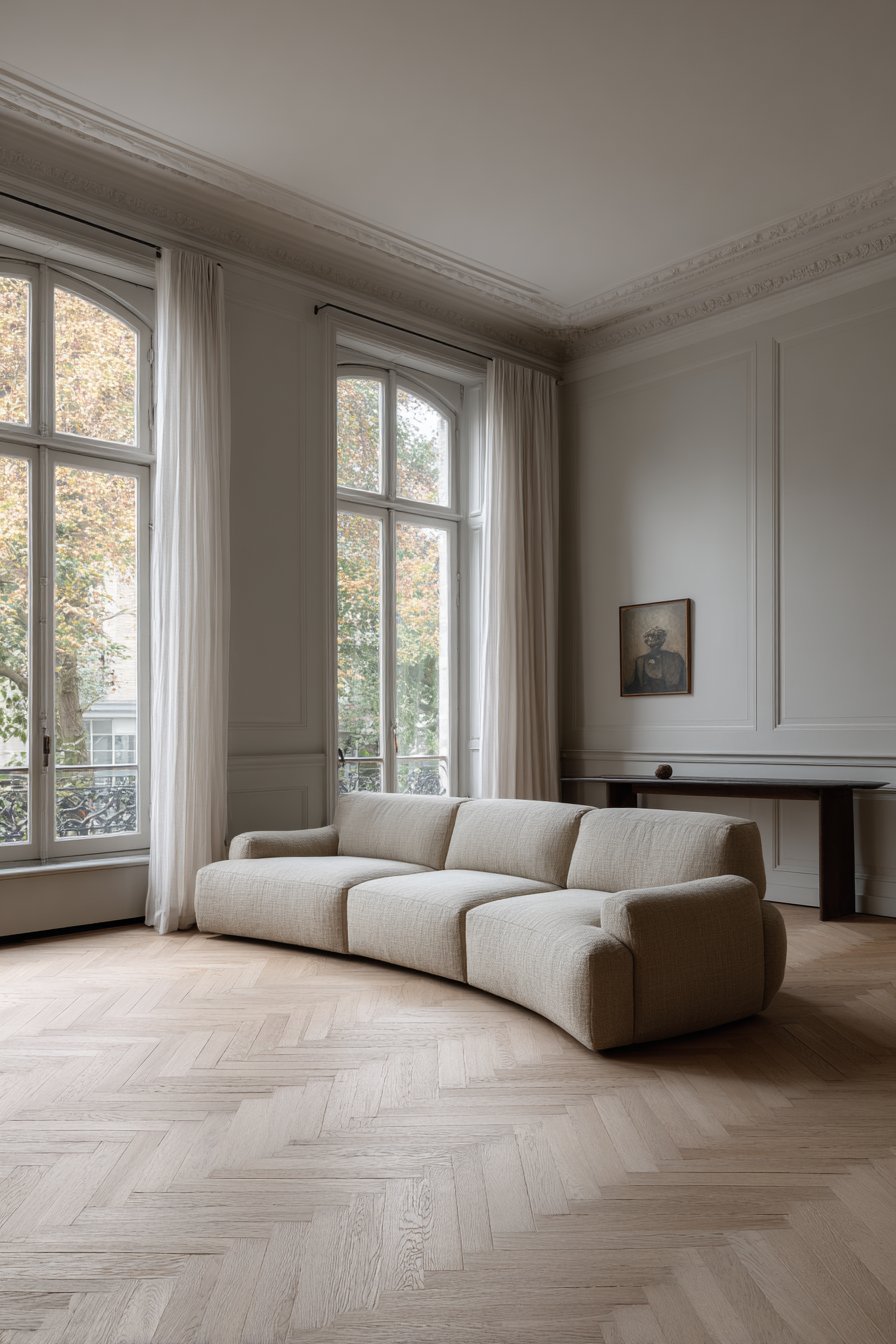
Light grey walls and sheer white curtains complete the optical illusion, working in concert with the mirror to enhance the sense of openness. Grey provides subtle sophistication without the stark brightness of pure white, while the sheer curtains filter natural light softly, creating a luminous quality that fills the space. The curtains’ transparency ensures that windows don’t become visual barriers, maintaining the connection to the outdoors and the precious natural light that makes narrow spaces feel livable.
Key Design Tips:
- Place mirrors on narrow end walls to create the illusion of width and depth, making the space feel significantly more expansive than its actual dimensions.
- Position mirrors to reflect windows or light sources, multiplying natural illumination throughout the room and creating a brighter, more cheerful environment.
- Choose sectional sofas over traditional sofa-and-chair combinations to maximize seating in minimal space, tucking the configuration efficiently into corners.
- Add console tables behind sofas to provide surface space without extending into the room’s center, creating layers of functionality.
- Use sheer window treatments that filter light without blocking it, maintaining visual connection to the outdoors and preserving the flow of natural illumination.
4. Symmetrical Seating for Balanced Proportions
Symmetry brings a sense of order and calm to narrow spaces, and this approach leverages balanced design to create a harmonious living environment. Two matching armchairs in soft grey velvet face each other across a slim rectangular coffee table crafted from reclaimed wood, establishing a formal conversation area that feels intentional and sophisticated. The symmetrical arrangement counteracts the room’s asymmetrical proportions, creating visual equilibrium that makes the space feel more balanced and less awkwardly elongated.
The grey velvet armchairs provide luxurious comfort while maintaining a relatively compact footprint. Velvet’s light-absorbing quality adds depth and richness to the space, creating tactile interest that invites touch and engagement.
The soft grey hue maintains the neutral palette while introducing subtle sophistication. These chairs prove that narrow rooms needn’t sacrifice style or comfort—with careful selection, you can have furniture that’s both beautiful and appropriately scaled.
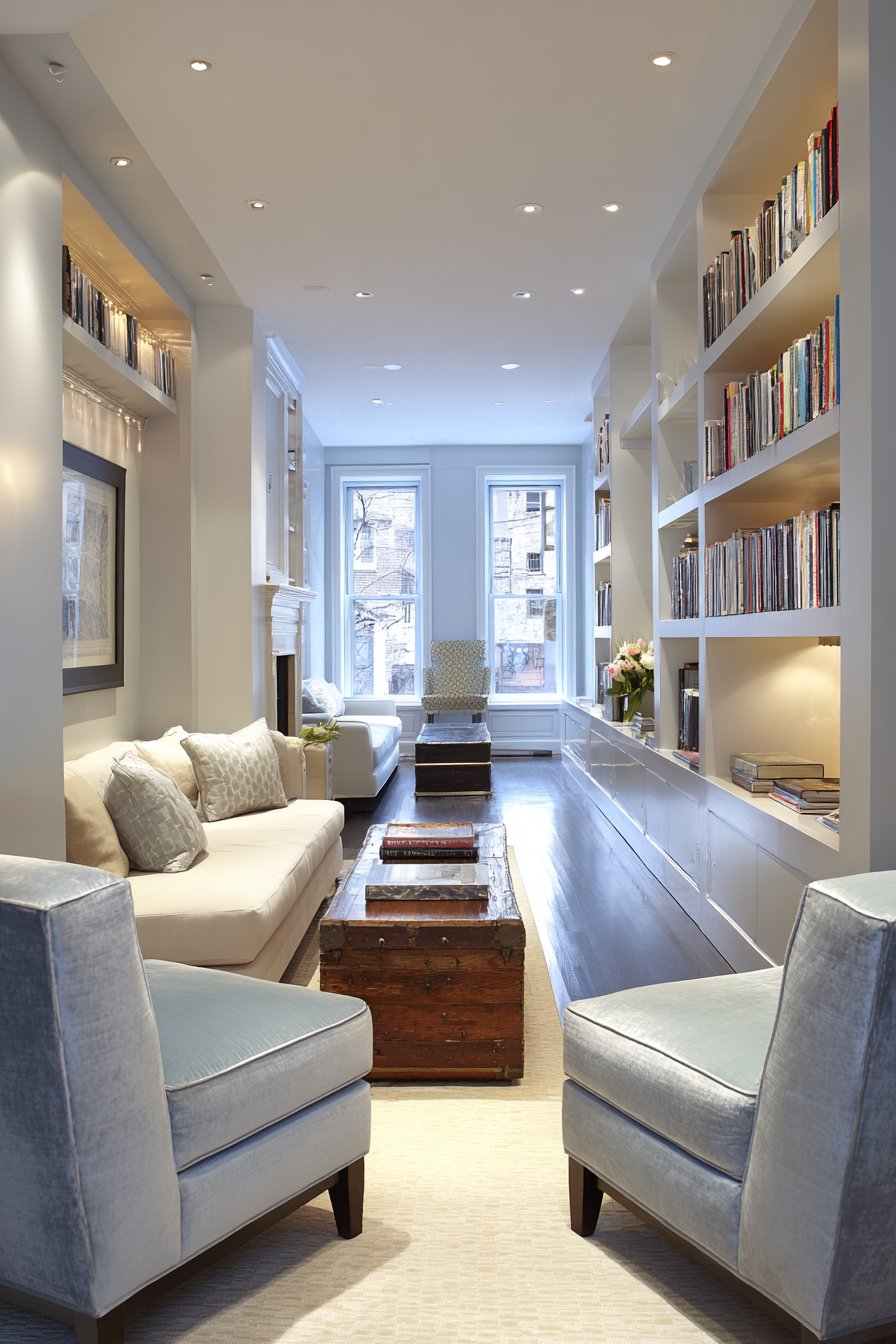
The slim rectangular coffee table serves as the anchor point between the two chairs, its reclaimed wood construction bringing organic warmth and character to the arrangement. The narrow profile ensures the table doesn’t obstruct movement between the chairs, maintaining clear walkways along both sides of the room.
Reclaimed wood tells a story, its weathered surface and unique grain patterns adding personality and history to the space. This material choice grounds the design with natural authenticity.
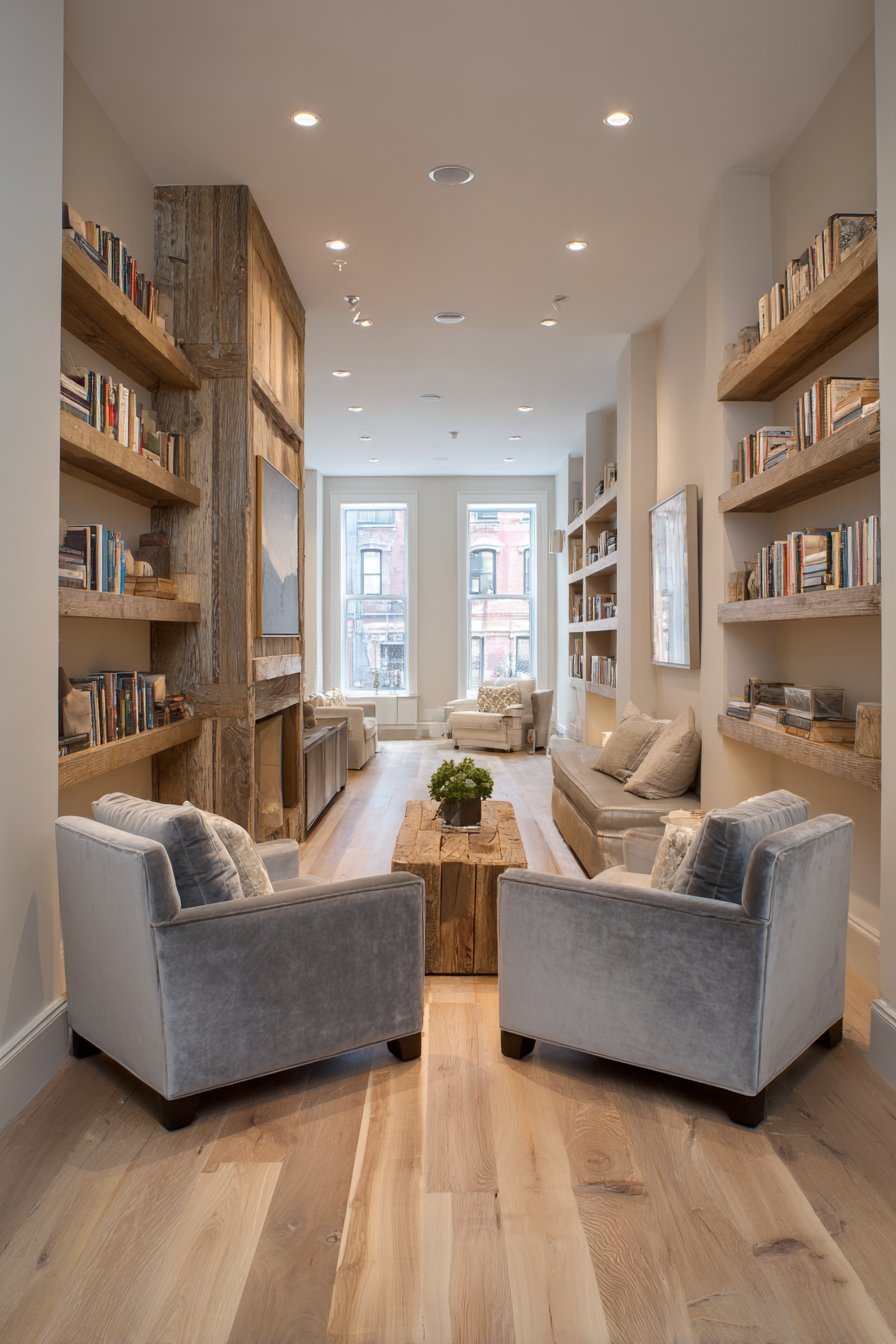
Built-in floating shelves on one long wall display books and minimal decor without protruding significantly into the room. These shelves maintain the clean lines and streamlined aesthetic while providing essential storage and display space. The floating installation creates negative space beneath, emphasizing airiness rather than bulk. Natural lighting from windows at the far end illuminates the balanced composition, drawing the eye through the length of the room and emphasizing the thoughtful spatial planning.
Key Design Tips:
- Create symmetrical furniture arrangements to establish visual balance in asymmetrical narrow spaces, making the room feel more proportionate and harmonious.
- Use matching pairs of smaller furniture pieces rather than one large sectional to create flexibility and maintain clear circulation paths along both sides.
- Select slim-profile coffee tables that provide function without obstructing movement, ensuring walkways remain unimpeded.
- Install floating shelves on long walls for storage and display that doesn’t consume floor space, keeping the visual field open.
- Position light sources at the room’s end to draw the eye through the length of the space, emphasizing depth and creating focal points that guide visual flow.
5. Multi-Functional Flexibility for Adaptable Living
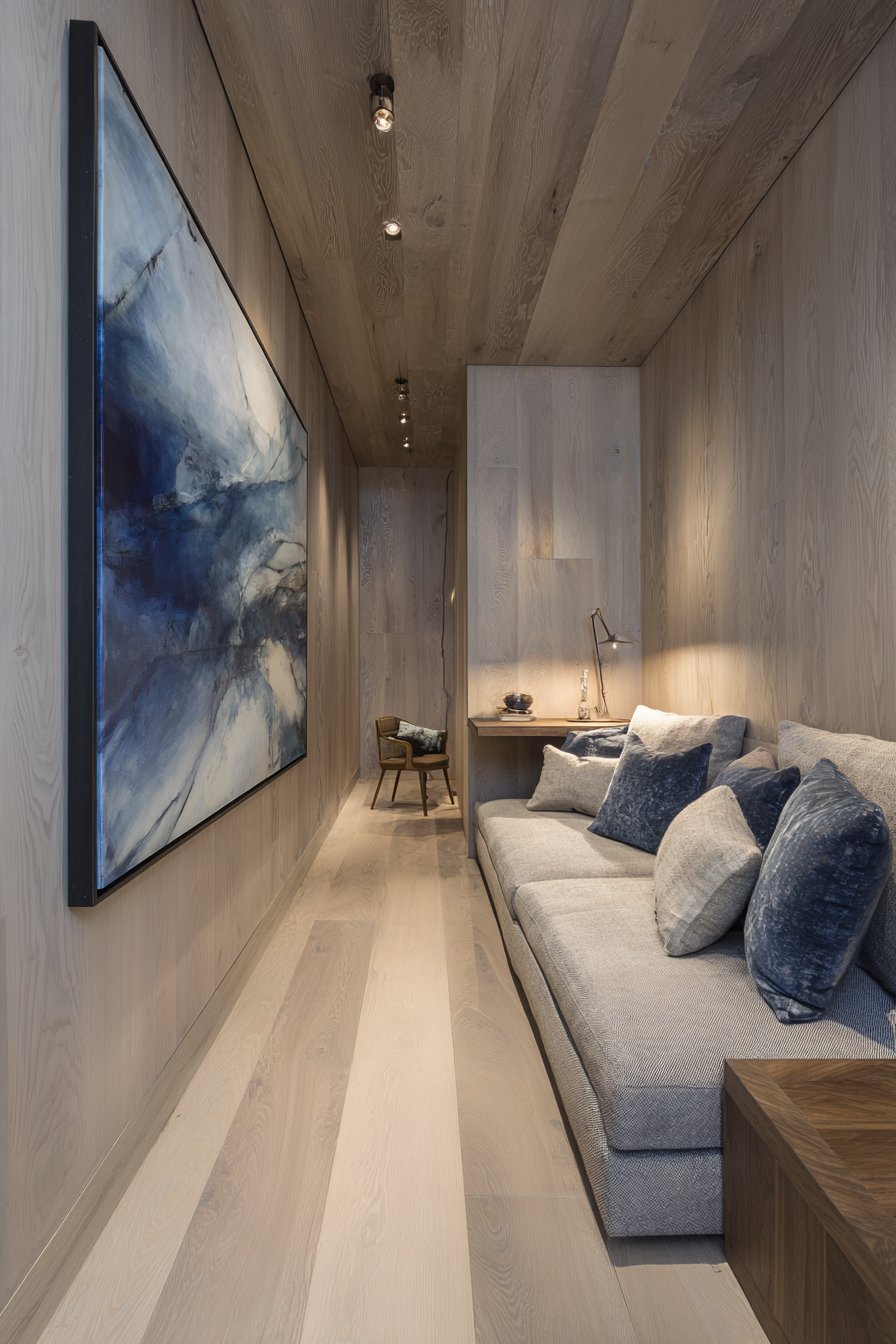
Modern living demands flexibility, and this approach embraces multi-functional furniture that adapts to changing needs without overwhelming limited space. A sleek sofa bed in charcoal grey fabric serves as the centerpiece, providing comfortable daily seating that transforms into guest sleeping accommodations when needed.
This dual functionality eliminates the need for a separate guest room, making the narrow living room work harder without requiring additional square footage. The charcoal grey color adds sophisticated depth while maintaining the neutral palette that prevents visual crowding.
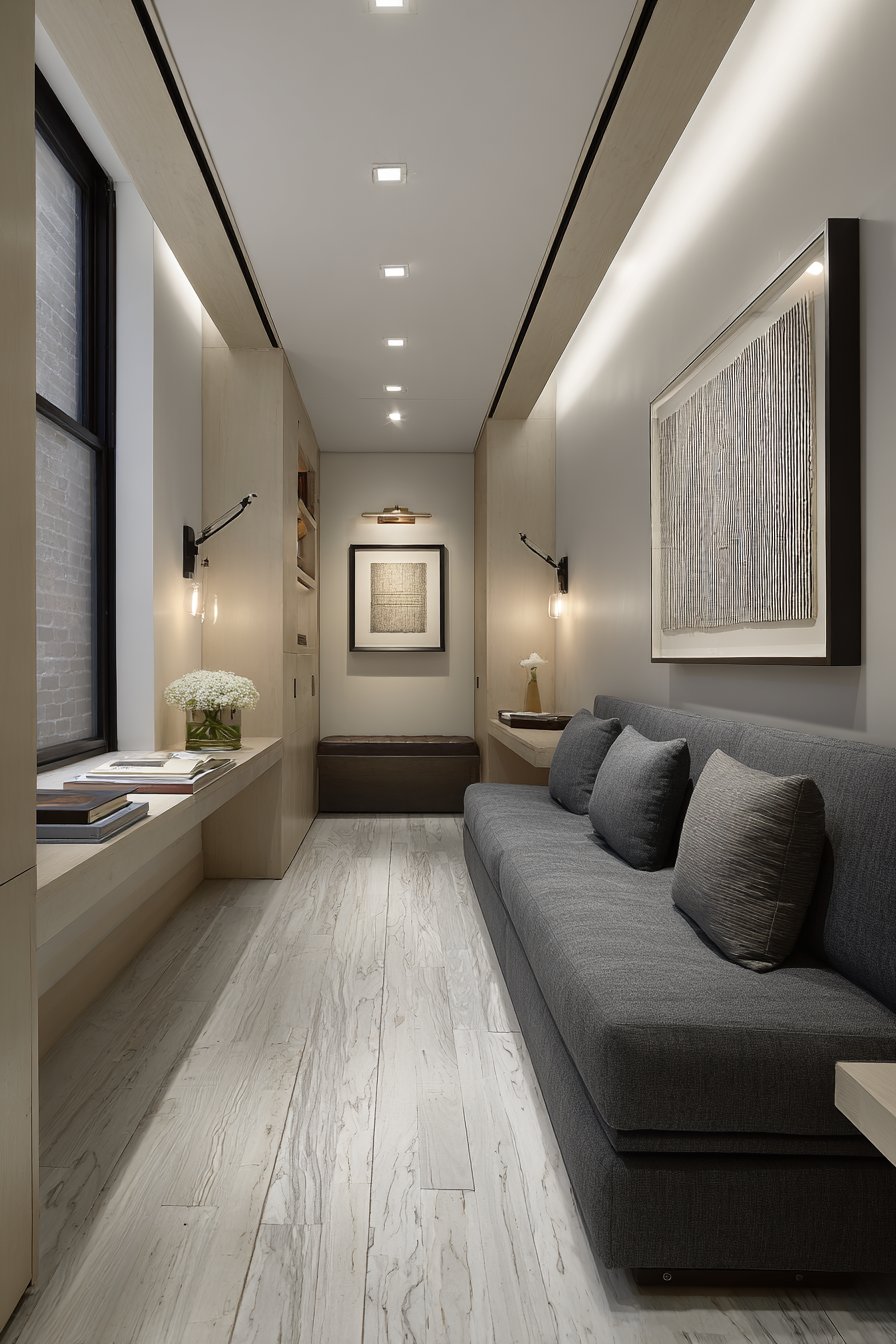
The design incorporates wall-mounted folding side tables that can be deployed when needed and folded flat against the wall when not in use. This ingenious solution provides surface space for drinks, snacks, or laptops without permanently consuming floor area.
The tables demonstrate how temporary functionality can be just as effective as permanent fixtures, especially in spaces where every inch matters. Retractable lighting fixtures continue this theme of adaptability, offering illumination that can be adjusted or hidden based on current needs.
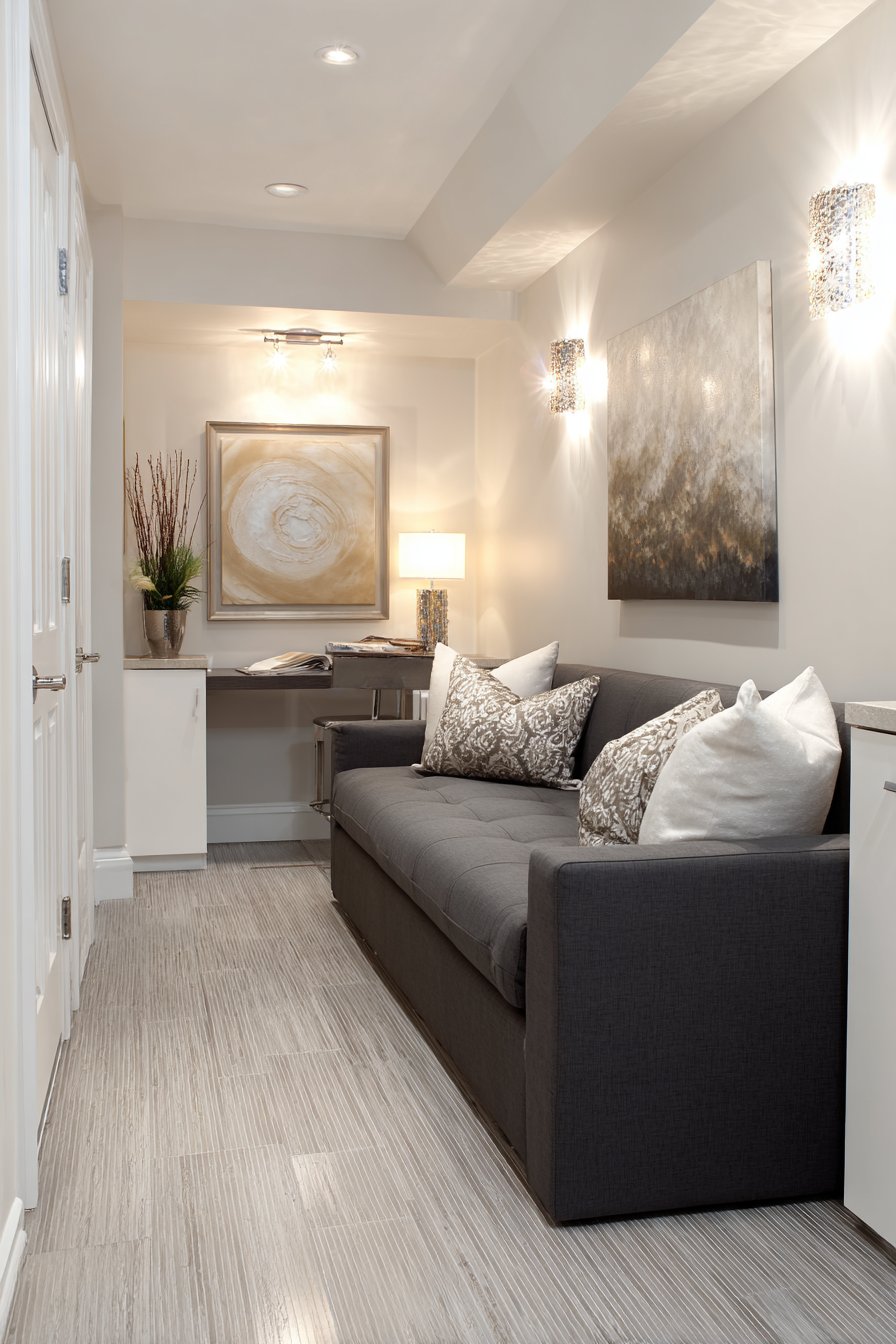
Light oak flooring with a lengthwise grain pattern visually extends the room, the natural wood tones creating warmth without visual weight. The grain direction is intentional—by running lengthwise, it emphasizes the room’s depth rather than its narrow width, guiding the eye toward the far end and creating a sense of elongation that makes the space feel more expansive. Oak’s durability ensures the floor will withstand years of use while maintaining its beauty.
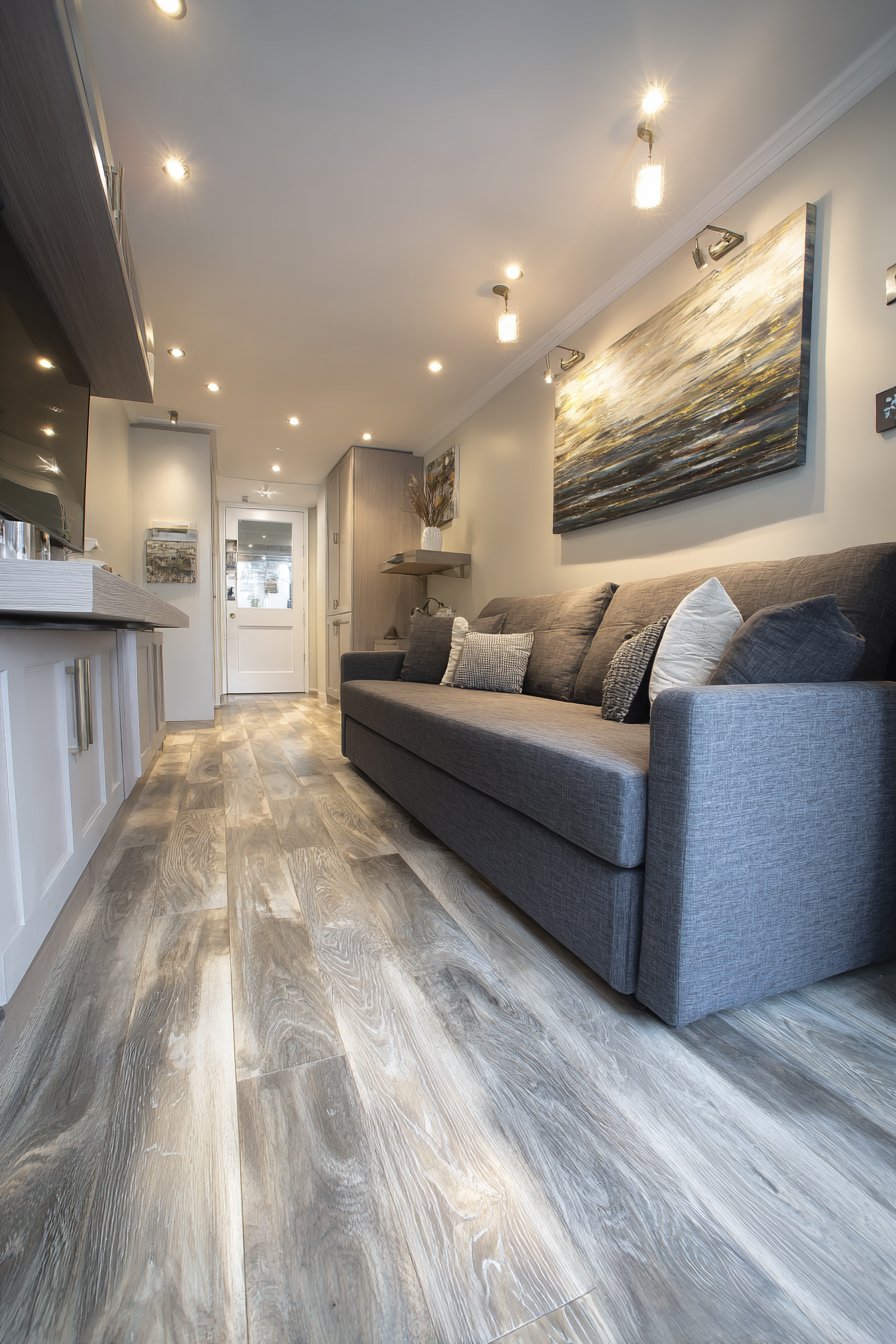
A single large abstract artwork on the narrow end wall draws the eye forward, creating a focal point that gives the gaze somewhere to land. This strategic placement prevents the room from feeling like an endless corridor by providing visual punctuation at the terminus. The artwork’s abstract nature allows for personal interpretation while introducing color and personality without cluttering the space with multiple smaller pieces.
Key Design Tips:
- Invest in multi-functional furniture like sofa beds, ottomans with storage, and extendable tables that serve multiple purposes without requiring additional pieces.
- Install wall-mounted folding elements for tables, desks, or shelving that can be deployed when needed and hidden when not, maximizing flexibility.
- Choose retractable or adjustable lighting that can be customized based on activities and needs, providing versatility in ambiance and function.
- Run wood grain lengthwise on floors and wall paneling to visually extend the space and emphasize depth over width.
- Use a single large artwork on end walls rather than multiple small pieces to create a strong focal point without visual clutter.
6. Minimalist Scandinavian Serenity
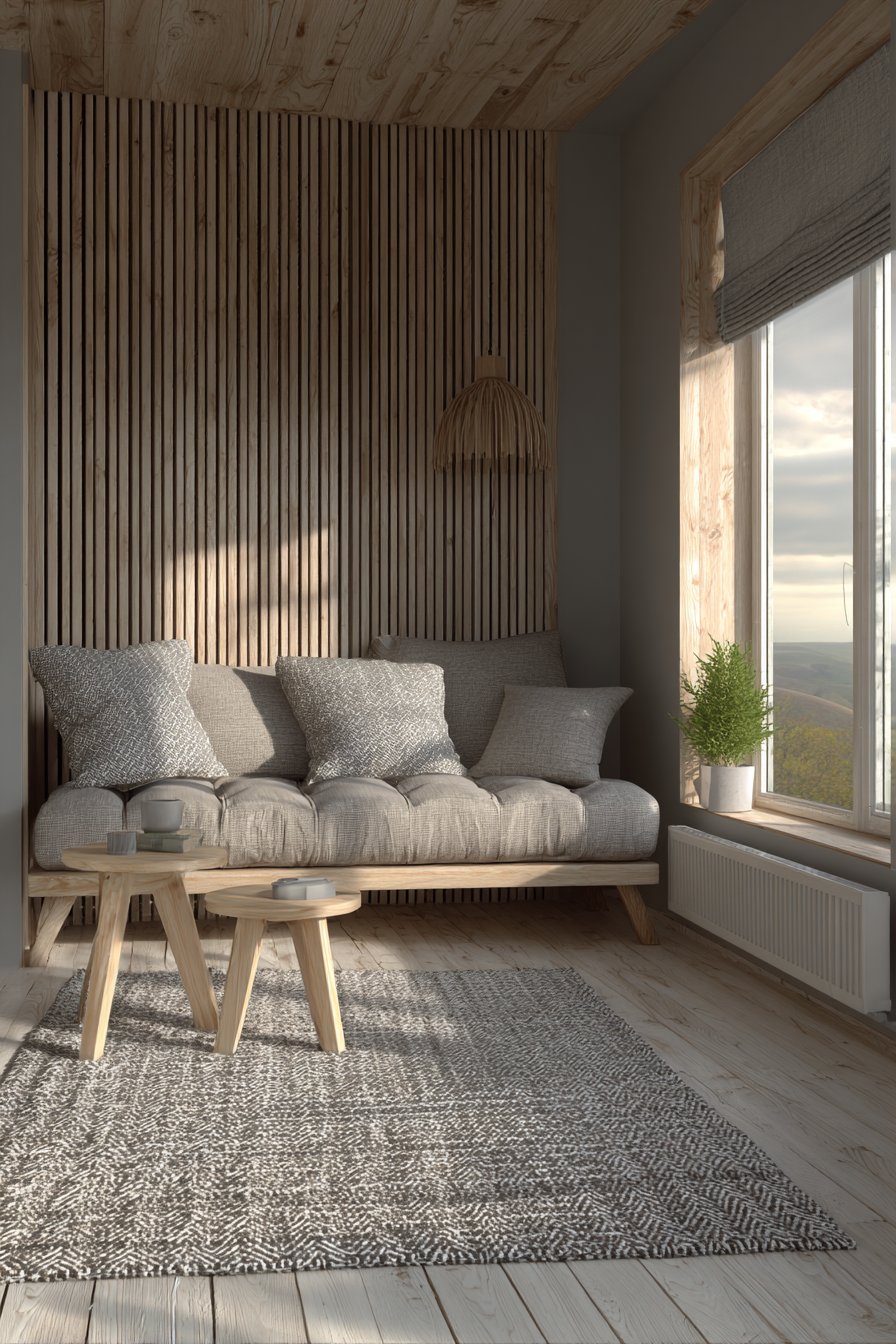
Scandinavian design principles align perfectly with narrow room challenges, emphasizing simplicity, functionality, and natural materials that create serene, uncluttered spaces. This approach features a low-profile modular sofa in natural linen positioned along one wall, its neutral color and minimal design preventing visual bulk.
The modular nature provides flexibility—sections can be rearranged or separated as needs change, adapting to different occasions and uses. Linen’s breathable, natural texture adds organic warmth without overwhelming the senses.
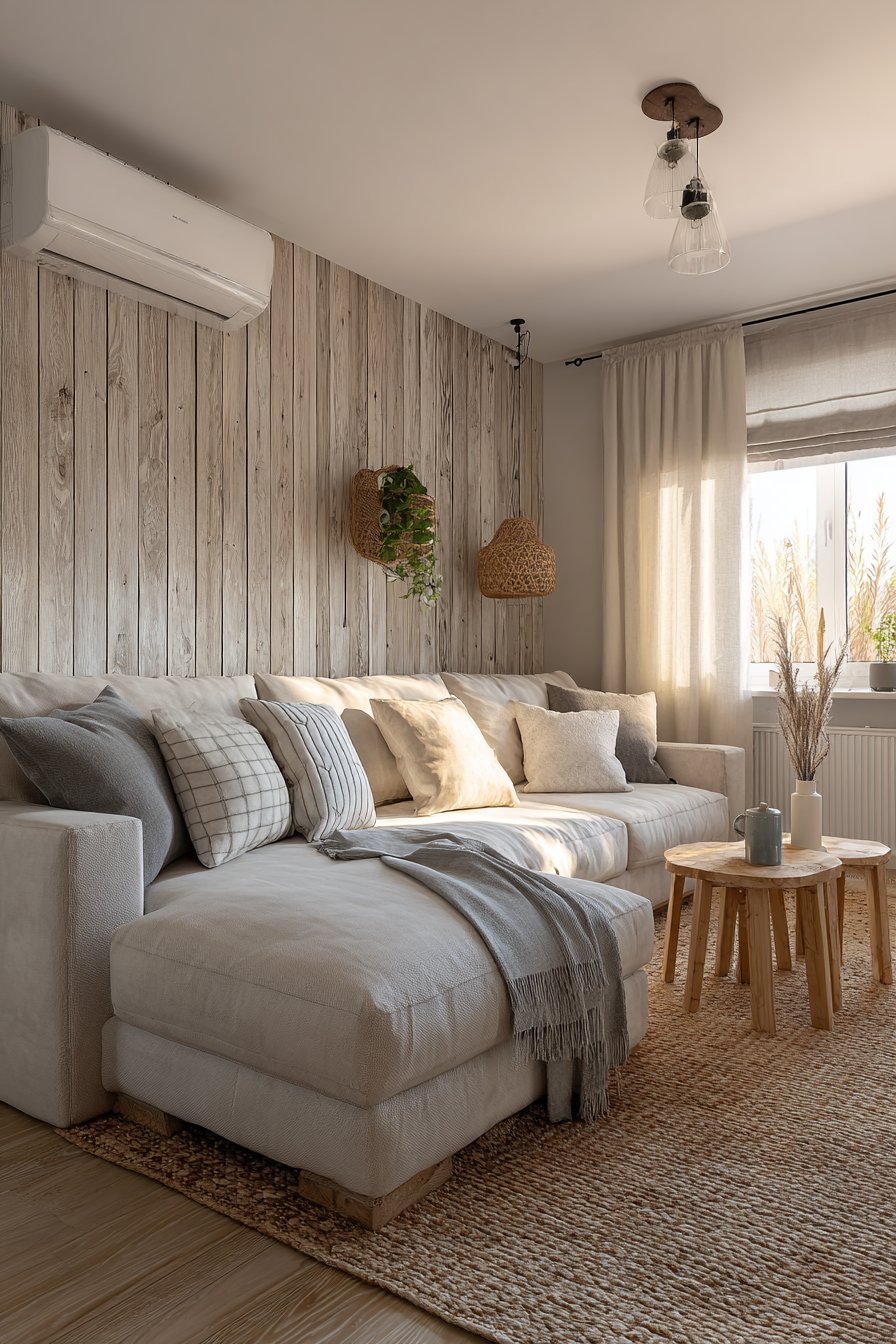
Nesting side tables in light wood exemplify the Scandinavian commitment to practical beauty. These tables can be tucked together when not needed, minimizing their footprint, or separated to provide multiple surface areas when entertaining. The light wood tone complements the linen sofa while maintaining the airy aesthetic that makes narrow spaces feel open. These pieces prove that Scandinavian minimalism isn’t about deprivation—it’s about intentionality and purpose.
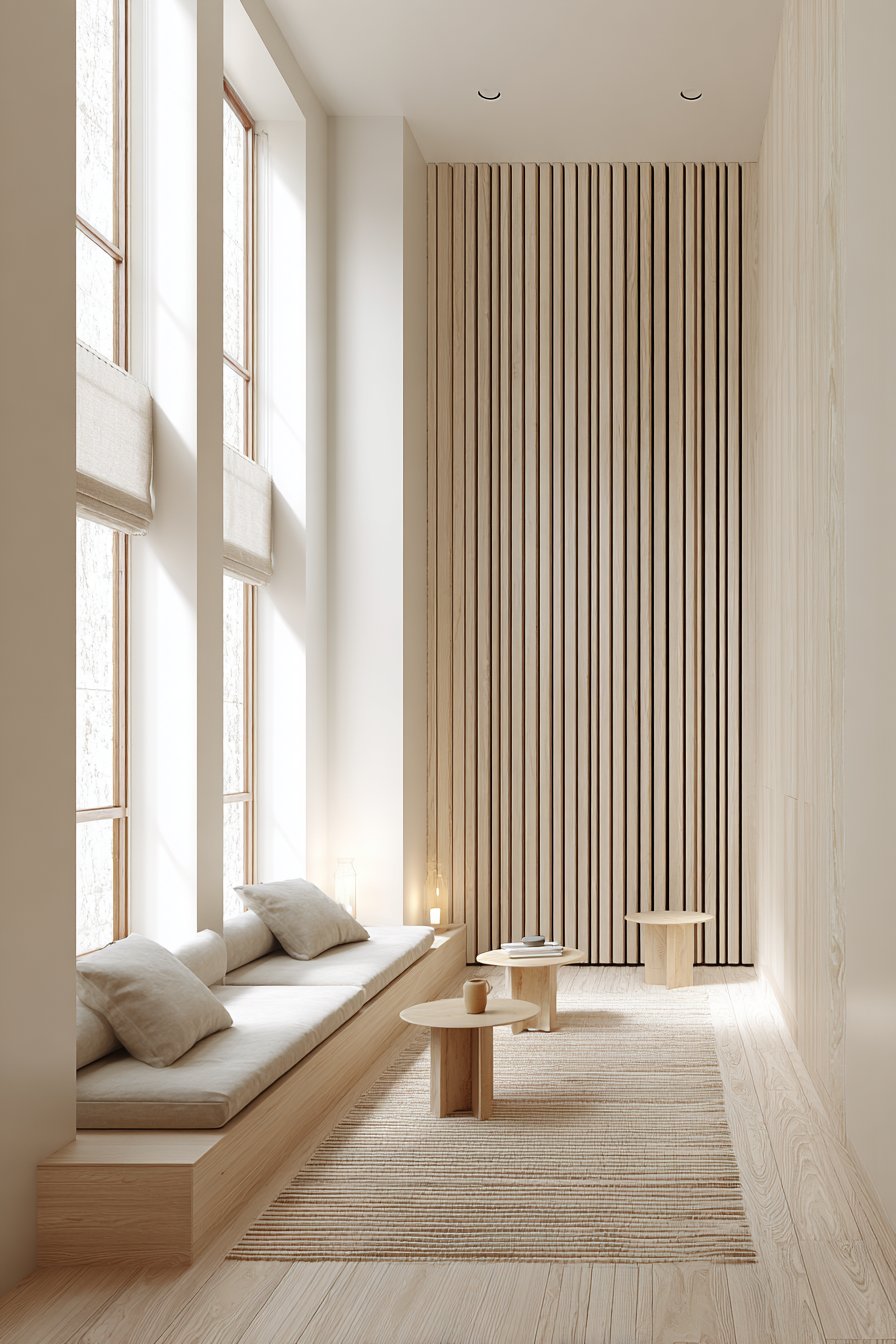
The opposite wall features vertical wood slat paneling that adds texture and visual interest while drawing the eye upward. This architectural detail creates dimension without consuming floor space, transforming a plain wall into a design feature.
The vertical orientation emphasizes ceiling height, counteracting the horizontal stretch of the narrow room. The wood slats introduce natural material beauty, connecting the interior space to the organic world beyond.
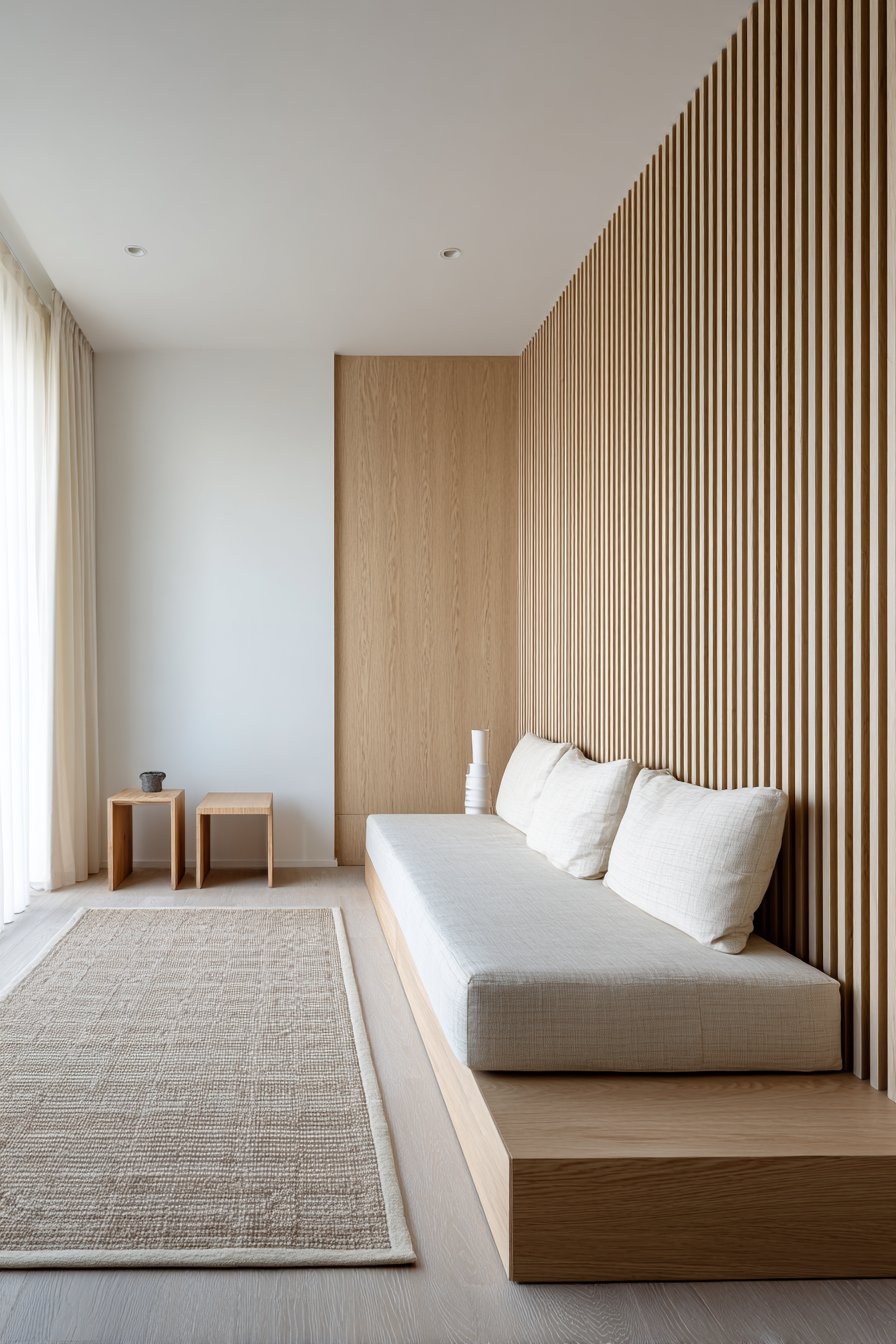
A jute area rug with subtle pattern defines the seating zone without creating visual clutter. Jute’s natural fiber texture grounds the space with earthy authenticity while maintaining the light, neutral palette. The rug’s subtle pattern provides just enough visual interest without competing for attention or making the space feel busy. Soft natural daylight filters through simple roller shades, creating even, diffused illumination that enhances the serene atmosphere.
Key Design Tips:
- Choose low-profile furniture that sits close to the ground, creating visual openness above and making ceilings appear higher relative to furnishings.
- Invest in modular seating that can be reconfigured based on needs, providing flexibility without requiring multiple furniture sets.
- Use nesting tables that stack together when not needed, minimizing footprint while maximizing functionality when expanded.
- Install vertical paneling on walls to add texture and architectural interest without consuming floor space, drawing eyes upward to emphasize height.
- Select natural fiber rugs in light tones that define zones without creating visual weight or making the narrow space feel constricted.
7. Integrated Storage Wall for Streamlined Living
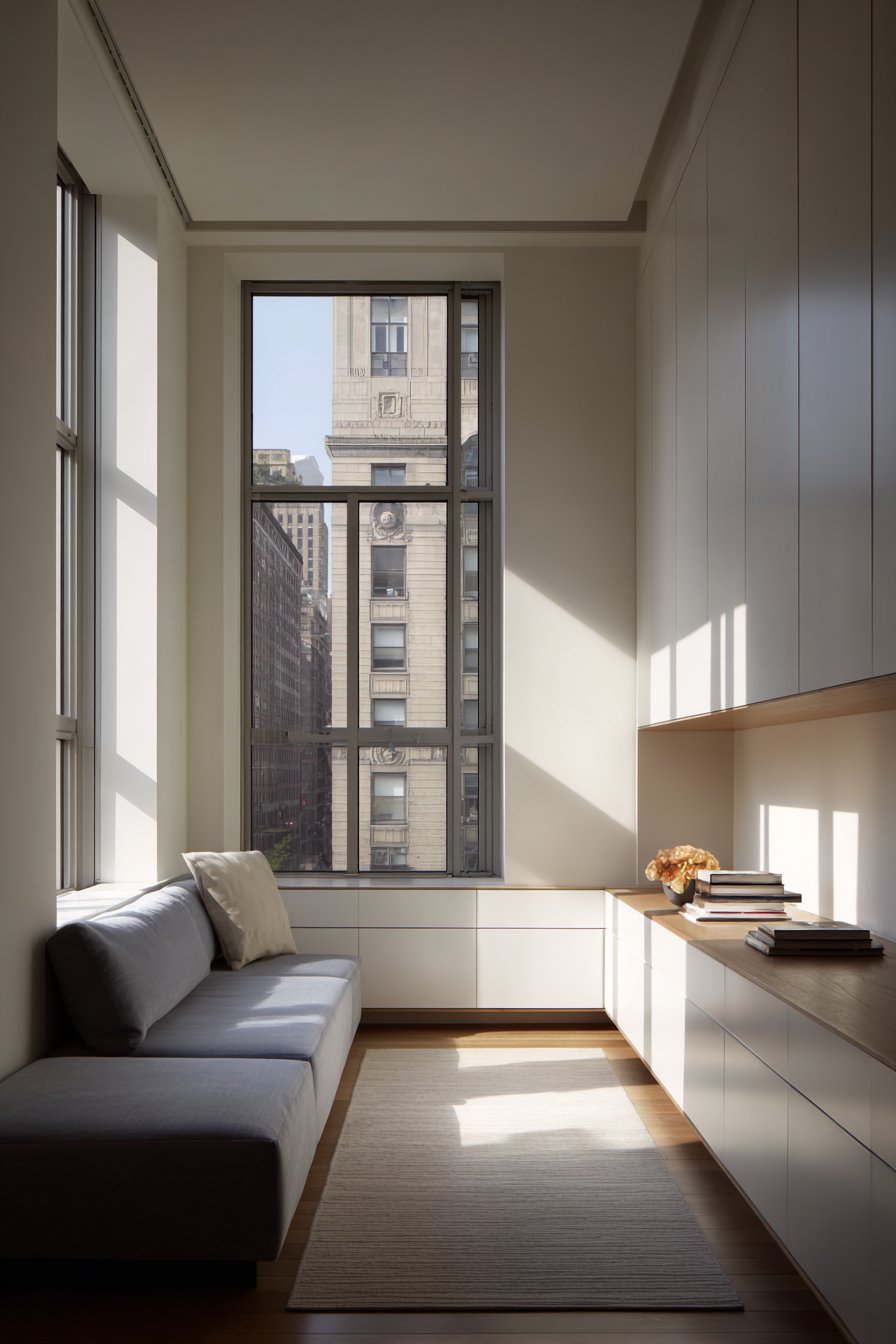
Custom built-in solutions offer the most efficient use of narrow spaces, and this approach demonstrates how a floating media wall can transform storage from a challenge into a design feature. The floor-to-ceiling integrated storage in matte white finish spans one long wall, creating a streamlined focal point that provides abundant storage without protruding significantly into the room. The matte finish diffuses light softly, preventing the stark glare that glossy surfaces might create while maintaining the clean, contemporary aesthetic.
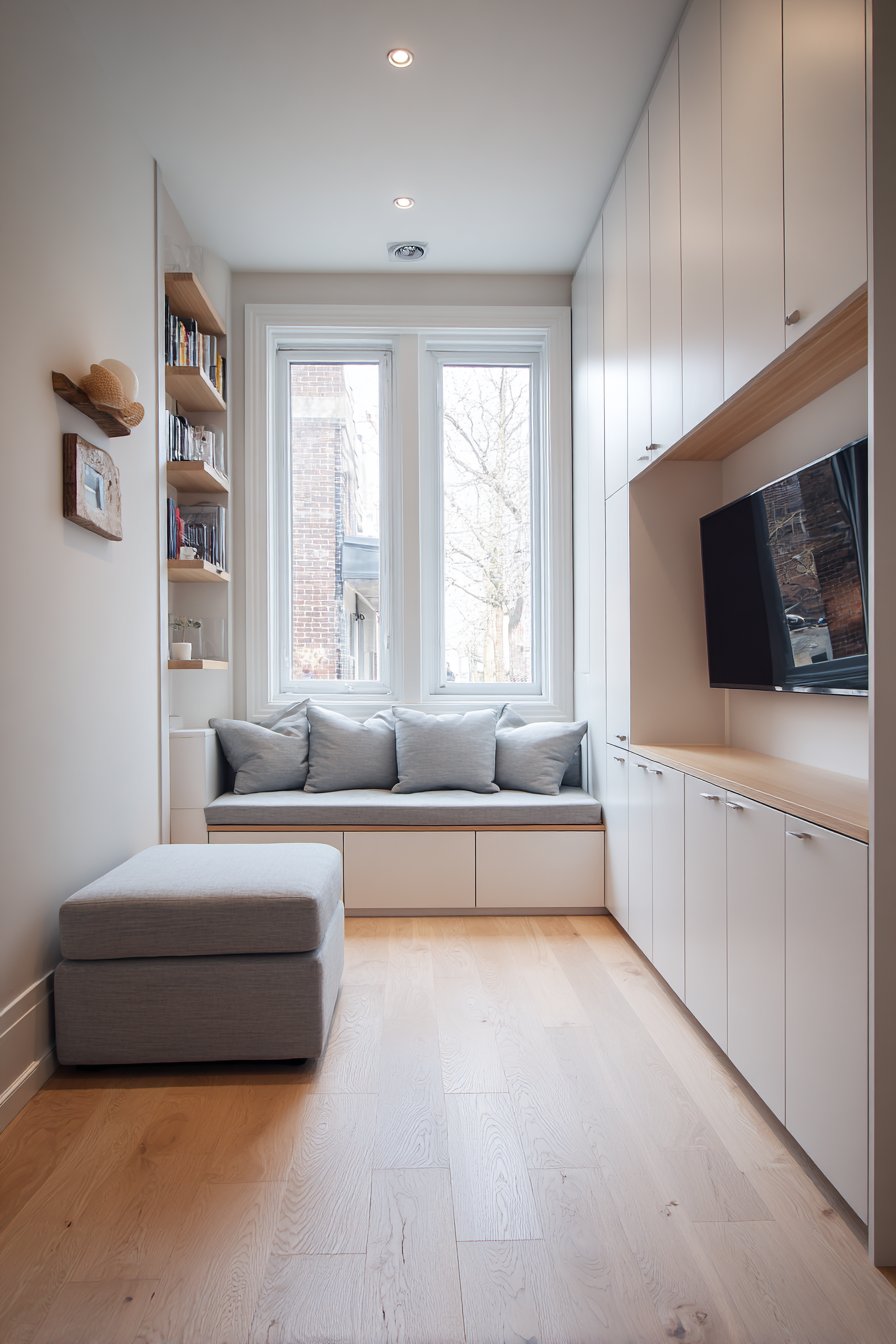
This wall system houses entertainment components, books, decorative objects, and everyday items behind closed doors and on open shelves, eliminating the need for freestanding storage furniture. The integrated nature means everything has its place, contributing to the uncluttered appearance that narrow rooms desperately need. The white color ensures the storage wall recedes visually rather than dominating the space, creating a neutral backdrop against which other design elements can shine.
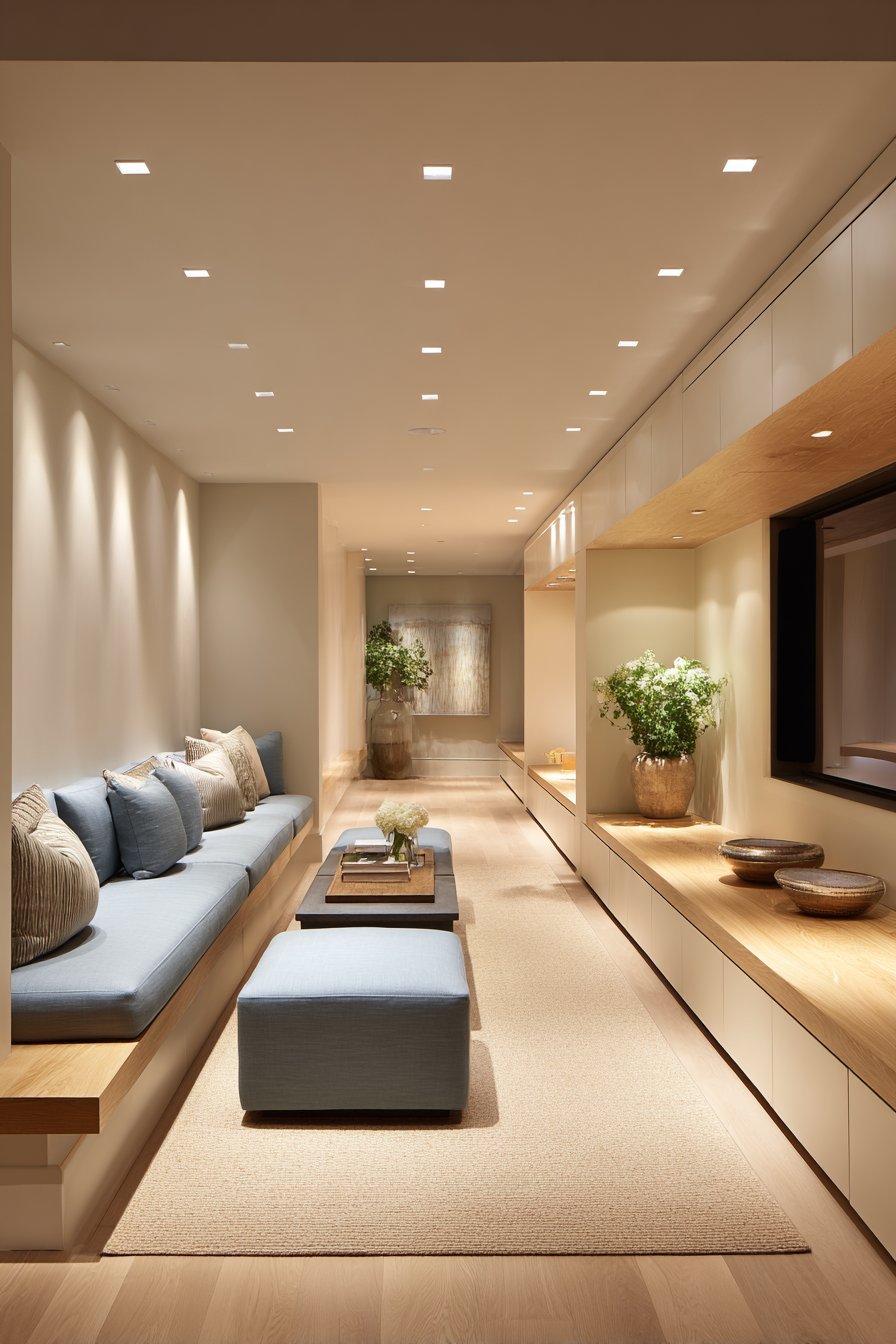
A narrow loveseat in dusty blue fabric faces the entertainment area, its compact scale perfectly suited to the room’s proportions. The dusty blue introduces subtle color without overwhelming the neutral scheme, adding personality and warmth. The loveseat’s narrowness ensures ample circulation space remains around it, preventing the bottleneck effect that oversized furniture creates in tight quarters. A slim ottoman doubles as extra seating and a footrest, exemplifying the dual-purpose approach that narrow rooms require.
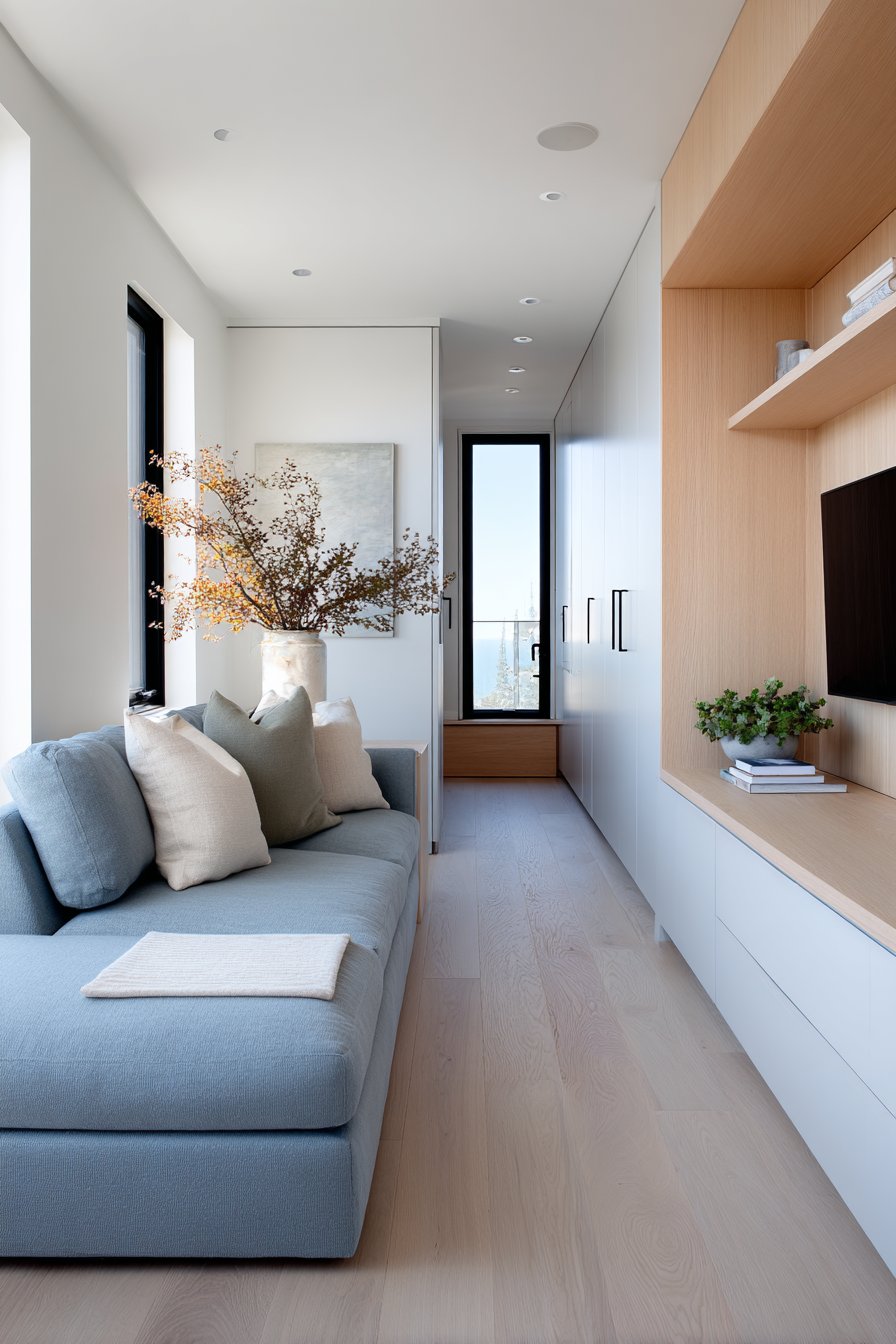
The color scheme features soft neutrals with natural wood accents, creating visual continuity throughout the space. Wood tones warm the predominantly white palette, preventing the sterility that all-white rooms can sometimes exhibit. Recessed lighting provides even illumination without consuming headspace or requiring floor lamps that would clutter the limited surface area. The lighting washes the walls evenly, eliminating shadows that might make the narrow space feel more confined.
Key Design Tips:
- Commission custom built-in storage along long walls to maximize storage capacity while maintaining a streamlined appearance that doesn’t protrude into the room.
- Choose floor-to-ceiling cabinetry to utilize vertical space fully, providing abundant storage without requiring additional floor area.
- Select matte finishes for large surfaces to diffuse light softly and prevent glare that can be overwhelming in narrow spaces.
- Introduce subtle color through compact upholstered pieces rather than overwhelming the space with bold hues on walls or large furniture.
- Install recessed lighting to provide illumination without consuming headroom or requiring floor space for lamps, maintaining clean sight lines.
8. Dynamic Angled Arrangement for Visual Interest
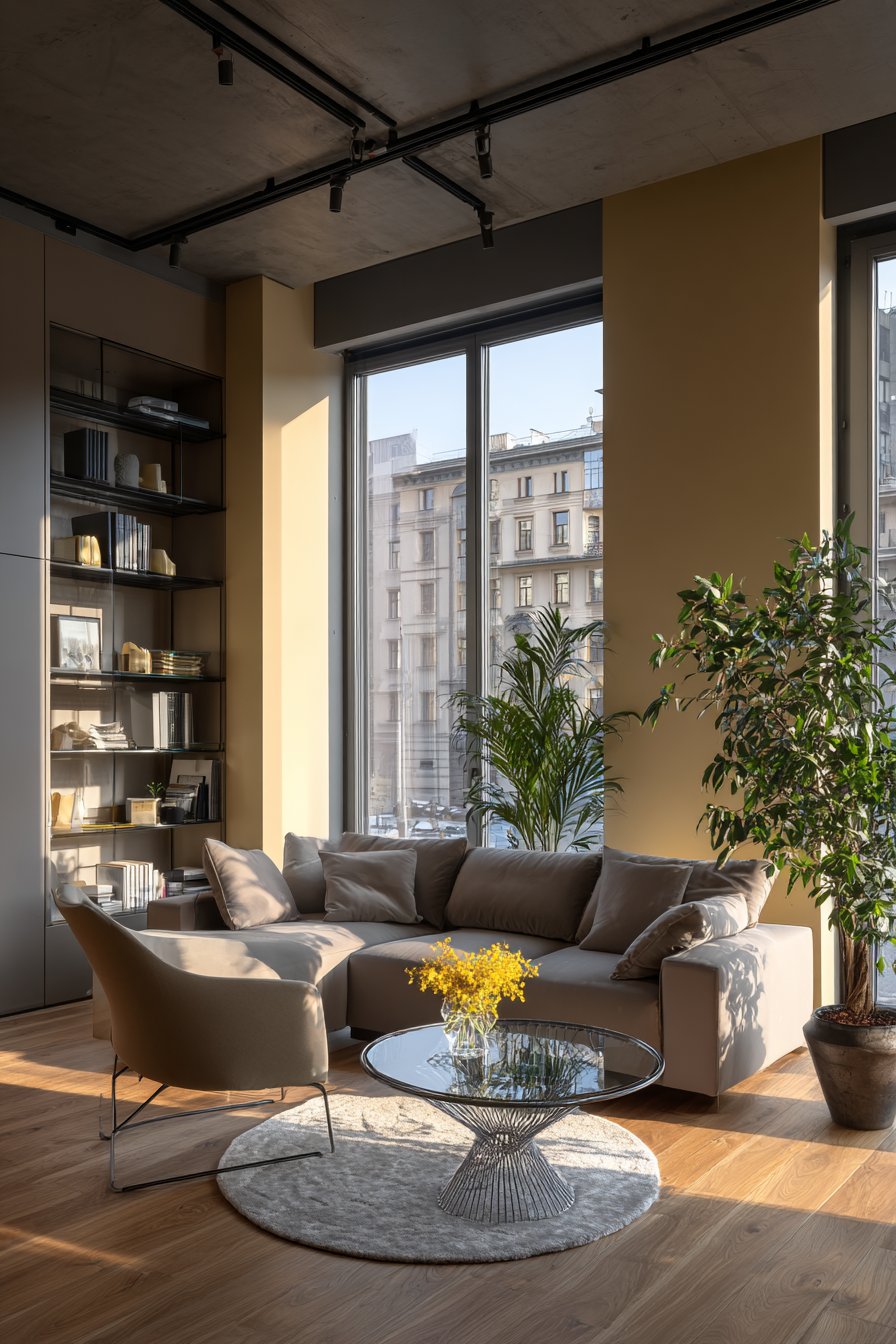
Breaking free from parallel wall constraints can inject energy and flow into narrow spaces, and this approach demonstrates how angled furniture placement creates dynamic movement. A contemporary sofa in warm taupe is positioned slightly diagonal, its unconventional orientation disrupting the expected parallel arrangement and creating visual interest. This angled placement makes the room feel less like a corridor and more like a curated space where design choices were made intentionally rather than dictated by architectural limitations.
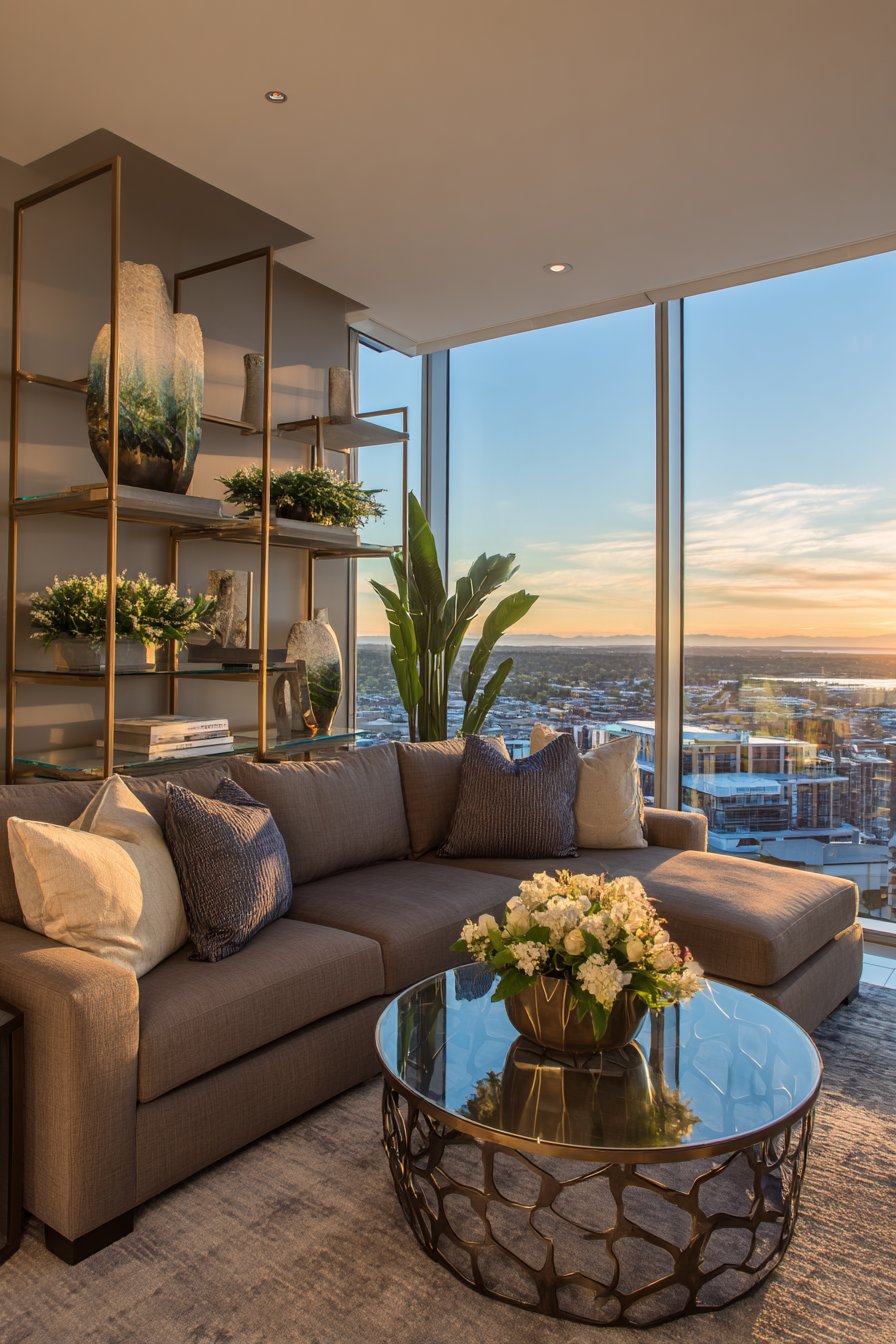
The diagonal sofa creates triangular negative spaces in the corners, which can be utilized for circulation or for placing smaller elements like plants or floor lamps. This arrangement proves that furniture doesn’t always need to hug walls—sometimes floating pieces away from walls creates better flow and more interesting spatial relationships. The warm taupe color brings coziness and sophistication, a earthy neutral that feels grounded and inviting.
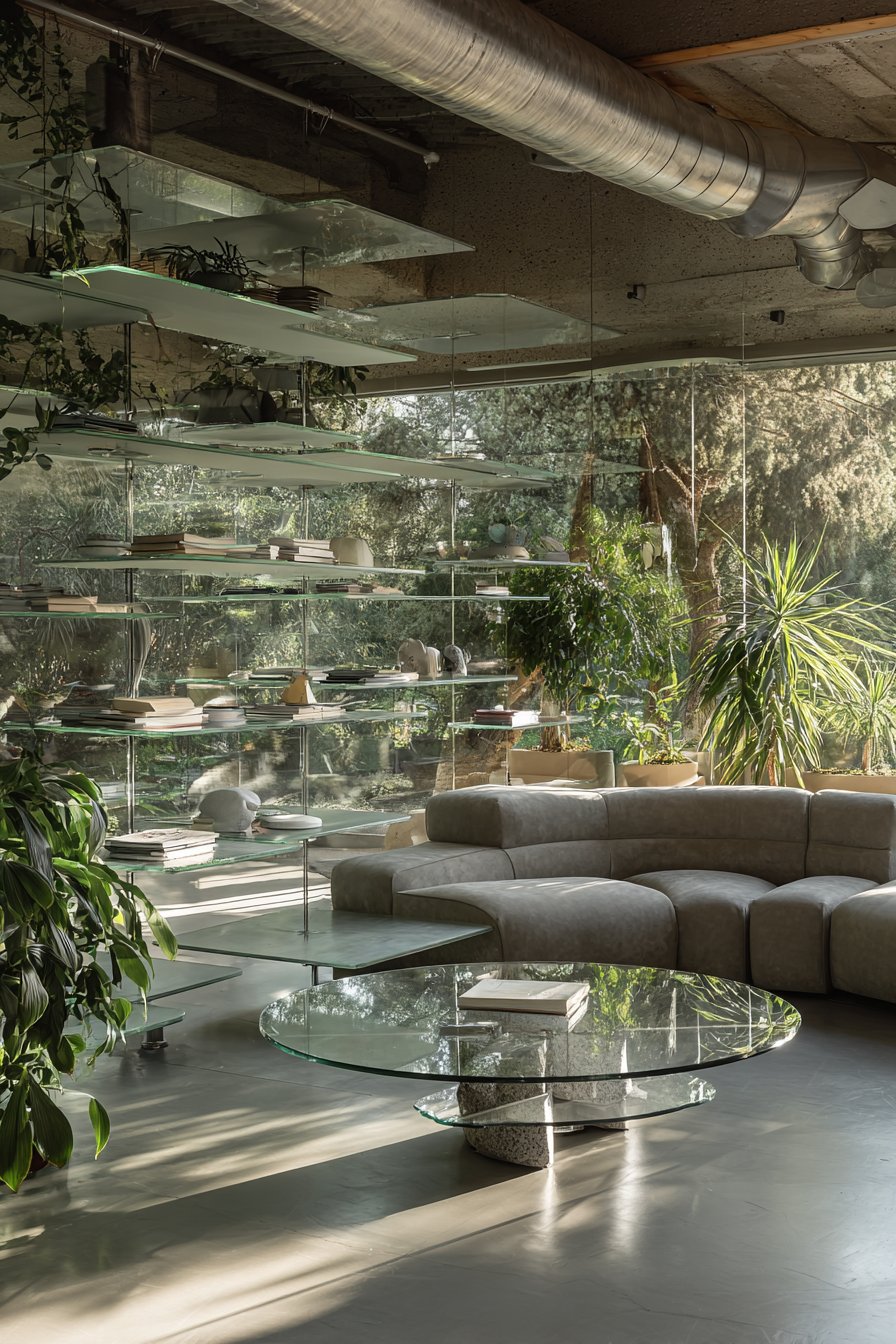
A round glass-top coffee table with a sculptural metal base provides function without sharp corners that could impede movement in the already narrow space. The round shape promotes better traffic flow, allowing people to move around it from any direction without navigating sharp edges.
The sculptural base transforms a functional piece into an art object, adding visual interest at eye level. The glass top maintains transparency, ensuring the sculptural base remains visible while providing a practical surface.
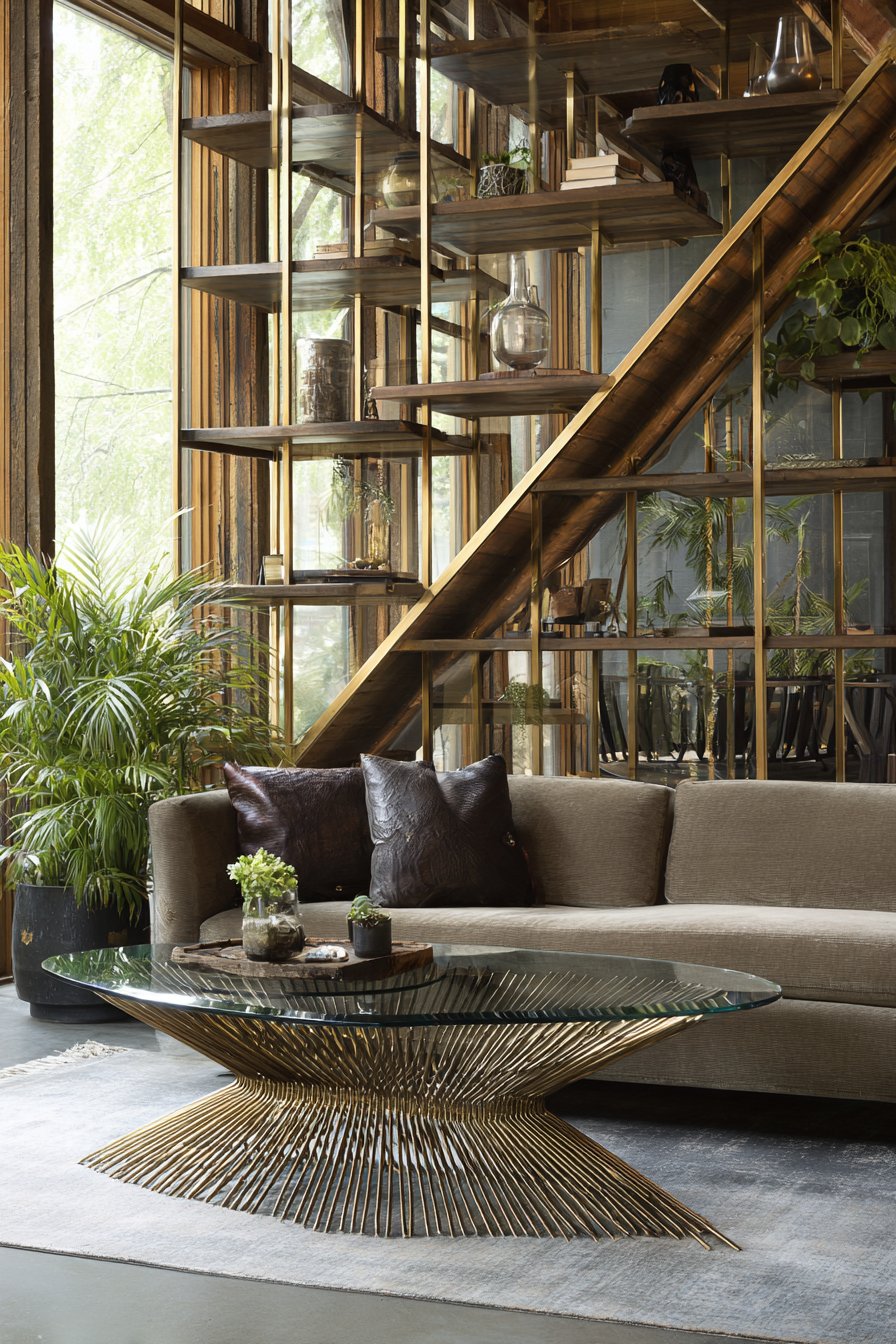
One wall features open shelving with varied depths, creating visual rhythm through dimensional variation. Different depth shelves accommodate objects of varying sizes while creating shadow patterns that add depth and interest to what might otherwise be a flat wall. Large potted plants in corners soften the linear space, introducing organic shapes that contrast with the room’s architectural rigidity. Natural golden hour lighting streams through windows, creating warm ambiance that makes the narrow space feel intimate rather than confined.
Key Design Tips:
- Position furniture at slight angles to break up the parallel monotony of narrow rooms, creating dynamic flow and unexpected visual interest.
- Choose round coffee tables to promote better traffic flow and eliminate sharp corners that can be hazardous in tight spaces.
- Install varied-depth shelving to create dimensional interest and accommodate objects of different sizes without uniform flatness.
- Place large plants in corners to soften hard architectural lines and introduce organic shapes that humanize the space.
- Maximize natural light by keeping windows unobstructed, allowing sunlight to create warmth and diminish the tunnel-like feeling of narrow proportions.
9. Zone-Based Design for Activity Separation
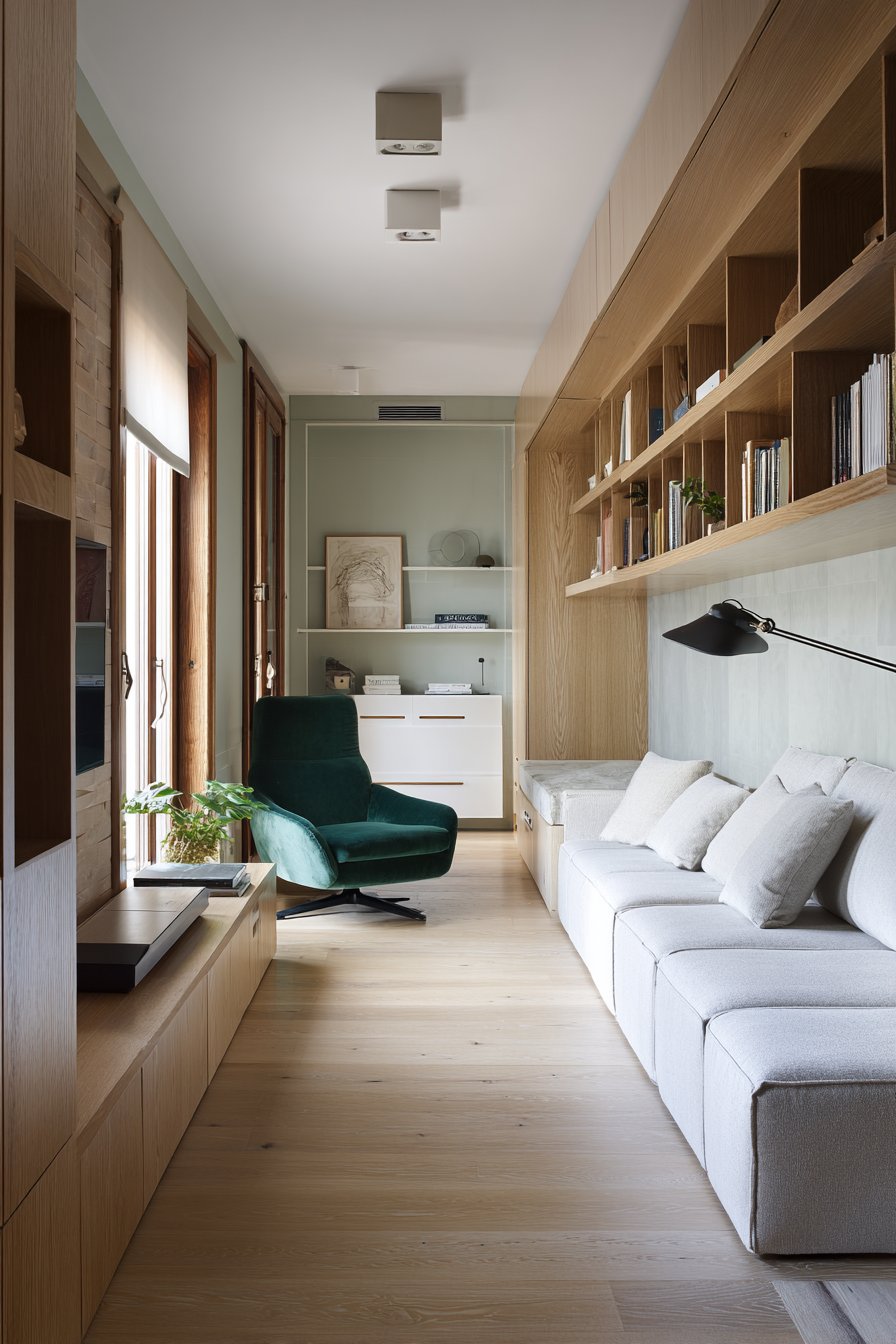
When narrow rooms stretch particularly long, creating distinct zones for different activities can make the space more functional and visually interesting. This approach divides the room into separate areas despite the limited width, demonstrating that narrow spaces can accommodate multiple functions with thoughtful planning. The front section includes a compact reading nook with a single accent chair in forest green velvet beside a slim floor lamp and floating wall shelf, creating an intimate retreat for quiet activities.
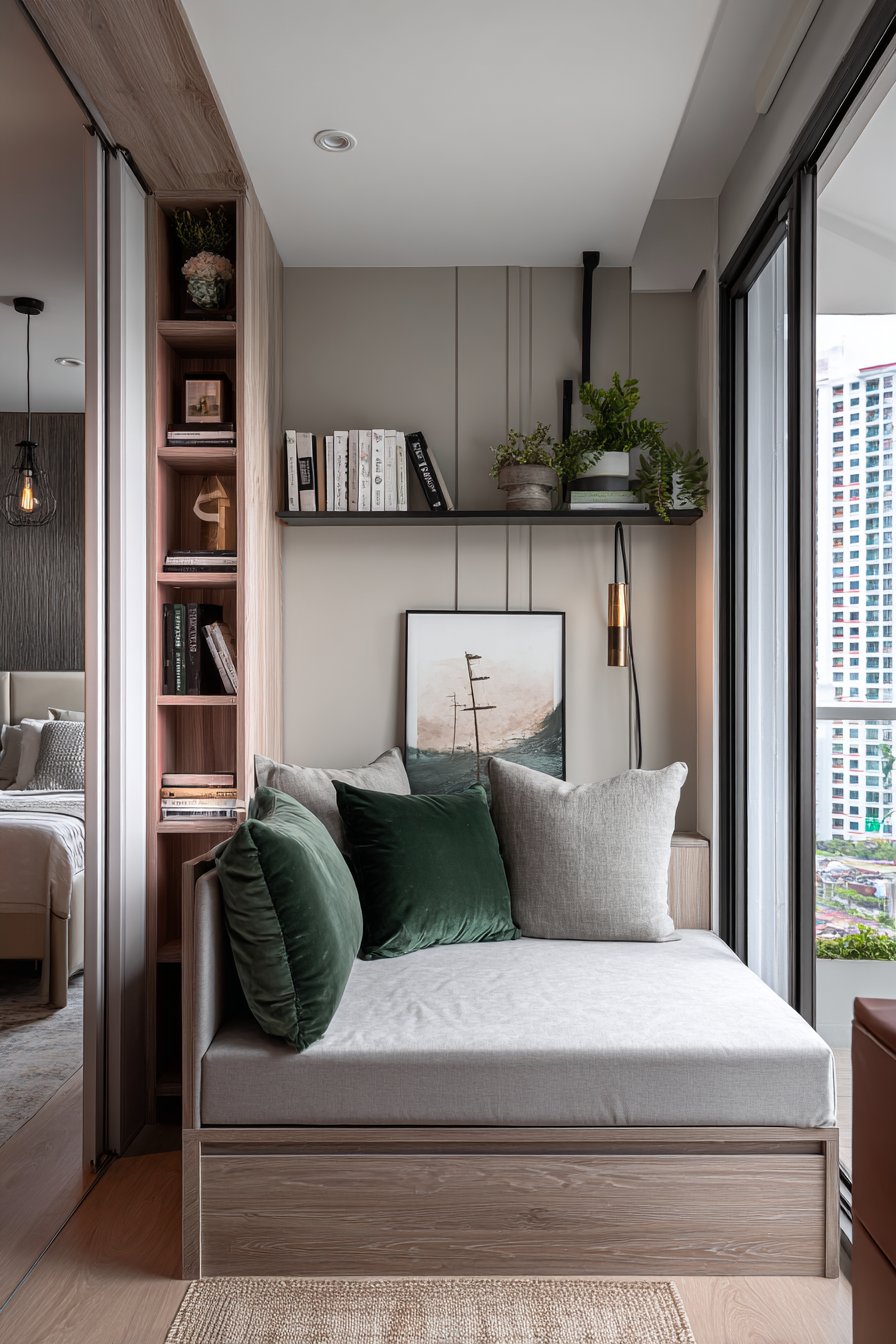
The forest green accent chair introduces bold color in a controlled way—one statement piece rather than an overwhelming application of hue throughout the space. Velvet’s luxurious texture invites lingering, making the reading nook feel special and intentional.
The slim floor lamp provides task lighting without consuming surface space, its vertical profile adding height without width. The floating wall shelf holds books within arm’s reach, eliminating the need for a bulky bookcase that would crowd the narrow zone.
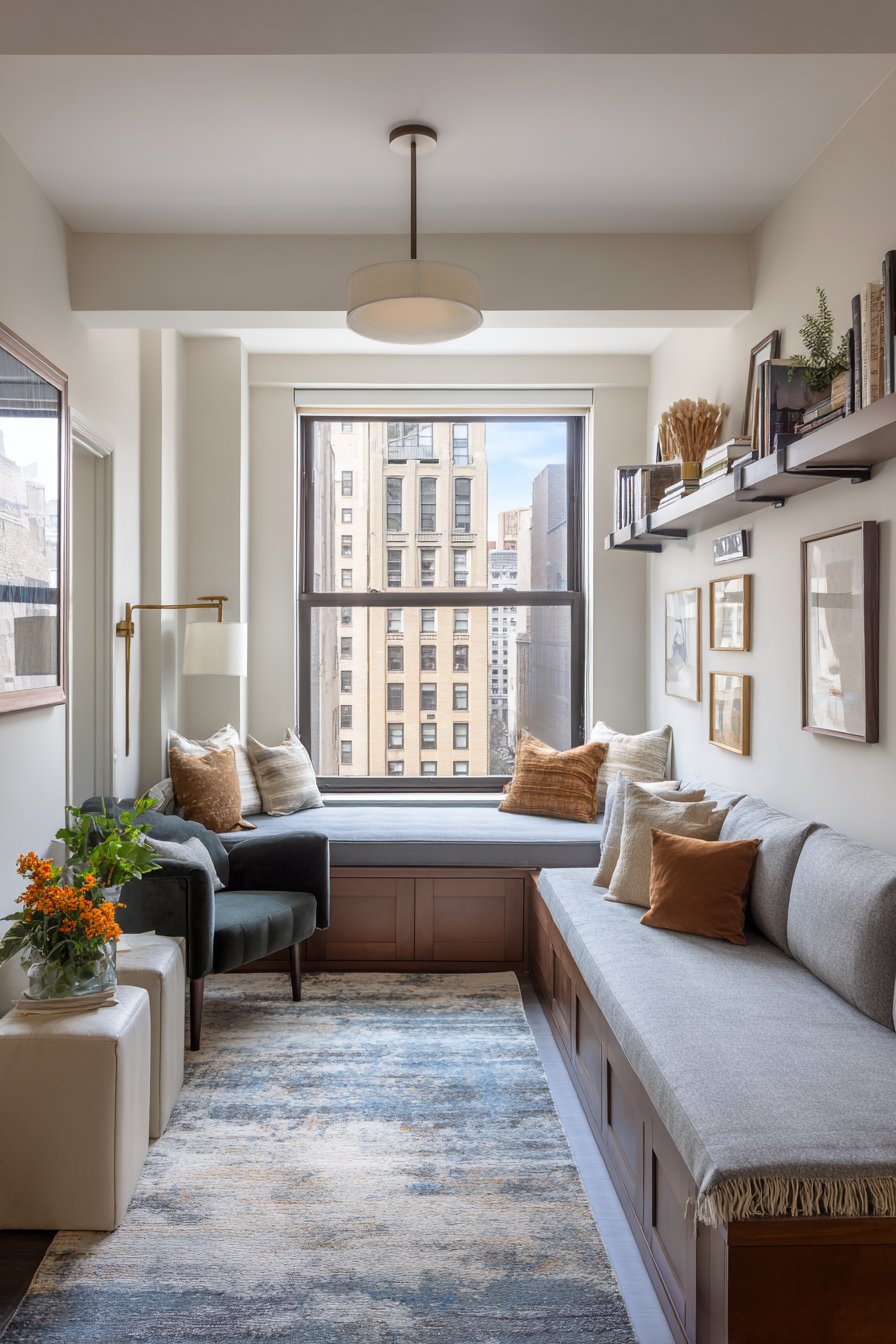
The rear section contains a streamlined sofa in light grey with built-in storage underneath, maximizing functionality in the primary seating area. The under-sofa storage provides a home for items that might otherwise require additional furniture, keeping the space uncluttered.
The light grey maintains the neutral palette while complementing the forest green accent from the reading zone. This zoning approach creates visual journey through the room, with each area offering its own character while contributing to the cohesive whole.
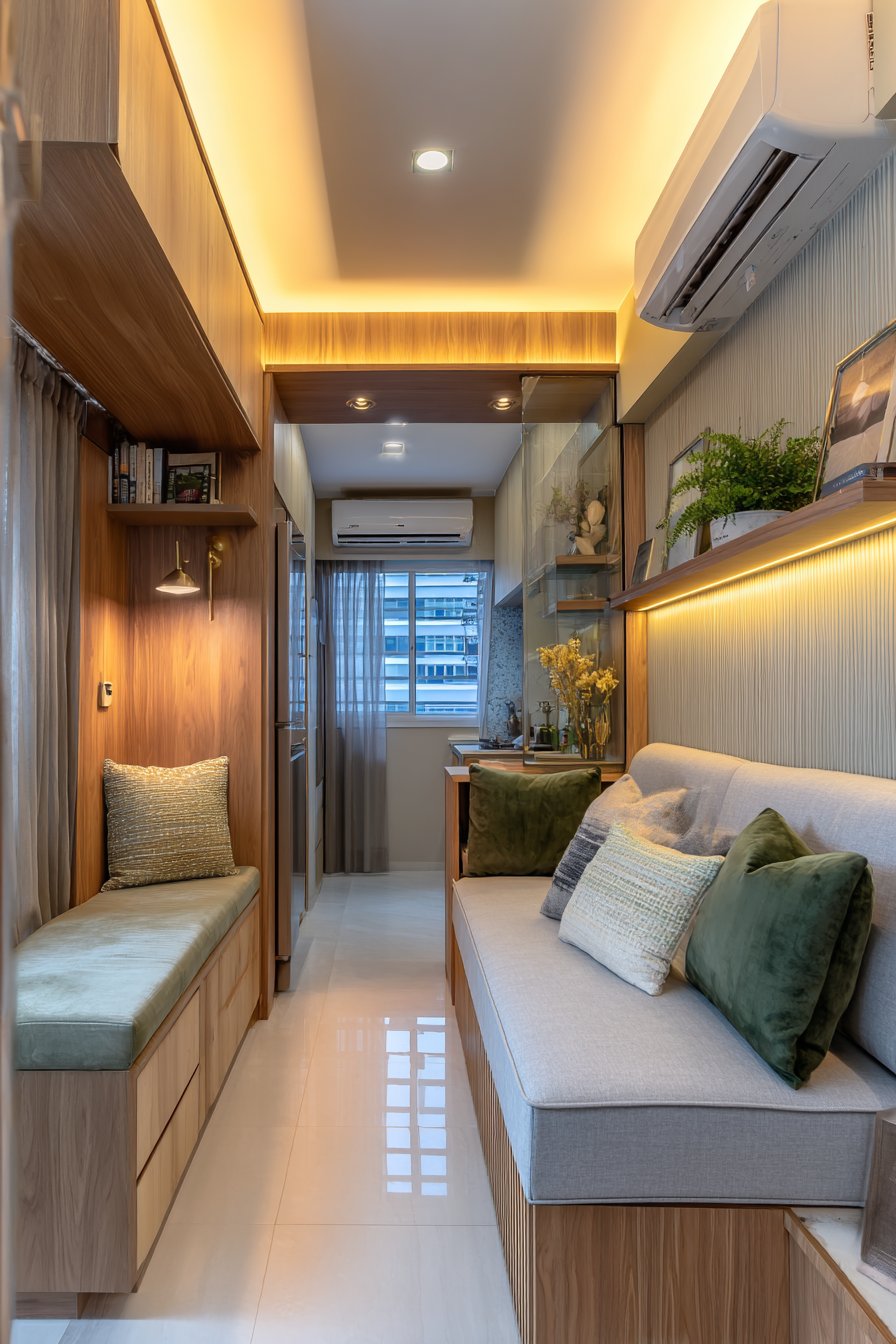
A consistent color palette of soft neutrals with natural wood tones unifies the divided space, ensuring the zones feel connected rather than disjointed. Wood accents appear in both zones through furniture legs, shelving, and accessories, creating visual threads that tie the areas together. The zoning demonstrates that narrow rooms can be just as versatile as wider spaces when design is approached strategically, with each zone serving distinct purposes while maintaining overall harmony.
Key Design Tips:
- Create distinct activity zones in long narrow rooms to maximize functionality and add visual interest through varied purposes and arrangements.
- Use bold accent colors sparingly in single pieces like chairs to add personality without overwhelming the limited space with chromatic intensity.
- Position task lighting near specific activity zones to provide appropriate illumination for reading, working, or other focused activities.
- Select furniture with integrated storage to eliminate the need for additional storage pieces that would consume precious floor space.
- Maintain color continuity across zones with consistent neutral palettes and repeated accent materials to ensure visual cohesion despite spatial division.
10. All-White Light Enhancement Strategy
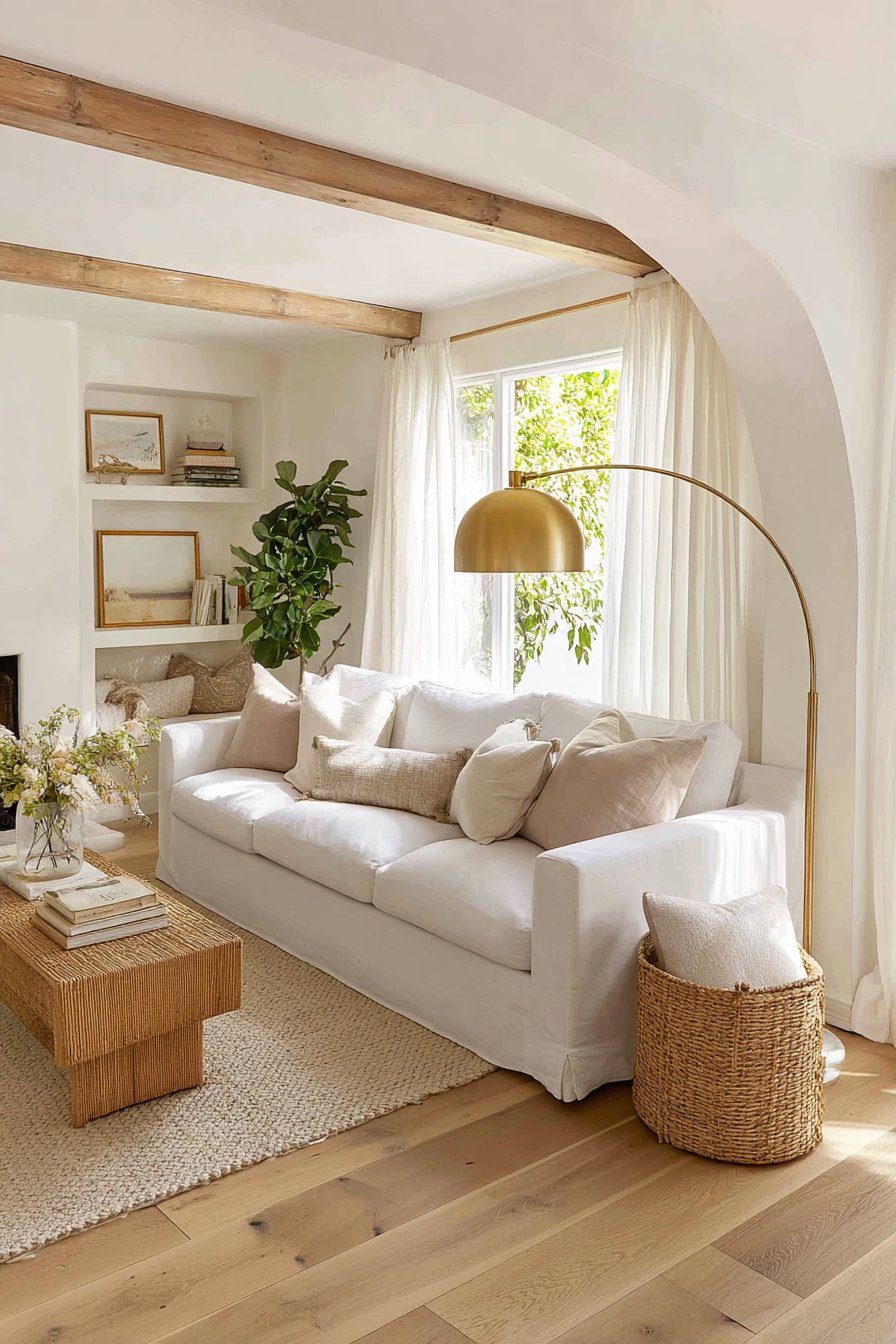
Maximizing light reflection through monochromatic design can transform narrow spaces from dark corridors into luminous sanctuaries, and this all-white approach demonstrates the power of chromatic simplicity. A crisp white slipcovered sofa anchors the space, its fresh, clean appearance creating an airy foundation.
Slipcovered furniture offers practical benefits beyond aesthetics—covers can be removed for washing, maintaining the pristine white appearance that might otherwise be difficult to sustain. The white sofa reflects rather than absorbs light, bouncing illumination throughout the space.
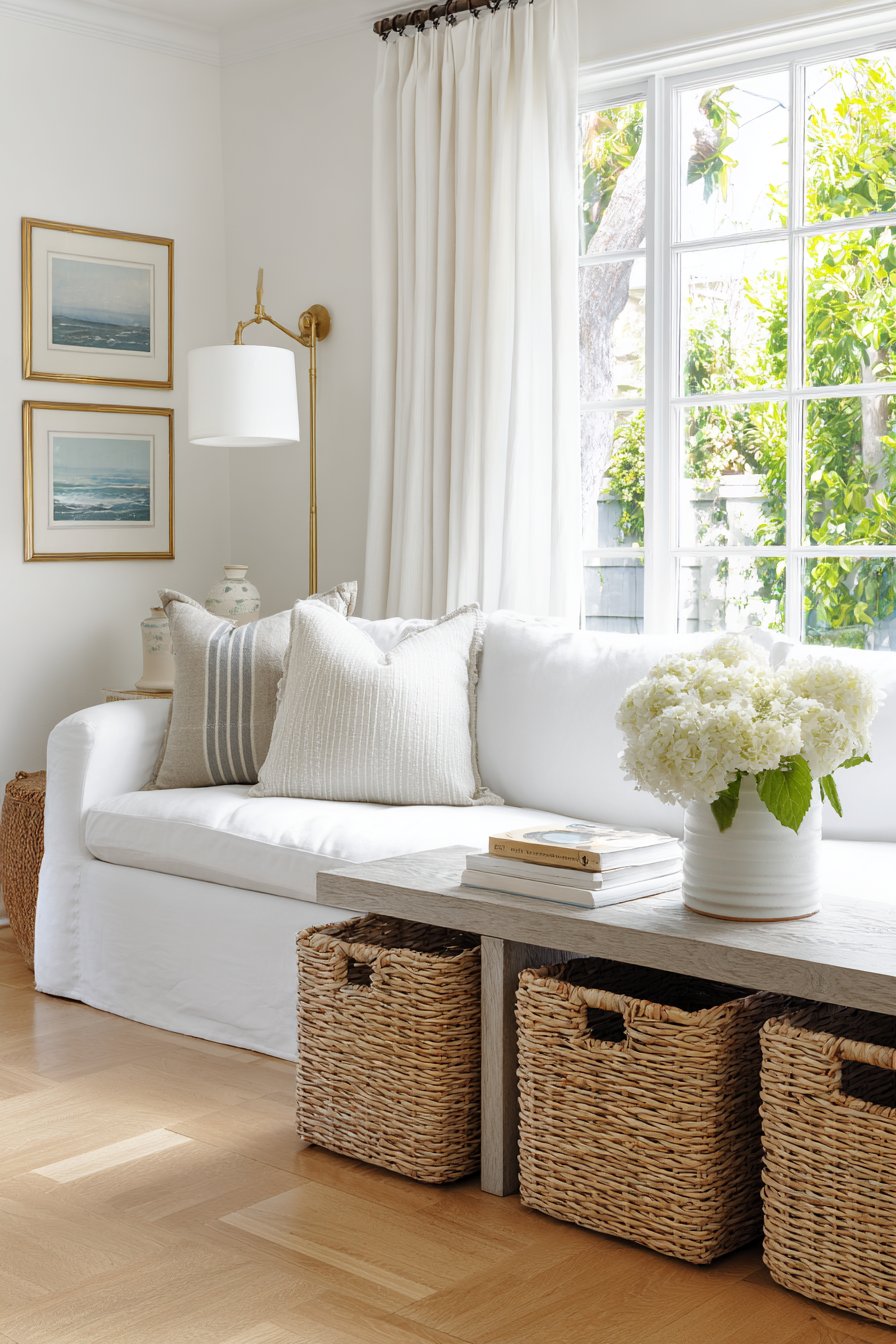
White-washed oak flooring continues the light-enhancing strategy underfoot, the subtle wood grain providing texture without introducing color that might darken or reduce the space’s brightness. The white-washed treatment allows oak’s natural beauty to show through while maintaining the overall luminous scheme. This flooring choice demonstrates that monochromatic doesn’t mean monotonous—texture and material variation create interest within a single color family.
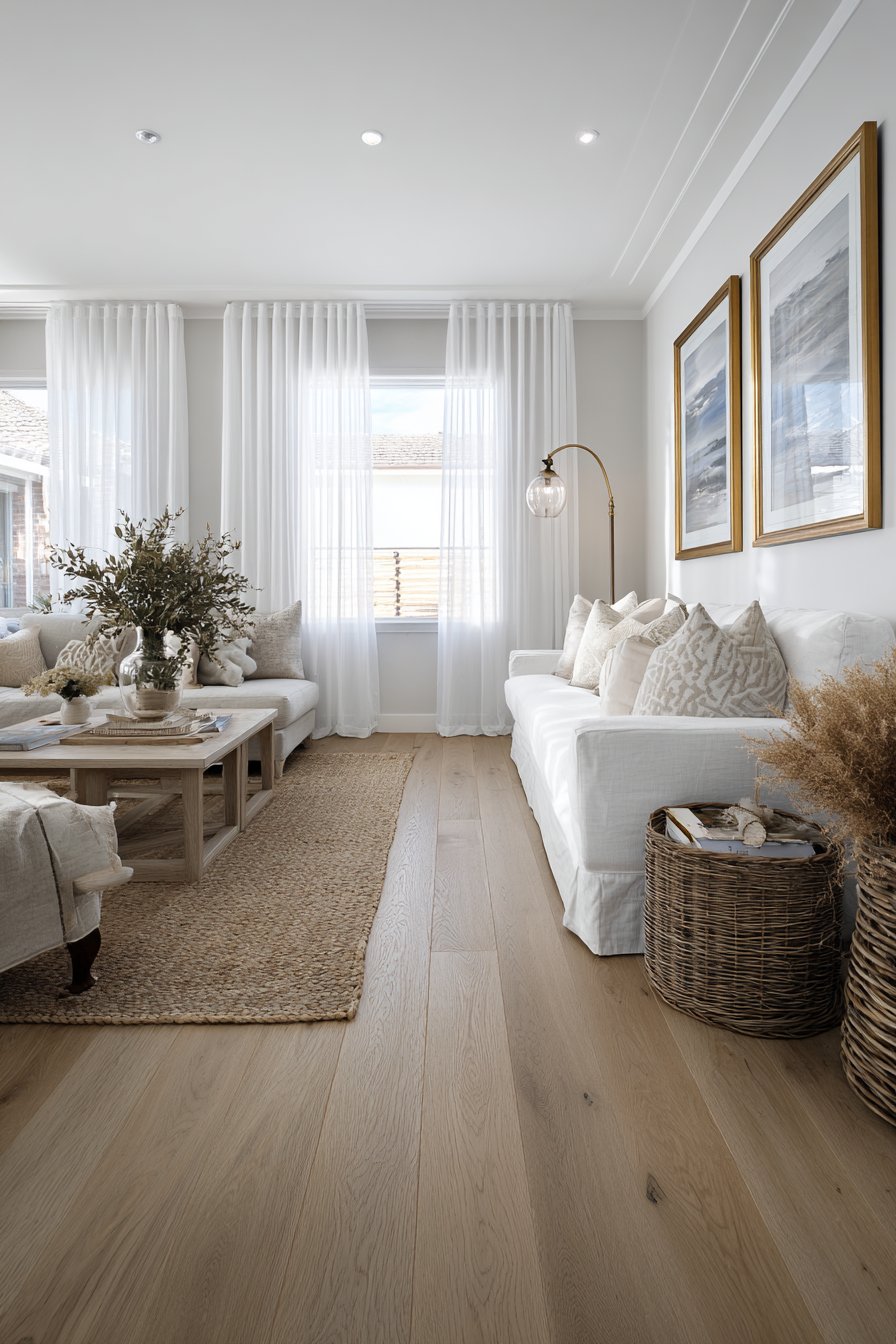
Sheer white drapery maximizes natural light reflection and transmission, filtering sunlight softly without blocking it. These window treatments create privacy without darkness, maintaining the connection to the outdoors while diffusing light beautifully.
The sheerness ensures windows don’t become visual barriers, preserving the sense of openness that narrow rooms desperately need. Strategic placement of metallic accents through brass picture frames and a gold-finish arc floor lamp adds warmth without visual weight, preventing the all-white scheme from feeling cold or clinical.
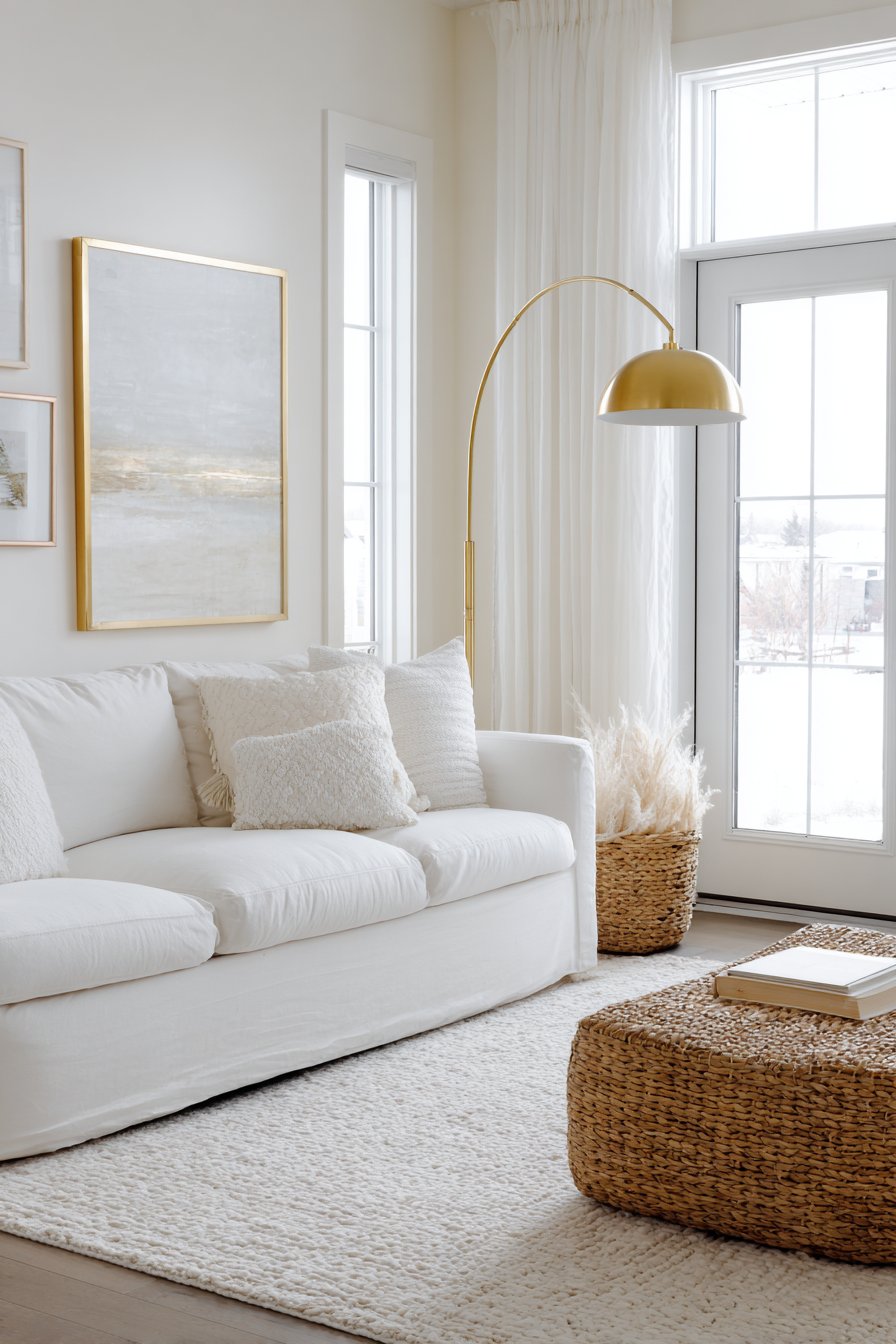
A narrow bench with woven rattan storage baskets provides both seating and organization, the rattan introducing natural texture that contrasts beautifully with the smooth white surfaces. The minimalist approach prevents the narrow space from feeling cramped—by eliminating color and pattern complexity, the design creates visual breathing room that makes the dimensions feel more generous than they actually are. This strategy proves that sometimes less is indeed more, especially in challenging, narrow layouts.
Key Design Tips:
- Embrace monochromatic white schemes to maximize light reflection and create the illusion of expanded space through chromatic simplicity.
- Choose slipcover furniture for practical maintenance of light-colored upholstery while maintaining the fresh, airy aesthetic.
- Install sheer drapery that filters rather than blocks light, preserving natural illumination while providing privacy.
- Add metallic accents in warm tones like brass or gold to prevent all-white spaces from feeling cold or sterile.
- Incorporate natural textures like rattan, jute, or linen to add tactile interest within the monochromatic palette, creating depth through material variation.
Why These Narrow Living Room Ideas Are the Best Design Solutions
These ten narrow living room ideas represent the pinnacle of contemporary interior design thinking for challenging spaces, each offering proven solutions to common spatial constraints. The streamlined furniture arrangement approach prioritizes circulation flow and visual balance, essential elements for narrow living room layouts where every inch of floor space matters. By positioning slim-profile sofas against long walls and incorporating vertical storage units, this design maximizes functionality without compromising aesthetics, making it ideal for urban apartments and compact homes where narrow living room dimensions are common.
The built-in seating solution with window benches and wall-mounted entertainment centers exemplifies space-saving living room furniture at its finest. These custom integrated elements eliminate the footprint of traditional freestanding pieces, creating narrow living room storage solutions that work with rather than against the room’s proportions. This approach is particularly effective for narrow long living rooms where bulky furniture would create bottlenecks and impede movement. The dual-purpose nature of window benches—providing seating while concealing storage—makes this one of the best narrow living room ideas for families needing to maximize every function.
Strategic mirror placement for creating visual width represents one of the most powerful optical tools in the narrow living room design arsenal. Mirrors multiply light and space perception, making narrow rectangular living rooms feel significantly more expansive without any structural changes. This narrow living room decorating idea is particularly valuable for renters or those with limited renovation budgets, as mirrors provide dramatic impact through simple installation. Combined with light color palettes and compact sectional sofas, the mirror strategy addresses the fundamental challenge of narrow living room layouts—the tunnel-like feeling that proper design must overcome.
Symmetrical seating arrangements bring formal elegance and visual balance to narrow living room spaces, counteracting asymmetrical proportions through intentional furniture placement. This approach works exceptionally well for narrow formal living rooms or narrow living room dining room combinations where creating distinct conversation areas is important. The matched armchair arrangement with slim coffee tables demonstrates how narrow living room furniture arrangement can be both beautiful and functional, maintaining clear walkways while providing ample seating. This design proves that narrow living rooms needn’t sacrifice style for practicality.
Multi-functional furniture solutions featuring sofa beds and wall-mounted folding elements represent the future of narrow living room design, where adaptability and flexibility are paramount. These narrow living room ideas with multi-purpose furniture address the modern need for spaces that transform based on changing requirements—guest sleeping, work-from-home setups, or entertainment areas. The retractable nature of folding tables and adjustable lighting means the narrow living room layout can be customized throughout the day, maximizing utility without permanent spatial commitments. This approach is essential for studio apartments or narrow living room bedroom combinations where square footage is severely limited.
The minimalist Scandinavian approach with low-profile modular sofas and natural materials offers timeless appeal for narrow living room decor. Scandinavian design principles align perfectly with narrow space constraints, emphasizing simplicity, functionality, and light-enhancing elements. The vertical wood paneling and natural fiber rugs add texture without bulk, creating narrow living room wall decor solutions that transform flat surfaces into interesting architectural features. This design style works particularly well for narrow living rooms with fireplaces, where the minimalist approach prevents the space from feeling overcrowded despite the focal point.
Integrated storage walls represent the ultimate narrow living room built-in solution, transforming one entire wall into a streamlined organizational system. Floor-to-ceiling cabinetry provides abundant storage capacity without the footprint that freestanding furniture requires, making this ideal for narrow living rooms in small apartments where clutter quickly overwhelms. The clean lines and matte finishes create a contemporary, narrow living room aesthetic that feels sophisticated rather than cramped. This approach is particularly effective for narrow living room television placement, integrating media components seamlessly into the overall design rather than allowing them to dominate.
Dynamic angled furniture arrangements break free from parallel wall constraints, creating visual interest and improved traffic flow in narrow living room layouts. By positioning sofas diagonally and incorporating round coffee tables, this approach makes narrow long living room spaces feel more curated and intentional rather than dictated by architectural limitations. The varied-depth shelving and corner plants introduce dimensional variation that transforms flat walls into engaging displays. This design strategy works beautifully for narrow awkward living rooms where conventional arrangements feel too predictable or corridorlike.
Zone-based design for activity separation demonstrates how narrow living rooms can accommodate multiple functions despite width limitations. Creating distinct areas for reading, conversation, and entertainment makes narrow studio living room layouts more livable and organized. The forest green accent chair and light grey sofa define separate zones while maintaining visual cohesion through consistent neutral palettes. This approach is particularly effective for narrow open concept living rooms where delineating spaces without physical walls is essential. The zoning strategy proves that narrow living room, small space constraints needn’t limit functionality.
The all-white light enhancement strategy represents the most dramatic approach to making narrow living rooms feel expansive, using monochromatic schemes to maximize light reflection and visual breathing room. This narrow living room color scheme eliminates chromatic complexity, creating a serene environment where architectural proportions feel less constraining. The combination of white upholstery, white-washed flooring, and sheer drapery creates a luminous envelope that transforms potentially dark narrow spaces into bright sanctuaries. Metallic accents prevent coldness while maintaining the light-enhancing benefits, making this one of the best narrow small living room ideas for spaces with limited natural light.
These narrow living room layout ideas work because they address fundamental spatial challenges through proven design principles—maximizing vertical space, maintaining clear circulation paths, using light and color strategically, and selecting appropriately scaled furniture. Whether you’re dealing with a narrow rectangular living room, narrow long living room, or narrow living room with a fireplace, these approaches offer adaptable solutions that can be customized to your specific dimensions and needs. From narrow living room furniture ideas to narrow living room paint colors, from narrow living room TV placement to narrow living room seating arrangements, these designs cover every aspect of creating beautiful, functional spaces despite challenging proportions.
Conclusion:
Transforming a narrow living room from a spatial challenge into a design triumph requires understanding core principles while maintaining flexibility for personal expression. The ten approaches explored in this guide demonstrate that narrow living room dimensions needn’t limit your design ambitions—with strategic furniture placement, thoughtful color choices, and clever storage solutions, even the most constrained spaces can become beautiful, functional havens. Whether you embrace minimalist Scandinavian simplicity, dynamic angled arrangements, or light-enhancing monochromatic schemes, success lies in working with your space’s natural proportions rather than fighting against them.
Remember that the best narrow living room designs prioritize circulation flow, maximize vertical space, and use light as a design tool. Glass furniture maintains visual transparency, mirrors multiply perceived dimensions, and built-in solutions provide storage without footprint penalties. Multi-functional pieces adapt to changing needs, while zone-based layouts create variety within linear constraints. Don’t be afraid to experiment with these ideas, mixing elements from different approaches to create a custom solution perfectly tailored to your specific narrow living room layout.
Start by assessing your space’s unique characteristics—where does natural light enter, what are the exact dimensions, and how do you actually use the room? Then select strategies that address your particular challenges and align with your aesthetic preferences. Whether you’re furnishing a narrow apartment living room, renovating a narrow Victorian parlor, or maximizing a narrow basement living room, these design principles provide the foundation for success. Your narrow living room can become one of your home’s most impressive spaces—a testament to thoughtful design and creative problem-solving that transforms limitation into opportunity.
