


In today’s world of urban living and compact homes, the bathroom often becomes one of the most challenging spaces to design effectively. However, small doesn’t mean sacrificing style or functionality. Minimalist design philosophy offers the perfect solution for transforming cramped bathrooms into serene, highly functional retreats. By embracing the “less is more” approach, you can create a bathroom that feels spacious, calming, and remarkably efficient, regardless of its actual square footage.
The beauty of minimalist bathroom design lies in its ability to eliminate visual clutter while maximizing every inch of available space. This design philosophy focuses on clean lines, simple forms, and a carefully curated selection of essential elements. Each fixture, surface, and accessory serves a purpose, creating harmony between aesthetics and utility. Through thoughtful material selection, strategic lighting, and intelligent storage solutions, even the smallest bathroom can become a sophisticated sanctuary that rivals larger, more elaborate spaces.
This comprehensive guide explores ten exceptional minimalist small bathroom designs, each offering unique solutions to common spatial challenges. From floating vanities that create the illusion of more floor space to wet room configurations that maximize openness, these designs demonstrate how restraint and precision can transform limitations into opportunities. Whether you’re renovating an existing compact bathroom or designing a new one, these inspiring concepts will help you create a space that breathes tranquility while meeting all your practical needs.
1. Classic Horizontal Subway Tile Serenity
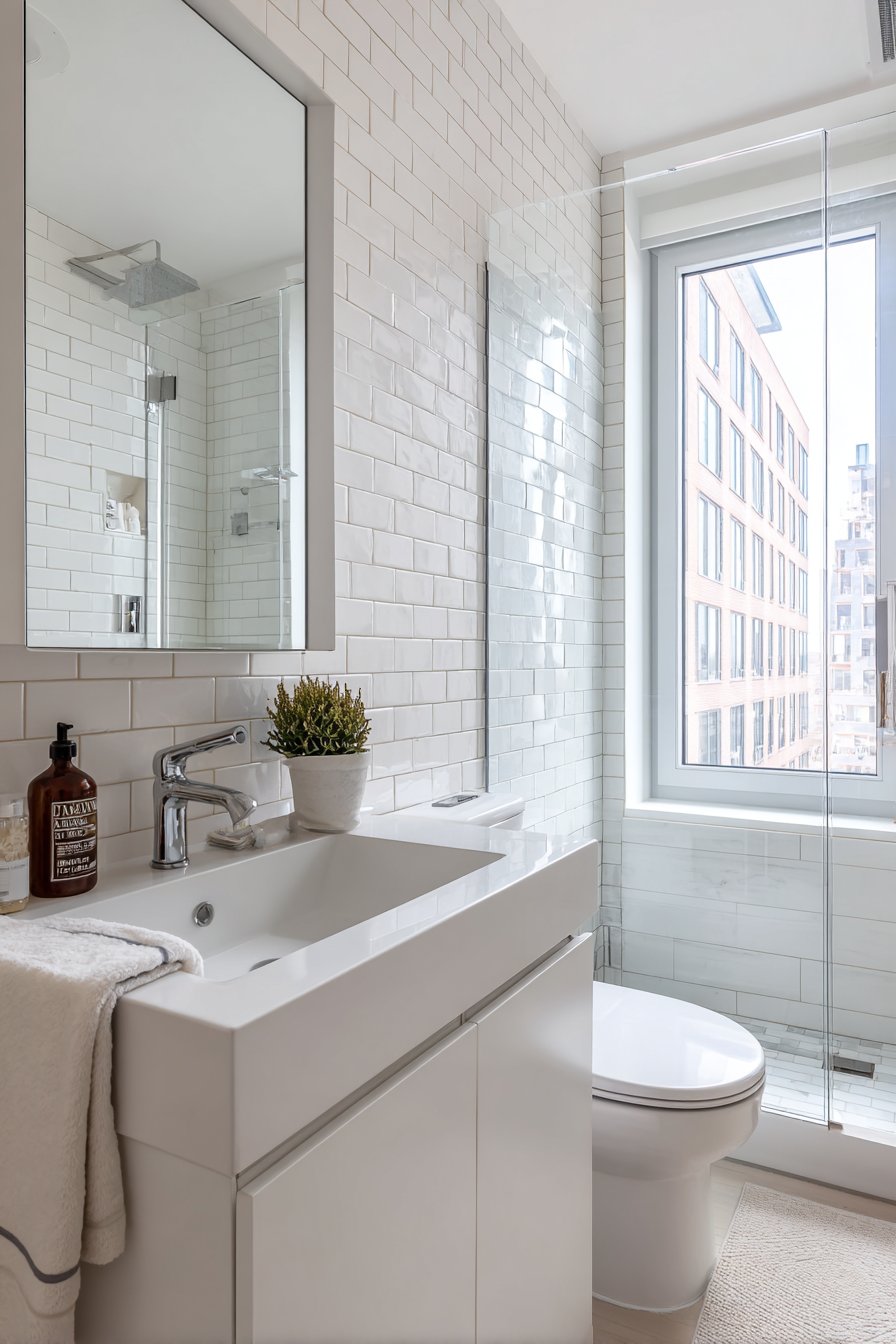
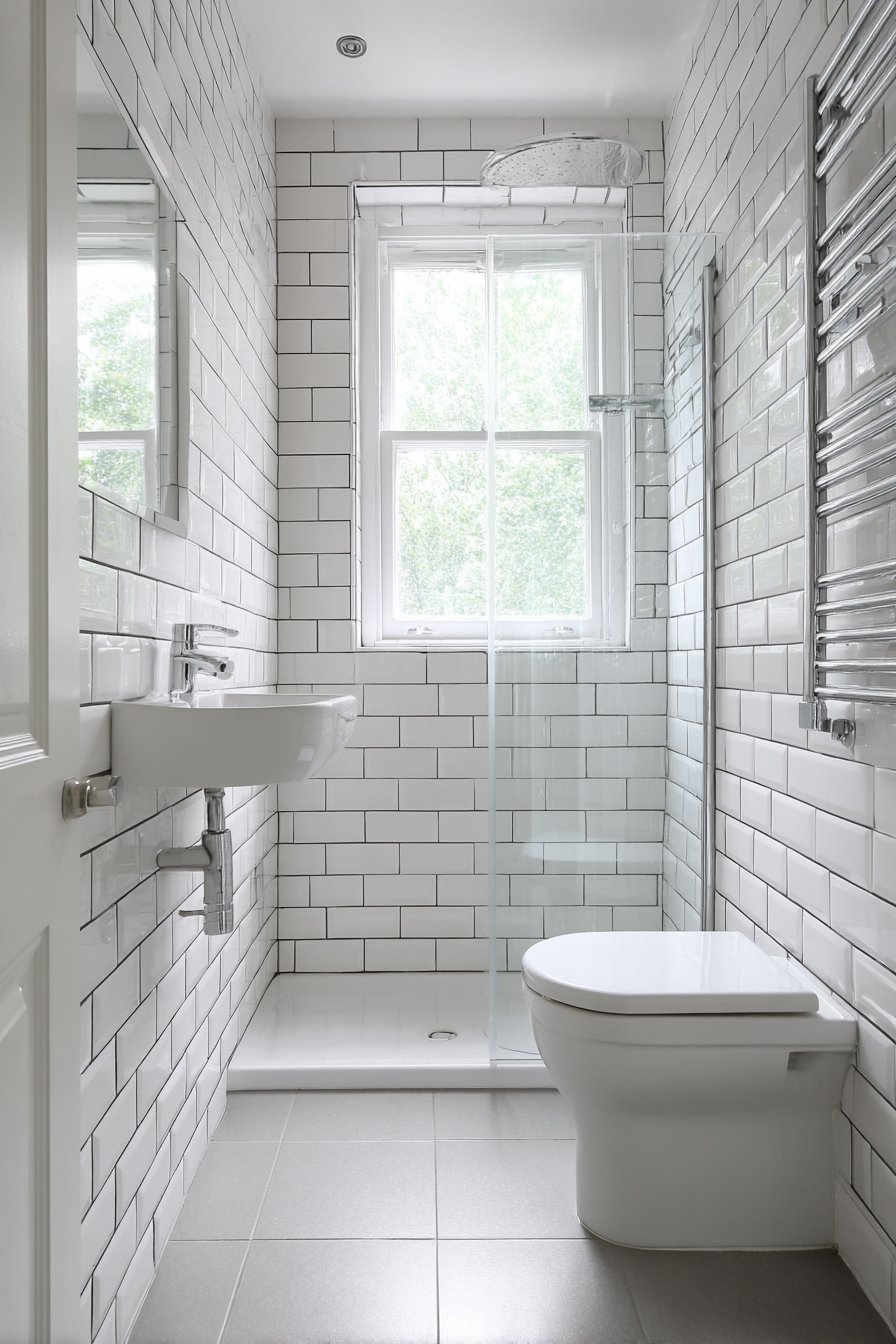
The foundation of this minimalist bathroom design centers on the timeless appeal of white subway tiles arranged in traditional horizontal patterns. Wall-mounted porcelain sinks with clean, geometric lines eliminate the bulk of traditional vanities. This instantly opens up valuable floor space.
A single chrome faucet provides the only necessary fixture. It embodies the minimalist principle of essential-only design. The frameless glass shower enclosure maintains visual continuity throughout the space. Light flows freely without barriers or visual interruptions.
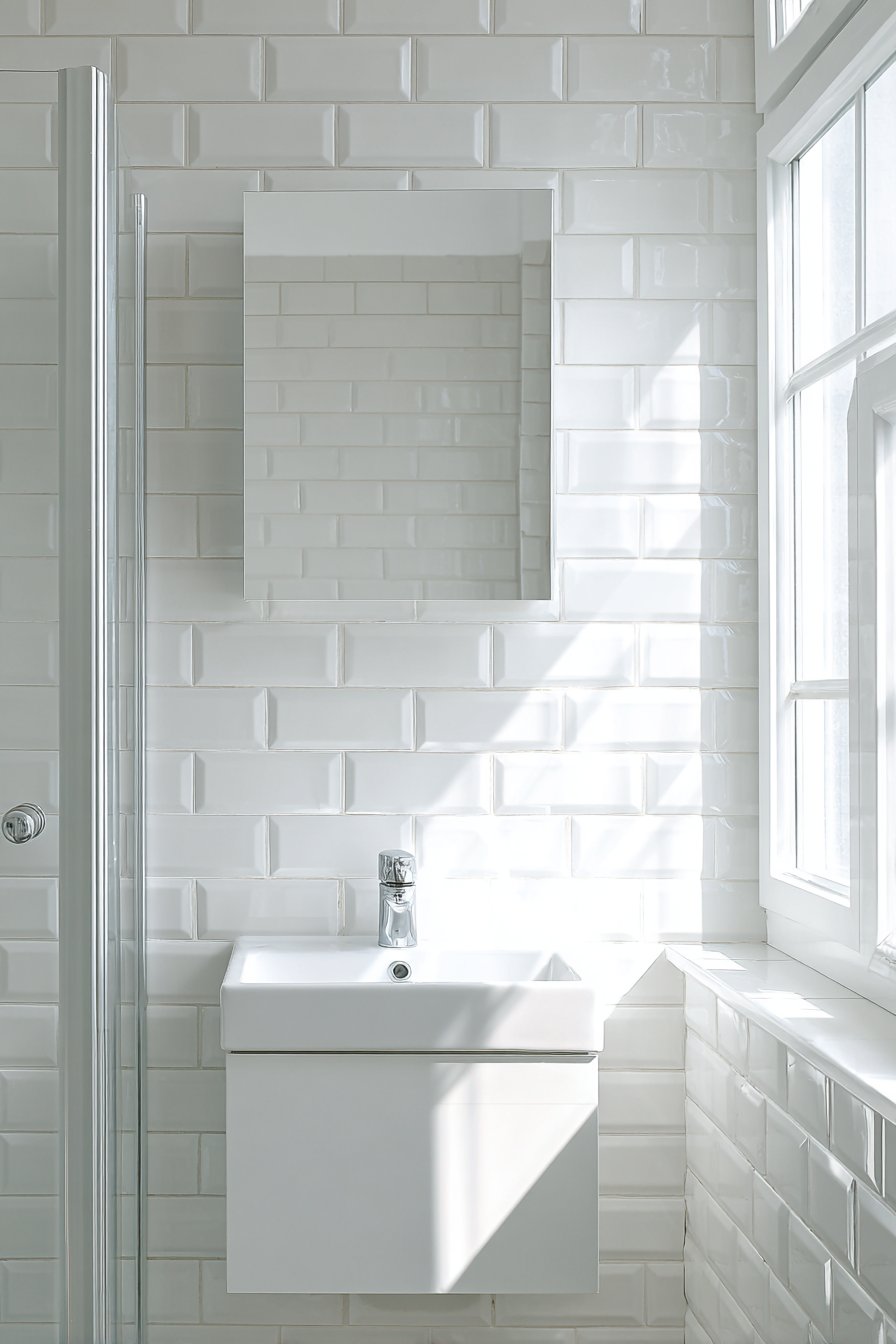
Light grey grout lines define each tile with subtle precision. They create texture without overwhelming the senses. This careful detail work prevents the all-white space from appearing sterile or clinical. The recessed medicine cabinet serves dual purposes: providing concealed storage while functioning as a mirror. This integration eliminates the need for additional wall-mounted elements. Such elements would fragment the clean wall planes. Natural daylight filtering through a small frosted window creates soft, diffused illumination. The light changes throughout the day, adding dynamic interest to the static surfaces.
The wide-angle perspective reveals how efficiently every element contributes to the overall composition. Material textures become apparent under balanced exposure: the smooth porcelain, reflective chrome, and transparent glass each play distinct roles. The horizontal tile pattern draws the eye across the walls. It makes the narrow space feel wider than its actual dimensions. This optical trick, combined with the floating sink, creates a bathroom that feels significantly larger than its footprint suggests.
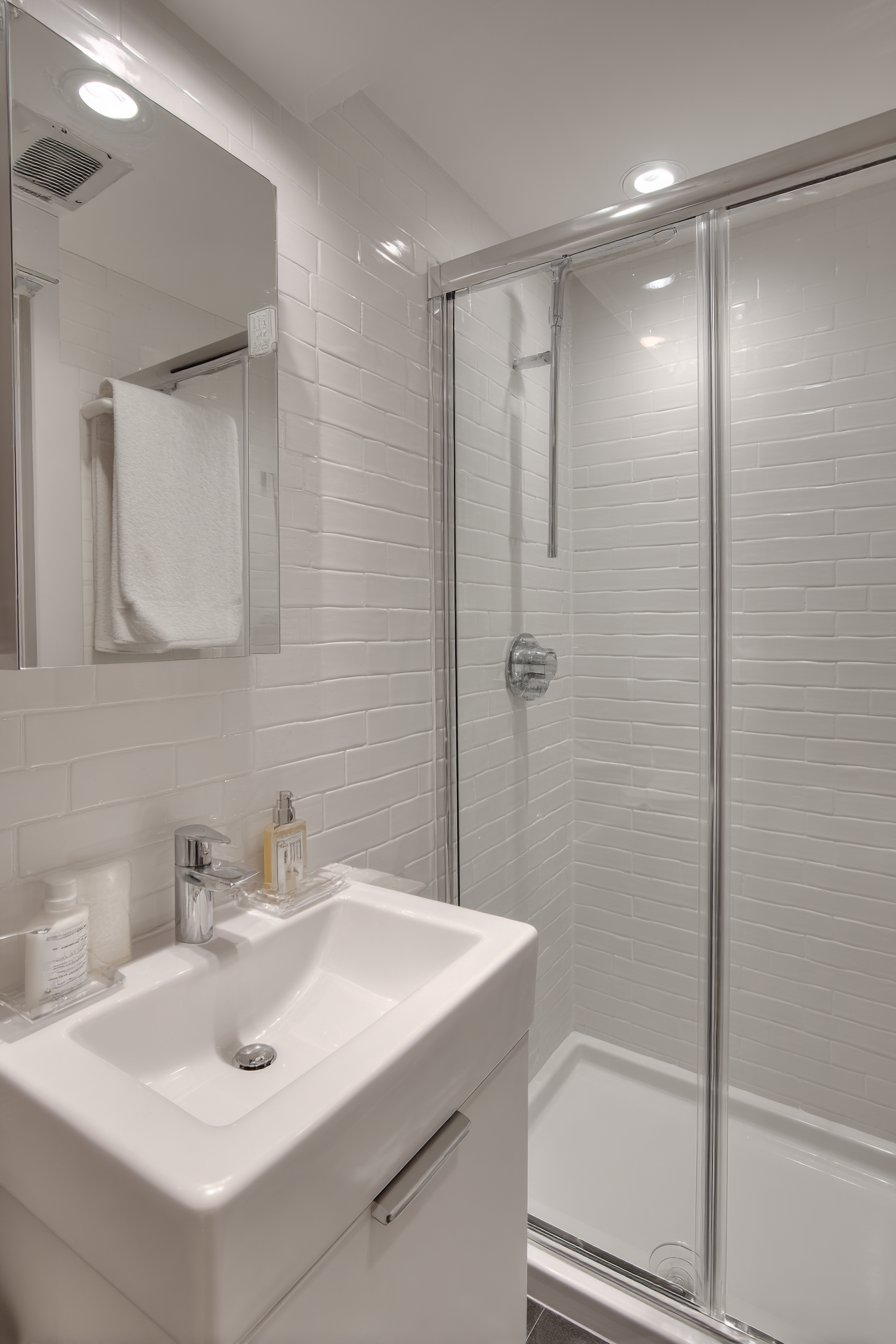
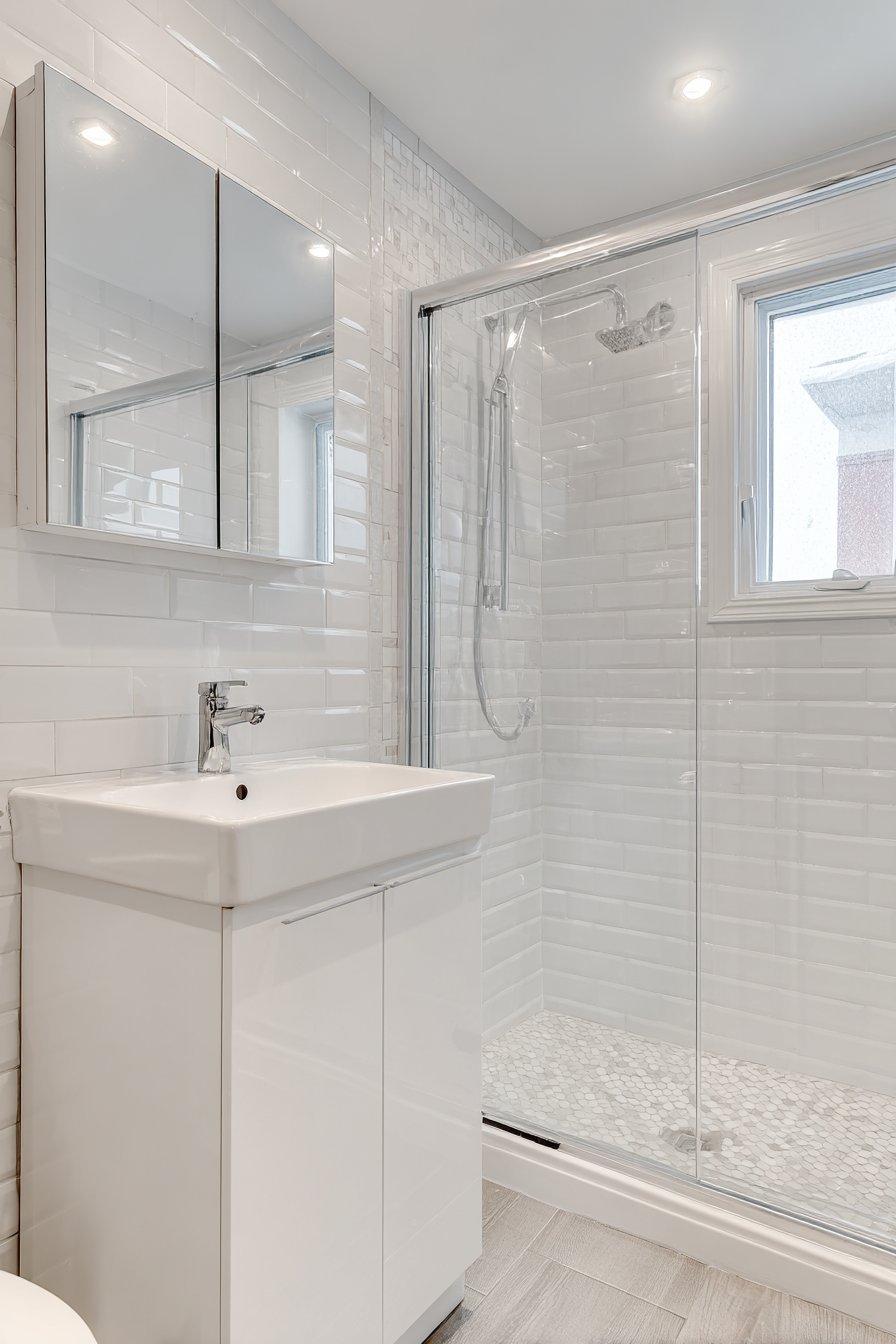
The beauty of this design lies in its restraint. No decorative elements compete for attention. The focus remains on pure form and function. The chrome fixtures catch and reflect light, creating subtle sparkle points. These moments of reflection add visual interest without clutter. The shower enclosure’s frameless design allows the tile pattern to continue uninterrupted. This creates a seamless visual flow from wall to wall.
Key Design Tips:
- Install wall-mounted fixtures to maximize visible floor space and simplify cleaning routines
- Choose frameless glass enclosures to maintain visual openness throughout the compact bathroom
- Use light grey grout for definition without creating harsh contrast against white tiles
- Incorporate recessed storage solutions to eliminate visual clutter on countertops and surfaces
- Position frosted windows strategically to provide natural light while maintaining privacy
- Select chrome fixtures for their reflective qualities that enhance light distribution
2. Floating Elements and Vertical Expansion
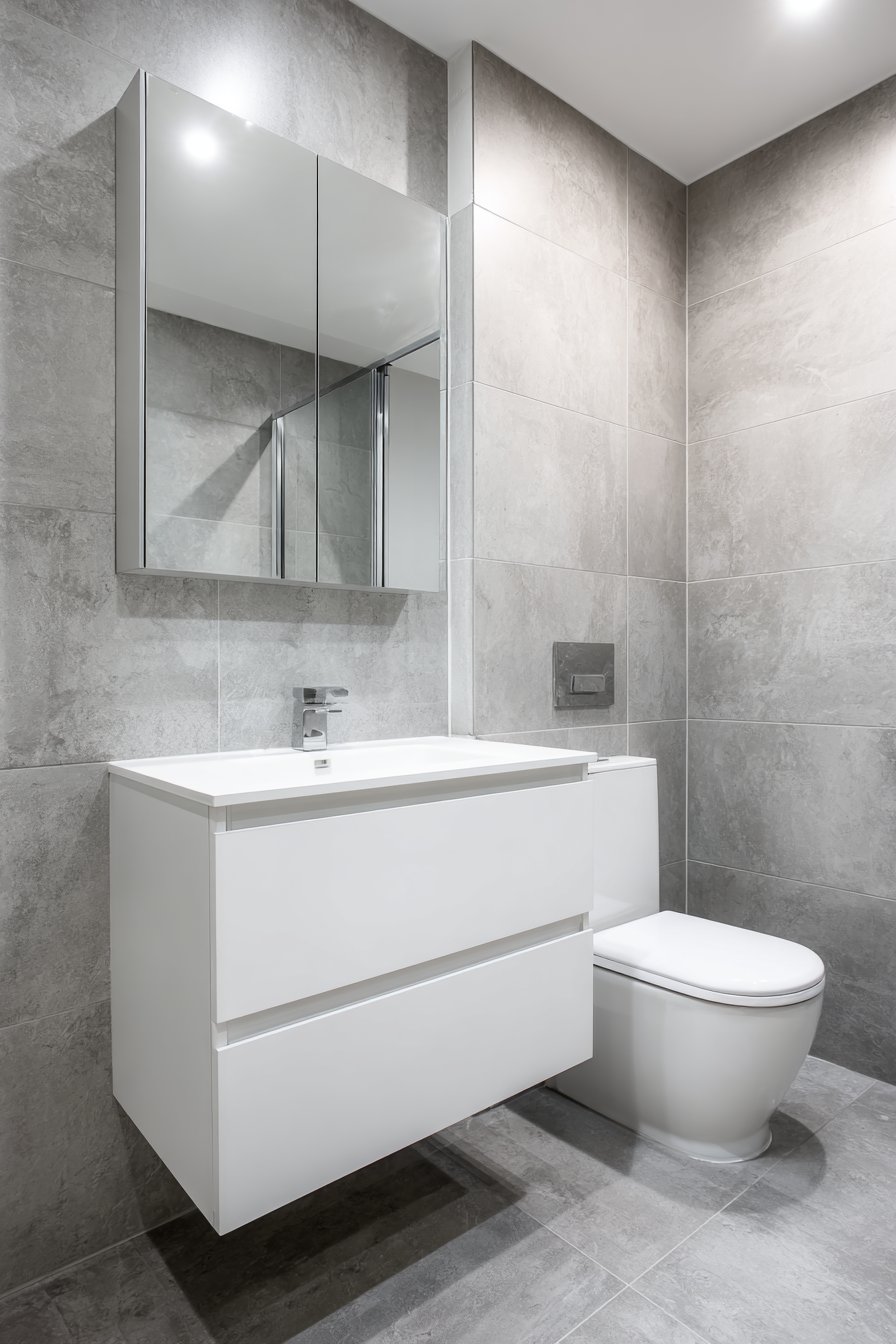
This sophisticated design employs floating wall-mounted elements to create a remarkable sense of spaciousness. Both the toilet and vanity appear to hover above the floor. This floating effect visually expands the room by revealing more floor surface.
The matte white vanity features a single drawer with integrated handle cutout. This eliminates protruding hardware that would disrupt the clean lines. The slim white quartz counter sits atop the vanity with minimal overhang. Every millimeter is considered and purposeful.
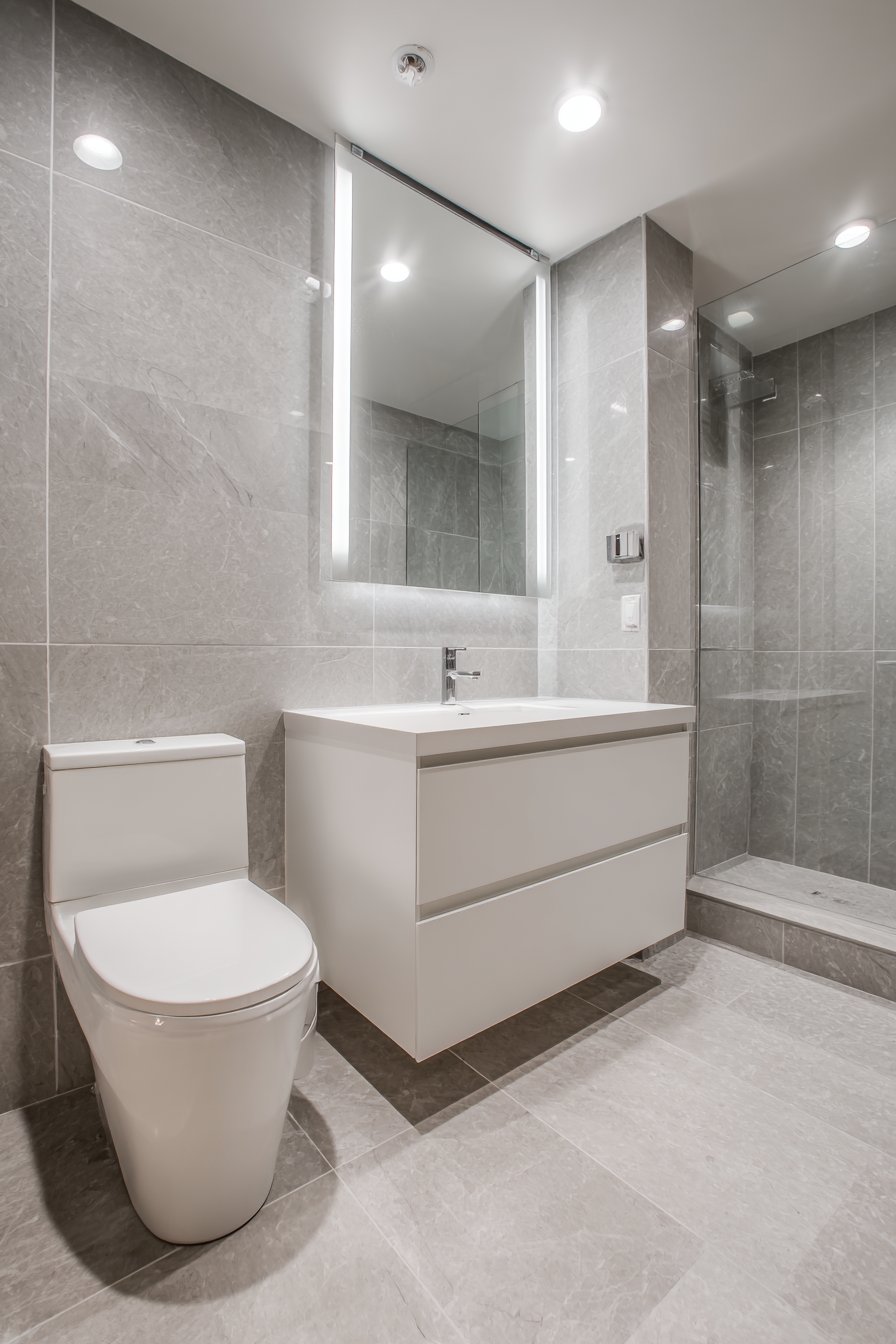
Large-format light grey porcelain tiles cover the walls with minimal grout lines. Fewer grout lines mean less visual fragmentation. The eye can travel smoothly across surfaces without interruption. A narrow vertical mirror extends from counter to ceiling.
This creates a powerful vertical emphasis that draws the eye upward. The vertical orientation makes the ceiling appear higher than it actually is. This simple trick transforms the perceived proportions of the entire room.
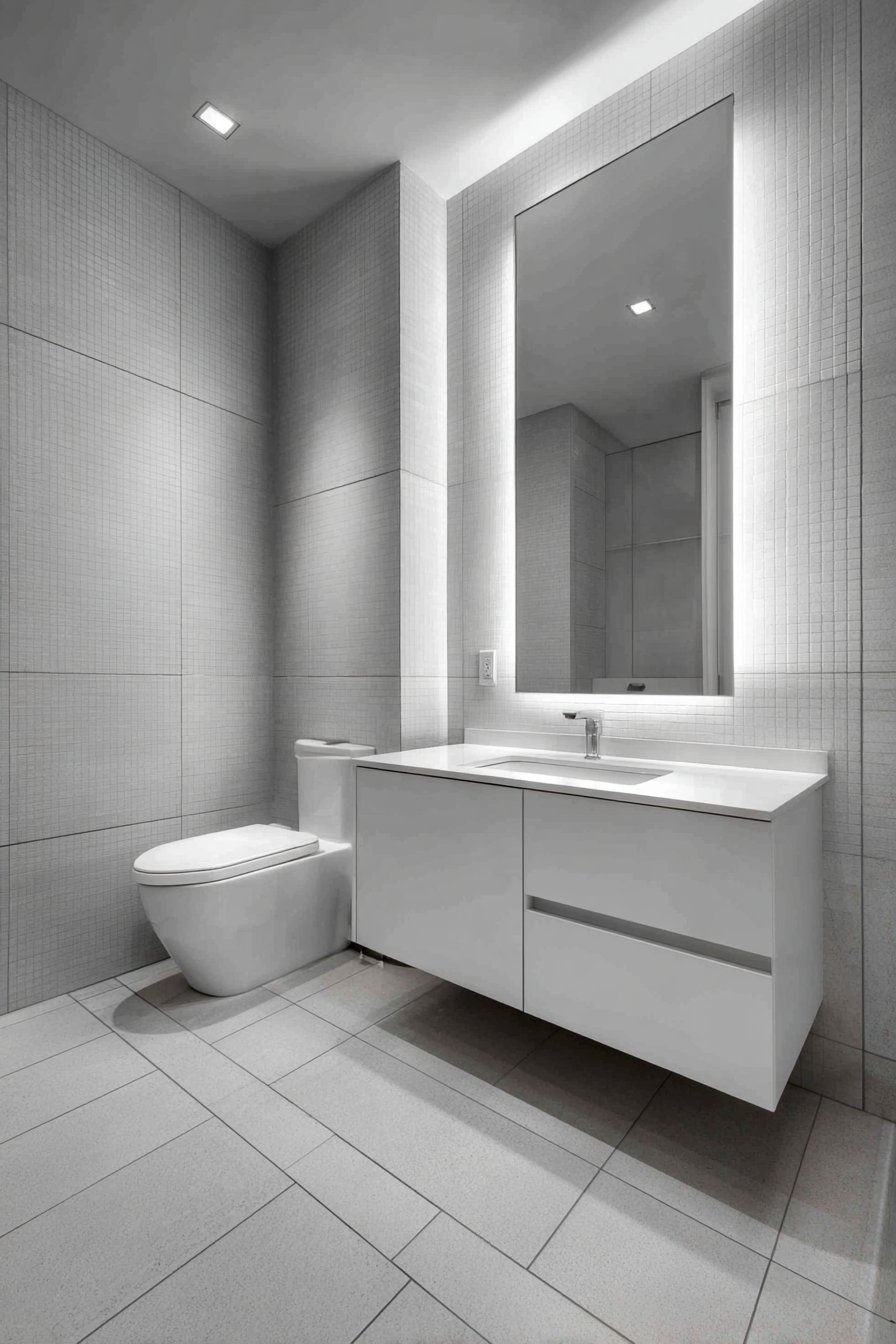
Recessed LED lighting provides even, shadow-free illumination without fixtures protruding into the limited space. The lights disappear into the architecture. Only their glow remains visible. This creates ambient lighting that feels natural and unforced. The integrated handle cutout on the drawer represents pure minimalist thinking. Form and function merge into a single element. No separate handle is needed. The cutout itself becomes both an aesthetic feature and functional necessity.
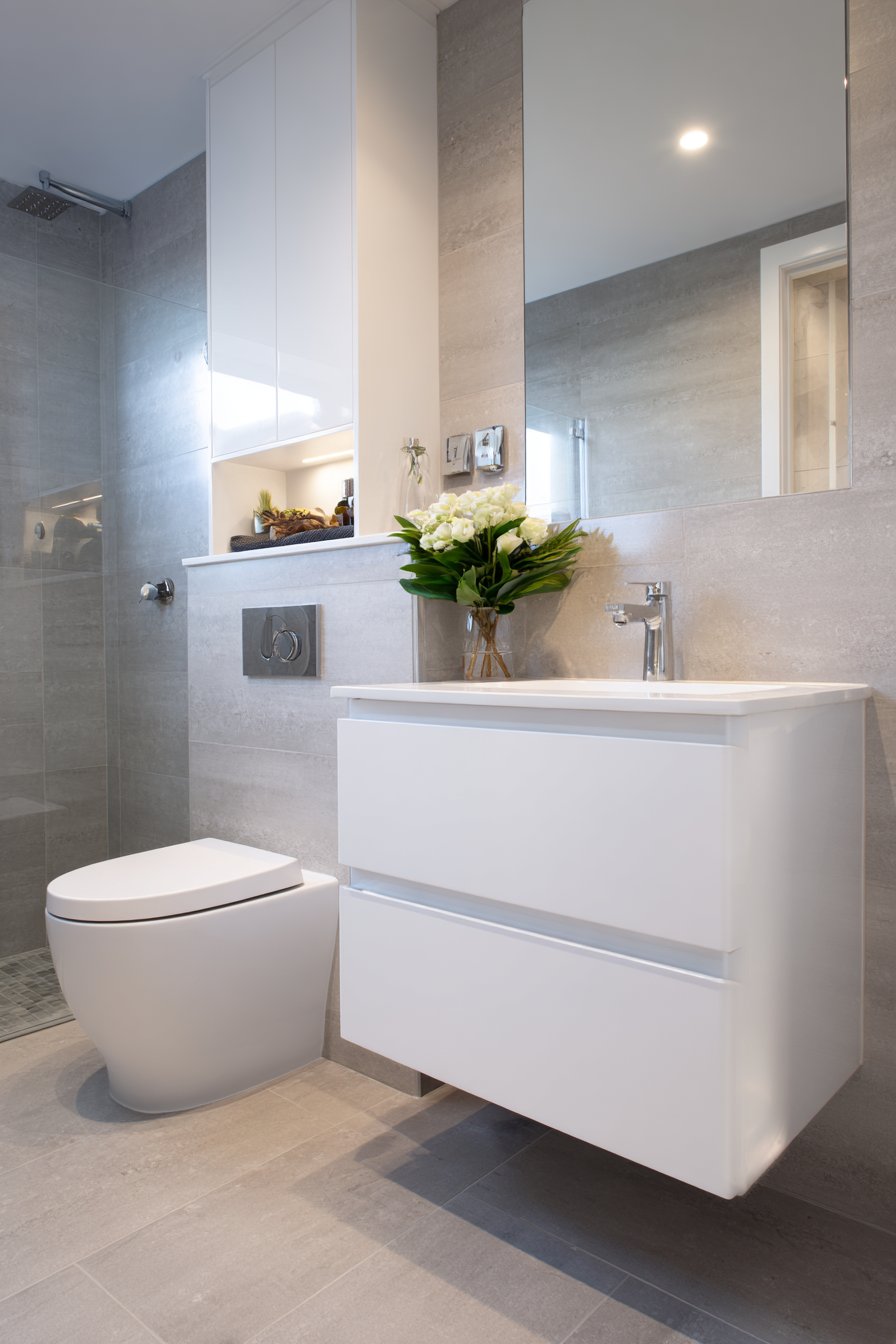
The matte white finish on the vanity contrasts subtly with the glossy porcelain tiles. This interplay of finishes adds depth without introducing color. The monochromatic palette remains intact while subtle variations in sheen create visual interest. The floating toilet offers practical benefits beyond aesthetics. Cleaning becomes easier when floor space remains unobstructed. The entire floor can be mopped without navigating around a toilet base.
Key Design Tips:
- Mount toilets and vanities on walls to create floating effects that reveal more floor space
- Extend mirrors vertically from counter to ceiling to emphasize height in compact rooms
- Select large-format tiles to minimize grout lines and reduce visual complexity
- Install recessed lighting to eliminate protruding fixtures in tight spaces
- Choose integrated handles over hardware to maintain clean, uninterrupted surfaces
- Mix matte and glossy finishes within the same color for subtle depth
3. Seamless Glass and Built-In Storage
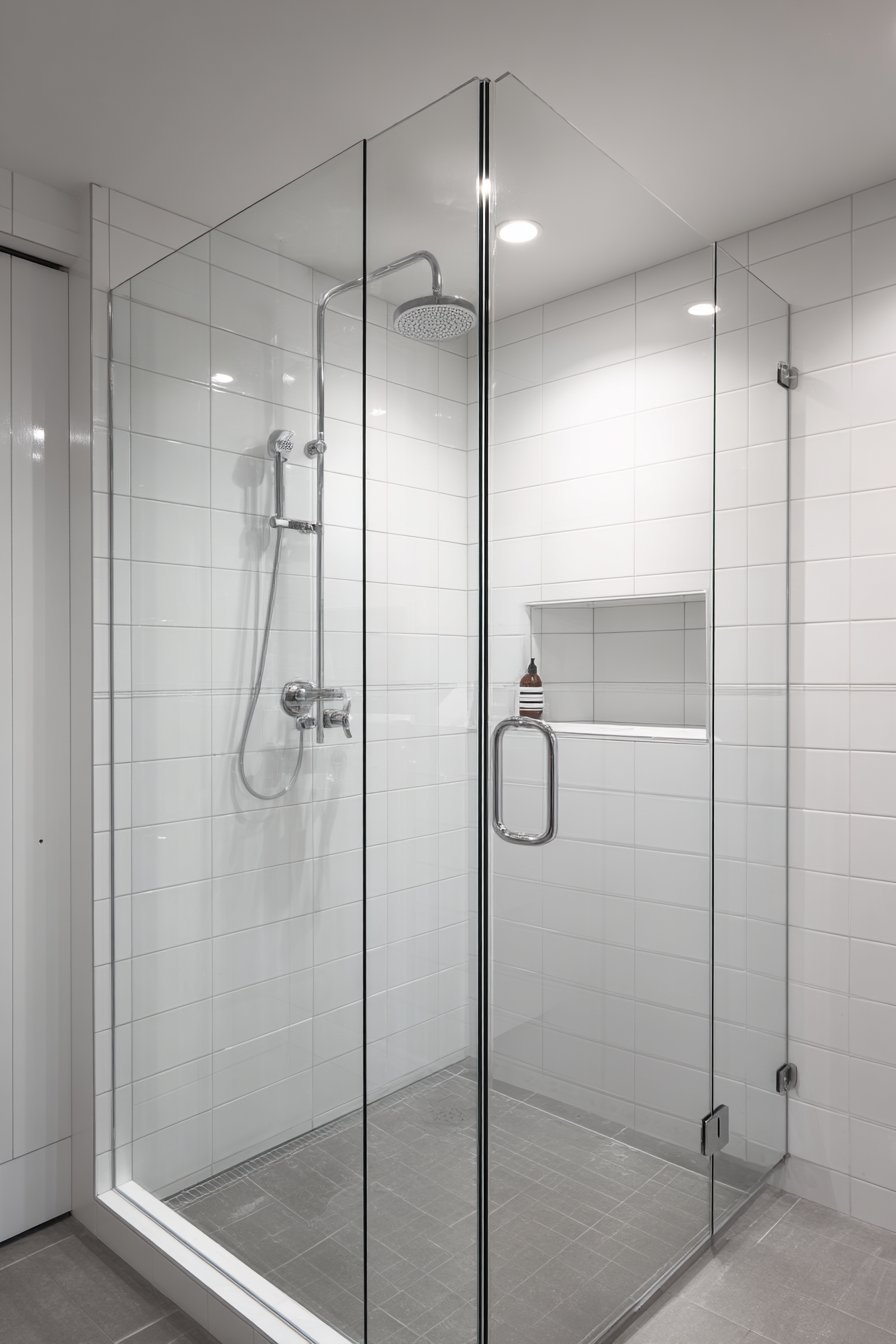
The shower area takes center stage in this minimalist design with its seamless glass partition. White ceramic tiles extend from floor to ceiling without interruption. This continuous surface treatment eliminates visual breaks that would fragment the space.
A single chrome rainfall showerhead mounted on the ceiling provides primary water delivery. A hand shower on a simple sliding bar offers flexibility. These represent the only fixtures needed for full functionality.
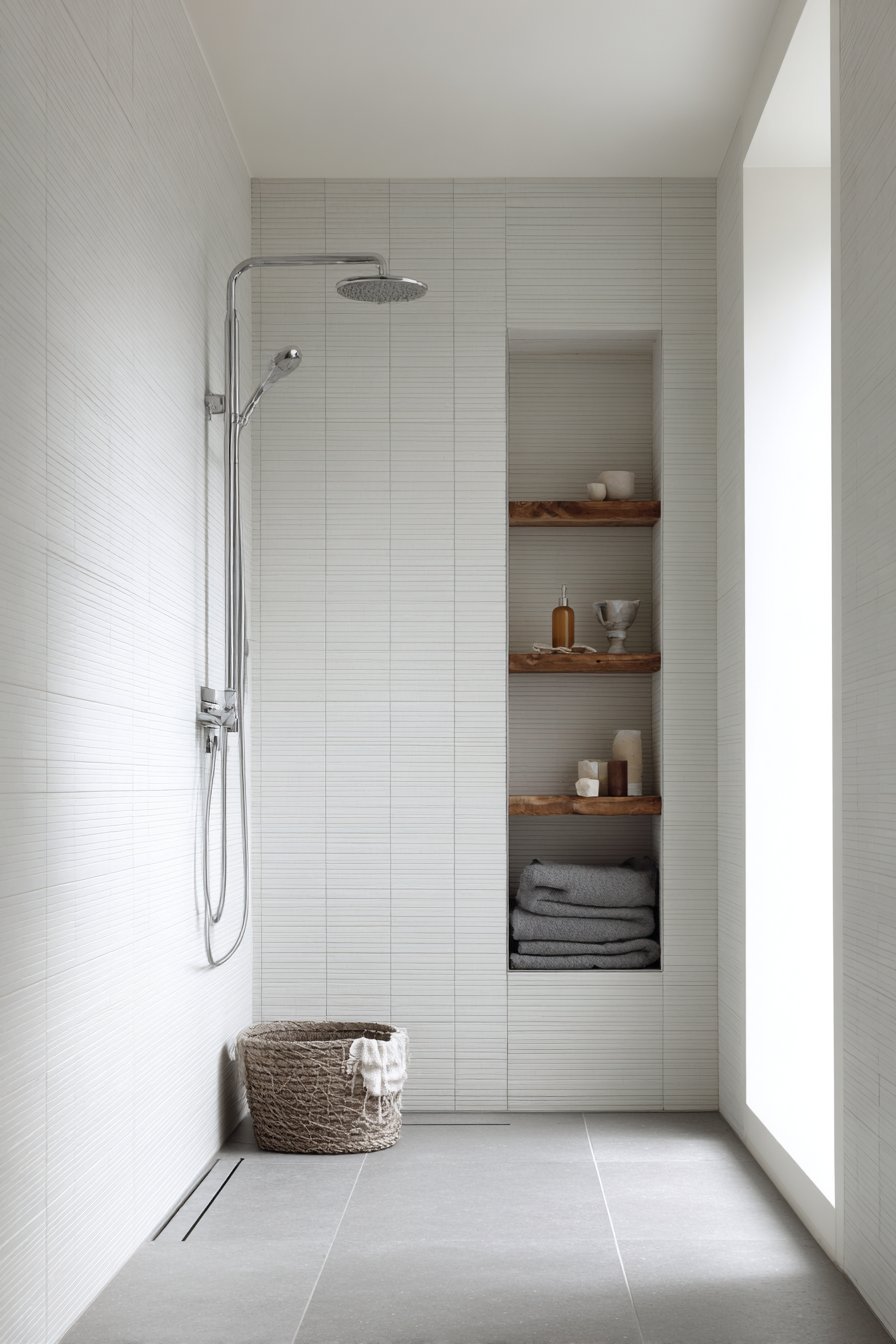
A built-in corner niche with clean horizontal lines provides storage for shower essentials. The niche integrates seamlessly into the tile work. It appears as an intentional recess rather than an added element. This thoughtful integration maintains the minimal aesthetic while solving practical storage needs.
Light grey concrete-effect floor tiles with slip-resistant finish ground the space. They provide textural contrast to the smooth wall tiles while ensuring safety.
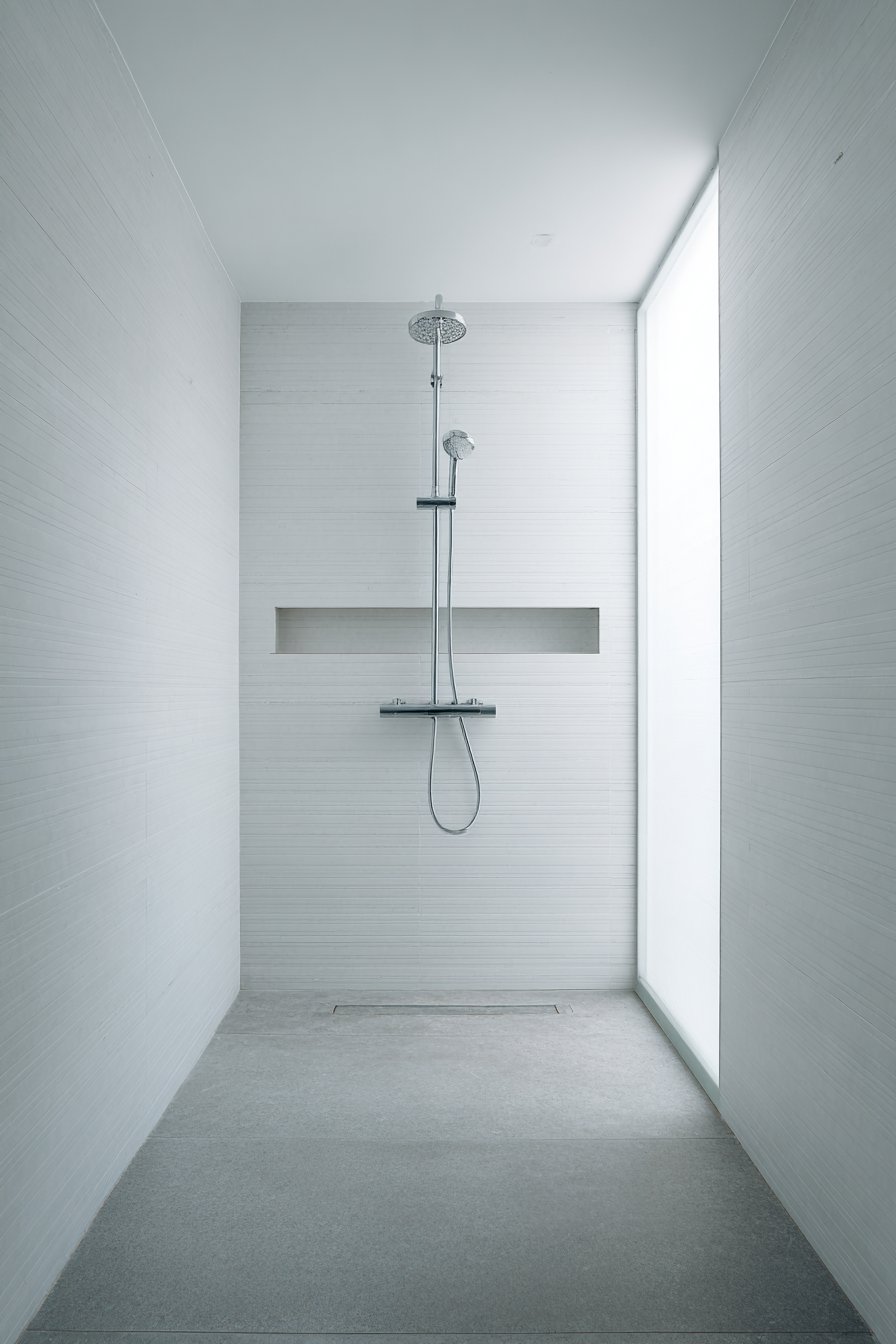
Soft natural lighting from above highlights the streamlined design. Overhead light creates gentle shadows that emphasize the geometry of the built-in niche. The precision of tile placement becomes apparent. Each edge aligns perfectly with adjacent surfaces.
The sliding bar for the hand shower demonstrates practical minimalism. It allows height adjustment without complex hardware or multiple mounting points. The simple rail mounts flush to the wall.
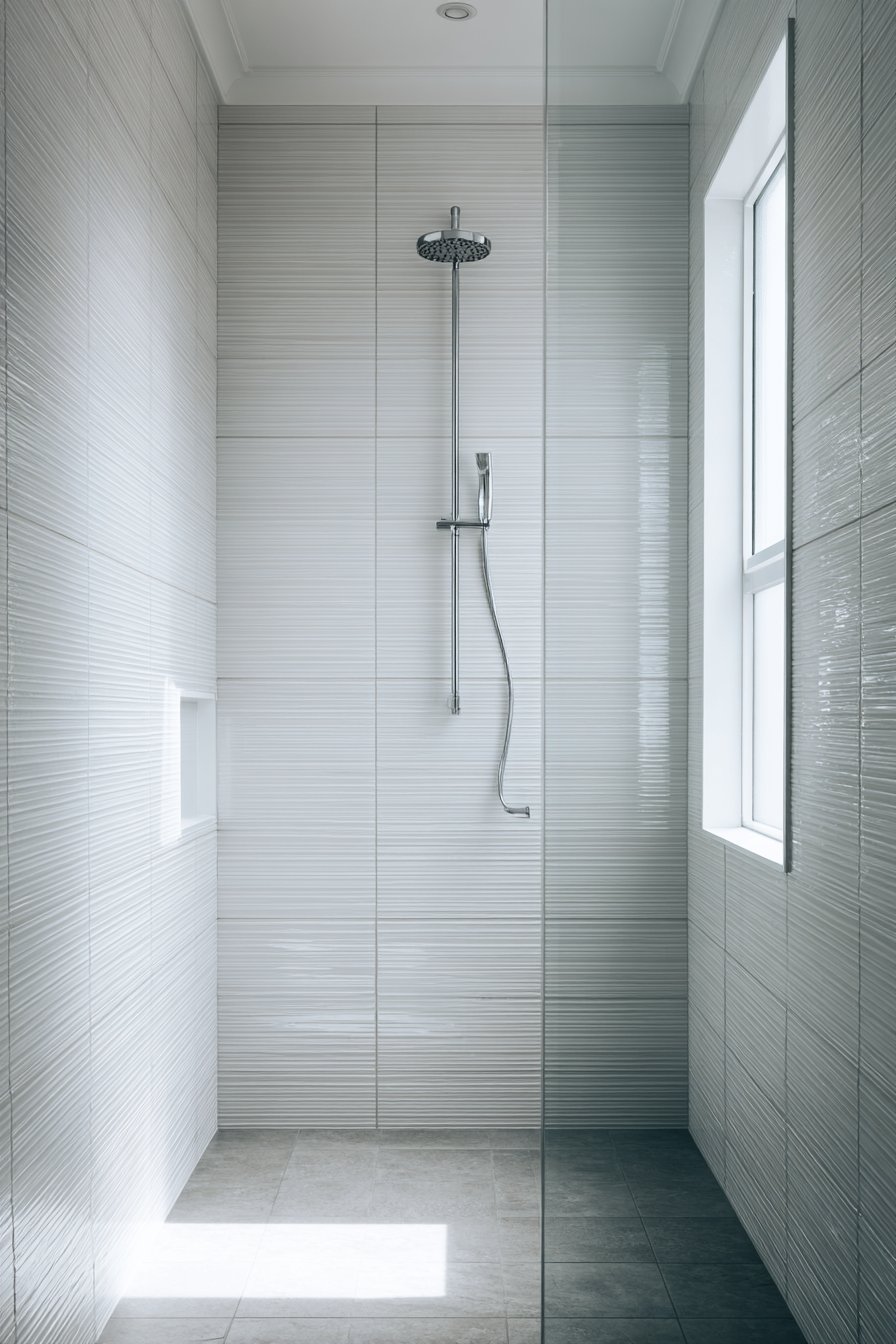
The seamless glass partition divides space without creating visual barriers. You can see through to the opposite wall. This transparency maintains the sense of openness essential in small bathrooms. The glass requires no frame or track at the bottom. Water containment comes from proper floor sloping toward the drain. This frameless approach represents the ultimate in visual simplicity.
Key Design Tips:
- Install seamless glass partitions without frames to maintain visual openness in shower areas
- Create built-in niches between wall studs for storage that doesn’t protrude into space
- Extend wall tiles from floor to ceiling for uninterrupted vertical surfaces
- Choose concrete-effect floor tiles for textural interest while maintaining a minimal palette
- Position skylights or high windows to provide natural light without compromising privacy
- Use sliding bar systems for flexible hand shower placement with minimal hardware
4. Recessed Storage and Angular Efficiency
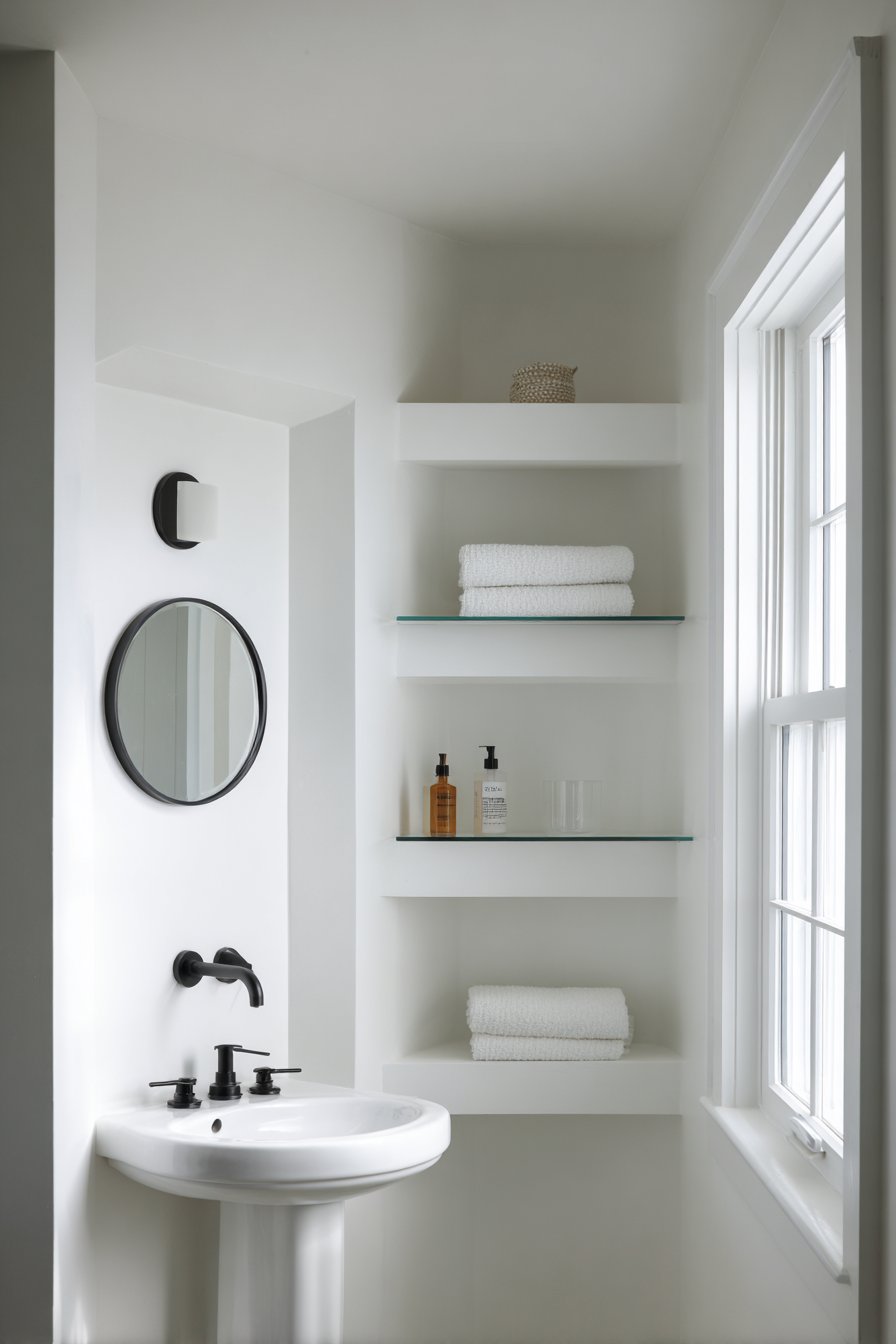
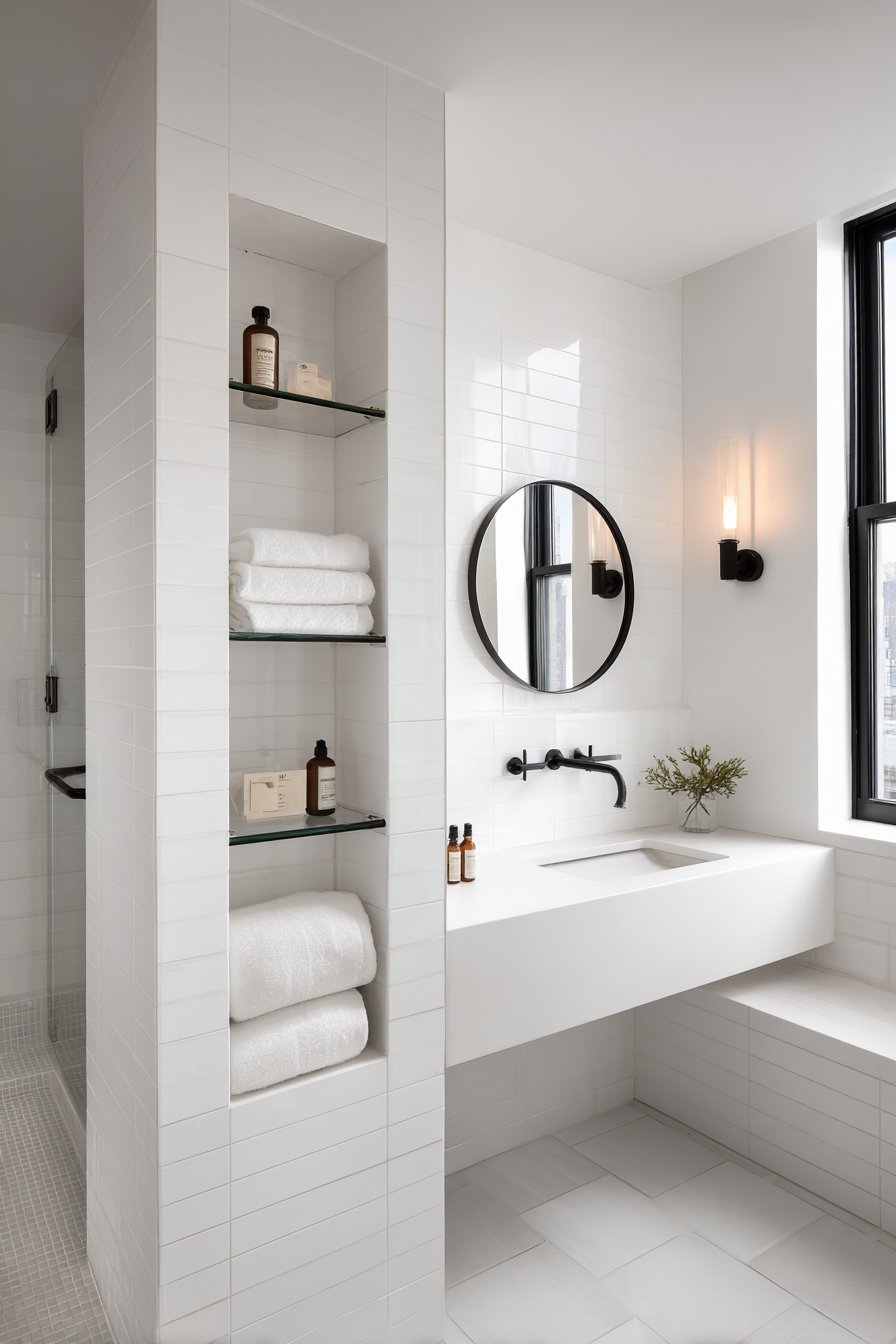
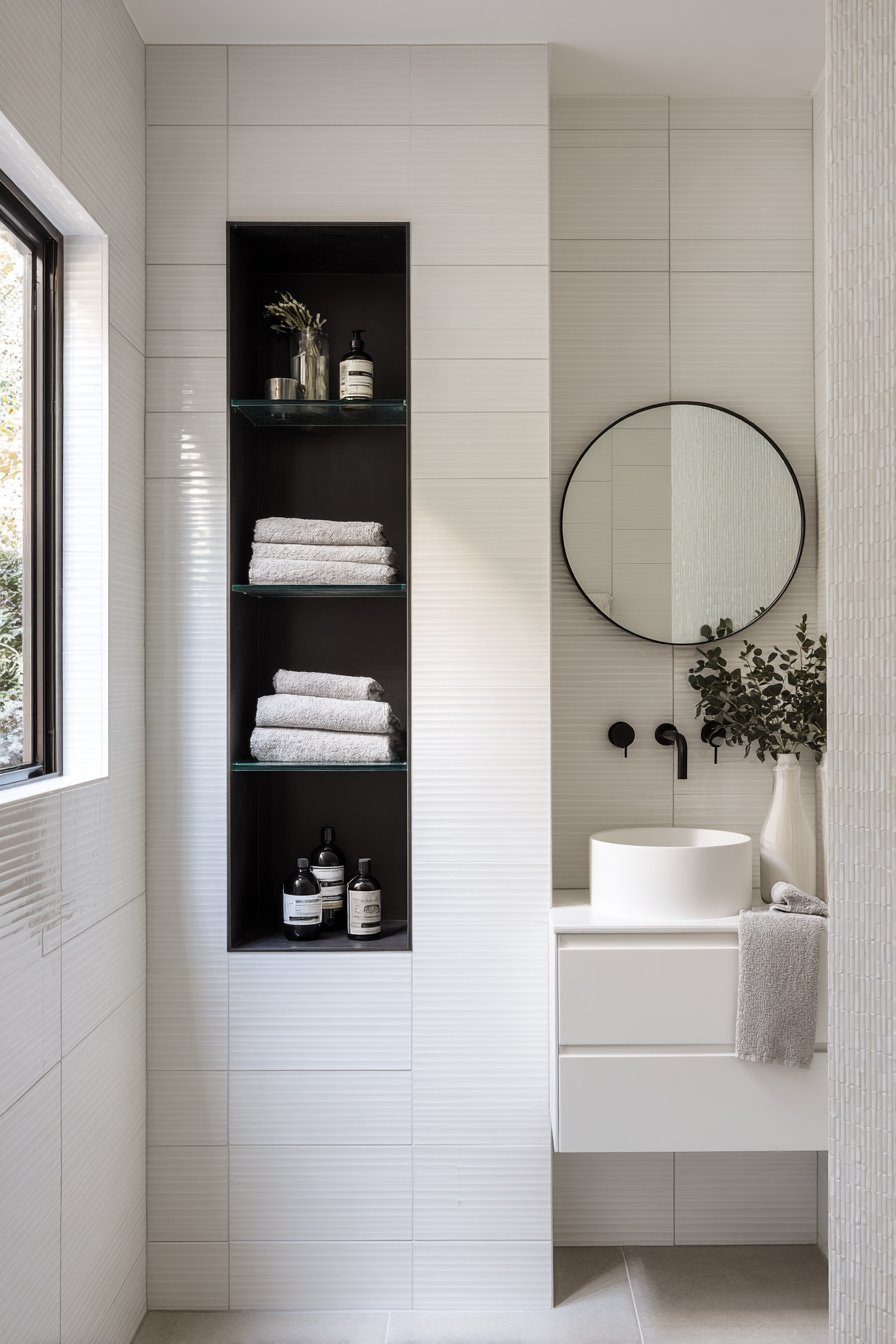
This design showcases how recessed wall niches can provide storage without consuming precious space. The niche sits between wall studs, lined with the same white tiles as the surrounding walls. Three evenly spaced glass shelves hold neatly arranged towels and minimal toiletries.
The glass shelves appear to float. They create storage tiers without visual weight. The transparent material maintains the light, open feeling throughout the space.
A compact corner sink with angular design maximizes floor space in an often-wasted area. The angular form fits precisely into the corner. It provides washing functionality while occupying minimal square footage. A small round mirror above maintains proportional balance.
The circular shape softens the angular geometry of the sink below. This creates visual harmony through contrasting forms. Matte black fixtures provide subtle contrast against the predominantly white palette.
Natural window light creates gentle highlights on the smooth surfaces. Light plays across the white tiles, revealing their subtle texture. The matte black fixtures absorb light rather than reflect it. This creates focal points that anchor the composition.
The fixtures stand out without dominating. Their dark tone provides just enough contrast to define functional elements. The round mirror reflects light back into the space. It also provides the necessary functionality for daily grooming tasks.
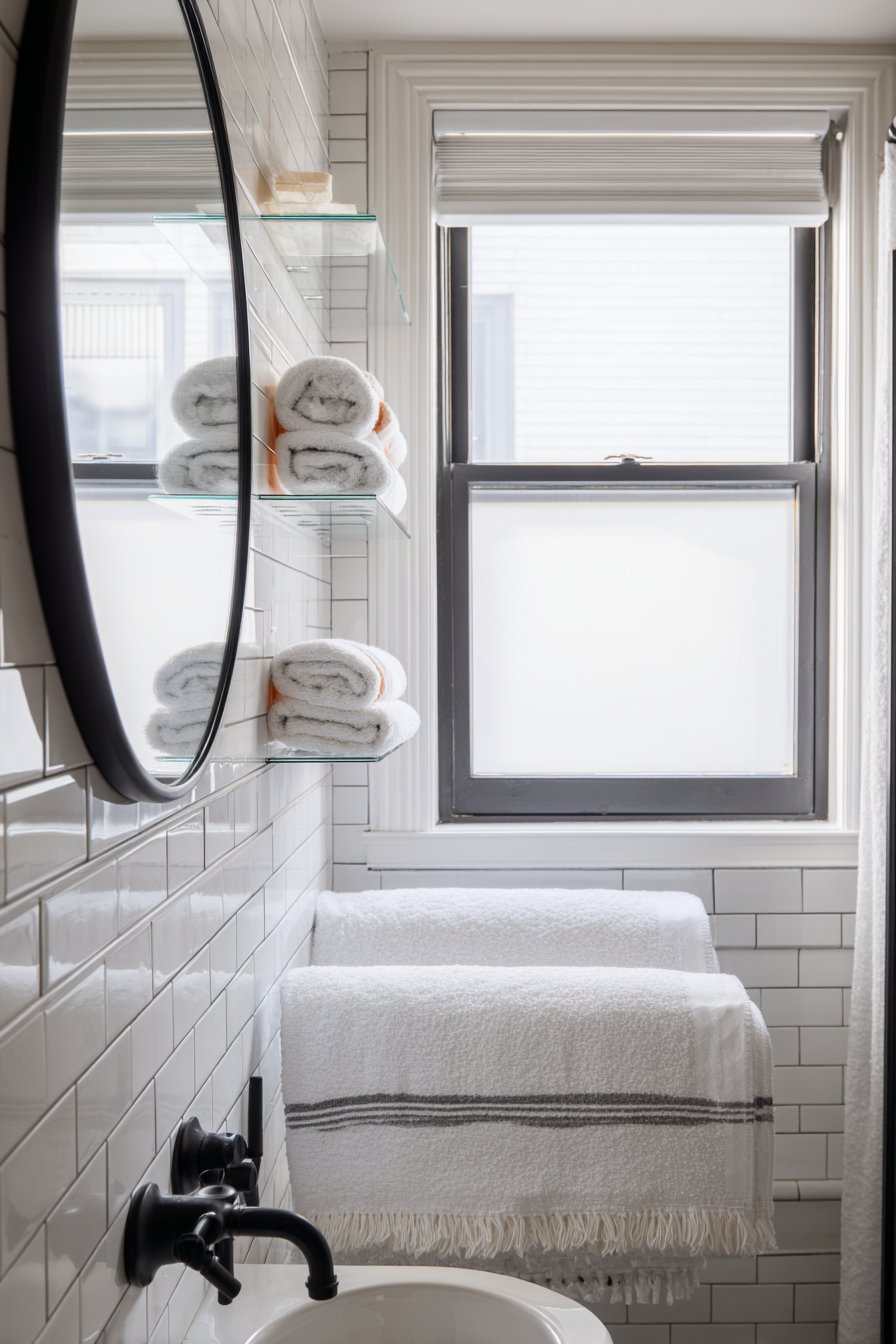
The recessed niche demonstrates brilliant spatial planning. Traditional medicine cabinets or wall-mounted shelves would protrude into the room. The recessed approach uses depth within the wall cavity. This maintains clean, flat wall surfaces while providing essential storage. The glass shelves allow light to pass through. Objects stored on lower shelves don’t cast shadows on those below.
Key Design Tips:
- Create recessed niches between wall studs for flush storage that doesn’t protrude into space
- Install corner sinks to utilize typically underused angular spaces efficiently
- Use glass shelving for storage that maintains visual lightness and allows light passage
- Introduce matte black fixtures as subtle contrast points in predominantly white spaces
- Select round mirrors to soften angular geometry and create visual balance
- Position mirrors to reflect natural light deeper into the compact bathroom
5. Light Oak Warmth and Hexagonal Interest
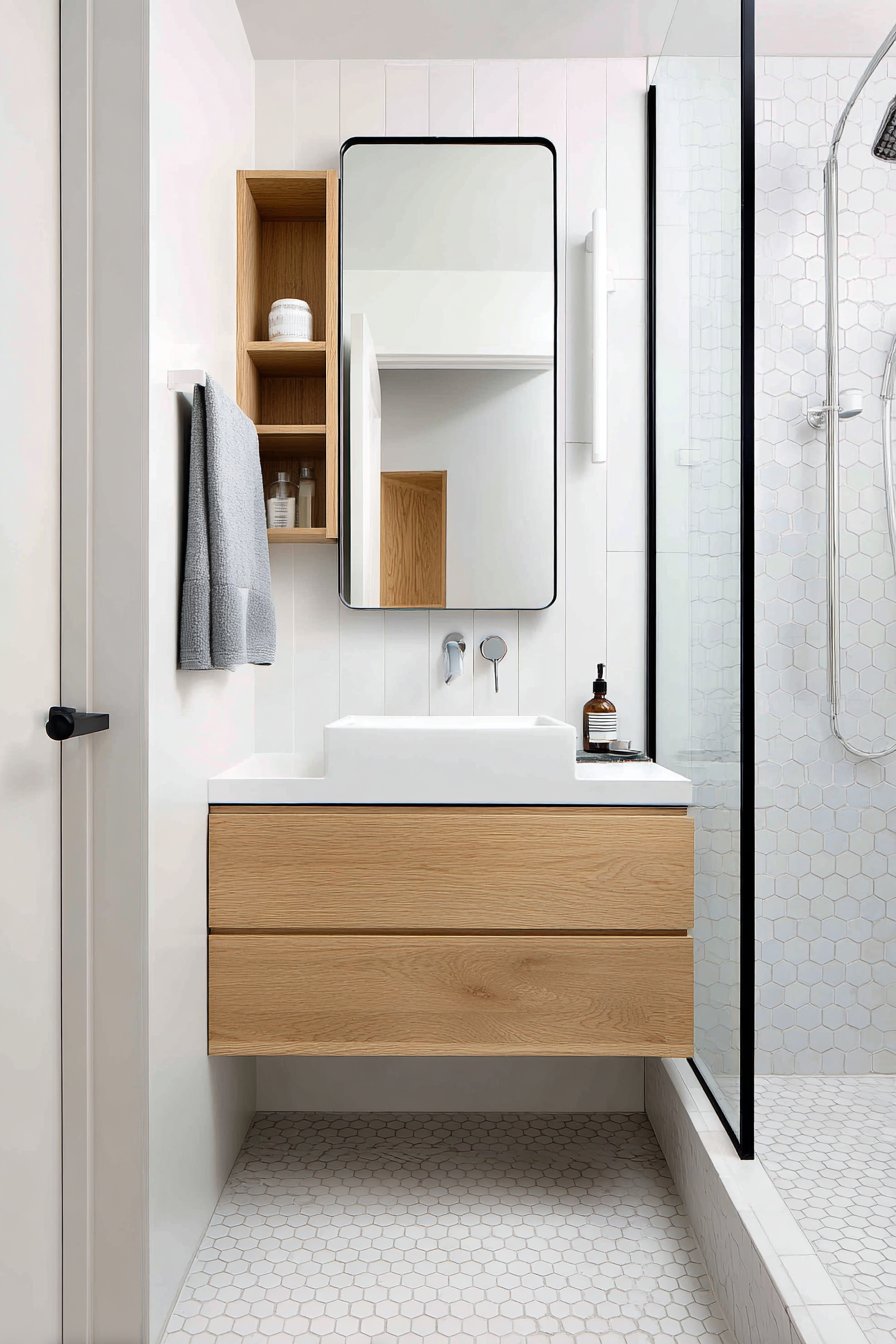
This bathroom introduces natural warmth through a light oak floating vanity that spans the narrow width efficiently. The wood tone breaks the typical all-white minimalist palette. It brings organic warmth without overwhelming the clean aesthetic.
The single integrated basin eliminates seams between sink and counter. This creates one continuous surface. Concealed soft-close drawer storage hides beneath. The mechanism provides silent operation. It reflects attention to sensory experience beyond just visual design.
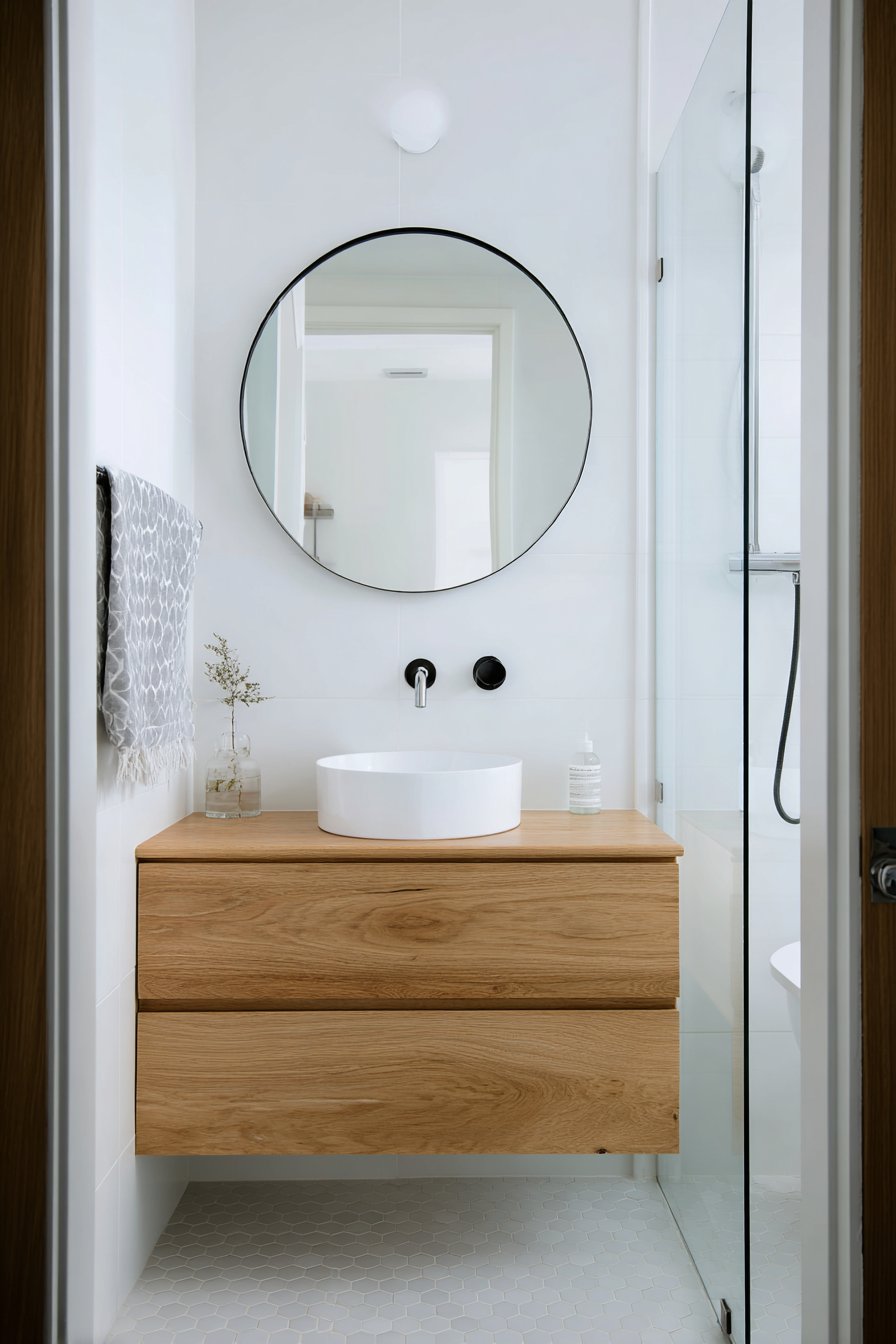
A simple rectangular mirror with thin black metal frame hangs above without elaborate mounting hardware. The minimal frame defines the mirror edges without drawing excessive attention. White hexagonal floor tiles in matte finish add subtle geometric interest.
The hexagon shape creates pattern through repetition while remaining understated. Each tile connects to six neighbors. This creates an interlocking geometry that guides the eye across the floor. The matte finish prevents glare and reduces slip risk.
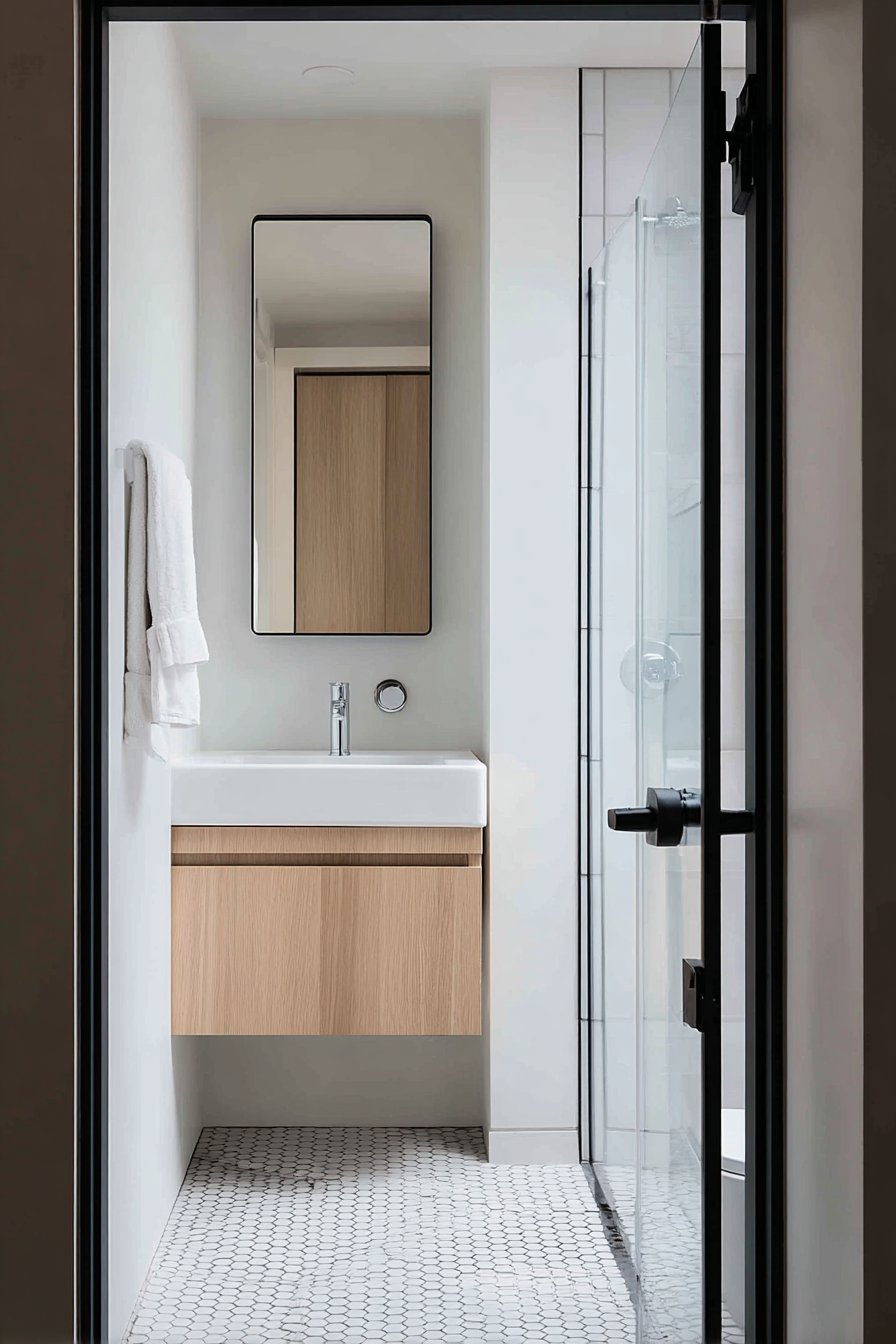
A compact glass-enclosed shower with white grout and minimal chrome fixtures occupies the far end. The white grout matches the tile color for subtle definition. Chrome fixtures echo those at the vanity. This creates material consistency throughout the space.
The glass enclosure allows views through to the back wall. Visual depth increases when sight lines remain unobstructed. Balanced natural lighting captures the cohesive simplicity and practical layout.
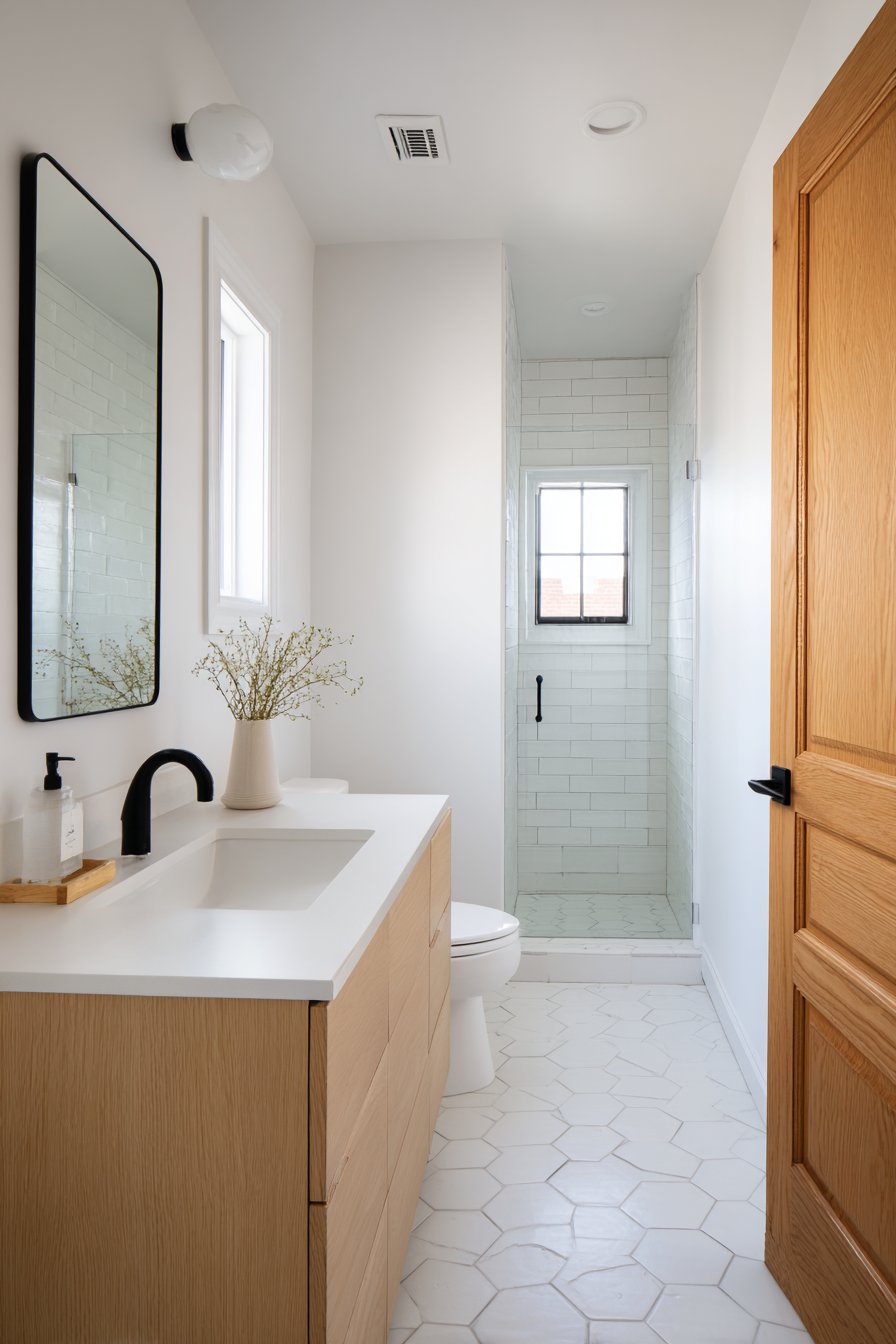
The light oak vanity provides the sole natural material in an otherwise synthetic environment. Wood brings warmth and tactile appeal. It ages gracefully, developing character over time. The floating installation creates shadow lines beneath. This emphasizes the hovering effect. The pocket door entry saves the swing space traditional doors require. It slides into the wall cavity when open. This design detail further maximizes usable square footage.
Key Design Tips:
- Introduce light wood tones to add warmth while maintaining minimalist principles
- Choose integrated basin vanities to eliminate seams and simplify cleaning
- Install soft-close drawer mechanisms for a refined sensory experience
- Use hexagonal floor tiles for subtle geometric interest without busy patterns
- Specify matte tile finishes to reduce glare and enhance slip resistance
- Consider pocket doors to eliminate door swing radius in tight spaces
6. Monochromatic Purity and Three-Piece Efficiency
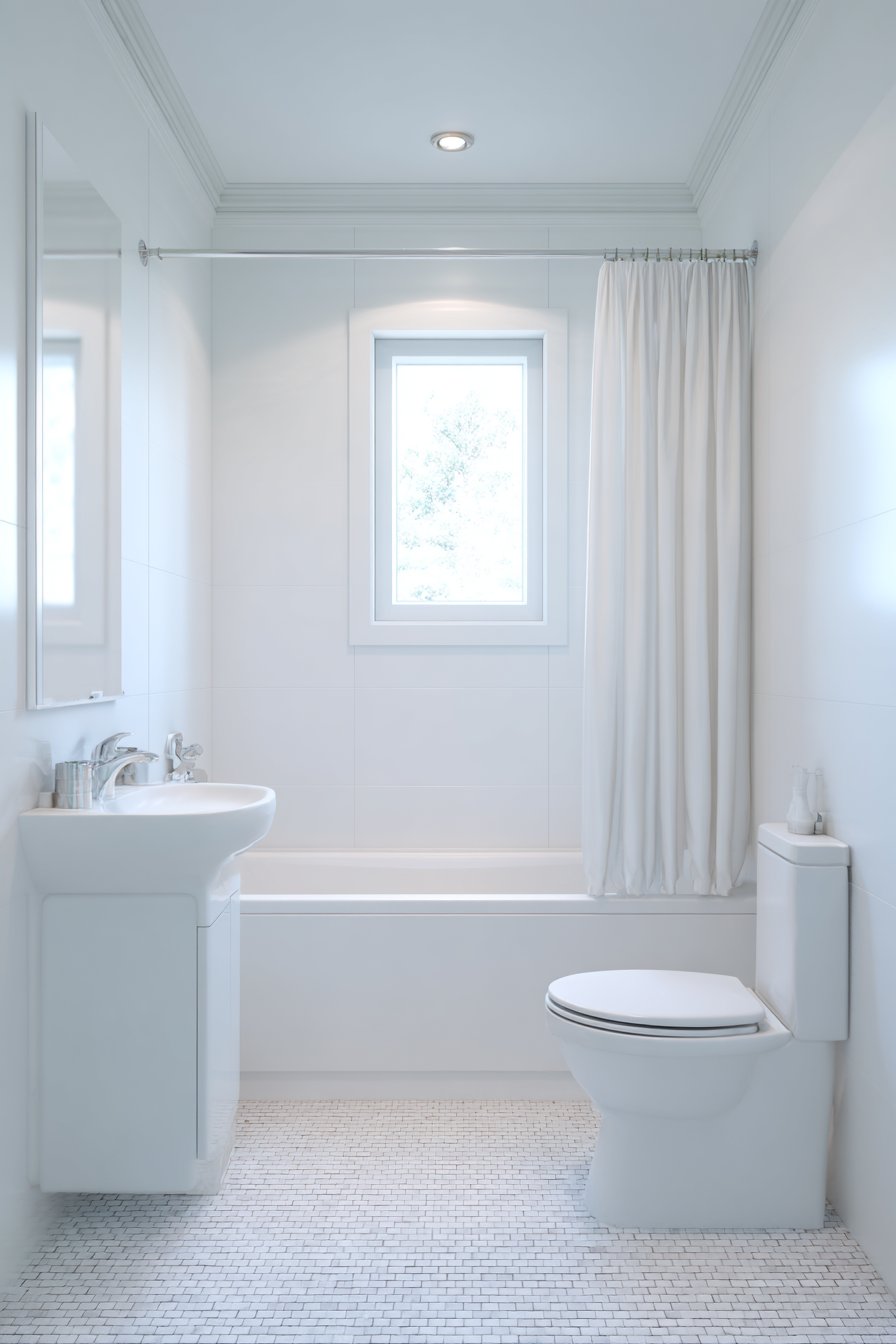
This bathroom embraces monochromatic white surfaces throughout. A compact bathtub-shower combination maximizes functionality in minimal space. The tub provides soaking capability while the shower offers quick bathing.
A simple white shower curtain on a straight chrome rod divides the wet area from the rest of the room. The straight rod mounts directly to opposing walls. No curved tracks or complex hardware needed. This exemplifies functional minimalism.
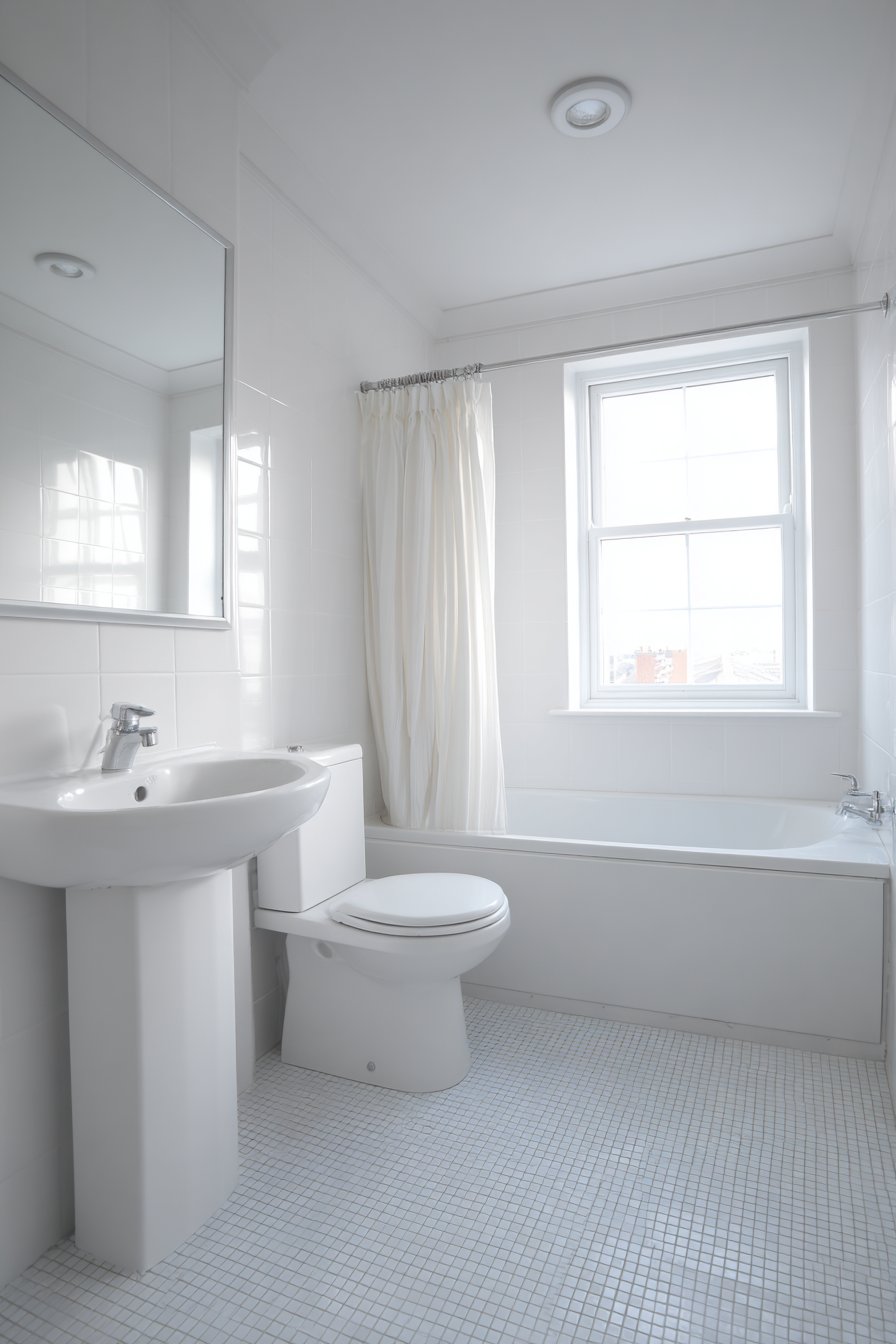
The white three-piece bathroom suite includes a close-coupled toilet and pedestal sink with clean geometric forms. Each piece exhibits simple, straightforward design. No decorative flourishes or ornamental details appear. The close-coupled toilet features an integrated tank and bowl. This reduces visual bulk compared to traditional two-piece designs. The pedestal sink stands on a slender column. Its narrow base preserves floor space while providing adequate washing area.
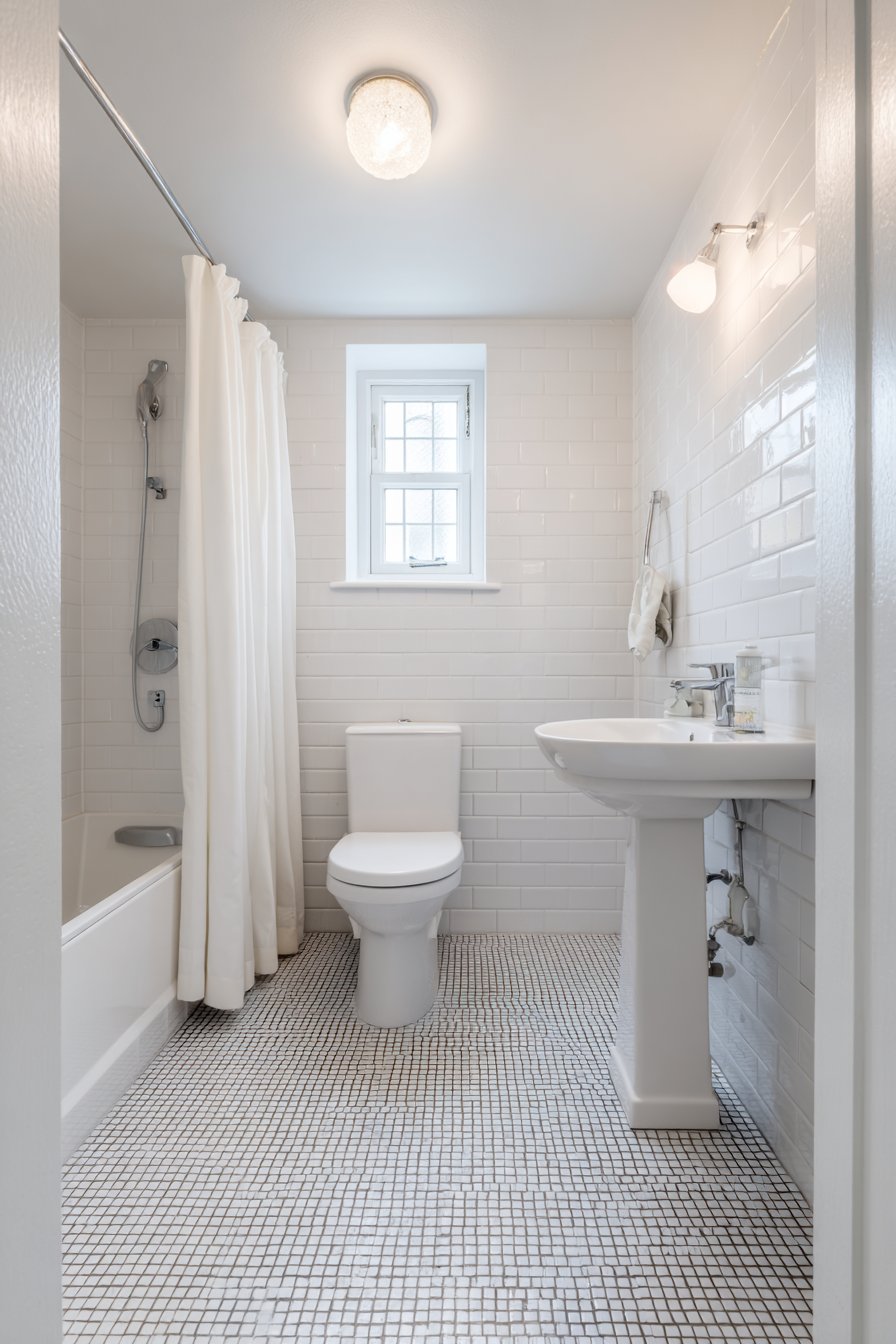
Walls feature smooth white painted finish. The seamless surface requires no grout lines or tile joints. This creates the cleanest possible backdrop. Small white mosaic tiles with light grey grout cover the floor. The small scale provides slip resistance. The grout color maintains the light, bright feeling.
A single recessed ceiling light provides even illumination. The centered fixture eliminates shadows in corners. A small frosted glass window admits natural light while maintaining privacy.
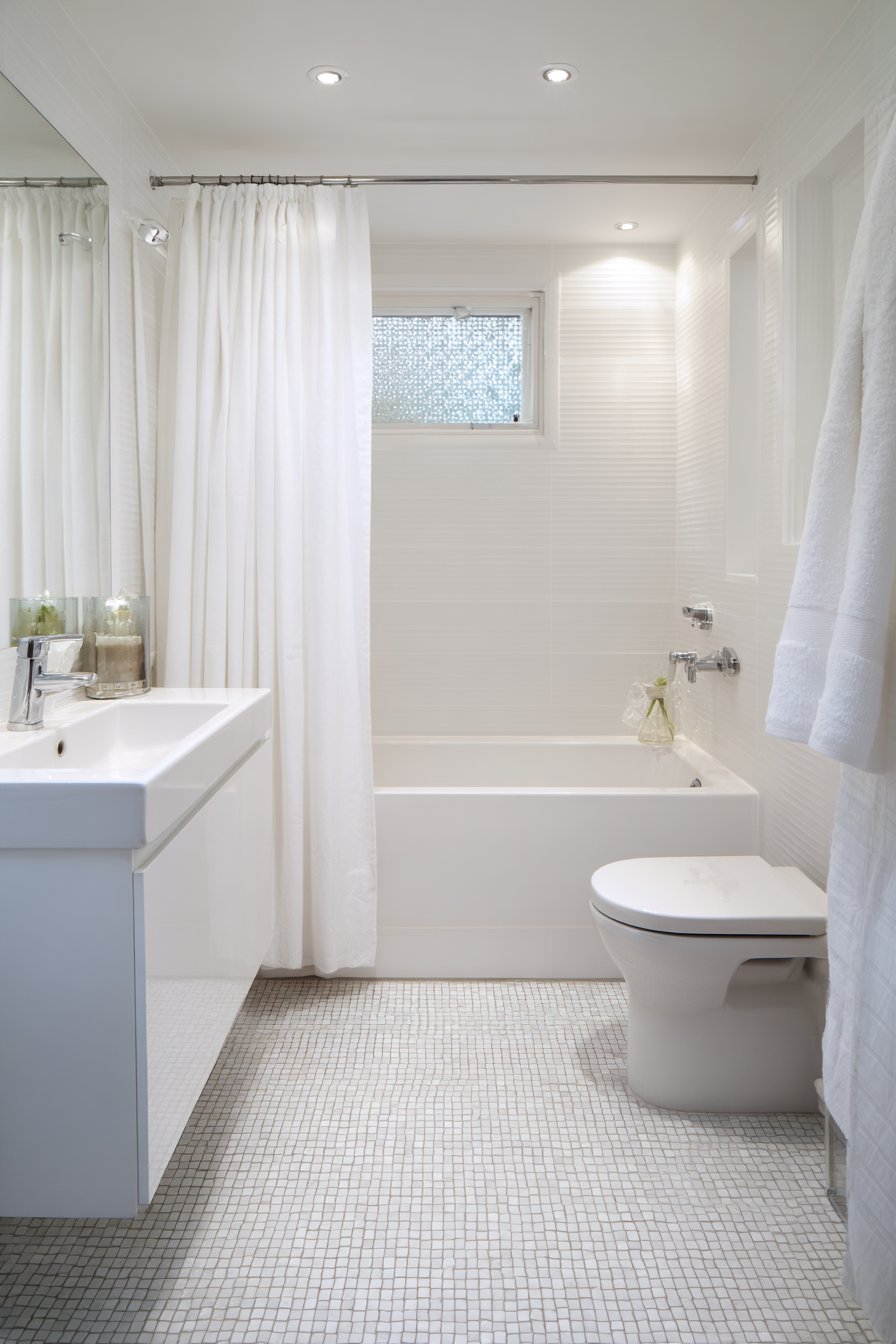
The all-white palette could feel cold or institutional. However, the interplay of different white materials creates subtle variation. Painted walls have one texture. Porcelain fixtures present another. The shower curtain fabric introduces yet another. These subtle differences in sheen and texture prevent monotony. The space feels cohesive rather than boring. Everything belongs to the same family of whites while maintaining individual character.
Key Design Tips:
- Combine tub and shower functions when space doesn’t allow separate fixtures
- Use straight shower curtain rods for the simplest installation and clean lines
- Choose close-coupled toilets to reduce visual bulk of traditional two-piece designs
- Install pedestal sinks with narrow bases to maximize floor space visibility
- Select small mosaic floor tiles for slip resistance in compact wet areas
- Use single centered ceiling lights for even, shadow-free illumination
7. Accessible Luxury with Natural Accents
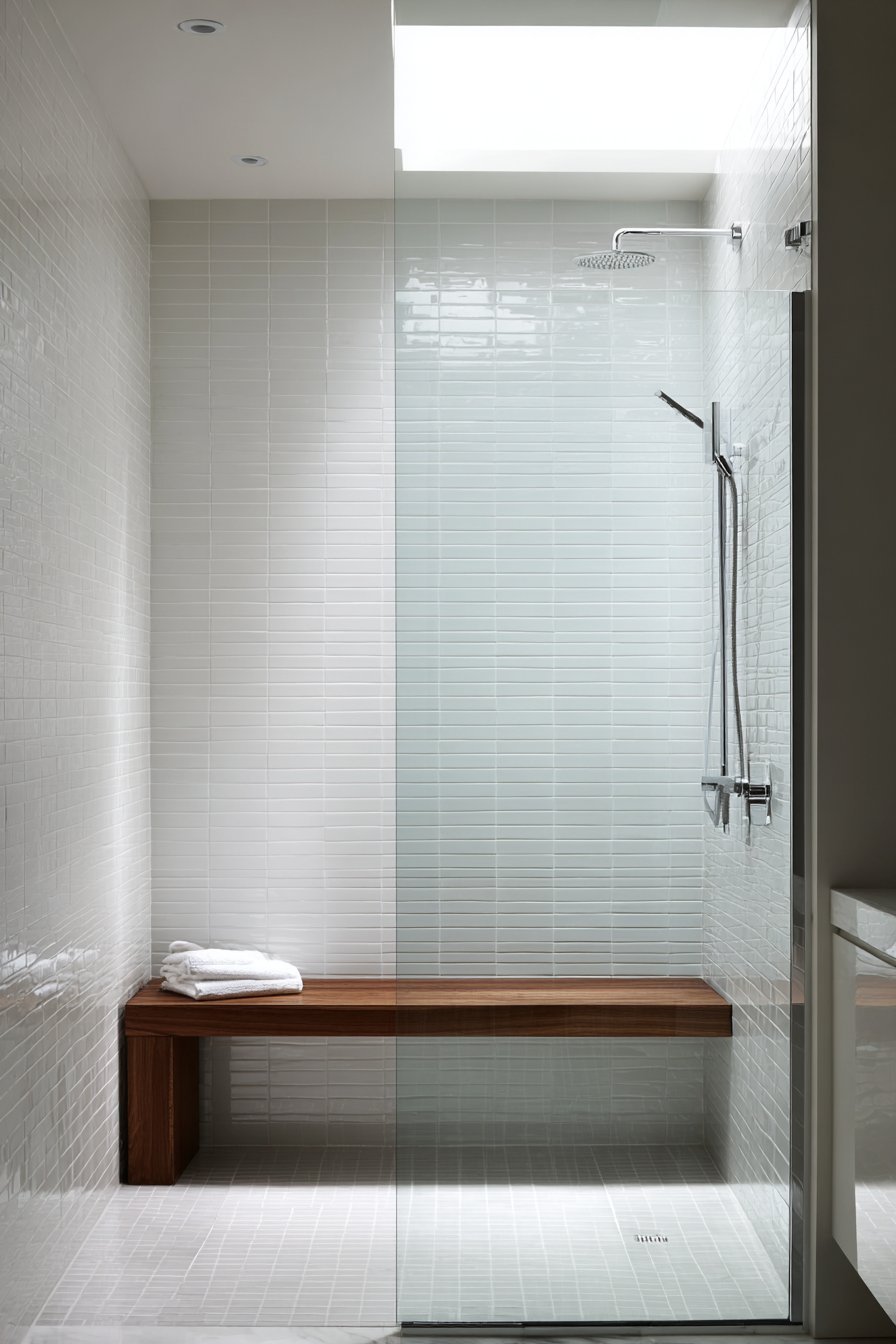
This design prioritizes accessibility without sacrificing aesthetics. A walk-in shower features a curbless entry and linear drain. The zero-threshold entry allows easy access for all mobility levels. It also creates visual continuity between bathroom floor and shower floor.
The linear drain sits flush with the floor. Water flows across a gentle slope toward the drainage channel. This maintains the flat, uninterrupted floor plane essential to the minimalist aesthetic.
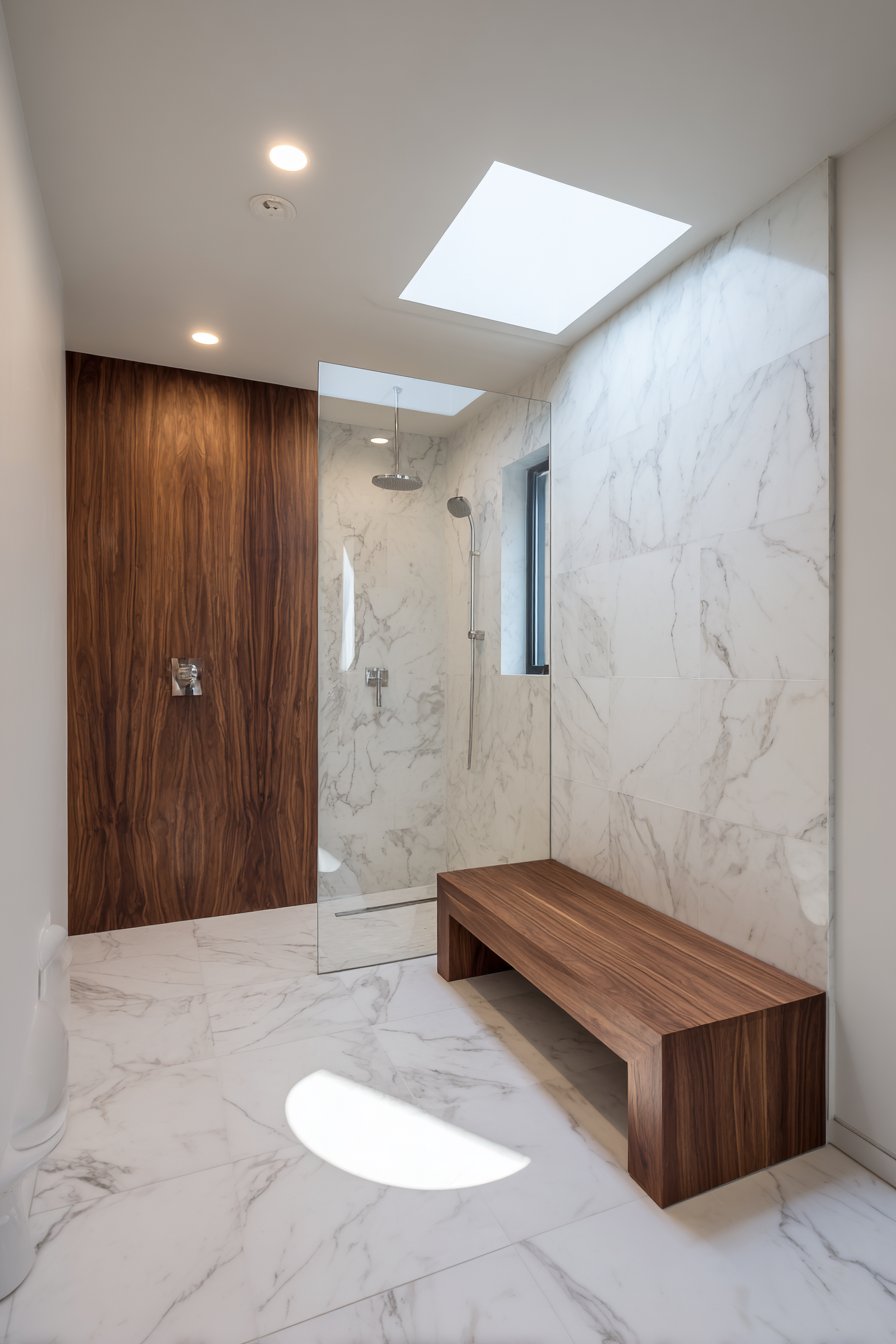
Large white porcelain tiles in twelve-by-twenty-four-inch format create a sense of spaciousness. Fewer grout lines mean less visual interruption. The eye can travel across larger expanses of continuous surface. A wall-mounted teak wood shower bench provides functional seating.
The natural wood introduces organic warmth into the white environment. Teak’s natural oils make it water-resistant. It develops a beautiful silver patina over time when left unsealed. This aging process adds character and visual interest.
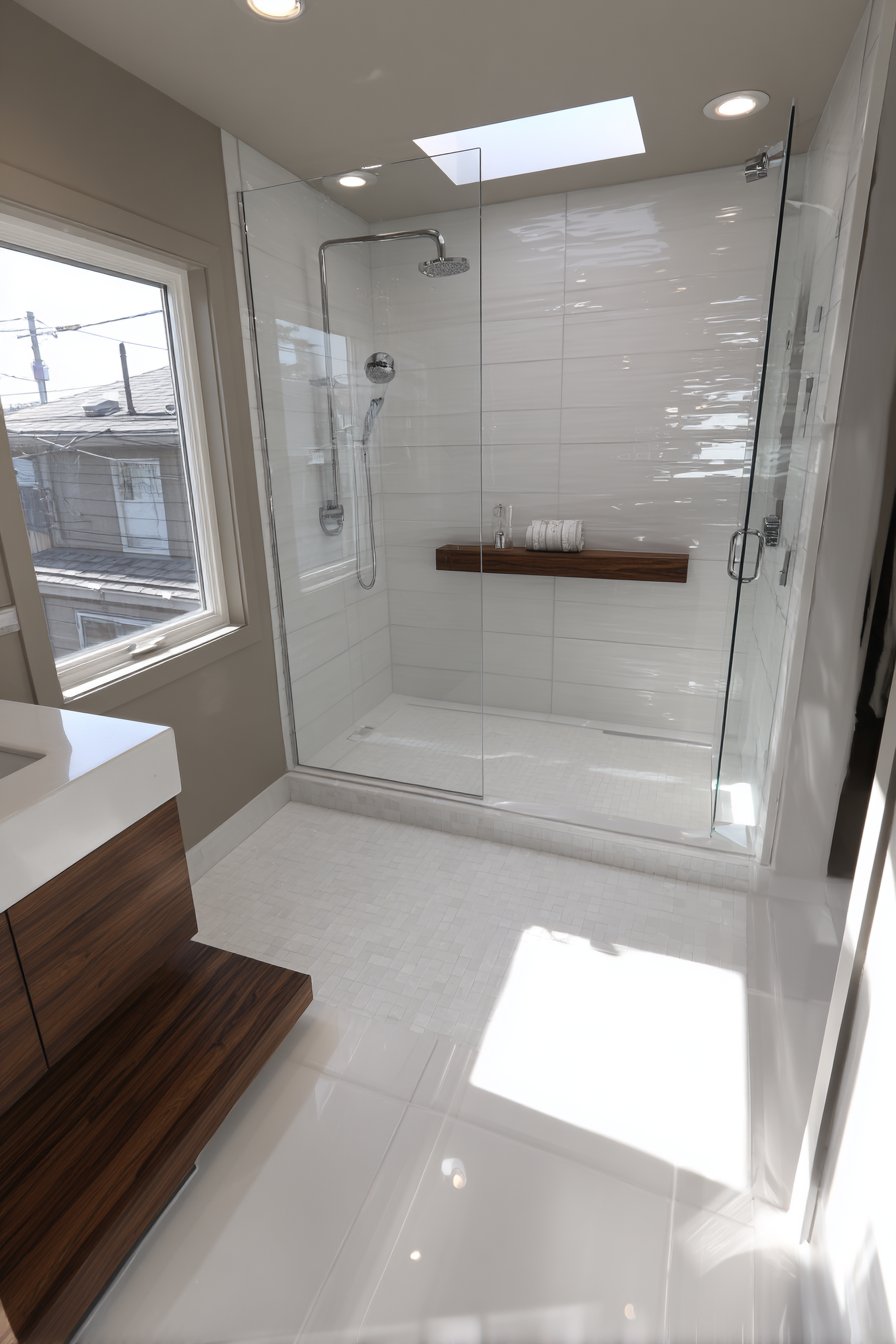
Chrome fixtures with simple cylindrical forms maintain the minimal vocabulary. Each fixture reduces to its essential geometric shape. Handles, spouts, and shower heads all speak the same design language. A skylight above the shower fills the space with natural daylight.
The overhead window creates dynamic shadows throughout the day. Morning light differs from afternoon light. The space transforms with the sun’s movement. This natural variation prevents the static feeling some minimalist spaces can have.

The curbless entry represents universal design principles. What benefits wheelchair users also benefits parents with strollers and anyone entering with arms full of laundry. The design becomes more functional for everyone. The linear drain requires careful floor sloping. Water must flow reliably toward the channel. Professional installation ensures proper drainage without standing water. The teak bench can fold up against the wall when not needed. This preserves open shower space for standing users.
Key Design Tips:
- Install curbless shower entries for accessibility and visual continuity with bathroom floor
- Use linear drains to maintain flat floor planes essential to minimalist design
- Incorporate large-format tiles to minimize grout lines and create spacious feeling
- Add teak wood benches for natural warmth that withstands moisture
- Position skylights above showers for dynamic natural lighting throughout the day
- Choose cylindrical fixture forms for simple, timeless geometric shapes
8. Honest Materials and Exposed Plumbing
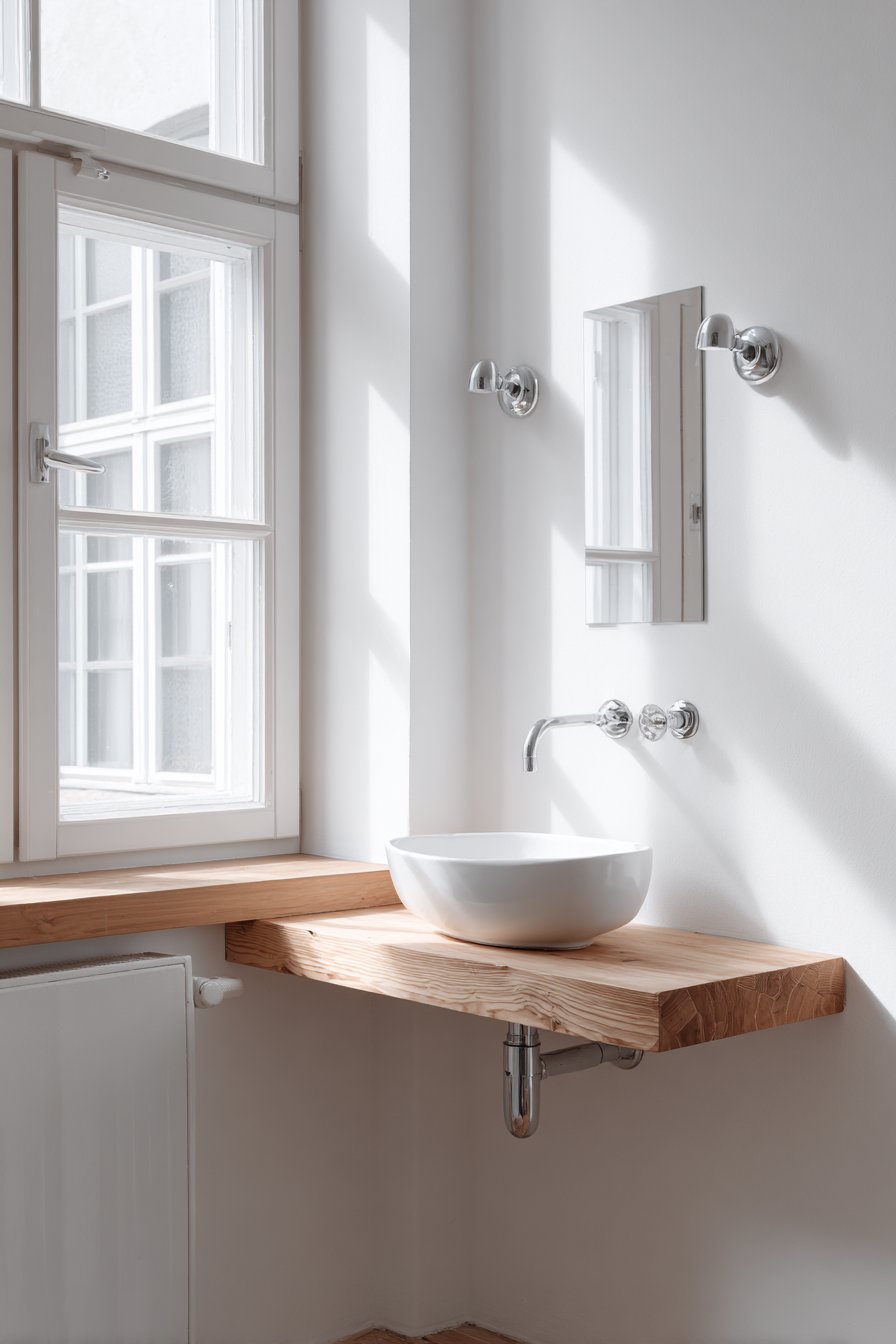
This bold design celebrates honest material expression. A narrow floating shelf in natural maple wood supports a white oval vessel sink. The sink sits atop the shelf like a sculptural object. The exposed plumbing features a simple chrome bottle trap.
Rather than hiding the plumbing within cabinetry, this design makes it visible. The bottle trap becomes a design element. Its clean, geometric form contributes to the overall aesthetic rather than creating visual clutter.
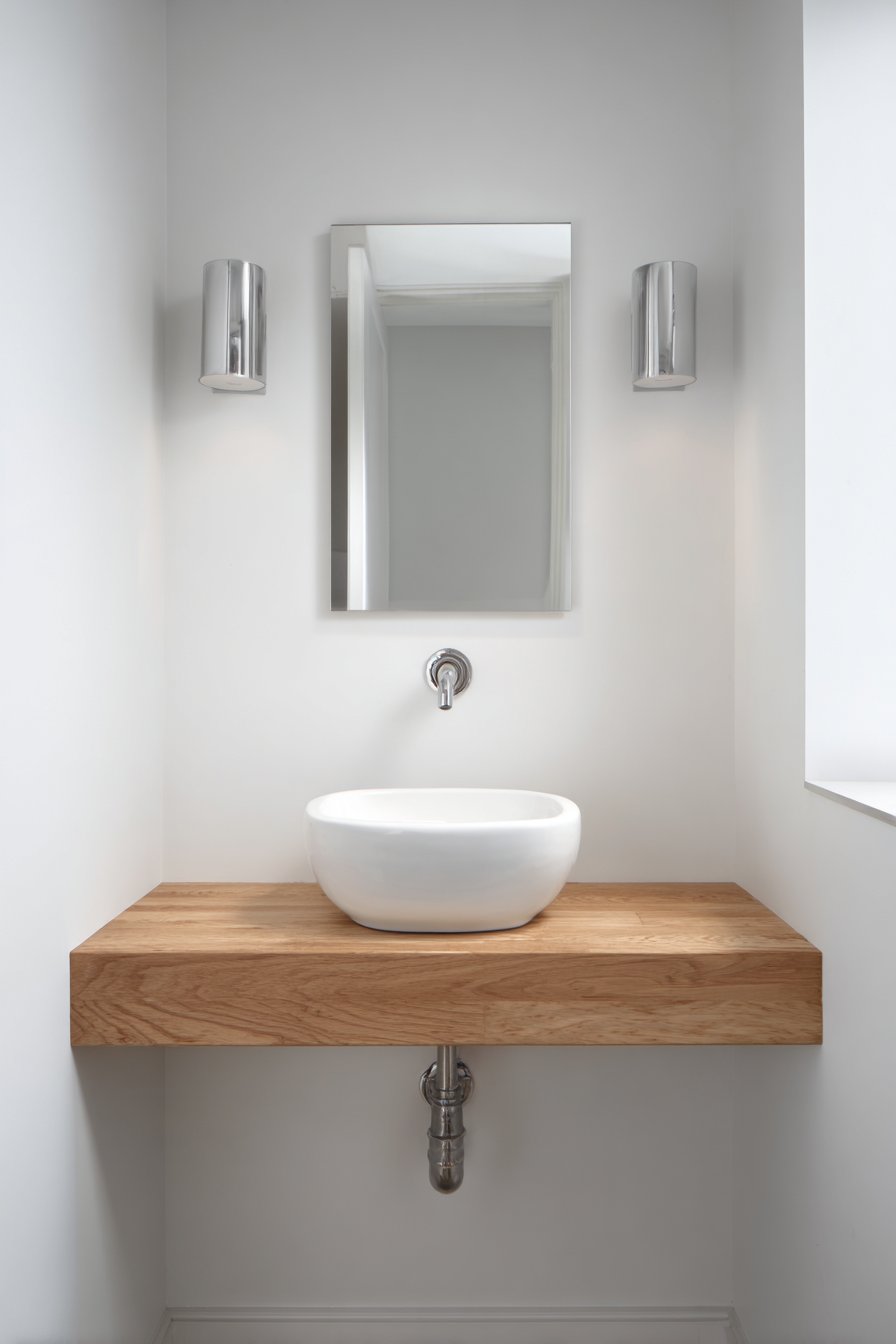
A small rectangular mirror sits directly on the white wall without a frame. The mirror’s edges meet the wall cleanly. No frame mediates between reflective surface and background. This direct approach eliminates unnecessary elements.
Two simple wall-mounted chrome sconces provide task lighting. They flank the mirror symmetrically. The exposed bulbs create points of bright light. Open space beneath the floating shelf maintains visual lightness essential in compact rooms.
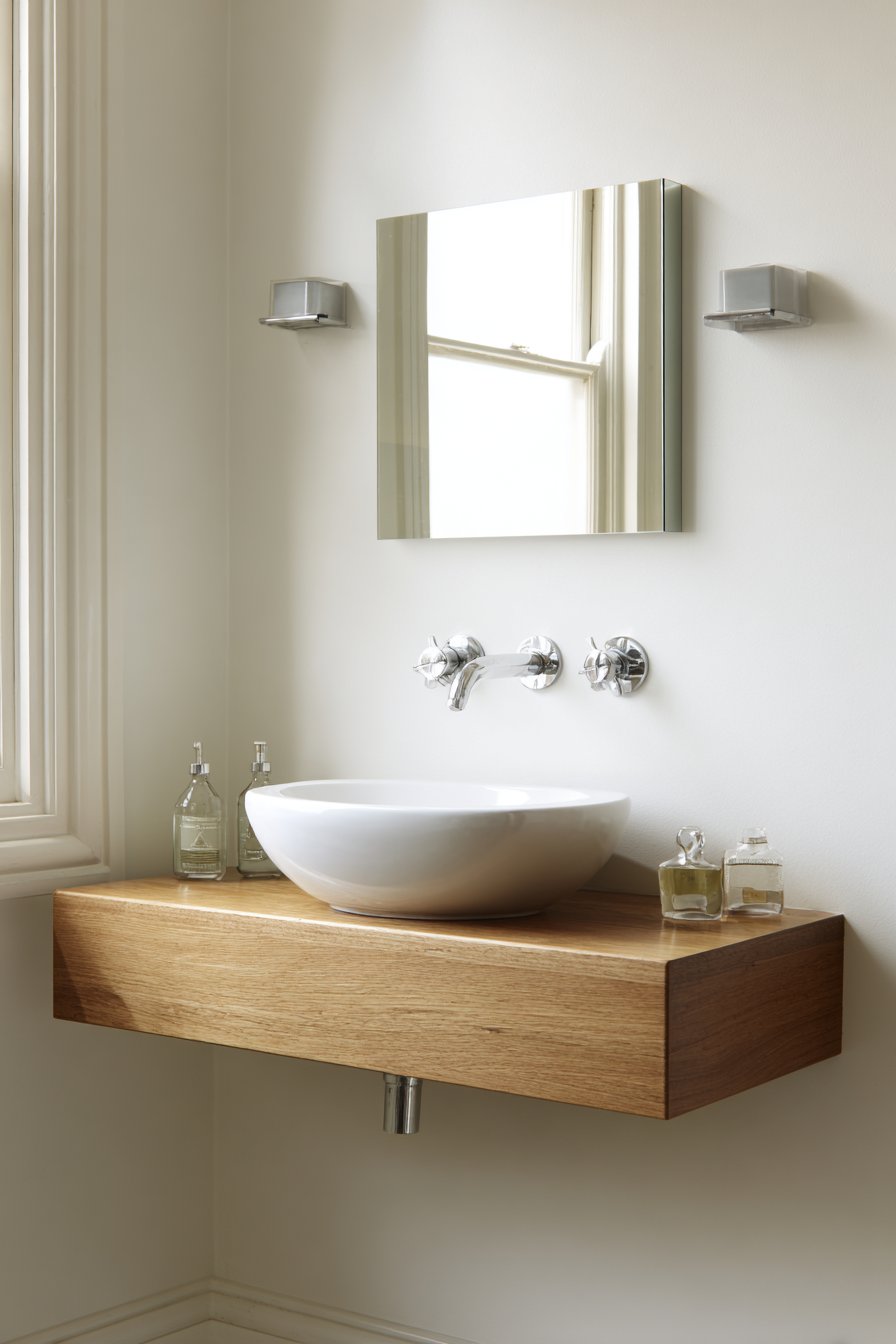
Soft natural window light from the side creates gentle highlights. The light grazes across the white wall. It emphasizes the texture of the painted surface. The maple shelf’s wood grain becomes apparent under natural illumination.
Each unique pattern in the wood tells a story of the tree’s growth. The vessel sink’s white porcelain contrasts with the natural wood. The two materials complement each other through their differences. One organic, one manufactured. One warm, one cool.
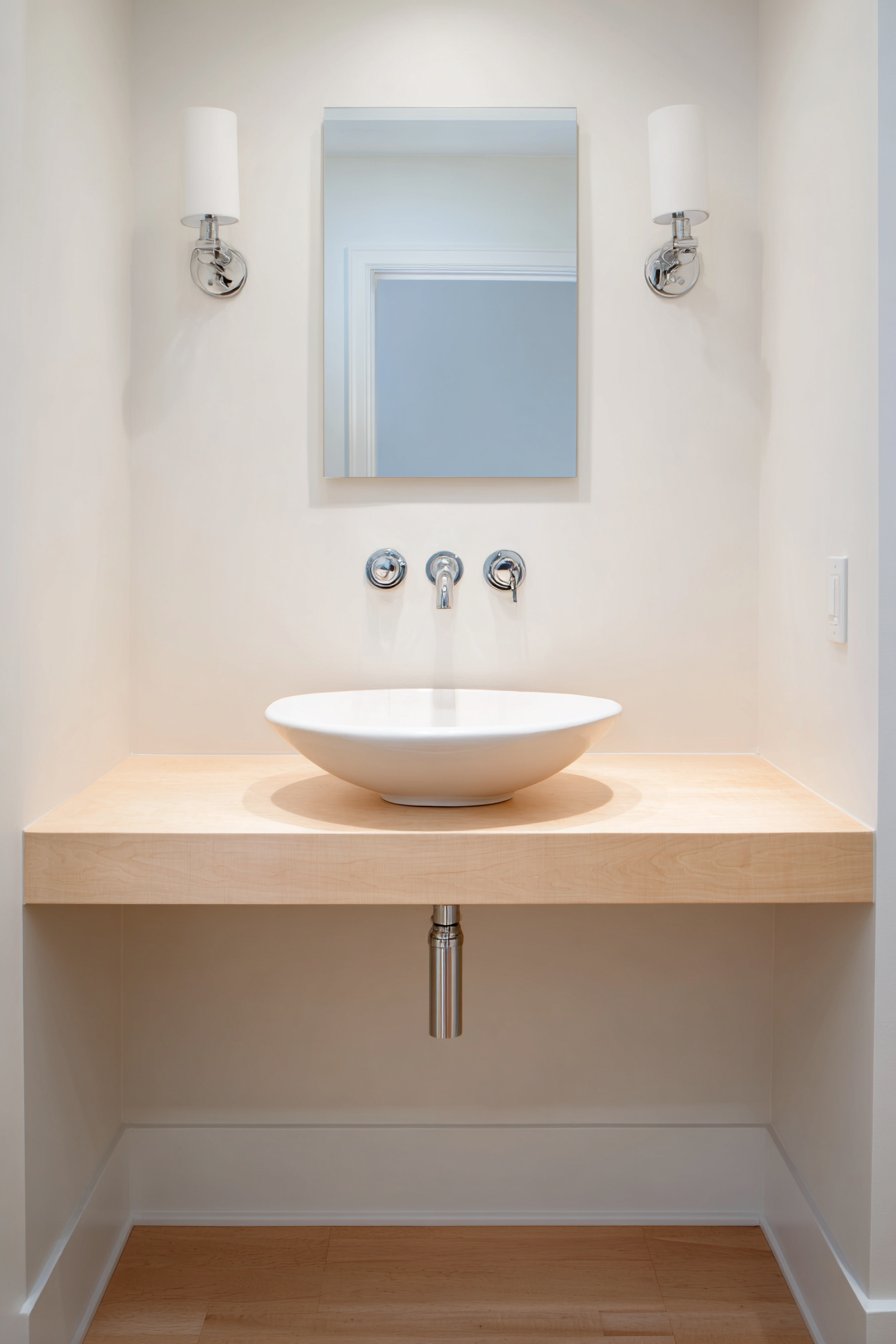
The exposed plumbing approach requires confidence. Most bathroom designs hide pipes and drains. This design embraces them as honest expressions of function. The chrome finish on the bottle trap matches the faucet and sconces. Material consistency unifies the disparate elements. The floating shelf installation requires secure mounting into wall studs. The shelf must support the sink’s weight plus water and user interaction. Professional installation ensures structural integrity while maintaining the floating appearance.
Key Design Tips:
- Use floating shelves instead of bulky vanities to maintain visual lightness
- Expose plumbing with attractive finishes as honest design elements
- Choose vessel sinks as sculptural objects that sit atop surfaces
- Mount mirrors directly on walls without frames for ultimate simplicity
- Install wall-mounted sconces for task lighting that doesn’t consume counter space
- Select natural wood shelving for organic warmth against white backgrounds
9. Vertical Emphasis and Corner Efficiency
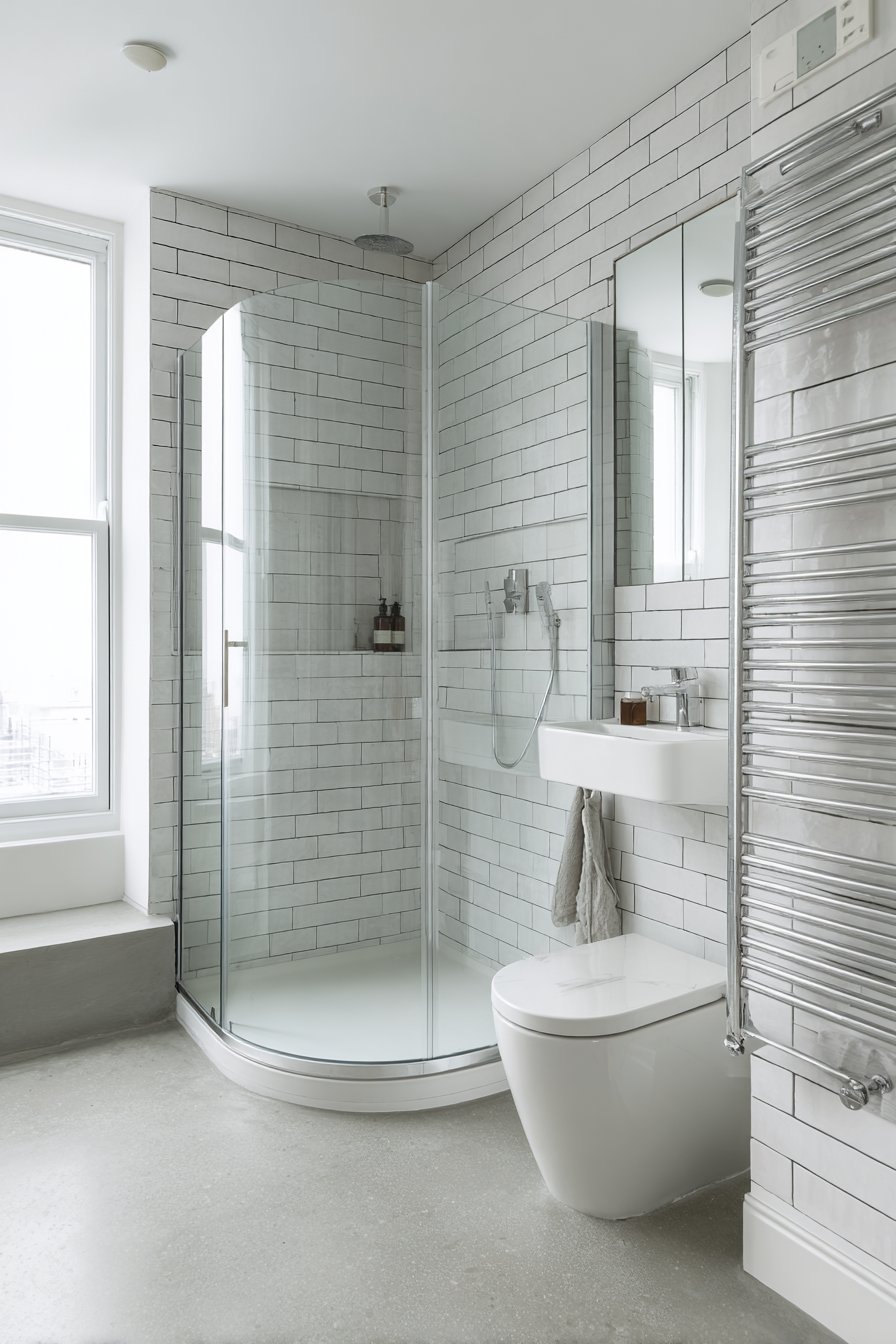
This bathroom employs floor-to-ceiling white vertical subway tiles. The vertical orientation creates an elongating visual effect. The eye travels upward along the tile lines. This draws attention to the full height of the space. The ceiling appears higher than it actually measures.
A compact corner shower with curved glass panel maximizes the limited footprint. The curved panel follows the corner’s natural arc. It defines the shower zone while consuming minimal floor area.
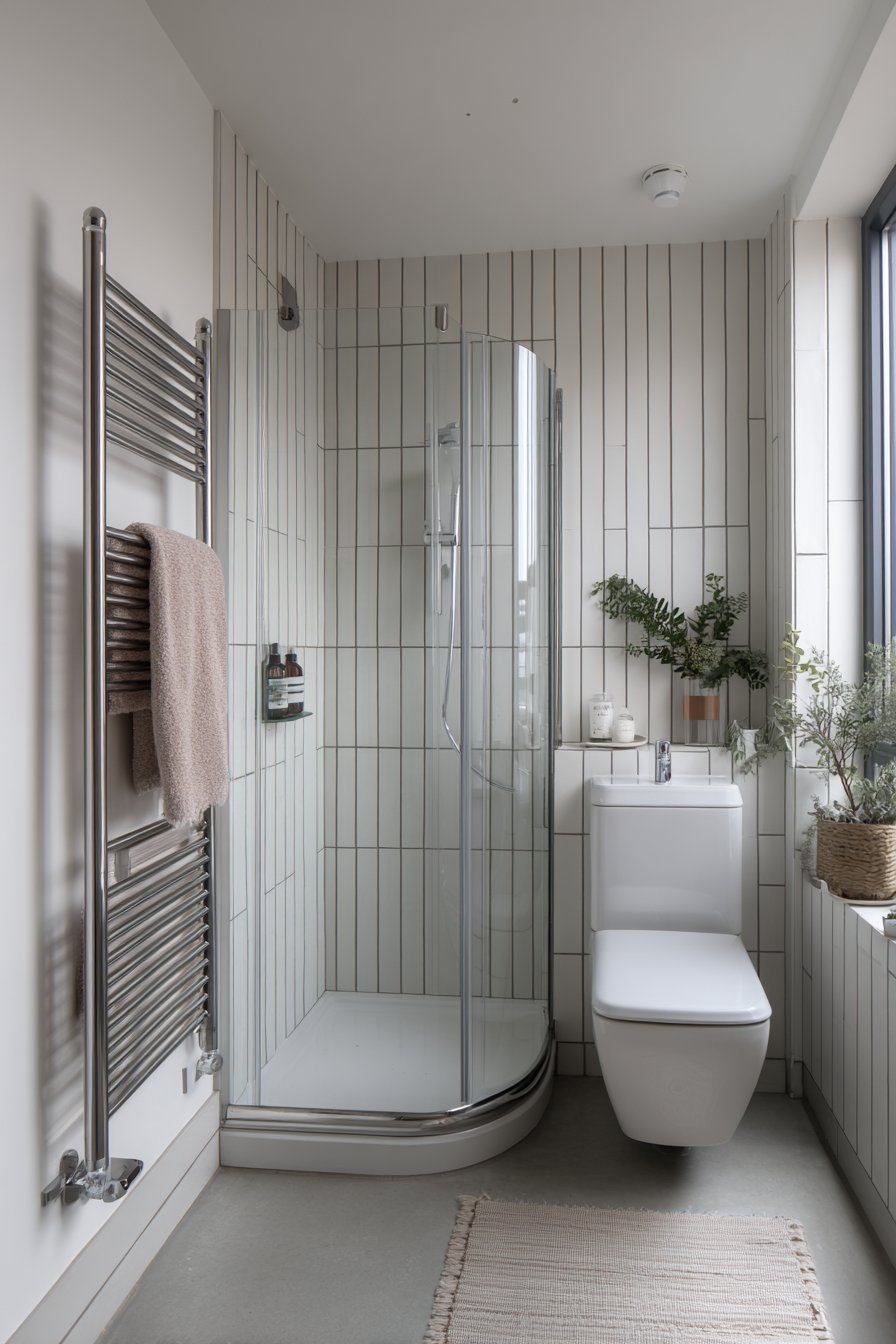
A simple white wall-hung sink with a minimal chrome faucet occupies the opposite corner. Corners often become wasted space in small bathrooms. This design intentionally places key fixtures in corners. The strategy opens up the central floor area. The toilet features a concealed cistern with a simple flush plate. The cistern hides within the wall. Only the flush plate remains visible on the wall surface. This creates a clean wall plane without the bulk of a traditional toilet tank.
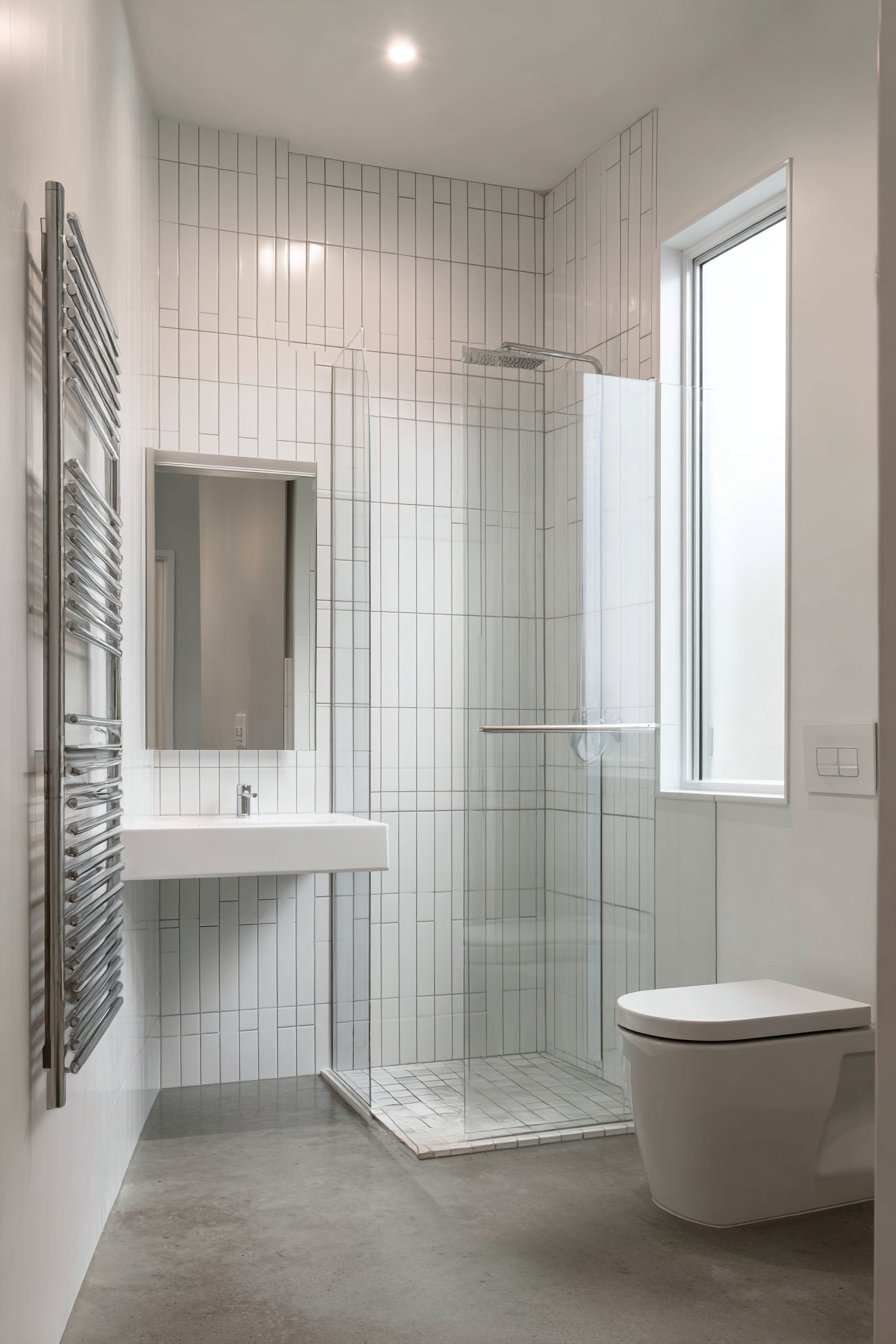
Light grey polished concrete floor provides a subtle contrast and durability. The concrete’s cool tone complements the warm white walls. Its polished surface reflects light upward. This brightens the entire space from the ground up. A single tubular chrome heated towel rail serves dual purpose. It provides towel storage and gentle radiant heat. The tubular form maintains the minimal aesthetic. Natural daylight from a high horizontal window maintains privacy while providing illumination.
The vertical tile orientation represents a conscious departure from typical horizontal installations. Most subway tiles run horizontally. The vertical choice creates distinction and visual impact. The continuous vertical lines guide the eye upward without pause. The concealed cistern toilet requires in-wall installation during construction or renovation. The tank sits within the wall cavity. This approach demands planning but delivers significant visual benefits. The wall remains mostly flat with only the bowl protruding.
Key Design Tips:
- Install subway tiles vertically to create height-enhancing visual emphasis
- Place key fixtures in corners to maximize open central floor area
- Use curved glass shower panels to follow corner geometry efficiently
- Specify concealed cistern toilets for clean wall planes without visible tanks
- Choose polished concrete floors for durability and light-reflective properties
- Position high horizontal windows for natural light without sacrificing privacy
10. Wet Room Openness and Material Continuity
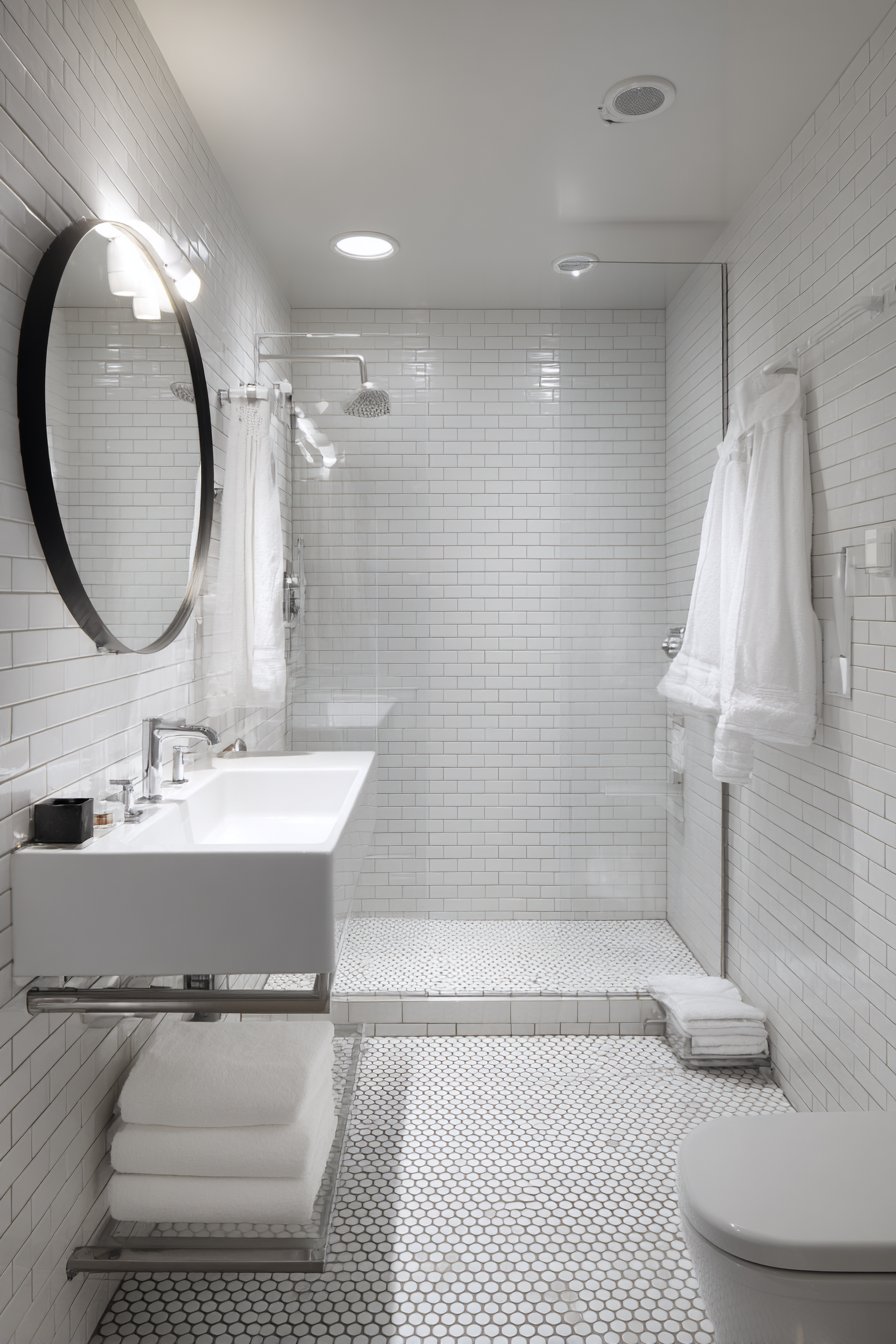
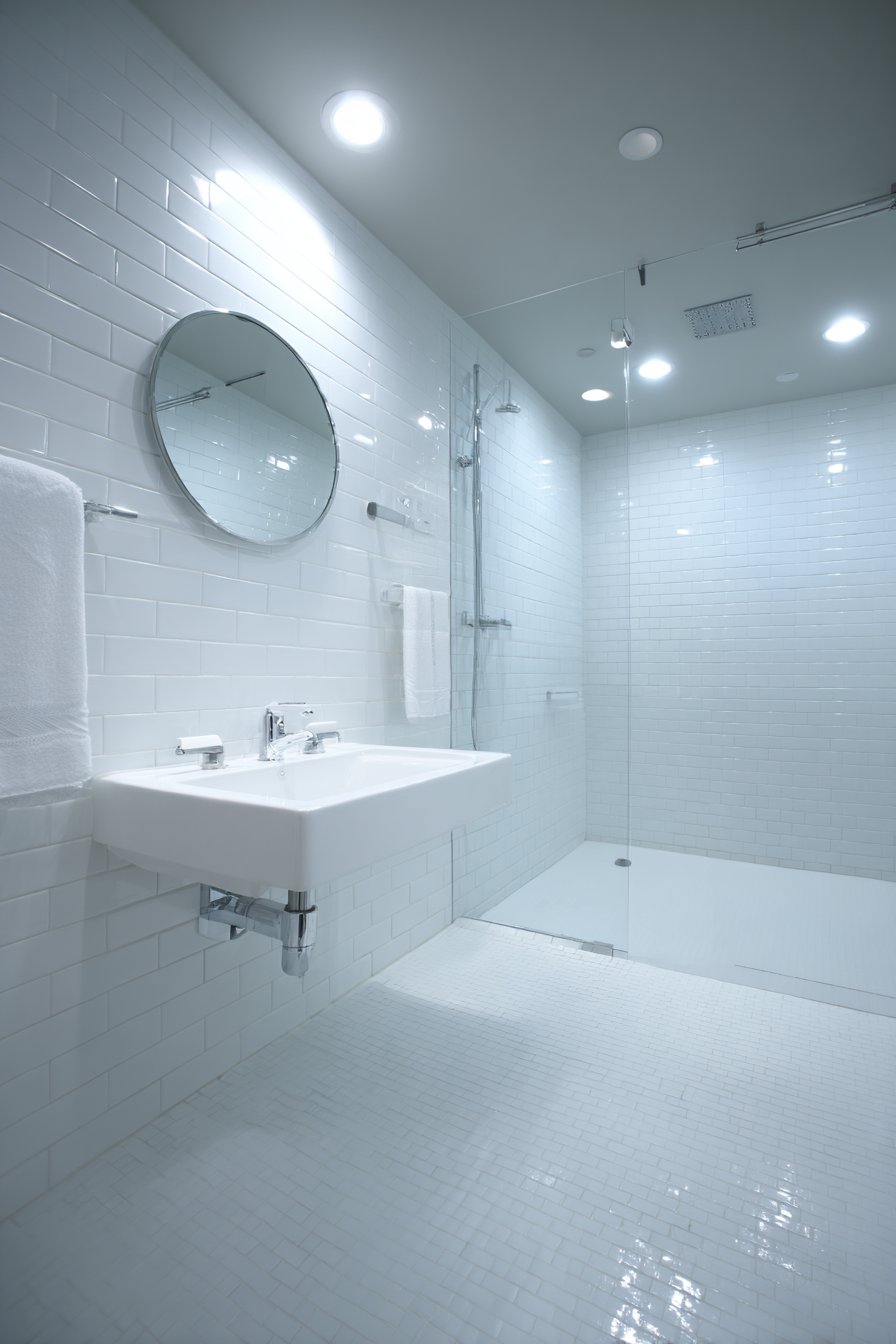
This design embraces the wet room concept fully. Waterproofed walls and floor allow the shower area to occupy one end without a separate enclosure. The entire bathroom becomes the shower room when needed. White large-format tiles with rectified edges and minimal grout joints cover walls and floor. Rectified tiles have precisely cut edges. They can be installed with minimal grout lines. This creates near-seamless surfaces. The same tile on walls and floor establishes visual continuity.
A glass screen partially separates the shower zone while maintaining openness. The screen prevents spray from reaching the dry end of the room. However, it doesn’t fully enclose the shower. Open space above and beside the screen maintains the room’s visual and spatial unity. A wall-mounted sink with an integrated towel bar combines two functions in one fixture. The towel bar extends from the sink’s side. This integrated approach reduces the number of separate elements. A wall-hung toilet preserves floor space.
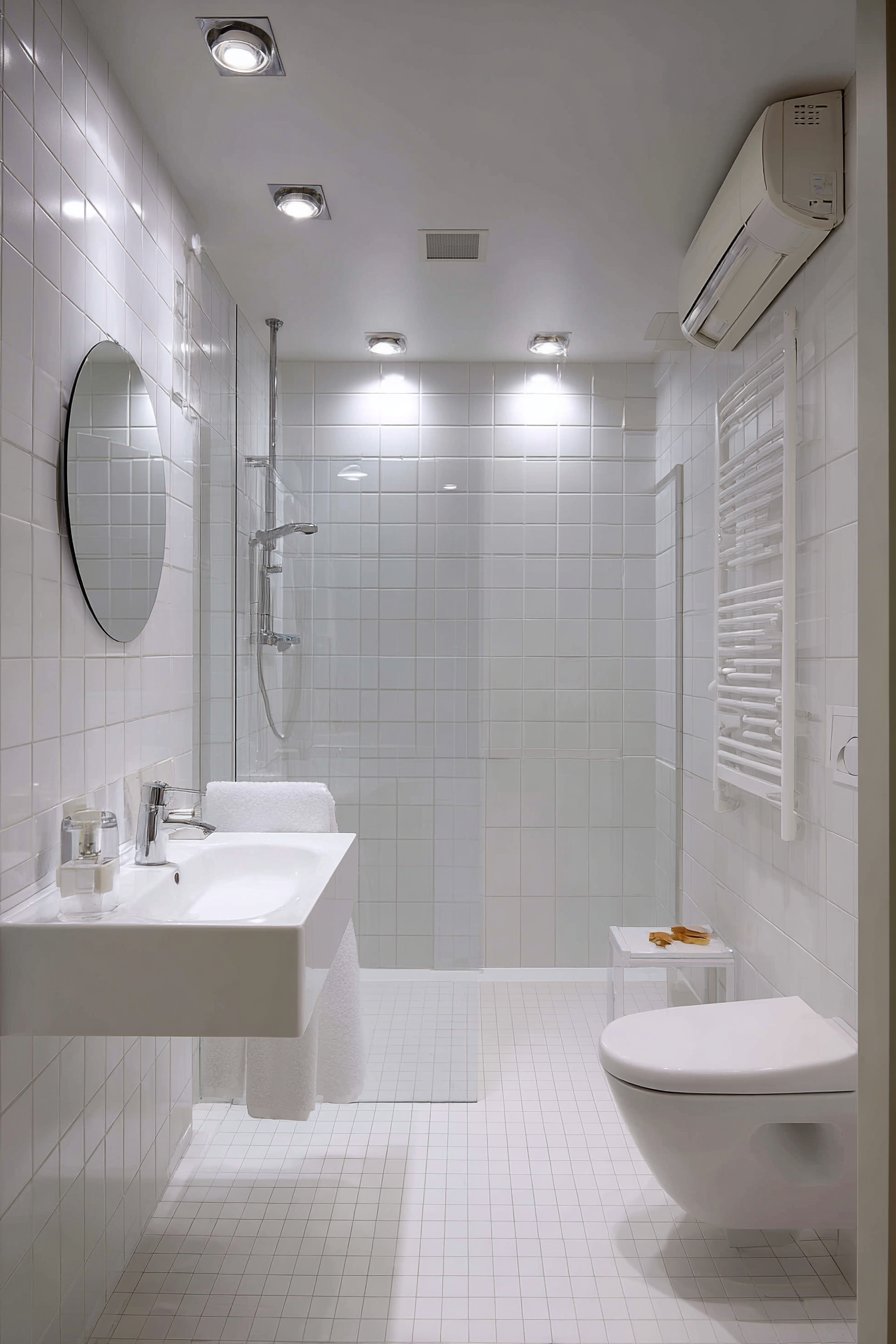
Brushed stainless steel fixtures complete the essential elements. The brushed finish provides subtle texture. It resists fingerprints and water spots better than polished chrome. A single round mirror hangs without elaborate mounting hardware. Recessed ceiling spots provide functional lighting.
Multiple spots distribute light evenly across the space. The wet room approach requires professional waterproofing throughout. Every surface must resist water penetration. Floor sloping must direct water toward the drain efficiently.
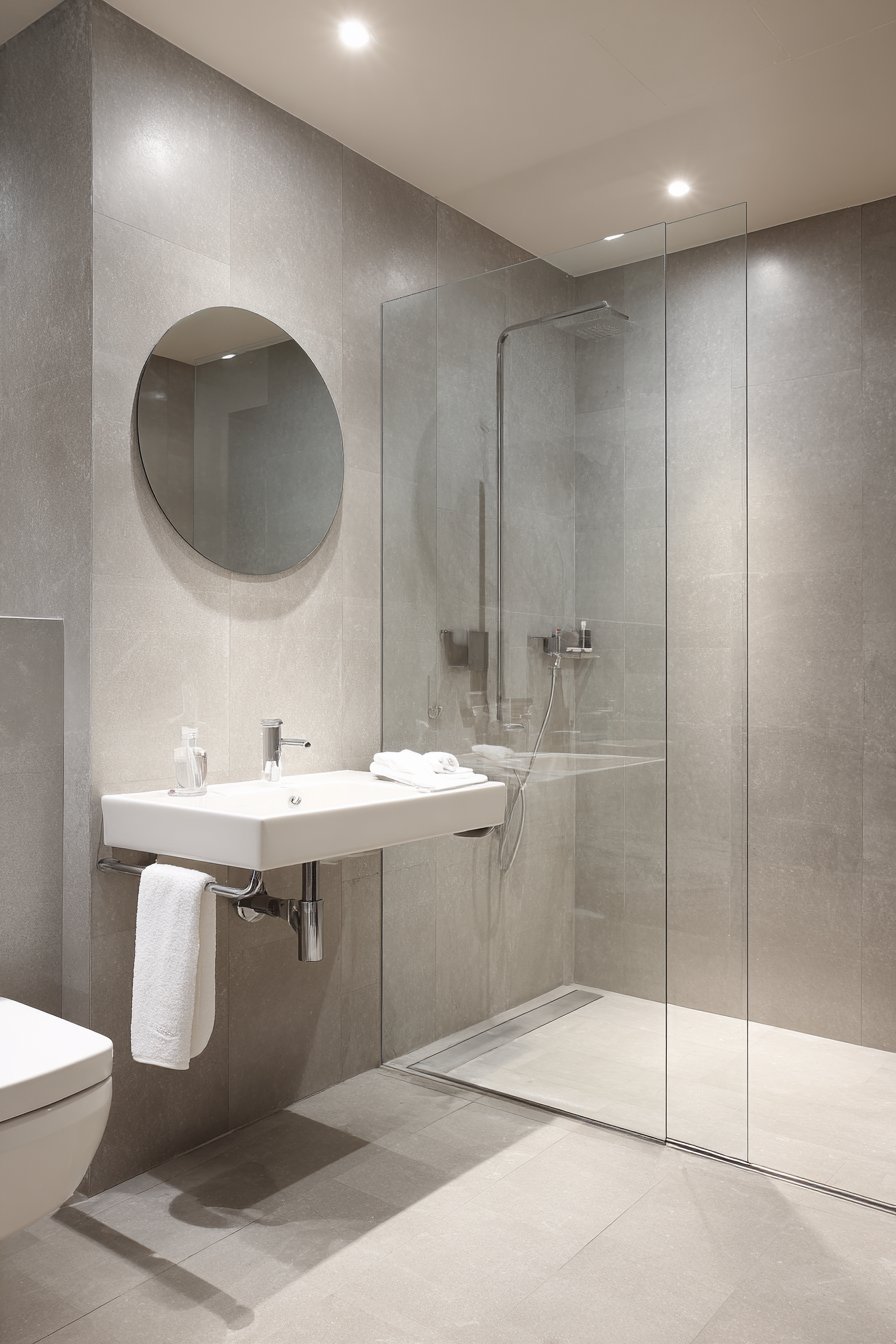
The material continuity from floor to wall creates powerful visual impact. No baseboard or transition trim interrupts the surface flow. The large-format tiles make this seamless appearance possible. Smaller tiles would require too many grout lines.
The wet room design offers practical benefits beyond aesthetics. Cleaning becomes simpler when the entire space can get wet. No shower door tracks collect soap scum. No shower curtain requires washing. Everything can be sprayed down and squeegeed clean.
Key Design Tips:
- Implement wet room design for ultimate openness in small bathroom footprints
- Use identical large-format tiles on floors and walls for seamless visual continuity
- Install partial glass screens to contain spray while maintaining spatial openness
- Choose integrated towel bar fixtures to reduce the number of separate elements
- Specify brushed finishes on fixtures for practical resistance to water spots
- Ensure professional waterproofing throughout when creating wet room environments
Why These Minimalist Small Bathroom Designs Excel
These ten minimalist small bathroom designs represent the pinnacle of contemporary bathroom planning. They excel because they address the fundamental challenge of small spaces: how to provide complete functionality without visual chaos. Each design demonstrates that minimalism isn’t about deprivation. Rather, it’s about intentionality. Every element earns its place through functional necessity or aesthetic contribution. Nothing superfluous remains.
The classic subway tile approach excels for its timeless appeal and proven track record. White subway tiles never go out of style. They work in traditional and contemporary settings equally well. The horizontal pattern creates width in narrow spaces. The floating element strategy succeeds by revealing floor area. When fixtures hover above the floor, the room appears larger. Cleaning becomes easier. The visual lightness contributes to a serene atmosphere perfect for small bathrooms.
The seamless glass partition design maintains openness essential in compact spaces. Solid shower walls would fragment the room visually. Glass allows sight lines through to the back wall. This preserves the perception of full room depth. The recessed storage solution brilliantly uses space within walls rather than consuming room volume. Traditional cabinets protrude into precious space. Recessed niches provide storage without spatial penalty.
The light oak warmth concept proves that minimalism needn’t be cold or sterile. Natural wood introduces organic warmth and tactile appeal. The monochromatic purity approach demonstrates how variations within a single color create subtle visual interest. Different materials in the same white family maintain cohesion while preventing monotony. This strategy works particularly well in very small bathrooms where color variety might feel overwhelming.
The accessible luxury design shows that universal design principles enhance everyone’s experience. Curbless showers help wheelchair users, parents with children, and aging-in-place homeowners. The teak bench adds natural beauty while serving practical needs. The honest materials concept challenges traditional bathroom design rules. Exposed plumbing can be beautiful when executed thoughtfully. Vessel sinks become sculptural focal points rather than merely functional fixtures.
The vertical emphasis strategy manipulates perception through tile orientation. Vertical lines draw the eye upward. The space feels taller and more generous. Corner fixture placement maximizes central floor area. The wet room approach represents ultimate spatial efficiency. When the entire room functions as a shower, no space is wasted on enclosures. Material continuity from floor to wall creates seamless visual flow that makes the room feel larger.
These designs incorporate numerous keywords essential to minimalist small bathroom planning: wall-mounted fixtures, floating vanities, frameless glass, subway tiles, large-format tiles, recessed storage, natural light, chrome fixtures, white porcelain, concrete floors, vessel sinks, curbless showers, linear drains, concealed cisterns, integrated storage, matte finishes, vertical mirrors, hexagonal tiles, teak wood, exposed plumbing, corner sinks, pocket doors, rainfall showerheads, brushed stainless steel, and wet room design.
Each design prioritizes clean lines, simple forms, minimal grout lines, neutral palettes, efficient space planning, integrated solutions, and honest material expression. These principles combine to create bathrooms that feel calm, spacious, and highly functional despite limited square footage. The designs prove that small bathrooms can be luxurious when every detail receives careful consideration.
The success of these minimalist approaches stems from their focus on spatial perception rather than actual dimensions. Visual tricks like floating fixtures, vertical tile patterns, and seamless glass expand perceived space. Material selection plays a crucial role. White tiles, chrome fixtures, and glass surfaces reflect light. This brightness makes spaces feel larger and more inviting. Storage integration eliminates clutter without consuming floor area. Recessed niches, integrated towel bars, and concealed cisterns provide necessary storage and function invisibly.
Lighting strategy proves essential in small minimalist bathrooms. Natural light from windows and skylights brings dynamic variation throughout the day. Recessed fixtures provide illumination without protruding into limited space. Fixture selection must balance form and function perfectly. Simple geometric shapes maintain the minimal vocabulary. Quality materials ensure durability and timeless appeal. Color restraint keeps the palette calm and cohesive. White, grey, and natural wood tones create harmony. Occasional matte black accents provide subtle contrast without disruption.
These designs demonstrate that minimalist small bathrooms can achieve remarkable sophistication through thoughtful planning. They prove that luxury comes from quality rather than quantity. Each fixture, surface, and detail contributes to a cohesive whole. The result is bathrooms that feel serene, spacious, and remarkably efficient. Whether you’re working with a tiny urban apartment bathroom or a compact powder room, these principles and strategies can transform your space into a minimalist sanctuary.
Conclusion
Creating a beautiful, functional, minimalist small bathroom requires careful planning and thoughtful execution. The ten designs explored in this article demonstrate how intentional choices in fixtures, materials, colors, and spatial planning can transform even the tiniest bathroom into a serene retreat. The key lies in embracing minimalist principles: eliminate the unnecessary, celebrate simple forms, maximize natural light, and choose quality over quantity.
Remember that minimalism isn’t about cold sterility. It’s about creating calm, uncluttered spaces where every element serves a purpose. Floating fixtures reveal floor space. Frameless glass maintains openness. Recessed storage eliminates visual clutter. Natural materials like wood and concrete add warmth. These strategies combine to create bathrooms that feel significantly larger than their actual dimensions while providing complete functionality for daily use.
As you plan your own minimalist small bathroom, start by identifying your essential needs. Then select fixtures and materials that fulfill those needs with simple, elegant forms. Embrace white and neutral tones as your foundation. Add natural light wherever possible. Install floating or wall-mounted elements to reveal floor area. Consider vertical elements to emphasize height. Most importantly, resist the urge to over-decorate. In minimalist design, restraint creates beauty. Your small bathroom can become a sophisticated sanctuary where less truly delivers more.
