


The mid century modern kitchen represents one of the most enduring and beloved design movements in interior architecture, seamlessly blending form and function in a way that remains remarkably relevant today. Born from the post-war optimism of the 1940s through 1960s, this aesthetic philosophy emphasizes clean lines, organic forms, and the honest use of materials—principles that continue to resonate with homeowners seeking spaces that are both beautiful and practical. The mid century modern kitchen isn’t merely a nostalgic nod to the past; it’s a living, breathing design approach that celebrates simplicity, craftsmanship, and the integration of indoor and outdoor living spaces.
What makes the mid century modern kitchen particularly compelling is its ability to adapt to contemporary lifestyles while maintaining its distinctive character. These kitchens prioritize efficiency without sacrificing warmth, incorporating natural materials like teak, walnut, and birch alongside innovative surfaces that were revolutionary in their time. The movement’s emphasis on democratizing good design means that mid century modern kitchens can be achieved at various price points, from authentic vintage pieces to inspired contemporary interpretations. Whether you’re renovating a period home or incorporating mid century elements into a modern space, understanding the key principles of this design movement will help you create a kitchen that’s both timeless and thoroughly livable.
In this comprehensive guide, we’ll explore ten distinct interpretations of the mid century modern kitchen, each showcasing different aspects of this influential design movement. From the warm embrace of teak cabinetry to the bold statement of period-appropriate colors, from compact efficient layouts to sophisticated galley designs, these examples demonstrate the remarkable versatility and enduring appeal of mid century modern aesthetics. You’ll discover how to incorporate iconic furniture pieces, select authentic materials, master the characteristic color palettes, and understand the lighting approaches that define this style. Whether you’re planning a complete kitchen renovation or simply looking to infuse your current space with mid century charm, these detailed explorations will provide the inspiration and practical guidance you need to create a kitchen that honors the past while embracing the present.
1. Iconic Teak Elegance with Waterfall Island
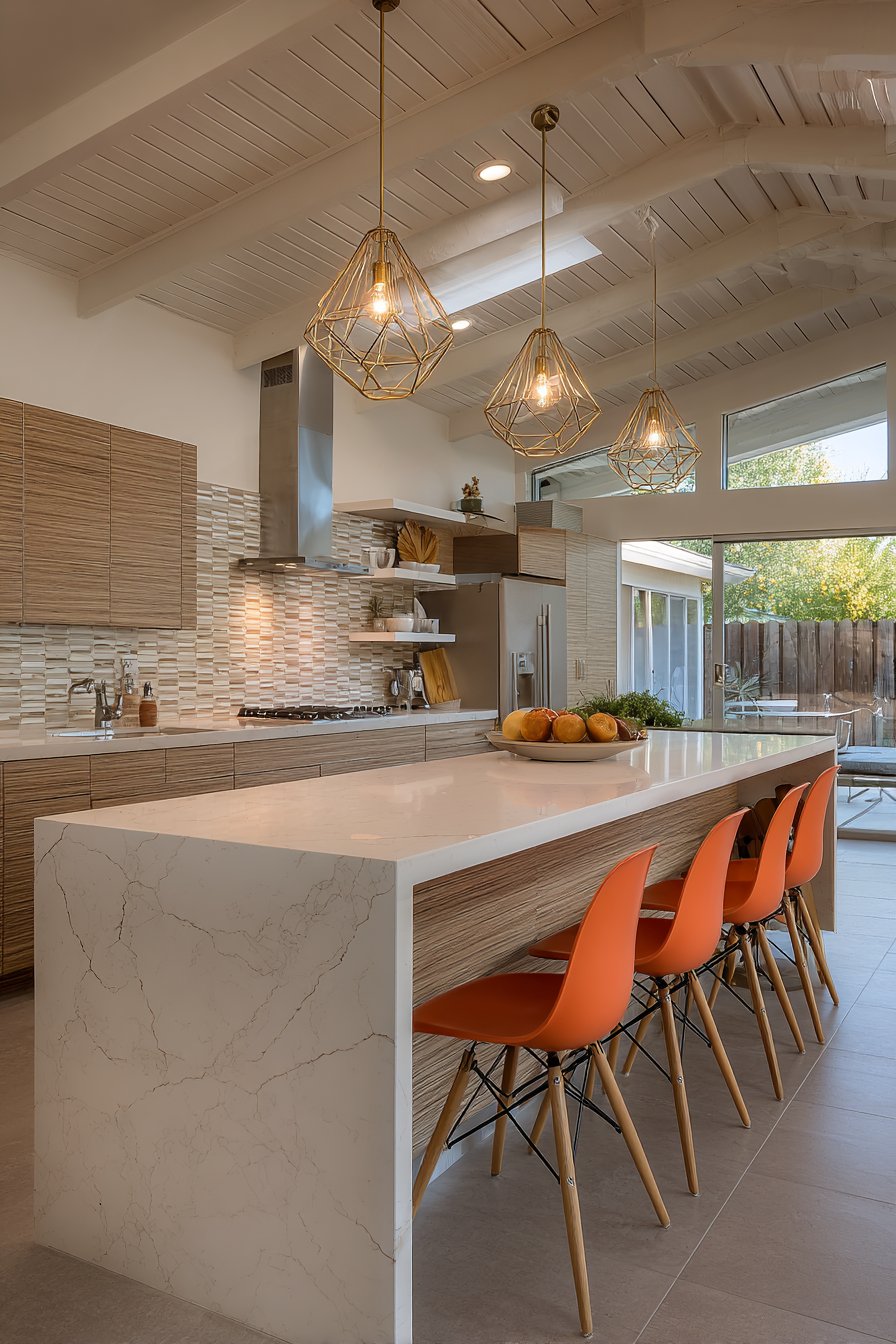
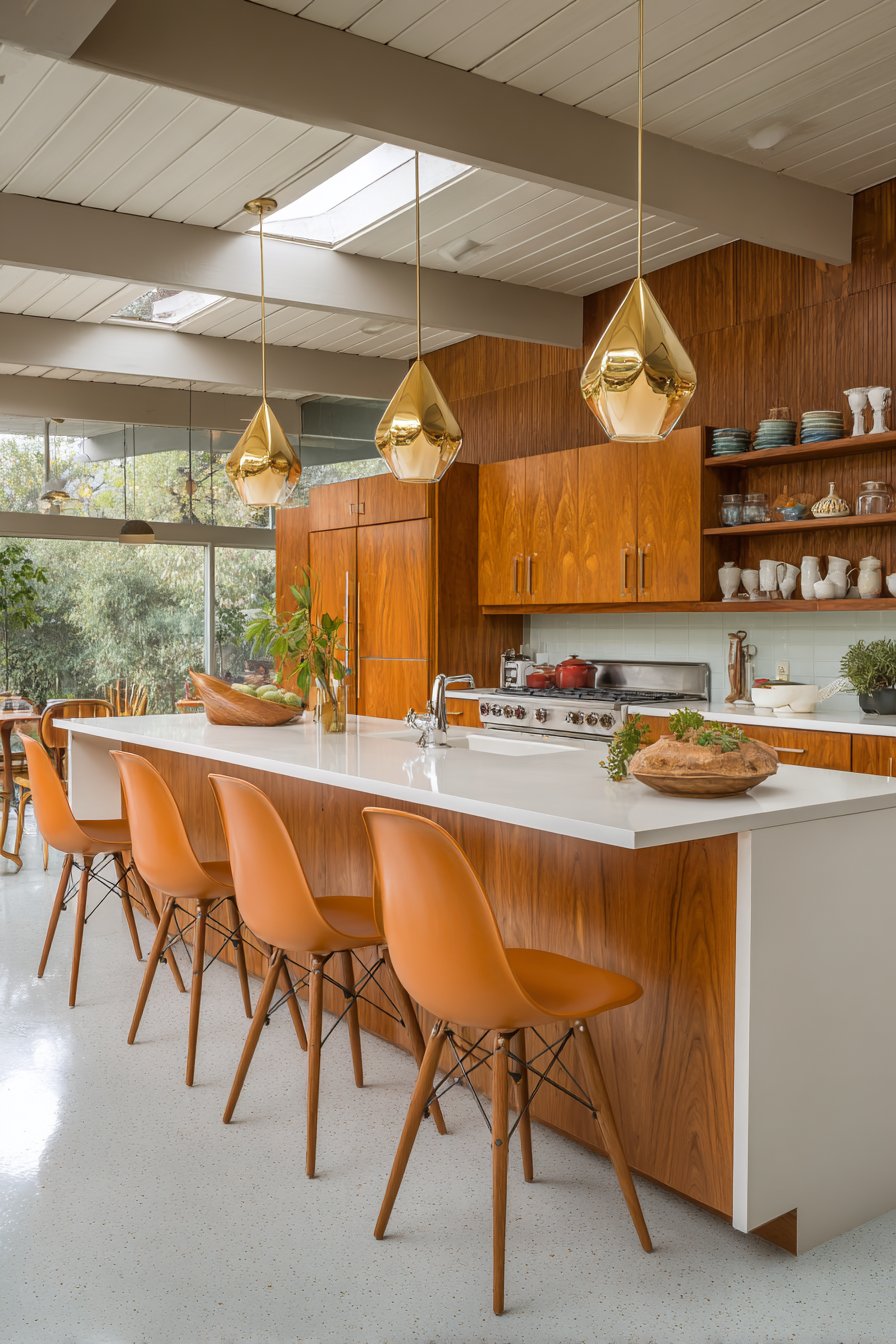
The heart of this stunning mid century modern kitchen is the magnificent flat-panel teak cabinetry, where distinctive horizontal grain patterns create a visual symphony across the walls. The wood’s rich, warm tones develop a lustrous patina that speaks to both craftsmanship and authenticity, while the tapered wooden legs—a hallmark of the era—elevate the cabinets literally and figuratively, creating an airy feeling that distinguishes mid century design from heavier traditional styles. This elevation allows light to flow beneath the cabinetry, emphasizing the room’s spaciousness and the designer’s commitment to visual lightness despite the substantive presence of wood throughout the space.
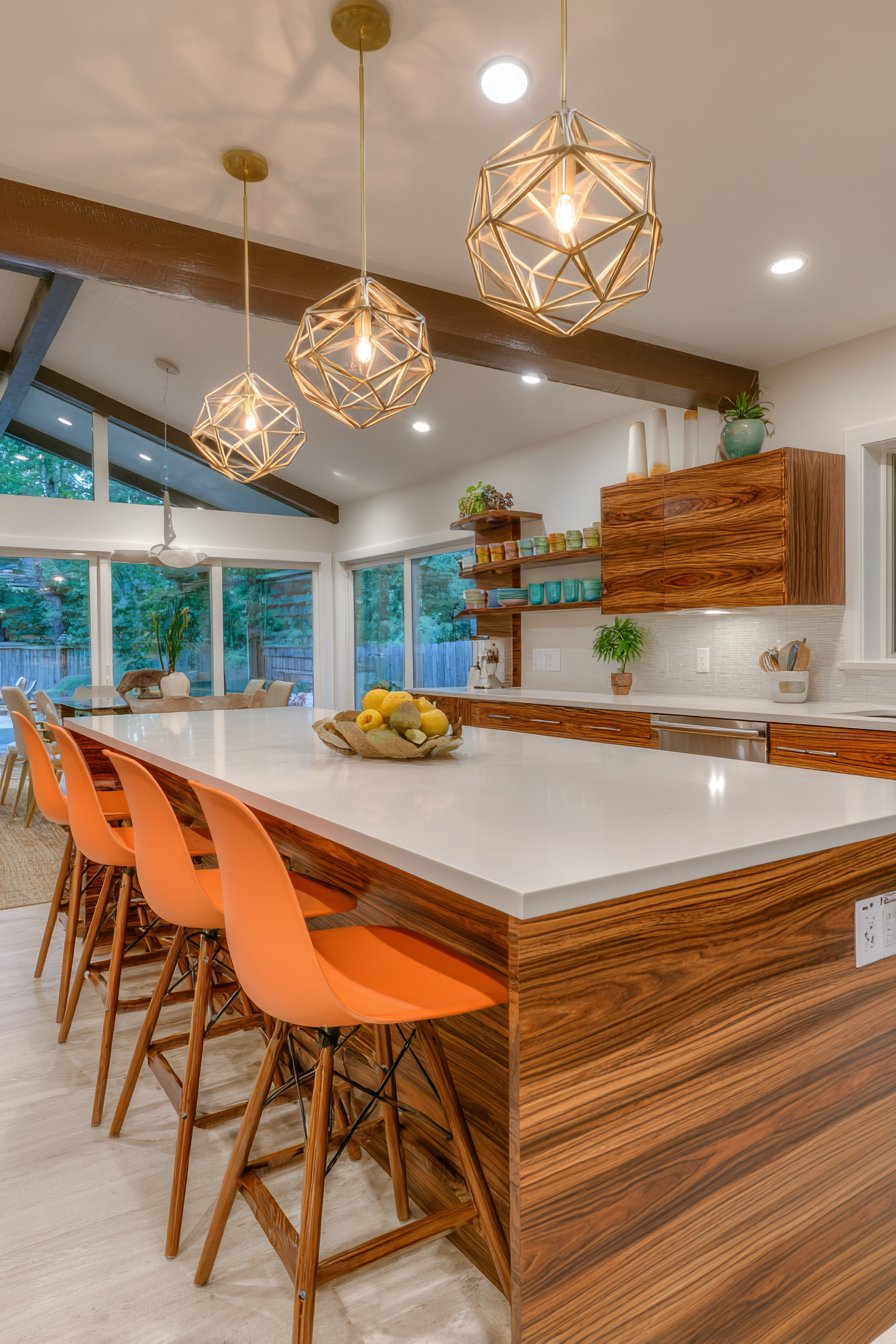
The kitchen island serves as the room’s centerpiece, featuring a stunning white quartz waterfall countertop that cascades down both sides in a continuous flow of stone. This contemporary material choice pays homage to the mid century fascination with innovative surfaces while providing the durability modern families require. The integrated seating area showcases iconic Eames-style molded plastic chairs in warm orange tones, their sculptural forms and vibrant color creating focal points that draw the eye and invite conversation. These chairs, inspired by Charles and Ray Eames’ groundbreaking work in molded plywood and plastic furniture, represent the democratic design principles that defined the era—beautiful, functional pieces accessible to everyday families.
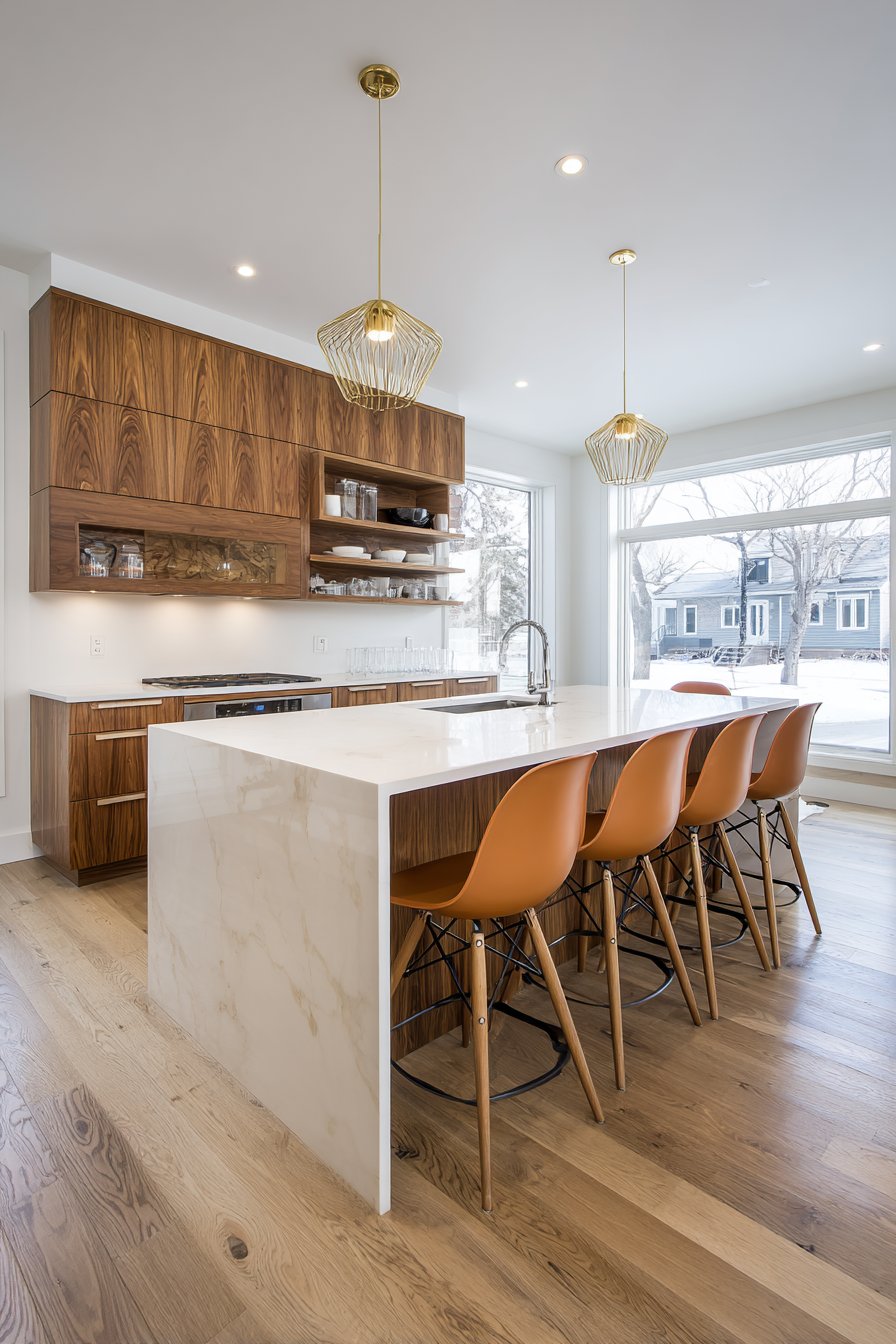
Geometric pendant lights with brass accents hang above the island at carefully calculated heights, their clean-lined forms echoing the architectural precision found throughout the space. The brass elements pick up warm undertones in the teak, creating subtle visual connections that unify the design. Open shelving displays period-appropriate ceramics and glassware, transforming everyday objects into decorative elements—a key mid century principle that blurred the lines between function and art. Large windows flood the space with soft natural lighting, emphasizing the clean lines and organic materials that characterize authentic mid century modern design while connecting the interior to the natural world outside.
Key Design Tips:
- Select teak cabinetry with visible grain patterns to maximize visual interest and authenticity
- Incorporate tapered legs on base cabinets and islands to create the characteristic floating effect
- Choose geometric lighting fixtures with metallic accents in brass or copper for period accuracy
- Display curated collections of vintage ceramics and glassware on open shelving
- Position furniture pieces like Eames chairs in bold, saturated colors as sculptural accents
2. Two-Tone Drama with Vintage Flair
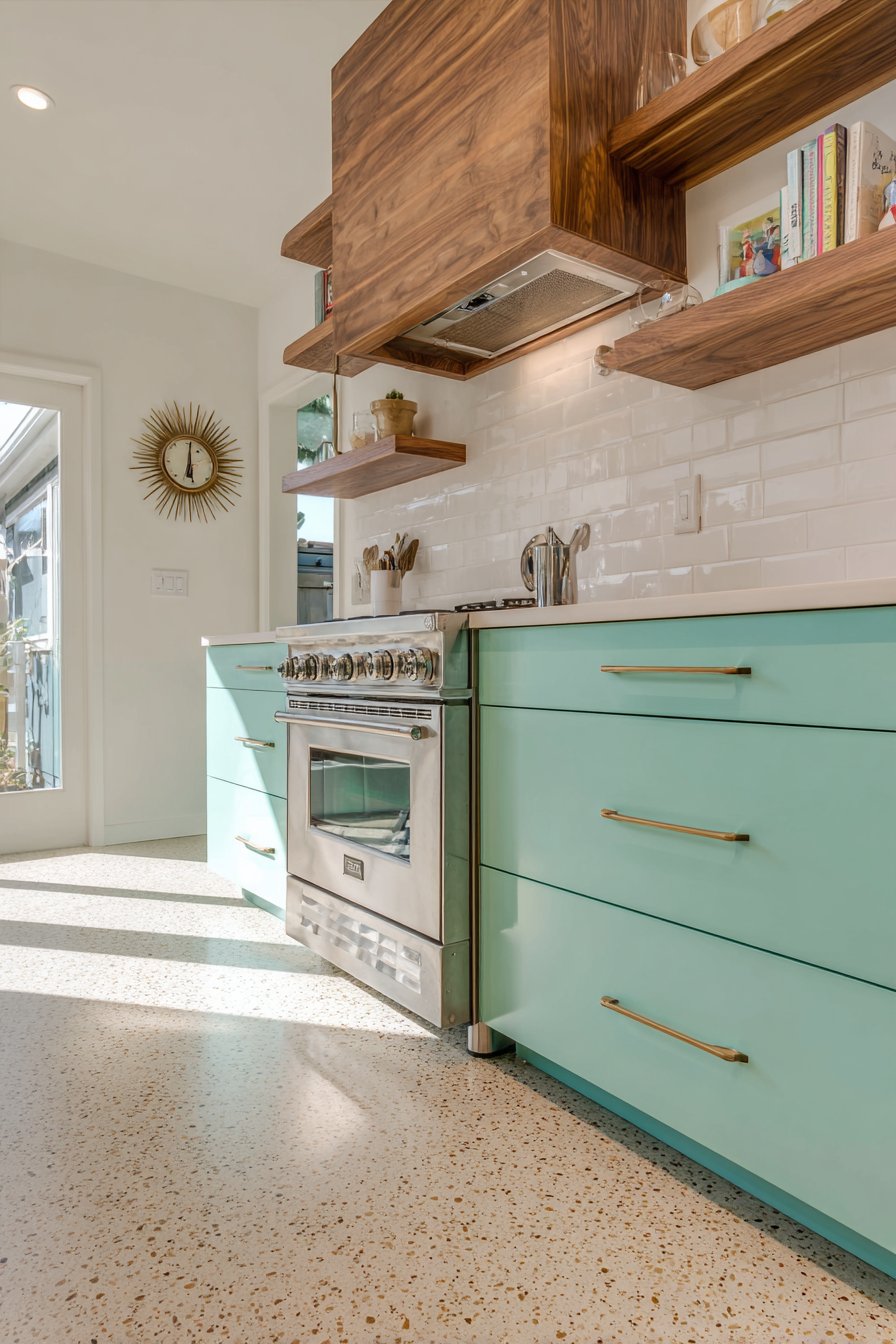
This captivating mid century modern kitchen embraces the era’s love of color through sophisticated two-tone cabinetry that combines natural walnut upper cabinets with mint green lower cabinets, creating a dynamic visual rhythm that energizes the entire space. The walnut uppers showcase the wood’s complex grain structure and deep chocolate tones, providing visual weight and grounding at eye level, while the unexpected mint green lowers inject playful personality without overwhelming the design. Sleek bar pulls in brushed brass punctuate the cabinet faces, their linear simplicity and warm metallic finish bridging the gap between the natural wood and painted surfaces while adding tactile interest at every touchpoint.
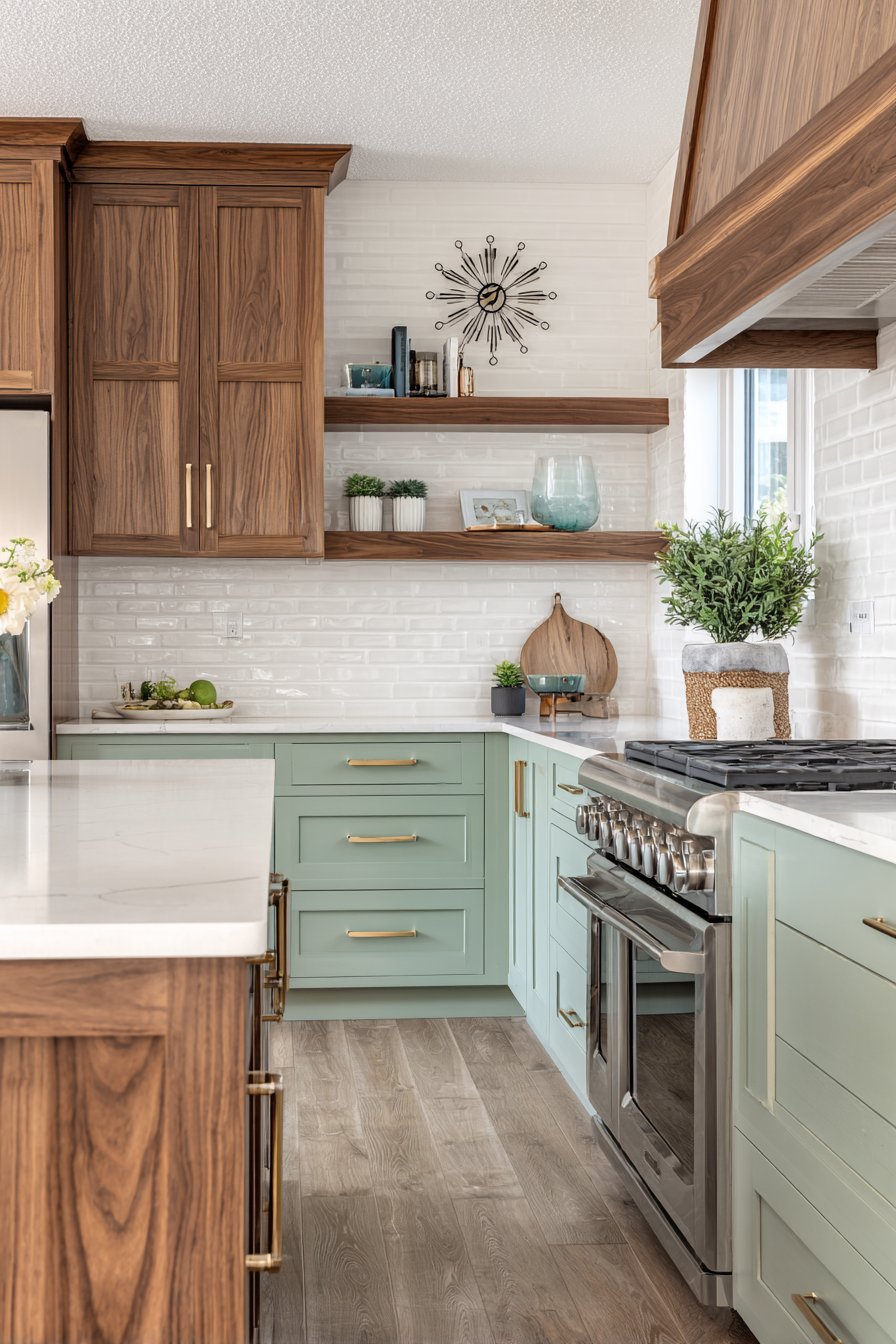
The white subway tile backsplash extends dramatically to the ceiling behind a vintage-inspired range with chrome knobs, creating a crisp, reflective surface that bounces light throughout the kitchen while providing easy-to-clean protection for the cooking zone. This floor-to-ceiling treatment amplifies the room’s vertical dimensions and serves as a neutral canvas that allows the colored cabinetry and period appliances to command attention. Above the vintage range, a cheerful sunburst clock adorns the wall—an iconic mid century motif that represents the era’s optimistic embrace of atomic age aesthetics and the future’s promise. Floating shelves in matching walnut interrupt the tile field, offering practical storage for frequently used items while maintaining the open, accessible quality that defines mid century kitchen design.
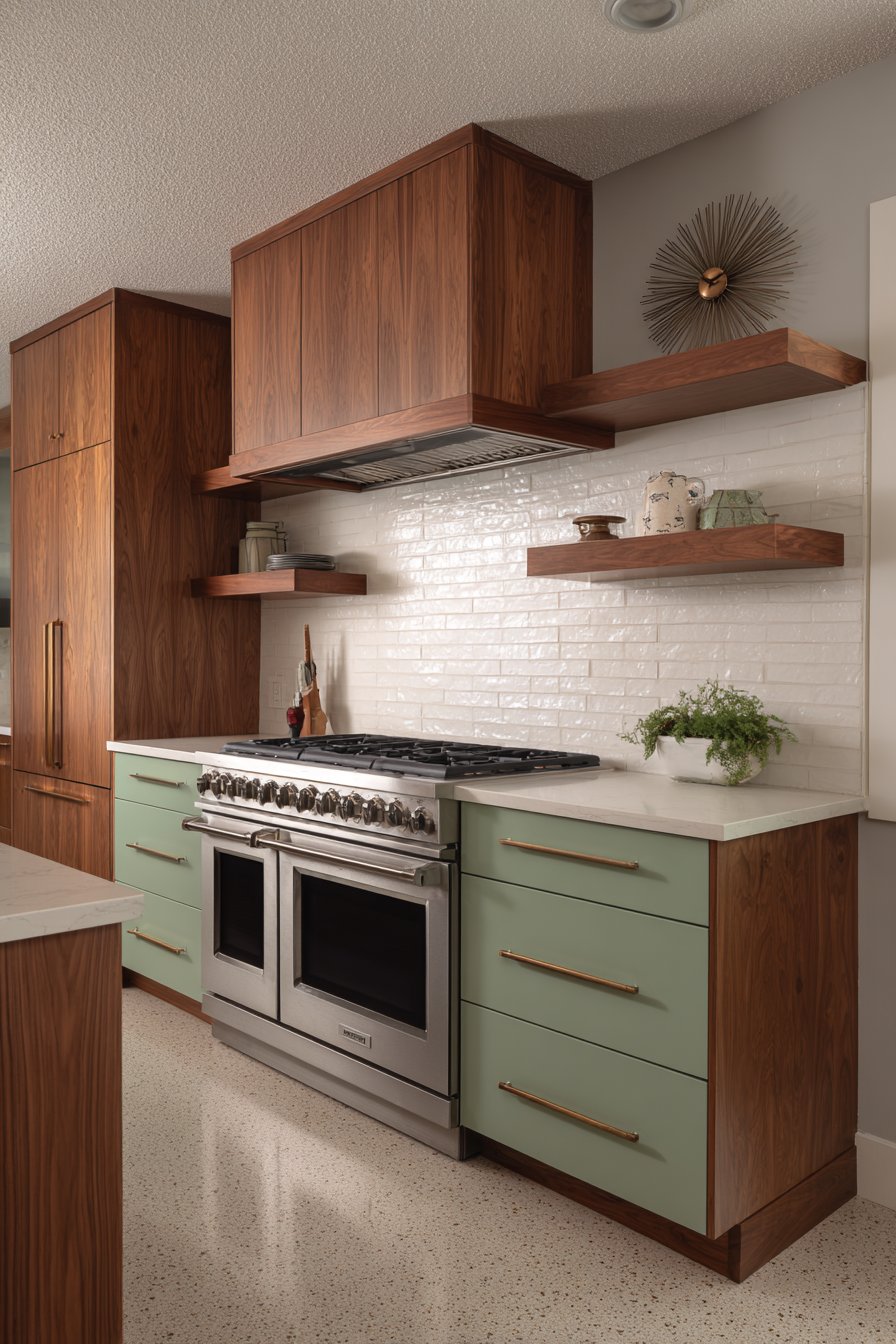
The terrazzo-style flooring provides the perfect foundation for this vibrant kitchen, its speckled surface pattern incorporating chips of colored aggregate that echo the mint green cabinetry and brass hardware. This flooring choice adds authentic period detail while offering practical benefits—the busy pattern disguises dirt and wear, making it ideal for high-traffic kitchen environments. The terrazzo’s slight texture provides slip resistance without compromising the smooth, polished aesthetic that characterizes mid century surfaces. Professional interior photography with balanced exposure captures how natural daylight creates gentle shadows that emphasize the architectural elements, revealing the depth of the wood grain, the glossy finish of the painted cabinets, and the dimensional quality of the tile work.
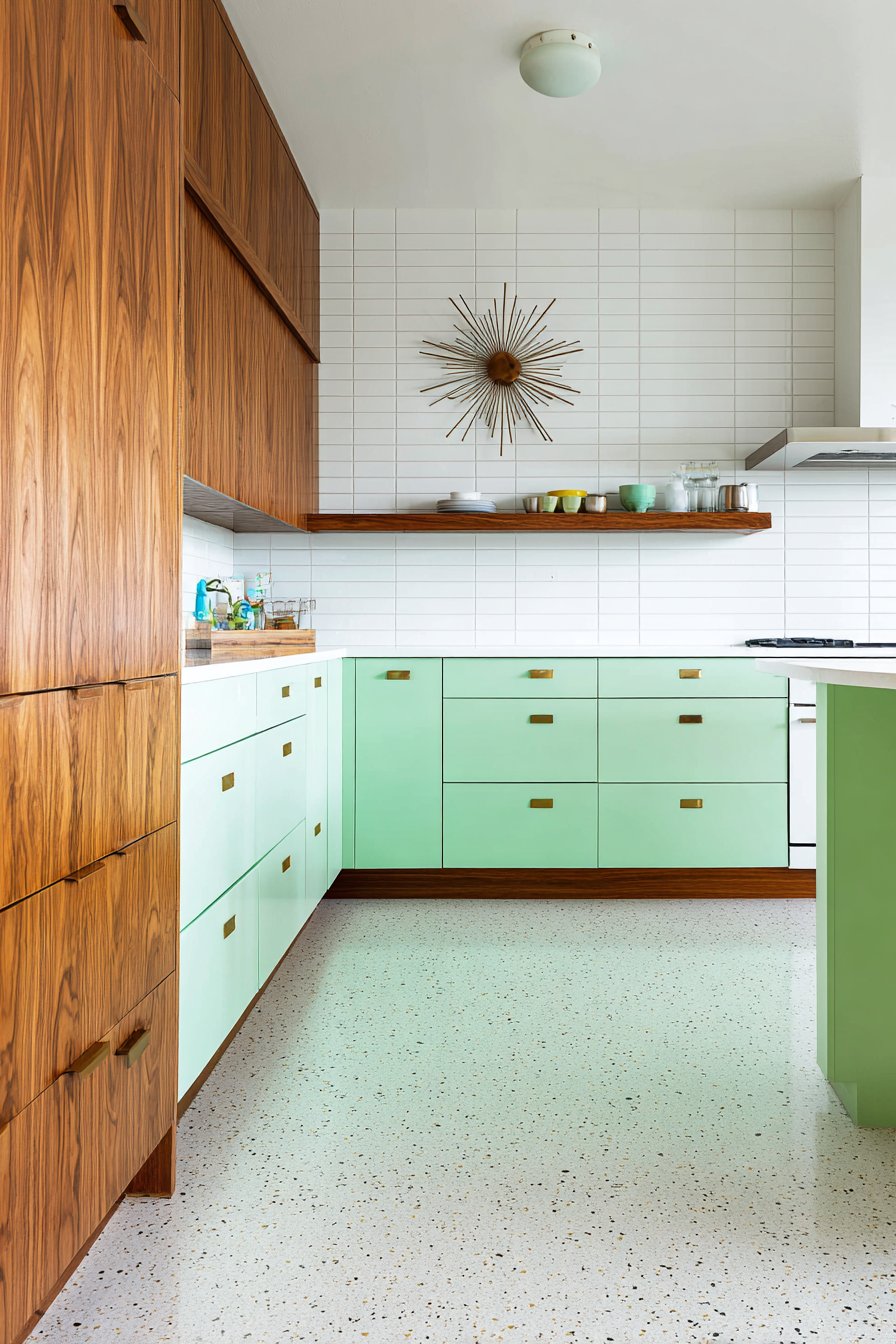
The bold color choices in this kitchen demonstrate how mid century modern design embraced optimism and experimentation, moving away from the purely neutral palettes of earlier decades. The mint green represents the era’s fascination with bringing nature-inspired hues indoors, while the combination with walnut creates sophisticated contrast that feels both grounded and energetic. This functional layout maximizes efficiency without sacrificing style, positioning the range, sink, and refrigerator in an optimal work triangle while ensuring that every surface contributes to the overall aesthetic impact.
Key Design Tips:
- Combine natural wood and painted cabinetry in complementary tones for visual interest
- Extend subway tile backsplashes to the ceiling for dramatic vertical emphasis
- Choose vintage-inspired appliances with authentic details like chrome knobs and period-correct proportions
- Incorporate iconic mid century accessories like sunburst clocks for instant era recognition
- Select terrazzo or terrazzo-style flooring for authentic period detail and practical durability
- Use brushed brass hardware consistently throughout to unify disparate cabinet finishes
3. Compact Efficiency with Breakfast Nook Charm
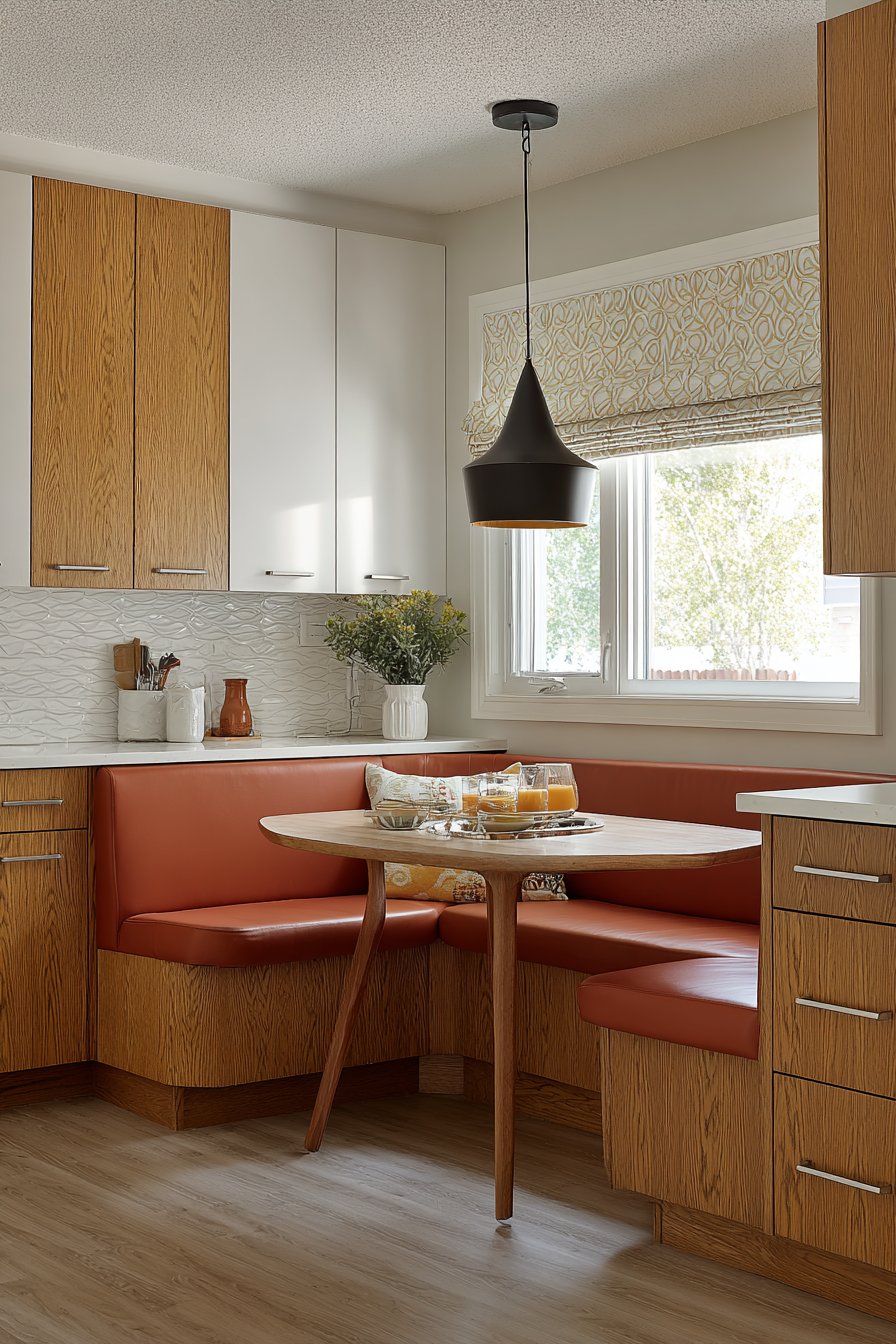
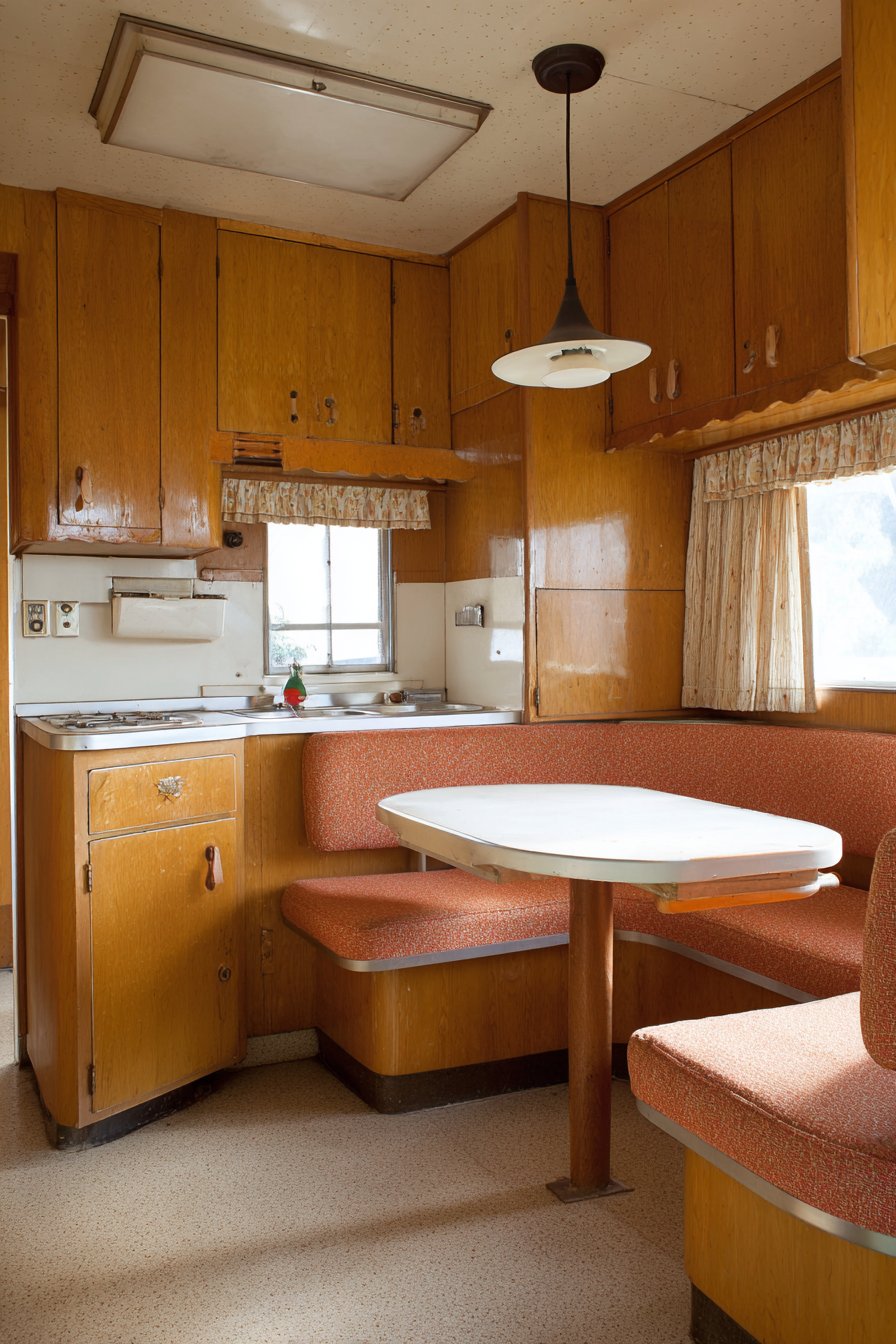
This thoughtfully designed compact mid century modern kitchen proves that limited square footage need not compromise style or functionality, featuring an L-shaped layout that maximizes every inch of available space. The honey-toned wood cabinetry wraps two walls in warm, glowing color, its simple recessed handles maintaining the clean-lined aesthetic while eliminating protruding hardware that could interfere with traffic flow in the narrow space. This wood selection—likely oak or birch with a golden stain—exemplifies the mid century preference for light-to-medium wood tones that create welcoming environments without the heaviness of darker finishes.
White laminate countertops with subtle boomerang pattern edge detail provide striking contrast against the honey cabinetry while introducing one of the era’s most recognizable decorative motifs. The boomerang pattern, with its organic, asymmetrical curves, represents mid century designers’ fascination with biomorphic forms and their skill at incorporating playful details into functional elements. These laminate surfaces also speak to the period’s embrace of new materials and manufacturing technologies—laminate was revolutionary in its time, offering affordable, easy-to-clean surfaces in an array of colors and patterns that weren’t previously accessible to average homeowners.
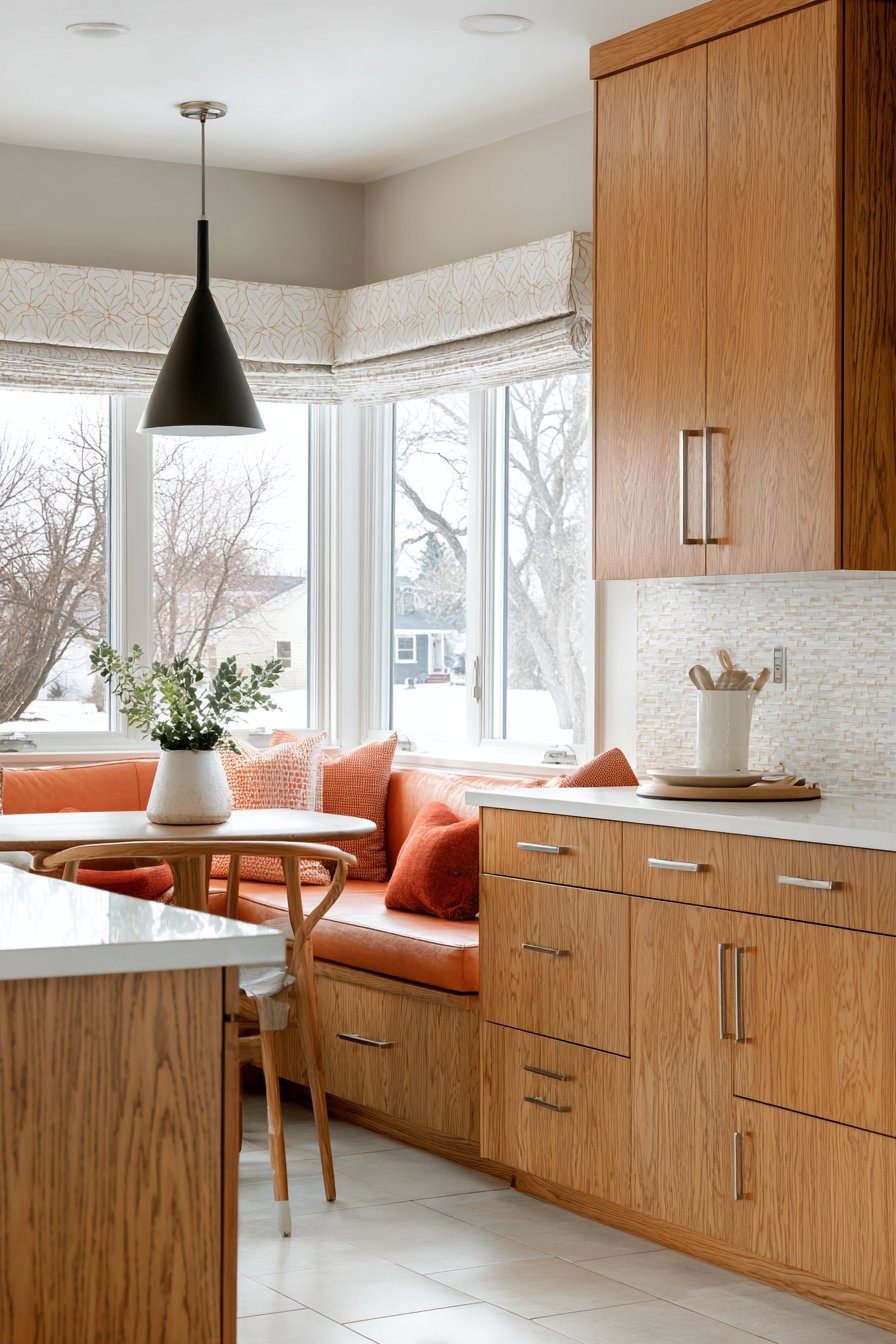
The small breakfast nook with built-in banquette seating becomes the kitchen’s emotional center, upholstered in burnt orange vinyl that injects vibrant personality into the compact space. This integrated seating solution demonstrates the era’s genius for space-saving furniture that serves multiple purposes—the banquette likely conceals storage beneath the cushions, maximizing utility in every cubic inch. The vinyl upholstery, far from being a budget compromise, represents authentic period material choices; mid century designers celebrated vinyl and other synthetic materials for their durability, easy maintenance, and ability to hold bold, saturated colors without fading. Simple Roman shades at the window above the banquette control light and privacy while maintaining the streamlined aesthetic—no fussy curtains or heavy drapes interrupt the clean architectural lines.
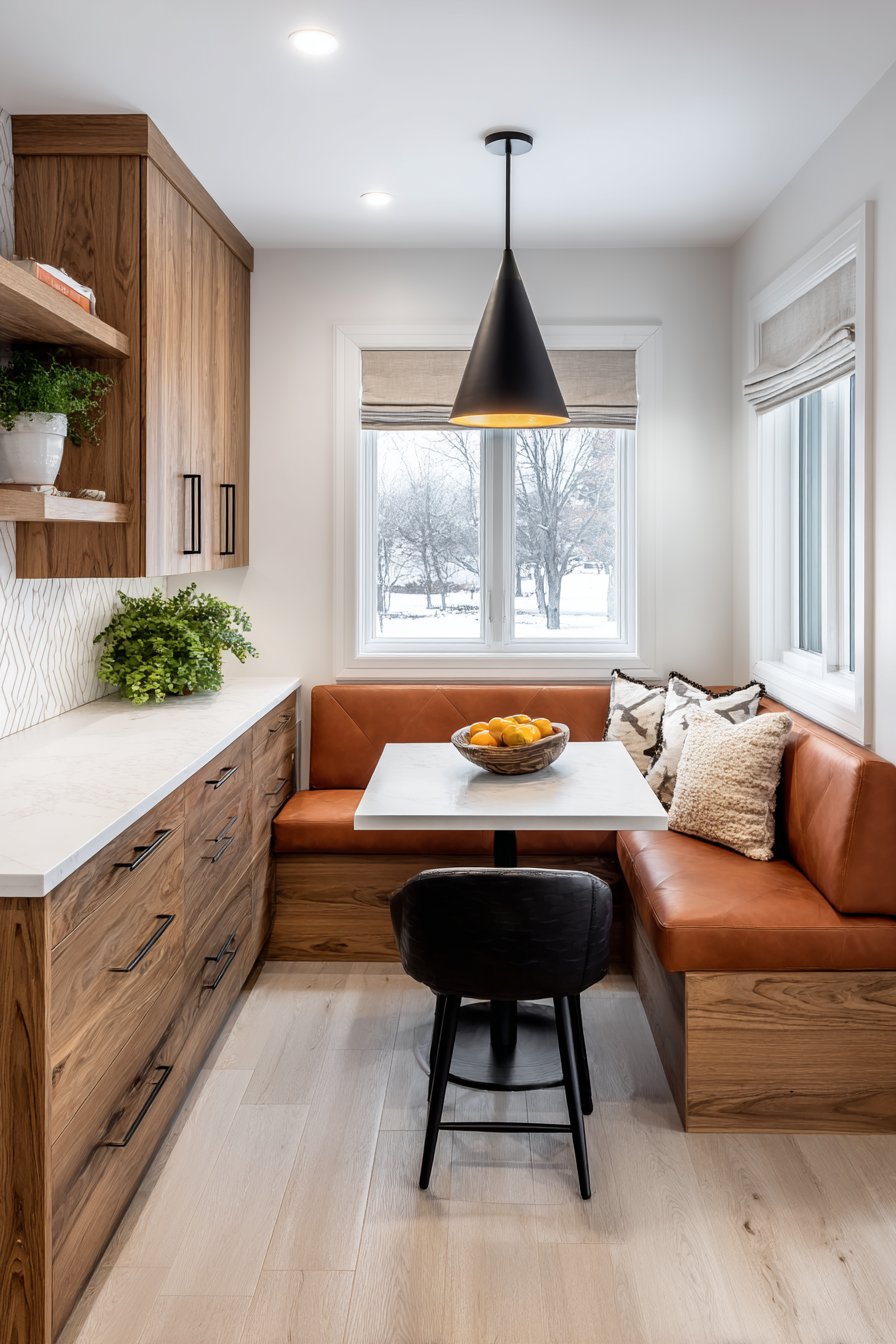
A cone-shaped pendant light in matte black hangs centered above the breakfast nook, its geometric form and monochromatic finish providing sculptural interest without competing with the colorful upholstery below. This lighting choice illustrates the mid century principle of using simple, bold forms rather than ornate fixtures—the cone’s pure geometry needs no embellishment to make a statement. The efficient use of space evident throughout this kitchen reflects the era’s problem-solving approach to design, where constraints became opportunities for innovation rather than limitations. Every element serves a purpose, yet nothing feels purely utilitarian; beauty and function coexist harmoniously.
Key Design Tips:
- Choose L-shaped layouts to maximize counter and storage space in compact kitchens
- Select honey or golden wood tones for warmth without visual heaviness
- Incorporate boomerang or other organic patterns in countertop edges for authentic detail
- Design built-in banquette seating with hidden storage to maximize functionality
- Use burnt orange, mustard, or avocado upholstery colors for period-correct seating areas
- Hang geometric pendant lights at appropriate heights to define dining zones
- Opt for recessed cabinet handles to maintain clean lines in tight spaces
4. Sophisticated Galley with Seamless Integration
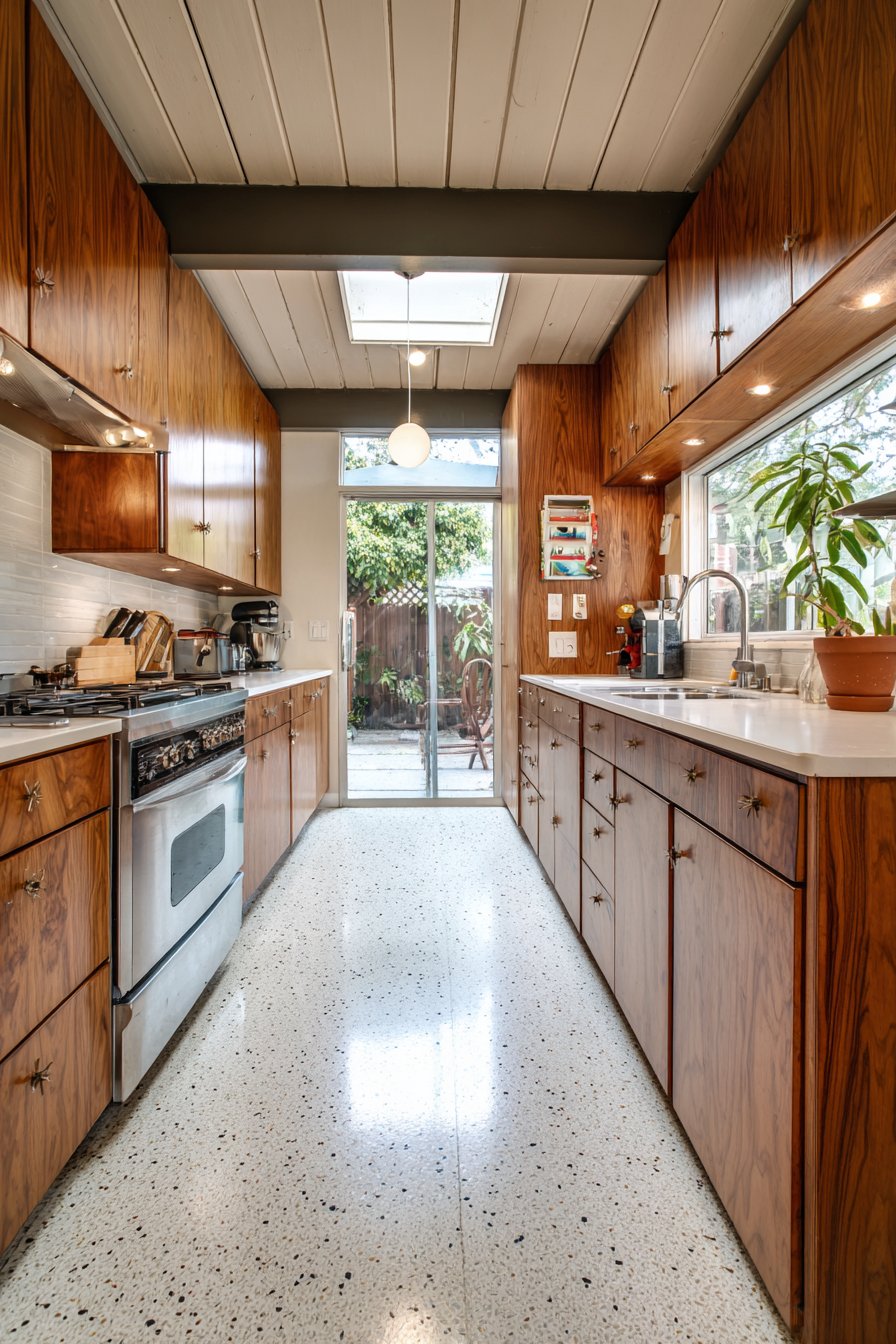
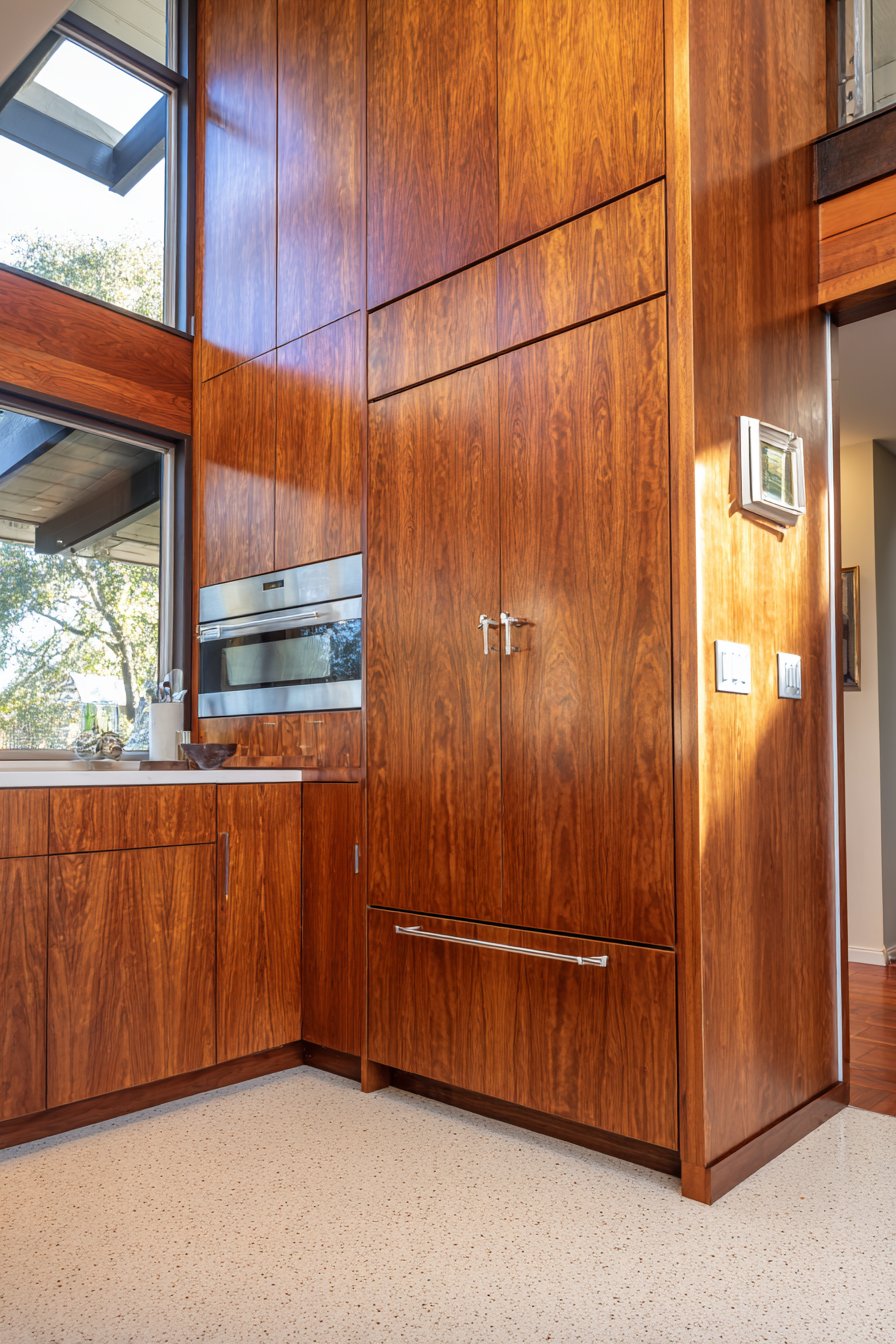
This refined mid century modern kitchen embraces the galley-style layout—a configuration that originated in ship design and proves ideal for creating efficient, streamlined workspaces. The floor-to-ceiling walnut cabinetry showcases distinctive vertical grain patterns that draw the eye upward, emphasizing the room’s height while the rich, dark wood creates an enveloping sense of sophistication and intimacy. The integrated appliance panels represent a distinctly mid century innovation, concealing refrigerators and dishwashers behind matching cabinet faces to create a seamless, uninterrupted visual flow. This approach prioritizes the architecture and materials over appliance branding, allowing the beautiful walnut to command full attention.
The narrow center aisle features stunning white terrazzo flooring speckled with black and gold aggregate, its polished surface reflecting light upward to brighten the space while the metallic gold chips create subtle sparkle that enlivens the composition. This flooring choice balances the dark cabinetry, preventing the galley from feeling cave-like while introducing textural interest underfoot. The terrazzo’s durability made it a favorite for mid century commercial and residential applications, and its comeback in contemporary design speaks to both its practical benefits and timeless aesthetic appeal.
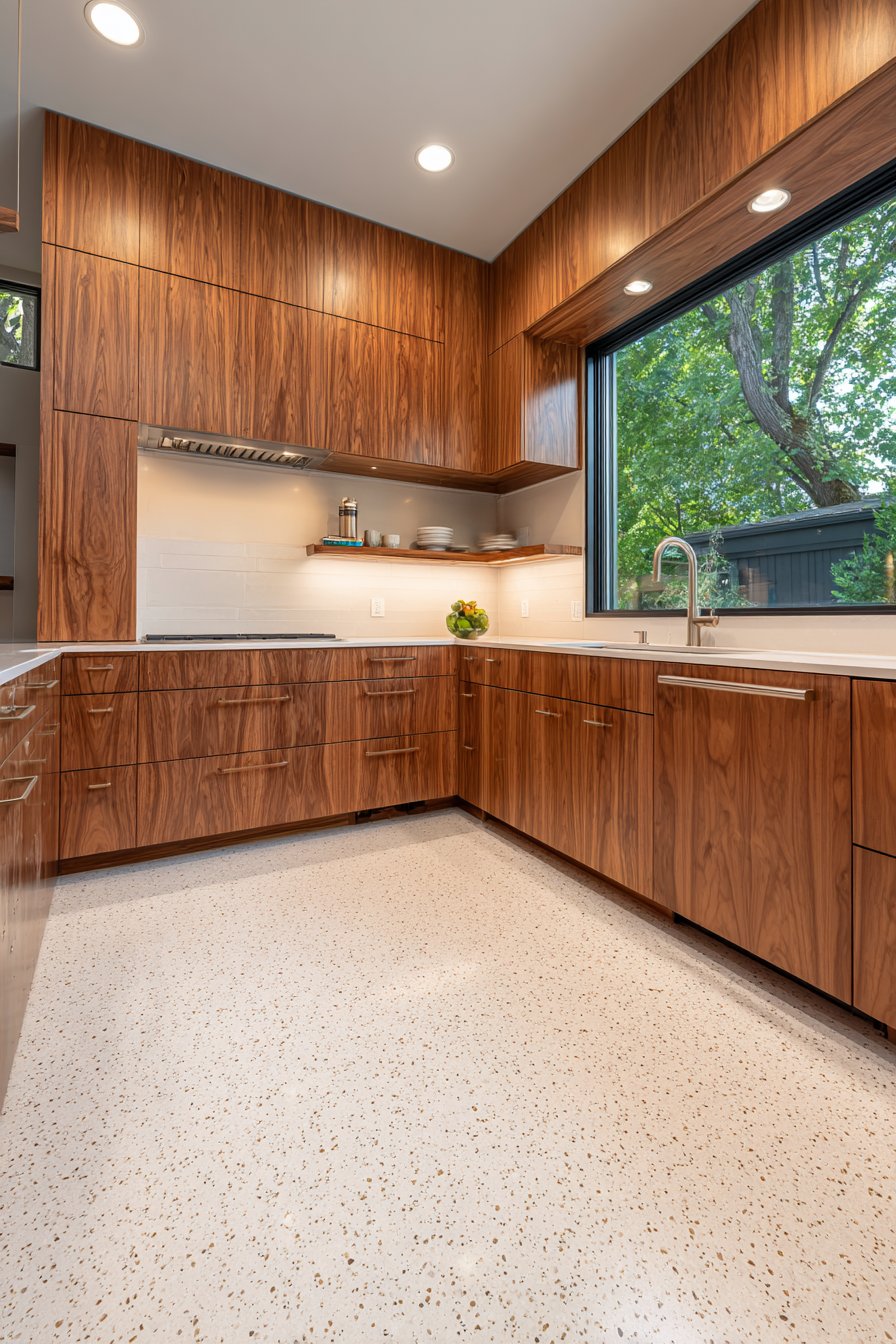
Starburst-design cabinet hardware in antique brass punctuates the smooth cabinet faces at regular intervals, these atomic-age motifs serving as jewelry for the kitchen while providing functional pull points. The starburst pattern, with its radiating lines suggesting energy and expansion, epitomizes mid century optimism and the era’s fascination with space exploration and scientific progress. The antique brass finish adds warmth and patina, preventing the hardware from appearing too shiny or new against the mature walnut grain.
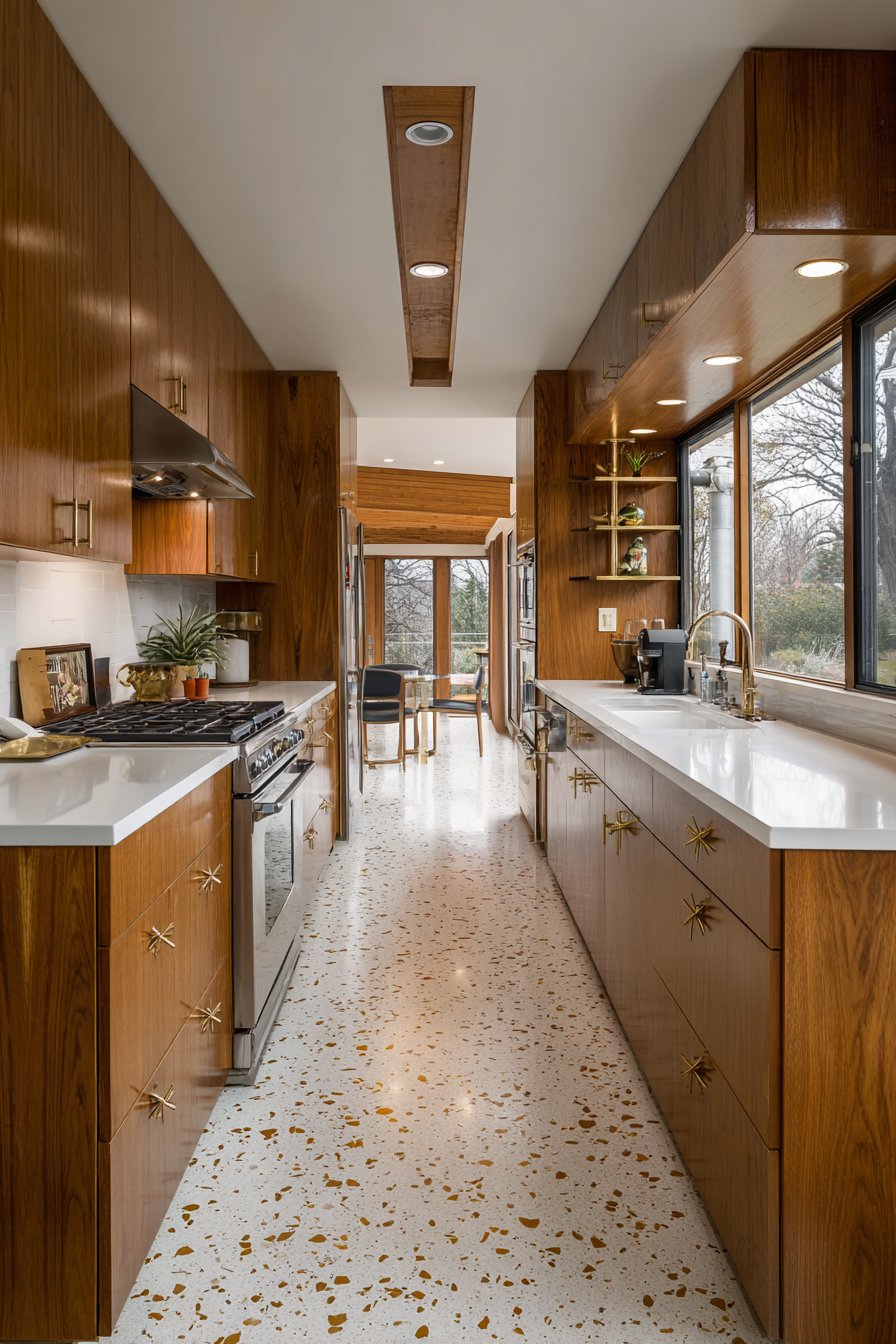
A pass-through window with floating shelf connects the kitchen to the adjacent dining area, exemplifying the mid century commitment to open-concept living and the breakdown of traditional room barriers. This architectural feature allows food service without requiring servers to navigate through doorways, while the floating shelf provides display space for serving pieces or decorative objects that can be appreciated from both rooms. The pass-through also facilitates conversation between cook and guests, transforming meal preparation from isolated labor into social activity—a revolutionary concept when these kitchens were first designed.
Key Design Tips:
- Choose floor-to-ceiling cabinetry in galley kitchens to maximize storage without expanding footprint
- Select vertical grain walnut for sophisticated, formal aesthetics
- Conceal appliances behind integrated panels for seamless visual flow
- Use terrazzo flooring with metallic aggregate to brighten dark wood spaces
- Incorporate starburst or atomic-era hardware designs for authentic period detail
- Create pass-through windows to adjacent spaces for improved flow and connectivity
- Install floating shelves as functional room dividers that maintain visual openness
5. Avocado Green Statement with Organic Warmth
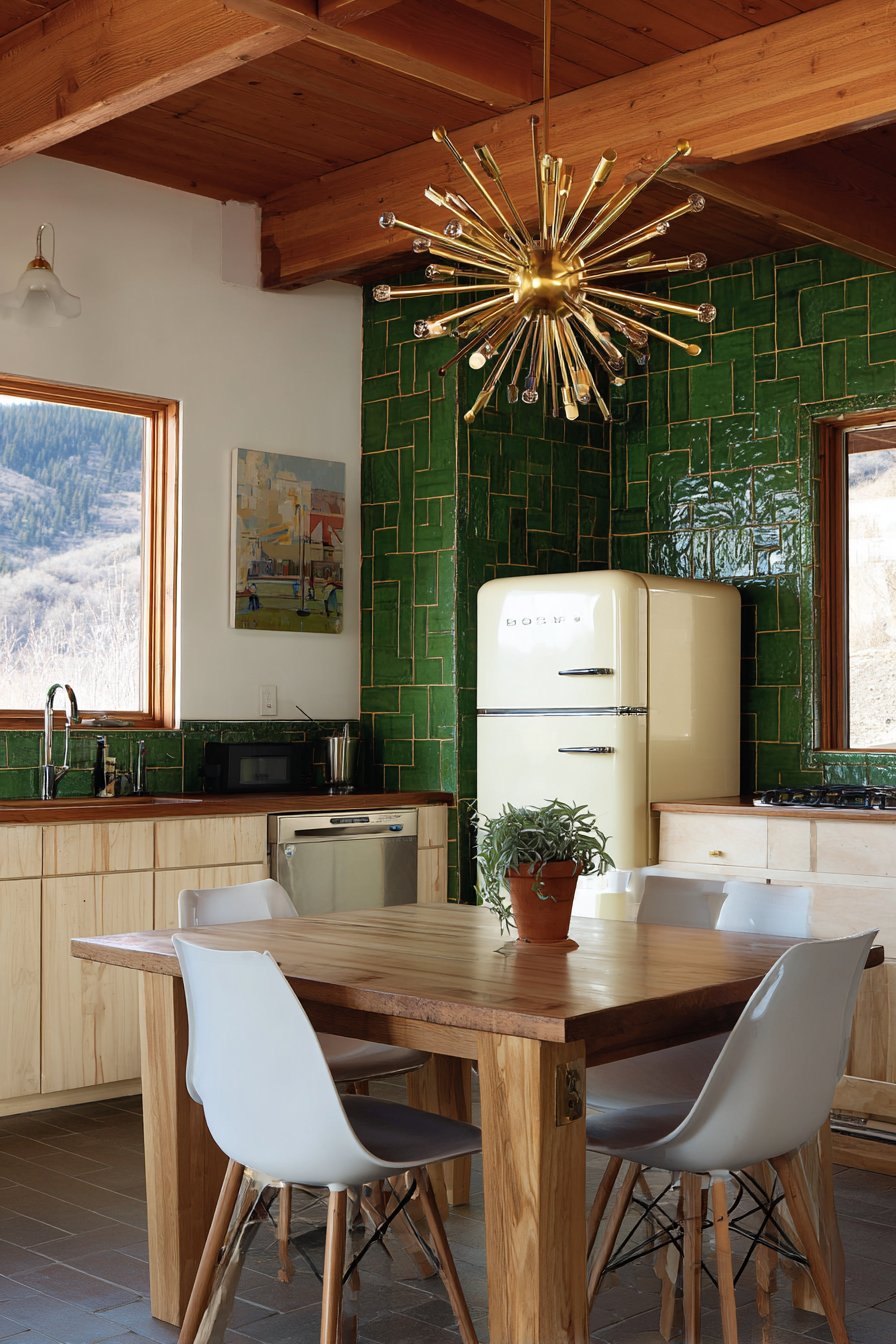
This bold mid century modern kitchen fearlessly embraces one of the era’s most characteristic colors—avocado green—deploying it as a statement backsplash that commands immediate attention. The ceramic tile, with its slight color variation from tile to tile, creates depth and visual interest that flat paint cannot achieve, while the glaze catches and reflects light in subtle ways that animate the surface throughout the day. This green, neither too yellow nor too olive, represents the mid century obsession with bringing nature-inspired hues indoors, reflecting the broader cultural movement toward environmental awareness and organic living that characterized the late 1960s.
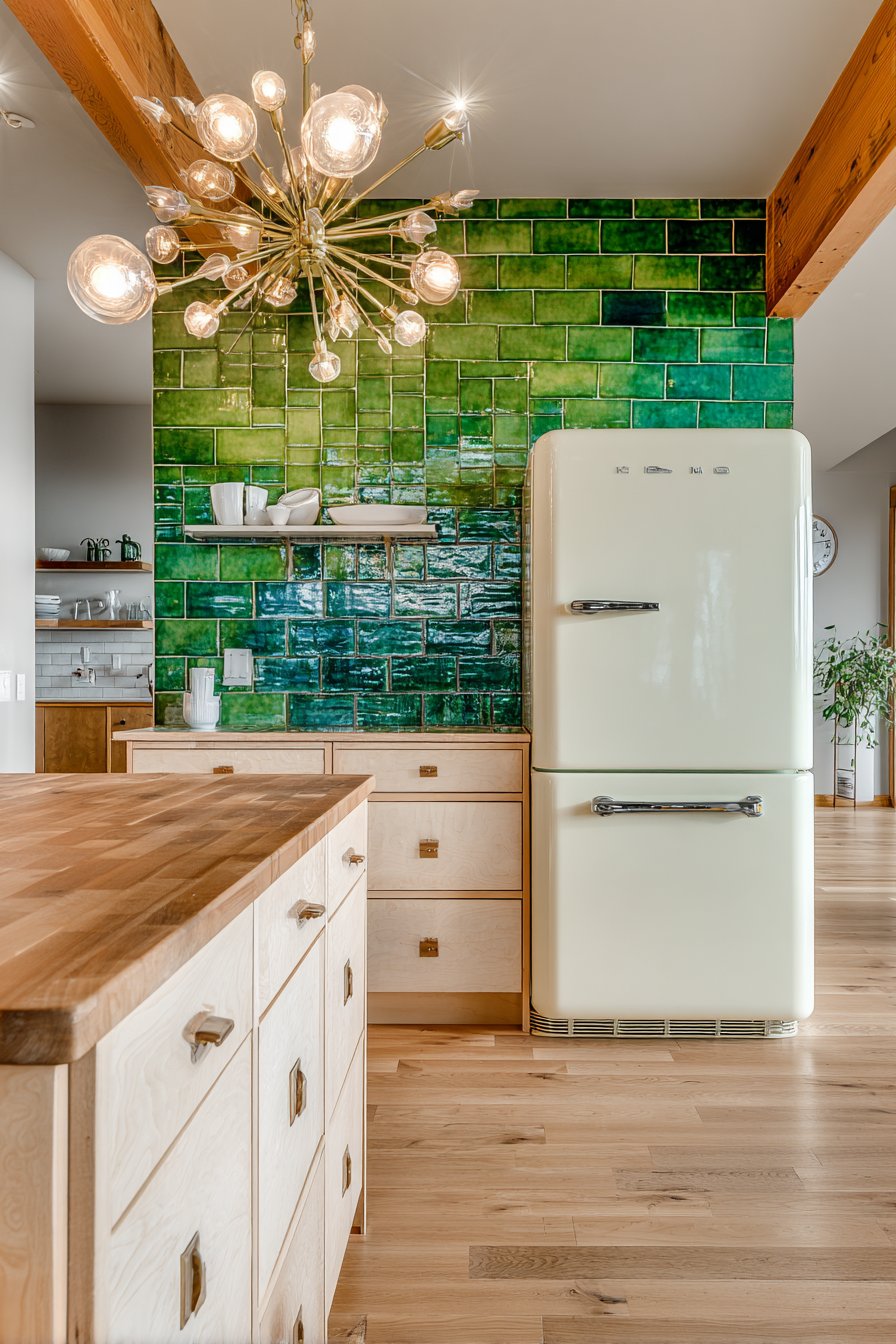
Natural birch cabinetry with visible wood grain provides the perfect counterpoint to the saturated green backsplash, its pale, creamy tones and delicate grain patterns creating visual breathing room while emphasizing the organic materials philosophy central to mid century design. The tapered legs supporting the base cabinets lift the birch boxes off the floor, creating that signature floating effect while allowing cleaning tools easy access beneath—a practical consideration that also enhances the room’s sense of spaciousness. Butcher block countertops with rich honey patina introduce another layer of natural material, their warm tones bridging between the pale birch and the deeper avocado green while providing an ideal, slightly yielding surface for food preparation tasks.
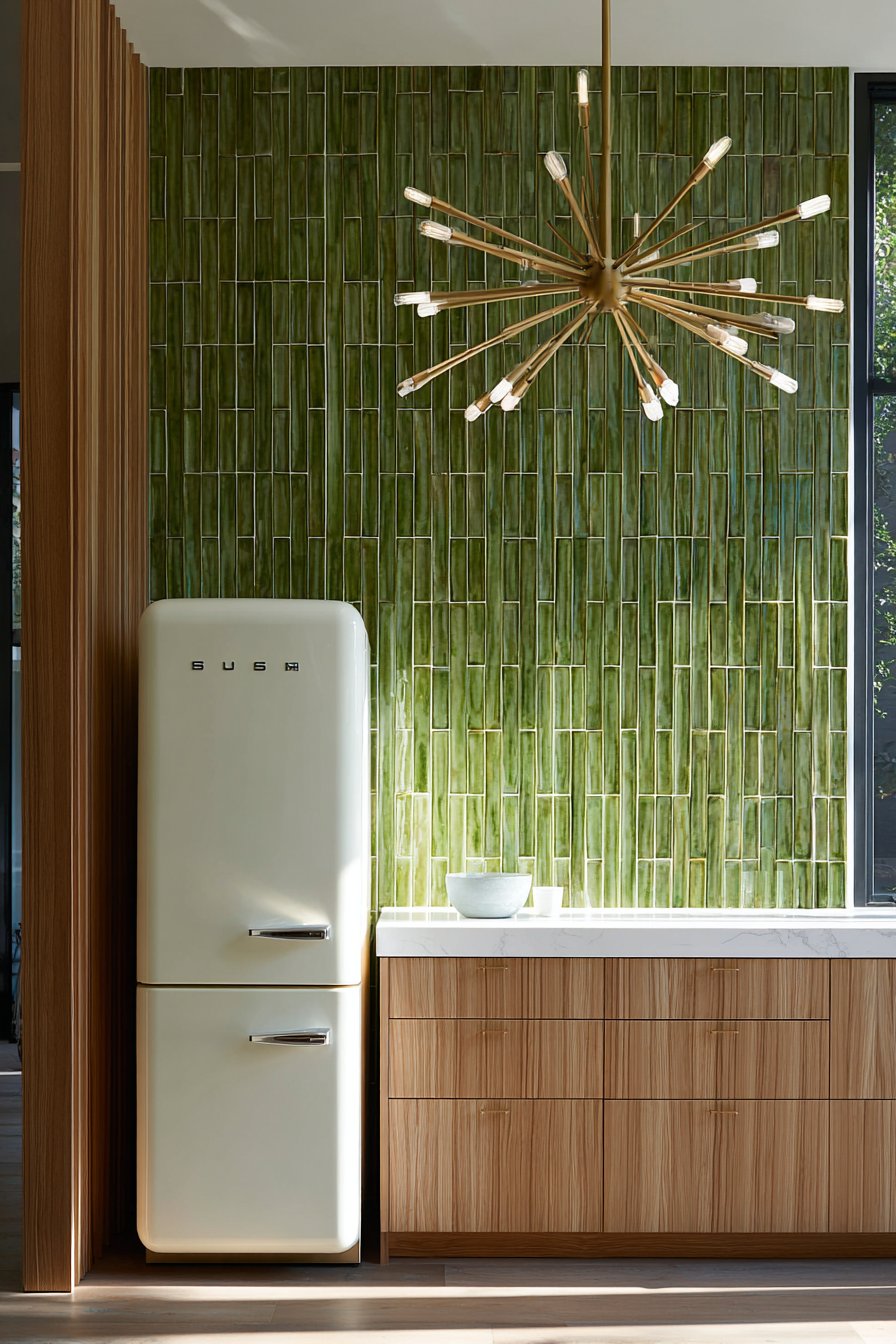
A vintage-style refrigerator in cream white anchors one wall, its rounded corners and period-correct proportions providing authentic detail that modern appliances simply cannot replicate. These reproduction appliances have become increasingly available as homeowners seek to complete their mid century visions, and while they incorporate contemporary cooling technology and energy efficiency, their exterior designs faithfully reproduce the charming aesthetics of their vintage predecessors. The cream white color provides neutral relief within the palette of greens and wood tones, preventing the space from feeling too monochromatic.
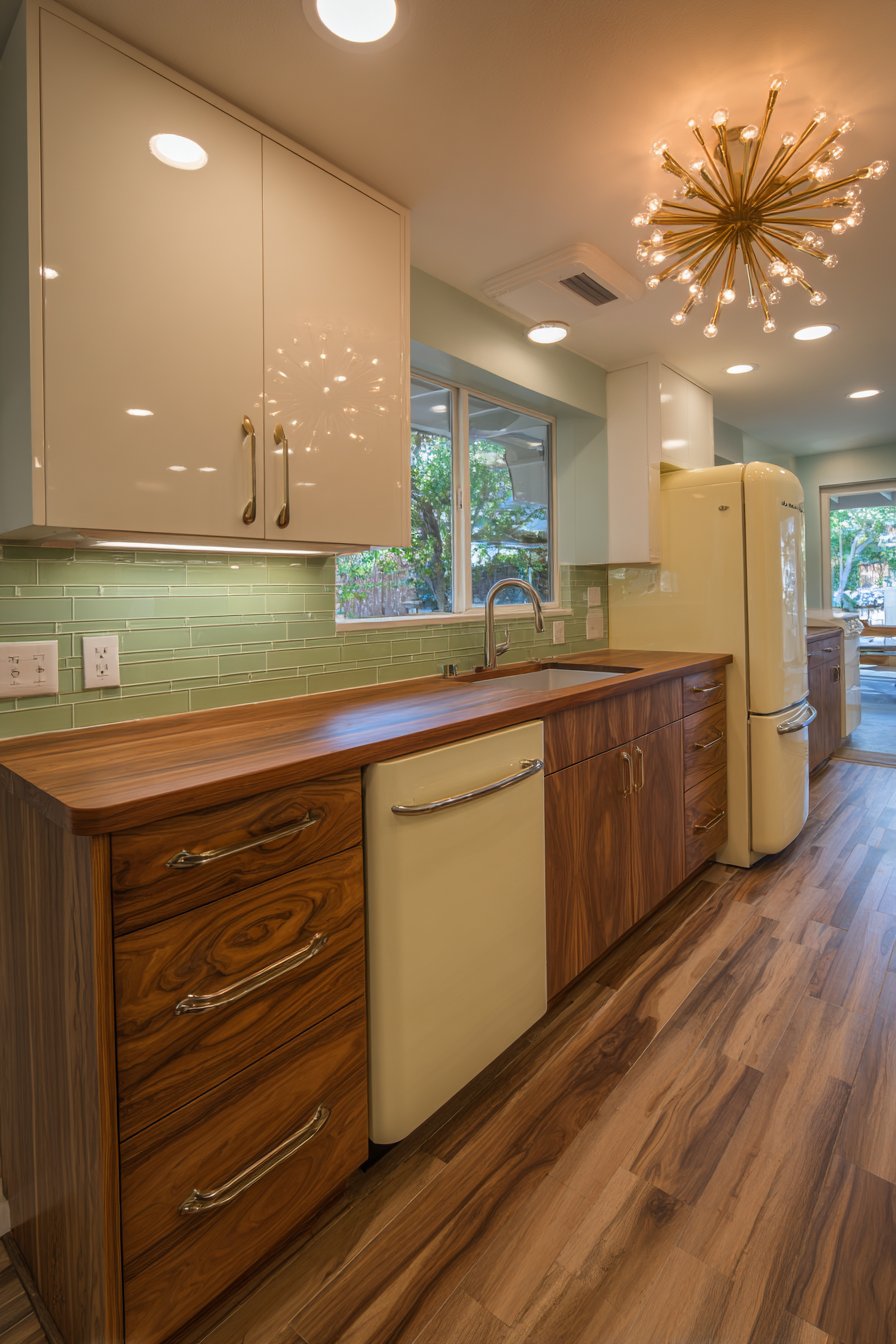
The Sputnik-style chandelier with multiple brass arms radiating from a central sphere provides both ambient lighting and sculptural focal point, its space-age design referencing the 1957 Soviet satellite launch that captivated the world’s imagination. This iconic lighting fixture type, with its numerous bulbs creating a constellation of light points, distributes illumination evenly while making an unmistakable style statement. The brass arms pick up golden undertones in the butcher block and birch, creating cohesive metallic threads throughout the composition. Natural window light supplements the artificial lighting, highlighting the organic materials and retro appliance integration while demonstrating how authentic mid century kitchens relied on generous fenestration to reduce daytime energy consumption.
Key Design Tips:
- Choose one bold period color like avocado green for focused impact rather than overwhelming the space
- Select ceramic tile with slight color variation for depth and authentic handcrafted appearance
- Pair pale wood cabinetry with butcher block countertops for layered organic texture
- Incorporate vintage or reproduction appliances with period-correct proportions and colors
- Install Sputnik or atomic-style chandeliers as sculptural focal points
- Use cream or white appliances to provide neutral anchors within bold color schemes
- Position cabinetry on tapered legs to emphasize the floating aesthetic
6. Textured Brick Accent with Practical Storage
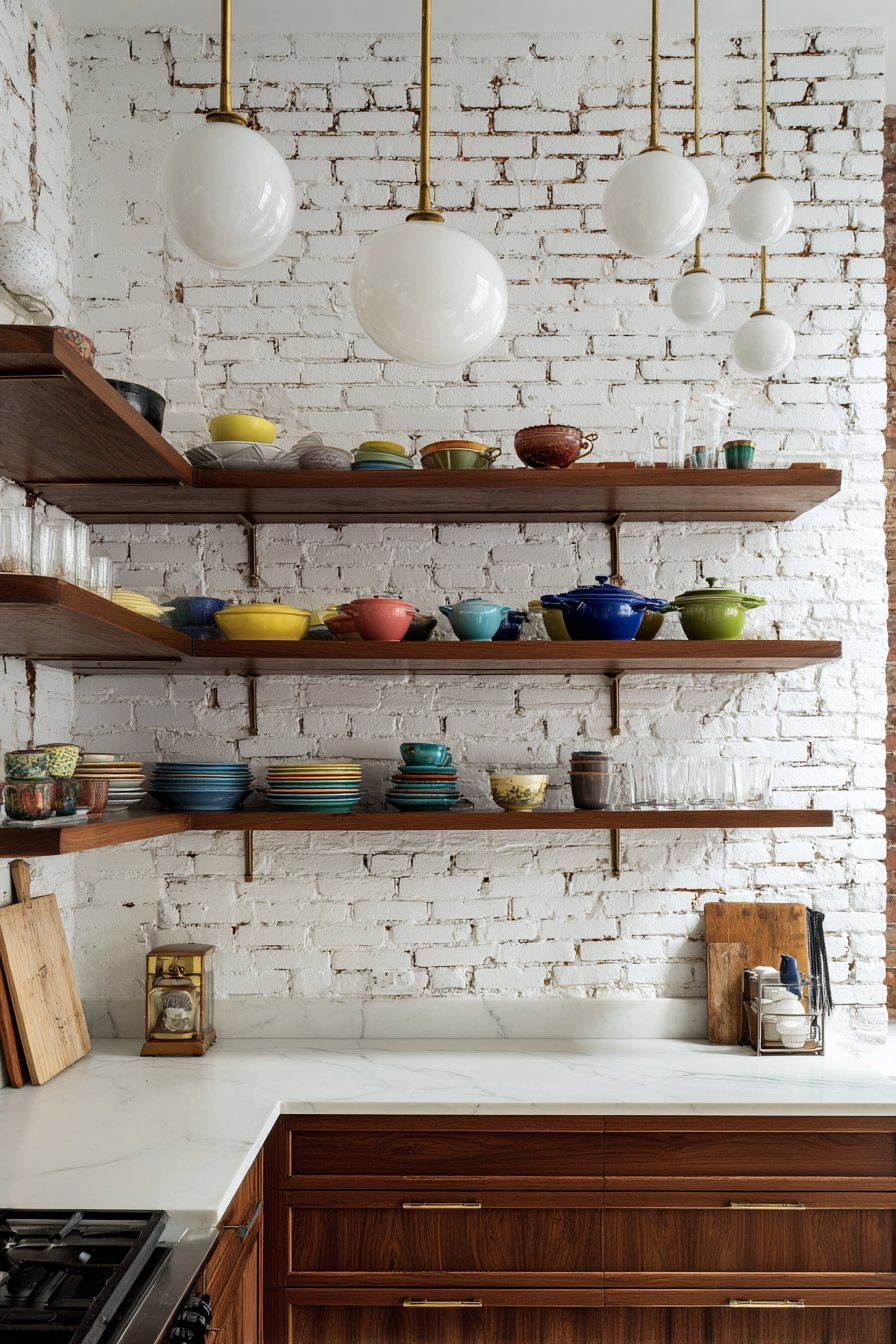
This charming mid century modern kitchen introduces unexpected textural complexity through a white painted brick accent wall that provides dimensional interest behind open wooden shelving. The brick, with its irregular surface and mortar lines, creates tactile richness that contrasts beautifully with the smooth surfaces dominating the rest of the kitchen—painted cabinets, Corian countertops, and glass accessories. Painting the brick white brightens the space while preserving the material’s inherent texture, demonstrating the mid century skill at balancing rustic elements with refined finishes.
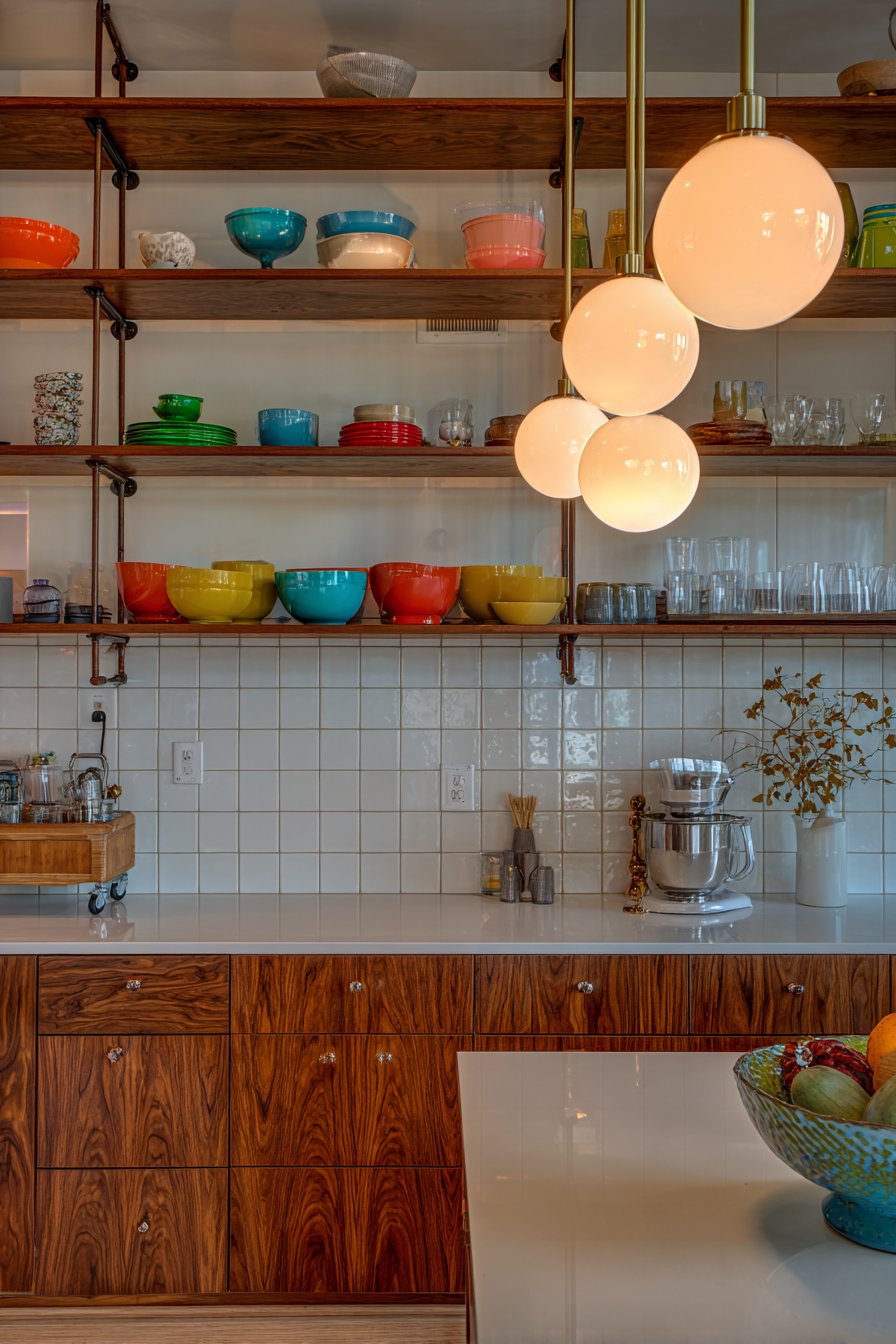
The open wooden shelving displays a carefully curated collection of colorful Pyrex bowls and period glassware, transforming everyday kitchen items into a dynamic, ever-changing art installation. The Pyrex, in its characteristic bright primary colors and cheerful patterns, represents quintessential mid century Americana—affordable, durable, and beautiful objects that democratized good design. These pieces, whether authentic vintage or contemporary reproductions, inject personality and color while remaining fully functional for daily cooking needs. The open shelving itself embodies mid century values of accessibility and display, rejecting the hidden, closed storage of earlier eras in favor of making beautiful objects visible and readily available.
Lower cabinetry in rich mahogany features clean lines and minimal hardware, its deep reddish-brown tones providing grounding weight and sophistication. The mahogany’s lustrous finish catches light differently than matte surfaces, adding subtle variation to the visual experience as one moves through the space. White Corian countertops crown the mahogany bases, their solid surface construction offering seamless, easy-to-clean work areas without visible seams or grout lines. Corian, introduced in 1967, represented cutting-edge material technology in the late mid century period, and its continued popularity speaks to its practical benefits and aesthetic versatility.
A small mobile kitchen cart with hairpin legs provides additional workspace, exemplifying the mid century love of flexible, multipurpose furniture. The hairpin legs—thin metal rods bent into simple curves—became iconic mid century elements, their minimal material use and maximum structural efficiency representing the era’s less-is-more philosophy. This mobile cart can be positioned wherever needed, then rolled away when not in use, adapting to the kitchen’s changing needs throughout the day. Globe pendant lights with milk glass shades hang at varying heights, their simple spherical forms and soft, diffused light creating ambient illumination that flatters both people and spaces. The varying heights introduce dynamic visual rhythm while ensuring task lighting reaches different work surfaces.
Key Design Tips:
- Paint brick accent walls white to maintain texture while brightening the space
- Display colorful vintage Pyrex and glassware on open shelving for functional decoration
- Combine rich wood cabinets with white countertops for classic contrast
- Choose Corian or solid surface countertops for seamless, low-maintenance work surfaces
- Incorporate mobile carts with hairpin legs for flexible additional workspace
- Hang globe pendant lights at varying heights for dynamic visual interest
- Use minimal cabinet hardware on flat-panel doors to emphasize clean lines
- Curate displayed items by color and form for intentional, cohesive compositions
7. Dark Contrast with Pegboard Organization
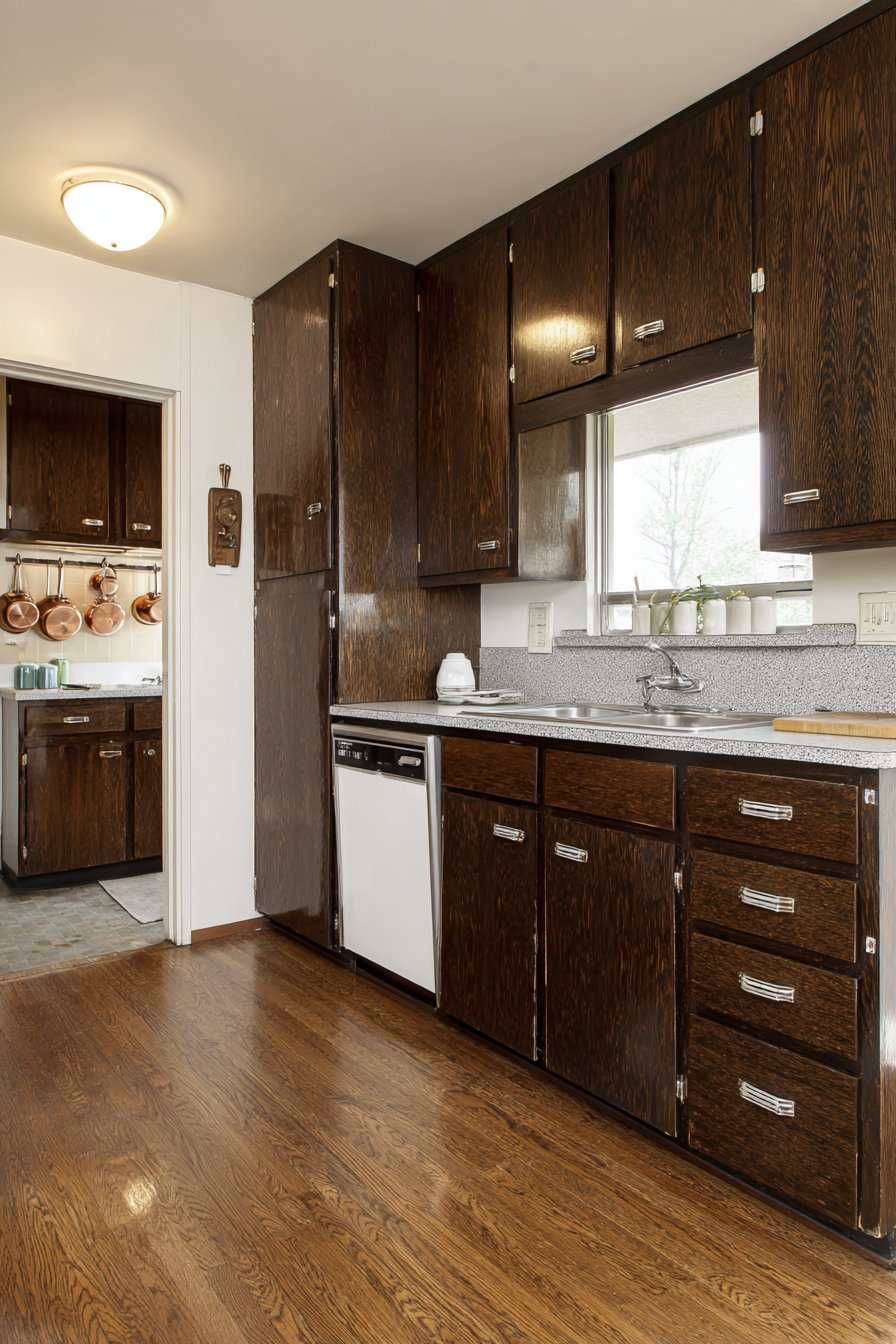
This dramatic mid century modern kitchen creates striking visual impact through the bold use of dark espresso-stained oak cabinets against crisp white walls, demonstrating how the era’s designers weren’t afraid of strong contrast and defined boundaries between surfaces. The espresso stain emphasizes the oak’s prominent grain pattern, creating rich visual texture that rewards close examination while the near-black color provides sophisticated gravitas. This darker palette represents a departure from the lighter woods featured in many mid century kitchens, proving the style’s versatility and ability to accommodate varied aesthetic preferences.
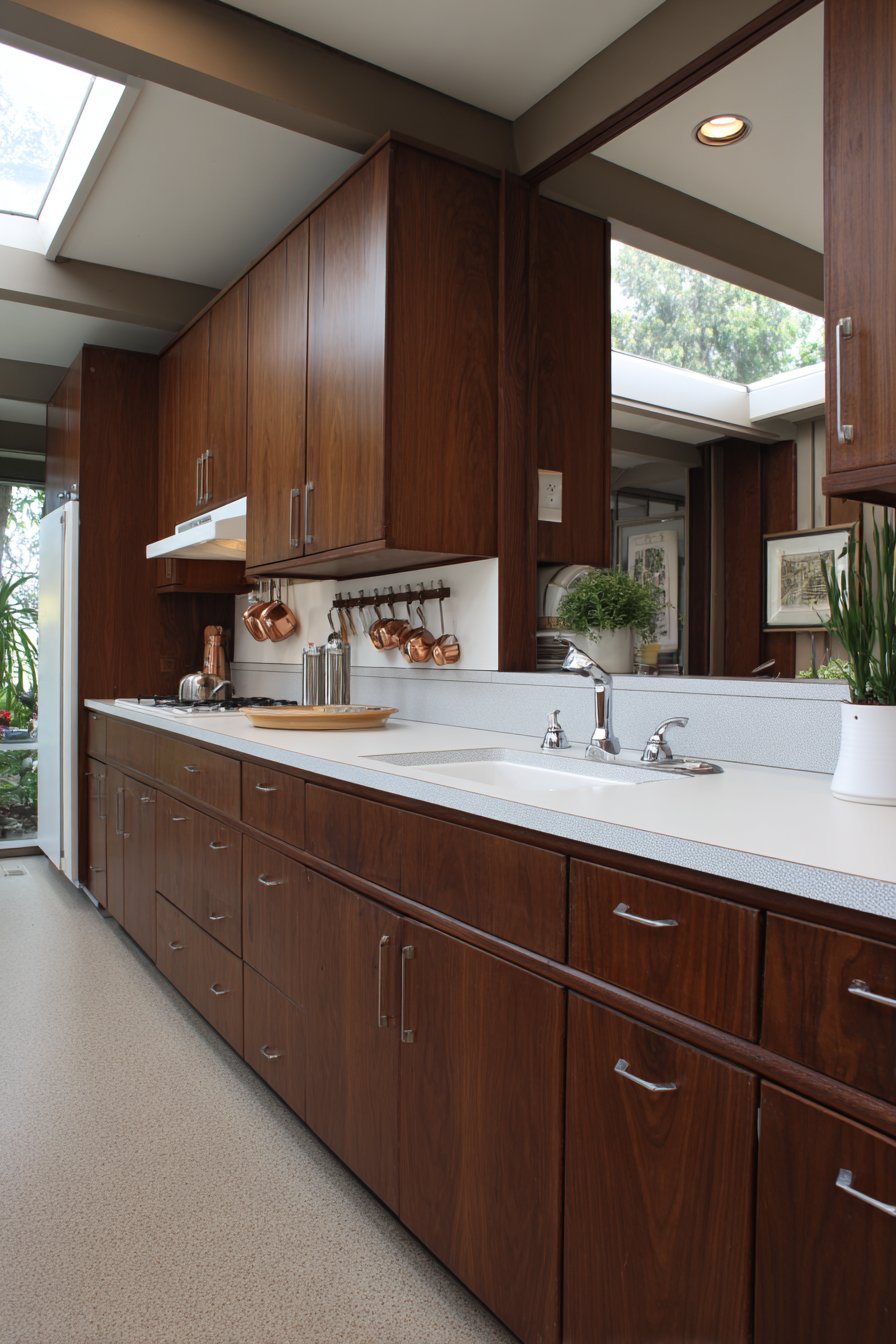
The original-style pegboard wall system represents one of the most ingenious and influential mid century storage innovations, transforming a simple perforated panel into a highly functional, infinitely customizable organizational tool. Wooden pegs inserted into the board’s regular grid of holes support copper pots, cooking utensils, and small shelves, keeping frequently used items within easy reach while creating an attractive display that celebrates the beauty of well-designed tools. The pegboard system embodies mid century problem-solving at its best—simple, affordable, adaptable, and honest about its function. The copper pots hanging on the pegboard add warm metallic accents that glow against the white wall, their rounded forms and burnished surfaces providing organic contrast to the geometric precision of the pegboard grid.
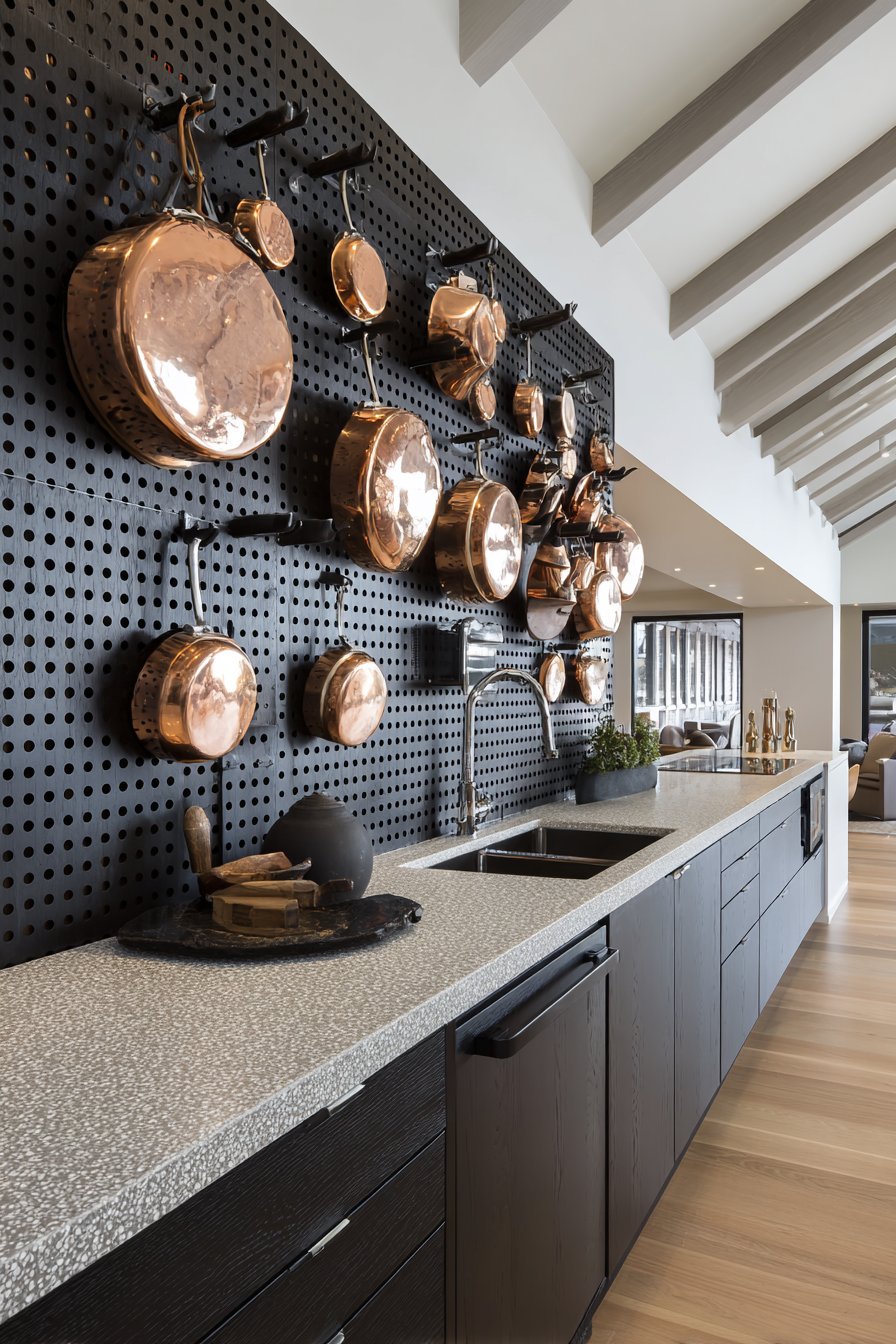
Laminate countertops in speckled grey with boomerang pattern edges provide durable work surfaces that require minimal maintenance, their busy pattern concealing minor scratches and wear while the distinctive edge profile injects characteristic mid century flair. The grey tone bridges between the dark cabinets and white walls, creating visual transition while remaining neutral enough to accommodate various accent colors in accessories, textiles, or small appliances. These laminate surfaces, far from being budget compromises, represent authentic period material choices that offered revolutionary benefits to mid century homeowners.
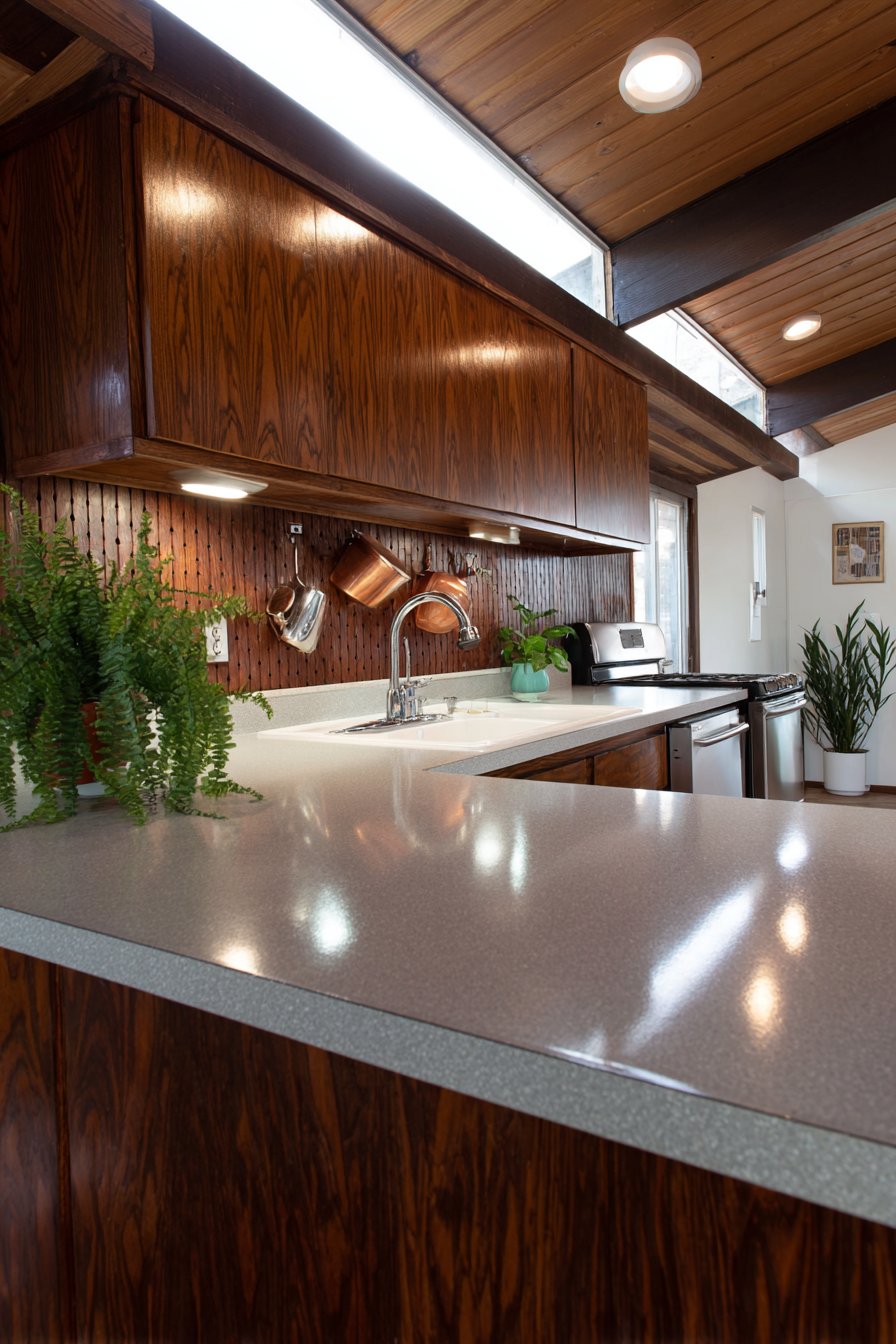
A vintage-inspired chrome faucet with separate hot and cold handles serves the undermount sink, its bright reflective finish and traditional cross handles providing nostalgic detail that completes the period aesthetic. These separate handles, while perhaps less convenient than modern single-lever designs, offer authentic period accuracy and a tactile, mechanical quality that many find satisfying. The chrome finish, maintained through regular polishing, catches light and adds jewelry-like sparkle to the sink area. Natural lighting from clerestory windows—high windows positioned near the ceiling—floods the space with soft, diffused illumination that doesn’t require window treatments and maintains privacy while maximizing daylight penetration. These windows emphasize the room’s architectural elements, casting subtle shadows that reveal the three-dimensional quality of the pegboard, the depth of the cabinet grain, and the profile of the boomerang countertop edges.
Key Design Tips:
- Use dark wood stains on oak cabinets to emphasize grain pattern and create drama
- Install pegboard wall systems for functional, customizable, and attractive tool storage
- Display copper cookware as decorative elements that provide warm metallic accents
- Choose laminate countertops with period-appropriate patterns like boomerang or atomic designs
- Select vintage-style faucets with separate handles for authentic period detail
- Incorporate clerestory windows for privacy-protected natural lighting
- Paint walls bright white to maximize contrast with dark cabinetry
- Arrange displayed tools and cookware with attention to composition and balance
8. Light Ash Innovation with Geometric Flooring
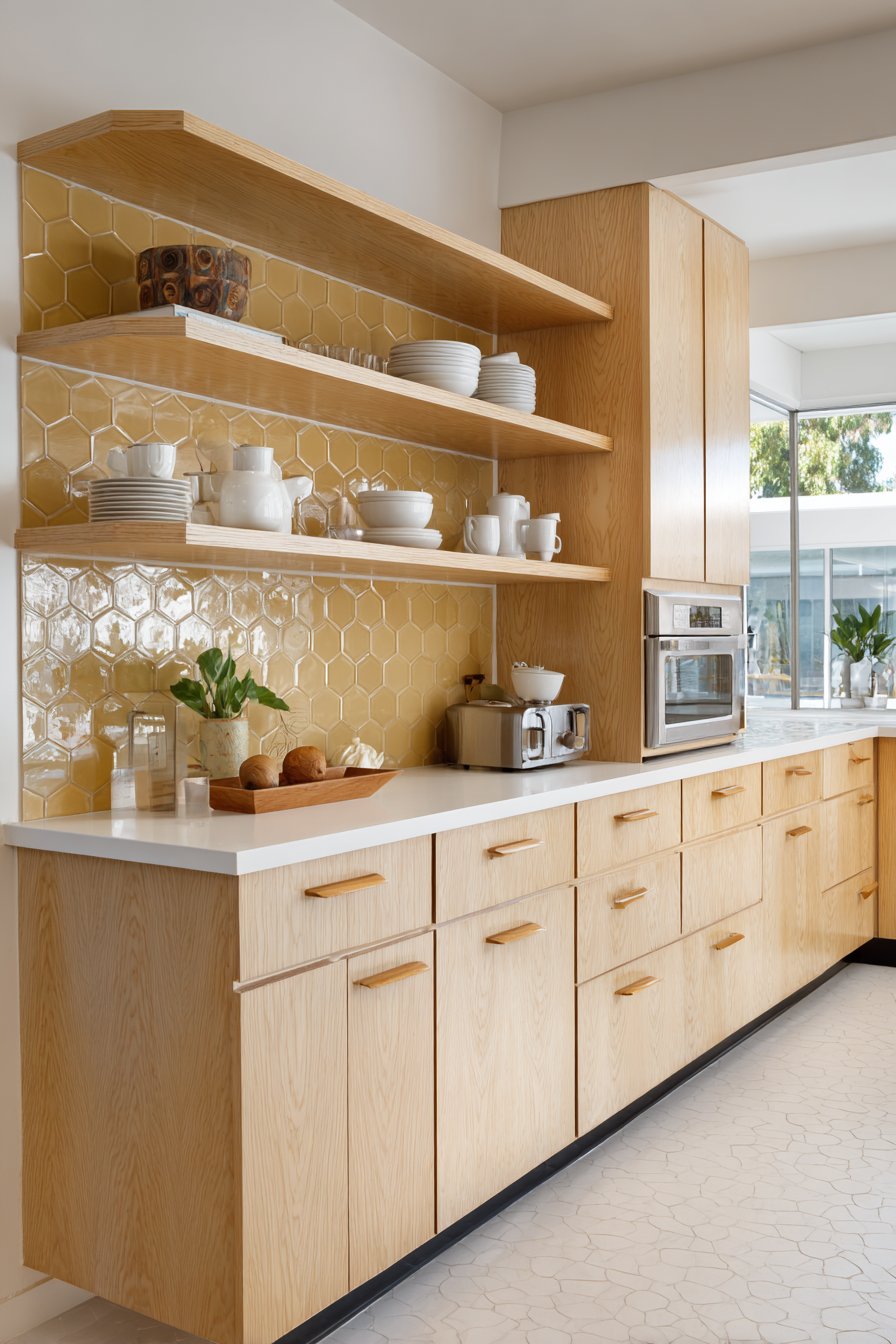
This sophisticated mid century modern kitchen showcases light ash wood cabinetry featuring innovative tambour door roll-up sections that reveal small appliance storage, exemplifying the era’s fascination with clever mechanical solutions and hidden functionality. The tambour doors, constructed from narrow wooden slats attached to flexible backing, roll up and disappear into the cabinet body, eliminating the swing radius required by traditional hinged doors while adding kinetic interest through their unique operation. The light ash wood, with its pale blonde tones and subtle grain, creates an airy, Scandinavian-influenced aesthetic that feels fresh and contemporary even decades after the style’s heyday.
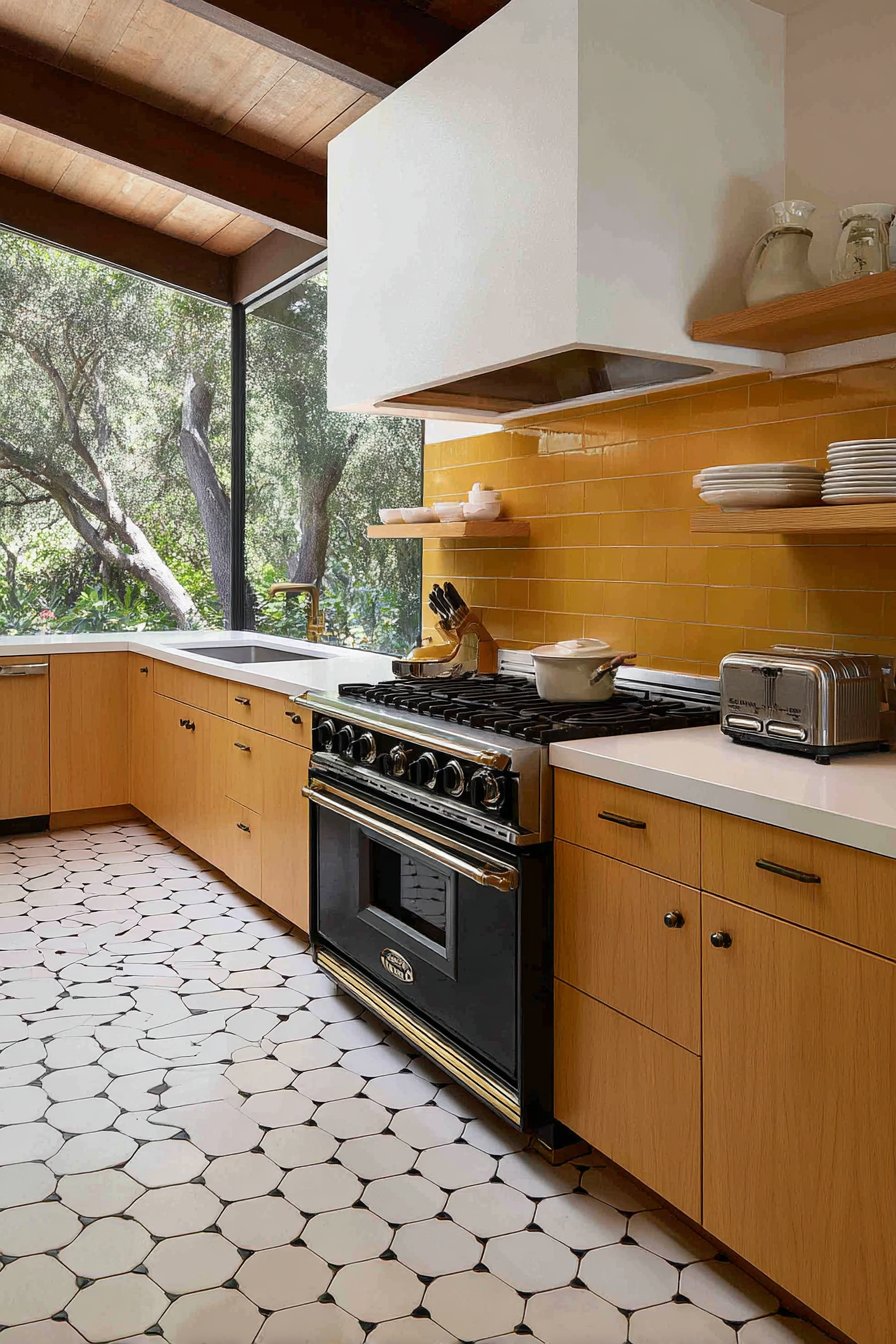
White hexagonal floor tiles with black grout create bold geometric interest underfoot, their honeycomb pattern introducing organic mathematics that contrasts with the rectilinear cabinetry while the high-contrast grout emphasizes each tile’s shape and the overall pattern’s structure. This flooring choice demonstrates mid century designers’ skill at incorporating pattern and visual complexity in unexpected places—while walls and cabinets remain relatively plain, the floor becomes a graphic canvas. The hexagonal tile also offers practical benefits, its smaller scale providing more grout lines for slip resistance and its geometric shape allowing for easy accommodation of drains and irregular corners.
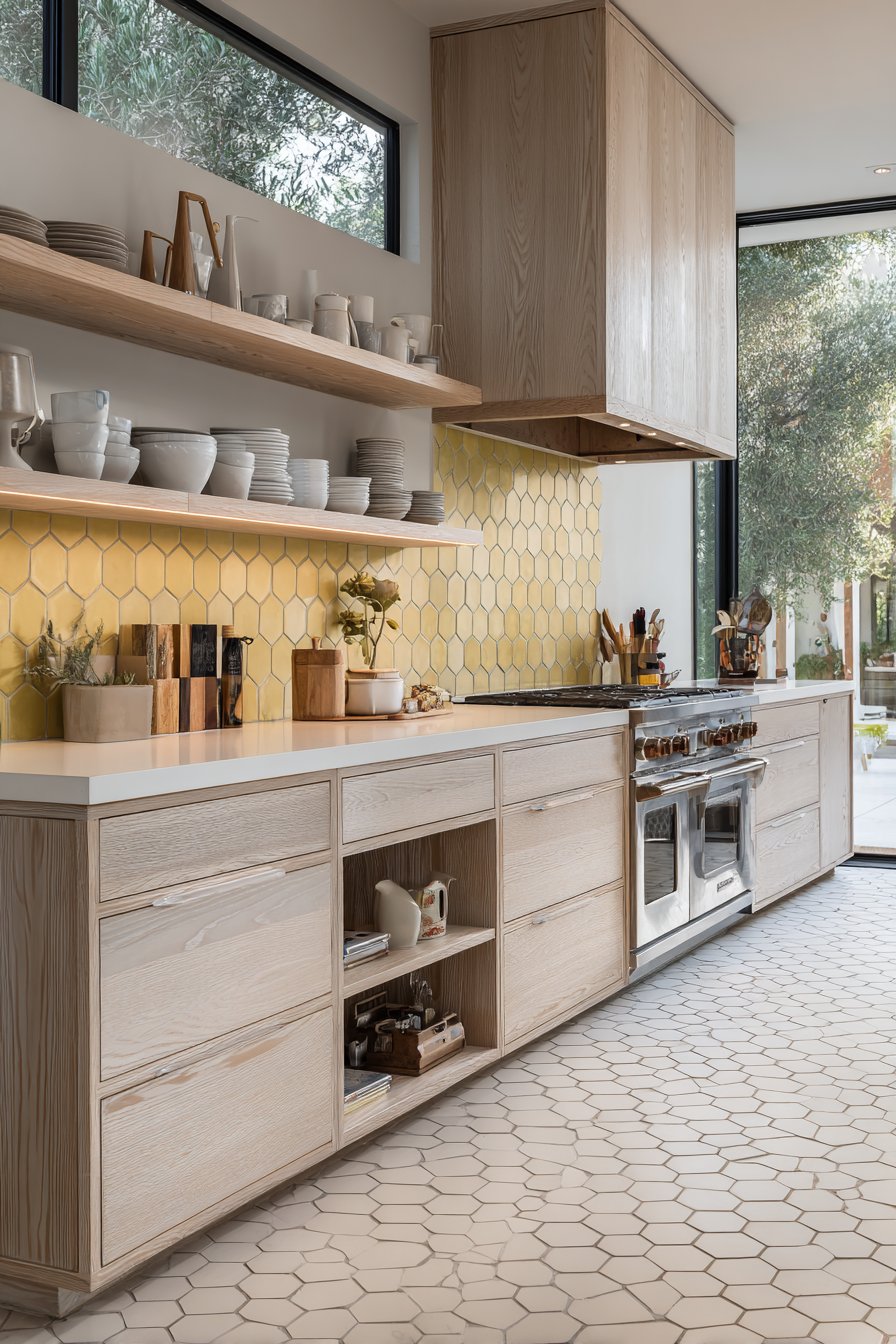
The range wall showcases a mustard yellow ceramic tile backsplash with slight glaze variation, its warm, earthy tone providing energizing color that stops short of overwhelming the serene ash cabinetry. The mustard yellow, slightly deeper and more complex than pure bright yellow, represents another characteristic mid century color—optimistic and cheerful but grounded enough for long-term livability. The ceramic tile’s handcrafted appearance, with glaze that pools slightly differently on each tile, adds artisanal quality that machine-made materials cannot replicate, honoring the mid century respect for craft despite the era’s embrace of mass production.
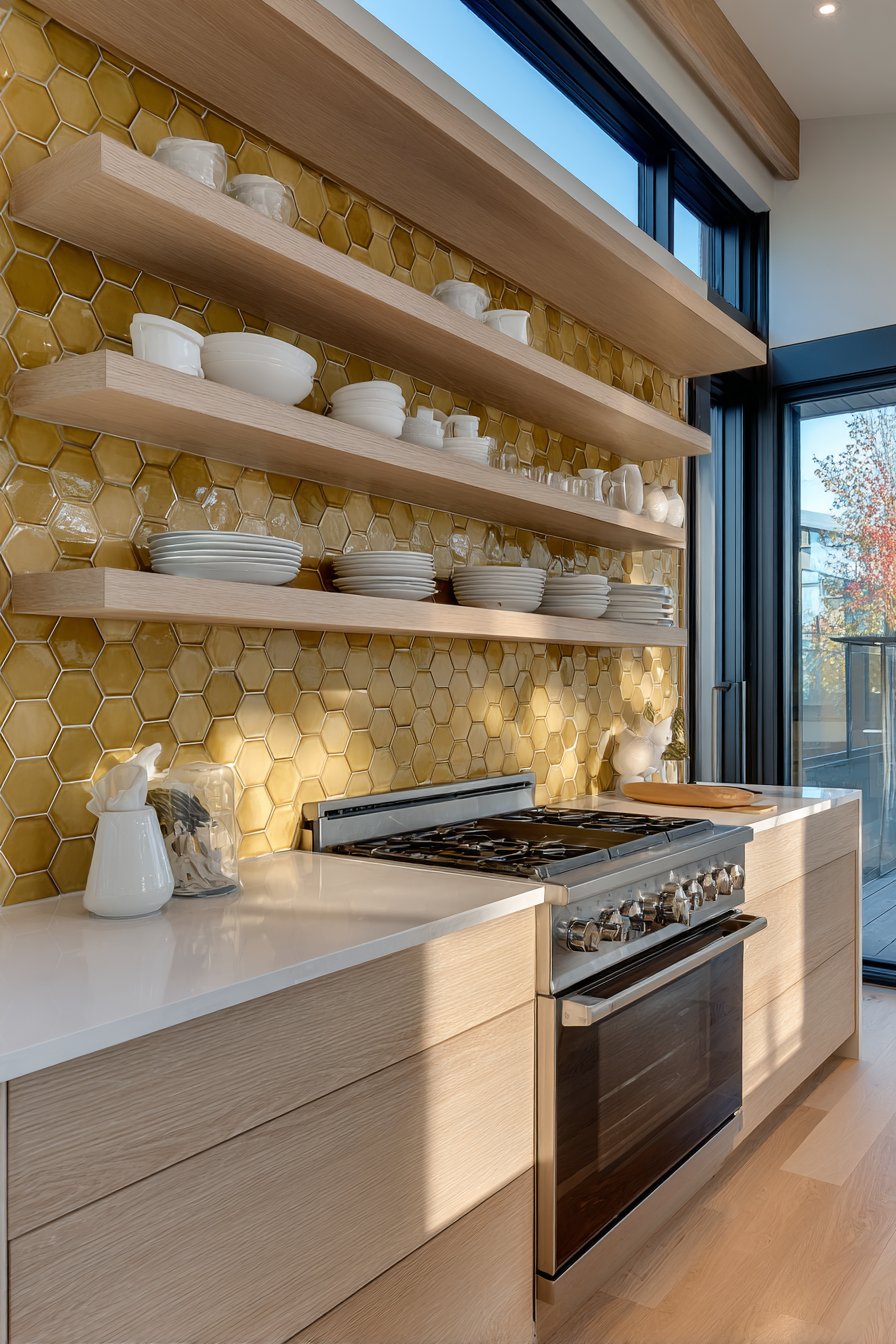
Floating shelves in matching ash wood display minimalist white dinnerware, their clean lines and pale color allowing the dishes’ forms to read clearly while maintaining visual calm. This display strategy—uniform dishes in neutral colors—creates order and serenity rather than the visual variety of multicolored collections. The floating shelves appear to emerge directly from the wall without visible brackets, their seamless integration representing mid century engineering skill and aesthetic commitment to clean lines. Professional interior photography captures natural golden hour lighting streaming through horizontal windows, that warm, directional light highlighting the pale wood tones, the dimensional quality of the hexagonal floor pattern, and the lustrous glaze of the yellow tile. This lighting reveals the functional design’s beauty and authenticates the period color palette’s warmth.
Key Design Tips:
- Incorporate tambour doors for space-saving appliance storage with mechanical interest
- Choose light ash or blonde wood for airy, Scandinavian-influenced aesthetics
- Install hexagonal tile flooring with contrasting grout for bold geometric pattern
- Use mustard yellow or golden tones in tile backsplashes for warm accent color
- Display uniform white dinnerware on open shelving for serene, minimalist impact
- Select ceramic tiles with slight glaze variation for handcrafted authenticity
- Design floating shelves that appear to emerge seamlessly from walls
- Maximize natural lighting through horizontal windows for authentic mid century ambiance
9. Split-Level Innovation with Atomic Details
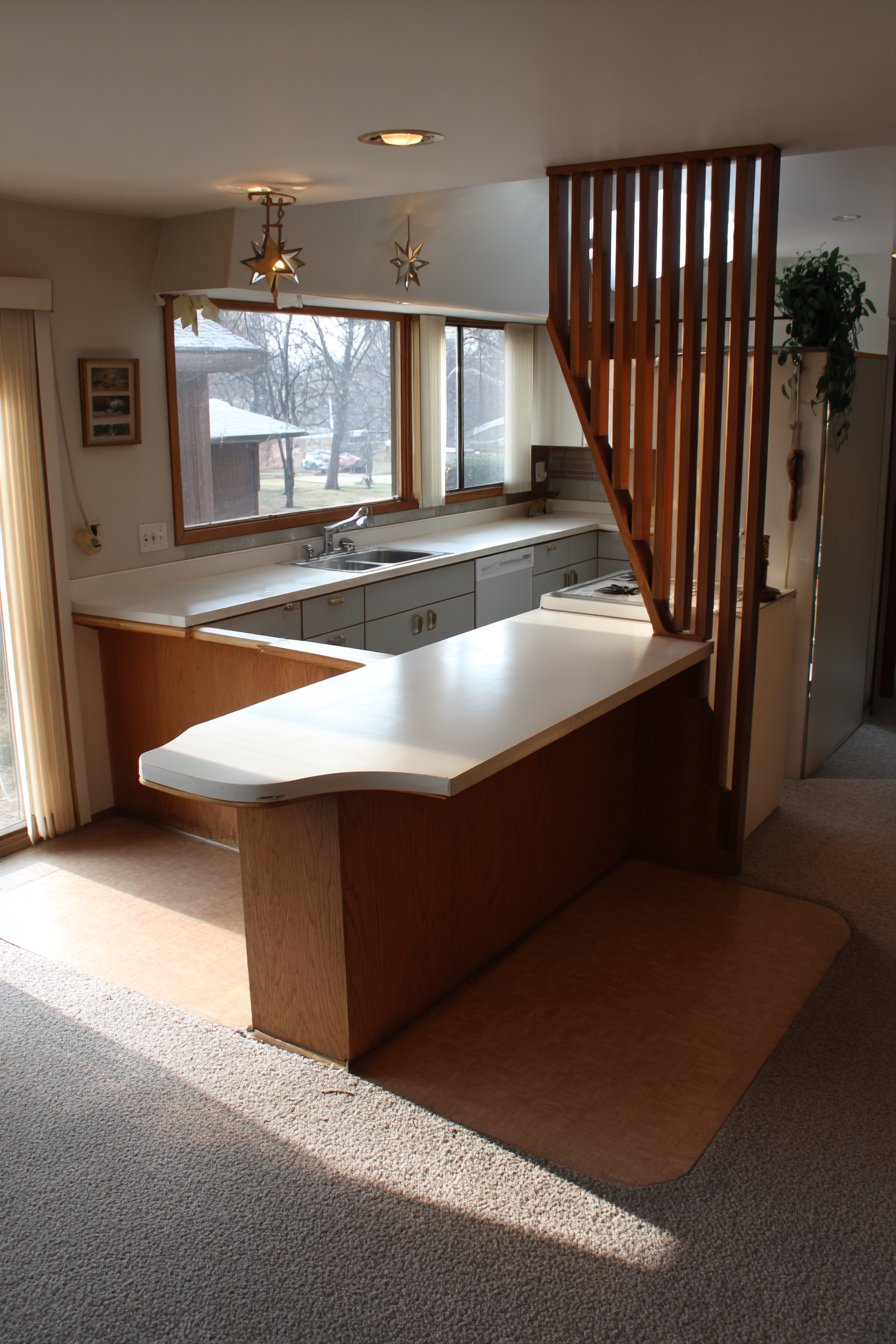
This groundbreaking mid century modern kitchen features an innovative split-level design that separates functions vertically, with a raised dining counter in natural teak creating a visual and physical barrier from the lower food prep area with white laminate surfaces. This split-level approach reflects the era’s experimental attitude toward spatial organization and its willingness to challenge conventional kitchen layouts. The raised counter serves multiple purposes—it provides casual dining seating, conceals cooking mess from dining guests, and creates architectural interest through its dimensional variation. The natural teak counter, with its rich grain and warm color, designates the dining area as a special zone worthy of premium material, while the practical white laminate below prioritizes easy cleaning in the work zone.
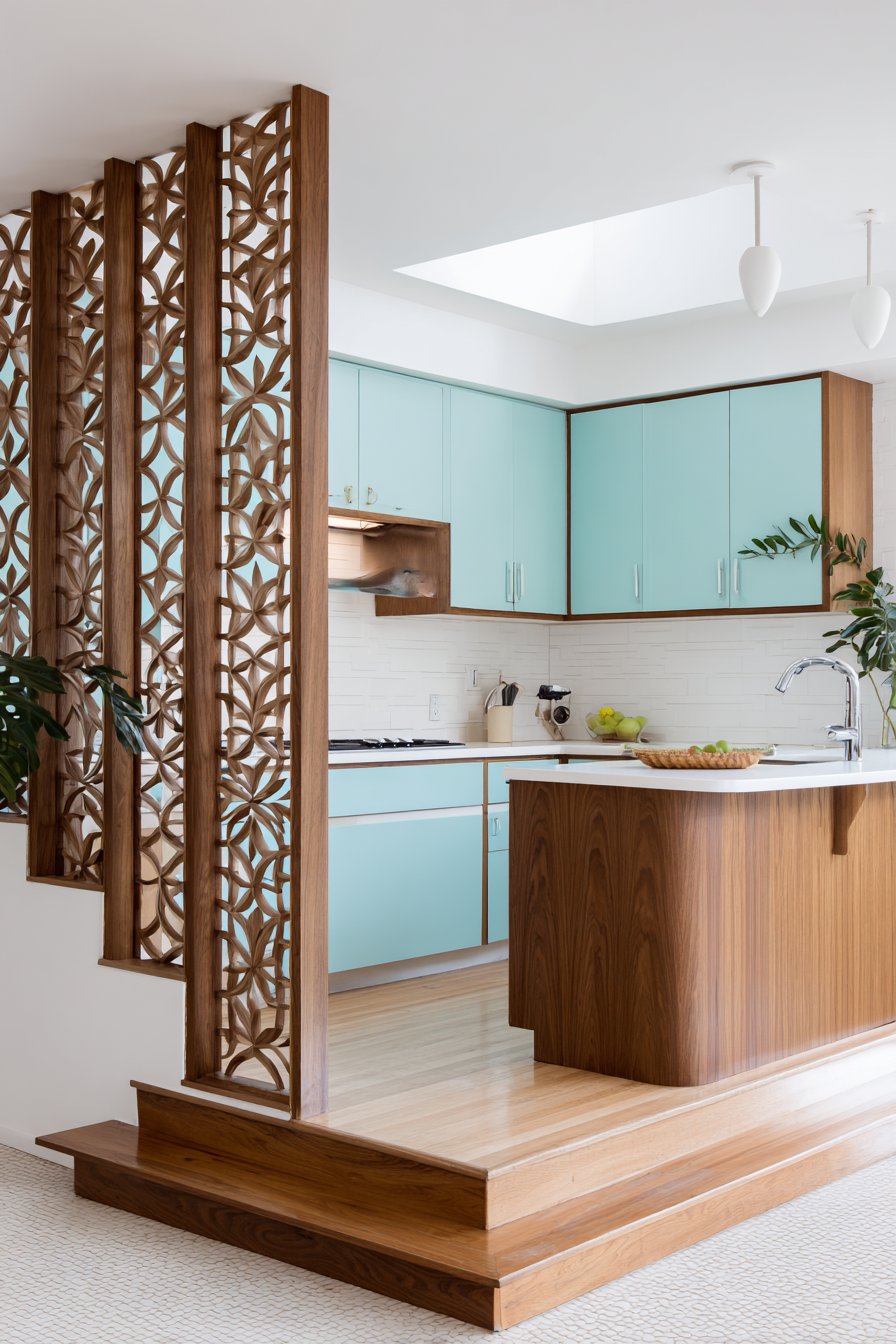
Cabinet doors in pale aqua blue introduce refreshing color that evokes swimming pools, tropical waters, and the optimistic leisure culture of mid century America. This distinctive shade, neither too green nor too saturated, demonstrates the era’s sophisticated color sensibility and willingness to use unexpected hues in permanent installations. The doors feature atomic-era starburst cutout handles in polished chrome, these negative space details serving as both functional grips and decorative elements that transform every cabinet face into a miniature sculpture. The starburst cutouts, with their radiating points suggesting explosive energy, perfectly capture mid century atomic age iconography while providing fingerhold functionality without protruding hardware that could snag clothing or impede traffic.
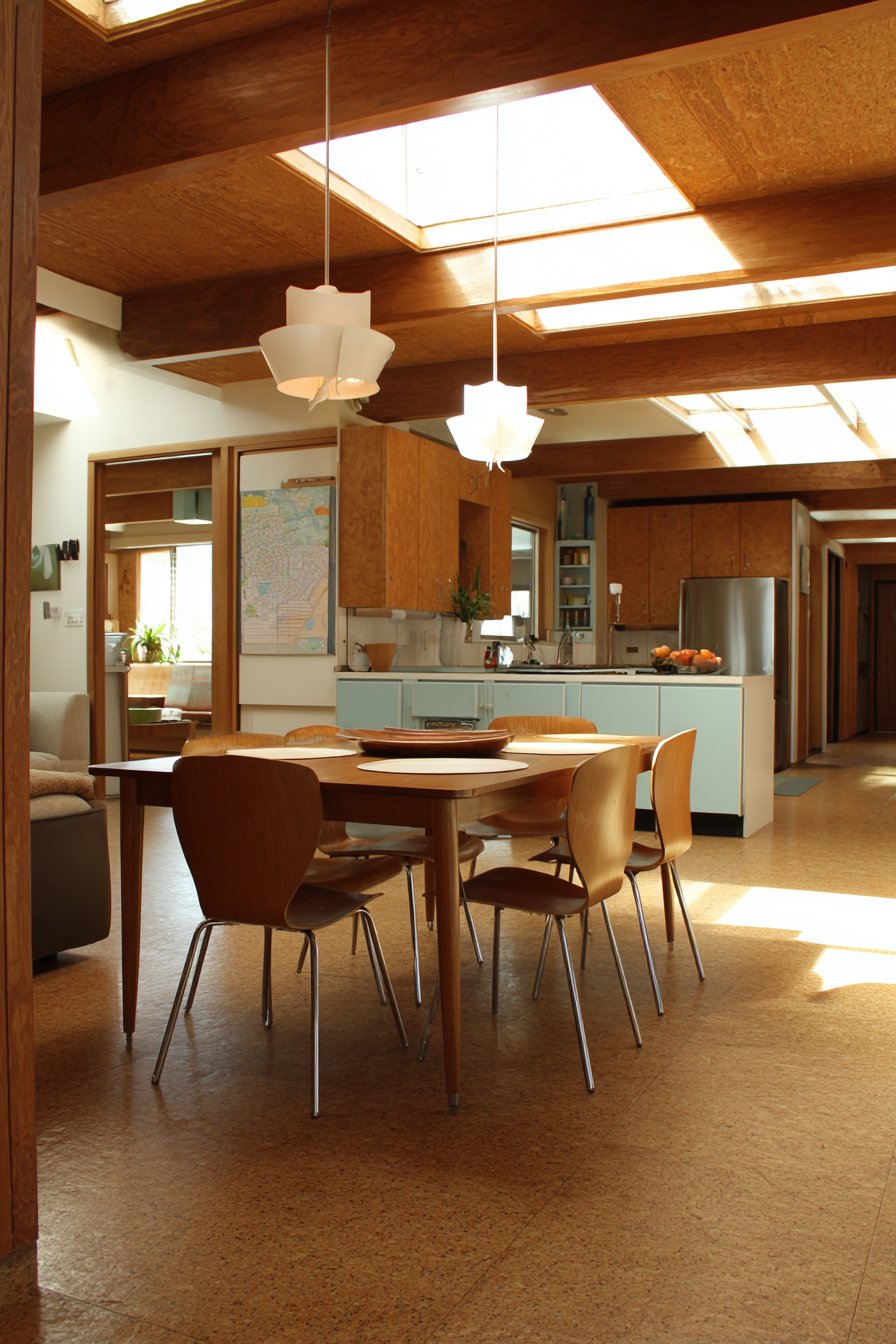
Cork flooring provides warmth and authenticity throughout the kitchen, its natural honey tones and subtle texture creating comfortable, resilient surfaces that honor mid century values of organic materials and practical innovation. Cork, harvested from renewable bark without harming trees, represented an early example of sustainable material use, while its cushioning properties reduce fatigue during long cooking sessions and its acoustic dampening qualities reduce noise—practical benefits that made cork a mid century favorite. The material’s slight give underfoot and warm temperature, even in winter, create sensory comfort that harder materials cannot match.
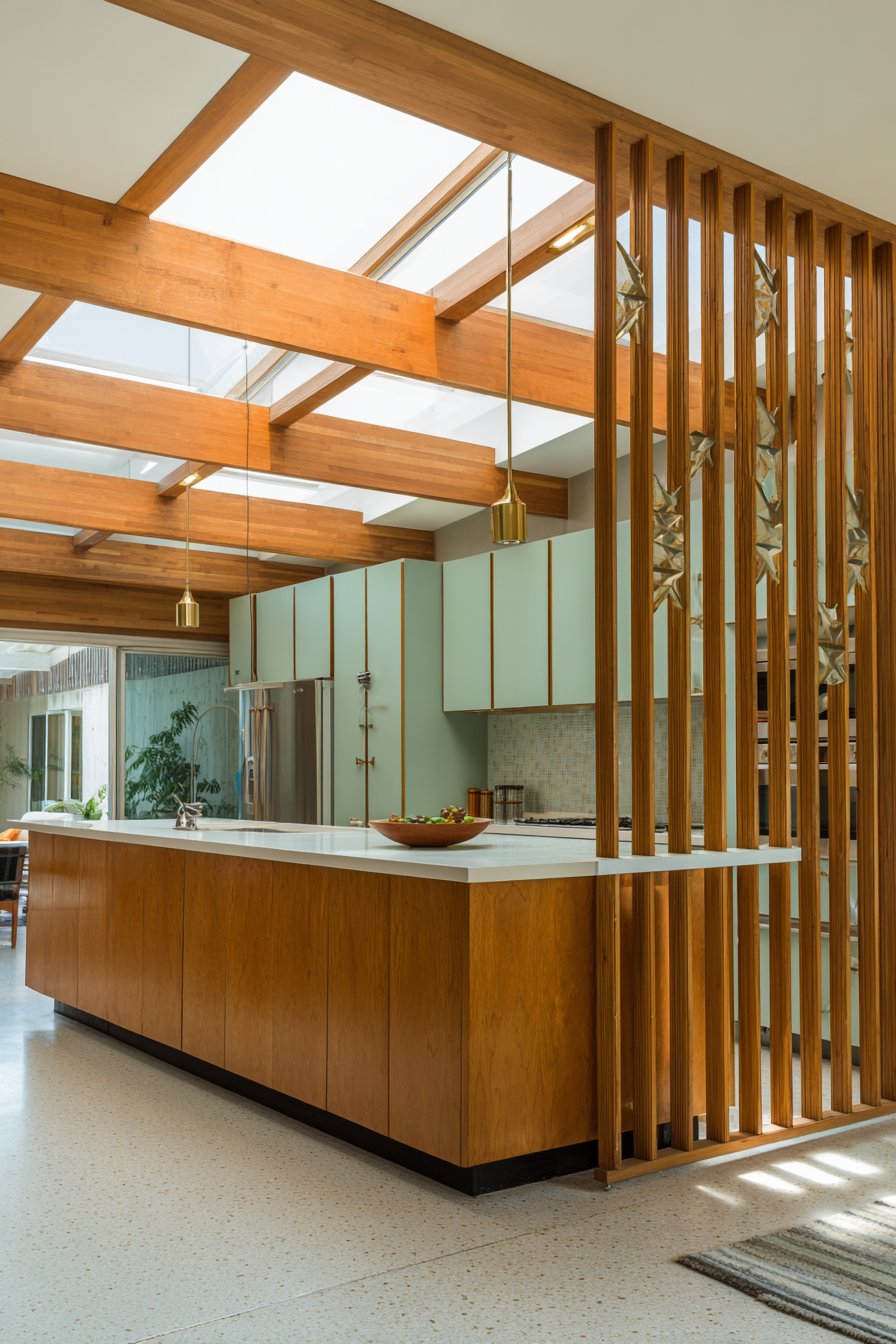
A geometric room divider with wooden slats partially separates the kitchen from the adjacent living space, maintaining visual connection while suggesting spatial boundaries. These dividers, popular throughout the mid century period, exemplify the era’s nuanced approach to open-concept living—spaces should flow together but retain distinct identities. The vertical slats filter views without blocking them entirely, cast interesting shadow patterns as light moves through the day, and provide architectural rhythm through their regular spacing. The divider’s presence emphasizes that open concept doesn’t mean undifferentiated; instead, it means thoughtfully connected zones that support different activities while maintaining family cohesion.
Key Design Tips:
- Create split-level counters to separate prep and dining functions while adding architectural interest
- Use premium woods like teak for dining areas and practical laminates for work zones
- Choose pale aqua or turquoise blue cabinetry for refreshing, water-inspired color
- Incorporate atomic starburst cutout handles for decorative function without protruding hardware
- Install cork flooring for sustainable warmth, comfort, and acoustic benefits
- Design slatted room dividers to suggest boundaries while maintaining visual connection
- Vary material finishes by function—natural wood for display, laminate for utility
- Embrace split-level design to create distinct zones within open-concept layouts
10. Peninsula Efficiency with Frosted Glass Details
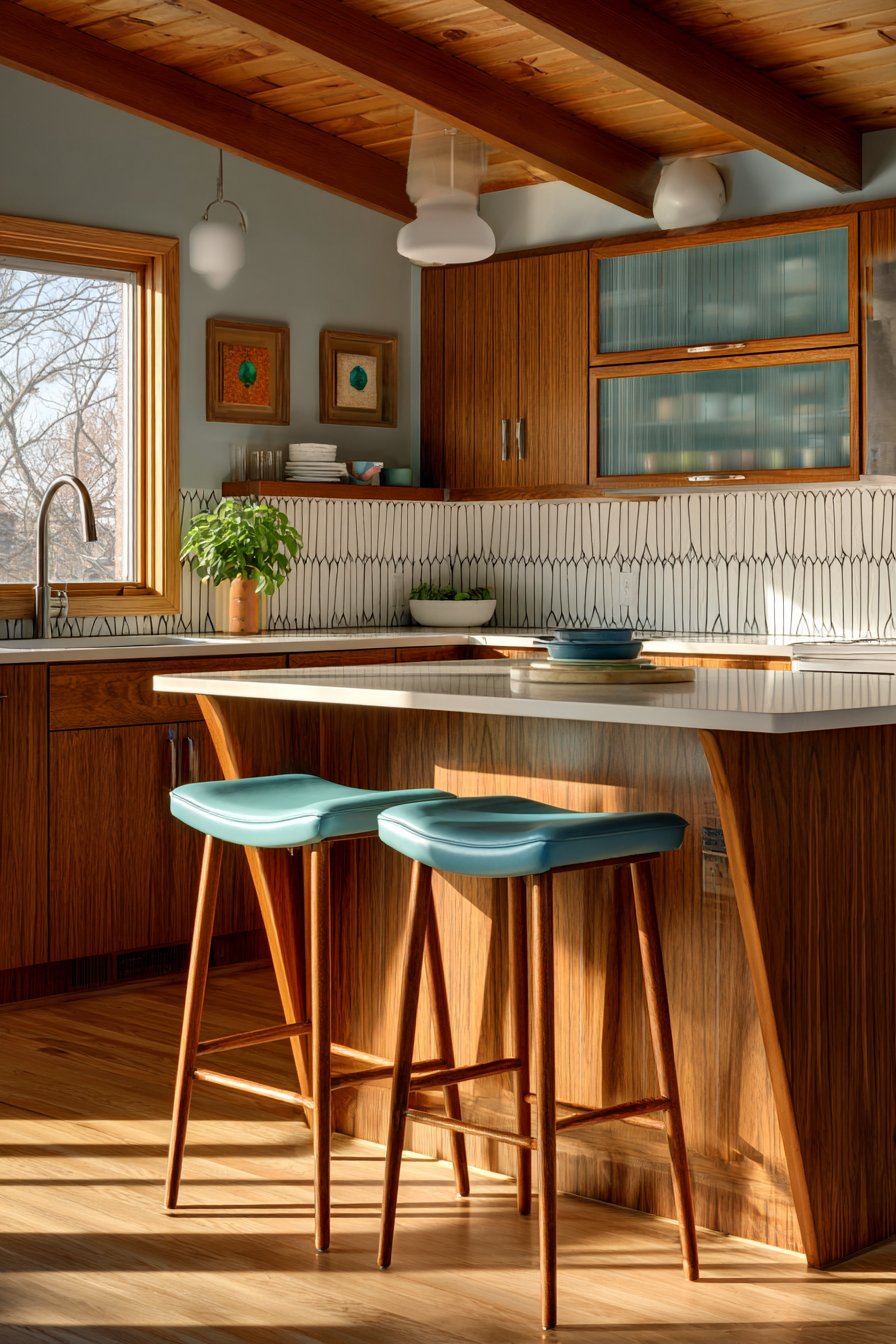
This expertly planned mid century modern kitchen showcases a peninsula layout with cantilevered breakfast bar, the overhanging counter supported by tapered walnut legs that create seating space for bar stools while maintaining the characteristic floating aesthetic. The cantilever, an engineering detail beloved by mid century architects, demonstrates how structure can be aesthetically expressive—the seemingly weightless overhang suggests both technical sophistication and visual lightness. The walnut legs, tapering from thicker at the top to narrower at the bottom, echo furniture design principles in this architectural element, blurring boundaries between built-in and movable components. Bar stools with teal vinyl cushions provide seating, their saturated blue-green upholstery injecting vibrant personality while complementing the walnut’s warm tones through color theory principles of complementary contrast.
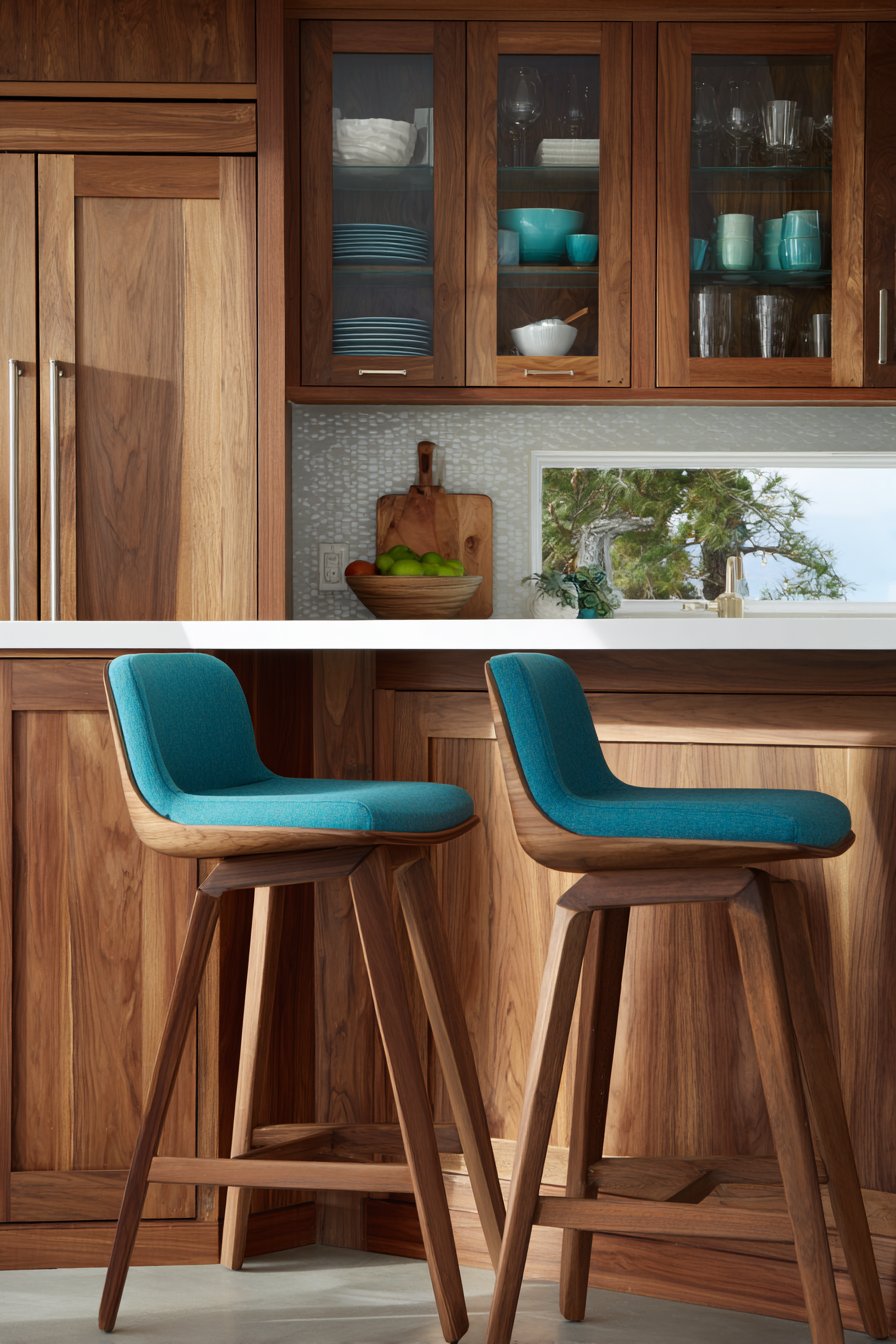
Upper cabinets in blonde wood feature frosted glass inserts that reveal organized dishware while diffusing the view, creating a translucent quality that feels lighter than solid doors. These glass inserts serve multiple purposes—they break up large expanses of wood, create visual interest through the interplay of opacity and transparency, and encourage organizational discipline since contents remain partially visible. The frosted treatment, whether sandblasted, acid-etched, or applied film, softens the view of stacked dishes and glassware while allowing their forms and colors to register as abstract shapes and shadows. This semi-transparent quality adds depth and complexity to the cabinet composition, especially when interior cabinet lighting illuminates the contents from behind.
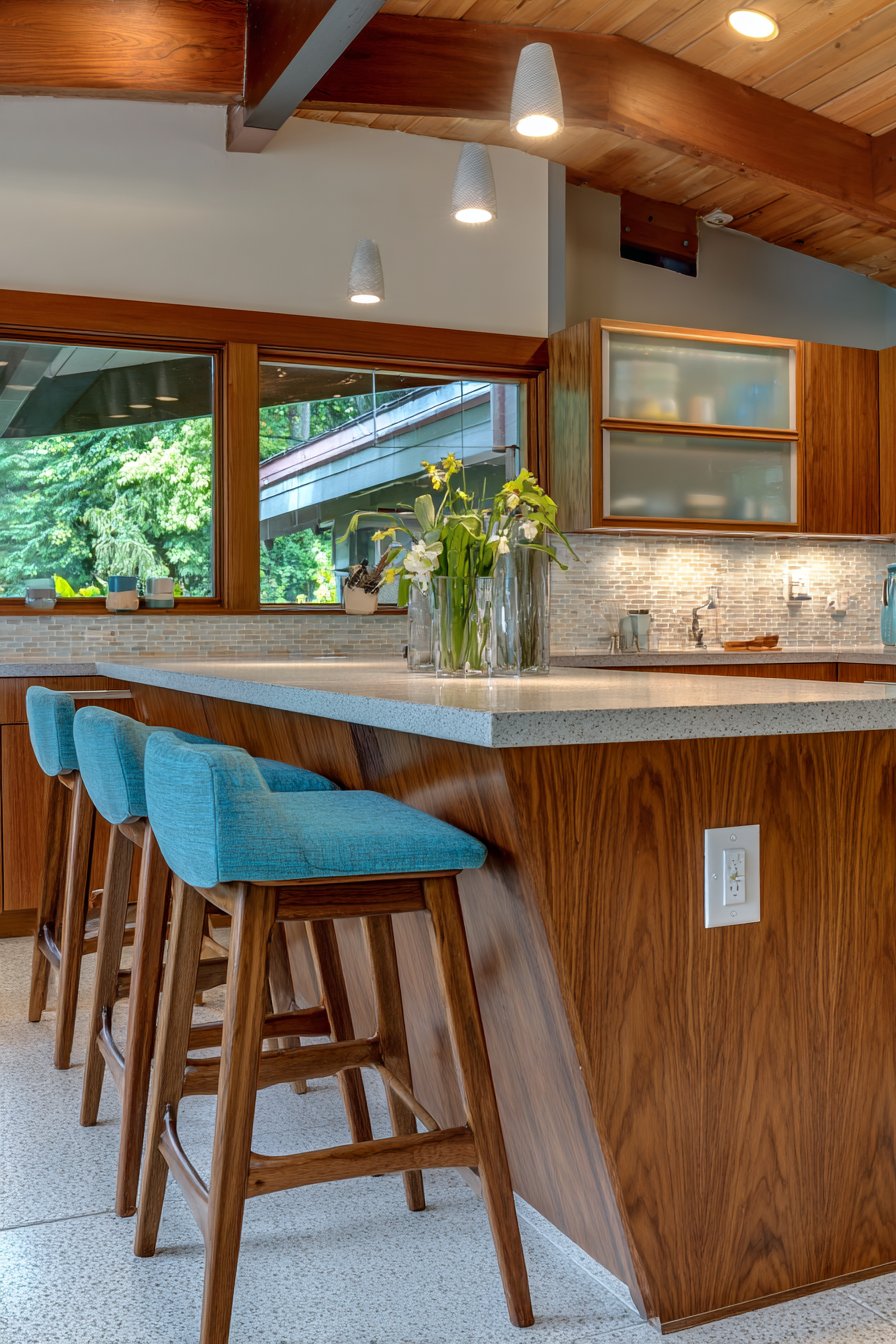
White penny tile backsplash with grey grout adds subtle texture without competing for attention, its small circular tiles creating a fine-grained pattern that reads almost as solid surface from a distance but rewards closer examination with rhythmic repetition. The penny tile format, reminiscent of classic American diners and soda fountains, introduces nostalgic associations while providing practical coverage for the backsplash area. The grey grout, rather than white, defines each penny’s circular form and creates a cohesive grid that unifies the thousands of individual tiles into a coherent field.
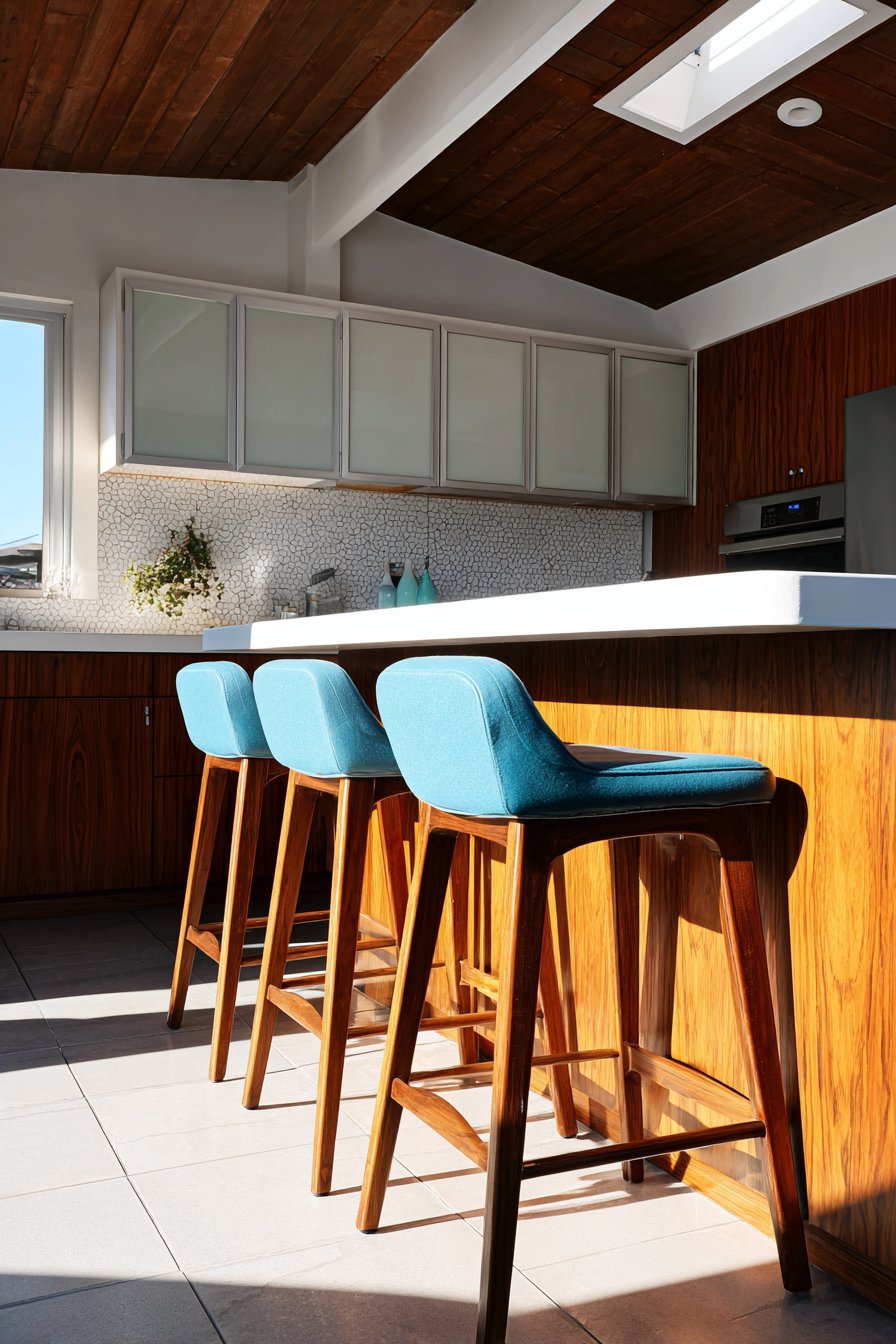
Recessed lighting in original metal housings provides task illumination, these flush-mounted fixtures maintaining clean ceiling planes while directing light downward onto work surfaces. The metal housings, with their period-appropriate detailing and proportions, distinguish these fixtures from contemporary recessed lights, their visible rings and bezels adding subtle decorative detail to what might otherwise be purely utilitarian elements. Wide-angle interior photography captures the efficient workspace design and authentic material choices, while natural window light creates realistic shadows that enhance the dimensional quality of the wood grain, the depth of the frosted glass panels, and the clean architectural lines that define the peninsula’s profile and the cabinet composition.
Key Design Tips:
- Design peninsula layouts with cantilevered breakfast bars for efficient seating solutions
- Support overhangs with tapered walnut legs for structural and aesthetic expression
- Choose teal or turquoise vinyl upholstery for bold color on seating elements
- Install frosted glass cabinet inserts to lighten upper cabinets while displaying contents
- Use penny tile backsplashes with colored grout for subtle texture and pattern
- Select recessed lighting in period-appropriate metal housings for authentic task illumination
- Display organized dishware behind glass to encourage visual discipline
- Combine blonde wood cabinetry with white tile for bright, airy aesthetics
Why These Mid Century Modern Kitchen Designs Represent the Best of the Style
The ten mid century modern kitchen designs explored in this article collectively demonstrate why this aesthetic movement has endured for over six decades and continues to influence contemporary kitchen design. These spaces succeed because they honor the fundamental principles that made mid century modern revolutionary—the integration of form and function, the honest expression of materials, the embrace of new technologies and manufacturing processes, the commitment to democratic design accessible to average families, and the sophisticated use of color as an emotional and spatial tool.
Superior Material Selection and Craftsmanship: Each featured kitchen showcases the mid century commitment to quality materials used honestly and expressively. The teak, walnut, birch, ash, and mahogany cabinetry displays natural grain patterns rather than concealing wood character beneath heavy finishes. The stone and solid surface countertops—whether quartz, laminate, butcher block, or Corian—demonstrate the era’s excitement about new materials and willingness to experiment with surfaces that offered unprecedented durability and ease of maintenance. The ceramic tile backsplashes in avocado green, mustard yellow, and subway white patterns provide both practical protection and colorful personality. These material choices remain relevant today because they prioritize longevity, sustainability through durable construction, and timeless beauty over trendy aesthetics that quickly date.
Innovative Spatial Planning and Functional Efficiency: The layouts featured—from compact L-shaped configurations to sophisticated galley designs, from split-level innovations to peninsula arrangements—all demonstrate mid century designers’ problem-solving genius. These kitchens maximize efficiency through careful work triangle planning, position storage where items will be used, and incorporate flexible elements like mobile carts and open shelving that adapt to changing needs. The compact breakfast nook kitchen proves that small spaces can accommodate both cooking and dining functions, while the split-level design separates messy preparation from presentable serving areas. This spatial intelligence makes mid century kitchens work harder while requiring less square footage than contemporary designs that prioritize sheer size over thoughtful planning.
Distinctive Color Theory and Palette Mastery: The bold use of period-appropriate colors—mint green, burnt orange, avocado, mustard yellow, pale aqua, and teal—distinguishes these kitchens from generic neutral designs while demonstrating sophisticated color theory knowledge. These hues, inspired by nature and the optimistic post-war cultural moment, create emotional resonance and memorable visual impact. The designers understood that color could zone spaces, highlight architectural features, draw attention to beautiful objects, and influence mood. The combination of these saturated accent colors with warm wood tones and neutral whites creates balanced compositions that feel energetic without becoming overwhelming, proving that mid century color schemes remain psychologically effective and aesthetically powerful.
Iconic Furniture and Lighting Integration: The incorporation of classic mid century furniture pieces—Eames molded plastic chairs, bar stools with hairpin legs, mobile kitchen carts—and lighting fixtures like Sputnik chandeliers, globe pendants, and geometric brass fixtures elevates these kitchens beyond mere background spaces into curated environments. These iconic pieces, whether vintage originals or quality reproductions, provide sculptural focal points while offering full functionality. The furniture’s clean lines and honest construction echo the architectural values visible in the cabinetry and spatial planning, creating holistic design where every element reinforces the overall aesthetic. These pieces have achieved classic status because they solved design problems elegantly, combined beauty with utility, and used materials efficiently—principles that remain relevant regardless of passing trends.
Authentic Period Details and Hardware Selection: The attention to period-appropriate details—starburst cutout handles, atomic-era hardware designs, tambour doors, pegboard systems, frosted glass inserts, boomerang edge profiles—separates authentic mid century modern kitchens from superficial imitations. These details, while small individually, collectively create authentic character that resonates with anyone familiar with the era’s design language.
The hardware choices—brushed brass bar pulls, polished chrome starburst cutouts, recessed handles—demonstrate how functional necessities can become decorative opportunities. The mechanical innovations like tambour doors and pass-through windows showcase the era’s engineering creativity and commitment to improving daily life through thoughtful design. These authentic details transform generic spaces into period-specific environments that tell stories about their historical moment while remaining fully functional for contemporary use.
Seamless Indoor-Outdoor Connection and Natural Light Optimization: The emphasis on large windows, clerestory openings, and horizontal fenestration patterns reflects the mid century philosophy that kitchens should connect to nature and benefit from natural illumination. These kitchens reject the closed, isolated cooking spaces of earlier eras in favor of light-filled environments that reduce daytime energy consumption while improving occupants’ mood and well-being. The window treatments—simple Roman shades rather than fussy curtains—control light and privacy without blocking views or architectural clarity. This relationship with natural light and outdoor spaces makes mid century kitchens feel expansive despite often modest square footage, proving that perceived spaciousness depends more on light quality and visual connection than raw dimensions.
Flexible Open-Concept Living Integration: The featured designs demonstrate sophisticated approaches to open-concept living through slatted room dividers, pass-through windows, peninsula layouts, and split-level configurations that maintain spatial flow while preserving functional zones. These solutions represent a middle path between completely closed traditional kitchens and the undifferentiated great rooms that sometimes result from contemporary open-concept approaches. The mid century designers understood that family members want to maintain connection during meal preparation and dining without completely eliminating spatial definition. These strategies allow conversation and supervision while containing cooking mess, noise, and odors, creating layouts that support real family life rather than idealized magazine scenarios.
Sustainable Design Through Quality and Longevity: Although sustainability wasn’t a primary concern when these kitchens were originally designed, their emphasis on durable materials, quality construction, timeless aesthetics, and repairable rather than disposable components aligns perfectly with contemporary environmental values. Cork flooring, solid wood cabinetry, stone countertops, and ceramic tile all represent materials that last decades or centuries with proper maintenance. The classic designs avoid trend-driven details that quickly appear dated, reducing pressure for frequent renovation and the environmental impact of construction waste. The celebration of vintage appliances and furniture demonstrates that mid century pieces were built to last and remain desirable, contradicting the planned obsolescence that characterizes much contemporary manufacturing.
Democratic Design Accessibility and Adaptability: The mid century modern movement fundamentally believed that good design should be accessible to average families, not reserved for wealthy elites. This democratic philosophy remains evident in these kitchens through their use of affordable materials like laminate countertops alongside premium woods, their celebration of mass-produced items like Pyrex bowls as decorative elements, and their straightforward construction that doesn’t require specialized craftspeople for maintenance. This accessibility means that homeowners at various budget levels can achieve authentic mid century aesthetics, whether through complete renovations using reproduction materials or gradual incorporation of vintage pieces and period-appropriate colors into existing spaces.
Multi-Generational Appeal and Timeless Relevance: Perhaps the ultimate proof of these designs’ excellence is their ability to appeal across generations—from those who remember mid century kitchens from childhood to millennials and Gen Z homeowners discovering the style for the first time. The clean lines, organic materials, bold colors, and functional layouts speak to fundamental human preferences that transcend specific cultural moments. Young families appreciate the durability and low-maintenance requirements, design enthusiasts value the historical authenticity and iconic pieces, empty nesters enjoy the uncluttered aesthetics and efficient workflows, and sustainability advocates embrace the quality-over-quantity philosophy. This broad appeal explains why mid century modern kitchens continue influencing contemporary design rather than remaining niche historical curiosities.
Integration of Art and Function: These kitchens exemplify the mid century conviction that everyday objects and spaces should be beautiful as well as functional. The display of colorful Pyrex bowls, the sculptural quality of Eames chairs, the geometric patterns in flooring and backsplashes, the artistic composition of pegboard tool displays—all demonstrate that cooking and dining environments can elevate daily activities into aesthetic experiences. This integration of art and life, rather than reserving beauty for formal spaces or special occasions, creates environments that support well-being through constant exposure to thoughtful design. The kitchens become stages for daily living rather than mere service rooms, honoring the importance of domestic labor while making it more pleasant.
Technical Innovation and Material Experimentation: The featured designs showcase the mid century era’s remarkable material innovation—laminate countertops, Corian solid surfaces, vinyl upholstery, terrazzo flooring, and aluminum hardware all represented cutting-edge technologies when introduced. This experimental spirit, embracing new manufacturing processes and synthetic materials alongside traditional woods and stones, created possibilities that didn’t exist in earlier periods. Contemporary mid century enthusiasts can choose between authentic vintage materials that have proven their durability through decades of service or modern versions that maintain period aesthetics while incorporating improved performance characteristics. This balance between historical authenticity and practical improvement allows mid century kitchens to function excellently in contemporary homes.
Sophisticated Color Psychology and Emotional Design: The strategic use of color throughout these kitchens demonstrates advanced understanding of color’s psychological effects. The warm oranges and yellows create energy and appetite stimulation appropriate for eating spaces. The cool aquas and teals provide refreshing calm in hot cooking areas. The deep woods ground and anchor, while bright whites energize and expand. The bold accent colors create memorable personality without overwhelming through careful proportion—typically one or two saturated hues balanced with neutrals. This sophisticated color deployment makes mid century kitchens emotionally resonant spaces that affect occupants’ moods and behaviors, proving that aesthetic choices have real psychological consequences.
Celebration of Craft Within Industrial Context: Despite the mid century embrace of mass production and industrial manufacturing, these kitchens maintain respect for craftsmanship visible in hand-glazed ceramic tiles, carefully grain-matched wood panels, thoughtfully curated display compositions, and custom-built elements like banquette seating. This balance between industrial efficiency and artisanal quality creates spaces that feel both accessible and special, machine-made yet human-centered. The recognition that some elements benefit from mass production while others deserve individual attention demonstrates nuanced thinking about appropriate technology—a sophistication that contemporary designers continue learning from as they navigate similar tensions between digital manufacturing and handcraft.
The ten mid century modern kitchen designs presented in this article represent the best of the style because they embody principles that transcend their historical moment—functional efficiency, honest material expression, democratic accessibility, innovative problem-solving, emotional resonance through color, integration with nature, and the fundamental belief that daily life deserves beautiful, well-designed environments. These kitchens work as hard as any contemporary design while offering distinctive character, timeless aesthetics, and proven durability that mass-market alternatives cannot match. Whether you’re restoring a period home to authentic glory or incorporating mid century elements into a contemporary space, these examples provide comprehensive guidance for creating kitchens that honor the past while serving present needs and future sustainability.
Conclusion
The enduring appeal of mid century modern kitchen design lies in its remarkable ability to balance seemingly opposing qualities—warm yet minimal, functional yet beautiful, innovative yet timeless, democratic yet sophisticated. The ten kitchen designs explored in this comprehensive guide demonstrate the incredible versatility within the mid century aesthetic, from the iconic teak elegance of Eames-inspired spaces to the bold color statements of avocado and mustard interiors, from compact breakfast nook efficiency to sophisticated split-level innovations. Each design offers unique lessons about material selection, spatial planning, color theory, lighting design, and the integration of furniture and architectural elements into cohesive environments.
What makes these mid century modern kitchens particularly relevant today is their alignment with contemporary values we’ve come to prioritize—sustainability through quality and longevity, connection to nature through large windows and organic materials, open-concept living that maintains functional zoning, efficient use of space that doesn’t require excessive square footage, and the celebration of craftsmanship within accessible price points. The movement’s democratic design philosophy, which insisted that good design should be available to everyone rather than reserved for wealthy elites, resonates powerfully in our current era of mass-produced mediocrity and disposable goods. Mid century kitchens prove that affordability need not mean compromising aesthetic quality or functional excellence.
As you consider incorporating mid century modern elements into your own kitchen, remember that authenticity comes from understanding and applying core principles rather than simply collecting vintage pieces or copying surface aesthetics. Focus on clean lines and honest material expression. Choose quality over quantity, investing in fewer, better pieces that will last decades. Embrace color confidently, understanding that mid century palettes were carefully considered rather than randomly selected. Prioritize natural light and connection to outdoor spaces. Design for efficiency, ensuring that your kitchen layout supports actual cooking and dining activities rather than merely looking attractive in photographs. Display beautiful objects openly rather than hiding everything behind closed doors. Select furniture and lighting that provides sculptural interest while serving practical functions.
Whether you’re planning a complete kitchen renovation that faithfully reproduces a period design or simply want to infuse your current space with mid century character through strategic updates—perhaps replacing hardware with starburst designs, painting lower cabinets in mint green or pale aqua, adding a Sputnik chandelier, displaying vintage Pyrex on open shelving, or installing a white subway tile backsplash—the principles explored in this article will guide you toward creating a space that feels both historically grounded and thoroughly contemporary. The beauty of mid century modern design is that it welcomes partial implementation; even small changes can significantly impact your kitchen’s character and functionality.
Experiment with these ideas, trust your instincts about color and material combinations, seek out vintage shops and salvage yards for authentic period pieces, consider quality reproductions when originals are unavailable or impractical, and most importantly, create a kitchen that serves your family’s real needs while reflecting your aesthetic values. The mid century modern movement’s greatest gift was demonstrating that good design improves daily life—that the spaces where we cook, eat, and gather deserve the same thoughtful attention traditionally reserved for formal rooms. By applying these principles to your own kitchen, you’ll create not just a beautiful space but a functional, welcoming environment that honors the past while fully serving the present and future.
